Steyr AUG · Volume 10
Repair, the Optic and the Rail — Stoppages, What Breaks, and the 1.5× Sight Built Into the Receiver
Steyr's own stoppage tables, what an owner can fix and what goes to an armourer, the gas regulator as a wear part, and the integral optic against the Picatinny rail
This volume covers what goes wrong and how it is put right, and then the sight. The two belong together on an AUG more than on most rifles, because on the original rifle the sight is part of the receiver, and a receiver is the one part an owner cannot simply replace.
As in the other volumes, every procedure and limit is the maker’s and is cited. Where a failure is widely reported but no source for it was found, it is listed in §10.5 as unsourced rather than repeated as fact.
10.1 Stoppages, From the Maker’s Tables
Steyr’s US and European manuals each carry a table of stoppages. The US A3 M1 table, in substance:1
Table 1 — 10.1 Stoppages, From the Maker's Tables
| Symptom | Cause, per the manual | Remedy, per the manual |
|---|---|---|
| Trouble feeding and loading | Magazine inserted wrongly; magazine damaged or dirty | Reinsert and listen for the click; replace or clean |
| Insufficient gas pressure | ”Move the gas regulator to position two (indicated by a big dot at the gas cylinder)“ | |
| Chamber dirty; defective or dirty cartridge | Clean; discard the round and clean the chamber | |
| Bolt does not lock completely | Chamber or bolt dirty; defective cartridge; extractor jammed | Clean; discard; clean and oil chamber and extractor |
| Misfire | Defective cartridge; dirty bolt | Discard; clean and oil |
| Broken firing pin; broken trigger mechanism | Factory service | |
| Trouble extracting | Extractor jammed | Clean and oil |
| Broken extractor; weak extractor spring | Factory | |
| Trouble ejecting | Broken ejector | Factory |
The European AUG SA table adds causes the US one leaves out: a follower spring “broken or too weak” (replace the spring or the magazine); a broken or weak magazine-catch spring, an ejector or ejector spring defect, and a defective hammer mechanism, all for “a qualified gunsmith”; and, for a failure to eject, “Working gas pressure too low,” remedied by increasing the regulator position by one.2
The military manual adds the diagnosis that matters most on a gas gun: “If weapon continues to malfunction and bolt lock is not opening enough to eject fired brass or is closing on empty chamber, gas piston and cylinder may require cleaning.” After a second misfire it tells the soldier to “Field strip gun lock group and inspect bolt lock face, locking lugs, extractor, ejector and ‘pin, firing’,” and to inspect the trigger mechanism.3
Immediate action in the US manual is: safe; magazine out; cycle the cocking handle; lock it back; look; remove a stuck round “using your fingers or a pointed wooden dowel. Do not use a metal tool.” For a hang-fire the US manual says keep the rifle pointed safely for 30 seconds; the European manual says 60.12 Both manuals send a light, off-centre or absent firing-pin strike to be examined rather than fired through.
A warning in the European manual is worth repeating because the bullpup layout invites the mistake: “Emptying the magazine attached to the weapon by repeatedly pulling back the bolt is a major safety risk and is therefore forbidden.”4
10.2 What an Owner Fixes, and What Goes to an Armourer
By the maker’s rules the line falls in the same place as the field strip (Vol 9 §9.1). The owner cleans, adjusts the regulator, changes a magazine spring, exchanges a whole bolt, and changes the ejection side. The US manual sends a broken firing pin, trigger mechanism, extractor, extractor spring or ejector to the factory.1
A kit builder is his own armourer, and for him the useful division is different: which repairs are a whole-assembly swap, and which need the armourer’s detail strip.
Table 2 — 10.2 What an Owner Fixes, and What Goes to an Armourer
| Repair | How, on the maker’s evidence |
|---|---|
| Worn or broken extractor, ejector, their springs, firing pin | Steyr Arms USA sells a complete bolt, right or left hand, “complete” with extractor, ejector and control pin ($330.00), and a spare-parts kit with extractor and ejector assemblies and a firing pin ($249.00), 2026-09-19.5 The armourer’s detail strip is Vol 9 §9.5. Replacing a bolt calls for a headspace check (Vol 7 §7.8). |
| Trigger mechanism fault | Replaced as an assembly. Steyr Arms USA’s semi-automatic pack was $136.00 on 2026-09-19.5 The European table: “defective hammer mechanism → replace hammer mechanism.”2 |
| Gas piston or rings | Rings replaced only “if damaged”; piston when its chrome is peeled (Vol 9 §9.10). |
| Regulator | See §10.3. |
| Recoil springs | Inside the carrier’s guide rods, behind thread-locked thrust pieces torqued to 20 Nm; an armourer’s job (Vol 9 §9.5). |
| Stock | See §10.4. |
| Optic | See §10.8. |
10.3 The Gas Regulator as a Wear Part
The regulator is a small part with a large effect, and it wears. The military manual gives a discard limit in millimetres: “As soon as the gas plug head shows a max. diameter of 2,3 mm at the largest hole and of 1,8 mm at the smallest hole discard.”6 The ports erode as the rifle is fired, the gas delivered at a given setting rises with them, and a regulator past its limit over-gasses the rifle at every setting.
Three practical points follow from Steyr’s documents.
- Diagnose before adjusting. Short-stroking — a case that does not clear, a bolt that does not hold open, a round not picked up — can be dirt in the cylinder, a wrong head, or genuinely low gas. The military manual’s first remedy for persistent short-stroking is cleaning the piston and cylinder; the US manual’s is position two.31
- Adjust only when cool. The US manual: “Never adjust the position of the gas regulator when using (firing) the AUG … Always allow the AUG to sufficiently cool down before adjusting.”7
- Know which head is fitted. The same large dot on the cylinder means “higher pressure” on the standard head and “gas off” on the KDO suppressor head (Vol 5 §5.3). A regulator of unknown origin in a kit is identified before it is used. Steyr’s European manual warns that the wrong head or position gives “too high gas pressure” and that “your weapon can be damaged if you use it for a long time.”8
The regulator’s slide is riveted to its pin, so it is not taken apart at the bench (Vol 9 §9.5). A worn regulator is replaced whole. Steyr Arms USA listed a “Gas Regulator for Suppressed Firing,” $109.00, out of stock on 19 September 2026; no standard regulator was listed as a separate item.5
10.4 The Stock
The AUG’s stock is the rifle’s chassis, and it is a plastic moulding. The military manual says “The two halves of the stock are inseparably connected by friction welding,” and gives the replacement rule: “A Steyr AUG butt must only be replaced when cracks or breakages of the material exist which are discernible with the naked eye.”96 In other words the stock is not repaired; it is inspected and, if cracked, replaced.
The stock matters more than a furniture part would, because it locates the receiver, holds the trigger mechanism, and carries the buffers the carrier runs back onto. The Australian experience shows what happens when a stock is not right. Chris Masters’s 2019 study for the Australian Strategic Policy Institute records that of the F88 SA2 rifles issued from 2009, 58 per cent showed one or more faults, among them butt-stock halves from the New Zealand maker that warped and threw the bolt face out of alignment, and that the Chief of Army ordered a recall.10 Those were not Steyr stocks, but they are the documented case of what a bad stock does to this rifle.
For a kit builder the check is straightforward: a surplus stock is inspected all over for cracks, especially around the receiver-lock and retaining-bolt bores, the magazine well and the trigger-guard junction, and a semi-automatic replacement is needed in any case if the kit’s stock is the military pattern (Vol 6 §6.6).
10.5 Failures That Are Repeated and Could Not Be Sourced
Several AUG failures are commonly asserted in enthusiast writing. None was found in a Steyr document, a military report or a specialist article in the research for this dive, and none is stated here as fact:
- stocks cracking at the trigger mechanism;
- firing pins breaking as a pattern;
- barrels working loose;
- magazine feed-lip wear;
- the integral optic fogging as a routine fault.
The maintenance manual does treat the last as an armourer job (§10.8), which shows that it happens; how often was not established.
10.6 Parts Availability
On 19 September 2026 the United States had one maker’s parts store and a few specialist dealers:
- Steyr Arms USA (steyr-arms.us) listed barrels, bolts, semi-automatic trigger packs, stocks, magazines, a spare-parts kit, rails and one optic housing. It listed no receiver, no bolt carrier and no standard gas regulator, and no listing stated where a part was made.5
- PJ’s Steyr AUG parts listed factory parts including semi- and full-automatic carrier groups, hammer packs and stocks, US-made barrels, and one receiver group (Vol 6 §6.5).11
- RTG Parts listed magazines, a 9 mm conversion kit, a StG 77 1.5× optic at $759.00, and rails, with no receiver or kit on the page read.12
- Corvus Defensio, an Austrian accessory maker whose rails Steyr Arms USA resells, listed a locking-piece set at €59.00, an ejector-and-extractor set at €119.00 and a firing pin at €59.00 on its own shop.13
Vol 8 covers sourcing for the build in full.
10.7 The Integral 1.5× Optic
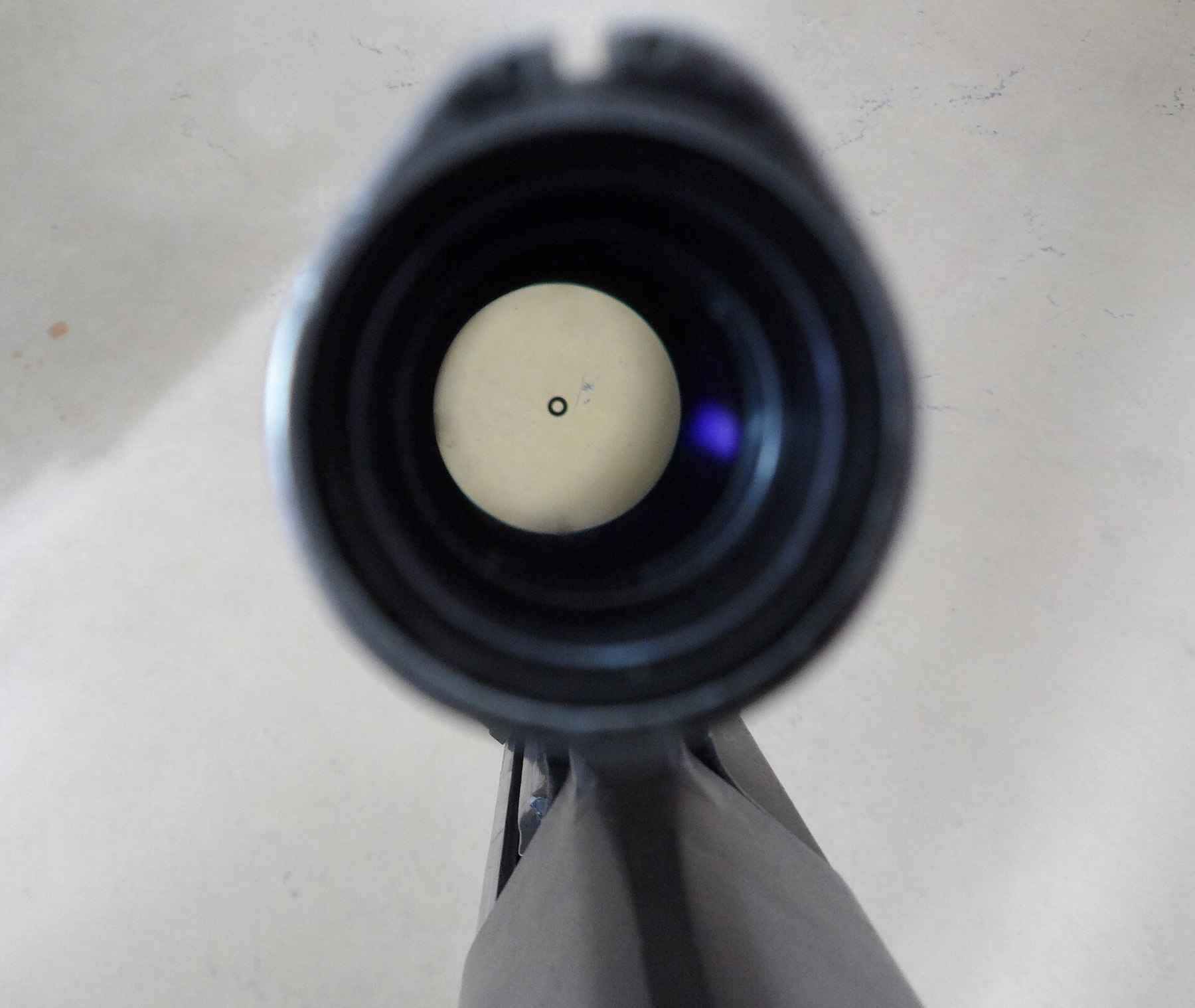
The StG 77’s defining feature was that it came with a magnified sight as standard, built into the carrying handle. Steyr’s own documents describe it as follows.
Table 3 — 10.7 The Integral 1.5× Optic
| Steyr’s statement | Source | |
|---|---|---|
| Magnification | 1.5× | maintenance manual; AUG SA manual; product sheets |
| Reticle | ”a black ring. The aiming mark is the ring” | AUG Z manual (A1 pattern) |
| Reticle (current) | “a black ring with a crosshair. The aiming mark is the cutting line of the crosshair” | AUG SA manual (2023) |
| Field of view | ”150 lines” | AUG Z and AUG SA manuals |
| Ring | inside diameter 6 lines, outside 12 lines | AUG Z and AUG SA manuals |
| Ranging | ring = 1.8 m at 300 m; field of view 45 m at 300 m | maintenance manual, technical data |
| Eye position | ”about 7cm behind the rear end of the scope housing” | AUG Z manual; AUG SA manual gives 7 cm (2.75 in) |
| Adjustment | ”1 click = 4cm/ 1,57” at a distance of 100m” | AUG Z manual |
| Sealing | ”maintenance-free, waterproof up to 1 bar pressure and shockproof under normal conditions” | AUG SA manual |
| Back-up | ”an emergency sight … designed for short distances … used like a normal iron sight,” on top of the housing | AUG Z manual |
Sources for each row are in the footnotes.91415
The “lines” are the German Strich, the military mil. The maintenance manual’s own figure — a 1.8-metre ring at 300 metres — is the 6-mil inner ring at that range, and is the source of the widely repeated statement that a standing man fills the ring at 300 metres. That statement is the maker’s arithmetic, not a slogan. The AUG Z manual adds, “No adjustments are required for different distances. With the ring reticle you’ve got the ‘all range adjustment’.”14
Two reticles, and a third. Steyr’s own manuals describe a plain ring on the A1-pattern rifle and a ring with a crosshair on the current AUG SA. The ASPI study records an Australian soldier’s recollection from Cambodia that the New Zealand rifles “had a different optic sight system to the F88 with cross-hairs instead of the central circle.”10 Steyr Arms USA’s copy for its limited MP88 describes a “Donut and Dot” reticle.16 “The AUG reticle” is therefore not one thing, and a photograph of one should be read before its reticle is described.
Who made the glass. The optic is universally attributed to Swarovski Optik. The ASPI study calls it “Swarovski Optik–designed.”10 No Steyr page or manual read for this dive names the maker; Steyr Arms USA’s copy for its current A3SF housing says only that “The optic tube is manufactured by an industry leading Austrian glass company.”5 The attribution is recorded as ASPI’s.
Where it sits in optics theory. An unpowered, fixed-low-power sight with an etched reticle and a short, fixed eye position is a prism-class sight in the Scopes dive’s taxonomy: the reticle is visible with no battery, it is not smeared by astigmatism the way a projected dot is, and the price is a short eye relief (Types of Scopes, Vol 5; eye relief and eye box in Vol 3; the battery argument in Vol 1). On a bullpup the short eye relief is not a compromise: the cheek weld is already far back, and Steyr’s 7 cm puts the eye where the stock puts the face.

10.8 Servicing the Optic, and Why a Kit Usually Has None
The AUG Z manual: “Only an authorized gun smith should dismantle the optical sight.” The military manual shows why. Removing the sight uses a mandrel; refitting uses sealing grease on the O-rings and screws torqued to 9.5 Nm; and the sealed optic is then purged under nitrogen and leak-tested under water at 35 ± 5 °C before a sight-line test.146 Fogging is an armourer’s repair with a gas supply and a test tank, not a bench job.
For a kit builder the more important fact is structural. On the A1-pattern rifle the optic’s housing is the carrying handle of the receiver. The kits on sale in September 2026 do not contain a receiver (Vol 6 §6.4), so they do not contain an A1 optic either. Replacing it means a receiver, or a later-generation housing on a receiver made to take one — and those are not interchangeable across generations. Steyr Arms USA’s own product title for its A3SF optic housing reads “will not fit the A3 SA”; its 2019 listing for the factory 1.5× optic for the A3 M1 said it “integrates onto the A3 M1 receiver ONLY,” held by three 4 mm hex bolts, at $499.00 then.517 On 19 September 2026 the factory 1.5× and 3× housings were still named as options on Steyr Arms USA’s store but could not be bought; only the A3SF 60 mm housing was available, at $899.00.5
10.9 The Rail
The optic-or-rail choice has a history that runs through the generations (Vol 4 has the photographs).
- A1 era: the integral optic was standard; a rail required a different receiver. Daniel Watters’s chronology puts it this way: before the A2, the choice required “two separate receivers.”18
- A2 (August 1997, per Watters): “a single receiver that can be equipped in either configuration, interchangeably.”18
- A3 (April 2004, per Watters): a Picatinny flat-top with the 1.5× optic clamped on, and bottom and side rails. Steyr’s c. 2009 product sheet: “Mil. Std. 1913 flat top rail with attached optical sight 1.5x.”19
- Current European AUG SA: the receiver comes “with the original optic carrier (1.5x / 3x) or with Picatinny rails,” in two sight-line heights: “SE 60mm” and “SE 70mm,” the latter “with original carrying handle.”20 Steyr Arms USA’s A3SF copy calls 70 mm the standard height, reached with a 10 mm riser.5
- US A3 M1 and M2: the A3 M1 was sold with a 1.5× or 3× optic, or with a high or low rail, in 2014 at $2,099 (rail), $2,499 (1.5×) and $2,599 (3×).21 The M2 is “Not sold with rail and handguard.”16
The rail is where the AUG meets the rest of the optics world, and there the Scopes dive applies without modification: magnified choices in Vol 4, reflex and prism sights in Vol 5, mounting and zeroing in Vol 8. Two AUG-specific notes: the charging handle runs along the left of the receiver, so a wide optic or mount can foul the hand, which is why Steyr’s European manual warns to pull it “with your palm facing up to prevent your knuckles from being cut or scraped on any devices that may be mounted on the Picatinny rail”; and the rail and optic interfaces differ by generation, so a rail is bought for the receiver in hand.22

10.10 What Could Not Be Confirmed
- Swarovski as the optic’s maker. Universal in secondary sources and stated by ASPI; not stated in any Steyr document read.
- Every failure in §10.5.
- A round count for any part. No wear interval is published.
- The availability of a standard gas regulator as a separate part in the United States.
- The magnification and reticle of the A3SF 60 mm housing, which Steyr Arms USA’s copy describes only as having “a Mildot reticle.”
Sources
Footnotes
-
Steyr Arms, Inc., Owner’s Manual STEYR AUG A3 M1, 2023, Chapter 4 (stoppages) and Chapter 9, p. 29 (malfunction table), https://steyr-arms.us/wp-content/uploads/2023/07/AUG_A3_M1_US_2023.pdf, retrieved 2026-09-19. ↩ ↩2 ↩3 ↩4
-
Steyr Arms GmbH, Instructions for use STEYR AUG SA, 1-BA-1726, EU-03, 2023, §9, pp. 93–95, https://www.steyr-arms.com/wp-content/uploads/2023/03/BA-STEYR-AUG-SA_ende_1-BA-1726_EU-03.pdf, retrieved 2026-09-19. ↩ ↩2 ↩3
-
Steyr Mannlicher AG, Maintenance Manual, Army Universal Assault Rifle, Steyr AUG, undated, Chapter II §1.5 (stoppage and immediate action). Internet Archive, retrieved 2026-09-19. Read from the text layer. ↩ ↩2
-
AUG SA manual (EU-03), p. 44. ↩
-
Steyr Arms, Inc., online store, https://steyr-arms.us/shop/category/tactical/aug/, product data read 2026-09-19. ↩ ↩2 ↩3 ↩4 ↩5 ↩6 ↩7 ↩8
-
Maintenance Manual, Chapter IV §2 (fo. 20, gas plug discard criterion; fo. 22–23, optical sight) and §4.1 (fo. 31, butt replacement criterion). The discard and butt criteria were checked against the page images; the optic procedure was read from the text layer. ↩ ↩2 ↩3
-
AUG A3 M1 manual (2023), p. 6. ↩
-
AUG SA manual (EU-03), p. 25. ↩
-
Maintenance Manual, fo. 5 (butt description; technical data including the optic), checked against the page images. ↩ ↩2
-
Chris Masters, Sticking to Our Guns: A Troubled Past Produces a Superb Weapon, Australian Strategic Policy Institute, October 2019, pp. 20, 27 and 51–52, https://ad-aspi.s3.ap-southeast-2.amazonaws.com/2019-10/Sticking%20to%20our%20guns.pdf, retrieved 2026-09-19. ↩ ↩2 ↩3
-
PJ’s Steyr AUG parts, http://www.pjs-steyraug.com/augusrparts.html, page marked “Updated: December 8, 2025,” read 2026-09-19. ↩
-
RTG Parts, “Steyr AUG,” https://www.robertrtg.com/steyr-aug, read 2026-09-19. ↩
-
Corvus Defensio, shop search “aug,” https://corvusdefensio.com/?s=aug&post_type=product, read 2026-09-19. Prices in euros as displayed. ↩
-
Steyr Arms GmbH, Instructions for use STEYR AUG Z, 1-BA-01046, EU-06, 2023, §§6.7–6.8, https://www.steyr-arms.com/wp-content/uploads/2023/03/BA_STEYR_AUG-Z_eng-de_1-BA-01046_EU-06.pdf, retrieved 2026-09-19. ↩ ↩2 ↩3
-
AUG SA manual (EU-03), §6.7.1 and p. 54. ↩
-
Steyr Arms, Inc., “AUG,” https://steyr-arms.us/firearms/tactical-rifles/aug/, read 2026-09-19. ↩ ↩2
-
Steyr Arms, Inc., “STEYR FACTORY 1.5 X OPTIC FOR AUG A3 M1,” SKU 1252020550, $499.00, Wayback Machine capture of 14 October 2019, retrieved 2026-09-19. ↩
-
Daniel E. Watters, “A 5.56 X 45mm ‘Timeline’,” The Gun Zone, entries for August 1997 and April 2004, Wayback Machine captures of http://www.thegunzone.com/556dw-11.html and -14.html, retrieved 2026-09-19. ↩ ↩2
-
Steyr Mannlicher, AUG A3 product sheet, c. 2009, Wayback Machine capture from steyr-mannlicher.com, retrieved 2026-09-19. ↩
-
AUG SA manual (EU-03), p. 20; Steyr Arms GmbH, “AUG SA,” https://www.steyr-arms.com/en/sporting-rifles/aug-sa/, accessed 2026-09-19. ↩
-
Hunter Outdoor Communications for Steyr Arms, press release, 20 October 2014, Wayback Machine capture of http://www.hunteroc.com/2014/Steyr_Arms_PR4.html, retrieved 2026-09-19. ↩
-
AUG SA manual (EU-03), §7.9, p. 76. ↩
Comments (0)