Steyr AUG · Volume 1
Steyr and the StG 77 — A Rifle Factory in Upper Austria and the Bullpup It Patented in 1974
The company from Werndl to RSBC, the engineers whose names the patents carry, the 1977 decision and the 1978 rifle, and what 'AUG' actually meant
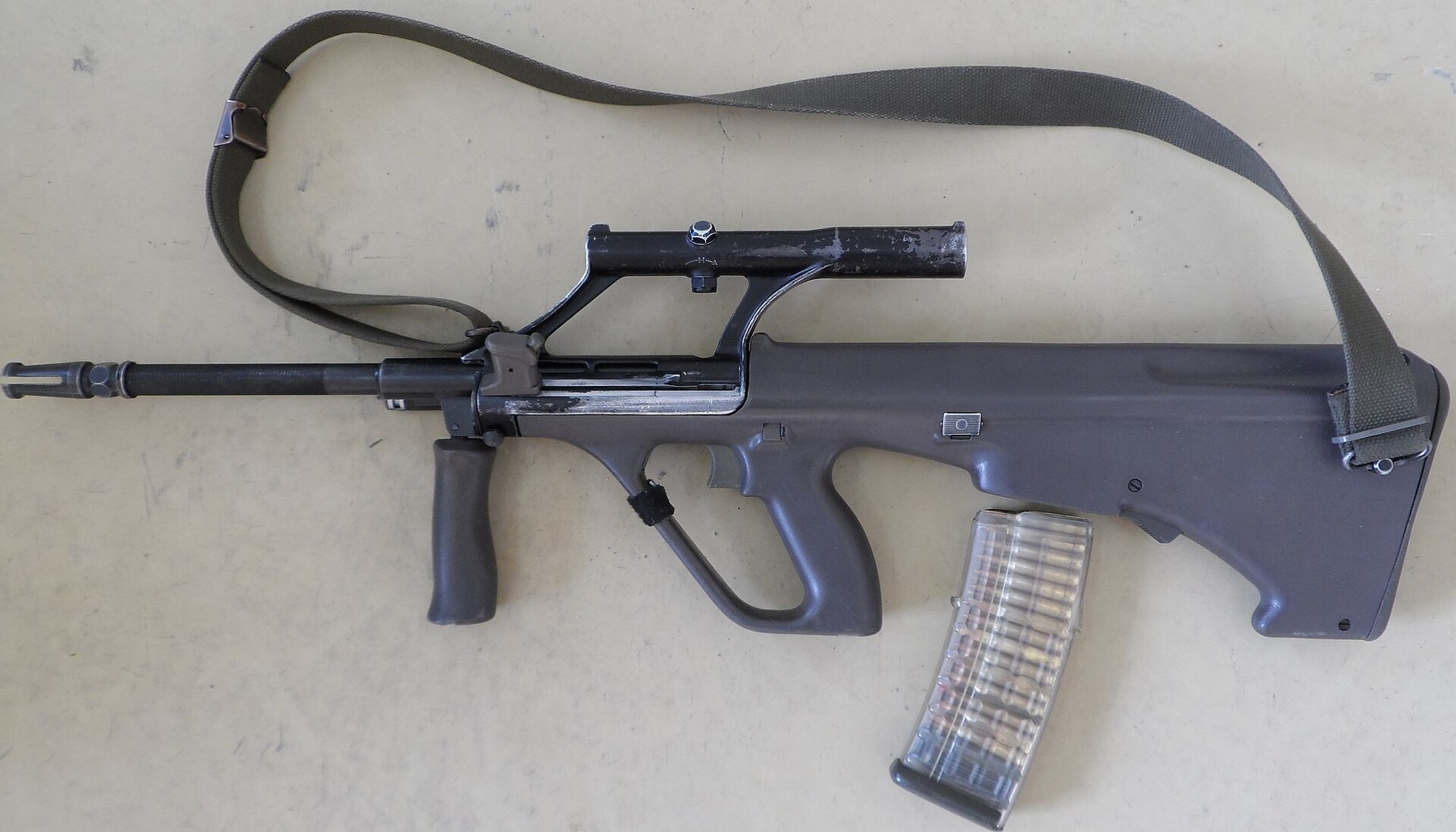
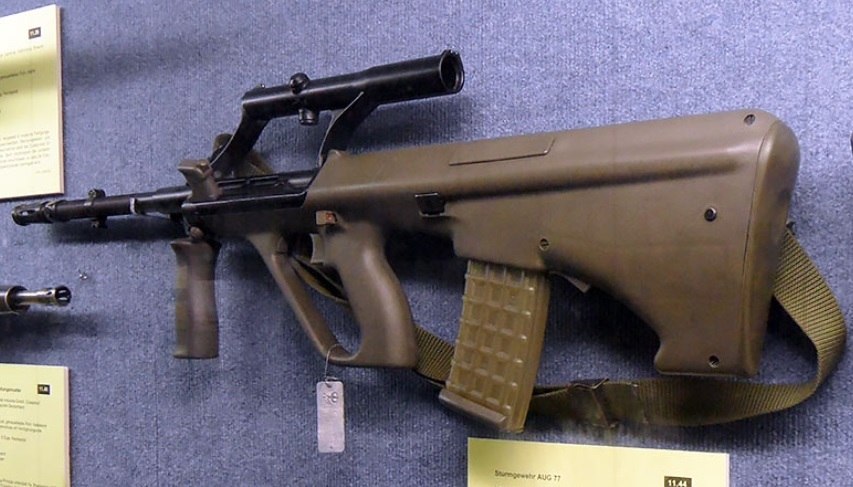
The Steyr AUG is a bullpup rifle that a national army adopted as its standard arm and has kept. Austria decided to adopt it in 1977, and forty-five years later the Austrian Army was still modernising the same rifles rather than replacing them. It was built under licence on three continents, adopted by Australia, New Zealand and Ireland, and carried by armies and police forces in about thirty countries by its makers’ own counts, which drift from “about 35” (Steyr, c. 2009) to “more than two dozen armies” (the 2024 buyer). In the United States it has been imported, banned from import, built under licence, cloned, and built again by the maker’s own American company.
It is also a rifle whose history is thick with confident repetition. This volume and the next two work from the maker’s own documents, the Austrian, Australian, Irish and New Zealand services’ own pages, patents, and the few specialist studies that rest on primary evidence. Several things commonly said about the AUG turn out not to survive that test. Where a figure is contested, each version is given with its source.
1.1 The Rifle in One Table
For the Austrian service rifle, from the Austrian Army’s own page and the Steyr Mannlicher maintenance manual.12
Table 1 — 1.1 The Rifle in One Table
| Austrian designation | Sturmgewehr 77 (StG 77) |
| Export name | AUG, “Armee Universal Gewehr” (Steyr) |
| Maker | Steyr-Daimler-Puch AG, Steyr, Upper Austria |
| Operation | short-stroke gas piston, rotating bolt, closed bolt, select-fire by trigger pull |
| Calibre | 5.56 × 45 mm |
| Barrel | 508 mm standard; others from 350 to 621 mm across the family (Vol 4) |
| Weight | 3.75 kg (Bundesheer); 3.80 kg without magazine, 508 mm barrel (Steyr maintenance manual) |
| Rate of fire | 700 rounds/min theoretical (Bundesheer); 680–850 (Steyr) |
| Muzzle velocity | 990 m/s (Bundesheer); about 980 m/s (Steyr) |
| Magazine | 30 rounds, transparent synthetic |
| Sight | 1.5× telescopic, ring reticle, in the carrying handle |
| Combat range | 300 m (Bundesheer, “Einsatzschussweite”) |
1.2 What the Name Means, and Whose Name It Was
“AUG” is usually glossed as Armee-Universal-Gewehr, “army universal rifle,” and that is correct. What is less often said is that it was, by Steyr’s own account, the name for export. Steyr Mannlicher’s American history page, as it stood in 2009:
“In the seventies, Steyr opened up new dimensions in the military firearms development as well, and developed a new assault rifle in a ‘bull-pup’ design, utilizing extensively synthetic materials, and an integrated fixed optic. This example of a new and modern generation of assault rifles was launched in Austria under the name ‘StG 77.’ The export version became the AUG – ‘Armee Universal Gewehr’ (Universal Army Assault Rifle). Remarkable success was achieved by licensing its production in Australia and Malaysia, as well as by exports to Ireland, New Zealand, Tunis, Saudi Arabia, Oman and the USA.”3
So the rifle an Austrian conscript carried was the StG 77, and the rifle Steyr sold abroad was the AUG. That paragraph is also the maker’s own short list of the design’s selling points in the order the maker put them: the bullpup layout, synthetics, and the built-in optic.
The same page is the maker’s own list of licensees (Australia, Malaysia) and early export customers (Ireland, New Zealand, Tunisia, Saudi Arabia, Oman and the United States). Vol 2 follows each of them.
1.3 Steyr, From Werndl to Steyr-Daimler-Puch
The company’s own history page gives the outline.4
- 1864: Josef Werndl, with his brother Franz, founds “Josef & Franz Werndl & Company, weapon factory” in Steyr, Upper Austria, on 16 April.
- 1867: the Werndl–Holub breech-loader becomes the Austrian Army’s standard rifle.
- 1869: the firm becomes a stock corporation, the Österreichische Waffenfabriks-Gesellschaft, on 1 August.
- 1885–1903: the Mannlicher straight-pull repeaters and the Mannlicher–Schönauer; by Steyr’s own claim, by 1891 the world’s largest weapons maker.
- 1916: car production begins. 1918: firearms production is banned after the war.
- 1926: renamed Steyr-Werke AG. 1930: firearms production resumes through cooperation with Swiss and German firms.
- 1934: Steyr-Werke merges with Austro-Daimler-Puchwerke to form Steyr-Daimler-Puch AG, the company that would make the AUG.
- 1938–45: absorbed into the Reichswerke Hermann Göring.
- 1950: sporting-rifle production resumes with Allied permission. 1969: the SSG 69 sniper rifle.
- 1977: the Austrian Army decides to adopt the new rifle as the StG 77.
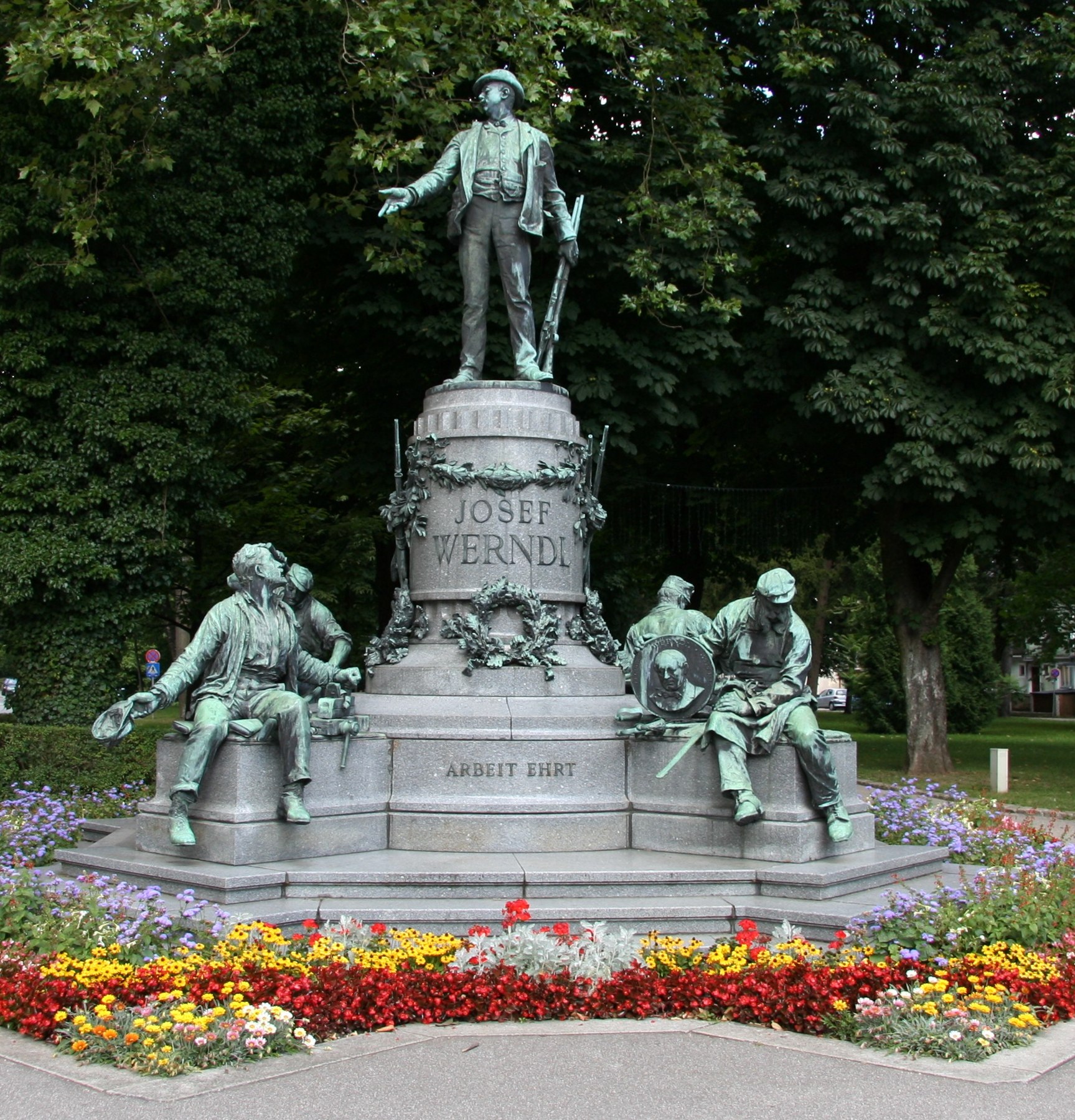
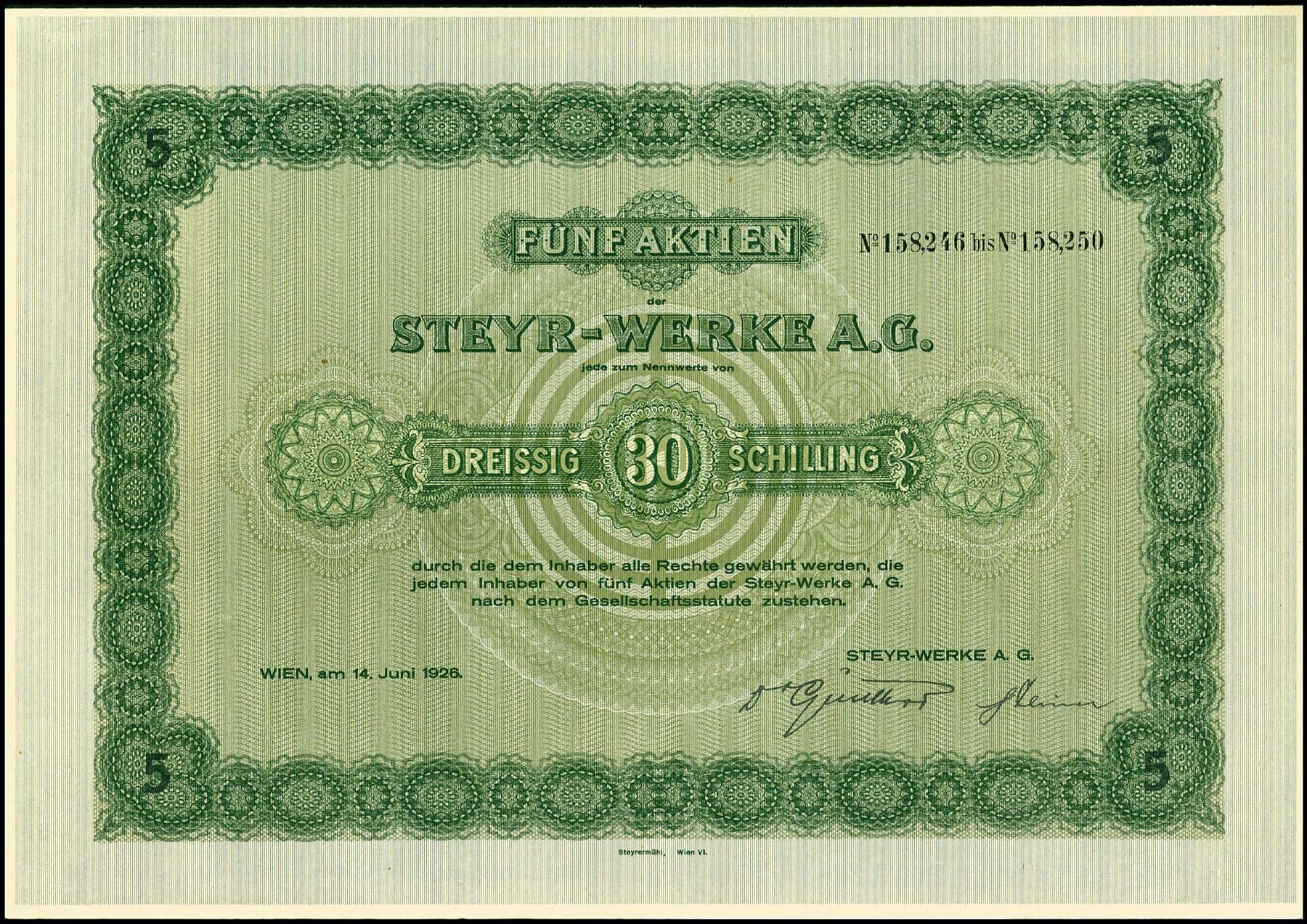
The point of the list for the AUG is in the 1934 name. Steyr-Daimler-Puch joined a rifle maker that had built cars since 1916 to two vehicle makers, and the company that designed the AUG was an engineering group whose arms business descended from the oldest part of the firm, not a small-arms specialist. The rifle’s heavy use of synthetics fits that background, and so does what happened when it went into licence production abroad: the ASPI study of the Australian programme records that the Australian rifle’s stock was made by a New Zealand racing-yacht builder and its magazines by a South Australian broom maker.5 The design lent itself to being made by firms that were not gunmakers.
1.4 The Patents of January 1974
The earliest firm dates for the design are not in any history of the rifle. They are in a group of patent filings. In January 1974 Steyr-Daimler-Puch filed a set of Austrian applications, published as Swiss patents, that between them describe the AUG:6
Table 2 — 1.4 The Patents of January 1974
| Patent | Austrian priority | Subject, from the English abstract |
|---|---|---|
| CH 579 761 | 4 January 1974 | ”Collapsible small automatic firearm”: a stock “complete with trigger mechanism and magazine” removable as an assembly; a central portion guiding the breech mechanism from which “the barrel with hand grip is removable”; captive locking bolts, one transverse through the stock; locking dogs on the barrel and a spring-loaded pin that snaps into a thrust flange |
| CH 577 157 | 14 January 1974 | ”Automatic rifle breech bolt with rotating guide” |
| CH 580 269 | 17 January 1974 | ”Automatic firearm with magazine in butt”: symmetrical ejection openings “alternately closed by a cover” |
| CH 580 270 | 22 January 1974 | ”Automatic firearm trigger mechanism”: a complete sub-assembly inserted from the rear of the hollow stock, linked to the trigger by a rearward release link |
Everything characteristic of the production rifle is in those four documents: the modular groups, the quick-change barrel, the ambidextrous ejection with a moving cover, and the drop-in trigger mechanism in the butt. The design was mature enough to protect three years before the Austrian Army decided to adopt it. The names of the inventors on these filings could not be read in the research for this dive, because the patent database returned errors on each attempt; they would settle part of the question in §1.5.
The bolt group followed. US Patent 4,191,089, “Breech-closing mechanism for automatic rifle,” filed by Ulrich Zedrosser with an Austrian priority of 22 December 1977 and granted in March 1980, describes the carrier with its guide tubes, the cam-slotted rotating bolt and the spring-loaded locking piece of the production rifle (Vol 5).7 Zedrosser also filed, in June 1986, the patent for the folding cocking handle that later AUGs use.8
1.5 Who Designed It
The AUG’s design team is usually given as a list of names — commonly Horst Wesp, Karl Wagner, Karl Möser and Helmut Weldle, sometimes with others — and the list is almost never sourced. The research for this dive checked each name against the patent record, which is primary evidence that a person was a Steyr small-arms engineer in the period, though not by itself proof of who designed which part of the AUG.6
- Horst Wesp is named as inventor on a Steyr-Daimler-Puch patent with a priority of January 1967 (a holding device for interchangeable magazines). The ASPI study independently records that “An Austrian design engineer, Horst Wesp, arrived in 1990” at Lithgow to interpret the licence drawings for the Australian rifle.5
- Karl Wagner is named on a run of Steyr-Daimler-Puch small-arms patents from 1965 to 1973, among them a rifle stock carrying a detachable magazine (US 3,638,344, 1968) and a rifle with a drum magazine inside the stock (1965).
- Karl Moser (the patents index the name without the umlaut) is named on Steyr-Daimler-Puch submachine-gun patents of 1966 and 1969.
- Helmut Weldle is not. Every small-arms patent in his name found in the research, from 1968 to 2000, is assigned to Heckler & Koch of Oberndorf, among them the pistol with shoulder stock that became the VP70. No Steyr patent carrying his name was found. The absence of a Steyr patent does not prove a man had no part in a design, but his entire recorded career is at another company, and this dive does not repeat his name as an AUG designer.
- Ulrich Zedrosser, who is rarely on the usual list, is the named inventor of the production bolt group and of the folding cocking handle (§1.4).
- A “Karl Stubenvoll,” sometimes added, produced no patent hits and no other source; he is not named here.
The defensible statement, then, is that Wesp, Wagner and Moser were Steyr-Daimler-Puch small-arms engineers in the years the design was developed, that Wesp was still working on the rifle in 1990, and that Zedrosser designed its bolt. A specialist source that names the team from Steyr’s own records was not found.
1.6 1977 or 1978
The adoption year is given as 1977 by some sources and 1978 by others, and the two are not in conflict. They are different events.
- 1977 is the decision. Steyr’s own history page: in 1977 “the Austrian Federal Army decided to establish the AUG … as its new standard assault rifle.” Steyr’s product page says the rifle has been a standard weapon “since 1977.” Daniel Watters’s 5.56 mm chronology: “1977: Austria adopts the 5.56mm Steyr AUG bullpup rifle as the Sturmgewehr 77 (StG 77).” The designation carries the year.48
- 1978 is the rifle in service. The Austrian reference site Doppeladler says it was “1978 beim Bundesheer eingeführt,” replacing the StG 58, Austria’s licence-built FN FAL. A 2024 trade report of the company’s sale gives 1978 for the same event.910
Steyr’s own history page calls the 1977 rifle the “AUG A1.” That is a later name applied backwards. Doppeladler dates the A1 to 1982, as a revision with improved safety features and a sealed sight, and calls the original StG 77 retrospectively the “A0.” In English-language writing “A1” is routinely used for every AUG with the integral optic, which is how Vol 4 uses it, with that caveat.9
1.7 Forty-Five Years in Austrian Service
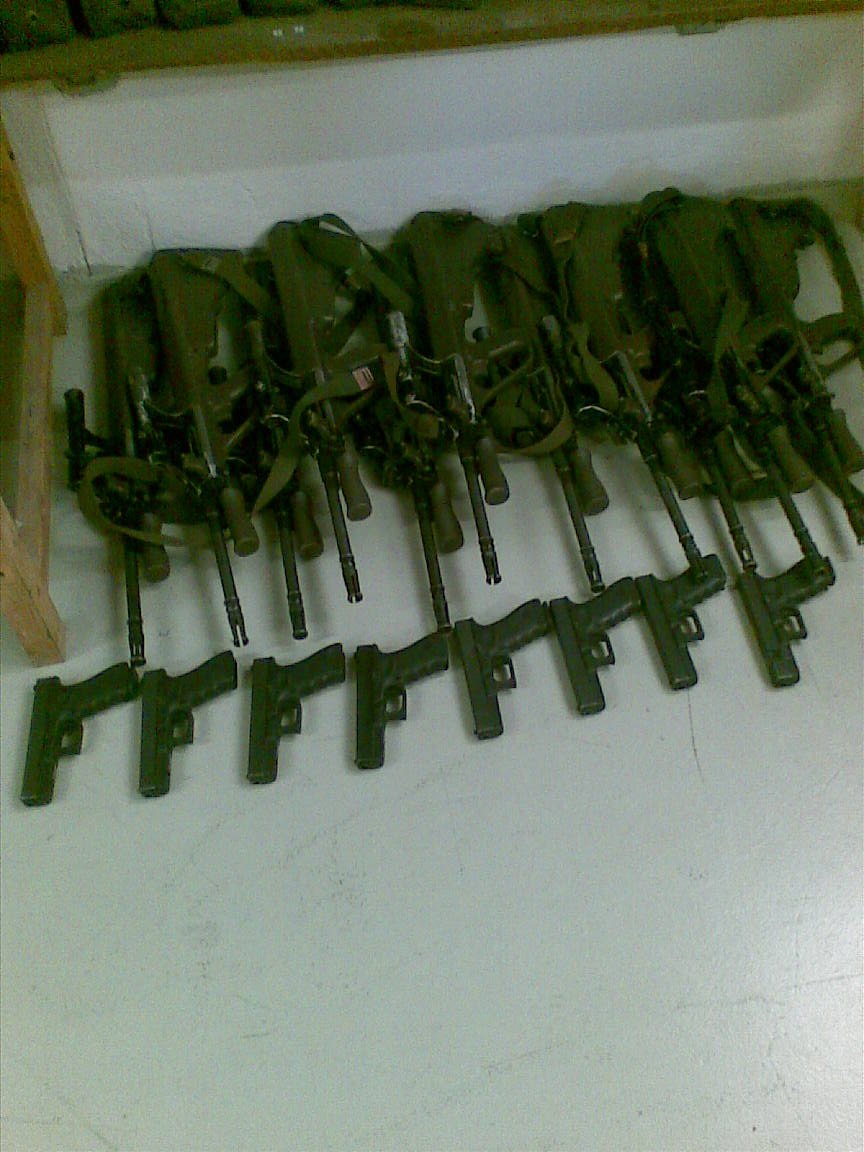
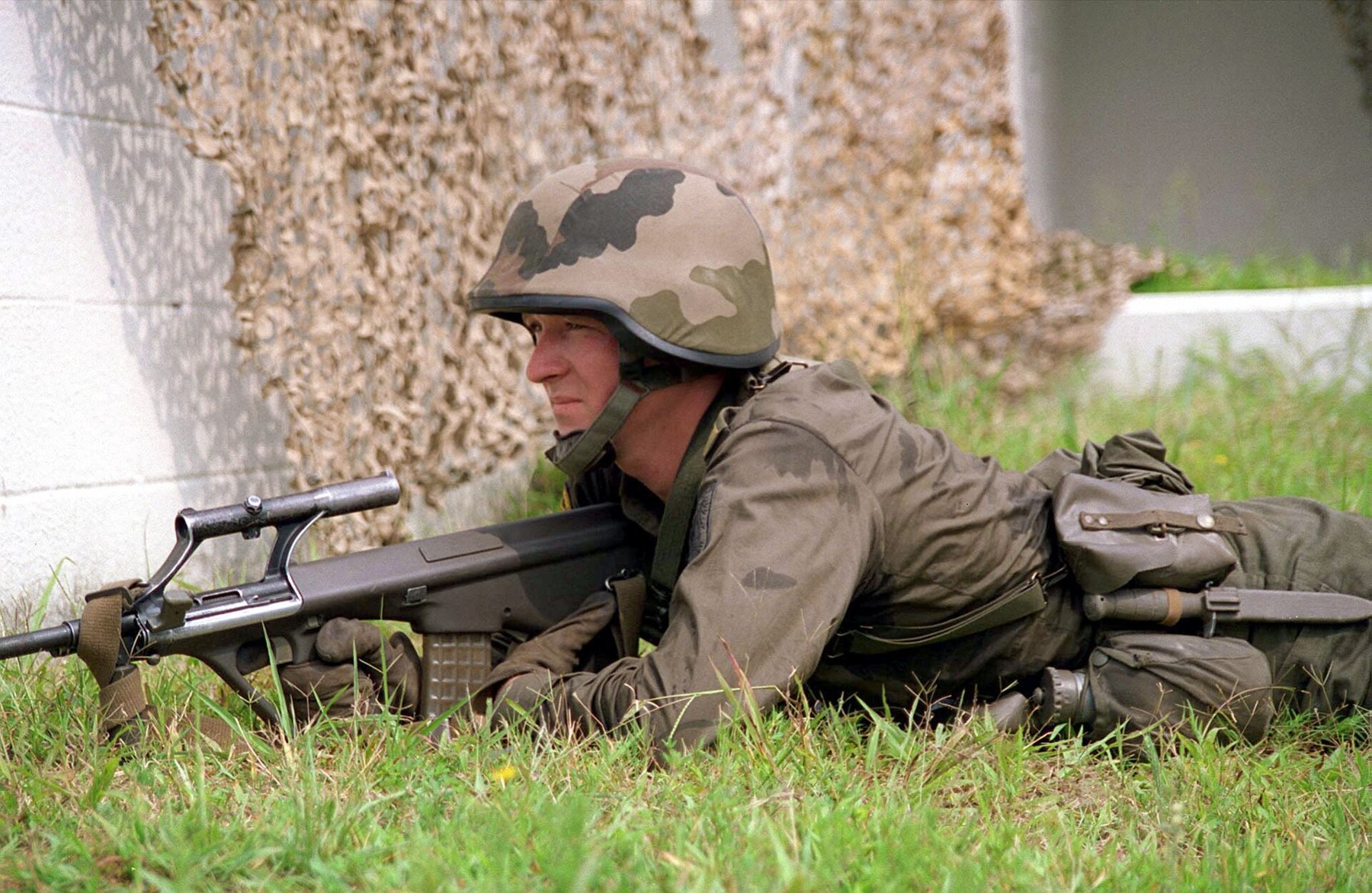
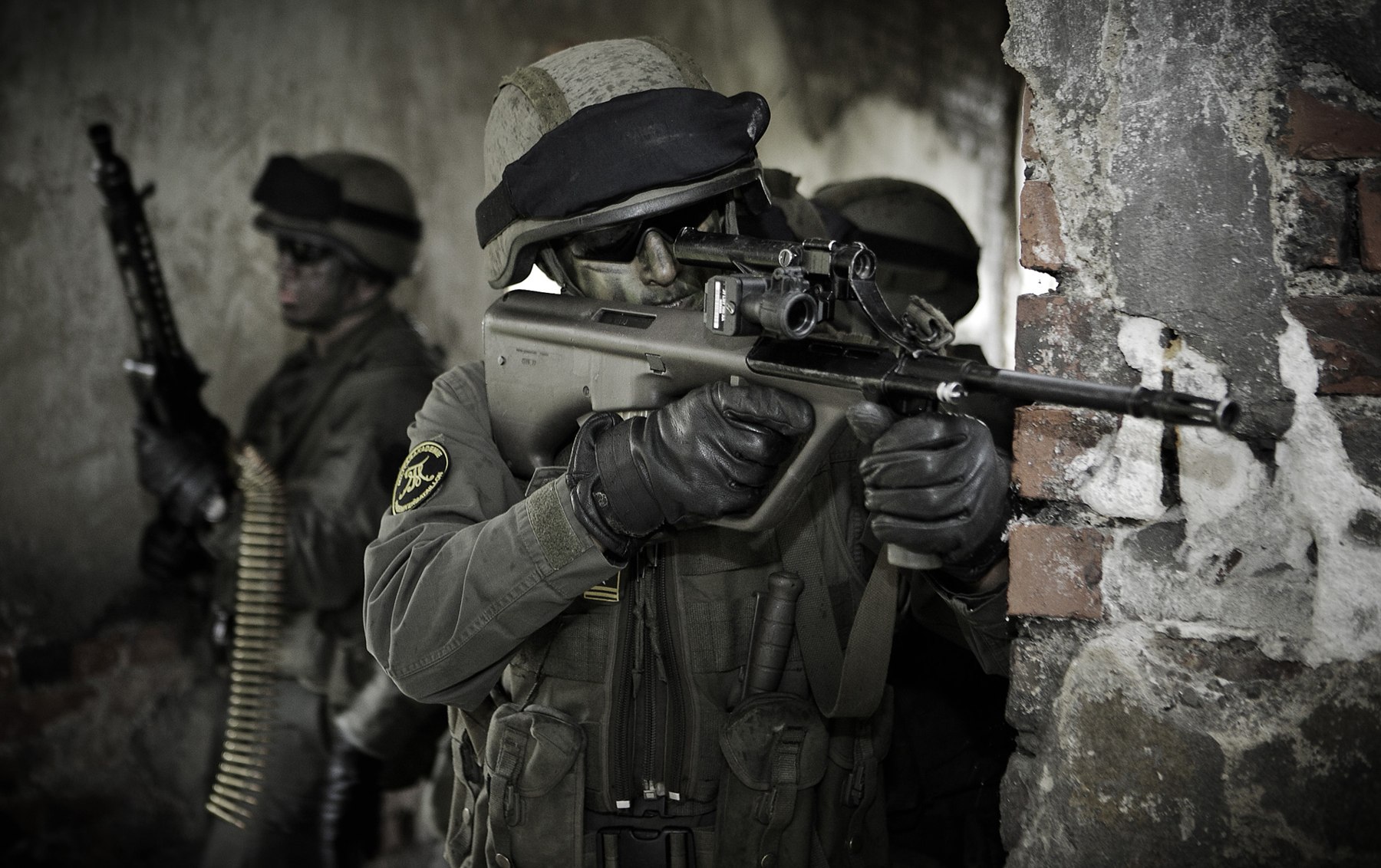
The Austrian Army’s own page still calls the StG 77 “die Standardbewaffnung der Soldaten des Bundesheeres,” the standard weapon of its soldiers.1 Over those years the Austrian designations recorded by Doppeladler, a reference site on the Bundesheer, run: StG 77 (the original), StG 77 A1, A2 and A3; the StG 77 A2 Commando, issued to special forces at the end of 2007; the lMG 77 A2, a heavy-barrel version; and the MP 88, the 9 mm variant.9
The most recent step is the one that shows how the Austrian Army regards the rifle. In February 2023 the Austrian defence ministry began handing over the StG 77 A1 MOD: existing StG 77 A1s rebuilt by Steyr Arms with a new receiver carrying Picatinny rails, an Aimpoint Micro sight, a Rheinmetall laser-light module with a pressure switch on the folding foregrip, a folding cocking handle and a brass deflector at the ejection port. According to the Austrian defence publication SPARTANAT, 14,400 rifles were to be converted over two years for the militia and ready-reaction units.11 A rifle first issued in 1978 was being upgraded, not replaced, in 2023.
1.8 Steyr After Steyr-Daimler-Puch
The conglomerate that designed the AUG no longer exists. Steyr’s history page records that in 1989 Steyr-Daimler-Puch was dissolved and “STEYR MANNLICHER AG” became independent; that between 2000 and 2004 the company moved its headquarters to Kleinraming, outside Steyr; and that on 1 January 2019 it took the name STEYR ARMS.4 Who owned Steyr Mannlicher between 1989 and 2007 was not established from a primary source.
From 2007 the owner was SMH Holding GmbH. On 23 April 2024 the Czech investment group RSBC, founded by Robert Schönfeld, bought all of the shares; the trade report of the sale says Steyr Arms then employed more than 200 people in Austria and the United States and had revenue above €45 million in 2023.10 The buyer was RSBC, not the Czechoslovak Group, with which it is sometimes confused.
The American company, Steyr Arms, Inc., is Vol 3’s subject. It has built the AUG in Alabama since 2014.
1.9 The Rifle Documented Here, and How These Volumes Are Arranged
The rifle documented in this dive is an AUG being built from an import parts kit, in progress in September 2026 and still needing parts. Its calibre, source, generation, receiver and barrel length are not yet recorded, and nothing in these volumes infers them. Vol 7 §7.1 is where the build will be documented as it proceeds.
The ten volumes are arranged in three parts.
- History — Vol 1 (Austria and the design), Vol 2 (the AUG abroad: Australia, New Zealand, Ireland, Malaysia and the rest), Vol 3 (the American AUG, from the 1989 import suspension to US manufacture).
- The rifle — Vol 4 (generations, variants and how to tell them apart in a photograph), Vol 5 (how it works).
- Building and keeping one — Vol 6 (the law), Vol 7 (building an import kit), Vol 8 (sourcing parts and magazines), Vol 9 (field strip, detail strip and maintenance), Vol 10 (repair, the optic and the rail).
Sources
Footnotes
-
Österreichisches Bundesheer, “Sturmgewehr 77,” https://www.bundesheer.at/unser-heer/waffen-und-geraet/sturmgewehr-77, accessed 2026-09-19. ↩ ↩2
-
Steyr Mannlicher AG, Maintenance Manual, Army Universal Assault Rifle, Steyr AUG, undated, fo. 3–6. Internet Archive, https://archive.org/details/maintenance-manual-army-universal-assault-rifle-steyr-aug, retrieved 2026-09-19. ↩
-
Steyr Mannlicher, “Our history,” Wayback Machine capture of 12 December 2009 of http://www.steyrarms.com/about/our-history, retrieved 2026-09-19. ↩
-
Steyr Arms GmbH, “History,” https://www.steyr-arms.com/en/company/history, accessed 2026-09-19; and “AUG A1,” https://www.steyr-arms.com/en/military-law-enforcement/assault-rifles/aug-a1/, accessed 2026-09-19. ↩ ↩2 ↩3
-
Chris Masters, Sticking to Our Guns: A Troubled Past Produces a Superb Weapon, Australian Strategic Policy Institute, October 2019, pp. 17–18, https://ad-aspi.s3.ap-southeast-2.amazonaws.com/2019-10/Sticking%20to%20our%20guns.pdf, retrieved 2026-09-19. ↩ ↩2
-
Google Patents records, queried 2026-09-19: CH 579 761 A5, CH 577 157 A5, CH 580 269 A5, CH 580 270 A5 (Steyr-Daimler-Puch, Austrian priorities January 1974; English titles and abstracts as supplied by Google Patents); AT 277 814 B (Wesp, priority 26 January 1967); US 3,638,344 A and AT 254 744 B (Wagner); DE 1 578 424 A1 and DE 1 903 000 A1 (Moser); Weldle’s patents including DE 1 728 249 A1 and DE 2 230 690 C2, assigned to Heckler & Koch GmbH. ↩ ↩2
-
US Patent 4,191,089, U. Zedrosser, assignor to Steyr-Daimler-Puch AG, “Breech-closing mechanism for automatic rifle,” Austrian priority 22 December 1977, granted March 1980. ↩
-
Daniel E. Watters, “A 5.56 X 45mm ‘Timeline’,” The Gun Zone, entries for 1977, 1978 and June 1986, Wayback Machine captures of http://www.thegunzone.com/556dw-7.html and -9.html, retrieved 2026-09-19. ↩ ↩2
-
Doppeladler.com, “StG 77 (Steyr AUG),” http://www.doppeladler.com/oebh/infanterie/stg77.htm, accessed 2026-09-19. A reference site on the Austrian Army, not an official source. ↩ ↩2 ↩3
-
all4shooters.com, “Czech financial investor RSBC announces the takeover of Austrian firearm manufacturer STEYR ARMS,” 24 April 2024, https://www.all4shooters.com/en/shooting/culture/czech-rsbc-group-buys-arms-manufacturer-steyr-arms/, accessed 2026-09-19. ↩ ↩2
-
SPARTANAT, “StG77 A1 MOD: modifizierte Sturmgewehre für die Truppe,” 17 February 2023, https://www.spartanat.com/2023/02/stg77-a1-mod-modifizierte-sturmgewehre-fuer-die-truppe/, accessed 2026-09-19. ↩
Comments (0)