Steyr AUG · Volume 3
The American AUG — Import Permits, the 1989 Suspension, Two Decades of Scarcity, and an Alabama Factory
Gun South's permits and lawsuit, what ATF actually did in 1989, the AUG by name in the 1994 ban, MSAR's clone, Sabre Defence's receivers, and Steyr Arms in Bessemer
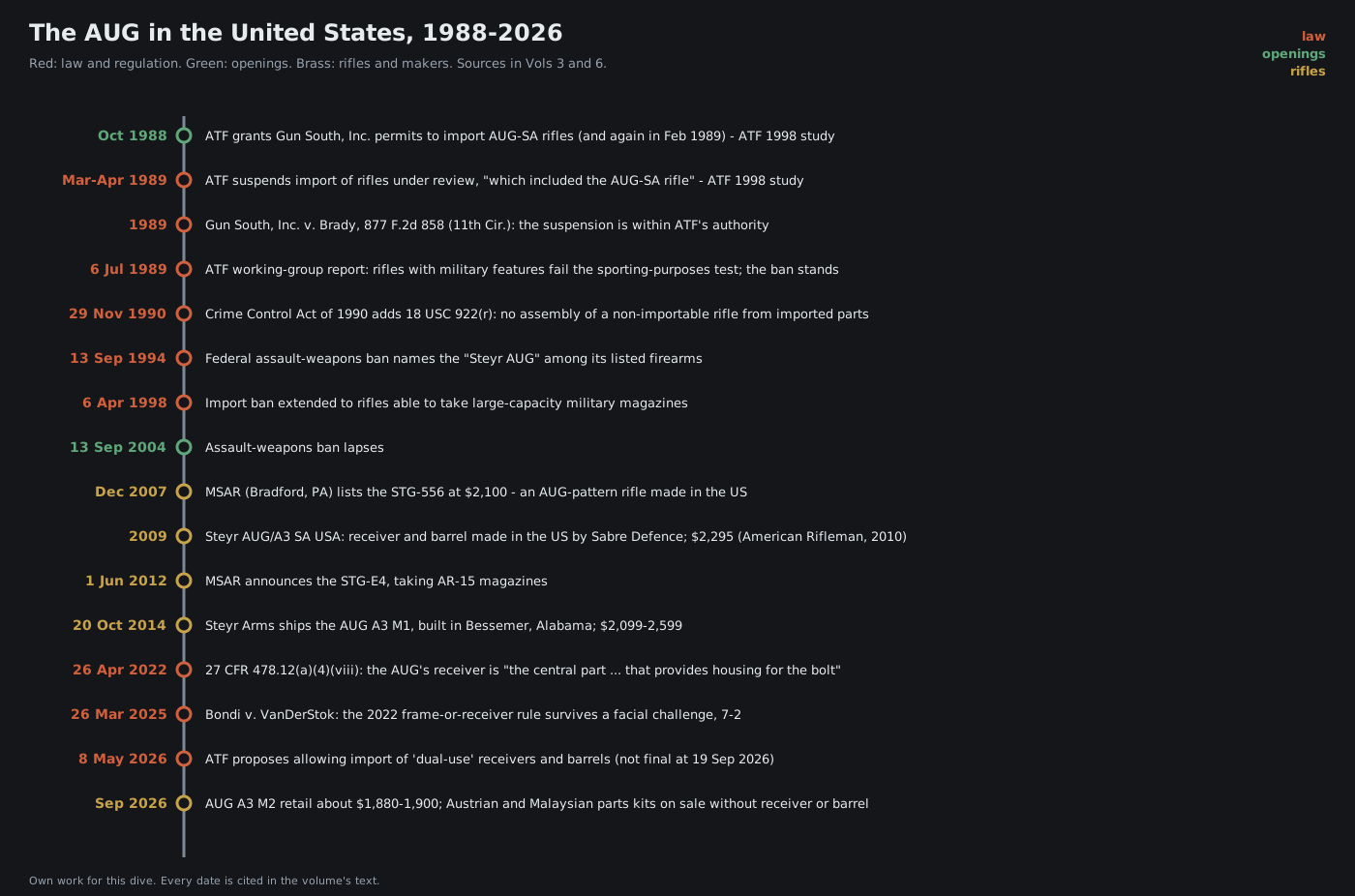
3.1 The Shape of the Story
The AUG’s American history has four phases. It was imported for a short time in the late 1980s. From 1989 it could not be imported, and for about two decades a semi-automatic AUG in the United States was a pre-ban rifle or nothing. Then an American clone appeared, and Steyr returned with rifles whose receivers and barrels were made in the United States. Since 2014 the maker’s own American company has built the rifle in Alabama. Kit building sits inside the last phase, and the law that shapes it was written in the second.
The legal side of the story is told in full in Vol 6. This volume is the narrative, and it rests where it can on ATF’s own account: the Treasury Department’s 1998 Study on the Sporting Suitability of Modified Semiautomatic Assault Rifles, which narrates the AUG’s 1989 case.1
3.2 Gun South and the AUG-SA
The American importer of the AUG in the 1980s was Gun South, Inc. What the primary record proves about its imports is narrow but exact. ATF’s 1998 study: “In October 1988 and February 1989, ATF had granted GSI permits to import AUG-SA rifles.”1 The “SA” was the semi-automatic version.
When Gun South began importing, and how many AUGs it brought in, were not established from a primary source. Earlier import years are widely given; none was confirmed. Gun South is also commonly placed in Trussville, Alabama, which is where Steyr’s own American company later had its address — the 2009 Steyr Arms, Inc. manual gives “P.O. Box 840, Trussville, AL 35173” — but the continuity between the two companies was not confirmed.2
3.3 1989: What ATF Did, and What It Was Not
In the spring of 1989 the importation of semi-automatic military-pattern rifles was stopped. ATF’s own account:
“In March and April 1989, ATF announced that it was suspending the importation of certain ‘assault-type rifles.’ … On July 6, 1989, the group issued its Report and Recommendation of the ATF Working Group on the Importability of Certain Semiautomatic Rifles.”1
On the AUG specifically:
“As mentioned previously, in March and April of 1989, ATF imposed a temporary suspension on the importation of rifles being reviewed in the 1989 study, which included the AUG-SA rifle. GSI filed suit in Federal court, seeking to prohibit the Government from interfering with the delivery of firearms imported under permits issued prior to the temporary suspension.”1
Gun South lost on appeal. The Eleventh Circuit, in Gun South, Inc. v. Brady, 877 F.2d 858 (1989), held that the Gun Control Act “impliedly authorizes” a temporary suspension and rejected the argument that the suspension was arbitrary because the rifle had not changed. The study notes that the court ruled “just days before the 1989 report was issued,” and that once the report was issued “no one pursued a lawsuit challenging ATF’s determination.”1
Two corrections belong here.
- It was not an executive order. The 1989 ban is often described, including in widely read encyclopaedic sources, as President George H. W. Bush’s executive order. ATF’s own account is of an ATF administrative suspension and an ATF working-group determination under the sporting-purposes test of 18 U.S.C. § 925(d)(3). The instrument was the agency’s.1
- The dates are months, not days, in the primary record. The widely repeated 14 March and 5 April 1989 dates for the two stages of the suspension did not appear in the ATF study, which gives “March and April 1989.” The working group’s report is dated 6 July 1989.1
The test the working group applied is the reason §922(r) applies to an AUG today. After 1989, the study says, a semi-automatic rifle with any of the eight military-configuration features — among them a separate pistol grip and a flash suppressor — other than the ability to take a detachable magazine “failed the sporting purposes test and, therefore, was not importable.”1 The AUG has both.
The market effect of the ban on AUG prices in the United States was not found documented in any source read. The hub’s AK-47 dive tells the same 1989 story for the Kalashnikov, with the importers’ response of sporting-configured rifles (AK-47, Vol 16).
3.4 1990: Section 922(r)
The Crime Control Act of 1990 added 18 U.S.C. § 922(r), signed on 29 November 1990, which made it unlawful to assemble from imported parts a semi-automatic rifle “identical to any rifle … prohibited from importation under section 925(d)(3).”3 Its implementing regulation, with its list of twenty parts and its ceiling of ten imported, is the subject of Vol 6 §§6.7–6.8. Its effect on the AUG was to close the obvious route around the import ban: bringing the rifle in as parts and assembling it at home.
3.5 1994: The AUG by Name
The Violent Crime Control and Law Enforcement Act of 1994 created a federal ban on “semiautomatic assault weapons” defined partly by features and partly by a list of named firearms. The AUG was on the list. Former 18 U.S.C. § 921(a)(30)(A) defined the term to include “any of the firearms, or copies or duplicates of the firearms in any caliber, known as— … (vii) Steyr AUG.”4
Being named mattered. A rifle defined by features can be redesigned to lose them; a named rifle and its “copies or duplicates … in any caliber” cannot. From 13 September 1994 new manufacture of an AUG for civilian sale was barred, until the ban lapsed ten years later, on 13 September 2004.4 ATF’s 1998 study notes a detail useful to anyone buying parts in that decade: ATF did not treat a bare receiver of a named model as a “semiautomatic assault weapon” unless it was actually incorporated in one.1
3.6 The USR, and 1998
The Steyr USR was a version of the AUG for the American market. It is commonly described as having a thumbhole stock; that was not confirmed from a primary source. That it existed as a US-market variant sharing parts with the A1 and A2 is documented by the maker: Steyr Arms USA’s archived store sold an “AUG SA Hammer Pack … for use on any A1/A2 or USR” in 2017 and 2019, and its current store still describes its magazine as fitting “all styles of the Steyr AUG-USR.”56 When the USR was imported, and exactly why it stopped, were not established from a primary source.
The 1998 extension of the import ban is the likely end of the story, but it cannot be stated as fact. On 6 April 1998 Treasury announced “a prohibition on the importation of modified, semiautomatic assault rifles with the ability to accept large capacity military magazines.”7 A USR that takes the AUG’s 30-round magazine — and Steyr’s own listing says its magazine fits “all styles of the Steyr AUG-USR” — plainly fails that test. But the USR is not among the rifles the 1998 study lists — its study group was AK, FAL, HK, Uzi and SIG 550 variants — and the named-model provision of the 1994 ban may have been the real constraint.1 Either reading fits the record; neither is proved by it.
3.7 MSAR and the STG-556
The first AUG-pattern rifle made in the United States in quantity was not a Steyr. Microtech Small Arms Research (MSAR) of Bradford, Pennsylvania, listed the STG-556 on its price list by December 2007: “STG-556 (comes standard with a 16in barrel and 10 round magazine),” at $2,100, with separate “STG-SA Hammer Pack Group” and barrel groups.8 The rifle’s manual says “The STG-556 accepts STG-556 magazines and most of AUG magazines.”9
On 1 June 2012 MSAR announced the STG-E4: “The semi-automatic rifle has been re-engineered,” with barrels of 16.5, 18.5 and 20 inches and a .300 Blackout option, and it took AR-15 magazines; its 2012 price list gave $1,980 for the XM17-E4.10 MSAR’s own parts page said older and newer MSAR receivers differed at the barrel-locking notch, and offered to re-cut a customer’s early receiver for $100 — “The original STG-556 stock would be rendered useless with this upgrade.”11
MSAR is gone. Its web domain now carries unrelated content, and its documents survive only in archived copies. For a kit builder, the MSAR point is Vol 8’s: nothing MSAR published claims that its barrels, bolts or trigger packs interchange with Steyr’s.
3.8 Steyr Comes Back: Sabre Defence and the A3 SA USA
Steyr returned to the American market with a rifle built to satisfy §922(r) by making its most important parts in the United States. American Rifleman’s 2010 review of the Steyr AUG/A3 SA USA is the clearest statement found of what that meant:
“Although the new gun’s investment cast aluminum receiver and steel barrel are made in the United States by Steyr partner Sabre Defence Industries of Nashville, Tenn., it benefits from oversight by Austrian engineers and from the use of some Austrian components.”12
The review gives the suggested retail price as $2,295, the receiver as “Investment cast, Eloxal-coated aluminum,” and the rifle’s availability as “limited for the past two decades owing to restrictions imposed on semi-automatics by the 1989 importation ban.”12 Steyr’s own 2009 product page describes the rifle as “the civilian version of the world-famous STEYR AUG … a gas-operated semi automatic sporting rifle with a changeable barrel and a picatinny rail,” supplied with two 30-round magazines.13
A later magazine account says that production slowed with Sabre’s difficulties and that Steyr then partnered “with VLTOR in 2012 to manufacture receivers and with FN USA to make barrels.”14 That is a single uncited magazine source, and it is reported here as its claim.
3.9 Bessemer: The A3 M1 and M2
The third phase ended with Steyr building the rifle itself. Steyr Arms’ press release of 20 October 2014:
“BESSEMER, Ala. (Oct. 20, 2014) — Steyr Arms announced today that it has begun shipping the new multi-configurable M1 variant of the AUG A3. … The AUG A3 M1 is built by Steyr Mannlicher-trained gunsmiths in Steyr Arms’ new Bessemer headquarters and manufacturing facility.”15
The release gives the A3 M1’s overall length as 28.15 inches with the 16-inch barrel, its receiver as “Hard Eloxal-coated aircraft aluminum,” and its suggested retail prices as $2,099 with either rail, $2,499 with the 1.5× optic and $2,599 with the 3× optic.15 Steyr Arms USA’s own store listed the A3 M1 at $2,195.00 in 2019.16
In September 2026 Steyr Arms USA’s model page listed the AUG A1 of 1977 as “No longer in production,” the AUG A3 M1, the AUG A3 M2 — “Modernized as a blank canvas in NATO or standard variants. Not sold with rail and handguard,” in 14.5-, 16-, 20- and 24-inch 5.56 barrels and a 16-inch .300 Blackout — and a limited 9 mm MP88 “with a 1.5x integral optic (Donut and Dot reticle),” sold through one distributor.17 Two retailers listed the A3 M2 at about $1,880 to $1,900 on 19 September 2026 (Vol 8).
3.10 The AUG in American Service
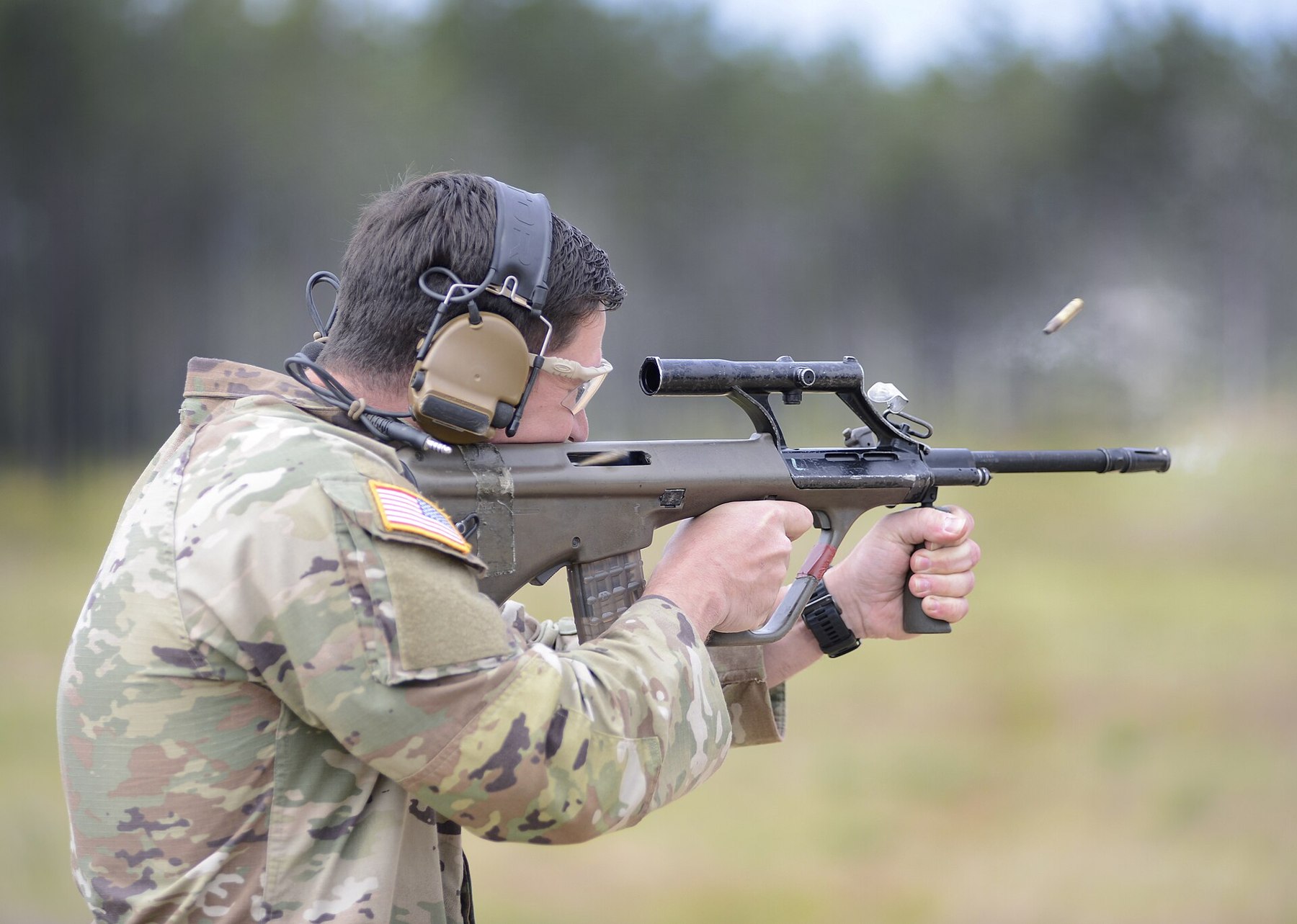
The AUG was never a US service rifle, but it appears in the American record in three ways.
- The Advanced Combat Rifle programme. Watters’s chronology records Steyr in the US Army’s ACR programme from 1986 to 1990 with a rifle that “outwardly resembled the AUG” but used a rising-chamber action firing a synthetic-cased flechette, credited to Ulrich Zedrosser, the designer of the AUG’s bolt (Vol 1).18 It is not an AUG variant.
- Federal agencies. The Irish Defence Forces’ 2007 page names the US Customs Service as a user.19 That claim was not checked against any US source.
- Foreign-weapons training. US special-operations and Marine units train on the AUG and its derivatives as foreign weapons, as the photographs in this dive from Fort Bragg and from Australian-hosted exercises show.
3.11 Where That Leaves a Kit Builder in 2026
The history explains the shape of the market an import-kit builder faces.
- Kits exist because rifles cannot be imported. Austrian and Malaysian military rifles come in as parts, without receivers, because the rifle itself has been non-importable since 1989 (Vol 6 §6.4).
- §922(r) exists because of the same ban, and it is why a kit builder counts parts.
- The US-made receiver is the historical answer — Sabre’s castings in 2009, Steyr’s Bessemer production since 2014 — and it is the part the builder now has to find (Vol 6 §6.5).
- A pending ATF proposal of 8 May 2026 would allow “dual-use” receivers and barrels to be imported again. If it is made final, imported AUG receivers and barrels may reappear; each would still count as an imported part (Vol 6 §6.11).
Sources
Footnotes
-
Department of the Treasury, Study on the Sporting Suitability of Modified Semiautomatic Assault Rifles (ATF, April 1998), Background, pp. 10–13, and Exhibit 2; Wayback Machine captures of http://www.atf.treas.gov/pub/assault_rifles/ (index captured 17 January 1999), retrieved 2026-09-19. ↩ ↩2 ↩3 ↩4 ↩5 ↩6 ↩7 ↩8 ↩9 ↩10
-
Steyr Arms, Inc., STEYR AUG/A3 SA USA owner’s manual, 2009, p. 2, Wayback Machine capture of 8 August 2009, retrieved 2026-09-19. ↩
-
18 U.S.C. § 922(r), uscode.house.gov (preliminary edition), with amendment note: added by Pub. L. 101–647, § 2204(b), 29 November 1990; retrieved 2026-09-19. ↩
-
18 U.S.C. § 921(a)(30)(A)(vii) (2000 edition), https://www.govinfo.gov/content/pkg/USCODE-2000-title18/html/USCODE-2000-title18-partI-chap44-sec921.htm, retrieved 2026-09-19, with the edition’s note that sections 110101–110105 of Pub. L. 103–322 were repealed effective ten years after 13 September 1994. ↩ ↩2
-
Steyr Arms, Inc., “AUG SA Hammer Pack,” Wayback Machine captures of 6 June 2017 (steyrarms.com) and 16 July 2019 (steyr-arms.com/us), retrieved 2026-09-19. ↩
-
Steyr Arms, Inc., online store, https://steyr-arms.us/shop/aug-waffle-magazines/, product data read 2026-09-19. ↩
-
Department of the Treasury, press release RR-2347, 6 April 1998, Wayback Machine capture of http://www.atf.treas.gov/pub/assault_rifles/treasrelease.htm, retrieved 2026-09-19. ↩
-
Microtech Small Arms Research, price list, Wayback Machine capture of 6 December 2007 of http://www.msarinc.com/pricelist.html, retrieved 2026-09-19. ↩
-
Microtech Small Arms Research, STG-556 Operator’s Manual, Wayback Machine capture of 14 July 2011, retrieved 2026-09-19. ↩
-
Microtech Small Arms Research, press release, “MSAR Announces Release of the STG-E4,” 1 June 2012, Bradford, Pennsylvania; and 2012 MSRP price list; Wayback Machine captures retrieved 2026-09-19. ↩
-
Microtech Small Arms Research, parts page, Wayback Machine capture of 12 December 2012, retrieved 2026-09-19. ↩
-
American Rifleman staff, “Steyr AUG/A3 SA USA,” 11 May 2010, https://www.americanrifleman.org/content/steyr-aug-a3-sa-usa/, read 2026-09-19. ↩ ↩2
-
Steyr Mannlicher, “Steyr AUG/A3 SA USA” product page, Wayback Machine capture of 6 June 2009 of http://www.steyrarms.com/products/sporting-rifles/steyr-aug-z, retrieved 2026-09-19. ↩
-
RECOIL, “Steyr AUG A3: The Incomparable, Futuristic Carbine,” recoilweb.com, undated, read 2026-09-19. ↩
-
Hunter Outdoor Communications for Steyr Arms, press release, 20 October 2014, Wayback Machine capture of http://www.hunteroc.com/2014/Steyr_Arms_PR4.html, retrieved 2026-09-19. ↩ ↩2
-
Steyr Arms, Inc., store page, Wayback Machine captures of 30 May 2019 and 14 October 2019 (steyr-arms.com/us), retrieved 2026-09-19. ↩
-
Steyr Arms, Inc., “AUG,” https://steyr-arms.us/firearms/tactical-rifles/aug/, read 2026-09-19. ↩
-
Daniel E. Watters, “A 5.56 X 45mm ‘Timeline’,” The Gun Zone, entries for 1986–1990, Wayback Machine capture of http://www.thegunzone.com/556dw-9.html, retrieved 2026-09-19. ↩
-
Irish Defence Forces, “Army Weapons – Steyr,” Wayback Machine capture of 16 October 2007, retrieved 2026-09-19. ↩
Comments (0)