Steyr AUG · Volume 2
The AUG Abroad — Lithgow, Wellington, Dublin, Kuala Lumpur and the Rest
The export and licence history country by country, with Australia's forty-year line from F88 to EF88 told from the Australian study that interviewed the people involved
The AUG’s export history is the part most often told from memory, and its dates are among the most often wrong. This volume is built on four kinds of source: Steyr’s own pages; the adopting services’ own pages (Australian Army, New Zealand Army and Ministry of Defence, Irish Defence Forces, Luxembourg Army), most read from archived copies; Daniel Watters’s 5.56 mm chronology, a specialist compilation from contract notices, patents and trade press; and, for Australia, Chris Masters’s 2019 study for the Australian Strategic Policy Institute, which rests on interviews with the soldiers, engineers and officials involved.12 Where they disagree, each is given.
2.1 Steyr’s List, and the Count That Drifts
Steyr’s own 2009 history page lists licence production in Australia and Malaysia, and exports to Ireland, New Zealand, Tunisia, Saudi Arabia, Oman and the United States.3 That is the maker’s short list, and every country on it is documented below.
The total number of users is a figure that drifts with whoever is counting. Steyr’s c. 2009 product sheet: “Armed and special forces in about 35 countries.” The Australian Army’s 2009 page: “in service in over 30 countries.” Lithgow Arms’ 2016 F90 datasheet: “in service in Australia and 30 other countries.” The 2024 report of the company’s sale: “more than two dozen armies.”4567 No list behind any of those numbers was found, and this volume does not construct one. The countries below are those for which a source was found.
2.2 The First Customers: Tunisia, Saudi Arabia, Oman, Cameroon
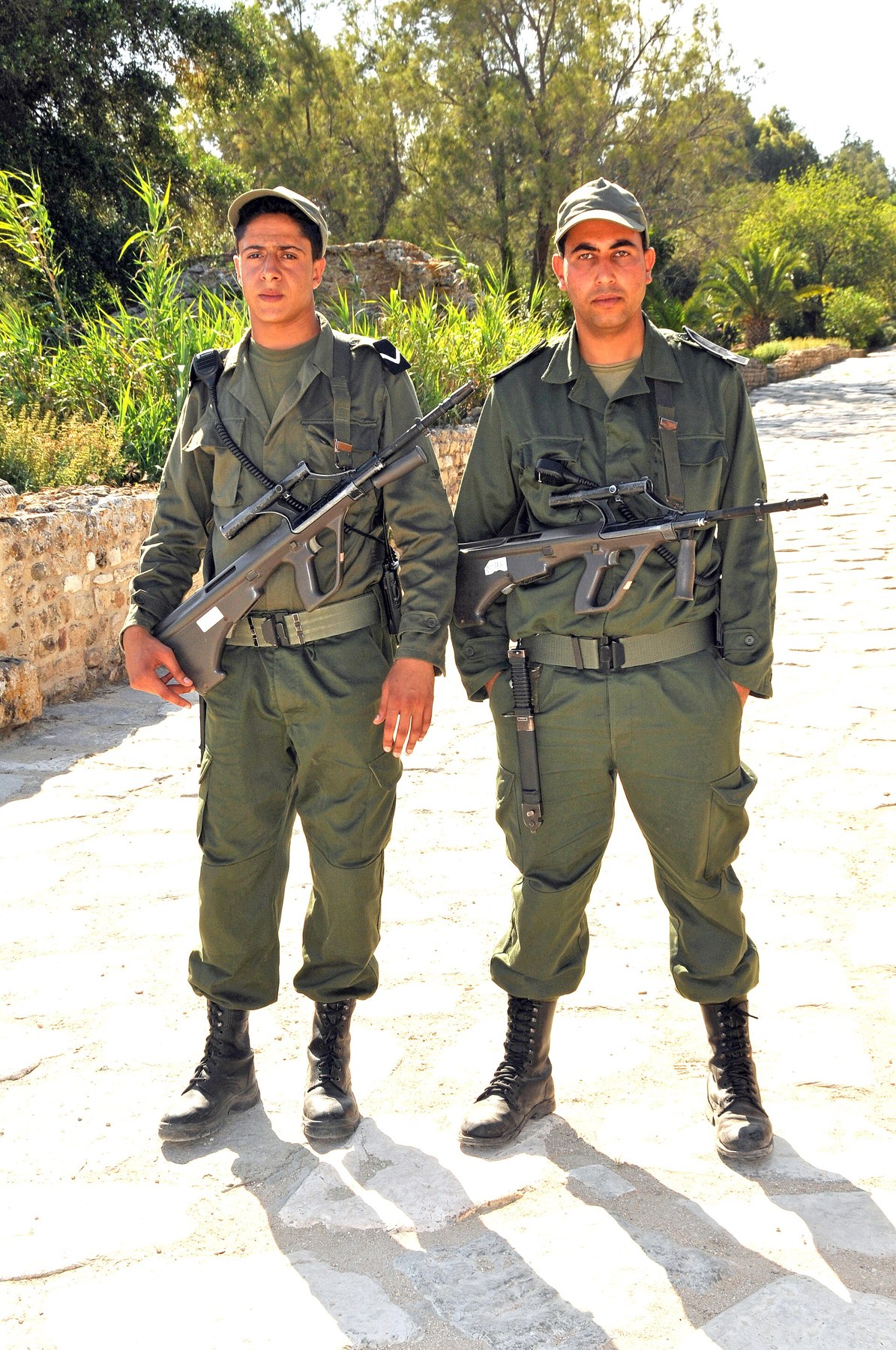
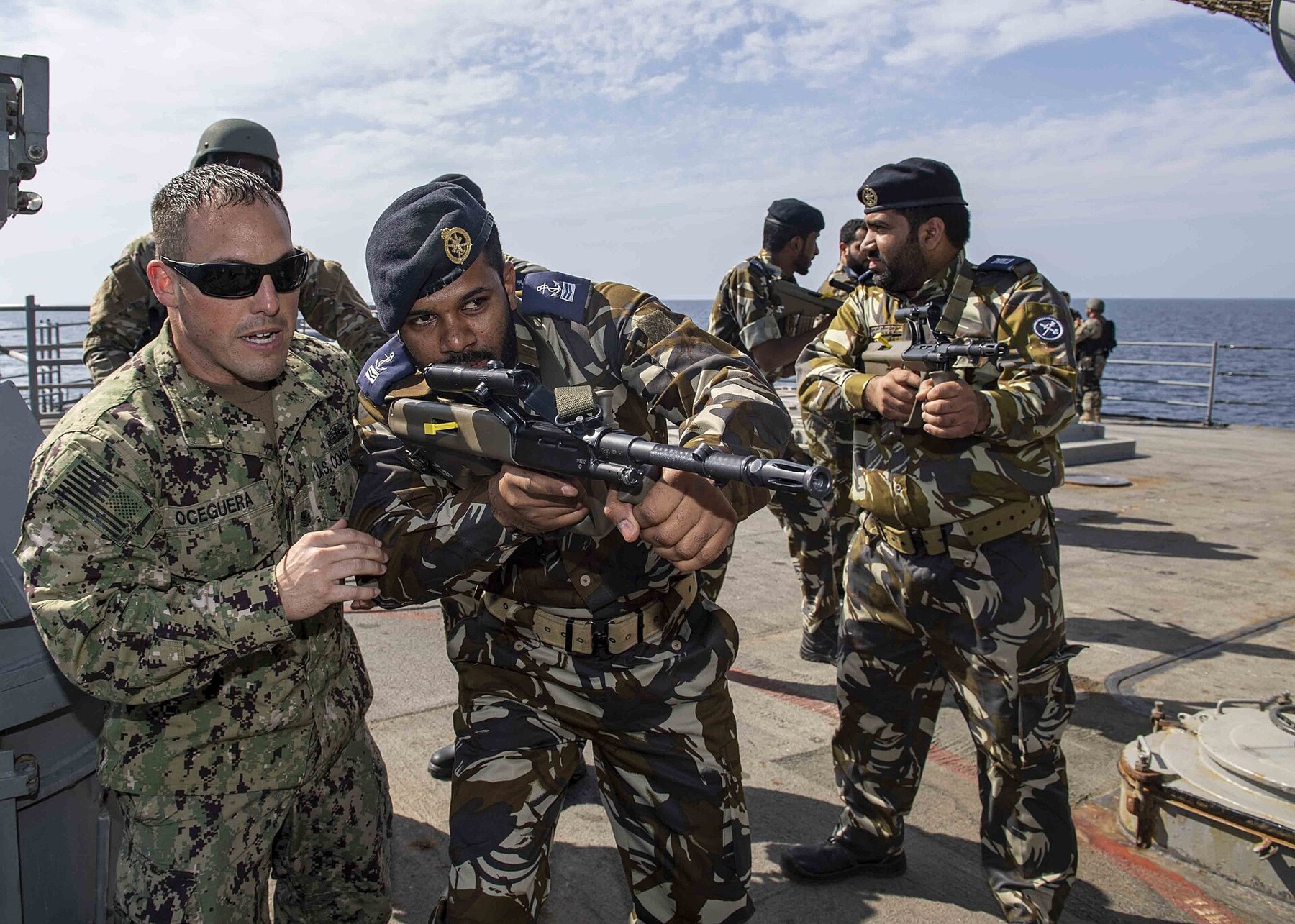
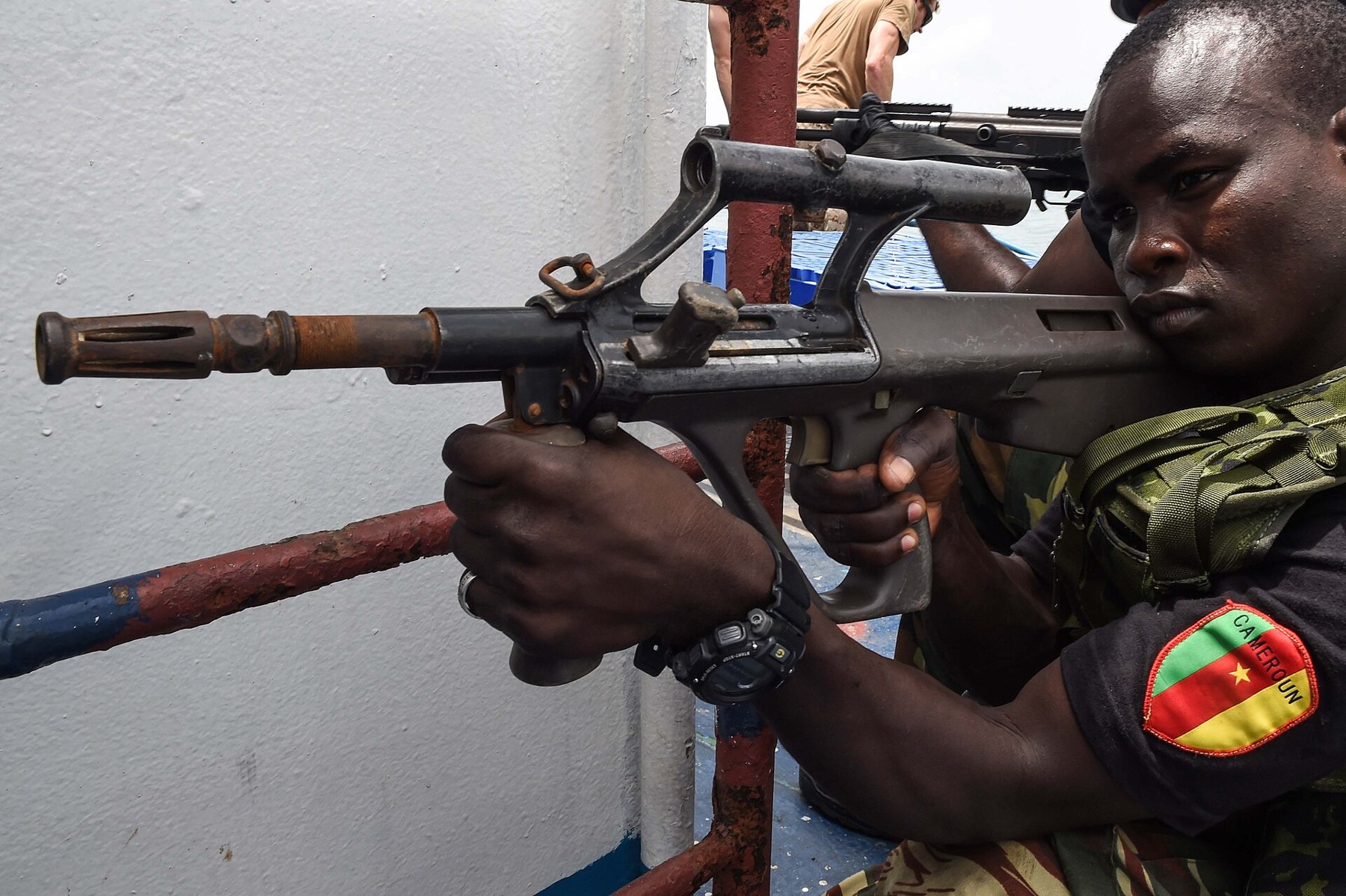
Watters’s chronology dates the early export deliveries.2
Table 1 — 2.2 The First Customers: Tunisia, Saudi Arabia, Oman, Cameroon
| Year | Event (Watters) |
|---|---|
| 1978 | ”Tunisia receives Steyr AUG.” |
| 1980 | ”Saudi Arabia takes its first delivery of Steyr AUG.” |
| 1982 | ”The Omani Royal Guard acquires Steyr AUG.” |
| 1983 | ”The Omani armed forces receive Steyr AUG.” |
| 1984 | ”Cameroon’s military purchases the Steyr AUG.” |
2.3 Australia: The Trials and the Decision
The largest foreign user of the AUG adopted it after a head-to-head trial with the M16A2, and the record of that trial is in the ASPI study.
An informal preliminary look at the School of Infantry at Singleton, New South Wales, narrowed a field that included an FN carbine, the Galil, a Heckler & Koch rifle, the M16A2 and the AUG to two. The evaluation that followed cost about A$6 million and ran from May 1984 to April 1985. Of 56 requirement categories, the study reports the two rifles equal in 21, the M16A2 better in 5 and the AUG better in 29; the AUG failed 2 requirements, the M16A2 failed 15, and both failed 1.1 One officer’s recollection of the first sight of the Austrian rifle: “It didn’t look sexy. It was green; it didn’t look like a weapon.”1
In December 1985 the manager of the Small Arms Factory at Lithgow announced government approval to make 67,000 Steyr rifles and 4,320 Minimi light machine guns, in a project costed at A$160 million, and to supply the New Zealand Defence Force with 18,000 Steyrs, an order worth $22 million.1 Watters’s chronology dates the adoption to 1985 too.2
That date is worth stating plainly because the Australian adoption is often given as 1988 or 1989. 1985 is the decision. November 1988 is the first delivery. 1991 is the first unit issued with it. All three are true, and they are three different things.
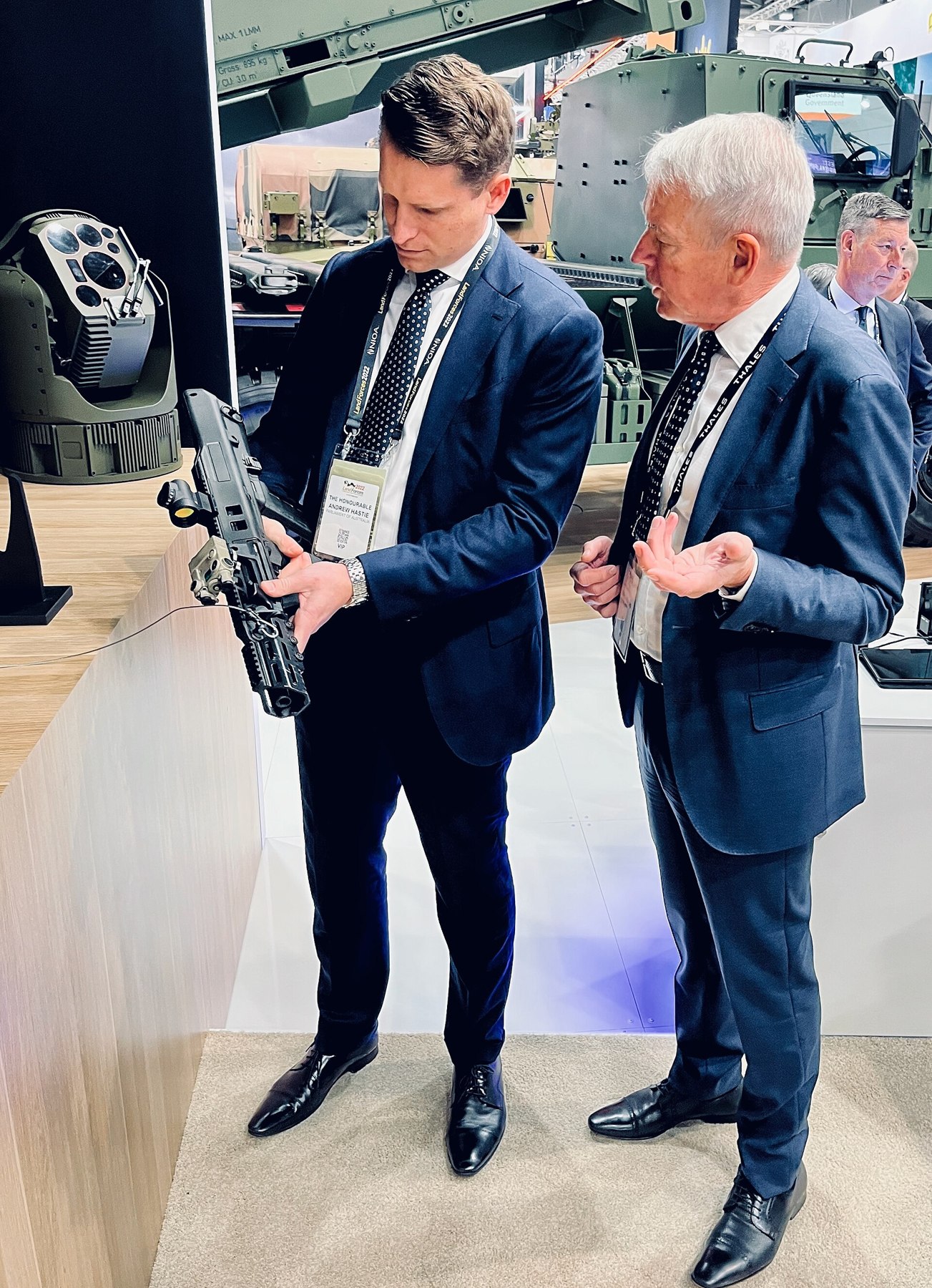
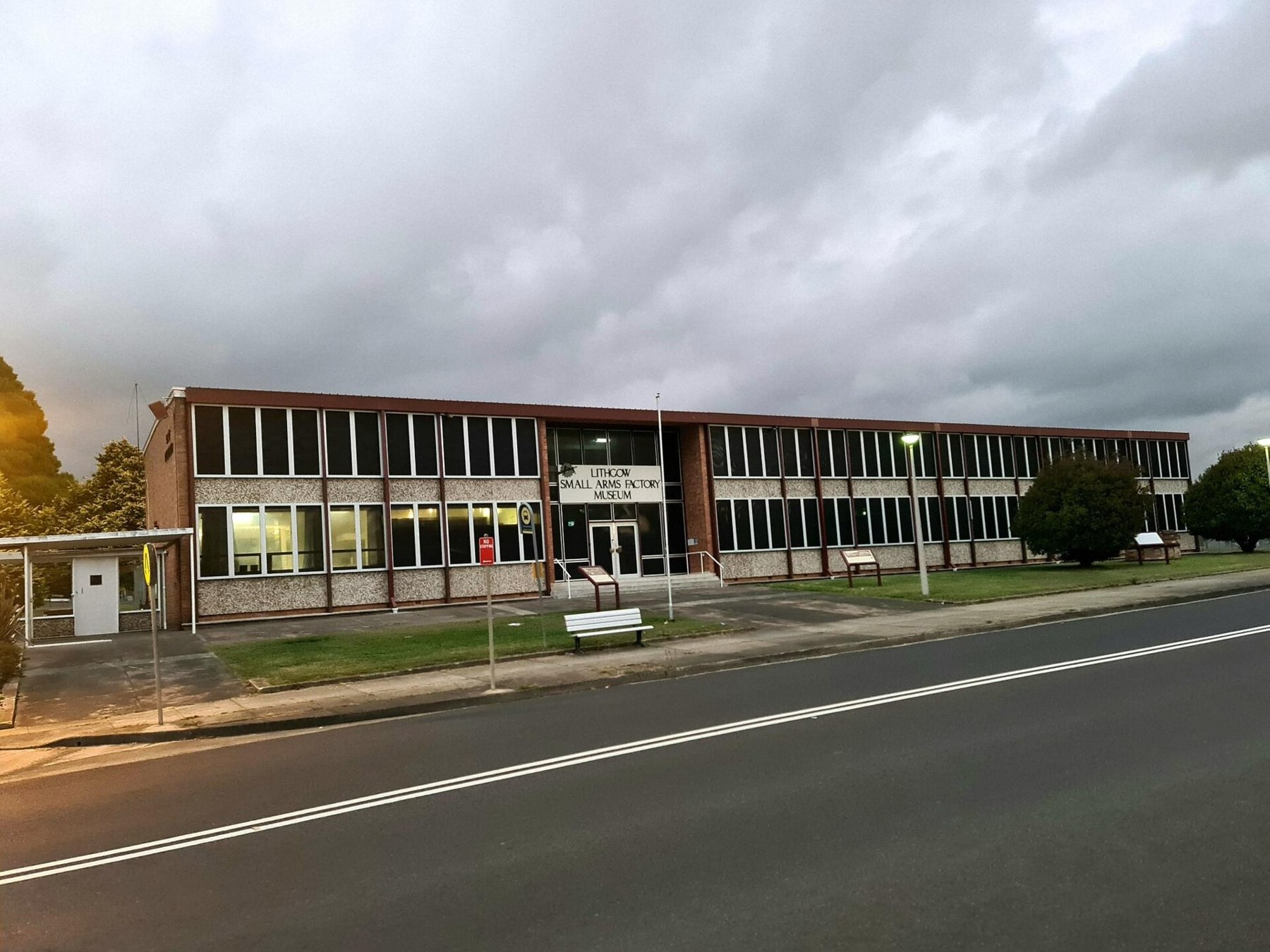
2.4 Australia: Lithgow Builds the F88
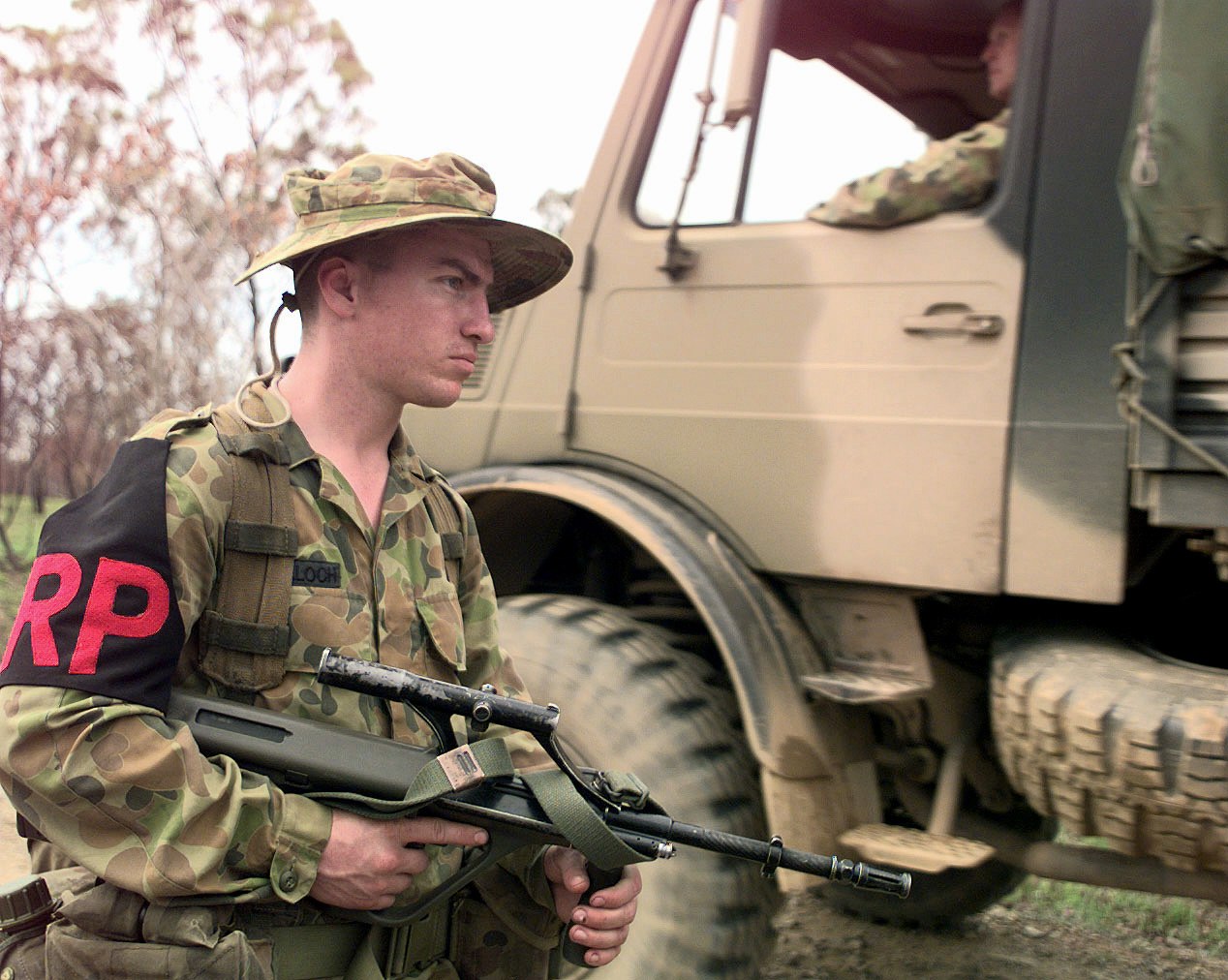
The Australian rifle was designated the F88, and “Austeyr” became its name. The ASPI study records that “The first trial batch of 500 standard service rifles was delivered to the Army in November 1988, Australia’s bicentenary year, marking the F88’s formal introduction,” and that the first rifles combined Australian- and Austrian-made parts.1
The licence programme was a substantial transfer of technology. Lithgow installed a hammer-forging machine for cold-forged, chrome-lined barrels, and Austrian technicians spent more than eighteen months rebuilding its controls. Some 200 components had to be changed to resist salt-water corrosion. The butts were made by a New Zealand racing-yacht company and the magazines by a South Australian broom maker. And in 1990, the study records, “An Austrian design engineer, Horst Wesp, arrived … to interpret drawings thought to be deficient in crucial detail” (Vol 1 §1.5).1 In May 1989 Lithgow came under the new, government-owned Australian Defence Industries (ADI).1
The early rifles had stoppages, and part of the cause was ammunition. The Australian F1 5.56 mm round, with a different propellant, ran at lower pressure; New Zealand had the same problem with its Austrian-made rifles fed Australian ammunition; and the fix was, in the study’s words, “a minor enlargement of the vent and gas plug.”1 It is the same regulator Vol 10 discusses as a wear part.
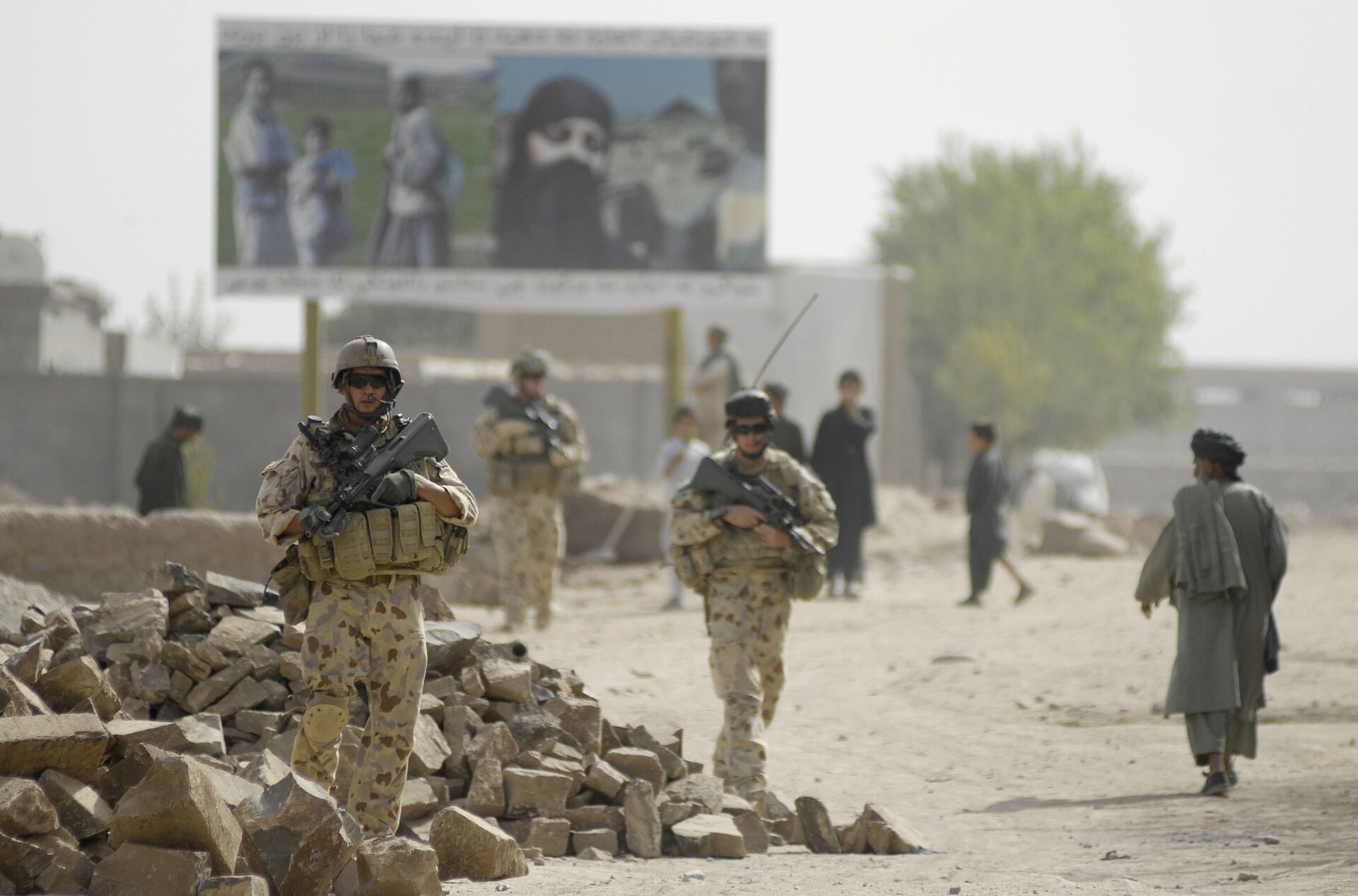
It was at least two years before F88s reached the regiments. The first unit issued with them was the 6th Battalion, Royal Australian Regiment, in 1991. The first major deployment was Operation Solace in Somalia in early 1993.1
The Australian Army’s own specification page, as it stood in 2009, gives the F88’s barrel as 508 mm for the rifle and 407 mm for the carbine, its accuracy as “60 mm at 50 m (5 round group),” its cyclic rate as 680–850 rounds a minute, and its effective range as 400 m.5
2.5 Australia: F88S, SA1, SA2
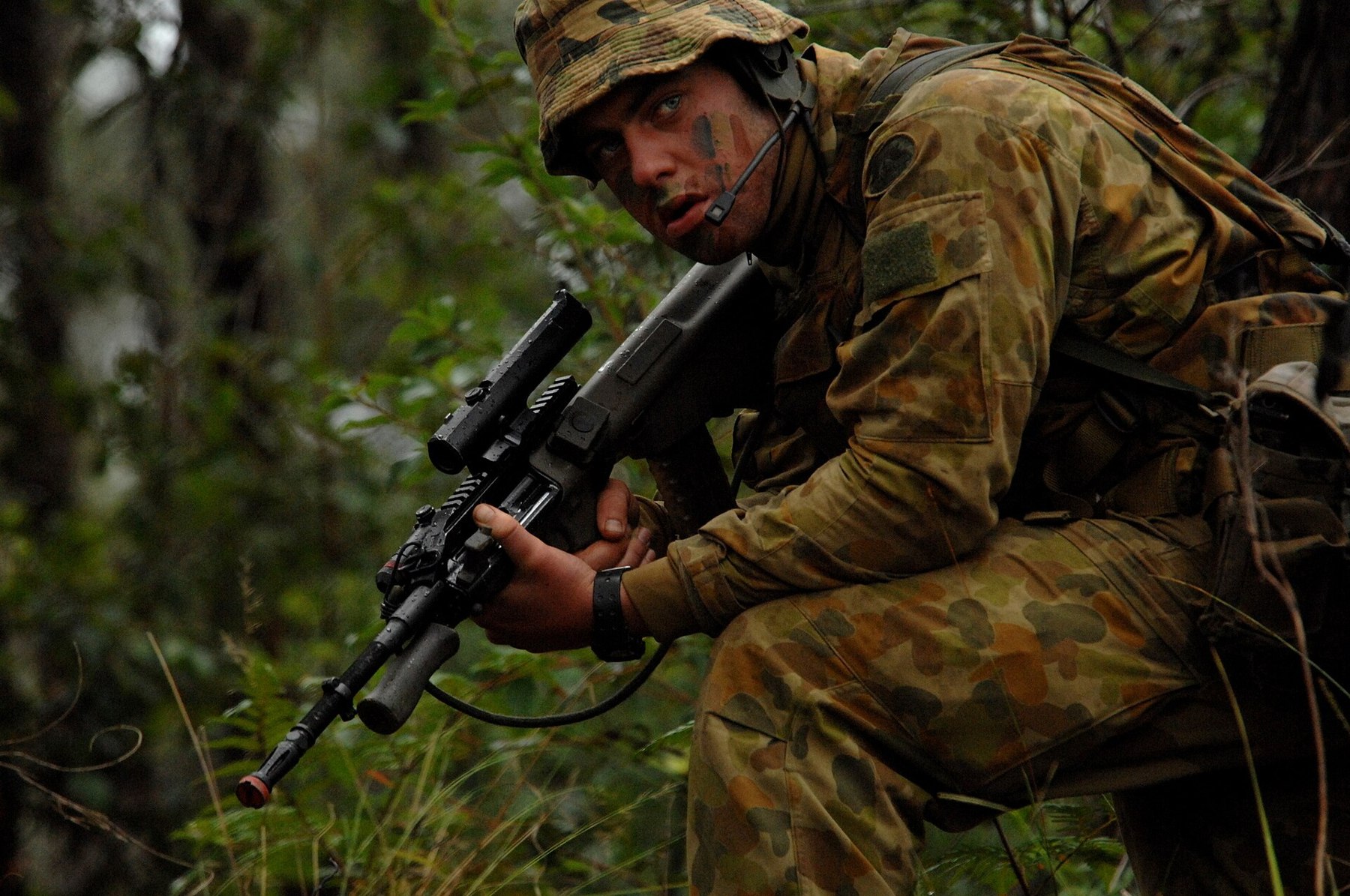
The Australian rifle then went through a sequence of upgrades whose names are easily confused. The ASPI study gives them in order.1
- F88S (“Special”), by 1998: a 508 mm rifle with an Accuracy International Mounting System rail for a more advanced sight. By 1998 the family was the standard F88 (508 mm, with a bayonet lug), the carbine (407 mm, no lug, for vehicle, ship and aircraft crews) and the F88S.
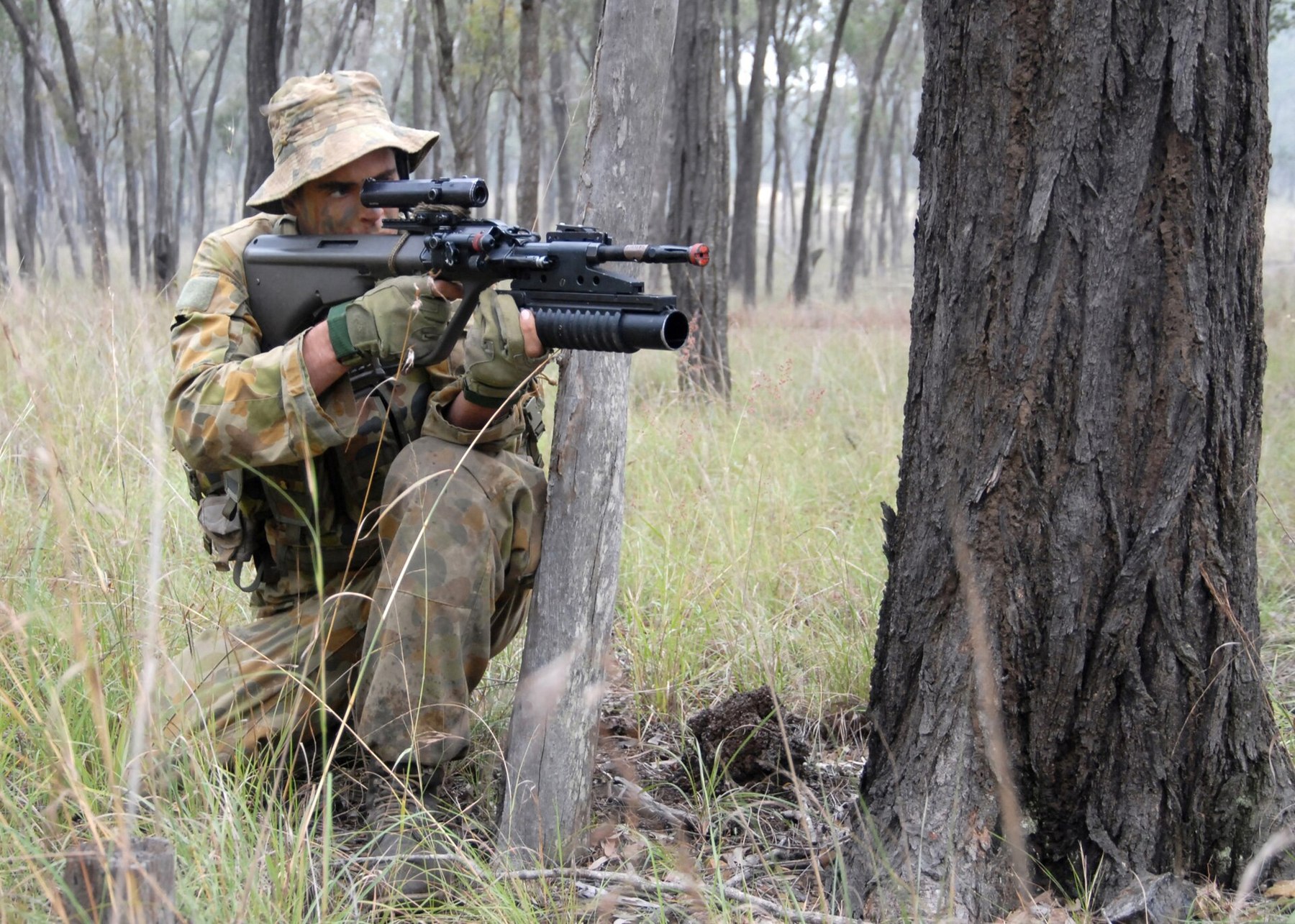
- F88 SA1: an ADF and ADI upgrade that replaced the integral optic with a MIL-STD-1913 rail for the Wildcat optical sight and a night sight. Work began in 1998; the SA1 was accepted into general service in 2003, and the F88S was withdrawn because its rail could not be converted.
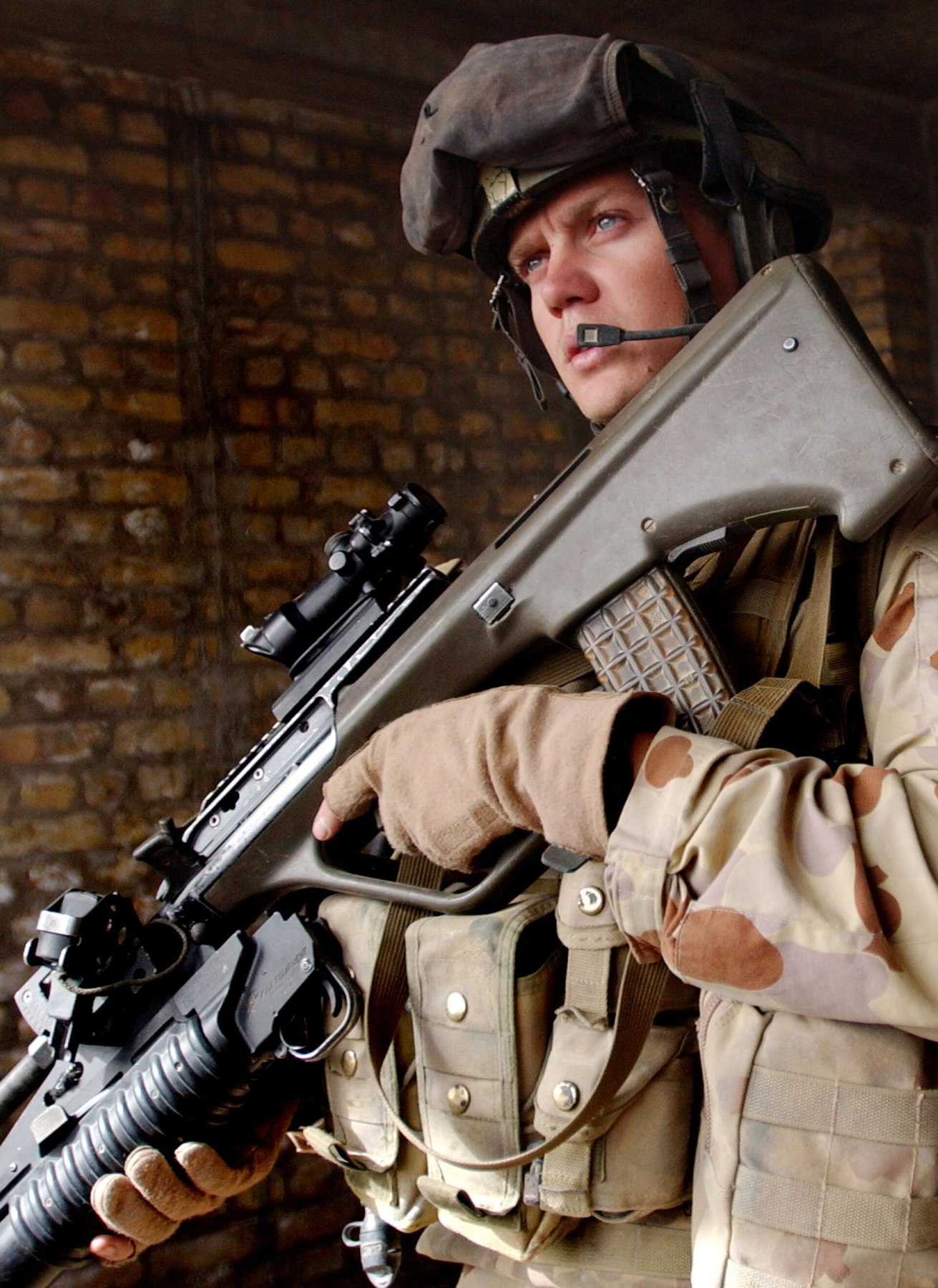
- F88 GLA: the grenade-launcher version, which lost its bayonet lug and foregrip for an interface bar fitted by an armourer, and carried the M203PI 40 mm launcher.
- F88 SA2: in October 2008 Thales, by then owner of the Lithgow factory, was contracted for a “factory thorough rebuild” of the Austeyr fleet over five years, estimated at A$84 million. The SA2 came into use in May 2009 with “greater modularity, a longer upper rail and a side bracket,” weighing 4.8 kg loaded. It was two-tone: “dark khaki undercarriage and a light brown upper to match the desert uniform.”
The SA2 is also the Australian programme’s cautionary tale. The study reports that 58 per cent of issued SA2s showed one or more faults, among them butt-stock halves from the New Zealand maker that warped and threw the bolt face out of alignment, firing-pin faults and trigger-pressure faults; the Chief of Army, Lieutenant General Ken Gillespie, ordered a recall, and the deployed force was re-equipped with SA1s.1
Ownership of the factory changed across the same years. Thomson-CSF, later Thales, took a half share in ADI, and in October 2006 Thales took 100 per cent of it.1
The naming is a trap for anyone identifying a photograph. “F88S” (1998, AIMS rail) and “F88 SA1” (2003, Picatinny rail) are different rifles. The Australian Army’s own later page uses both “F88SA2” in its text and “F88A2” in its web address.8 Watters records that ADI’s own railed project, first called the “AUG A3,” was renamed the F88A4 to avoid confusion with Steyr’s A3.2 Vol 4 gives the photographic cues.
2.6 Australia: The EF88 and the F90
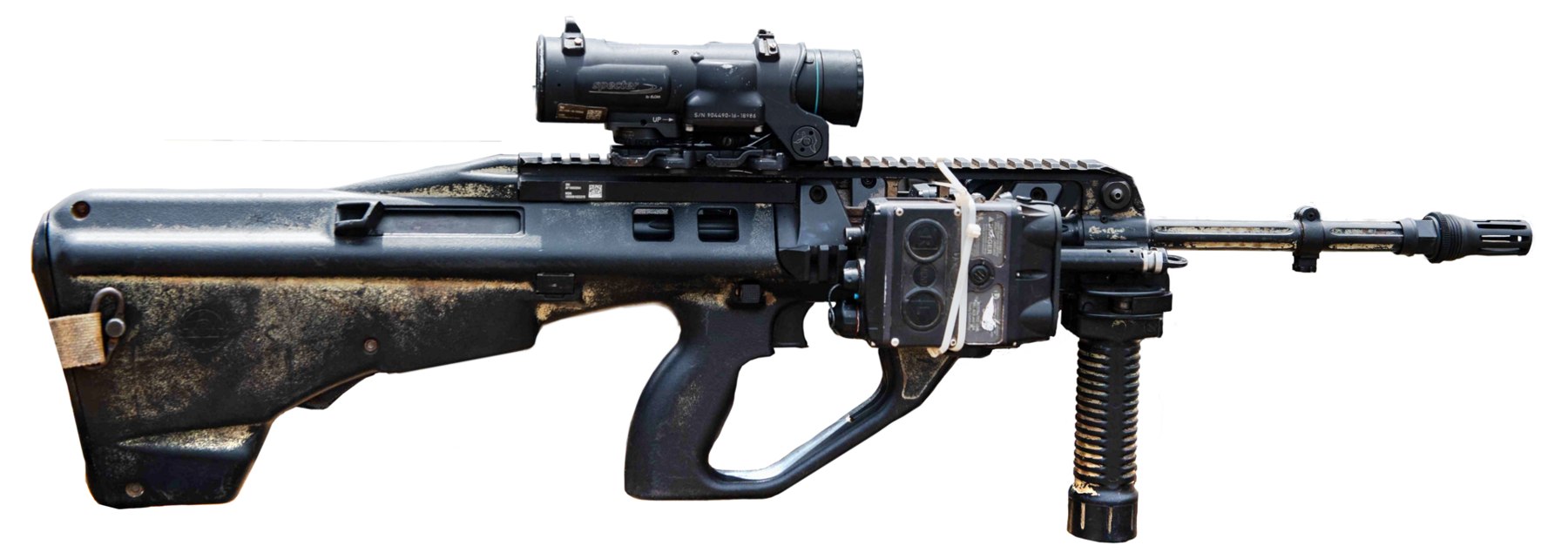
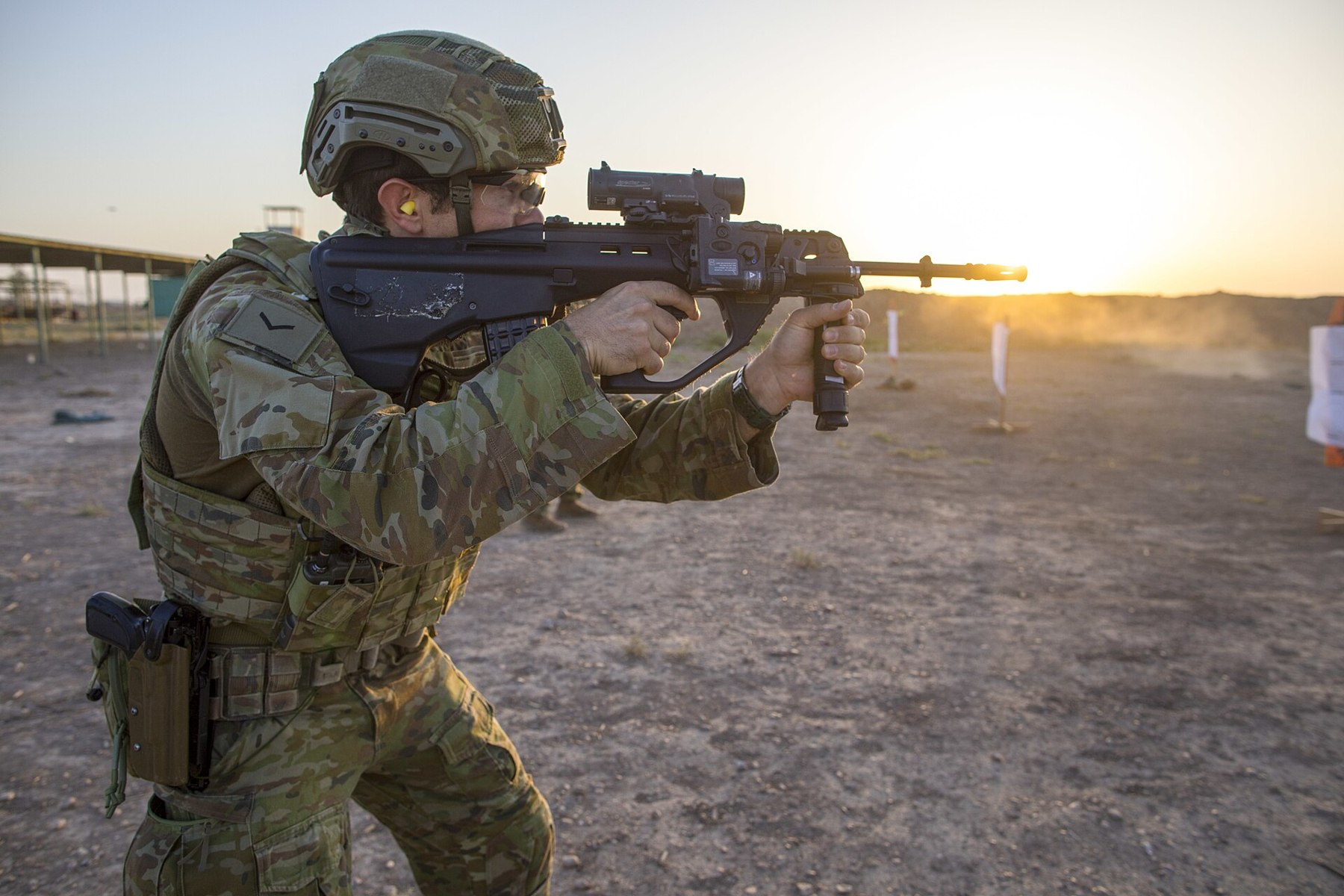
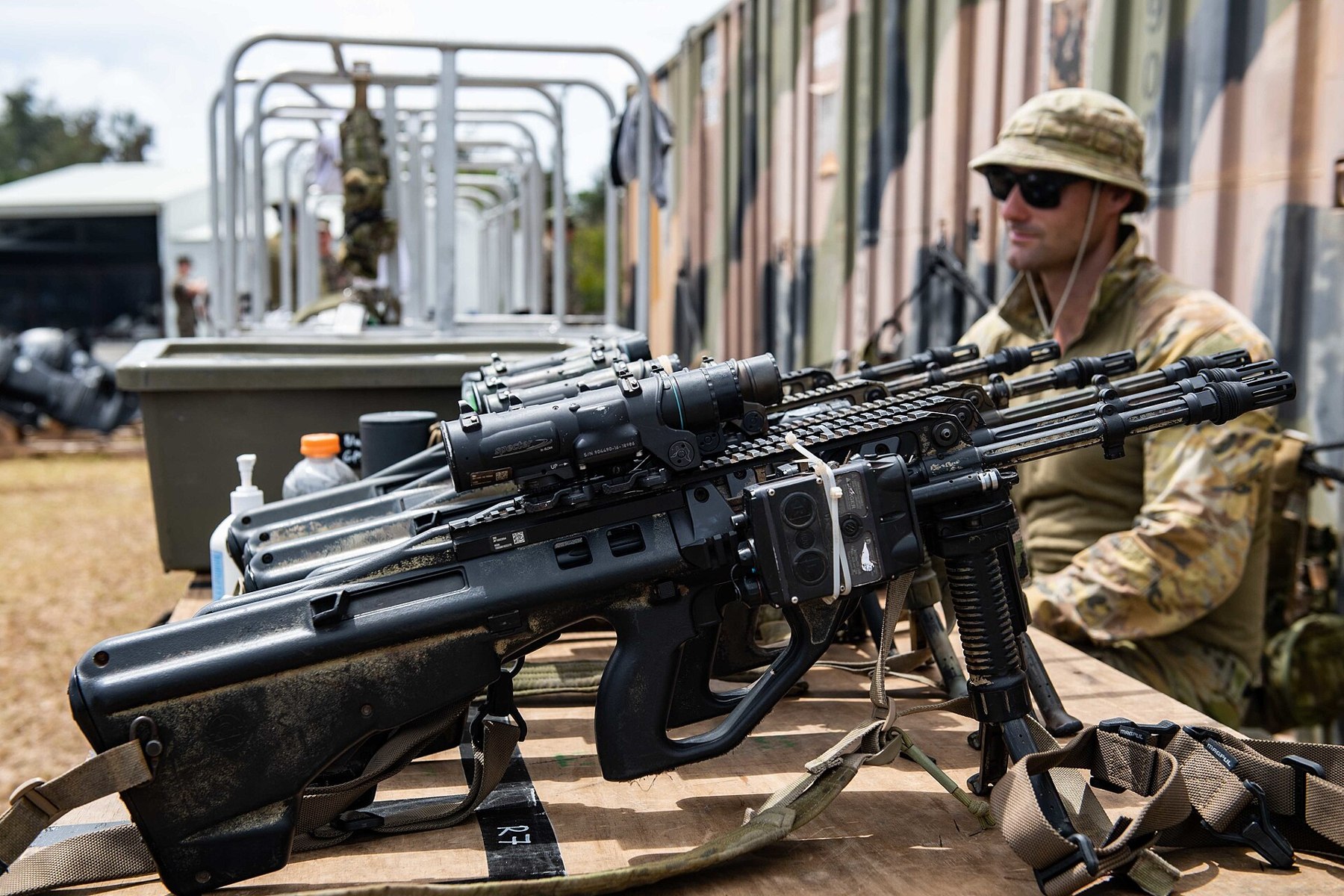
The last Australian step was a redesign large enough to take a new name. The EF88, for “Enhanced F88,” was contracted with Thales Australia in December 2011. The ASPI study lists the changes: the bolt release relocated for faster magazine changes; rails added, including a small one under the barrel, one on the right for a laser, and a longer top rail; the day sight permanently mounted with a clip-on night sight in front; a new side-opening grenade launcher, the SL40, which a soldier can fit and remove; a lighter, fluted barrel; a new folding cocking handle; a hammer pack modified for reliability and silent cocking; and a weight saving of almost half a kilogram.1 In July 2015 Thales won a A$100 million contract for 30,000 EF88s; the first were issued to the 1st Battalion, Royal Australian Regiment, in Townsville in June 2015.1
The EF88 is black. The study notes that the design-phase rifle had a coyote-tan upper, that the fielded rifle’s black was a decision “never explained,” and that troops later painted theirs.1 Black against the two-tone SA2 and the green F88 is the quickest way to tell the Australian generations apart.
For export Thales, trading as Lithgow Arms, sells the rifle as the F90. Its 2016 datasheet describes it as “evolved from the Austeyr family,” weighing 3.25 kg with a 407 mm barrel, with 508, 407 and 360 mm barrel options and an integrated side-loading 40 mm grenade launcher.6 The later F90MBR (“Modular Bullpup Rifle”) page describes a barrel with “Six external flutes,” a “Modular, light weight composite receiver,” and ambidextrous controls. It also prints the rifling as “6 grooves 1 : 7” (228 mm) right hand twist,” which contradicts itself — 1 in 7 inches is 178 mm, and 228 mm is 1 in 9 — so neither figure is repeated here as the F90MBR’s twist.9
2.7 New Zealand
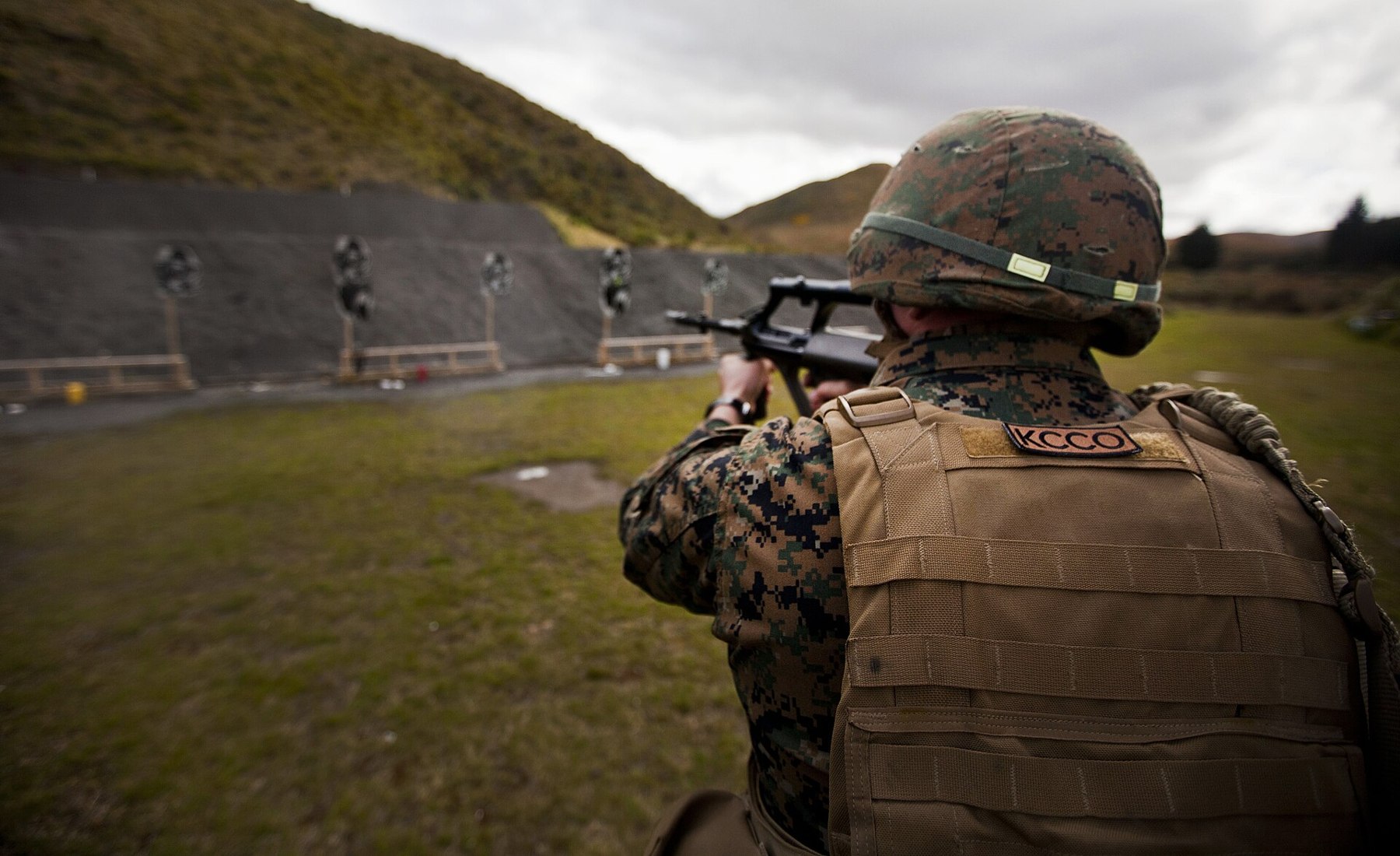
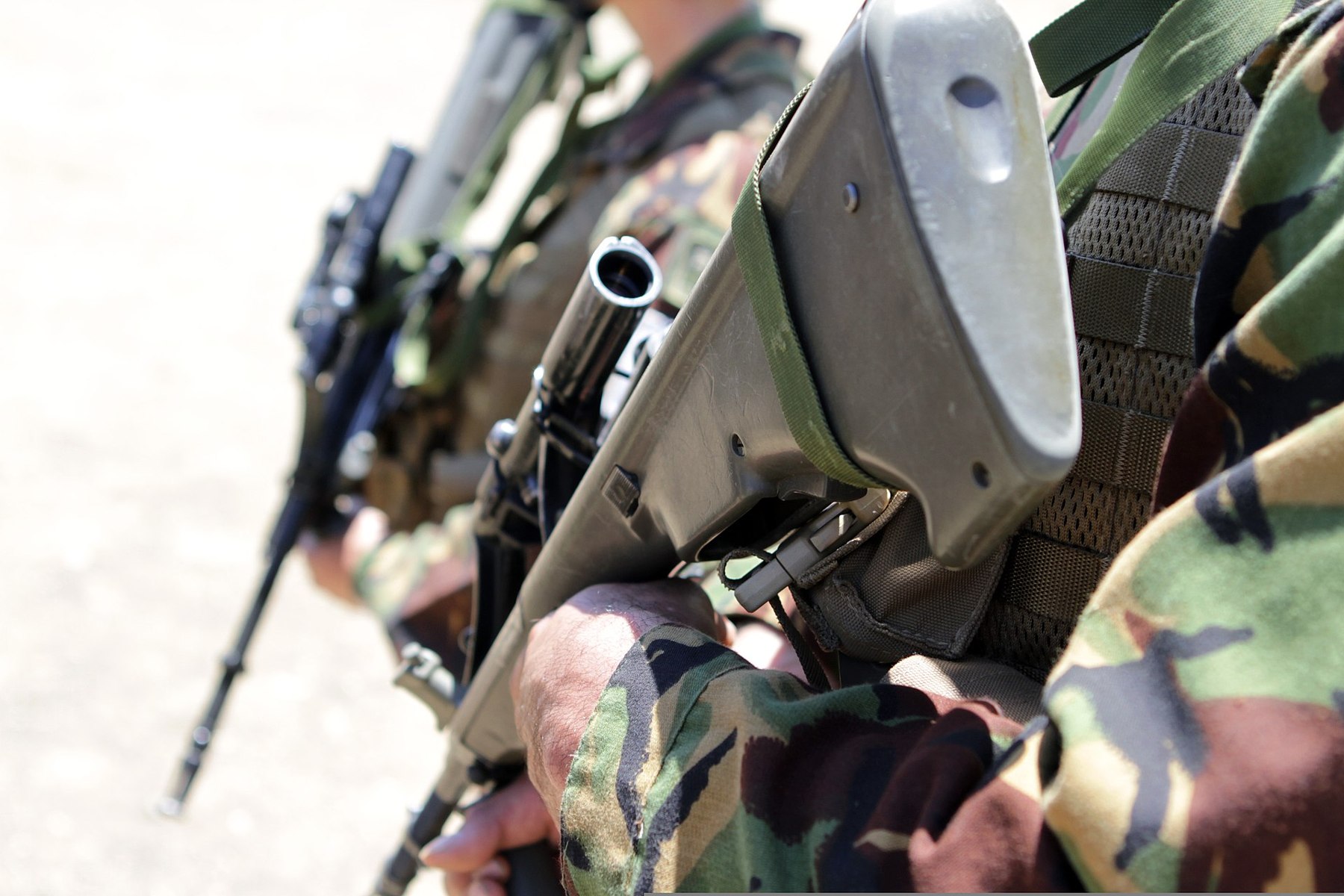
New Zealand called the rifle the IW Steyr (Individual Weapon). The New Zealand Army’s own page, as reviewed in 2008, says it was “introduced into service with NZDF in 1988” and was “made in Australia under licence by Thales in Lithgow.”10 Watters dates the adoption decision to 1986: “New Zealand adopts the Steyr AUG, intending to purchase Australian production rifles.”2 The ASPI study adds that New Zealand’s first rifles were Austrian-made, which is why New Zealand saw the same ammunition-related stoppages as Australia.1
The number of rifles is given two ways. The December 1985 Lithgow announcement was for 18,000 rifles for New Zealand (ASPI); a figure of about 13,000 appears in German-language reference writing. The first is an announced order and the second an unsourced total, and they are given separately.1
The New Zealand rifles also had a different optic. A soldier who served in Cambodia recalled to the ASPI study that “The New Zealanders had a different optic sight system to the F88 with cross-hairs instead of the central circle.”1
The IW Steyr’s replacement began in 2014. New Zealand’s Ministry of Defence records a tender approved in May 2014, the project approved on 7 December 2015, a contract for the LMT MARS-L signed in December 2015, and the first rifles expected in October 2016.11 Small Arms Review’s account of the replacement reports that the army “felt the AUG lacked accuracy beyond 200 yards”; that is the reason as the magazine reported it, not a test result.12 The New Zealand service life of the AUG therefore runs from 1988 to the replacement from 2016–17; an end date of 2019 found in encyclopaedic sources was not confirmed.
2.8 Ireland
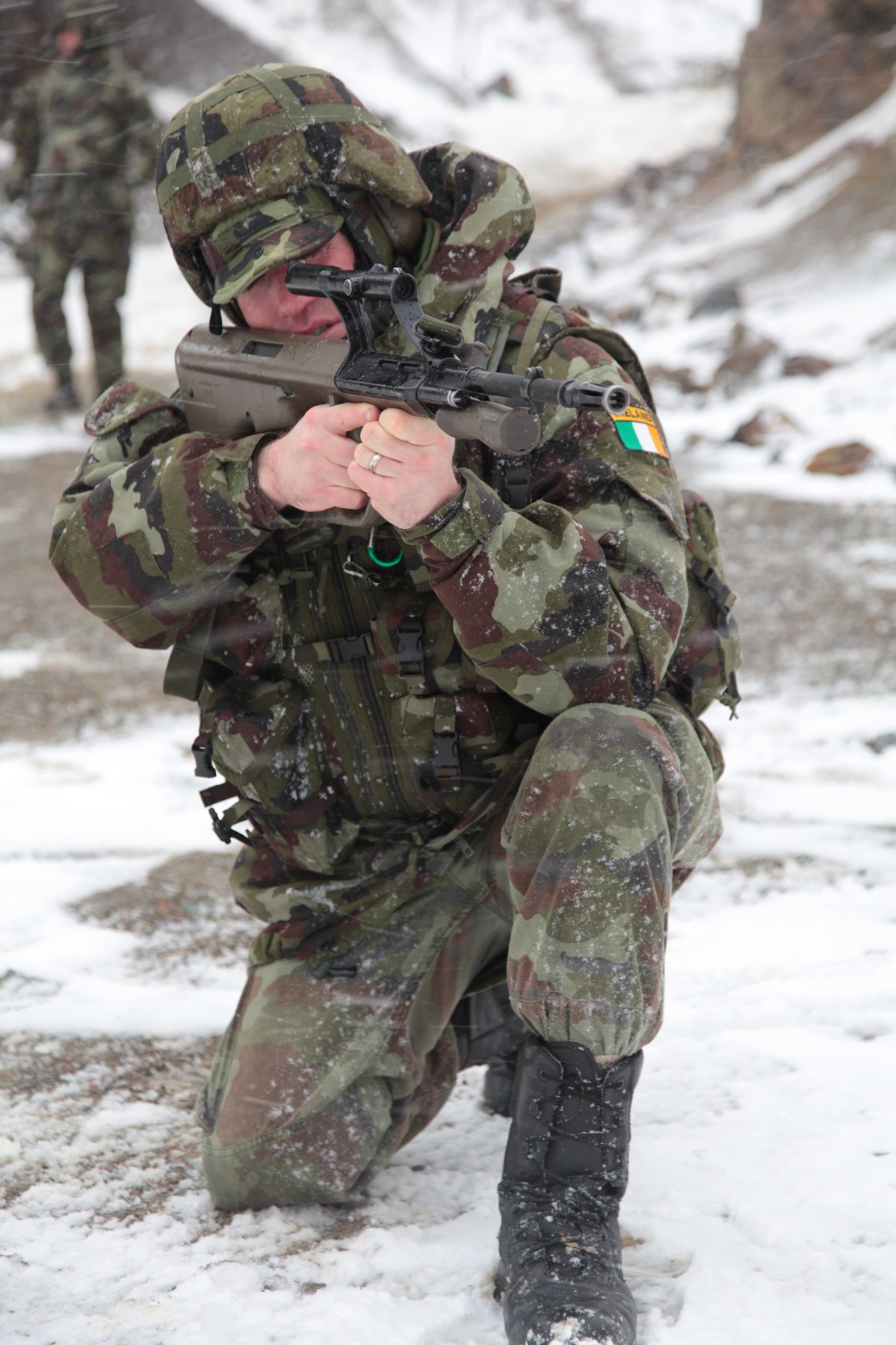
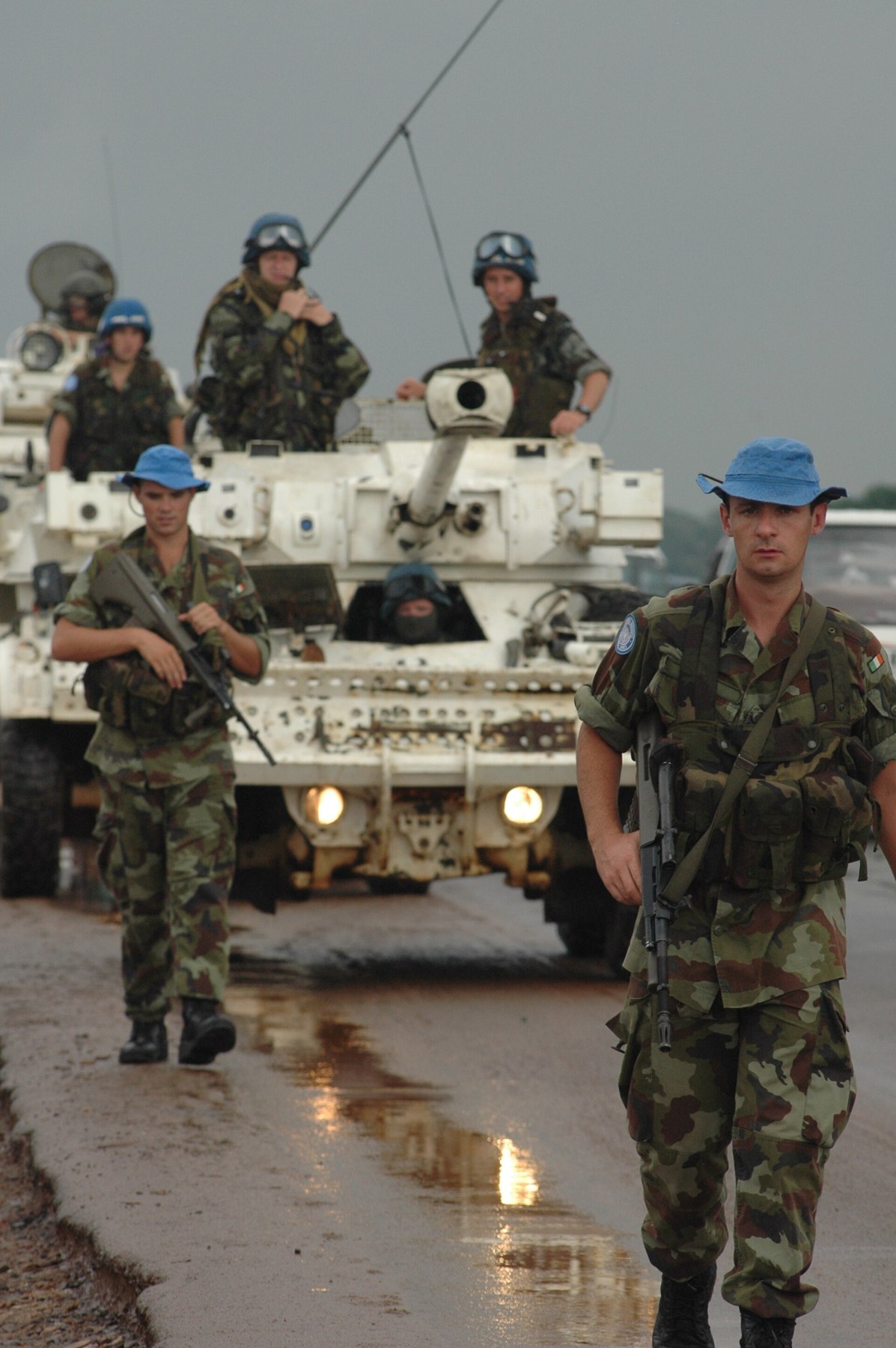
The Irish Defence Forces’ own page, as it stood in 2007, says: “The Steyr AUG A1 (Armee Universal Gewehr, meaning “Army Universal Rifle”) Assault rifle was introduced into service in the Defence Forces during 1988.” Its table gives Steyr-Daimler-Puch, Austria, as maker and 1988 as the year of entry into service, with a weight of 4.1 kg with a full magazine, a rate of 600–800 rounds a minute and a 1.5× optical sight.13
Watters dates the Irish decision to January 1988 and records the field it beat: “The AUG has beaten out the Beretta AR70/90, the Colt M16A2, the Enfield L85A1, the FN FNC, the HK G41, the IMI Galil, the FAMAS, and the SIG SG550.”2 A later Irish purchase of AUG A3s is widely reported; it was not confirmed from a Defence Forces source in the research for this dive.
2.9 Malaysia
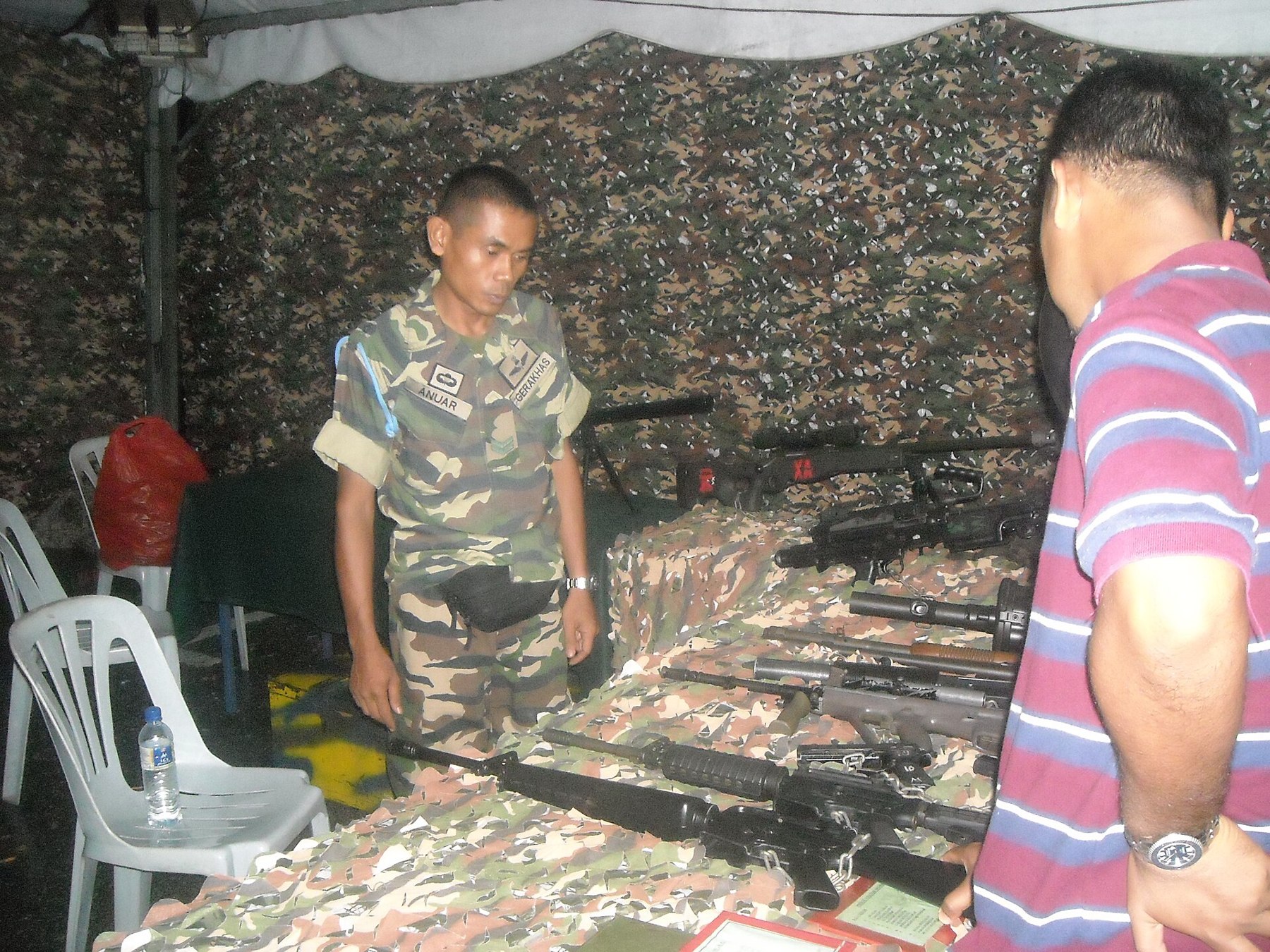
Malaysia is the second of Steyr’s two licensees, and it matters to an American kit builder because Malaysian-made AUG parts are on the US market (Vol 6 §6.4). Watters’s chronology gives the outline.2
- 1991: “Malaysia begins licensed production of the Steyr AUG,” by National Aerospace and Defence Industries (NADI) and SME Aerospace.
- 2001: the line closed for lack of orders; “106,000 rifles had been produced over the past ten years.”
- 2002: SME Ordnance resumed production when the Malaysian government ordered another 24,000 rifles, worth RM84.5 million.
- March 2004: NADI and Steyr formed a joint venture to transfer Steyr’s AUG production to Malaysia.
- April 2004: “Steyr Mannlicher (M) Sdn Bhd introduces the AUG A3.”
- 2005: NADI withdrew from the joint venture. 2006: Malaysia announced its intent to replace the AUG with licence-built Colt M4s.
The AUG A3, in other words, was launched by Steyr’s Malaysian joint venture, during a short-lived plan to move AUG production out of Austria. Vol 4 takes up the A3 itself.
2.10 Luxembourg, Ecuador, Papua New Guinea, Uruguay and Others
Table 2 — 2.10 Luxembourg, Ecuador, Papua New Guinea, Uruguay and Others
| Country | What was found | Source |
|---|---|---|
| Ecuador | ”receives delivery of Steyr AUG,” 1987 | Watters2 |
| Papua New Guinea | ”purchases 5,000 Australian-made AUG,” 1988 | Watters2 |
| Indonesia | Australian sale mooted in August 1994; after criticism, “merely donating 20 rifles for evaluation” | Watters2 |
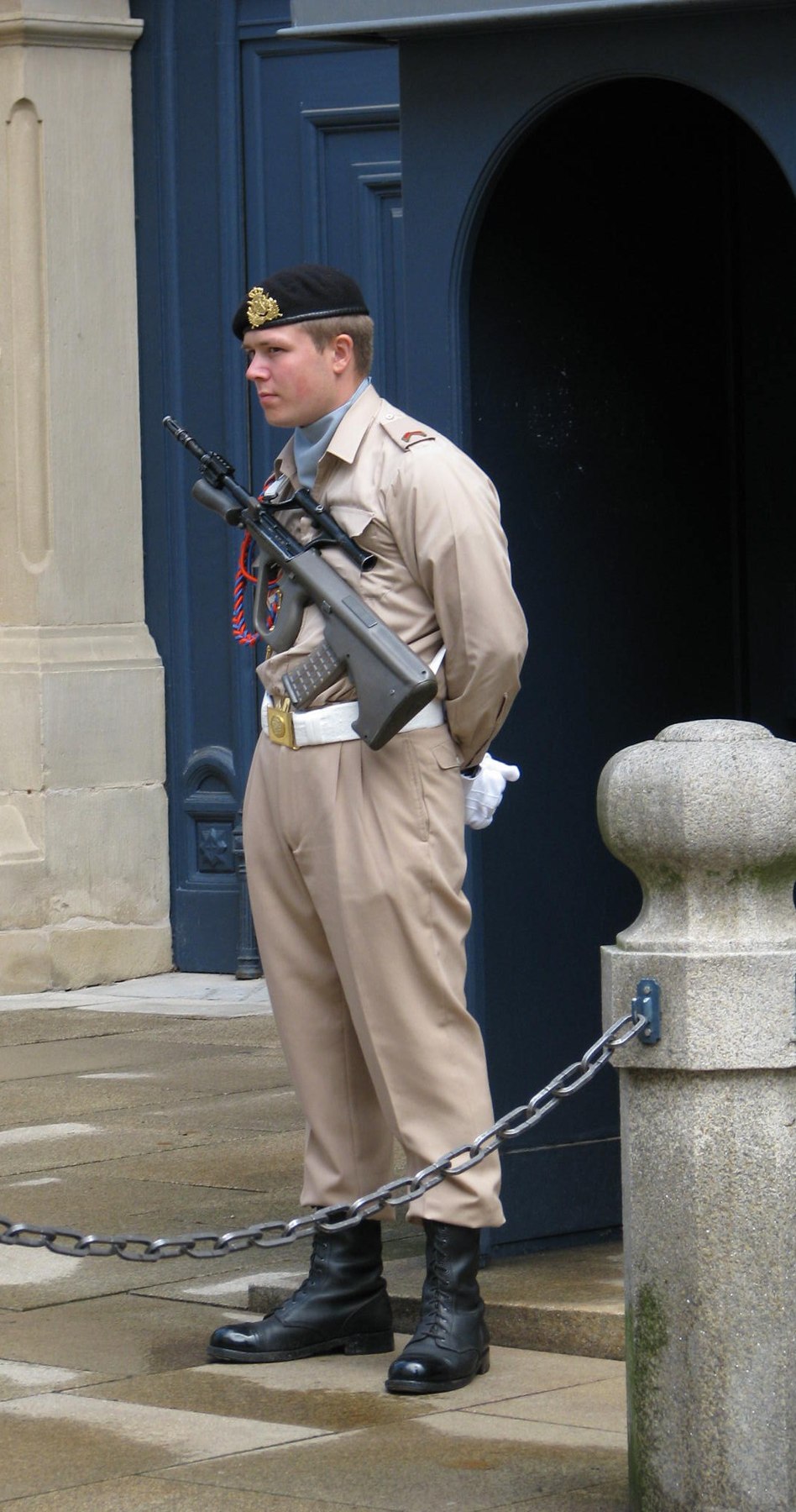
| Luxembourg | ”The Luxembourg Army adopts the Steyr AUG,” summer 1995; the army’s own page gives 3,800 g without magazine, 700 rounds a minute, 960 m/s and a 1.5× optic, and lists a heavy-barrel version | Watters; Lëtzebuerger Arméi214 |
| Uruguay | decided to acquire the AUG A3, February 2008, as reported by Jane’s | Watters2 |
| United States | the US Customs Service is named as a user on the Irish Defence Forces’ 2007 page | Irish DF (claim not checked)13 |
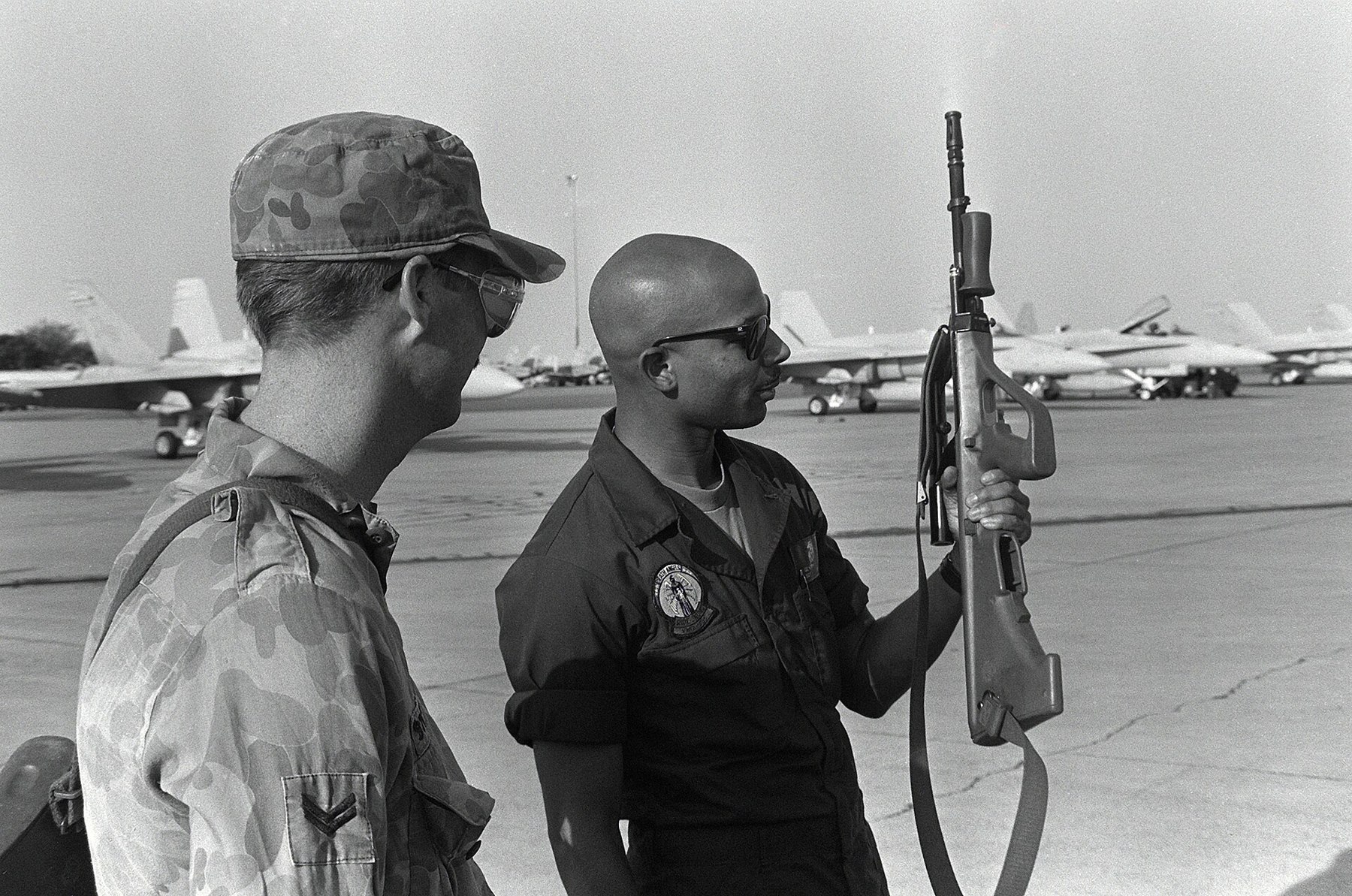
Argentina, Morocco and Pakistan are sometimes named as users. No source for any of them was found in the maker’s list, the services’ pages or Watters’s chronology, and they are not listed. One Commons photograph is captioned by its uploader as Argentine Army soldiers with AUGs in 1986; it is shown for what it is, a captioned photograph, not documentation.
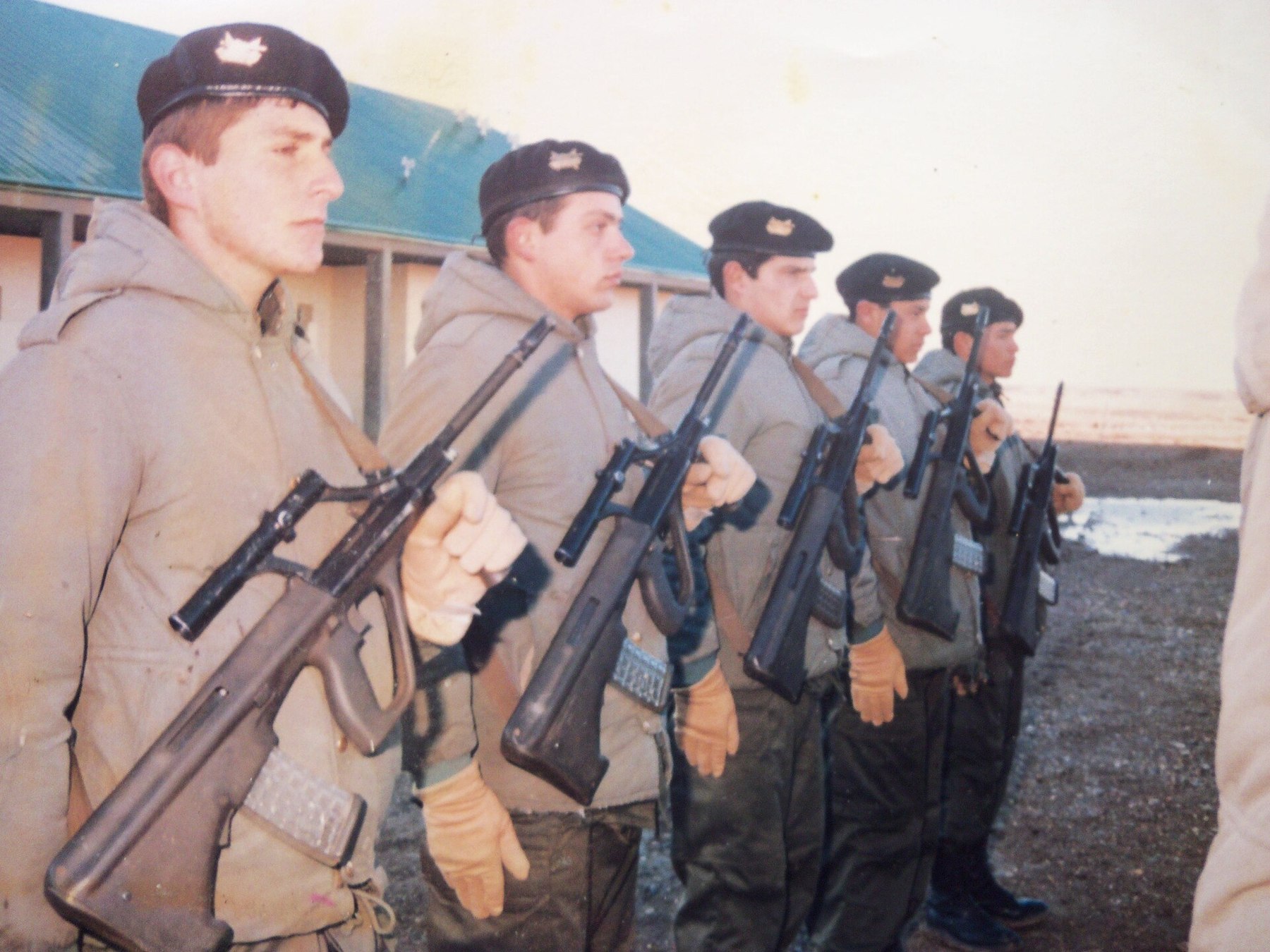
2.11 The Trials It Lost
Not every trial went the AUG’s way, and the ones it lost are part of its record. Watters records the AUG-HBAR as a competitor in the British Light Support Weapon trials of June–July 1984, against the L86 and the FN Minimi, in which the foreign weapons were judged more robust than the British one; that in May 1995 the Bundeswehr adopted the HK G36, “choosing it over the Steyr AUG”; and that the AUG was a candidate in Spain’s 1996 trials to replace the CETME L.2 Malaysia’s announced move to the M4 in 2006 and New Zealand’s to the LMT MARS-L in 2015 are the documented cases of national users leaving the rifle.
2.12 What the Export History Means for a Kit
For a builder in the United States, three facts from this volume are practical.
- The kits on the US market come from the two places that built the rifle for export in quantity: Steyr in Austria and SME in Malaysia. No Australian, Irish or other-origin AUG kit was found on a US vendor’s page (Vol 6 §6.4). Australian rifles are unlikely to reach the US market as kits in any case.
- Malaysian-made parts are licence-built AUG parts. Apex’s listing says its Malaysian kit was “Manufactured under license from STEYR, Austria by SME Ordnance in Malaysia.” Interchange with Austrian parts is what a licence implies; no source that tested it was found.
- The F88 and F90 take the AUG’s magazine. Magpul’s page for its AUG magazine lists compatibility with “Mil-issue Steyr AUG, F88 Austeyr, and F90.”15 Beyond the magazine, no source for part-level interchange between Lithgow and Steyr production was found.
Sources
Footnotes
-
Chris Masters, Sticking to Our Guns: A Troubled Past Produces a Superb Weapon, Australian Strategic Policy Institute, October 2019, pp. 14–72, https://ad-aspi.s3.ap-southeast-2.amazonaws.com/2019-10/Sticking%20to%20our%20guns.pdf, retrieved 2026-09-19. Page references in the research notes for this dive. ↩ ↩2 ↩3 ↩4 ↩5 ↩6 ↩7 ↩8 ↩9 ↩10 ↩11 ↩12 ↩13 ↩14 ↩15 ↩16 ↩17 ↩18
-
Daniel E. Watters, “A 5.56 X 45mm ‘Timeline’,” The Gun Zone, pages for 1974–79, 1980–85, 1986–89, 1990–94, 1995–99, 2002–03, 2004, 2005, 2006 and 2008, Wayback Machine captures of http://www.thegunzone.com/556dw-7.html to -18.html, retrieved 2026-09-19. ↩ ↩2 ↩3 ↩4 ↩5 ↩6 ↩7 ↩8 ↩9 ↩10 ↩11 ↩12 ↩13
-
Steyr Mannlicher, “Our history,” Wayback Machine capture of 12 December 2009 of http://www.steyrarms.com/about/our-history, retrieved 2026-09-19. ↩
-
Steyr Mannlicher, AUG A3 product sheet, c. 2009, Wayback Machine capture from steyr-mannlicher.com, retrieved 2026-09-19. ↩
-
Australian Army, “F88 AUSteyr,” defence.gov.au, updated 14 July 2009, Wayback Machine capture of 9 November 2009 of http://www.defence.gov.au/army/F88_AUSteyr.asp, retrieved 2026-09-19. ↩ ↩2
-
Lithgow Arms (Thales Australia), “F90” datasheet, dated 18 January 2016, Wayback Machine capture of 9 November 2016 of https://www.lithgowarms.com/wp-content/uploads/2016/01/ARM_LA_F90_single_page_web_1.pdf, retrieved 2026-09-19. ↩ ↩2
-
all4shooters.com, “Czech financial investor RSBC announces the takeover of Austrian firearm manufacturer STEYR ARMS,” 24 April 2024, accessed 2026-09-19. ↩
-
Australian Army, “F88 Austeyr – F88A2 with ring sight and F88A2 with ACOG RMR and GLA,” army.gov.au, Wayback Machine capture of 28 March 2023, retrieved 2026-09-19. ↩
-
Lithgow Arms, “F90MBR,” Wayback Machine capture of 27 April 2025 of https://www.lithgowarms.com/f90mbr/, retrieved 2026-09-19. ↩
-
New Zealand Army, “Weapons,” reviewed 8 October 2008, Wayback Machine capture of 18 December 2009 of http://www.army.mil.nz/our-army/equipment/weapons/default.htm, retrieved 2026-09-19. ↩
-
New Zealand Ministry of Defence, “Individual weapons replacement,” Wayback Machine capture of 7 April 2017, https://www.defence.govt.nz/what-we-do/delivering-defence-capability/defence-capability-projects/individual-weapons-replacement/, retrieved 2026-09-19. ↩
-
Christopher R. Bartocci, “The LMT MARS Rifle: The New Infantry Rifle for the New Zealand Defense Force,” Small Arms Review 20(6), 1 July 2016, https://smallarmsreview.com/the-lmt-mars-rifle-the-new-infantry-rifle-for-the-new-zealand-defense-force/, accessed 2026-09-19. ↩
-
Irish Defence Forces, “Army Weapons – Steyr,” Wayback Machine capture of 16 October 2007 of http://www.military.ie/army/equipment/weapons/inf/steyr/steyr.htm, retrieved 2026-09-19. ↩ ↩2
-
Lëtzebuerger Arméi, “Steyr AUG 5.56 mm – Données techniques,” Wayback Machine capture of 13 September 2009 of http://www.armee.lu/chap07/c070102.htm, retrieved 2026-09-19. ↩
-
Magpul Industries, “PMAG 30 AUS GEN M3 Window – Steyr AUG,” MAG575, https://magpul.com/pmag30ausgenm3window-5-56x45-steyraug-commercial.html, read 2026-09-19. ↩
Comments (0)