Steyr AUG · Volume 5
How It Works — Piston, Guide Rods, a Bolt That Locks to the Barrel, and a Trigger at the Wrong End
The operating cycle, part by part, from Steyr's own manuals and the Steyr-Daimler-Puch patents — including two places where the maker appears to contradict itself, and does not
The AUG is a short-stroke gas-piston rifle with a rotating bolt. Stated that way it sounds like a dozen other rifles of its generation. What makes it different is where things are. The bolt runs on two long rods that are part of its carrier. The barrel carries its own locking lugs, so it can come off without tools. The trigger sits ahead of the magazine, and the hammer sits behind it in the butt. Every one of those decisions has a consequence for the builder of a parts kit, and this volume sets out the mechanism with that reader in mind.
The sources are the maker’s own. Four Steyr manuals were read for this volume: the Steyr Mannlicher AG Maintenance Manual for the select-fire military rifle, which covers operator and armourer levels; the Steyr Arms USA owner’s manual for the semi-automatic AUG A3 M1 (2023); its 2009 predecessor for the AUG A3 SA USA; and the Steyr Arms GmbH instructions for the European semi-automatic AUG SA (edition EU-03, 2023).1234 Where the mechanism is not described in any manual, the Steyr-Daimler-Puch patents filed in 1974 and 1977 are used. They are primary sources for the design intent, but a patent drawing is not proof of a production part. Each place where that distinction matters is flagged.
5.1 The Rifle in One Table
Figures for the select-fire rifle are from the Steyr Mannlicher Maintenance Manual; figures for the US semi-automatic rifle are from the Steyr Arms USA A3 M1 manual. The two are different rifles and are kept in separate columns.
Table 1 — 5.1 The Rifle in One Table
| Select-fire (Steyr Mannlicher maintenance manual) | US semi-auto A3 M1, 16 in (Steyr Arms USA, 2023) | |
|---|---|---|
| Operation | ”gas operated semi and fully automatic … with locked action" | "gas operated semi-automatic rifle … with a locked action” |
| Firing | ”It fires from the locked bolt position” (closed bolt) | closed bolt |
| Calibre | .223 Rem. (5.56 × 45) | 5.56 × 45 |
| Barrels | 417, 508 and 621 mm (HBAR) | 16 in / 407 mm |
| Rifling | 6 grooves, right hand, 1 in 9 in or 1 in 7 in | 6 grooves, right hand, 1 in 9 in |
| Weight, no magazine | 3.61 kg (417 mm barrel); 3.80 kg (508 mm); 4.89 kg (HBAR) | 3.55 kg (7.8 lb) |
| Length | 690 mm (417); 790 mm (508); 900 mm (HBAR) | 715 mm (28.15 in) |
| Rate of fire | ”Automatic-fire 680 - 850 rds/min. theoretical” | semi-automatic only |
| Muzzle velocity | approx. 980 m/s | not stated |
| Magazine | 30 or 42 rounds, transparent synthetic | 30 standard; 10 and 42 optional |
| Optic | 1.5×, ring reticle | rail (A3 M1) |
Two numbers in that table are quoted elsewhere in different forms and are worth pinning to their sources. The Austrian Army’s own page for the StG 77 gives a theoretical rate of 700 rounds a minute and a muzzle velocity of 990 m/s.5 The Steyr maintenance manual gives 680 to 850 rounds a minute and about 980 m/s. Neither is wrong; they are different statements by different authorities, and they are given separately.
5.2 Six Groups, No Tools
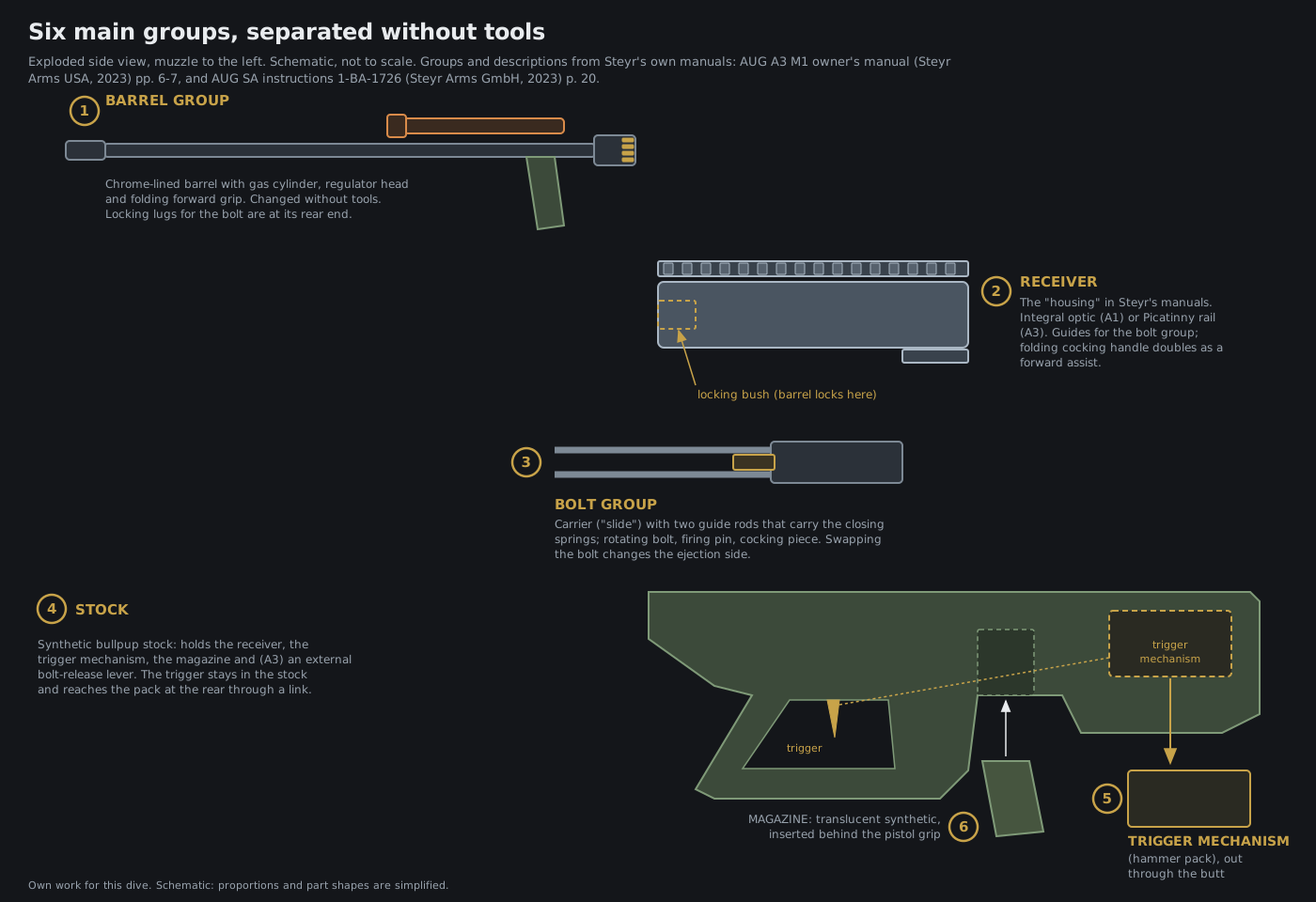
Steyr’s manuals describe the rifle as six main groups that come apart without tools: the barrel, the receiver (which Steyr’s English manuals mostly call the “housing”), the bolt group (in the military manual the “gun lock group”), the trigger mechanism, the magazine, and the stock (the “butt”).6 The stock is not a part of the rifle in the way an AR’s stock is. It is the chassis. The US manual says it “contains the receiver group, trigger mechanism group, magazine and external bolt release lever.”6
That modularity is the subject of the earliest patent in the family. Swiss patent CH 579 761, with a priority date of 4 January 1974, describes a rifle in which “the stock complete with trigger mechanism and magazine can be removed as an assembly,” in which the central portion guiding the breech mechanism “forms an assembly from which the barrel with hand grip is removable,” and in which the parts are held by captive locking bolts, one of them a transverse bolt through the stock.7 Those are, one for one, the receiver lock, the barrel lock and the quick-change barrel of the production rifle.
5.3 The Gas System and Its Regulator
The AUG is operated by a short-stroke gas piston. Gas is bled from the barrel into a cylinder fixed to the barrel; the piston is driven back a short distance, strikes the bolt carrier, and is returned by its own spring. The piston is a separate part with three rings, listed as “RING, GAS PISTON 3 pcs.” in the US parts list, and the military manual says it “is hard-chrome plated.”89 Because the whole gas system — cylinder, piston, spring and regulator — belongs to the barrel group, it leaves the rifle when the barrel does, and a spare barrel is a complete, self-contained gas system.
The regulator is where the manuals most obviously disagree, and the disagreement is resolved by reading which regulator each manual describes.
- The US A3 M1 manual describes two positions. “Position one, which is used under normal conditions, is indicated by a small dot at the gas cylinder. Position two, which is used under adverse conditions, such as cold weather, or when the STEYR AUG is dirty, is indicated by a big dot at the gas cylinder.”10
- The military manual describes three. It calls them two gas settings “ensuring function under all conditions” and a third that “allows the firing of rifle grenades (old versions).” Aligning the pin with the letters “GR” “blocks gas cylinder and weapon must be operated manually.”11
- The current European manual describes four different regulator heads. The standard head has position 1 (normal, small dot), position 2 (higher, large dot) and position 3 (“the gas hole is closed, no automatic function,” marked “GR”). A suppressor head called KDO has position 1 normal, position 2 gas-off, and position 3 the lowest pressure, “used for shooting with a silencer.” There is a head for the 382 mm barrel, and a six-position head for .300 AAC Blackout.12
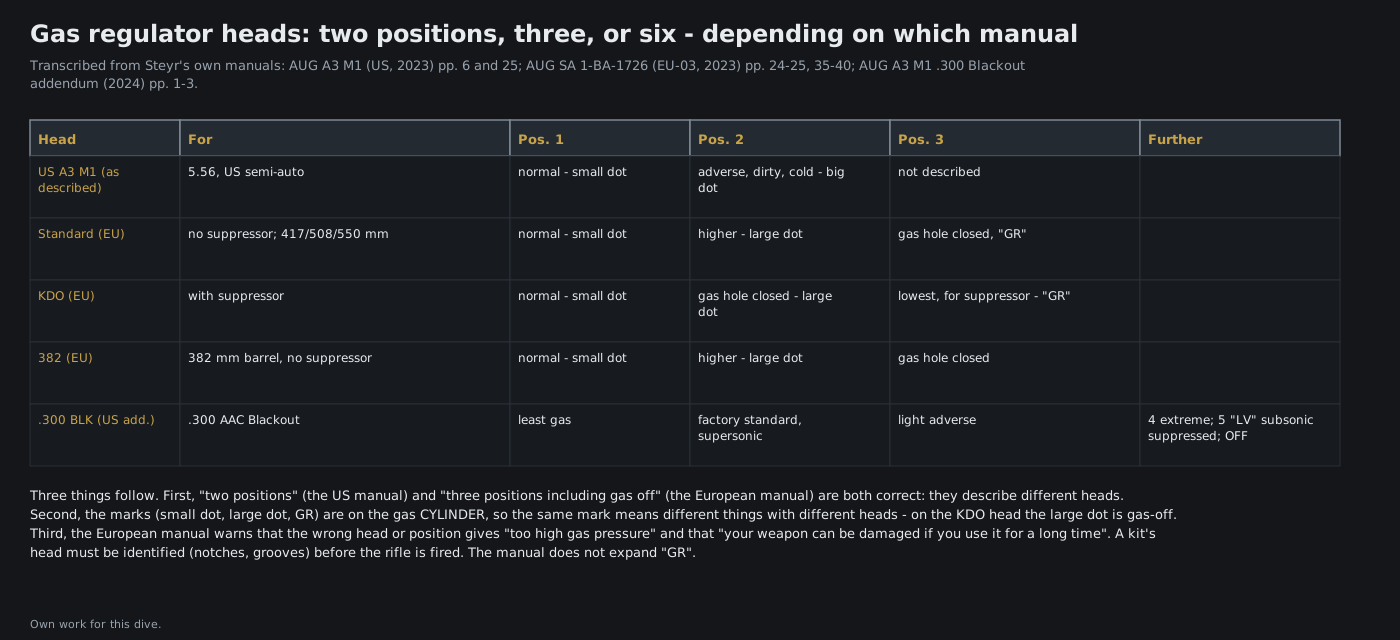
The point a kit builder needs from this is in the European manual’s warning. A wrong head, or a wrong position, gives “too high gas pressure,” and “your weapon can be damaged if you use it for a long time.”13 The marks — small dot, large dot, GR — are stamped on the cylinder, which is fixed to the barrel; the head rotates against them. So the meaning of a mark depends on which head is fitted, and the head is identified by milled notches (three on the KDO head) or grooves (two on the 382 head).12 A regulator head from an unknown kit is the one part of the gas system that must be identified before the first shot.
The .300 Blackout head deserves a sentence because it is the only one with a published factory setting. Steyr Arms USA says position 2 is “the setting in which the gun will come from the factory”; position 5, marked “LV”, is for subsonic ammunition with a suppressor, and “OFF” “cuts off all gas to the system and renders the gun a straight-pull repeater.”14 Subsonic use also needs Steyr’s enhanced (“red”) trigger-pack spring kit, which is taken up in §5.8.
5.4 The Carrier and Its Two Guide Rods
The bolt carrier — Steyr’s manuals call it the “slide” — is the most distinctive part of the rifle. It is a block with two long, hollow rods projecting forward from it. The patent that describes the production bolt group, US 4,191,089, filed by Ulrich Zedrosser for Steyr-Daimler-Puch with an Austrian priority of 22 December 1977, puts it plainly: “The slide 1 is provided with protruding guide tubes 4 … slidably mounted in mating slide bushings of the central part 5 of the rifle,” with “closing springs disposed in the guide tubes.”15
So the recoil springs are not behind the bolt, where a conventional rifle puts them and where the bullpup layout would leave no room. They are inside the carrier’s own rods. The military armourer’s manual confirms it from the other direction. Each rod holds a long spring, a short spring, a “compensating rod” and a plunger, closed at the front by a threaded thrust piece. The thrust pieces go on with Loctite 648, are torqued to 20 Nm with a special tube spanner, and may need heating to 250 °C to remove. New springs are set by leaving the carrier assembled and cocked for 12 hours.16 Behind the carrier, two riveted guide rods in the butt carry buffers that the carrier runs back onto.17
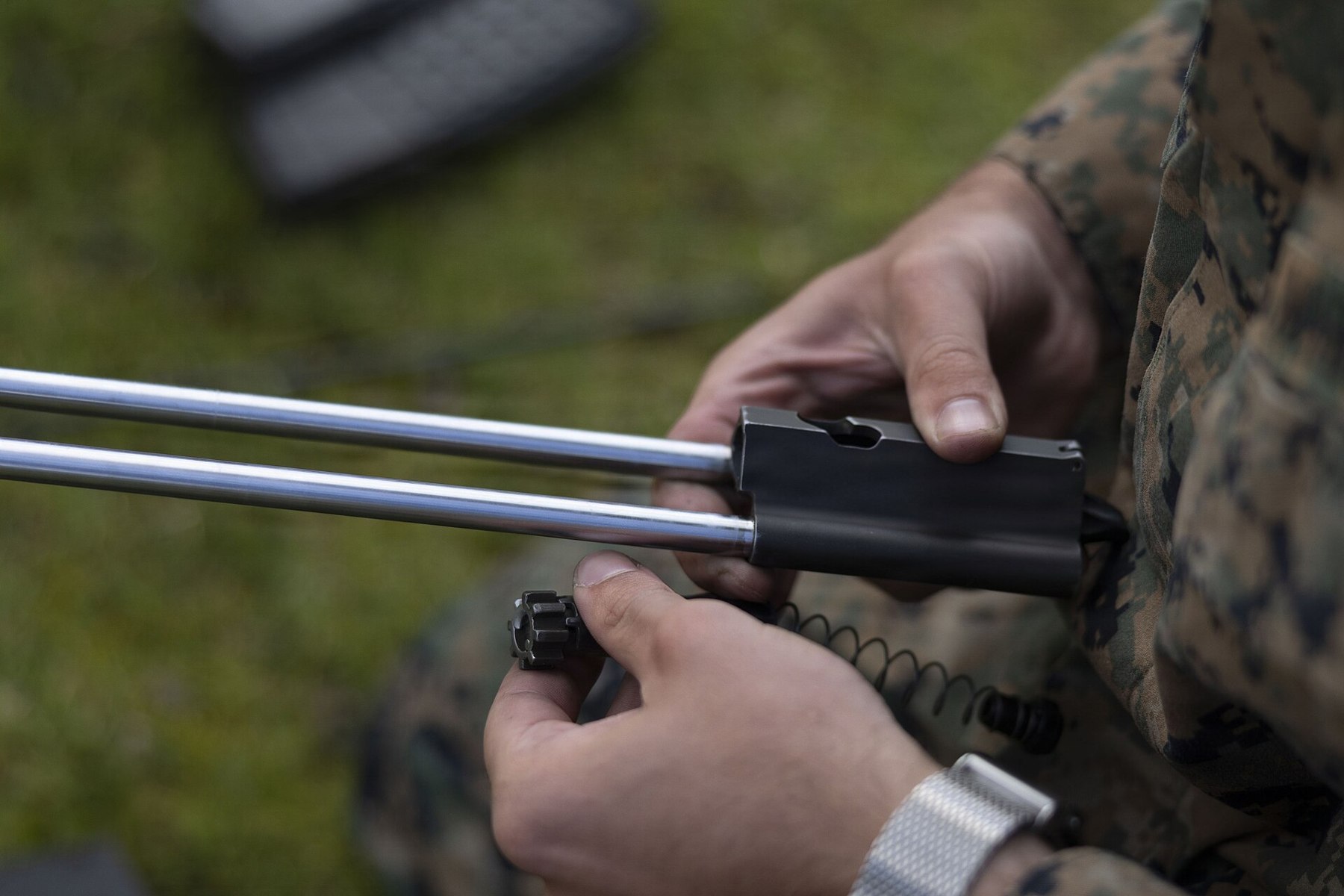
The piston drives the carrier through the thrust piece on the front of one rod. Which rod is a point no Steyr text states outright. Both current civilian manuals tell the user to push the piston out of its cylinder with “the right thrustpiece of the bolt group,” and the European manual couples the cocking handle to “the left thrustpiece.”1819 The consistent reading is right rod for the gas, left rod for the cocking handle, and that is the reading the diagrams in this dive use. It is labelled as a reading. The military manual, which says the left thrust piece “may be used” to push the piston out, shows that the removal step is a tool use, not a description of the gas path.11
5.5 The Bolt, and Why Some Have Six Lugs
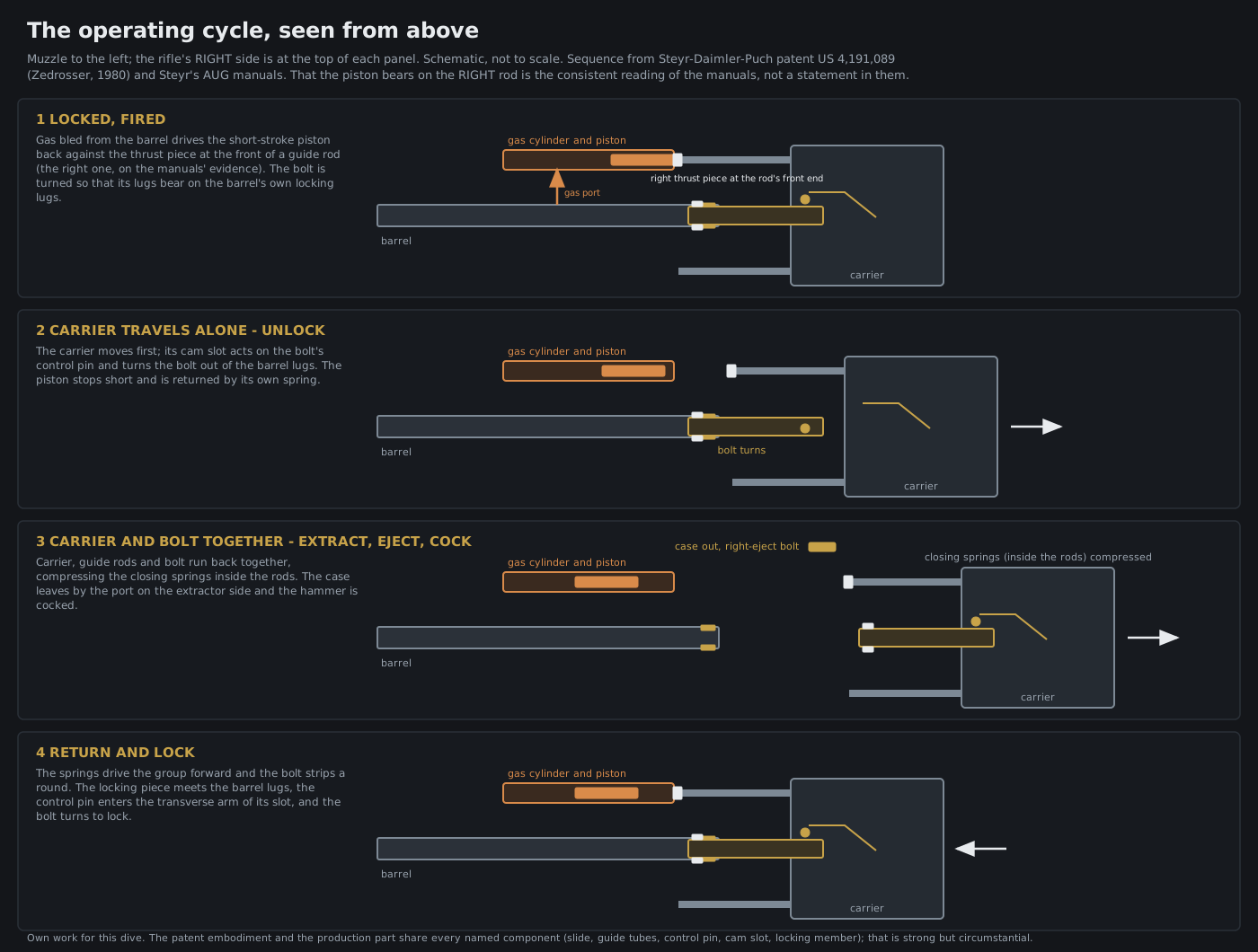
The bolt is a rotating bolt with a cam pin — Steyr’s “control pin” or “control bolt” — running in a cam slot in the carrier. The patent describes a delayed unlock by free travel: “the slide 1 is first returned alone under the gas pressure … the displacement of the slide 1 relative to the bolt 2 results in a rotation of the latter … The slide 1 and bolt 2 now return in unison.”15 The military manual gives the rotation: “The bolt locks following a rotation of 22,5°.”20
A fourth part keeps the bolt indexed. The patent calls it a locking member, “approximately semicircular in cross-section,” spring-loaded and “slidably mounted on the bolt,” which holds the bolt from rotating throughout its travel so that the lugs arrive lined up with the barrel’s. When it strikes the barrel’s lugs on the way forward, the cam pin enters a transverse arm of its slot and the bolt turns to lock. The patent gives the design’s purpose in terms of reliability “against dirt or ice.”15 Steyr’s manuals call this part the “locking piece” or “slide locking with spring and sleeve,” and it is the part the manuals tell the owner to oil with one drop.21
How many lugs the bolt has is a question the maker answers two ways, and the reason turns out to matter to anyone assembling a rifle from parts.
Table 2 — 5.5 The Bolt, and Why Some Have Six Lugs
| Steyr document | Rifle | Wording |
|---|---|---|
| AUG A1/A2 product sheet (c. 2009) | military | ”Fixed locking turn bolt, with seven locking lugs” |
| AUG A3 SA USA manual (2009) | US semi-automatic | ”a fixed locking bolt, with seven locking lugs” |
| AUG A3 M1 manual (2023) | US semi-automatic | ”a fixed locking bolt, with seven locking lugs” |
| AUG Z manual (EU-06, 2023) | European civilian | ”a fixed locking bolt, with six locking lugs” |
| AUG Z A3 manual (EU-03, 2023) | European civilian | ”a fixed locking bolt, with six locking lugs” |
| AUG SA manual (EU-03, 2023) | European civilian | ”the bolt with 6 supporting locking lugs” |
The split is by market, and it is deliberate. In 2005 the Austrian Interior Minister answered a parliamentary question about the civilian AUG Z by quoting the official firearms expert who had classified it in December 2004. Among the differences from the StG 77 the expert listed: the civilian barrel and bolt “are not compatible with military ones”; the receiver “has a modified seat for the barrel and bolt head, so military barrels do not fit”; and “the bolt head of the civilian model ‘Z’ accordingly has only 6 locking lugs.” The stock had two steel pins moulded into it so that an automatic mechanism could not be seated, and the military quick-change button was replaced by a pin that needed a tool.22
So a six-lug bolt is a European civilian bolt, built so that military parts will not go into it. The US rifles, by Steyr’s own US manuals, have seven. That is consistent with Steyr Arms USA’s statement that its StG 77-pattern 20-inch barrel “Fits all AUG models with 1:9 twist” (Vol 8). For a US kit builder the practical rule is: count the lugs. Seven is the military and US pattern; six is a European civilian bolt, which should not be expected to fit a military-pattern barrel extension. The military manual’s 22.5° of rotation is consistent with seven lugs on an eight-position pitch, one position being taken by the extractor, but that geometric reading is an inference and is labelled as one.
The bolt also carries the extractor and ejector, which is why changing the ejection side means changing the whole bolt (§5.10). Steyr’s US manual warns that the extractor must be on the right when a right-hand bolt goes back into the carrier.21 The military manual adds a rule that matters to anyone assembling a rifle from a box of mixed parts: “Do not interchange slides and bolt locks. Keep a slide with its original bolt carrier.”23
5.6 The Quick-Change Barrel, and Where the Firing Load Goes
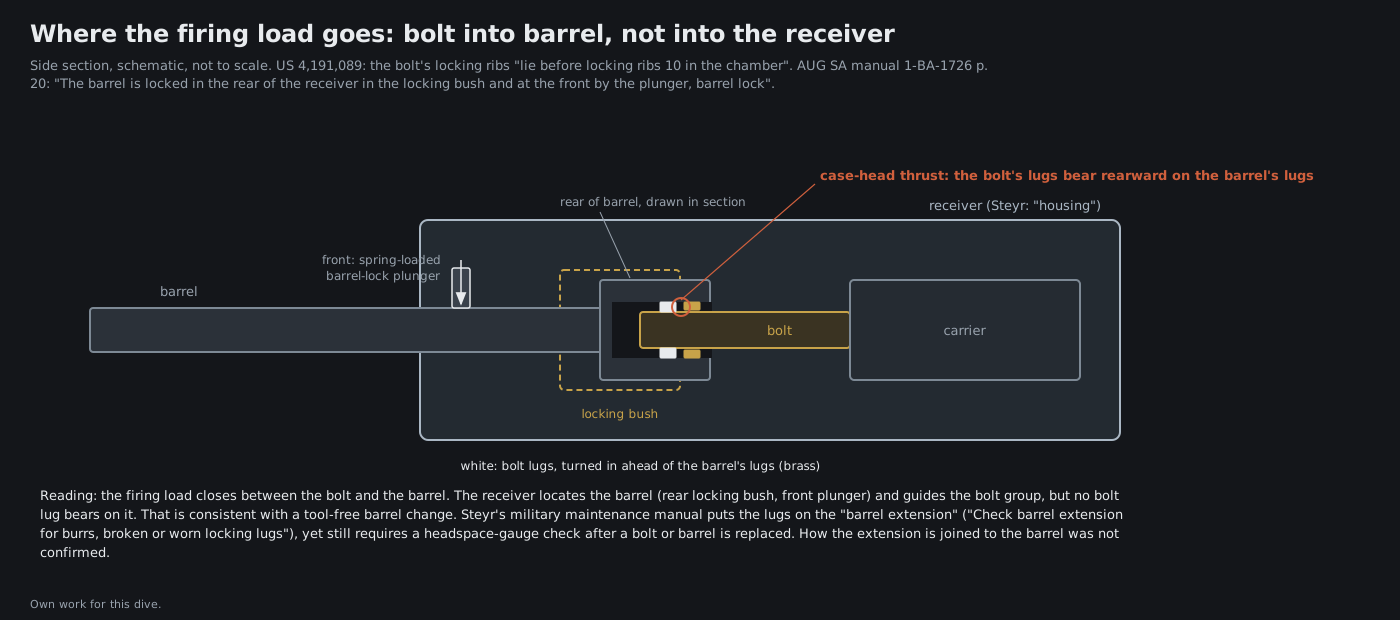
The barrel comes off in one movement. The operator presses the barrel-lock button, turns the barrel by its folding grip and pulls it forward.24 What holds it is described in the European manual: “The barrel is locked in the rear of the receiver in the locking bush and at the front by the plunger, barrel lock, which is under spring pressure.”25 The 1974 patent describes the same arrangement as “locking dogs … at the rear end of the barrel, engaging with mating dogs in the central portion,” with a spring-loaded pin that snaps into a hole in a thrust flange when the barrel is turned home.7
The more important question is where the bolt locks. The Zedrosser patent says the bolt’s locking ribs, when the breech is closed, “lie before locking ribs 10 in the chamber” — that is, the bolt locks into the barrel.15 The military manual’s inspection table confirms that the production rifle does the same: under “Barrel and barrel extension” it instructs the armourer to “Check barrel extension for burrs, broken or worn locking lugs.”26 The lugs are on the barrel group.
Two consequences follow for a builder, and both are qualified by the maker’s own words.
First, the receiver does not set headspace. Headspace on an AUG is a property of a bolt and a barrel extension. That is what makes a tool-free barrel change possible, and it is why the receiver — the part that is legally the firearm (Vol 6) — can be a different maker’s product from the barrel and bolt without the receiver itself being a headspace question.
Second, that does not mean any barrel is right with any bolt. The military manual says replacement parts “are interchangeable and require no adjustments,” and then, in the next breath, that if a bolt or barrel is replaced the armourer must check “that proper headspace is provided” with headspace gauge WL-6335, and fire a 30-shot function test.2326 A kit builder whose barrel and bolt did not start life together is in exactly that position. The hub’s Headspace dive covers the gauges and how to use them on a rotating-bolt action (using the gauges; why headspace is a property of the whole action), and Vol 7 of this dive applies it to the kit.
How the barrel extension is joined to the barrel — pressed, threaded, or machined in one piece — was not established from any source read for this dive.
5.7 Cocking Handle, Forward Assist and Hold-Open
The cocking handle is on the left of the receiver and does not reciprocate. The military manual: “‘Grip, slide cocking’ stays in the forward position during firing.”27 It is coupled to the carrier only when the operator retracts it, and it can be locked back by turning it into a notch in the receiver.24
The same handle is the forward assist. Steyr’s European manual: “Retract the cocking handle approx. 25mm / 1”. Turn the cocking handle grip inside with your left hand. The cocking handle and the left thrustpiece are connected now. Move the folded cocking handle forwards until you hear a clear ‘click’.”19 The military manual gives the same operation with a plunger on top of the grip that locks it to the end of the guide rod.27
The hold-open corrects a common claim. It is widely said that the original AUG had no last-round bolt hold-open and that the A3 added one. Steyr’s military manual says otherwise: “The Steyr AUG is equipped with a magazine ‘catch holding open’ that keeps gun lock to rear after last round is fired. To continue firing, insert loaded magazine, pull ‘grip slide cocking’ to rear most position to disengage ‘catch holding open’, and release.”27 What the A3 added was an external release lever. The European manual: “Compared to the A1 stock, the STEYR AUG A3 stock has an external bolt release lever on the left side behind the magazine well.”28 The hold-open catch itself is in the trigger mechanism, where the parts lists name it on both patterns.
5.8 The Trigger in Front and the Hammer Pack Behind
In a bullpup the trigger and the hammer are separated by the magazine. The AUG solves this by dividing the fire control into two places. The trigger stays in the stock ahead of the magazine, and everything that has to be near the bolt — hammer, hammer springs, disconnector, hold-open catch, drop safety — is in a separate trigger mechanism that slides into the butt from the rear. Swiss patent CH 580 270 (priority 22 January 1974) describes it: apart from “the trigger itself and a release link extending rearwards,” the mechanism “forms a complete sub-assembly … inserted from the rear into the hollow stock,” held by a transverse pin and closed by a bedplate.29
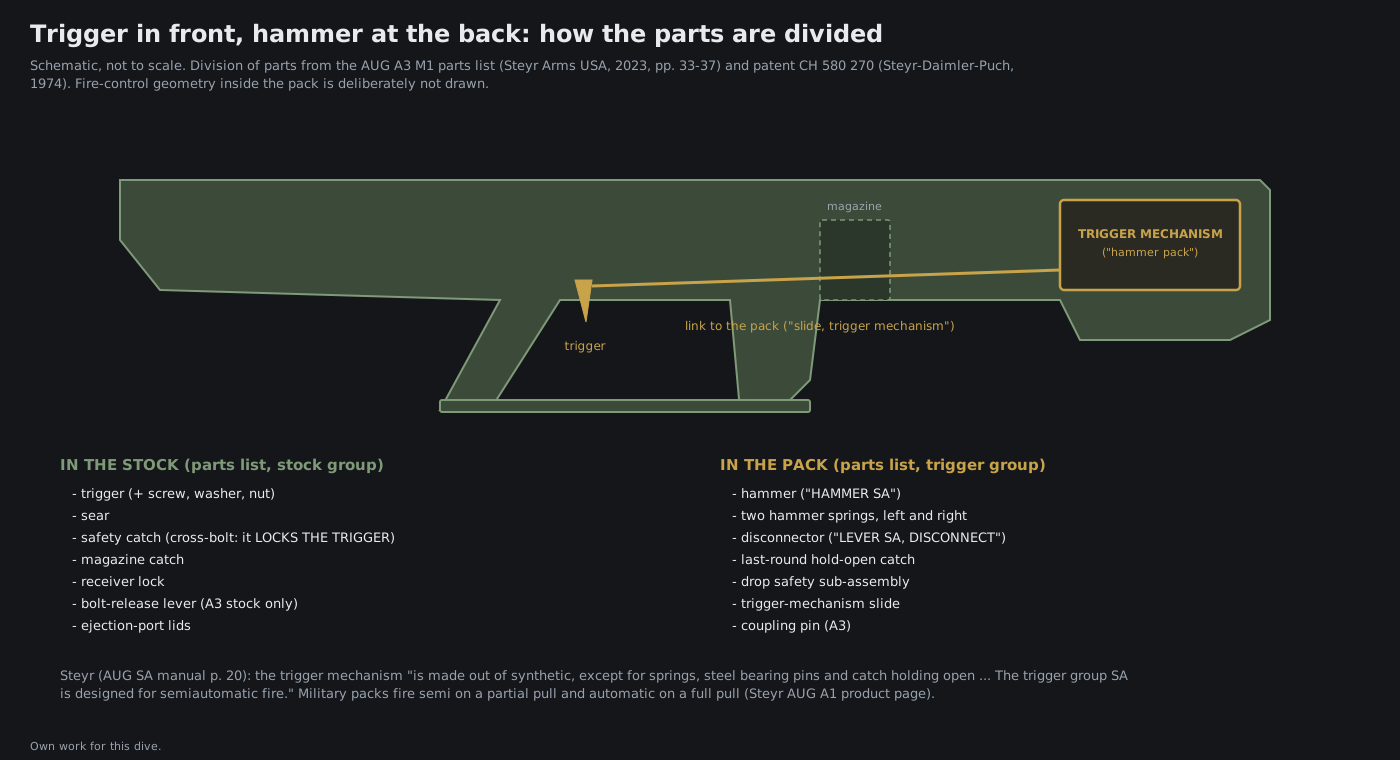
Steyr’s parts lists make the division exact. In the US A3 parts list, the stock group contains the trigger (with its screw, washer and nut), a part Steyr calls the sear, the safety catch, the receiver lock, the magazine catch and, on the A3, the bolt-release lever. The trigger group contains the pack body, the hammer, two hammer springs (left and right), the trigger-mechanism slide, the disconnector, the hold-open catch, a drop-safety sub-assembly and a coupling pin.8 The military manual shows that Steyr’s “sear” is the adjustable connection between the two: on reassembly the armourer slides it back “until it rests against the ‘slide, trigger mechanism’, but does not release it” and only then tightens the trigger screw.30 Functionally it is a trigger bar, set at assembly.
The pack is mostly plastic. The European manual: “The trigger mechanism is made out of synthetic, except for springs, steel bearing pins and catch holding open.”25 It is retained by the stock’s retaining bolt and closed by the butt plate, and the manuals require the hammer to be cocked when it goes in.2427
The safety is a cross-bolt in the top of the pistol grip. On the US rifle it has two positions: pushed from the right with a white dot showing is safe, pushed from the left with a red dot showing is fire, and the manual says it “locks the trigger” — not the hammer or the sear.31 On the military rifle it has three positions (§5.9).
The US trigger is heavy by modern standards. Steyr Arms USA sells an “Enhanced Trigger Spring Kit” — three springs, $56.00 on 19 September 2026 — which it says “reduces felt trigger poundage by 2-3 lbs” and fits both standard and NATO packs, and which the .300 Blackout addendum requires for subsonic ammunition.3214
5.9 Select-Fire and Semi-Automatic Packs
The military AUG has no selector lever. Its manual says the trigger mechanism “is designed for semi or fully automatic fire, just controlled by the trigger,” describes the trigger as a “‘Pull-through’ trigger system,” and describes the safety as “Lateral push-through type locks trigger movement, incorporated as part of the three position fire selection switch”: right for safe, and “centre or left” for fire.20 Steyr’s current product page for the military AUG A1 describes the same trigger as semi-automatic on the first stage of the pull and automatic when pulled fully back.33
This volume does not describe how the progressive trigger achieves that internally. None of the sources obtained for this dive describes it — the military parts list names a part, “lever, automatic firing,” and nothing more — and the hub’s boundary on automatic-fire mechanisms applies in any case.34
What matters to a builder is the difference between the packs, and that is documented by the maker’s own parts lists:
- The military pack contains a “lever, automatic firing.” The US semi-automatic pack’s parts list does not.348
- The US pack’s hammer, hammer springs and disconnector are distinct “SA” parts: “HAMMER SA”, “SPRING SA, HAMMER RIGHT/LEFT”, “LEVER SA, DISCONNECT”.8
- Steyr also designates the receiver, the bolt carrier, the receiver lock and the stock of the US rifle “SA”: “RECEIVER A3 SA”, “BOLT CARRIER SA”, “RECEIVER LOCK SA”, “STOCK USA SA”.83
- Steyr Arms USA’s archived store sold an “AUG SA Hammer Pack” that was “Semi Auto Only hammer pack for use on any A1/A2 or USR,” with the note “Not for use on the new AUG/A3 models with last round hold open.”35 A semi pack is not a semi pack for every generation.
Exactly which geometric feature makes each SA part incompatible with a military part — whether a semi carrier, stock or receiver physically refuses an automatic pack — is not stated in any source read. The pattern of “SA” designations across five groups is consistent with a deliberate interlock design, and it is stated here as a pattern, not as a mechanism. Vol 6 takes up what that means in law for a kit that arrives with military parts in it.
5.10 Changing the Ejection Side
The stock has an ejection port on each side. One is always closed by a snap-on cover. Swiss patent CH 580 269 (priority 17 January 1974): “The firearm stock has symmetrically arranged ejection openings which are alternately closed by a cover which matches each of the two openings.”36
Changing sides therefore takes two things, and Steyr’s manual lists both: “you need a bolt for left ejection and the ejection lid has to be converted from the left to the right side.”37 The bolt is exchanged whole, because extractor and ejector are on it; the carrier, cocking piece and firing pin are common. The cover is two parts, an outside lid and an inside lid, and the manual’s procedure is to lift the outside lid with a screwdriver, let the inside lid drop into the stock, and refit both on the other side.38 The European manual offers an alternative for a rifle that must serve both hands: “A brass deflector can be mounted on the right side, then the weapon is suitable for right and left handed shooting.”37
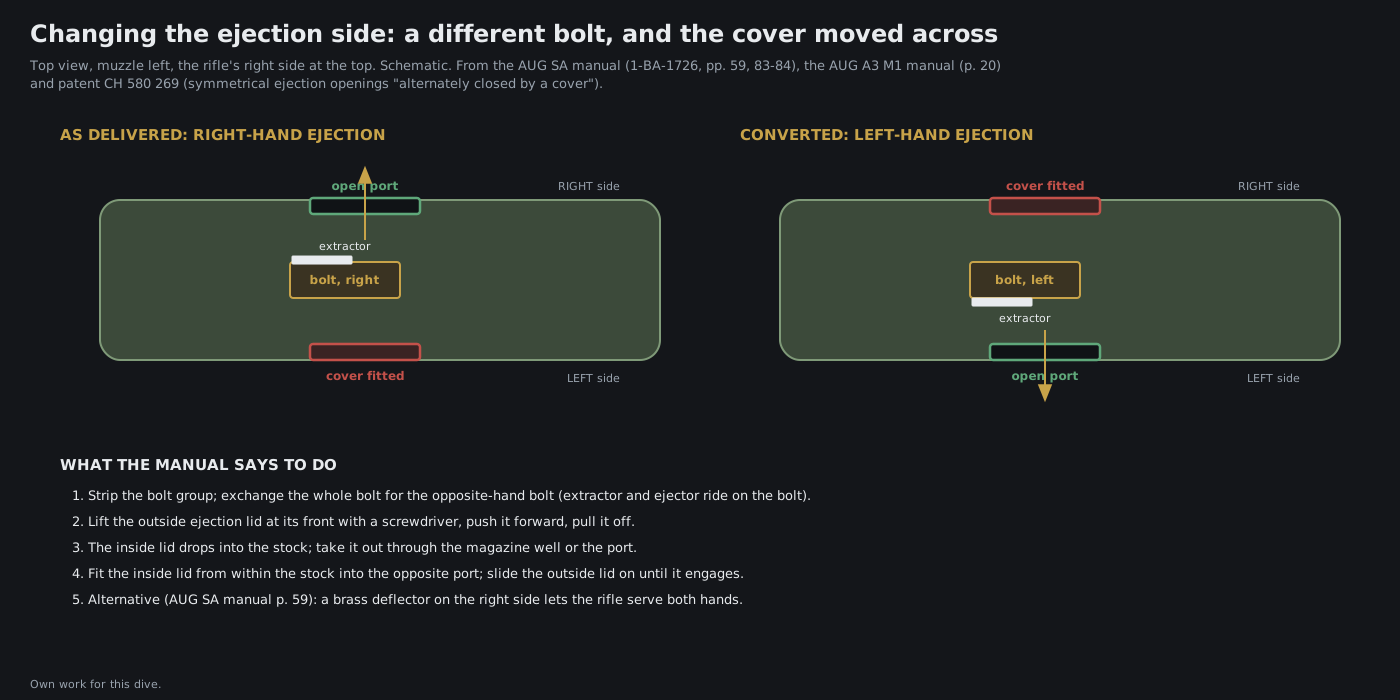
A left-hand bolt is a separately sold part. Steyr Arms USA listed “AUG Bolts,” right or left hand, at $330.00 on 19 September 2026, each “complete” with extractor, ejector and control pin.32 For a kit builder the useful fact is the reverse: a kit’s bolt must be checked for which hand it is, because a left-hand bolt in a stock whose right port is covered is a rifle that ejects into its own cover.
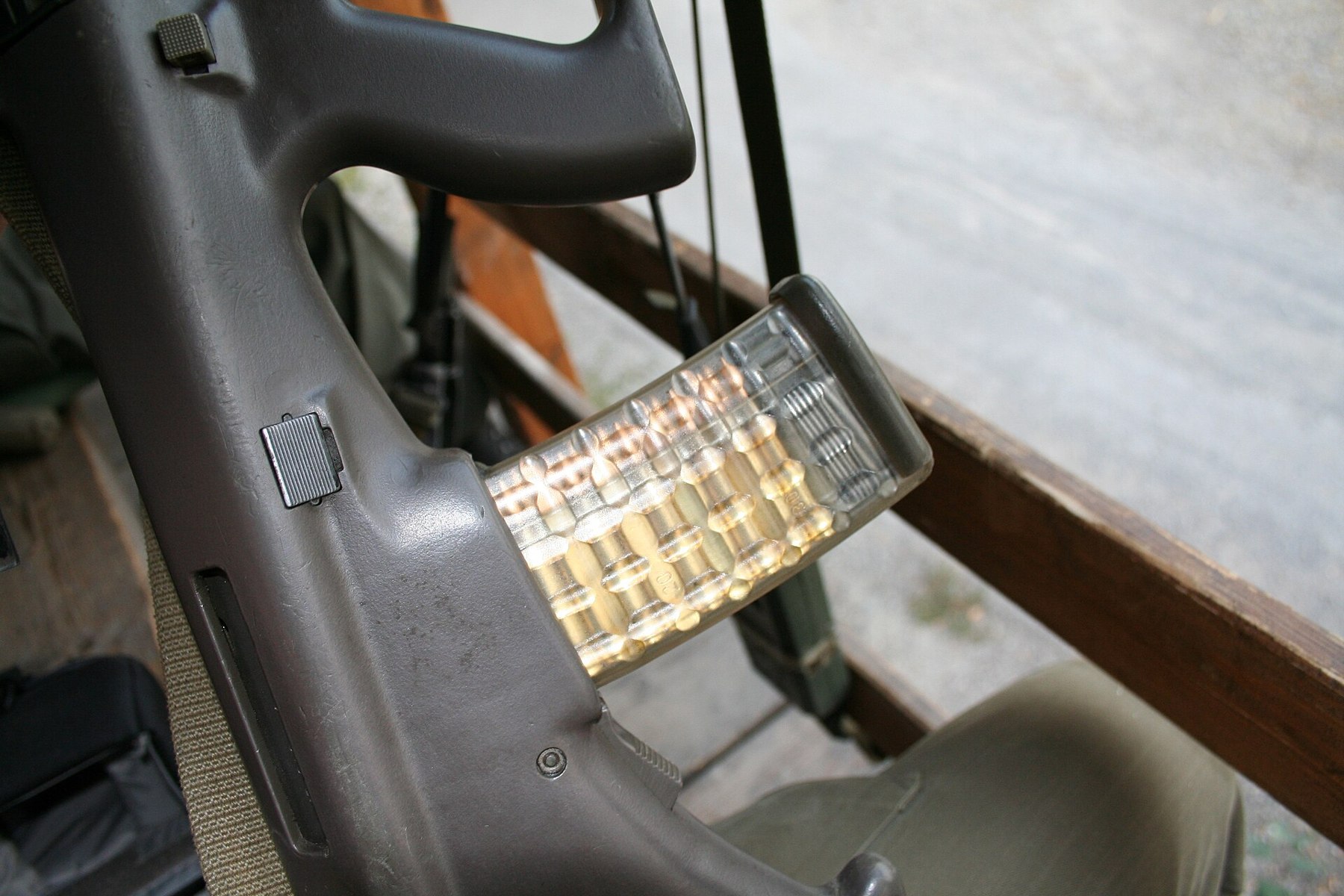
5.11 The Magazine
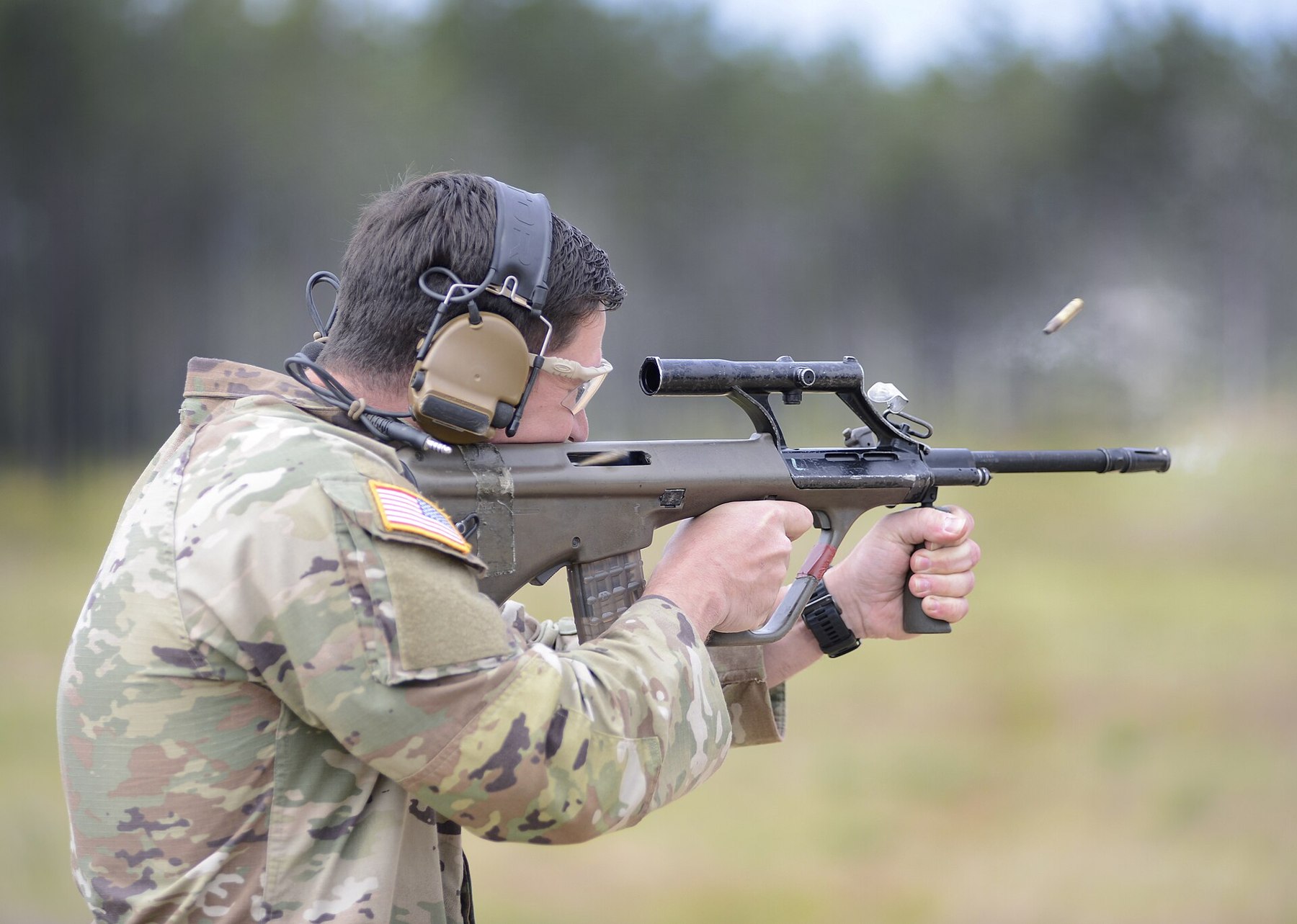
The magazine is a double-column box in transparent synthetic material. The military manual adds that “The spring is non corrosive” and tells the soldier not to oil it.209 Capacities are 30 and 42 rounds, with a 10-round US and a 9-round European magazine.639 The magazine catch is behind the magazine, at the front of the butt.
The magazine is taken up as a parts question in Vol 8 (which makers’ magazines fit which stocks) and as a legal question in Vol 6 (a magazine contributes three parts to the §922(r) count).
5.12 One Full Cycle
From a loaded rifle with the bolt closed and the hammer cocked:
- The trigger is pressed. Through the trigger bar (“sear”) and the pack’s slide, the pack releases the hammer, which strikes the firing pin. The rifle fires from a closed bolt.20
- Gas is tapped from the bore into the cylinder and drives the piston back against the carrier’s thrust piece. The piston travels a short distance and is returned by its own spring.8
- The carrier moves alone first. Its cam slot turns the bolt’s control pin, rotating the bolt 22.5° out of the barrel extension’s lugs.1520
- Carrier and bolt run back together on the guide rods, which slide in bushings in the receiver, compressing the closing springs inside the rods. The extractor draws the case and the ejector throws it through the open port. The carrier rides over the hammer and cocks it, and the disconnector holds it.158
- The carrier runs back onto the buffers in the butt and the springs drive it forward. The bolt strips a round from the magazine and chambers it.17
- The locking piece meets the barrel’s lugs, the control pin enters the transverse arm of its slot, and the bolt turns to lock.15
- When the trigger is released, the disconnector hands the hammer back to the trigger for the next shot. If the magazine is empty, the hold-open catch holds the carrier back.27
5.13 What Could Not Be Confirmed
- Which guide rod the piston strikes. The right, on the consistent reading of Steyr’s civilian manuals; no Steyr text states it.
- Why seven lugs and a 22.5° rotation. The eight-position pitch with one position lost to the extractor is an inference from the angle, not a statement.
- How the barrel extension is joined to the barrel.
- The internal mechanism of the progressive trigger. Not described in any source obtained, and not described here.
- The geometric differences between SA and military parts. The designations are documented; the features that make them incompatible are not.
- The receiver material. Commonly described as aluminium or as a steel-reinforced aluminium extrusion; that description comes from secondary sources only, and no Steyr document read for this dive states it.
Sources
Footnotes
-
Steyr Mannlicher Aktiengesellschaft, Maintenance Manual, Army Universal Assault Rifle, Steyr AUG, Cal. .223 (5,56 mm), undated, Steyr, Austria. Internet Archive item
maintenance-manual-army-universal-assault-rifle-steyr-aug, https://archive.org/details/maintenance-manual-army-universal-assault-rifle-steyr-aug, retrieved 2026-09-19. Folio references are to the printed pages. The manual lists 417, 508 and 621 mm barrels and calls the grenade setting “old versions”, so it is not a first-issue StG 77 manual. ↩ -
Steyr Arms, Inc., Owner’s Manual STEYR AUG A3 M1, 2023, https://steyr-arms.us/wp-content/uploads/2023/07/AUG_A3_M1_US_2023.pdf, retrieved 2026-09-19. The manual is a light revision of the 2009 AUG A3 SA USA manual and still carries its part names. ↩
-
Steyr Arms, Inc. (Trussville, Alabama), STEYR AUG/A3 SA USA owner’s manual, 2009, Wayback Machine capture of 8 August 2009, http://www.steyrarms.com/fileadmin/user/pdf/AUG_A3_SA_USA_Manual.pdf, retrieved 2026-09-19. ↩ ↩2
-
Steyr Arms GmbH, Instructions for use STEYR AUG SA, 1-BA-1726, edition EU-03, 2023, https://www.steyr-arms.com/wp-content/uploads/2023/03/BA-STEYR-AUG-SA_ende_1-BA-1726_EU-03.pdf, retrieved 2026-09-19. Page references are to the PDF. ↩
-
Österreichisches Bundesheer, “Sturmgewehr 77”, https://www.bundesheer.at/unser-heer/waffen-und-geraet/sturmgewehr-77, accessed 2026-09-19. ↩
-
Swiss patent CH 579 761 A5, Steyr-Daimler-Puch, priority 4 January 1974, “Collapsible small automatic firearm” (Google Patents English abstract), retrieved 2026-09-19. ↩ ↩2
-
AUG A3 M1 manual (2023), parts list, pp. 32–37 of the PDF; the same list appears in the 2009 AUG A3 SA USA manual. ↩ ↩2 ↩3 ↩4 ↩5 ↩6 ↩7
-
Maintenance Manual, cleaning and lubrication, Chapter II §§1.10–1.12 (read from the Internet Archive OCR and checked against the page sense): “Do not oil cylinder, piston and ‘spring, piston’. The piston is hard-chrome plated and it is not necessary to oil it.” ↩ ↩2
-
AUG A3 M1 manual (2023), p. 6 (repeated p. 25). ↩
-
Maintenance Manual, fo. 4 (barrel group description) and Chapter II §1.10 (gas settings and piston removal). ↩ ↩2
-
AUG SA manual (EU-03), pp. 24–25 and 35–40, §§6.2.1–6.2.4. ↩ ↩2
-
AUG SA manual (EU-03), p. 25, CAUTION. ↩
-
Steyr Arms, Inc., AUG A3 M1 .300 Blackout addendum, 2024, https://steyr-arms.us/wp-content/uploads/2024/03/AUG-A3M1-300-Blackout.pdf, retrieved 2026-09-19, pp. 1–3. ↩ ↩2
-
US Patent 4,191,089, U. Zedrosser, assignor to Steyr-Daimler-Puch AG, “Breech-closing mechanism for automatic rifle”, Austrian priority 22 December 1977, issued 1980. Retrieved from Google Patents 2026-09-19. ↩ ↩2 ↩3 ↩4 ↩5 ↩6 ↩7
-
Maintenance Manual, Chapter IV §2, fo. 24 (slide sub-assembly). ↩
-
Maintenance Manual, Chapter IV §2, fo. 26 (butt: “rod, guide”, “buffer”, “plate, buffer”, two each), and Chapter V parts list. Read from OCR. ↩ ↩2
-
AUG SA manual (EU-03), §7.2, pp. 65–66; AUG A3 M1 manual (2023), p. 18. ↩
-
Maintenance Manual, fo. 3–6 (description, technical data, firing characteristics), checked against the page images. ↩ ↩2 ↩3 ↩4 ↩5
-
AUG A3 M1 manual (2023), pp. 23–28 (lubrication and reassembly). ↩ ↩2
-
Republik Österreich, Parlament, Anfragebeantwortung 3599/AB, XXII. GP, answer by the Federal Minister of the Interior to parliamentary question 3647/J (asked 30 November 2005), https://www.parlament.gv.at/PAKT/VHG/XXII/AB/AB_03599/fnameorig_056189.html, accessed 2026-09-19. Translation for this dive; the lug sentence reads “Der Verschlusskopf des zivilen Modells “Z” ist entsprechend nur mit 6 Verriegelungswarzen versehen.” ↩
-
Maintenance Manual, Chapter IV §4.2, “Replacement of parts”, fo. 32. ↩ ↩2
-
AUG SA manual (EU-03), p. 20 (receiver group and trigger group descriptions). ↩ ↩2
-
Maintenance Manual, Chapter IV §4.1, inspection table, fo. 31. ↩ ↩2
-
Maintenance Manual, Chapter II §§1.4 and 1.8, fo. 9 (loading, forward assist, hold-open; checked against the page image) and field stripping. ↩ ↩2 ↩3 ↩4 ↩5
-
AUG SA manual (EU-03), p. 32. ↩
-
Swiss patent CH 580 270 A5, Steyr-Daimler-Puch, priority 22 January 1974, “Automatic firearm trigger mechanism” (Google Patents English abstract), retrieved 2026-09-19. ↩
-
Maintenance Manual, Chapter IV §2, fo. 26 (trigger and sear). Read from OCR. ↩
-
AUG A3 M1 manual (2023), p. 7. ↩
-
Steyr Arms, Inc., online store, https://steyr-arms.us/shop/category/tactical/aug/, product data read 2026-09-19 (AUG Bolts, SKU 120004057, $330.00; AUG Enhanced Trigger Spring Kit, SKU 1251030600, $56.00). ↩ ↩2
-
Steyr Arms GmbH, “AUG A1”, https://www.steyr-arms.com/en/military-law-enforcement/assault-rifles/aug-a1/, accessed 2026-09-19. ↩
-
Maintenance Manual, Chapter IV §2, fo. 28–29, and Chapter V (trigger mechanism group parts). Read from OCR. ↩ ↩2
-
Steyr Arms, Inc., “AUG SA Hammer Pack”, $125.00, Wayback capture of 6 June 2017, https://web.archive.org/web/20170606090007/http://steyrarms.com:80/accessories/aug/aug-sa-hammer-pack.html, retrieved 2026-09-19. ↩
-
Swiss patent CH 580 269 A5, Steyr-Daimler-Puch, priority 17 January 1974, “Automatic firearm with magazine in butt” (Google Patents English abstract), retrieved 2026-09-19. ↩
-
AUG A3 M1 manual (2023), p. 20. ↩
-
AUG SA manual (EU-03), p. 18, technical data. ↩
Comments (0)