Remington Nylon 66 · Volume 7
Collecting: Dating, Rarity, Values and the Law
Reading the barrel code and the serial, which variants are actually scarce, thirty-four dated auction results, curio-and-relic status, the serialised-cover problem, and a buyer's checklist
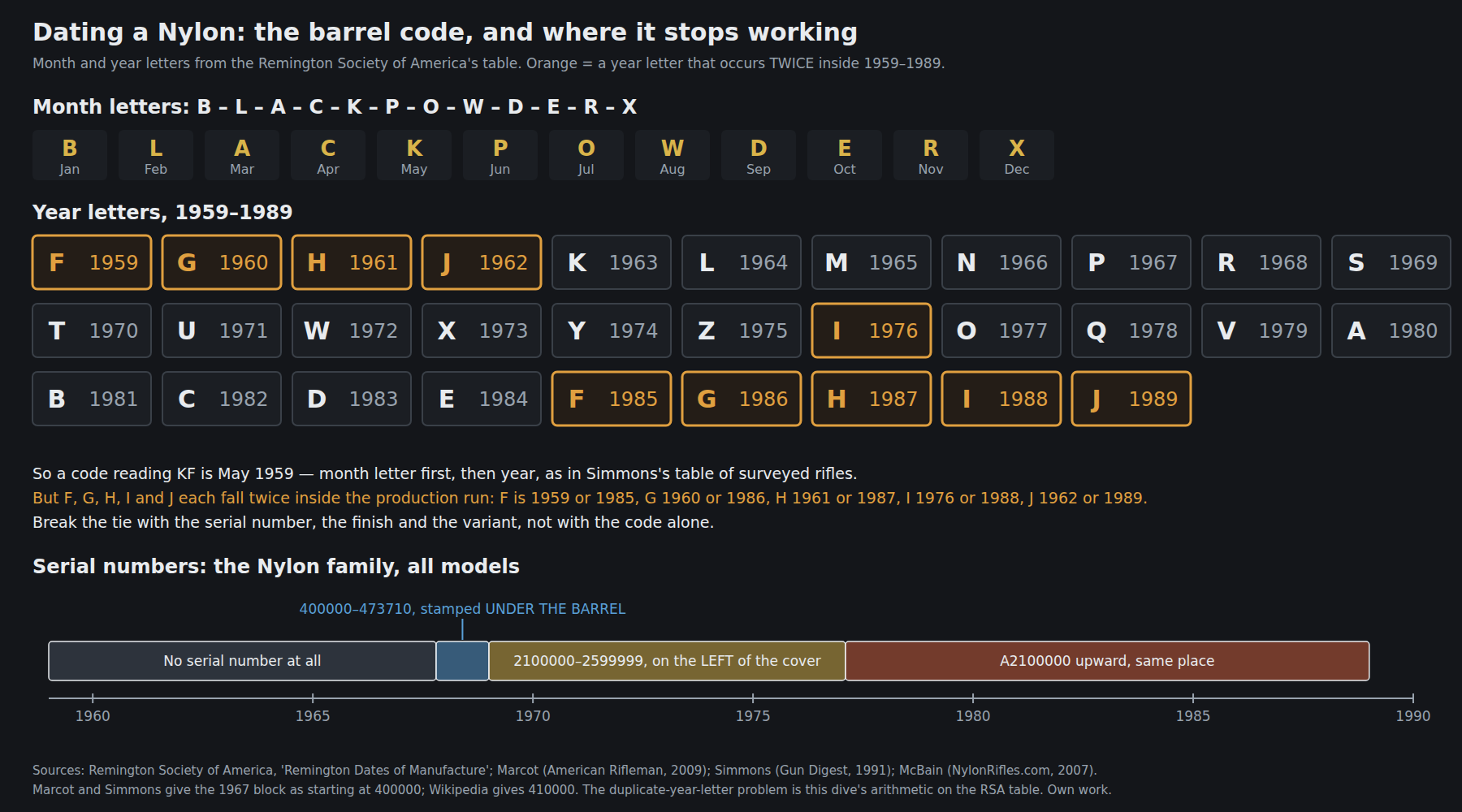
7.1 Dating a Nylon
A Nylon 66 can be dated two ways, and on most rifles only one of them is available. The barrel carries a date code from the first year of production. The serial number exists only from October 1967. Marcot’s summary of why: “The receiver cover had no serial number stamped on it until October 1967, just prior to the enactment of the 1968 Gun Control Act, which required that all guns have serial numbers.”1
That makes the barrel code the primary tool. It is stamped, according to the Remington Society of America, “on the left side of the barrel near the frame”, with the rest of the barrel markings changing over the years in the sequence Simmons recorded: “PAT. PEND.” over “22 L.R. ONLY” plus the date code and inspector’s stamp at first; the patent-pending line dropped and a stylised “Remington” added once the patents issued in 1962; a larger “REMINGTON 22 LONG RIFLE ONLY” behind the front sight from the early 1980s.23
7.2 The Barrel Code, and Where It Fails
The code is two letters: a month letter and a year letter. The month letters spell BLACKPOWDER — B January, L February, A March, C April, K May, P June, O July, W August, D September, E October, R November, X December.2 Simmons’s own survey table, compiled in April 1988 from rifles he had examined, shows the order in practice: “66MB KF MAY59”, “66SG BG JAN60”, “76MB LJ FEB62”. The month letter comes first.3
The year letters run F 1959, G 1960, H 1961, J 1962, K 1963, L 1964, M 1965, N 1966, P 1967, R 1968, S 1969, T 1970, U 1971, W 1972, X 1973, Y 1974, Z 1975, I 1976, O 1977, Q 1978, V 1979, then A 1980 through J 1989.2 Rock Island Auction’s catalogue readings agree with that table: it reads “Q” as 1978 and “P” as 1967 on two rifles in the same lot.4
The failure is at both ends of the run, and no source consulted points it out. The year letters recycle on a 26-year cycle, so five of them fall twice inside the Nylon 66’s own production life:
Table 1 — The failure is at both ends of the run, and no source consulted points it out. The year letters recycle on a 26-year cycle, so five of them fall twice inside the Nylon 66's own production life
| Letter | Could be | Or |
|---|---|---|
| F | 1959 | 1985 |
| G | 1960 | 1986 |
| H | 1961 | 1987 |
| I | 1976 | 1988 |
| J | 1962 | 1989 |
For most Remington models that ambiguity is harmless, because no model ran for twenty-six years. The Nylon 66 ran for thirty. A rifle stamped with a month letter and “H” is either an early Mohawk Brown or Seneca Green from 1961, or a very late rifle from 1987, and those are opposite ends of the collector market.
Three things break the tie:
- The serial number. Any serial at all means the rifle is from October 1967 or later, which resolves F, G, H and J immediately. An A-prefixed serial means February 1977 or later, which resolves I.
- The variant. Seneca Green ended in 1961 or 1962 and Black Diamond began in 1978; a green rifle with an “H” is 1961, a Black Diamond with an “I” is 1988.
- The finish. Marcot records that covers and barrels went from blued to matte black near the end of production, and Simmons records the later, deeper serial stamping and the larger barrel legend of the 1980s.13
7.3 Serial Numbers
The published blocks, which Marcot, Simmons and McBain agree on except at one point:135
Table 2 — Serial Numbers
| Period | Numbers | Where stamped |
|---|---|---|
| Before October 1967 | none | — |
| October 1967 – 1968 | 400000–419011 | underside of the barrel, just aft of the front sight |
| 1968 | 419012–473710 | same |
| December 1968 – February 1977 | 2100000–2599999 | left side of the receiver cover |
| February 1977 onward | A2100000 upward | same |
McBain adds the point that matters for the whole family: “These serial number series were for all Nylon rifles, not just Nylon 66s.”5 A serial in the 2.1 million range therefore does not say which model it came from, and a Mohawk 10C shares the series with a Nylon 66.
The one disagreement: Marcot and Simmons both start the 1967 block at 400000; Wikipedia’s article gives 410000, without a source.6 The two published accounts are preferred here, and the discrepancy is flagged rather than reconciled.
Two useful cross-checks come from Simmons. He puts the last production year, 1988, in the “A2360000 range”, and McBain records observed Apache 77 serials from A2330000 in April 1987 into the A2400000 range by June 1988.35 Those two independent statements agree, which is some corroboration that the A-series ran roughly 2,100,000 to about 2,400,000 across eleven years.
7.4 The Serialised Part Is the Lid
A quirk of this design has real consequences for a collector. From December 1968 the serial number is on the receiver cover, a sheet-steel stamping held on by two screws that any owner can remove in a minute (Volume 5). The part that actually contains the action — the moulded nylon shell with the bolt tracks, the barrel cradle and the recoil shoulders — carries no number at all.
Remington’s own parts list marks the “Receiver Cover Assembly … Restricted”, in both the standard and the Apache Black versions, which is the company’s designation for a part it would not simply sell over the counter.7 That is consistent with Remington treating the cover as the controlled component.
Two practical consequences:
- Covers get swapped. A 150th Anniversary emblem, a chrome Apache Black cover or a plain blued cover can all be moved between rifles. A commemorative that consists only of a marked cover on an unremarkable rifle is worth checking carefully, and so is a rifle whose cover finish does not match the rest of its era.
- Paperwork follows the number on the cover. Whatever the legal analysis, a buyer’s record will carry the cover’s number.
What this dive cannot tell you is which part United States law treats as the firearm on a Nylon 66. The serialised, “Restricted” part is the cover; the part that houses the bolt and barrel is the nylon moulding. No ATF determination for this model was located for this dive, and the current federal definition of a frame or receiver in 27 CFR 478.12 was not analysed against this rifle. Anyone contemplating replacing either part should get that question answered by someone competent to answer it, and should not rely on this volume.
7.5 What Is Actually Scarce
The relative rarity below is built on the production figures in Volume 2, with the warning that the colour-by-colour figures are a collector compilation whose Mohawk Brown number looks derived rather than counted.5
Table 3 — What Is Actually Scarce
| Rifle | Quoted production | Comment |
|---|---|---|
| Nylon 66 Mohawk Brown | 716,492 | The default rifle. Common everywhere. |
| Nylon 66 Apache Black | 221,000 | Common, and the most wanted of the standard colours. |
| Mohawk 10C | 128,358 | The second most numerous Nylon. |
| Nylon 66 Black Diamond | 56,000 | Scarcer than Apache Black; a ten-year run. |
| Apache 77 | about 54,000, possibly more | A single retailer’s run; often found with its original scope. |
| Nylon 66 Seneca Green | 42,500 | The scarce colour, and the one most often misidentified. |
| Nylon 12 | 27,551 | |
| Nylon 76 Trailrider | 26,927 | Only about 1,600 in Apache Black, by McBain’s figure. |
| Nylon 11 | 22,423 | |
| Nylon 77 | 15,327 | The five-shot original. |
| Nylon 10 | 10,670 | |
| Nylon 66 Bicentennial | 10,268 | |
| Nylon 66 150th Anniversary | 3,792 | The rarest catalogued Nylon 66 with a published figure. |
| Nylon 10SB smooth bore | 2,064 | Simmons calls it “probably the rarest”. |
| Nylon 66 Gallery Special | not published | No count located. Institutional rifles; survival rate unknown. |
Two cautions. The Gallery Special’s absence from every published count means nobody can say where it ranks. And an Apache Black Nylon 76, at about 1,600 rifles, is rarer than anything on this list except the smoothbore, but it is a variant of a model rather than a model, so it rarely appears in rarity discussions at all.
7.6 What They Sell For
Every result below is a hammer price from a Rock Island Auction lot page, with the date of the sale. Hammer prices exclude the buyer’s premium, so the sum a buyer actually paid was higher. Estimates are the auction house’s own. These are auction results for specific rifles in specific condition, not a price guide.4
Table 4 — What They Sell For
| Sale date | Lot | What | Estimate | Hammer |
|---|---|---|---|---|
| 2017-11-02 | 2015/687 | Nylon 66, “Good” | $150–300 | $275 |
| 2018-03-29 | 2017/531 | Nylon 10C, stock cracked | $200–300 | $275 |
| 2019-01-03 | 2021/683 | Nylon 66 Apache Black, “Excellent” | $400–600 | $650 |
| 2019-01-03 | 2021/684 | two Nylon 66s, “Good” | $400–600 | $550 |
| 2021-06-30 | 2046/691 | Nylon 66 with case, made 1964 | $250–500 | $375 |
| 2021-06-30 | 2046/692 | Mohawk 10C | $250–450 | $425 |
| 2021-11-17 | 2052/547 | Mohawk 10C | $300–500 | not sold |
| 2022-04-27 | 2057/606 | Nylon 66, “Good” | $250–450 | $475 |
| 2023-09-13 | 2077/733 | Nylon 66 AB with matching box | $400–700 | $850 |
| 2023-09-13 | 2077/734 | Mohawk 10C with matching box | $400–600 | $650 |
| 2023-11-15 | 2080/64 | Mohawk 10C, box and manual, “Excellent” | $450–750 | $750 |
| 2024-02-07 | 2083/483 | Nylon 66, box, manual, sleeve, scope | $400–700 | $550 |
| 2024-03-06 | 2084/125 | Mohawk 10C, box and papers | $450–750 | $550 |
| 2024-10-16 | 2095/601 | Mohawk 10C, box, magazine damaged | $300–500 | $375 |
| 2024-11-29 | 5002/114 | Mohawk 10C, magazine absent | $250–400 | $275 |
| 2024-12-18 | 2099/629 | Nylon 66 (black, black diamond) with scope | $300–500 | $450 |
| 2025-05-04 | 5011/1130 | Apache 77, parts absent | $200–500 | $375 |
| 2025-05-04 | 5011/1138 | CBC Nylon 66 copy with scope | $100–200 | $250 |
| 2025-06-08 | 5013/365 | Nylon 66 Apache Black, “Excellent” | $600–900 | $650 |
| 2025-12-14 | 5025/192 | Apache 77 with box, magazine broken | $400–700 | $500 |
| 2026-02-01 | 5027/757 | Nylon 66 Mohawk Brown, 1988, box and scope | $200–400 | $1,200 |
| 2026-03-29 | 5030/1152 | Nylon 66, catalogued 1959 | $200–450 | $550 |
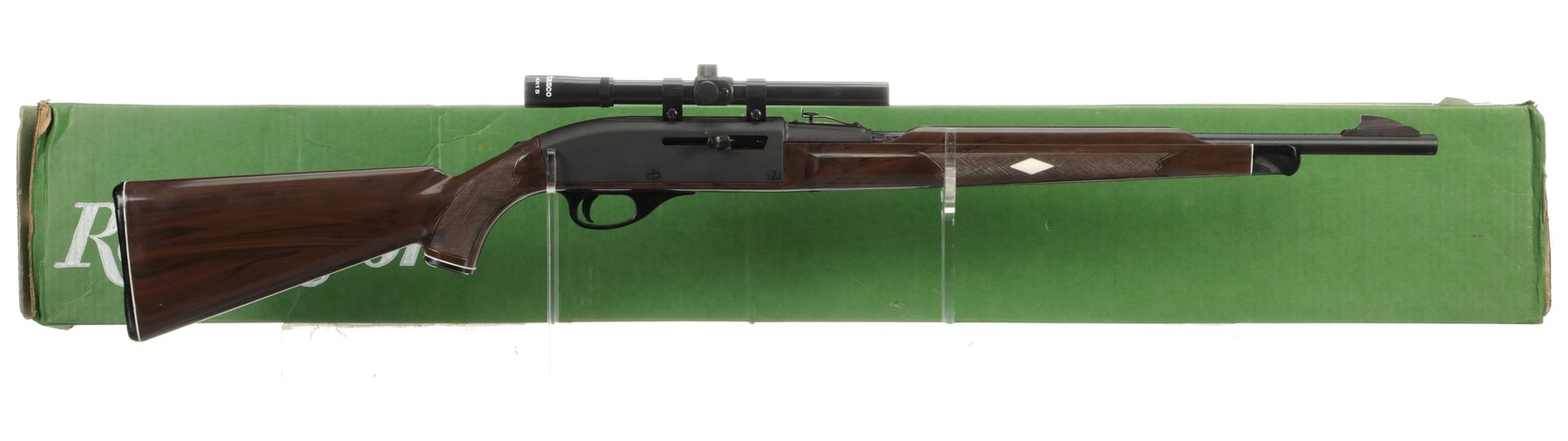
The Nylon 76 and the multi-rifle collector lots sit well above the single autoloaders:
Table 5 — The Nylon 76 and the multi-rifle collector lots sit well above the single autoloaders
| Sale date | Lot | What | Estimate | Hammer |
|---|---|---|---|---|
| 2018-02-17 | 1030/4967 | Nylon 76, “Fine” | $800–1,200 | $1,000 |
| 2021-06-30 | 2046/690 | Nylon 76, “Good” | $300–500 | $1,400 |
| 2021-07-28 | 2048/407 | Nylon 76 with Weaver C4 scope | $800–1,200 | $950 |
| 2022-08-10 | 2062/475 | Nylon 76, “Fine” | $800–1,200 | $1,600 |
| 2019-02-14 | 1032/768 | two factory-sealed Nylon 66s | $850–1,400 | $2,750 |
| 2025-02-21 | 1048/802 | Nylon 12, Nylon 10 and Nylon 11 together | $1,000–1,600 | $2,500 |
| 2025-02-21 | 1048/803 | 66 AB (1979), Apache 77, 66 MB (1975) | $900–1,400 | $2,500 |
| 2025-02-22 | 1048/2935 | 66 MB (1978), 66 AB (1967), Nylon 12 (1963) | $900–1,500 | $2,250 |
| 2016-02-25 | 1026/6681 | seven Nylons including a 76 and a boxed Apache 77 | $1,400–2,000 | $2,500 |
| 2022-04-27 | 2057/605 | Apache 77 and a 150th Anniversary rifle | $500–800 | $1,100 |
| 2023-06-21 | 1043/1170 | CBC GR-8, serial GR10001, boxed | $300–500 | $600 |
| 2023-11-01 | 2079/125 | the same CBC GR-8, five months later | $400–700 | $450 |
For a non-auction reference point, American Rifleman wrote in October 2021: “Today, you can expect to pay around $300 for a lightly used, cosmetically solid Nylon 66. As condition drops, of course, so does the price.”8
7.7 Reading the Price Table
Five patterns come out of those numbers.
- A plain shooter is a $275–550 rifle at auction, consistently, across nine years of results. The 2021 magazine estimate of about $300 sits inside that range.
- The Nylon 76 is the money model. Four results from 2018 to 2022 run $950 to $1,600, two to four times a Nylon 66 of similar condition, on a production run of about 27,000. It is the scarcest common Nylon and the one non-collector buyers overlook.
- The box roughly doubles the rifle. The two factory-sealed Nylon 66s made $2,750 the pair, about $1,375 each, against $275–550 for loose examples. A “matching factory box” lifted an Apache Black to $850 and a 10C to $750.
- Estimates are beaten more often than missed. Of the 34 results tabulated above, 16 hammered above the auction house’s top estimate, none sold below its low estimate, and one did not sell at all. That is a market with more demand than the cataloguers assume, and it argues against treating an auction estimate as a value.
- The same rifle is not worth the same twice. The CBC GR-8 with serial GR10001 sold for $600 in June 2023 and $450 in November 2023. Two sales of one object, five months apart, differing by a quarter.
The outlier is worth a sentence: a 1988 Mohawk Brown with its box and a Tasco scope made $1,200 against a $200–400 estimate in February 2026. Nothing in the catalogue description explains it. Single results, including that one, should not be read as a trend.
7.8 Curio and Relic Status
Two separate routes make Nylons curios or relics under federal law:
By name. ATF’s Firearms Curios or Relics List (1972–1998) includes, in its Section II listing, “Remington, 150th Anniversary model Nylon 66 semiautomatic rifle, caliber .22LR.”9 That single variant is named regardless of age.
By age. 27 CFR 478.11 classifies as curios or relics firearms “manufactured at least 50 years prior to the current date”. In 2026 that covers every Nylon made up to 1976, which is every Nylon 10, 11, 12 and 76, every Nylon 77, most Mohawk 10Cs, and every Nylon 66 up to and including the Bicentennial year. The hub’s M1 Garand dive covers the regulation, the Type 03 collector licence and what it does and does not allow; that material is not repeated here.
One caution specific to this rifle: ATF’s position on curio status for modified guns turns on original configuration, as that dive sets out. A Nylon whose cover has been swapped is a question worth thinking about before relying on C&R status for an interstate transfer.
7.9 Owning One: Federal and Michigan
There is very little law to know. The Nylon family is entirely Title I: rimfire rifles with barrels well over 16 inches, no detachable-magazine restrictions of the modern kind, no National Firearms Act issues at all.
- Pre-1968 rifles have no serial number and that is lawful. The Gun Control Act’s marking requirement applied from 1968 forward and was not retroactive, which is why Remington began numbering in October 1967 in anticipation of it.1 An unnumbered Nylon is a normal, legal, pre-1968 rifle. A dealer’s record for one will note the absence.
- Michigan. Michigan’s pistol-specific machinery — the licence to purchase, the pistol sales record, MCL 28.422 and 28.422a — applies to pistols, not to rifles. The hub’s Remington XP-100 dive quotes those statutes in full for the pistol case. A Nylon 66 is a long gun and none of that applies to it.
- Ammunition. The rifle is .22 Long Rifle only, and the reasons are in Volume 3. The hub’s .22 Rimfire dive covers the cartridge itself.
7.10 A Buyer’s Checklist
- Read the pistol-grip cap. The model name is on it. This settles most arguments before they start.
- Read the barrel code, then check it against the serial and the variant using the figure at the head of this volume. Do not accept a single letter as a date.
- Check the cover against the rifle. Finish, serial presence and era should agree. A chrome cover on an otherwise brown rifle, or a commemorative emblem on a rifle whose other features do not match 1966 or 1976, deserves scrutiny.
- Look at the stock in daylight, not under a seller’s lights, before believing a “Seneca Green” description. Then check the other Seneca Green features: blued cover, white diamond and spacers, butt tube, no serial number.
- Inspect the moulding for cracks, particularly along the centreline seam, around the fore-end and at the grip. A cracked stock is a cracked receiver (Volume 5).
- Work the action. The bolt should run freely in clean tracks; grit in the tracks is the wear that matters.
- Check that the magazine is complete. On the tube guns, the inner tube, follower, spring and plug; on the box guns, the magazine itself, which is plastic and is missing or broken in a striking number of auction lots.
- Expect no spare parts. Remington’s own parts list says parts “may no longer be in production and may not be available”, and the moulded stock cannot be bought at all.7
- Do not pay a commemorative premium for a cover.
- Keep it out of the sun. Nylon 6,6’s sunlight resistance is moderate at best on DuPont’s own data (Volume 5).
7.11 What This Dive Could Not Settle
Stated plainly, so that nobody mistakes an open question for a settled one:
- Which part is the firearm in law on a post-1968 Nylon: the serialised cover or the moulded shell. No ATF determination located.
- The Nylon 66’s true end date: 1987, 1988, 1989 and 1991 are all published, by Remington and by its own historian (Volume 2).
- The origin of the name: the polymer, or the Number 66 colour mixture, or unknown (Volume 1).
- Whether the variant production breakdown is real data or a reconstruction from Remington’s total (Volume 2).
- The Gallery Special’s production figure, which no source gives.
- The Bicentennial marking’s appearance, which no located photograph shows.
- Whether the Black Diamond’s spacers are black, as McBain says, or white, as the rifle photographed for Volume 4 shows.
- The design patent for the rifle’s appearance, credited by Simmons to Robert P. Kelly, James S. Martin and Wayne E. Leek, whose number was not found.
- Simmons’s account of CBC, including Remington’s minority holding and the 1981 nationalisation, which no independent source confirmed (Volume 4).
References
Footnotes
-
Roy Marcot, “The Remington Nylon 66”, American Rifleman, 27 August 2009, including the serial blocks and the October 1967 start. Archived: https://web.archive.org/web/20150303174642/http://www.americanrifleman.org:80/articles/2009/8/27/the-remington-nylon-66 , retrieved 2026-09-19. ↩ ↩2 ↩3 ↩4
-
Remington Society of America, “Remington Dates of Manufacture” (month and year code tables; “a code located on the left side of the barrel near the frame”). Archived 7 December 2015: https://web.archive.org/web/20151207200916/http://www.remingtonsociety.org:80/manufacture-dates , retrieved 2026-09-19. ↩ ↩2 ↩3
-
Donald M. Simmons, “Those Plastic Remingtons”, The Gun Digest, 45th Edition (1991), including the barrel-marking sequence, the serial blocks, the A2360000 figure for 1988 and his April 1988 table of surveyed rifles with their date codes. Archived scan: https://web.archive.org/web/20100524123435/http://www.nylonrifles.com/Nylonpdf/PlasticRems.pdf , retrieved 2026-09-19. ↩ ↩2 ↩3 ↩4 ↩5
-
Rock Island Auction Company lot pages, each at https://www.rockislandauction.com/detail/{auction}/{lot}/ with the auction and lot numbers given in the tables; retrieved 2026-09-19 through the shared fetch engine. Hammer prices and estimates are from each page’s data and sale dates are as printed there; hammer excludes the buyer’s premium. “Not sold” means the page’s hammer figure was zero. ↩ ↩2
-
Gary McBain, “Nylon Rifles – Facts and Figures”, NylonRifles.com, 29 April 2007, including the serial-series note and the Apache 77 observed serials. Archived: https://web.archive.org/web/20100521055828/http://nylonrifles.com/NylonRifles/Articles/Entries/2007/4/29_Nylon_Rifles_-Facts_and_Figures.html . ↩ ↩2 ↩3 ↩4
-
“Remington Nylon 66”, Wikipedia, raw text retrieved 2026-09-19; used for the 410000 figure attributed to it. ↩
-
Remington Arms Company, Nylon 66 parts list (sheet RF 22) in the Nylon 66 information packet, including the “Restricted” marking against the receiver cover assembly and the note that the firearm is no longer produced. Archived PDF: https://web.archive.org/web/20110910092323/http://www.remington.com:80/~/media/Files/Owners-Manuals/Nylon%2066.ashx . ↩ ↩2
-
Guy Sagi, “Remington Nylon 66: A Vintage Gun of the Future”, American Rifleman, archived 6 October 2021: https://web.archive.org/web/20211006132737/https://www.americanrifleman.org/content/remington-nylon-66-a-vintage-gun-of-the-future/ , retrieved 2026-09-19. ↩
-
Bureau of Alcohol, Tobacco and Firearms, Firearms Curios or Relics List, 1972–1998 (cumulative and current through 20 May 1998), Section II. Mirror consulted: https://www.makarov.com/pdf/curio.pdf , retrieved 2026-09-19. Whether the entry is carried forward unchanged in ATF’s current list was not re-checked. ↩
Comments (0)