Remington Nylon 66 · Volume 5
Takedown, Maintenance and Repair
Remington's own field strip and jam-clearing procedure, why the detail strip is where owners come unstuck, what solvents do to nylon on DuPont's own data, the parts that wear and break, and what can be fixed at the bench
5.1 What This Volume Is Based On
Almost everything in this volume comes from two Remington documents and one materials handbook:
- Remington’s Nylon 66 information packet, an owner-request document sent from Madison, North Carolina, containing the safety rules, the operating and care instructions, the exploded view (sheet RF 21) and the parts list (sheet RF 22).1
- Remington’s period Nylon 77 instruction folder, printed at Ilion, which covers the same action in a box-magazine rifle and is more explicit about disassembly limits.2
- DuPont’s Zytel design handbook, for what the stock material tolerates.3
Where those are silent, this volume says so rather than filling the gap. The one thing it does not contain is a detail-strip sequence, for reasons set out below.
5.2 Unloading
Remington’s sequence, in its own order:4
- Push the safety thumbpiece rearward to SAFE. The red dot should not show.
- Unlock and remove the magazine tube from the rear of the stock, turn the muzzle upwards and let the live cartridges empty out of the magazine. Replace the tube and lock it.
- “After unloading, pull bolt handle back repeatedly to unload live cartridges from action or barrel chamber.”
- “A colored magazine follower should be seen from ejection port when action is empty.”
- “Check chamber of barrel from open ejection port to make sure no live cartridge remains in chamber.”
Steps 3 to 5 matter on this rifle more than on most. The magazine feeds from the butt along a passage under the action, so emptying the tube does not empty the feed passage; a round can still be lying in it, or chambered. The yellow follower showing at the ejection port is Remington’s own confirmation that the passage is clear.
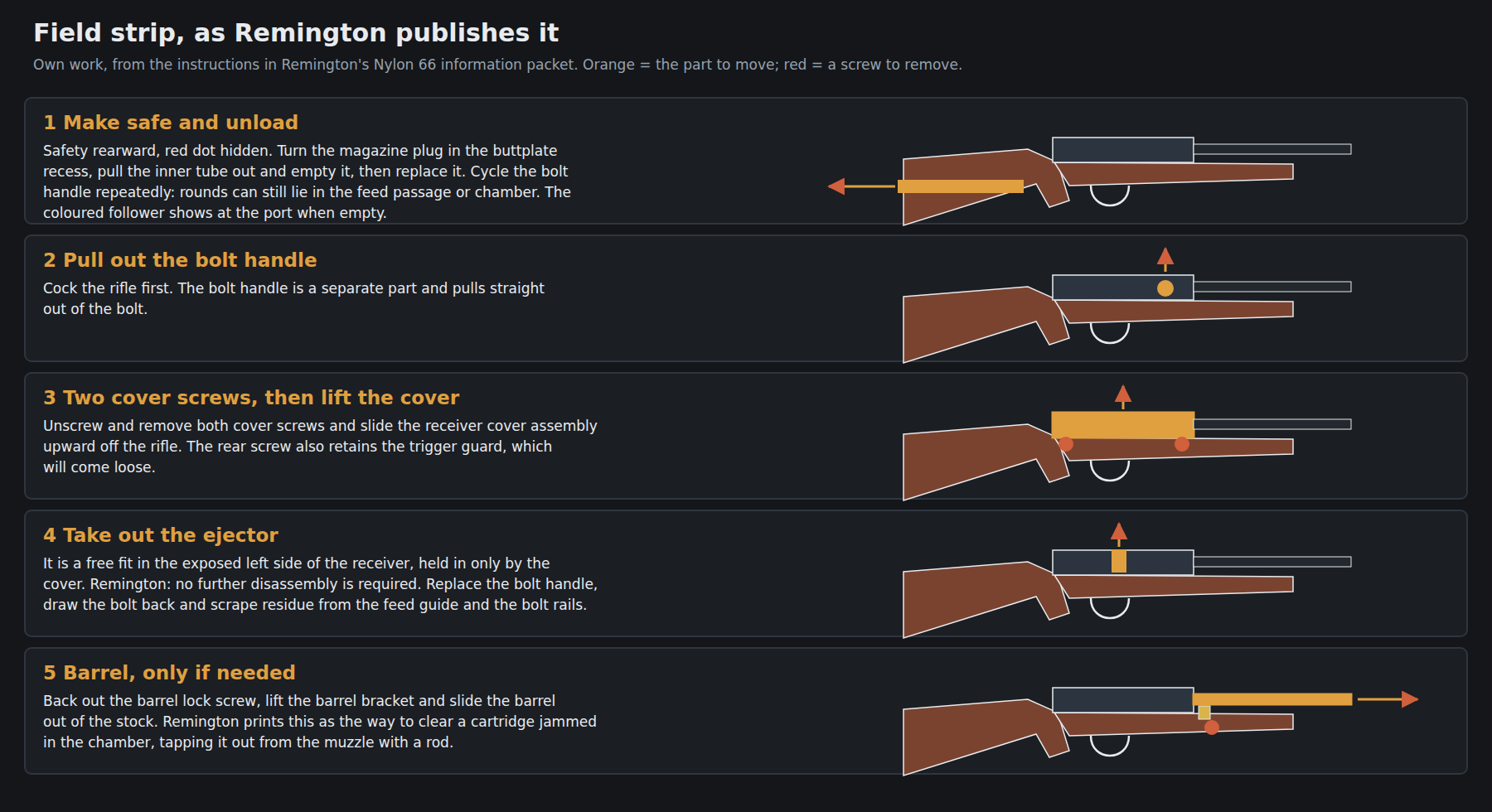
5.3 Field Strip, in Remington’s Words
Remington’s instructions treat partial disassembly as a cleaning operation, needed only “after extended shooting or when rifle is to be stored for sometime”.4 The steps, as printed:
- Make sure the rifle is unloaded. Cock the rifle and put the safety at SAFE.
- “Pull out bolt handie.” The typo is Remington’s. The handle is a separate part and simply pulls out of the bolt.
- “Unscrew and remove the two (2) cover screws and slide the receiver cover assembly upward and remove from rifle.”
- “Remove ejector from exposed left side of rifle.” It is a free fit, held in only by the cover.
- “No further disassembly is required. Replace bolt handle. Pull back bolt assembly and hold. Scrape shooting residue from cartridge feed guide and bolt rails in stock.” Clean the face of the bolt.
- Reassemble in reverse order.
The Nylon 77 folder gives the same sequence for the box-magazine rifle and adds the sentence that defines the design’s intent: “No further disassembly of rifle is recommended unless replacement of parts is required.”2
Two points that the instructions leave implicit. The rear cover screw also retains the trigger guard, which the patent states explicitly.5 Expect the guard to become loose when that screw comes out, and make sure it is seated when the screw goes back. And with the cover off, the ejector, the feed-guide spring riveted under the cover and the rear sight all leave with or from the cover; count them before and after.
5.4 Taking the Barrel Out, and Clearing a Jam
Remington publishes a barrel-removal sequence, but as part of a jam-clearing procedure. It is the remedy for the specific error of feeding .22 Short or .22 Long ammunition into a rifle chambered for Long Rifle only, which “may cause jamming of cartridge in barrel chamber. Should this occur, special care must be taken in removing jammed cartridge because of the possibility of accidental discharge.”4
- Point muzzle in a safe direction. Put safety on safe. Unload magazine.
- Pull out bolt handle. Unscrew and remove the two (2) cover screws and slide the receiver cover assembly upward and remove from rifle.
- Unscrew barrel lock screw. Lift barrel bracket upward and slide barrel out of stock.
- With muzzle of barrel pointed in a safe direction, insert a long rod into muzzle and carefully tap rearward until jammed cartridge is free of chamber.
That is the whole of the barrel mounting: one lock screw and a bracket (Volume 3). It is also how the barrel comes off for cleaning from the breech, which Marcot notes was one of the design’s conveniences.6
5.5 The Detail Strip, and Why This Dive Does Not Give You One
No manufacturer’s detail-strip procedure for the Nylon 66 was located for this dive. Remington’s own documents stop at the cover and the ejector and say that nothing further is required or recommended. The packet contains an exploded view and a numbered parts list, which are assembly references, not a sequence. The rifle’s reputation for being awkward to reassemble is consistent with that: Remington designed it to be assembled once, in a factory, “with little or no hand fitting”, and gave owners no instructions for going further.7
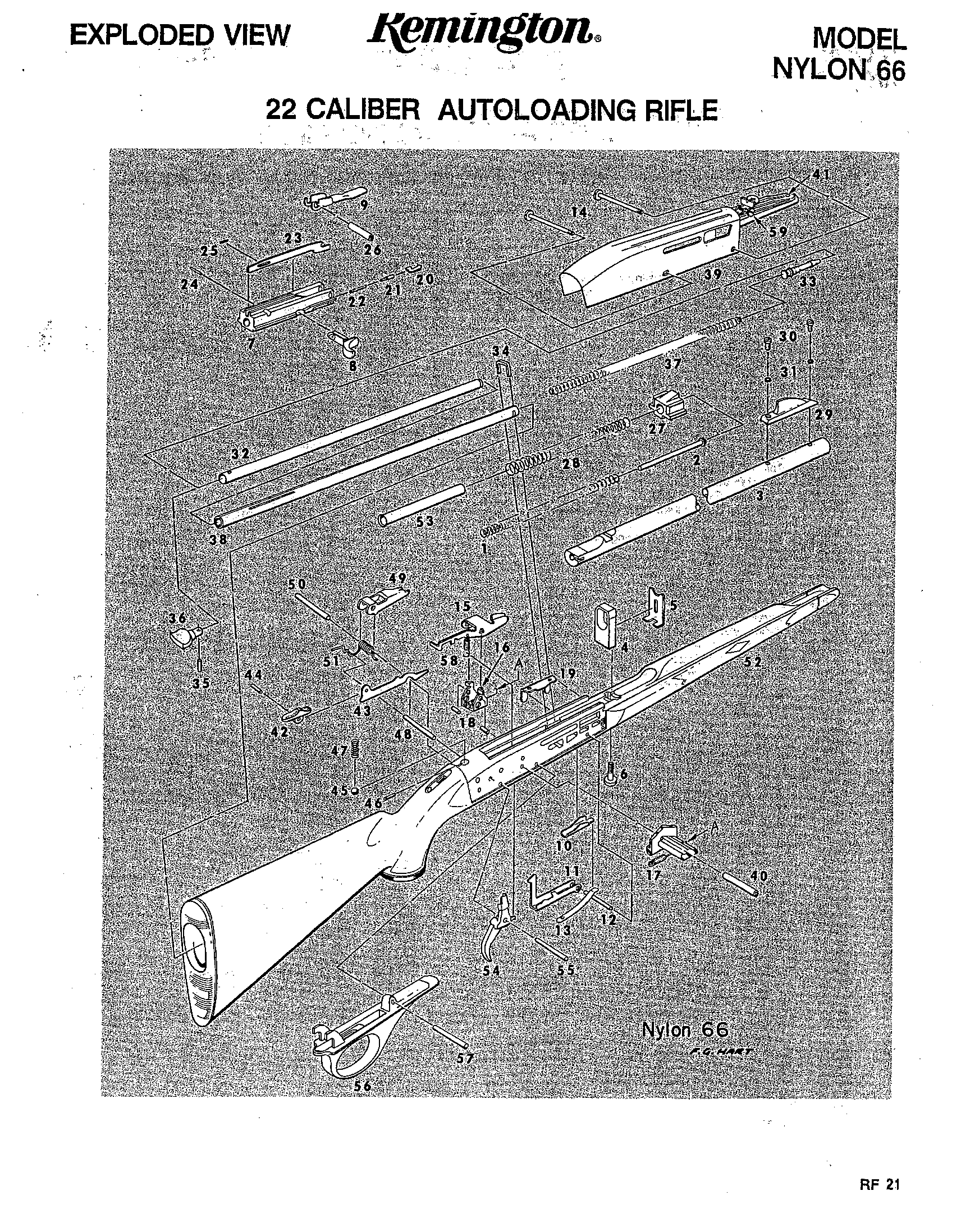
Rather than invent a sequence, here is what a correct procedure would have to account for, taken from the parts list, the patents and the published accounts. Anyone working out a strip on their own rifle should treat each of these as a place where a part will escape or a spring will launch:
- The trigger guard is structural and is retained by the rear cover screw.5 It has to come off before anything under it can be reached, and its T-shaped portion engages the moulding.
- Two springs are captive and concentric on the rear guide: the bolt-return spring inside, the striker spring outside, the latter bearing on a shoulder of the striker.5 Anything that frees the striker frees both.
- The striker spring sleeve is a separate part (53) that can be lost.8
- The safety carries a detent ball and spring (45, 47) behind it, with a retaining pin (46).8 Detent balls are the classic part to lose into a carpet.
- The firing pin is retained in the bolt by a pin (24), with its own retractor spring (25) and a stop pin (26).8
- The extractor has a plunger and spring (21, 22).8
- The cartridge feed guide is pinned in the bolt. Simmons records two versions: early guides held by “two hook-like arms” on a roll pin, later ones with two holes that fully enclose the pin.7 The pin type determines whether the guide can be removed without spreading the arms.
- The cartridge stop pivots on its own pin with a spring (11, 12, 13), and its arm has to sit in the bolt’s path when it goes back together.8
- The fire-control group is a sear-block system, not a conventional sear: the sear is free to pivot and is held only by the disconnector.7 A reassembly that leaves the disconnector out of place produces a rifle that will fire when it is jarred, which is exactly the fault the design was meant to prevent.
- Everything seats in nylon. Pins that a steel receiver would hold in shear are held by moulded bosses. Driving a pin against a plastic boss with a hammer is how a rifle acquires a crack that cannot be welded neatly.
If a rifle needs work beyond the cover, the right course is Remington’s own: “Rifle should be checked periodically by a competent gunsmith to ensure proper inspection and any necessary replacement of worn or damaged parts.”4 The exploded view in the packet is what a gunsmith will want to see.
5.6 Cleaning: What Remington Asks For
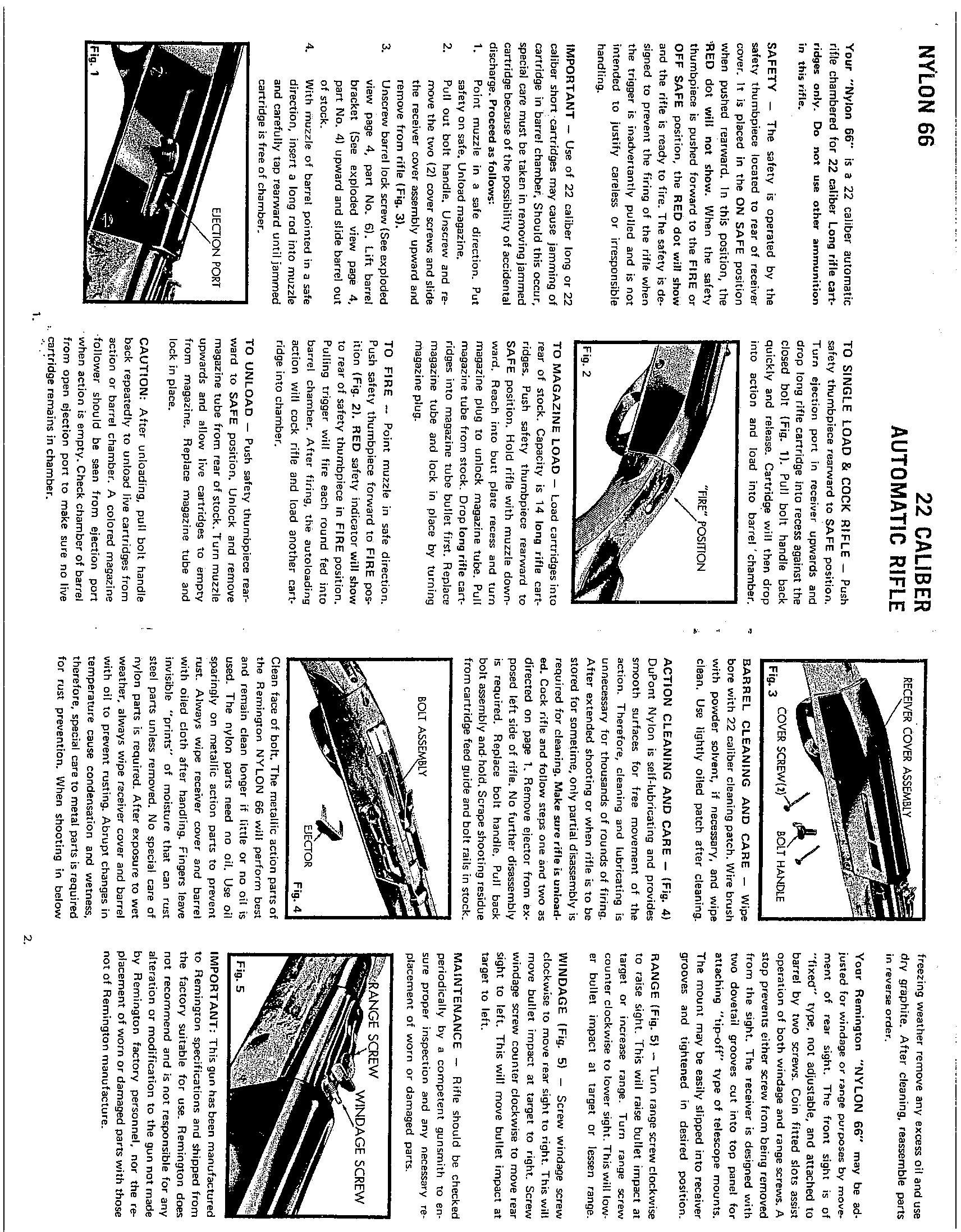
Barrel. “Wipe bore with 22 caliber cleaning patch. Wire brush with powder solvent, if necessary, and wipe clean. Use lightly oiled patch after cleaning.”4
Action. Remington’s claim and its instruction are worth reading together:
DuPont Nylon is self-lubricating and provides smooth surfaces for free movement of the action. Therefore, cleaning and lubricating is unnecessary for thousands of rounds of firing. After extended shooting or when rifle is to be stored for sometime, only partial disassembly is required for cleaning … Scrape shooting residue from cartridge feed guide and bolt rails in stock. Clean face of bolt.4
Oil. “The metallic action parts of the Remington NYLON 66 will perform best and remain clean longer if little or no oil is used. The nylon parts need no oil. Use oil sparingly on metallic action parts to prevent rust.”4 The Nylon 77 folder: “For best results do not oil Nylon parts.”2
Handling and weather. “Always wipe receiver cover and barrel with oiled cloth after handling. Fingers leave invisible ‘prints’ of moisture that can rust steel parts unless removed … After exposure to wet weather, always wipe receiver cover and barrel with oil to prevent rusting.”4
Cold. “When shooting in below freezing weather remove any excess oil and use dry graphite.”4
Inspection interval. Remington gives none. Its only statement is the periodic gunsmith check quoted above. No published service life, round count or replacement interval for any Nylon 66 part was located for this dive.
The practical reading of all this: the rifle wants to be clean and dry, not oiled. Oil on the nylon tracks does not reduce friction that is already low and does hold the grit that wears them. Simmons’s warning is the counterweight to Remington’s “unnecessary for thousands of rounds”: rifles that were never cleaned at all were “full of carbon deposits and grit and sand” and, though still working, were “subject to unwarranted wear because of the dirt”.7
5.7 What Solvents Do to Nylon
Remington’s original specification asked DuPont for a material “impervious to solvents, oils, mild acids, alkalis, fungus, rodents, and insects” (Volume 1). Zytel 101 largely delivers that, but not completely, and the exceptions are worth knowing before a bottle of anything goes near the stock. All of the following is DuPont’s own published data for unreinforced Zytel nylon 6,6.3
What nylon 6,6 shrugs off:
- “Lubricating oils and greases, and aliphatic and aromatic hydrocarbons (including conventional fuels)”: not affected. Petrol exposure for 270 days gave a weight gain of 0.6 % and a dimensional change of 0.01 %.
- Paints and lacquers, detergents and aerosol preparations; “excellent resistance to standard detergent formations” at 80 °C.
- Alkalis, “even at high concentrations up to 40%”.
- Salt water: “Unlike most metals, it is not affected by electrolytic corrosion as found in and around salt water.”
What it absorbs a little, reversibly:
- Alcohols and most chlorinated solvents. These “are absorbed in limited amounts and result in some plasticizing action resembling that of water” — the part softens slightly and grows slightly, and recovers when it dries. Acetone at 100 % for a full year at 23 °C is rated excellent with no length change.
What actually attacks it:
- Phenols and cresols. DuPont lists phenol at 90 % and m-cresol at 100 % with the comment “Solvent for nylon”.
- Formic acid (“Solvent for many nylons”), trichloroacetic acid and some fluoroalcohols.
- Strong mineral acids and oxidising agents, “especially at high operating temperatures”. Acetic acid “slowly attacks” it.
- Certain salts: calcium chloride “stress cracks at high temperature”, and “such salts as calcium thiocyanate, calcium bromide, calcium chloride, potassium thiocyanate and zinc chloride are known to have solvent action … particularly in high (50–80%) concentrations”. DuPont singles out zinc chloride as “especially harmful to 66 nylons such as ZYTEL 101” where the part is under stress — and the fore-end of a Nylon 66 is under stress, clamped by a cross-bolt.
How to use that. No gun-care product was tested for this dive, and none is named. The useful rule is that the classes to keep off the stock are phenolic compounds, strong acids, strong oxidisers and chloride salts, and the way to check a specific product is its safety data sheet, not its marketing. Ordinary hydrocarbon-based bore solvents, oils and degreasers are within what DuPont says the material tolerates. The same caution applies to rust-removal and bluing chemicals, which are acidic by design, and to any soak in an ultrasonic tank: the tank’s heat matters as much as its chemistry.
It is also worth noting what Remington itself says: powder solvent is prescribed for the bore, with the barrel out of the stock if necessary, and nothing is prescribed for the nylon at all.4
5.8 Heat, Water and Sunlight
Heat. Nylon 6,6 softens long before steel does. The specification asked only for “high resistance to heat distortion”, not immunity. The practical consequences are a warning against leaving a rifle in a closed car in summer, against paint-stripping heat guns near the stock, and against any hot-tank process.
Water. Nylon takes up water from the air and grows: about 2.8 % water and 0.6 % dimensional increase at 50 % relative humidity, about 8.5 % and 2.6 % at 100 %.3 The process is reversible and slow — about 125 days for a thin specimen to equilibrate. A Nylon 66 is not humidity-proof; it is humidity-tolerant, and its dimensional changes are small, slow and reversible instead of the grain-following warp of a wooden stock. Moisture also makes the material tougher, not weaker, in impact; a bone-dry rifle is the brittle one.
Sunlight. This is the real enemy of a display rifle. DuPont’s Florida exposure data for unstabilised Zytel 101 shows tensile strength falling from 73 MPa to 37 MPa in six months and elongation from 300 % to 10 %.3 Remington’s pigment and stabiliser package is not documented, and a black light-stabilised grade in the same table held its properties far better, so the numbers cannot be applied to a Mohawk Brown stock directly. The direction is clear enough: keep these rifles out of sunlit windows.
5.9 What Wears and What Breaks
Remington published no wear list, so this is assembled from the design, the parts list and documented failures.
Table 1 — What Wears and What Breaks
| Part | Why it matters | Evidence |
|---|---|---|
| Moulded bolt and striker tracks | The rifle’s bearing surfaces. Grit in the tracks is the wear mechanism that matters, and they cannot be replaced without replacing the stock. | Design; Simmons on dirty rifles.7 |
| Cartridge feed guide and its spring under the cover | Loss of spring tension gives partial chambering. Simmons cured a chronic jam by replacing the whole cover assembly and blamed the cover-mounted feed-guide spring.7 | Simmons’s own two rifles. |
| Magazine tube, spring and follower | Dents in a thin inner tube stop the follower; the tube is removed for every reload and gets dropped. | Design; Remington’s loading procedure.4 |
| Box magazines (77, 10C, Apache 77) | Almost entirely plastic, with only a spring and a small metal U-clip at the lips.7 Broken feed lips are common in the auction record. | Rock Island Auction lot descriptions: “Included magazine has broken piece”; “a magazine that is broken and disassembled”; “Magazine absent”.9 |
| Extractor, plunger and spring | Needed for hand-extraction of a live round, not for firing.7 | Simmons’s removal test. |
| Firing pin and its springs | Rimfire pins chip if the rifle is dry-fired on an empty chamber. | General rimfire practice; the hub’s .22 Rimfire dive covers dry-firing. |
| Cover screws and their headed sleeves | The only fasteners holding the action shut, threaded into inserts in plastic.5 | Patent; see below. |
| The stock itself | Cracks. See below. | Conner’s 1958 drop test; auction lots.69 |
5.10 Diagnosing the Common Malfunctions
Table 2 — Diagnosing the Common Malfunctions
| Symptom | First checks | Source |
|---|---|---|
| Cartridge stops part-way into the chamber, perhaps one round in twenty-five | Feed-guide tension from the spring under the cover; the guide’s pin and arms; residue on the feed ramp and bolt face | Simmons’s Mohawk 10C, cured by a new cover assembly7 |
| Fails to feed from the magazine at all | Magazine tube dents, weak or wrongly seated magazine spring, follower jammed, tube not locked by the plug | Remington’s loading instructions4 |
| Short-stroking or failure to eject with weak ammunition | Fouled tracks; standard-velocity ammunition in a rifle set up for high velocity | Simmons on a new rifle short-cycling standard ammunition7 |
| Cartridge jammed in the chamber | Wrong ammunition: .22 Short or Long in a Long Rifle chamber. Clear it by Remington’s procedure, above | Remington4 |
| Rifle fires when jarred, or doubles | Stop shooting. This is a fire-control fault: the disconnector and sear block are what prevent jar-firing | Simmons on the sear block7 |
| Point of impact shifts with a scope fitted | The scope sits on a stamped cover over a plastic receiver; a rigid grip moves it | Marcot and Simmons67 |
| Case heads marked, split or the case sticking | A bore or chamber problem; note the breech’s two gas-relief cuts are there for a ruptured case | Simmons7 |
5.11 Cracked Stocks
The stock is the receiver, so a cracked stock is a cracked receiver. Remington’s guarantee of 1959 to 1969 promised to replace any stock that would “warp, crack, chip, fade or peel”, free, for the life of the rifle.6 That guarantee is long gone and so is the supply of stocks.

What is known about the structure, from Volume 3: two moulded halves joined on a tongue-and-groove seam along the centreline, “cemented” or “autogenously welded” in the patent’s words, and clamped by cross-bolts under the diamonds and under the cover.5 Cracks therefore have two natural paths — along the bonded seam, and out of the thin sections around the fore-end and the grip.
What can be done, and what the sources actually support:
- Nylon can be welded, and DuPont’s own handbook names the chemicals that dissolve it: “Phenols and formic acid are powerful solvents and are used in certain bonding techniques.”3 The patent’s alternative was a solvent cement applied to the tongue or groove.5 Both of those are professional processes with real hazards; phenol and formic acid are corrosive and toxic.
- Ordinary adhesives are a poor bet on nylon, which is why DuPont’s bonding note points at solvents rather than glues.
- A cracked Nylon stock is not a cosmetic repair. It holds the bolt tracks, the barrel cradle and the recoil shoulders. A repair that leaves the tracks out of line or the cradle distorted produces a rifle that will not run, or will not shoot straight.
- The rifles tolerate more than they look as if they will. Conner cracked a fore-end by dropping a prototype on concrete in 1958 and the rifle “functioned flawlessly both before and after that incident”.6 That is one data point on one prototype, not a licence to shoot a cracked receiver.
The conservative course on a cracked stock is a gunsmith with plastics-welding experience, or retirement of the rifle to display. Given what complete rifles trade for (Volume 7), a donor rifle is often cheaper than a repair.
5.12 Cover Screws, Sleeves and the Trigger Guard
Two screws hold the cover on, and they are the fasteners an owner touches most. The patent describes them as “a pair of cover retaining screws 66 threadably engaging headed sleeves 67”, with the rear one also retaining the trigger guard.5 Remington’s parts list carries a rear cover screw bushing (40) and a rear cover screw lug, and separate cover screws for the blued and the Apache Black rifles.8
The failure mode follows from the construction: the threads are in a metal sleeve that is itself seated in nylon. Overtightening does not strip a steel receiver; it works the sleeve in its moulded seat. The practical rules are to tighten the screws firmly and no more, to make sure the trigger guard is seated before the rear screw is run home, and to treat a cover screw that turns without tightening as a sleeve problem rather than a screw problem.
5.13 Parts Availability Now
Remington itself gave up on the model decades ago. The note at the head of its own parts list says so:
This firearm is no longer produced by Remington. therefore, parts may no longer be in production and may not be available from our production facilities.8
Two further points from that list. The receiver cover assembly is marked “Restricted”, which is Remington’s designation for a part it would not sell across the counter, and after 1967 the cover is the serial-numbered part (Volume 7). And a long tail of parts is marked obsolete even in a document written while the company still existed, including every Gallery Special part, the sling fittings and the magazine tube assembly.
The Nylon 77 folder’s older promise gives the contrast: “Parts will be furnished for discontinued models … as long as the supply is available”, with a warning that parts “are made to close dimensions” and “the particular part may require slight adjustment or fitting”.2 That was the 1970s. Today the sources of supply are the used market, complete donor rifles and parts dealers. Numrich Gun Parts lists a Remington Nylon 66 parts category on its site, though its stock list is loaded dynamically and could not be read for this dive, so no claim is made here about which specific parts are in stock or what they cost.10 Prices and availability should be checked directly, and dated when recorded.
The part that cannot be bought at any price is the one that matters most: the moulded stock that is also the receiver. Remington’s moulds were worn out by 1988 and were not replaced (Volume 2). Every Nylon 66 in circulation is running on a part nobody makes.
References
Footnotes
-
Remington Arms Company, Nylon 66 information packet (Madison, NC), containing the Ten Commandments of Shooting Safety, the “Nylon Series of 22 Rimfire Rifles” table, the instructions quoted here, the exploded view (RF 21) and parts list (RF 22). Archived PDF: https://web.archive.org/web/20110910092323/http://www.remington.com:80/~/media/Files/Owners-Manuals/Nylon%2066.ashx , retrieved 2026-09-19. ↩
-
Remington Arms Company, “Nylon 77 Automatic Rifle · Instruction Folder and Parts List” (Ilion, New York). Archived PDF: https://web.archive.org/web/20110909062648/http://www.remington.com:80/~/media/Files/Owners-Manuals/Nylon%2077.ashx , retrieved 2026-09-19. ↩ ↩2 ↩3 ↩4
-
DuPont, “Minlon and Zytel Design Information – Module II” (2001), sections 1, 3 and 5, including the chemical-resistance discussion, Table 5.12 and the Florida weathering table. Archived: https://web.archive.org/web/20151016093431/http://www.dupont.com/content/dam/dupont/products-and-services/plastics-polymers-and-resins/thermoplastics/documents/Zytel/Minlon%20Zytel%20Design%20Info%20Module%202.pdf , retrieved 2026-09-19. The handbook describes current grades; the 1950s compound may have differed. ↩ ↩2 ↩3 ↩4 ↩5
-
The operating, cleaning and care instructions within that packet. ↩ ↩2 ↩3 ↩4 ↩5 ↩6 ↩7 ↩8 ↩9 ↩10 ↩11 ↩12 ↩13
-
W. E. Leek and C. H. Morse, US Patent 3,023,527, issued 6 March 1962. https://patentimages.storage.googleapis.com/pdfs/US3023527.pdf . ↩ ↩2 ↩3 ↩4 ↩5 ↩6 ↩7
-
Roy Marcot, “The Remington Nylon 66”, American Rifleman, 27 August 2009, including the stock guarantee text and Delbert Conner’s February 1958 field report. Archived: https://web.archive.org/web/20150303174642/http://www.americanrifleman.org:80/articles/2009/8/27/the-remington-nylon-66 . ↩ ↩2 ↩3 ↩4 ↩5
-
Donald M. Simmons, “Those Plastic Remingtons”, The Gun Digest, 45th Edition (1991), including his two Mohawk 10Cs, the extractor test and the feed-guide variants. Archived scan: https://web.archive.org/web/20100524123435/http://www.nylonrifles.com/Nylonpdf/PlasticRems.pdf . ↩ ↩2 ↩3 ↩4 ↩5 ↩6 ↩7 ↩8 ↩9 ↩10 ↩11 ↩12 ↩13
-
The parts list (sheet RF 22) within that packet; view numbers in parentheses are Remington’s. ↩ ↩2 ↩3 ↩4 ↩5 ↩6 ↩7
-
Rock Island Auction Company lot pages, retrieved 2026-09-19: 2017/531 (“Stock is cracked”), 2095/601 (“Included magazine has broken piece”), 5025/192 (“a magazine that is broken and disassembled”), 5002/114 and 1048/803 (“Magazine absent”). ↩ ↩2
-
Numrich Gun Parts Corporation, Remington Nylon 66 parts category, https://www.gunpartscorp.com/gun-manufacturer/remington/rifles/nylon-66 , page retrieved 2026-09-19. Only the existence of the category is asserted; the product listing is rendered client-side and was not read. ↩
Comments (0)