Remington Nylon 66 · Volume 1
Origins — DuPont, Zytel 101 and the Model 555
How a chemical company's control of a gunmaker produced the first mass-market rifle whose receiver is plastic: the cost problem, the twelve-point material specification, the patents, the prototype and the name
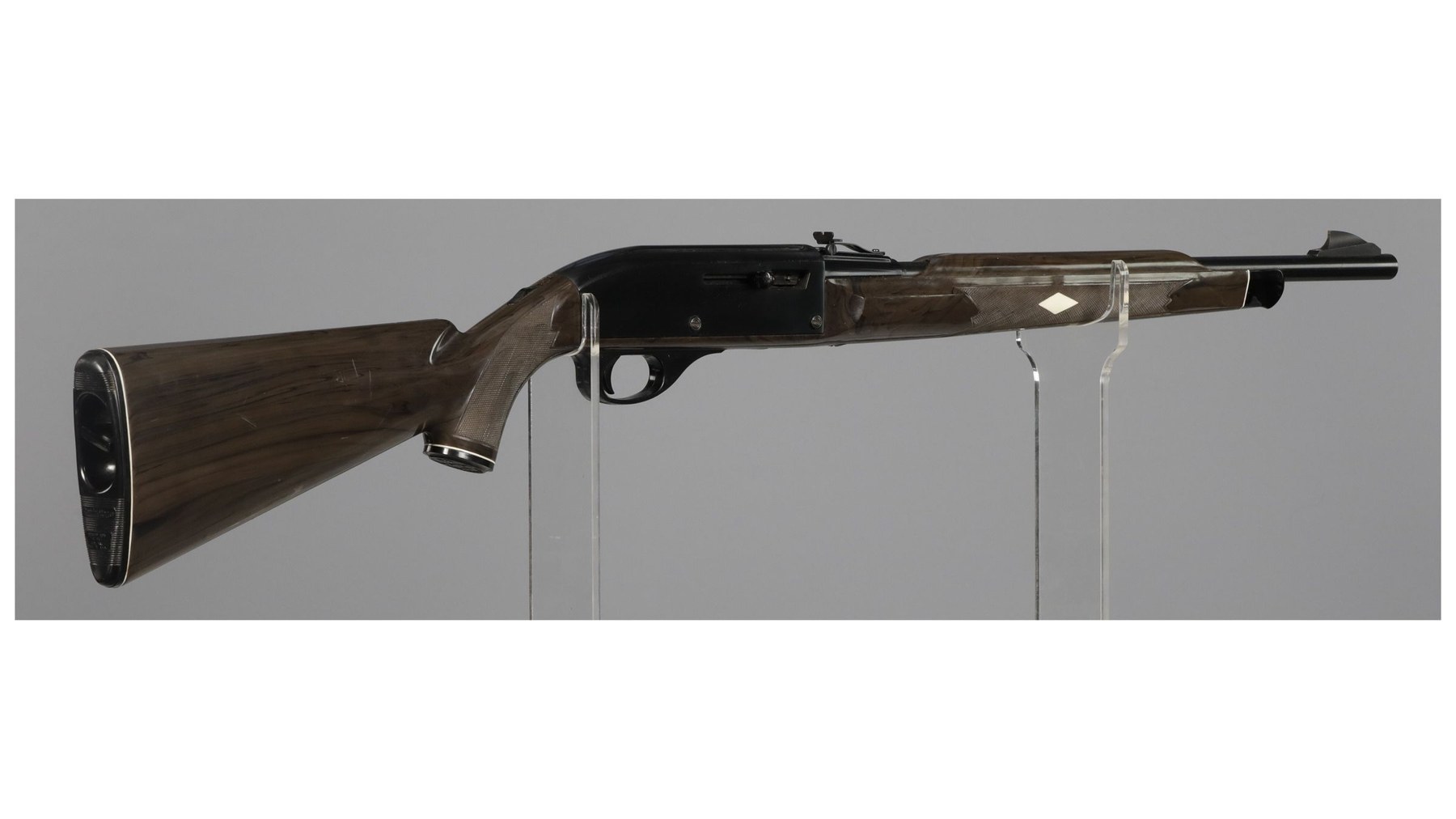
The Remington Nylon 66 was a .22 Long Rifle autoloader made at Ilion, New York, from late 1958 until the late 1980s. Its stock and receiver were one hollow moulding of DuPont’s Zytel 101 nylon. The steel bolt slid in grooves moulded into that nylon, and a thin pressed-steel cover over the top hid the arrangement. Remington’s own model history gives the total as “approximately 1,050,350”.1 It was not the first firearm with a plastic stock, but it was the first mass-market rifle in which a plastic did the work of the receiver.
This volume covers how that happened: a gunmaker controlled by a chemical company, a cost problem, a written specification for a material, two patents, a prototype machined from bar stock, and three years of field trials. The mechanism is in Volume 3, and the family of rifles that grew from the design is in Volume 4.
1.1 What the Nylon 66 Is
The rifle is a straight blowback .22 with a 19½-inch barrel. Its 14-round tubular magazine runs through the buttstock and loads from the buttplate. It weighed about 4 lb 8 oz.2 The whole stock, from buttplate to fore-end tip, is two injection-moulded nylon halves joined along the centreline. The middle of that moulding is the receiver: it holds the bolt, the striker, the fire-control group and the barrel. A blued steel cover slips over the top. It carries the rear sight and the scope grooves, and it hides the fact that there is no steel receiver underneath.3
That last point is what sets the Nylon 66 apart from the other plastic-stocked guns of its decade. Simmons, writing in the 1991 Gun Digest, made the comparison directly. The ArmaLite AR-7 of 1959 also had a plastic stock, but its bolt ran in a die-cast metal receiver, and “the size of the mould required to make the entire Remington stock is much larger”. Winchester’s Model 270 of the early 1970s used a Cycolac plastic stock and fore-end only.3 The hub’s XP-100 dive covers the pistol that Remington built on the same material in 1963. Its Zytel stock holds an action; it is not the receiver.
1.2 DuPont and Remington
E. I. du Pont de Nemours & Company took control of Remington Arms in 1933. American Rifleman’s 2009 history, by Remington historian Roy Marcot, calls it “DuPont’s control of Remington (since 1933)”.2 Simmons describes it more colourfully: in the spring of 1933, the depth of the Depression, DuPont “took a sick Remington Arms Company under its wing”. At the time Remington was making guns, controlled a large ammunition company, and “had been dabbling in such things as cash registers, typewriters, and pocketknives”. DuPont sent managers to Ilion. Their first job was modernising the existing line, which produced the 1936 renamings of the Model 24 as the 241, the 12 as the 121, the 14 as the 141 and the 8 as the 81.3
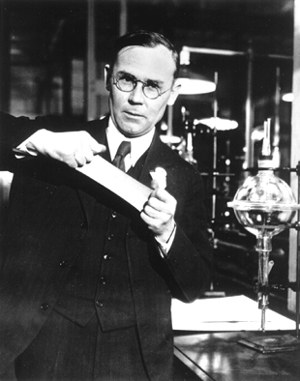
For the Nylon 66, the relationship mattered in two ways. DuPont owned nylon. Marcot’s account: at an R&D laboratory DuPont called Purity Hall, “the efforts of Gerald Berchet and Wallace Carothers resulted in 81 new polyamides in 1935”, from which polyamide 6-6 was chosen, at first called “Fiber 66”. It also had the moulding know-how to turn a resin into a large structural part. Marcot is explicit that the ownership “provided a resource for the new synthetic rifle stock”. American Rifleman’s 2026 television segment puts it more bluntly: Remington “decided that it would make use of its relationship with DuPont Company, which was, of course, a major chemical conglomerate at the time and also happened to own Remington Arms at this period.”4
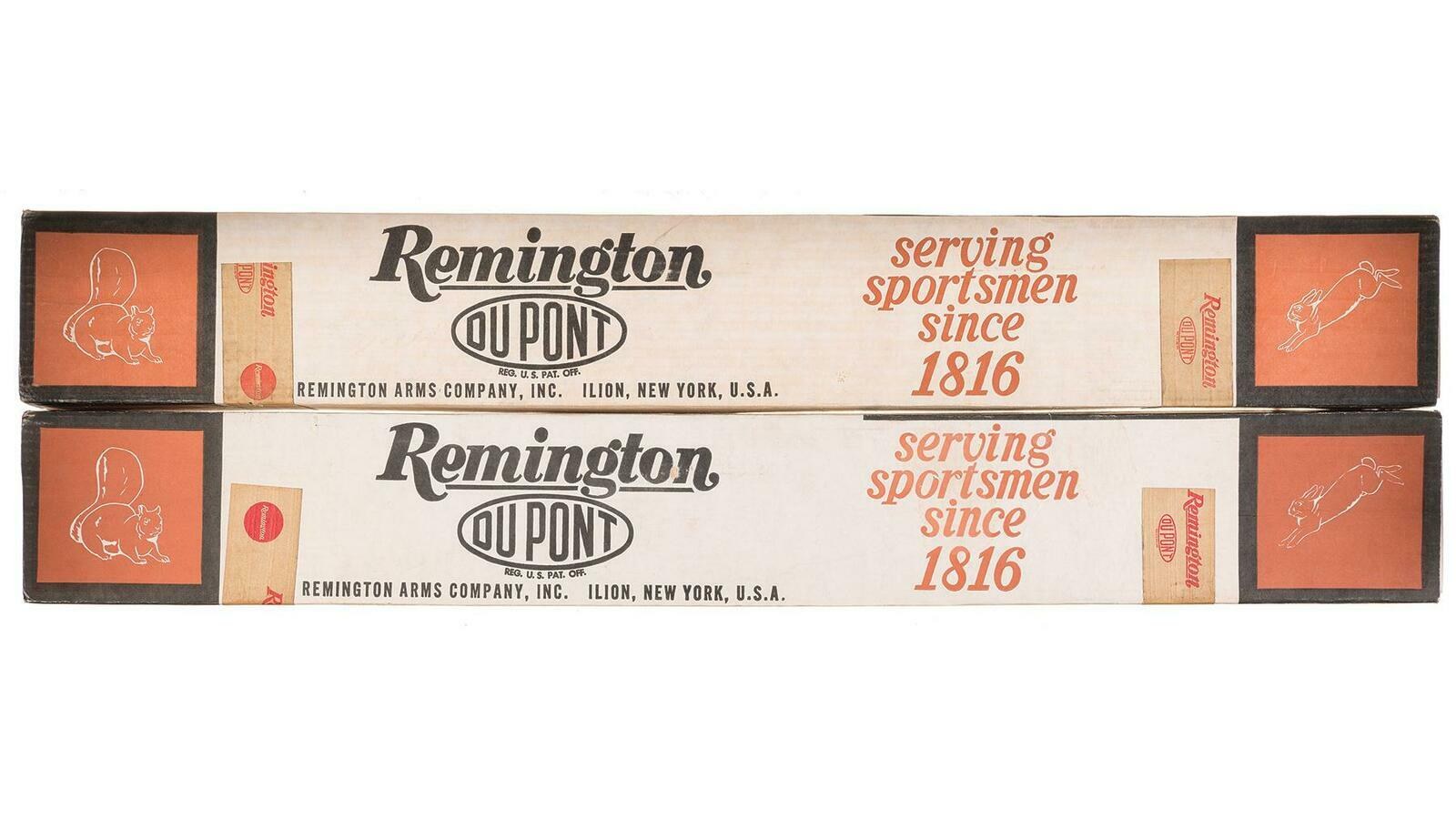
The factory cartons of the period show the connection plainly. The carton at the head of this volume prints an oval DuPont logo under the Remington script. Remington did not describe the rifle as a chemistry demonstration. DuPont’s name went on the box anyway.
1.3 The Cost Problem
The Nylon 66 began as a costing exercise, not a styling one. Marcot’s account, which follows the company’s own records:
In the early 1950s, Remington Arms Co. did not have a mid-priced .22-cal. semi-automatic rifle. Management knew that there were three high-cost components of any sporting arm – the barrel, receiver and stock. Engineers analyzed each to see if any significant cost savings could be obtained. They soon concluded that barrels did not offer much opportunity for savings, so they focused on the receivers and stocks.2
A conventional .22 autoloader of the time needed a machined steel receiver, a walnut or hardwood stock inletted to it, and hand fitting where the two met. Combining receiver and stock into one moulded part removed a whole class of machining and fitting operations. Simmons reports that one of the design’s main advantages “from a manufacturer’s point of view was that the gun could be assembled with little or no hand fitting”, and that trigger pulls were excellent regardless.3 Remington’s own patent claims the same advantage. The moulded stock assembly houses all the working parts “without the requirement for any fitting or selective assembly of any part”.5
Simmons also places the rifle within a post-war Remington philosophy of “having an entire line of firearms sharing a large number of parts and even sharing in common some of the more complicated subassemblies”.3 The Nylon 66 pursued the same goal by a different route. Where the family-of-guns approach shared parts between models, the Nylon removed parts altogether.
1.4 Twelve Requirements for a Material
Remington then asked DuPont for a material. The written specification survives in two published accounts, Simmons in 1991 and Marcot in 2009, and they agree word for word. Simmons numbers the requirements:3
- It must be capable of forming any shape desired.
- It must have a high tensile impact and flexural strength.
- It must have high abrasion resistance.
- It must have high resistance to heat distortion.
- It must be resistant to cold temperatures.
- It must, if exposed to a flame, not continue to burn when that flame is removed.
- It must be impervious to solvents, oils, mild acids, alkalis, fungus, rodents, and insects.
- It must have a finish that is easy to repair.
- It must be light in weight.
- It must hold permanent colors.
- It must have no corrosive effect on other parts.
- It must be self-lubricating and dimensionally stable.
Two of these requirements decided the design. Item 1 (“any shape desired”) made the one-piece stock-and-receiver possible. Item 12 (“self-lubricating”) meant the steel bolt could run directly in plastic grooves without metal bearing inserts. Item 7 is the one a modern owner should read carefully: “impervious to solvents” was the requirement, and DuPont’s own data show that nylon 6,6 met it for most solvents but not all. Volume 5 gives the exceptions.
Marcot reports that “in less than four months, DuPont’s engineers came back to Remington with Nylon Zytel-101.”2
1.5 Zytel 101 and the Chemistry Behind the Name
Zytel is DuPont’s trade name for its nylon moulding resins, and Zytel 101 is the basic unreinforced grade. DuPont’s current design handbook still describes it: the 101 grades “are 66 nylons made by the polymerization of hexamethylenediamine and adipic acid, each of which contain six carbon atoms.”6 The two sixes give the polymer its name, nylon 6,6. DuPont’s summary of the material’s character reads like Remington’s specification answered point by point: an “outstanding balance of properties – combining strength, moderate stiffness, high service temperature and a high level of toughness”, particular resistance to repeated impact, “low coefficients of friction and excellent resistance to abrasion”.6
The same handbook states the material’s limits, and the rifle’s later life depends on them:
- It takes up water. “66 nylon equilibrates at about 2,8% water at 50% RH and at about 8,5% at 100% RH”, which “increases dimensions of 66 nylons by 0,6% at 50% RH and about 2,6% at 100% RH”. The process is reversible and slow: a 1.5 mm specimen takes about 125 days to reach equilibrium.6 Nylon does not warp the way walnut does, but it is not dimensionally inert.
- It is not immune to chemicals. Nylon 6,6 resists “fuels, lubricants and most chemicals, but [is] attacked by phenols, strong acids and oxidizing agents.”6
- It is not immune to sunlight. “Natural and pigmented ZYTEL nylon resins have only moderate resistance to the effects of sunlight.”6
Remington’s patent, filed in 1956, names the material directly: “we prefer … to utilize one of the thermoplastic synthetic long-chain polyamide materials known as nylon—for example, that identified by the trademark ‘Zytel’ manufactured by the Du Pont Company which is available in a wide variety of stable colors.”5 The patent also records what was rejected. It lists Marbon’s Cycolac and Dow’s Styron 475 among materials that “may, with such design changes, be considered as alternatives”. Some of those alternatives had friction and galling characteristics that would “require the incorporation of metallic bearing surfaces”. Teflon worked but was “still too expensive and/or difficult to mold.”5 Nylon was the material that let the plastic itself serve as the bearing.
1.6 The Patents
Two United States patents cover the rifle. Both were assigned to Remington and both issued in the spring of 1962, three years after the rifle went on sale. Simmons identified them in 1991,3 and the texts were read for this dive from the Patent Office images.
Table 1 — The Patents
| Patent | Inventors | Filed | Issued | Title and subject |
|---|---|---|---|---|
| US 3,023,527 | Wayne E. Leek (Ilion, NY) and Charles H. Morse (Herkimer, NY) | 5 January 1956 (original application, later continued) | 6 March 1962 | ”Firearm Having Receiver Bearing Surfaces of Synthetic Resinous Material”. The one-piece moulded stock that is also the receiver, with integral guideways for the bolt. |
| US 3,027,811 | Homer W. Young (Ilion, NY) | 29 April 1958 | 3 April 1962 | ”Fire Control Mechanism for Reciprocating Bolt Firearms”. The sear-block disconnector built from sheet-metal stampings. |
The three names match Remington’s own model history, which lists the designers as “W.E. Leek, C.H. Morse, H.W. Young”.1 Marcot calls Wayne Leek “Remington’s primary gun designer of the day”.2 The hub’s XP-100 dive records that Leek was also behind that pistol.
The Leek–Morse patent describes the stock assembly in the terms the rifle was actually made to. It divides the moulding into three portions, buttstock, receiver and forestock, “used in the sense of their normal definitions referring to firearms”. It proposes “that a full length stock assembly be molded of a suitable thermoplastic or thermosetting resinous material, with recesses provided in the molded stock assembly to accommodate the barrel and to guide and support all of the necessary functional parts normally guided and supported by or secured to a conventional receiver.”5 The claims turn on a bearing surface of “long chain synthetic linear polyamide characterized by low friction, anti-galling and self-lubrication”.
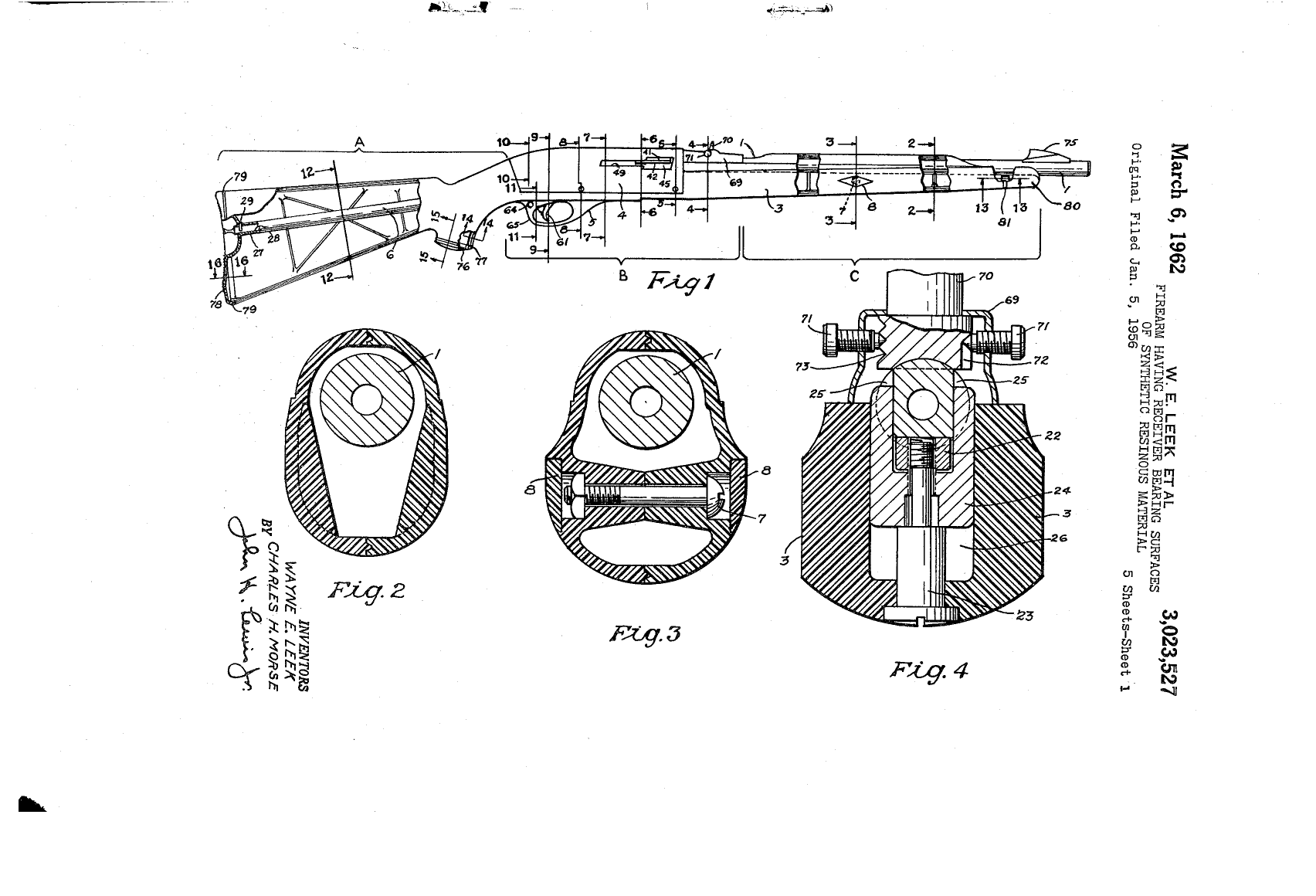
Simmons read both patents closely and noted several differences from the production rifle. The drawings show no cartridge feed guide, “because, obviously, it had not yet been found necessary to the smooth feeding of the autoloading rifle”. The patents show the designers undecided between a cross-bolt safety and a tang safety; production used the tang. The patented rear sight had a “double screw-adjustable windage setup” that production replaced with something simpler.3 He also reports a design patent in the names of Robert P. Kelly, James S. Martin and Wayne E. Leek. Its number could not be found for this dive.
The Leek–Morse patent also shows that the family was planned from the start. It says the design could be simplified to “an autoejecting single shot bolt” rifle, and that “any suitable means for locking the breech bolt directly to the rear end of the barrel will permit the production of positively locked breech loading firearms of either single shot or magazine fed types”.5 Those are recognisably the Nylon 10 single shot and the locked-breech Nylon 76 lever action, both introduced in 1962, the year the patent issued.
1.7 The Model 555 Prototype
The first working rifle was not moulded. “Because of mould cost,” Simmons writes, “the first model was not moulded; instead, a nylon prototype was machined out of bar nylon, and this amazing rifle was able to be fired 75,000 times.”3 Marcot gives the date and the result more exactly. An internal memo of 7 July 1955 reported that “a preliminary action design had been completed as a cooperative project with DuPont Polychemicals Dept., and a prototype of the new plastic-stocked rifle had been built.” That prototype “was then tested by firing 75,000 rounds with a malfunction rate of only 0.005 percent.”2
Marcot’s description of the prototype already contains every defining feature of the production gun: “two hollow nylon pieces that were fused together to form the completed stock”, and a centre section “covered by a low-cost, formed-steel metal cover – giving it the appearance of a more conventional gun with a steel receiver”.2 From the first prototype, the steel cover was meant to look like a receiver. Volume 6 takes that decision further.
Development continued through the summer and autumn of 1955. Marcot reports testing “to ensure there would be no distortions during molding and that stock shrinkage would not occur after the rifles were assembled”, and cost problems that did not go away. Outside vendors’ parts came in late and dearer, and management kept changing the projected production quantity, which changed the unit cost of parts.2 The requirement stayed fixed throughout: “the new rifle had to sell at no more than other mid-level .22 rifles on the market”.
1.8 Field Trials, 1955 to 1958
Remington’s answer to the question of whether shooters would buy a plastic gun was reliability evidence. Marcot describes “the most extensive field-testing program it had ever attempted, conducting tests almost continuously in late 1955, 1956, 1957 and into 1958. Hundreds of thousands of rounds were fired.”2
The best-documented trial is from January 1958. Each Remington sales representative received two prototypes, one “in olive drab green (later renamed Seneca Green) and one in walnut (later renamed Mohawk Brown)”. Each was to fire at least 1,000 rounds through each gun under adverse conditions and return them within 30 days. On 23 February 1958 a salesman named Delbert Conner sent Wayne Leek a four-page report. It began:
My first impression of these guns was, that they were just toys – or maybe air rifles for Buck Rogers. I doubt that the color or material will make much difference on the first showings. The public will refer to them as plastic.2
Conner then did his best to break them. He fired 2,000 rounds of assorted ammunition, holding the guns upright, upside-down and sideways, and fanned the trigger until one barrel was too hot to touch. He fired in a windstorm with blowing sand. He drove his station wagon over one, front and rear wheels. The next morning he took it out on a lake, lowered it fully loaded to the bottom on a string, pulled it up, drained it and fired 100 rounds without a malfunction. He cracked the front of one stock by deliberately dropping the gun onto a concrete sidewalk, and it worked before and after. His summary: “Looks like a plastic toy - performance and accuracy unbelievable.” He returned the rifles to Ilion with a request: “I would surely like to have one back – charged to my sample account – if and when available.”2
“Buck Rogers” in a salesman’s first sentence is worth noting. It shows that the rifle read as science fiction to the people selling it a year before it was sold. Volume 6 takes up that point.
1.9 Bearcat, 555, Nylon 66: the Name
The project’s working designation was Model 555, and Marcot reports that “a few of the early, prototype guns carrying the barrel stamp ‘Model 555’ have surfaced.” The first proposed nickname was Bearcat. It was dropped because Sturm, Ruger & Co. introduced its Bearcat revolver in 1958. On 2 May 1958 the designation became Nylon 66, and management gave final approval for introduction on 17 December 1958.2
Why “66” is disputed, and there are three published answers:
- The polymer. Wikipedia’s article says the name “was taken from the polymer of the same name”, that is, nylon 6,6.7 This fits the chemistry: Zytel 101 is a nylon 6,6.
- A colour number. Simmons, who corresponded with Remington staff for his 1991 article, gives a more specific account. Zytel 101 “only came in basic colors like red, blue, black and yellow but the engineers at Remington found that they could mix these colors and arrive at a wood-like shade. The wood-colored mixture was called Number 66, thus the name of the rifle.” He adds that “Remington calls Color Number 66 ‘Mohawk Brown.’”3
- Unknown. Marcot, the company’s historian writing in 2009, says only: “Just why Remington changed the model designation from Model 555 to Nylon 66 is not known.”2
The first two are not necessarily in conflict. A colour mixture of nylon 6,6 could have been numbered 66 because of the polymer. No company document settling the question was located, so the dive leaves it open.
1.10 Launch
According to Simmons, production began in November 1958.3 Marcot reports that “approximately 4,450 production Nylon 66s were made in late 1958 for shipment after the first of the year” and that the January 1959 retail price was $49.95.2 Remington’s own model history gives 1959 as the introduction year.1
That price put the new rifle in the middle of Remington’s own .22 autoloader line. The ageing Model 550-1 sold for $46.75 and the Model 552 for $52.25.2 It was not a budget gun. It was a mid-priced rifle made on a cheaper process, which left the margin with Remington. For comparison, the hub’s Ruger 10/22 dive records the field in 1964: a Nylon 66 at $54.95 against a 10/22 in the middle of the market.
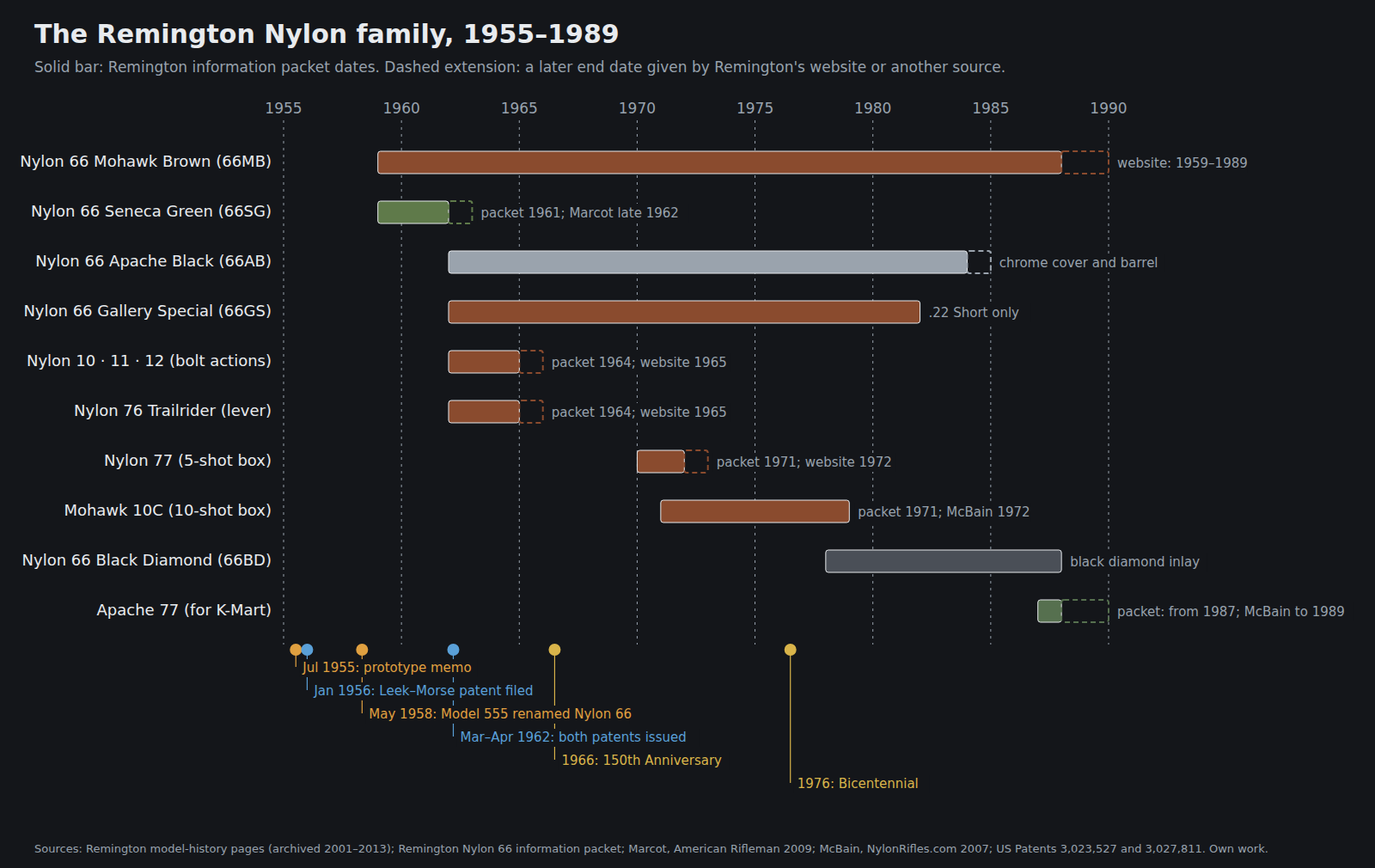
1.11 A Timeline of the Family
The Nylon 66 became the parent of a family of eight models over thirty years. The dates in Remington’s own documents do not agree with one another, and the disagreements are set out in Volume 4. The timeline below uses Remington’s model-history pages where they give dates and marks the conflicts.
References
Footnotes
-
Remington Arms Company, “Nylon 66 Autoloading Rimfire Rifle”, model history page (Introduction Year 1959; Year Discontinued 1989; Total Production “Approximately: 1,050,350”; Designer/Inventor “W.E. Leek, C.H. Morse, H.W. Young”; Serial Number Blocks 00001–2600000). Archived versions of 19 June 2001, 8 December 2007 and 16 December 2012: https://web.archive.org/web/20121216202834/http://www.remington.com/products/archived/rimfire/autoloading/nylon-66.aspx , retrieved 2026-09-19. ↩ ↩2 ↩3
-
Roy Marcot, “The Remington Nylon 66” (“Complete History and Development of the Remington Nylon 66”), American Rifleman, 27 August 2009. Full text read from the archived copy: https://web.archive.org/web/20150303174642/http://www.americanrifleman.org:80/articles/2009/8/27/the-remington-nylon-66 , retrieved 2026-09-19. ↩ ↩2 ↩3 ↩4 ↩5 ↩6 ↩7 ↩8 ↩9 ↩10 ↩11 ↩12 ↩13 ↩14 ↩15
-
Donald M. Simmons, “Those Plastic Remingtons”, The Gun Digest, 45th Edition (1991). Read from the scan hosted by NylonRifles.com, archived at https://web.archive.org/web/20100524123435/http://www.nylonrifles.com/Nylonpdf/PlasticRems.pdf (image-only; transcribed by OCR and checked against the page images), retrieved 2026-09-19. ↩ ↩2 ↩3 ↩4 ↩5 ↩6 ↩7 ↩8 ↩9 ↩10 ↩11
-
“I Have This Old Gun: Remington Nylon 66”, American Rifleman, video segment and text (Evan Brune), archived 14 January 2026: https://web.archive.org/web/20260114153310/https://www.americanrifleman.org/content/i-have-this-old-gun-remington-nylon-66/ , retrieved 2026-09-19. ↩
-
W. E. Leek and C. H. Morse, “Firearm Having Receiver Bearing Surfaces of Synthetic Resinous Material”, US Patent 3,023,527, issued 6 March 1962 (continuation of Ser. No. 557,473 filed 5 January 1956), assigned to Remington Arms Company. https://patentimages.storage.googleapis.com/pdfs/US3023527.pdf , retrieved 2026-09-19. H. W. Young, “Fire Control Mechanism for Reciprocating Bolt Firearms”, US Patent 3,027,811, filed 29 April 1958, issued 3 April 1962: https://patentimages.storage.googleapis.com/pdfs/US3027811.pdf . ↩ ↩2 ↩3 ↩4 ↩5
-
DuPont, “Minlon and Zytel Design Information – Module II” (2001), sections 1 and 5. Archived: https://web.archive.org/web/20151016093431/http://www.dupont.com/content/dam/dupont/products-and-services/plastics-polymers-and-resins/thermoplastics/documents/Zytel/Minlon%20Zytel%20Design%20Info%20Module%202.pdf , retrieved 2026-09-19. The handbook describes current grades; the 1950s compound’s additives and pigments may have differed. ↩ ↩2 ↩3 ↩4 ↩5
-
“Remington Nylon 66”, Wikipedia, raw text retrieved 2026-09-19. Used only for the statement attributed to it. ↩
Comments (0)