Remington Nylon 66 · Volume 4
The Family, and How to Tell Them Apart
Every Nylon model and colour with the maker's own dates, side-by-side comparison plates and close-ups of the features that separate them, drawings of the variants nobody photographed, and the Brazilian copies
Eight models carried the Nylon name, and the most common of them came in at least six catalogued forms. They share a silhouette, so they are confused constantly, including by people selling them. This volume is the identification key: what each model is, what it shows from the outside, and which claims in circulation do not survive a look at the photographs.
4.1 The Whole Family on One Page
Remington published its own figures on model-history pages and, later, in an information packet sent to owners. The two do not always agree; both are given.12 Collector counts, where they exist, come from Gary McBain’s compilation and from Simmons, and their provenance is discussed in Volume 2.34
Table 1 — The Whole Family on One Page
| Model | Action and feed | Years (Remington packet) | Years (Remington web pages) | Production |
|---|---|---|---|---|
| Nylon 66 MB, SG, AB, GS, BD | autoloader; 14-round tube in the butt | 1959–1987 (last line) | 1959–1989 | approx. 1,050,350 (all 66 variants) |
| Nylon 10 | bolt action, single shot | 1962–1964 | 1962–1965 | approx. 10,700 (10,670 McBain; 2,064 smoothbore) |
| Nylon 11 | bolt action; detachable steel box, 6 then 10 | 1962–1964 | 1962–1965 | approx. 22,500 (22,423 McBain) |
| Nylon 12 | bolt action; tube under the barrel | 1962–1964 | 1962–1965 | approx. 27,600 (27,551 McBain) |
| Nylon 76 Trailrider | lever action, locked breech; butt tube | 1962–1964 | 1962–1965 | approx. 26,927 (about 1,600 Apache Black, McBain) |
| Nylon 77 | autoloader; 5-round box | 1970–1971 | 1970–1972 | approx. 15,327 |
| Mohawk 10C | autoloader; 10-round box | 1971–1978 | not listed | 128,358 (McBain) |
| Apache 77 | autoloader; 10-round box; for K-Mart | from 1987 | not listed | about 54,000 (Blue Book via McBain), possibly more |
The Nylon 66’s own catalogued forms, from Remington’s packet:2
Table 2 — The Whole Family on One Page
| Form | Colour and finish | Years |
|---|---|---|
| 66MB Mohawk Brown | brown stock, blued cover and barrel | 1959–1987 |
| 66SG Seneca Green | dark green stock, blued cover and barrel | 1959–1961 |
| 66AB Apache Black | black stock, chrome cover and barrel | 1962–1983 |
| 66GS Gallery Special | brown, .22 Short only | 1962–1981 |
| 66MB with scope | brown | 1975–1983 |
| 66BD Black Diamond | black stock, black diamond | 1978–1987 |
| 66BD with scope | black | 1978–1983 |
| 150th Anniversary | brown, commemorative marking | 1966 |
| Bicentennial | brown, commemorative marking | 1976 |
4.2 The First Test: Look at the Grip Cap
Before any comparison of colours or silhouettes, there is a test that settles most questions in one look. Simmons, writing after handling the whole family:
A lot of confusion exists as to which model plastic rifle is which, all of which can be readily resolved by looking at any rifle’s black pistol grip cap where the full model nomenclature will be found.4
McBain says the same of the Apache 77: it is “Marked Apache 77 on grip plate”.3 The model name is moulded or printed into the black cap on the bottom of the pistol grip. A rifle whose grip cap is missing, replaced or unreadable has to be identified from its features, which is what the rest of this volume is for.
4.3 The Nylon 66 Variants, Side by Side
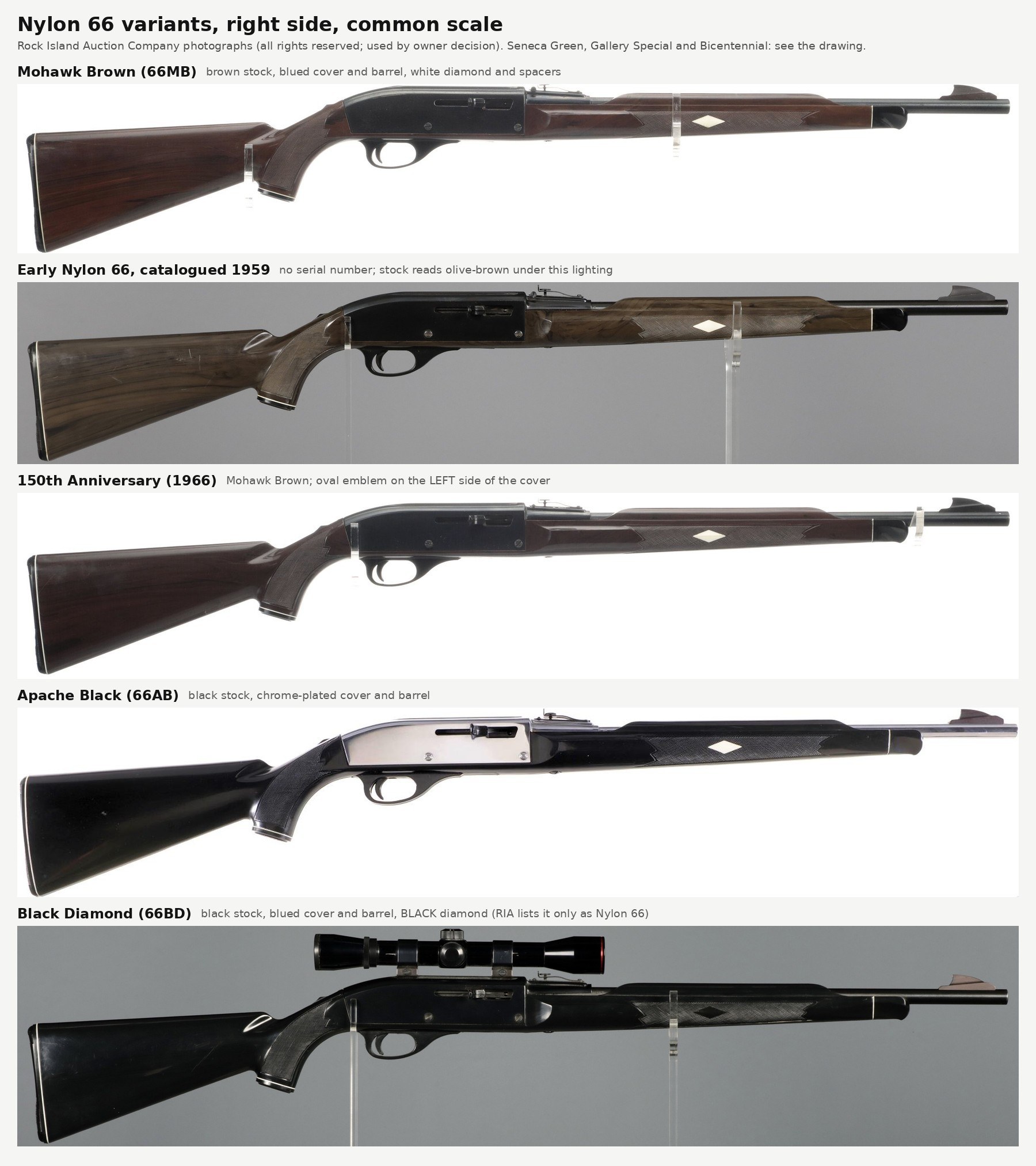
The plate at the head of this volume shows five rifles from the right side at a common scale. Read them in this order:
- Mohawk Brown. Brown stock, blued cover and barrel, white diamond on the fore-end, white spacers at buttplate, grip cap and fore-end tip. The default rifle; more than two-thirds of production by the usual figures.
- The 1959 rifle. Mechanically the same. Note that it has no serial number anywhere: Remington did not number these until October 1967 (Volume 7).
- 150th Anniversary, 1966. A Mohawk Brown rifle with an oval emblem rolled into the left side of the cover. The right side, which is what this plate shows, is indistinguishable from a plain 66.
- Apache Black. Black stock with a chrome-plated cover and barrel. Remington charged $5 more for it and Simmons records that it was also called the “Presentation” grade.4
- Black Diamond. Black stock, but the cover and barrel are blued or black, and the fore-end inlay is black instead of white. This is the rifle most often mistaken for an Apache Black; the giveaway is the absence of chrome.
4.4 Close-ups: Diamonds, Covers and Markings
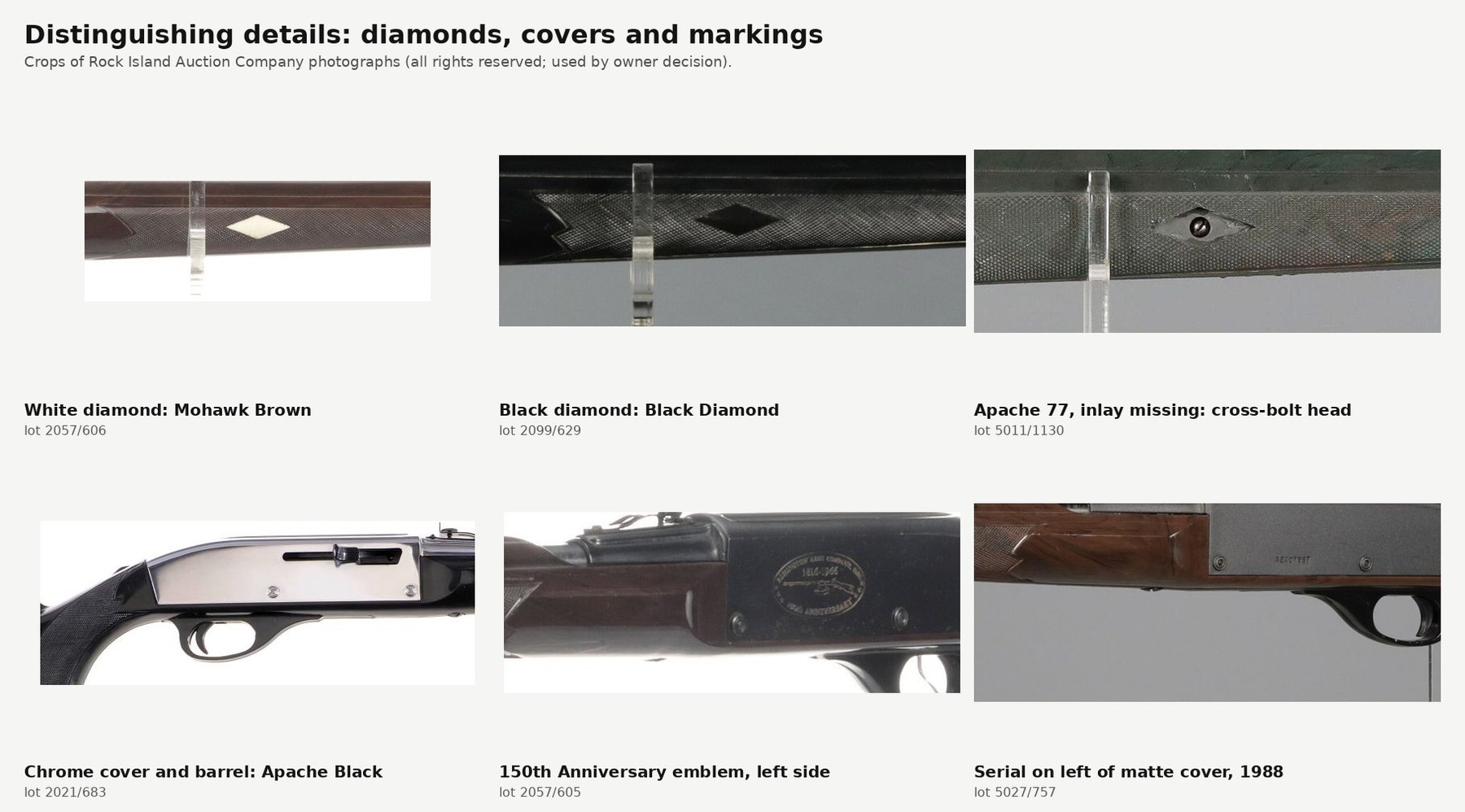
Four things in that plate are worth stating plainly.
The diamond is a fastener cap. The third panel is an Apache 77 that Rock Island Auction catalogued with “Parts of the stock and magazine absent”. What is absent is the diamond inlay, and underneath it sits a slotted screw head: the fore-end cross-bolt that the patent describes as being “covered by appropriate inlays”.5 The rifle’s best-known ornament is the cap over a structural fastener, and this photograph is the proof. Volume 6 builds the argument that the rest of the styling works the same way.
Diamond colour is a model test, with one caveat. White diamond on a black stock with a blued cover means either a Black Diamond that has lost its inlay to a replacement, a refinished rifle, or a Brazilian copy. McBain’s description of the Black Diamond says “black spacers on fore, butt and grip caps” as well as the black diamond.3 The Black Diamond photographed for the plate has a white spacer at the fore-end tip. Either the spacer colour is not a reliable Black Diamond feature or this rifle has a replaced part; the dive does not resolve it, and a buyer should not treat spacer colour as decisive.
The 150th Anniversary emblem is on the left. Rock Island Auction’s lot text records the marking as “REMINGTON ARMS COMPANY/1816-1966/150TH ANNIVERSARY” on the receiver, and the photograph shows it as an oval emblem on the left side of the cover.6 Simmons calls it an “embossed receiver cover”.4 Since the cover is a separate part held on by two screws, a 150th Anniversary cover can be swapped onto a plain rifle, and a plain cover onto a commemorative. The cover is also the serial-numbered part after 1967, which makes the swap worse than cosmetic (Volume 7).
The late guns are matte. Marcot: “The receiver covers and barrels were changed from blued to a matte black finish near the end of production.”7 The last panel shows a rifle Rock Island Auction dated to 1988 with a grey-looking matte cover carrying its serial number.
4.5 The Colour Problem
Colour is the least reliable thing about a Nylon, and three separate traps are documented.
Seneca Green looks brown in the wrong light. Wikipedia puts it well: “The Seneca Green is a dull colored green and, in some lighting conditions, Seneca Green is difficult to distinguish from the more common brown.”8 Simmons describes the colour as a “mottled dark olive”.4 The plate’s second panel shows the trap working in reverse: a rifle Rock Island Auction catalogued only as a Nylon 66 “Manufactured in 1959”, whose stock photographs as olive-brown under the auction house’s lighting. It may be an early Mohawk Brown; it may be a Seneca Green. The auction house does not say, and neither does this dive. The dating evidence would have to come from the barrel code and the absence of a serial (Volume 7), and the colour would have to be judged in daylight against a known rifle.
“Green” does not mean Seneca Green. The Apache 77 of 1987 has a green stock too, and McBain warns specifically: “Green stock, not to be confused with the original ‘Seneca Green’ stock on the 66.”3 The two are separated by everything else. Seneca Green is a 1959–62 rifle with a blued cover, a white diamond, white spacers and a tube magazine in the butt. The Apache 77 is a 1987–89 rifle with a matte grey or black cover, a black diamond, no white spacers and a detachable box magazine. Rock Island Auction has itself catalogued an Apache 77 as a “Nylon 77 Seneca Green Rifle … Manufactured in 1987”, which is a green stock on a box-magazine rifle from the wrong decade.6 That lot is a worked example of the mistake this dive is trying to prevent.
Brown is not one colour. Simmons’s account of the name (Volume 1) has Remington mixing pigments to reach “a wood-like shade” called Number 66. Moulded colour varies between batches, and thirty years of light exposure varies it further: DuPont’s own data show unstabilised nylon 6,6 losing most of its tensile strength and elongation in Florida sunlight within a few years, and states plainly that “natural and pigmented ZYTEL nylon resins have only moderate resistance to the effects of sunlight”.9 A faded or chalky stock is not evidence of a different factory colour.
4.6 The Variants Nobody Photographed
Three catalogued variants and one whole model could not be illustrated from any freely licensed or auction photograph located for this dive. They are drawn instead, from the written descriptions, and labelled as drawings.
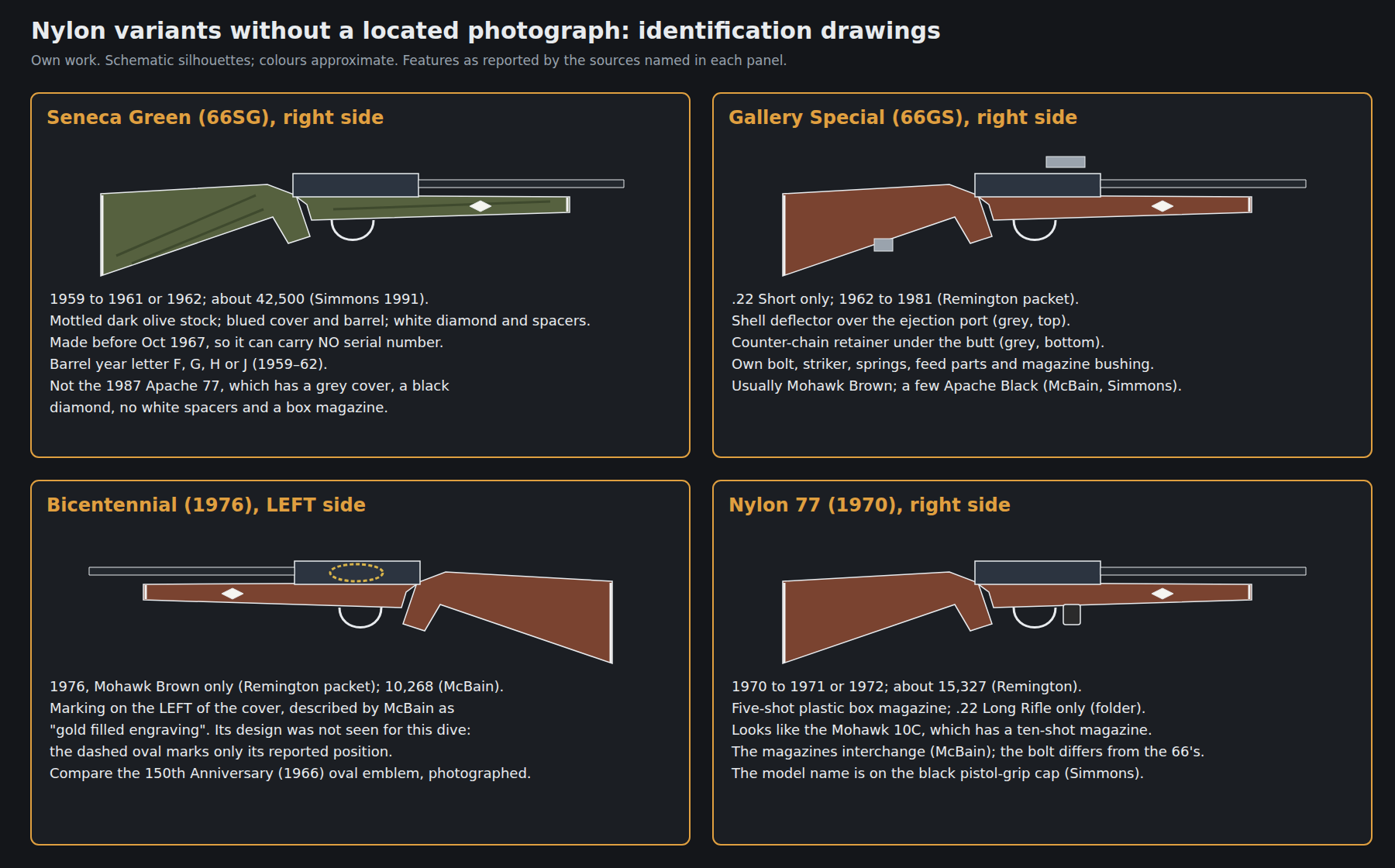
The Gallery Special is the most distinctive of them and the least likely to be recognised. It is a .22 Short rifle for shooting galleries, with a shell deflector over the ejection port and a counter-chain retainer under the stock so the gallery’s shot counter could be attached. Remington’s parts list gives it a different bolt, striker, springs, feed parts, cartridge stop, ejector, extractor, magazine tube and magazine bushing from the standard rifle, all marked obsolete.10 Simmons photographed its lightened bolt and striker beside the standard parts and called the rifles “relatively rare”.4 A Gallery Special missing its deflector and chain bracket is a .22 Short rifle that looks exactly like a Long Rifle one, and the barrel marking is the check.
The Bicentennial of 1976 is a Mohawk Brown rifle with, according to McBain, “gold filled engraving on left receiver”.3 No photograph of the marking was located, so the drawing shows a dashed placeholder where it is reported to be and says so. That is a gap a reader with the rifle could close.
4.7 The Other Actions, Side by Side
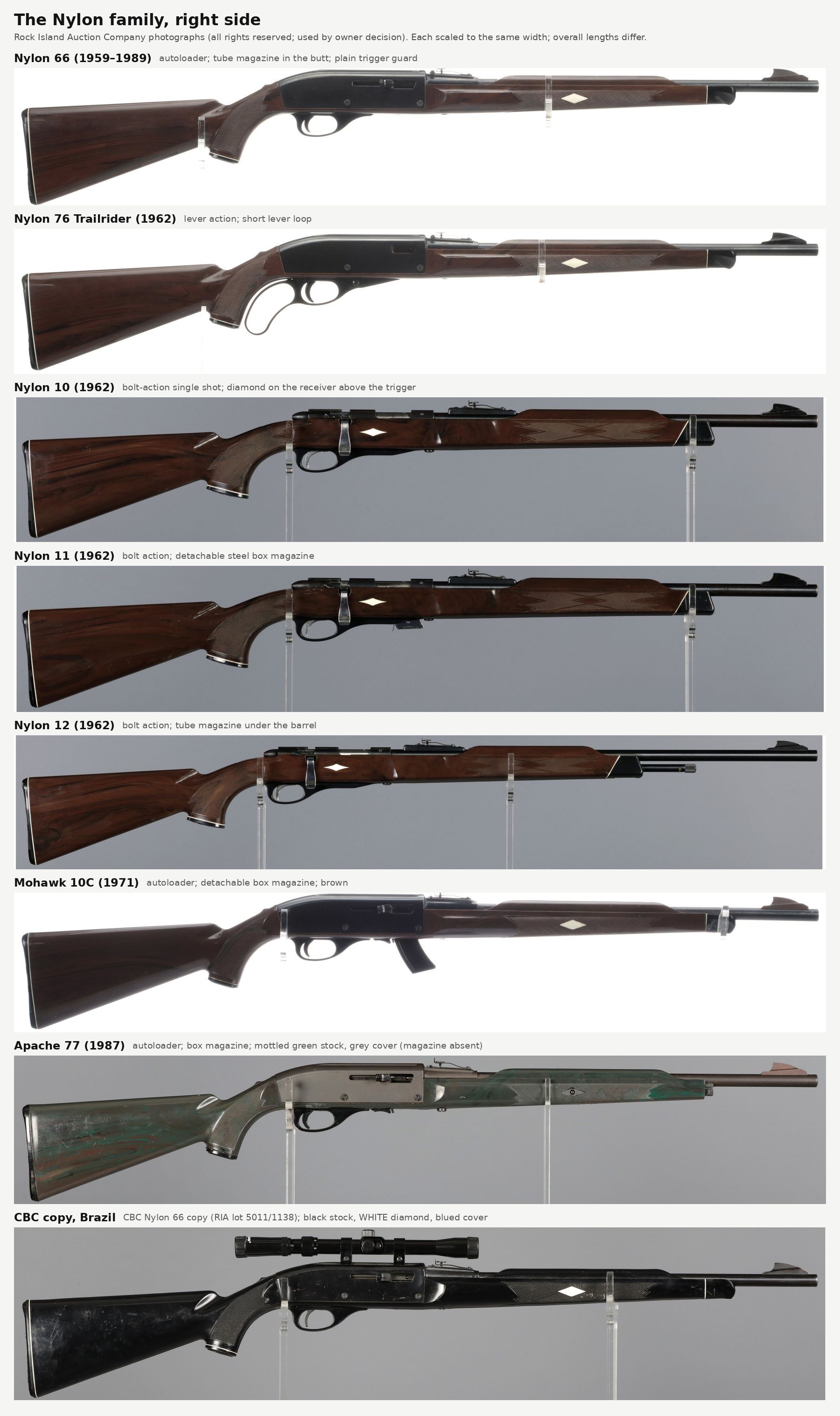
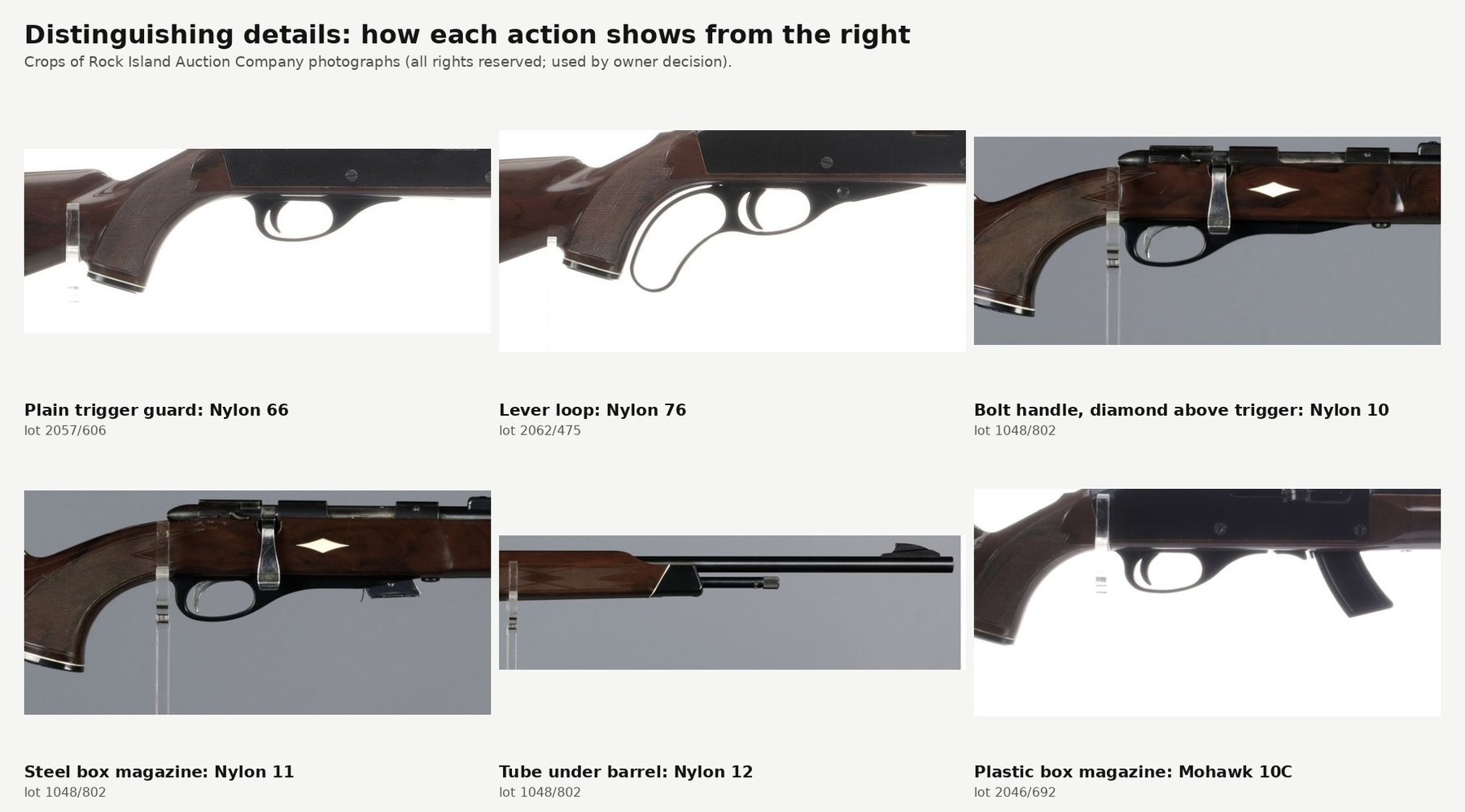
The family is easy to sort once the right features are known:
- Nylon 66: plain trigger guard, no magazine below the action, tube in the butt.
- Nylon 76: a lever loop in place of the trigger guard. It is the only Nylon with one.
- Nylon 10, 11, 12: a bolt handle on the right, and the white diamond sits on the receiver above the trigger rather than on the fore-end. Simmons noticed that even this diamond is a different part from the autoloader’s.4 Then: no magazine at all means the single-shot 10; a steel box below means the 11; a tube under the barrel means the 12.
- Mohawk 10C, Nylon 77, Apache 77: a detachable plastic box magazine ahead of the trigger guard.
4.8 Close-ups: How Each Action Shows
4.9 The Box-Magazine Rifles: 77, 10C and Apache 77
These three look alike and are routinely mixed up, including in auction catalogues.
The Nylon 77 came in 1970 with a five-shot plastic box magazine. Its instruction folder is titled “22 Caliber · Long Rifle Only · Clip Magazine — 5 Cartridge Capacity”.11 Remington’s own model-history page lists the calibre as “.22 short, .22 long, .22 long rifle”, which the period folder contradicts; the folder is the better evidence.12 Simmons says a ten-shot magazine was soon offered as an accessory because “the shooting public seemed to want more magazine capacity”.4
The Mohawk 10C of 1971 is the same rifle with the ten-shot magazine as standard equipment and a new name. McBain: “Virtually identical to the Nylon 77, renamed Mohawk 10C to reflect the 10 round mag. Mags will interchange between the two.”3 Simmons calls it “a promotional rifle offered to the distributors in large quantities at special discount”, which explains why it is the second most common Nylon after the 66 at about 128,000.43 Its carton is printed MOHAWK, not Nylon.
The Apache 77 of 1987 was a special run for K-Mart, and it is the one most often misdescribed. McBain’s identification: a green stock, “Matte black receiver cover & barrel, no white spacers on fore stock, buttplate, or grip. Has black diamond on fore stock”, marked Apache 77 on the grip plate, usually sold with a 4x Tasco or Bushnell scope, and with a ten-round magazine marked 77.3 Simmons, writing while they were on sale, describes “metal parts finished in a jet black with a black sand-blasted painted finish” and a stock “a dark olive blue-green”.4 Rock Island Auction has catalogued Apache 77s as “Manufactured in 1970-1971” (which are the Nylon 77’s dates) and as a “Nylon 77 Seneca Green” rifle.6 Neither description is right, and both are the sort of error the grip cap settles.
4.10 The Brazilian Copies
Production did not stop when Remington’s moulds wore out. A copy of the Nylon 66 was made in Brazil by Companhia Brasileira de Cartuchos of Santo André, and imported into the United States by Firearms Import & Export Corp. (F.I.E.) of Hialeah, Florida, as the “Black Beauty”.4 Wikipedia’s article says “FIE of Brazil also made a copy”, which reverses the relationship: F.I.E. was the Florida importer, CBC the Brazilian maker.8
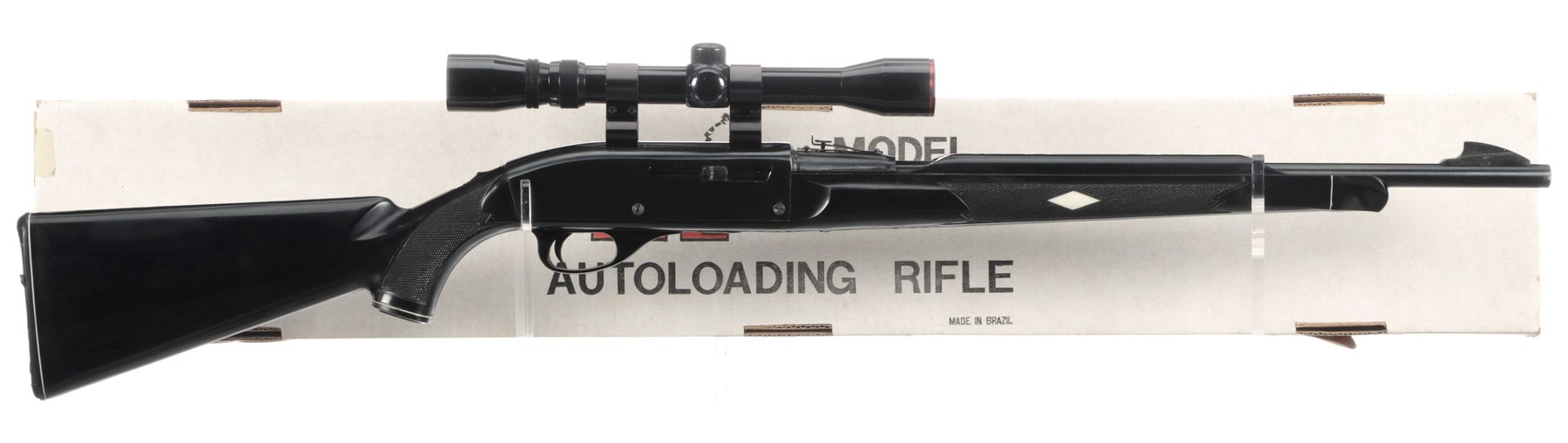
Simmons owned one and listed the differences from a Remington, which remain the identification test:4
- Black stock with black buttplate, grip cap and fore-end tip, each with a white spacer, and a white diamond over the fore-end stock bolt.
- Front sight a non-steel die casting, without Remington’s white dot.
- The rear sight keeps a knob on the windage screw, which Remington dropped in about 1964.
- Internal parts that Remington left in the white are blued; many internals are investment castings, including the trigger.
- Six lands and grooves with the same clockwise twist, but rounder lands and deeper grooves.
- Both the barrel and the receiver cover are serial-numbered, where Remington numbered only the cover.
- The muzzle is not crowned as the Remington’s is.
- The barrel support is marked “FRENTE” rather than Remington’s “FRONT”.
- A yellow magazine follower about an eighth of an inch longer than Remington’s, so the empty indicator shows more plainly.
- The manual contains no field-strip instructions at all, and Simmons found the cover screw, bolt handle and barrel bracket all markedly tighter than a Remington’s.
On price, Simmons found the copy was not the bargain: the 42nd Gun Digest listed the Remington 66 at $124 and the F.I.E. Black Beauty at $124.95, and at the K-Mart sale the Remington Apache 77 was $84.97 against the Black Beauty’s $96.95.4
Simmons’s account of how CBC came to build it is the one part this dive could not verify. He writes that “in the 1930s Remington Arms owned a minority interest in CBC and with the help of Remington’s engineering and production personnel they manufactured Remington guns for the Brazilian market”, and that when “in 1981, the Brazilian government nationalized the company, doing away with Remington’s interest in CBC, the Brazilian company was left with the tooling and know-how which enabled them to make a copy.”4 No independent confirmation of the minority holding or the 1981 nationalisation was found for this dive, and the claim is repeated here as his, not as established.
The rifles do trade. Rock Island Auction sold a “CBC Nylon 66 Semi-Automatic Rifle with Scope”, dated only “1960s-1990s”, for a hammer price of $250 in May 2025, and sold the same CBC Model GR-8 serial “GR10001”, described as “Believed to be the first produced of this model”, twice: $600 in June 2023 and $450 in November 2023.6 The GR-8 is the model designation Simmons pairs with the Black Beauty name.
4.11 Tell Them Apart: the Table
Table 3 — Tell Them Apart: the Table
| Question | What to look at | Answer |
|---|---|---|
| Which model is it? | Black pistol-grip cap | The full model name is there (Simmons; McBain for the Apache 77) |
| Autoloader, lever or bolt? | Trigger guard area, right side | Plain guard = 66 family; lever loop = 76; bolt handle = 10, 11, 12 |
| Which bolt gun? | Below and under the barrel | Nothing = 10 single shot; steel box = 11; tube under barrel = 12 |
| Tube or box feed? | Underside ahead of the trigger guard | Box magazine = 77, 10C or Apache 77; nothing = 66, 76 (both feed from the butt) |
| Five or ten shots? | Magazine length; the carton | 77 = five-shot; 10C = ten-shot, carton printed MOHAWK. Magazines interchange (McBain) |
| Apache Black or Black Diamond? | Cover and barrel finish | Chrome = Apache Black; blued or black = Black Diamond |
| Black Diamond or a refinish or copy? | Fore-end inlay | Black diamond = 66BD; white diamond on a black stock = Brazilian copy, replaced part or refinish |
| Seneca Green or Apache 77? | Cover, spacers, magazine | Blued cover, white spacers and diamond, butt tube = Seneca Green (1959–62). Matte cover, no white spacers, black diamond, box magazine = Apache 77 (1987–89) |
| Remington or CBC? | Muzzle, barrel markings, front sight | Uncrowned muzzle, serial on the barrel as well as the cover, no white dot on the front sight, “FRENTE” on the barrel support = CBC |
| Gallery Special? | Barrel marking, ejection port, underside of butt | .22 Short marking, shell deflector, counter-chain bracket |
| Commemorative? | Left side of the cover | Oval 1816–1966 emblem = 150th Anniversary; gold-filled marking = Bicentennial (reported, not seen here) |
| How old is it? | Barrel date code and serial | See Volume 7 |
4.12 Where the Sources Disagree
Anyone comparing catalogues will meet these conflicts. None of them is resolved by this dive; all are flagged where they matter.
Table 4 — Where the Sources Disagree
| Point | Remington packet | Remington web pages | Others |
|---|---|---|---|
| Seneca Green ends | 1961 | — | 1961 (Simmons); late 1962 (Marcot); 1962 (McBain, Wikipedia) |
| Nylon 10, 11, 12, 76 end | 1964 | 1965 | 1964 (Simmons, McBain) |
| Nylon 77 ends | 1971 | 1972 | 1972 (McBain); 1973 (Simmons’s table) |
| Mohawk 10C begins | 1971 | — | 1971 (Simmons); 1972 (McBain) |
| Apache Black ends | 1983 | — | 1983 plating ends (Simmons); 1984 (McBain, Wikipedia) |
| Nylon 66 ends | 1987 (last lines) | 1989 | catalogue drop 1988 per Jack Heath (Simmons); 1991 (Marcot) |
| Nylon 77 calibre | — | .22 S, L, LR | .22 Long Rifle only (Remington’s own Nylon 77 folder) |
References
Footnotes
-
Remington Arms Company, “Nylon 66 Autoloading Rimfire Rifle” model history page, archived 16 December 2012: https://web.archive.org/web/20121216202834/http://www.remington.com/products/archived/rimfire/autoloading/nylon-66.aspx , retrieved 2026-09-19. Companion pages for the Nylon 10, 11, 12 and 76 Trailrider archived 13 November 2013 and 24 April 2013 at remington.com/en/products/archived/rimfire/. ↩
-
Remington Arms Company, Nylon 66 information packet, including the table “Nylon Series of 22 Rimfire Rifles”. Archived PDF: https://web.archive.org/web/20110910092323/http://www.remington.com:80/~/media/Files/Owners-Manuals/Nylon%2066.ashx , retrieved 2026-09-19. ↩ ↩2
-
Gary McBain, “Nylon Rifles – Facts and Figures”, NylonRifles.com, 29 April 2007. Archived: https://web.archive.org/web/20100521055828/http://nylonrifles.com/NylonRifles/Articles/Entries/2007/4/29_Nylon_Rifles_-Facts_and_Figures.html . ↩ ↩2 ↩3 ↩4 ↩5 ↩6 ↩7 ↩8
-
Donald M. Simmons, “Those Plastic Remingtons”, The Gun Digest, 45th Edition (1991). Archived scan: https://web.archive.org/web/20100524123435/http://www.nylonrifles.com/Nylonpdf/PlasticRems.pdf . ↩ ↩2 ↩3 ↩4 ↩5 ↩6 ↩7 ↩8 ↩9 ↩10 ↩11 ↩12 ↩13 ↩14
-
W. E. Leek and C. H. Morse, US Patent 3,023,527, issued 6 March 1962. https://patentimages.storage.googleapis.com/pdfs/US3023527.pdf . ↩
-
Rock Island Auction Company lot pages, retrieved 2026-09-19 through the shared fetch engine: 2057/605 (150th Anniversary marking text), 5011/1130 and 5025/192 (Apache 77, including the “1970-1971” dating), 1048/803 (the “Nylon 77 Seneca Green … 1987” description), 5011/1138 (CBC Nylon 66, $250 hammer, 4 May 2025), 1043/1170 (CBC GR-8 serial GR10001, $600 hammer, 21 June 2023) and 2079/125 (the same rifle, $450 hammer, 1 November 2023). Hammer prices are before the buyer’s premium. ↩ ↩2 ↩3 ↩4
-
Roy Marcot, “The Remington Nylon 66”, American Rifleman, 27 August 2009. Archived: https://web.archive.org/web/20150303174642/http://www.americanrifleman.org:80/articles/2009/8/27/the-remington-nylon-66 . ↩
-
“Remington Nylon 66”, Wikipedia, raw text retrieved 2026-09-19. ↩ ↩2
-
DuPont, “Minlon and Zytel Design Information – Module II” (2001), section 5 (weathering; Florida exposure table). Archived: https://web.archive.org/web/20151016093431/http://www.dupont.com/content/dam/dupont/products-and-services/plastics-polymers-and-resins/thermoplastics/documents/Zytel/Minlon%20Zytel%20Design%20Info%20Module%202.pdf . ↩
-
The parts list (sheet RF 22) in the same packet, including the Gallery Special parts and the “Restricted” marking against the receiver cover assembly. ↩
-
Remington Arms Company, “Nylon 77 Automatic Rifle · Instruction Folder and Parts List”. Archived PDF: https://web.archive.org/web/20110909062648/http://www.remington.com:80/~/media/Files/Owners-Manuals/Nylon%2077.ashx , retrieved 2026-09-19. ↩
-
Remington Arms Company, “Nylon 77” model history page (Introduction 1970, Discontinued 1972, approx. 15,327, calibre listed as .22 short, long and long rifle), archived 2013 at remington.com/products/archived/rimfire/autoloading/nylon-77.aspx , retrieved 2026-09-19. ↩
Comments (0)