Remington Nylon 66 · Volume 6
The Look — A Moulding That Was Told to Look Like Walnut
Why the Nylon 66 looks the way it does, argued from how it was made: the two-part mould, the cross-bolts under the diamonds, the steel cover that exists to be a disguise, the pigment that was mixed to imitate wood, and why a rifle designed to look conventional reads as space-age now
The hub’s Whitney Wolverine dive argues that a pistol’s futuristic look was the visible result of one manufacturing decision, and that its makers said so at the time.1 The Nylon 66 invites the same treatment and gives a more complicated answer. Its shape is also the result of a manufacturing decision, and several of its most distinctive details are pure construction. But its overall silhouette was aimed in the opposite direction from the Wolverine’s: Remington used the freedom of the mould to make the rifle look conventional, not futuristic. The space-age reading is real, and it is ours, not theirs.
6.1 The Claim This Volume Tests
Put as a claim that can be checked: on the Nylon 66, every detail that a conventional rifle would achieve by wood and metalwork is instead a consequence of moulding two nylon halves and screwing a steel lid over them — and Remington spent that freedom on imitation rather than on novelty.
If that is right, four things should follow, and each is testable against the sources:
- The decorative details should turn out to be structural parts. (The diamonds)
- The one obviously “gun-like” component, the steel receiver cover, should exist for appearance first and function second, and the sources should say so. (The cover)
- The colour should have been chosen to imitate walnut. (The colour)
- The features that the mould made free — checkering, spacers, caps — should be exactly the features of a mid-priced wood-stocked sporting rifle. (Moulded checkering)
6.2 What the Makers Said They Were Doing
The design brief was cost, and the material specification that followed it was written in terms of function (Volume 1). Only two of the twelve requirements Remington gave DuPont concern appearance: the material “must have a finish that is easy to repair” and “must hold permanent colors”.2 There is no requirement about styling, and no designer’s manifesto of the kind the Whitney’s makers produced. What Remington said about appearance, it said defensively. Marcot’s summary of the reasoning behind the steel cover: “In order to avoid shooter rejection of this plastic gun, the designers covered the nylon receiver with a blued steel stamping.”3
That is the whole documented styling intent: avoid rejection. The rifle had to look enough like a rifle that a 1959 buyer would pick it up.
6.3 The Diamonds Are Bolt Heads
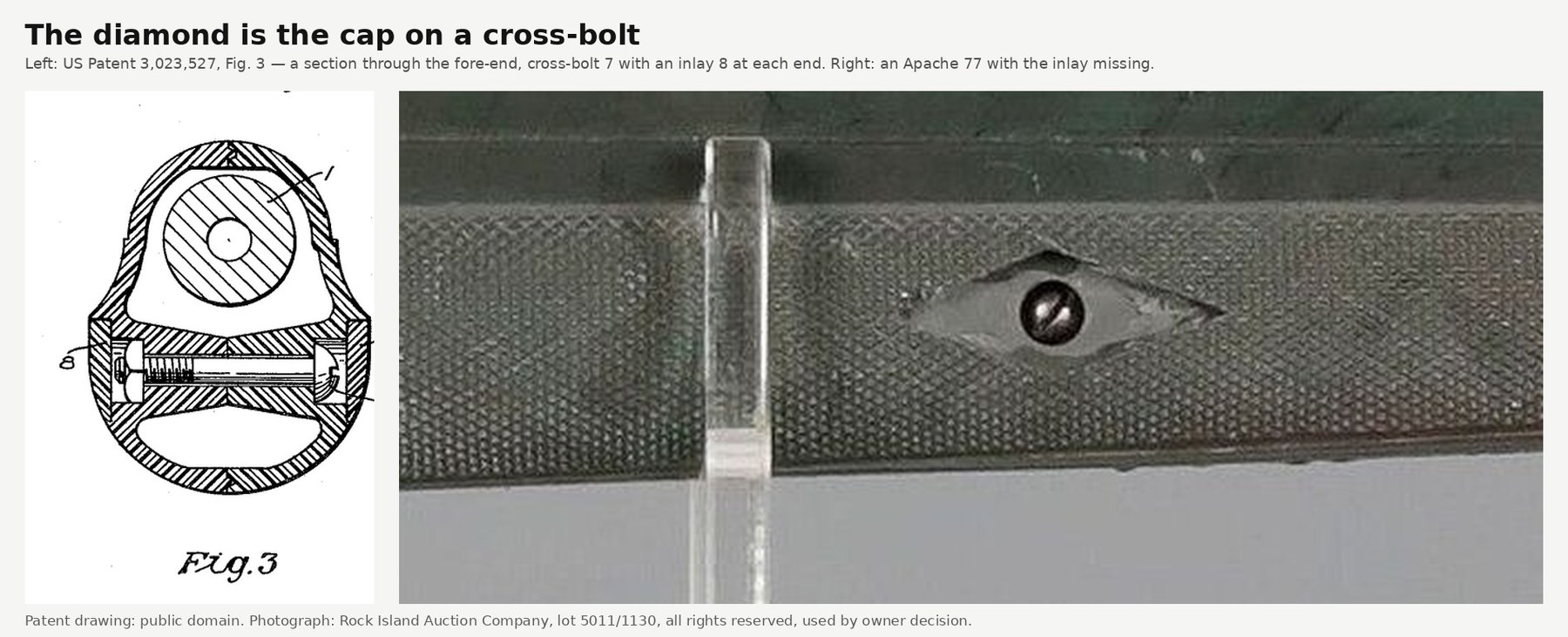
The white diamond on each side of the fore-end is the Nylon 66’s signature. It is also a cap on a fastener, and both the patent and a photograph prove it.
The patent, describing how the two moulded halves are held together: “At appropriate points, the joining of the halves of the stock assembly may be reinforced by cross-bolts 7 which may be covered by appropriate inlays 8 or by being enclosed within the cover 4.”4 Fig. 3 of the patent is a section through the fore-end showing exactly that: a bolt across the stock with a cap at each end.
Marcot and Simmons both count the production fasteners: “There were two reinforcing screws with nuts under the receiver cover, and there was one more under the ivory white diamonds on each side of the fore-end.”3 So the rifle has three cross-bolts. Two are hidden by the steel cover; the third had nowhere to hide, and became the ornament.
The photograph at the head of this volume closes the argument. It is an Apache 77 that Rock Island Auction sold with “Parts of the stock and magazine absent”: the inlay is gone, and in the diamond-shaped recess sits the slotted head of the cross-bolt.5
There is a second piece of evidence in the same vein, and it is the detail Simmons noticed: the bolt-action Nylons have a diamond too, but it is on the receiver, above the trigger, and “the white diamond that covers the screw in the bolt-action line is entirely different from the one used in the others”.2 The diamond moves because the screw moves. Ornament follows fastener.
6.4 The Cover Is a Disguise That Earns Its Keep
The pressed-steel cover is the most conventional-looking part of the rifle and the one that exists for the least conventional reason. Both published histories say plainly that it is a disguise, and then that Remington made it work for its living:
In order to avoid shooter rejection of this plastic gun, the designers covered the nylon receiver with a blued steel stamping. They must have decided that as long as they were going to disguise the receiver with a steel shell, they would make the shell serve some useful purpose so the rear sight assembly was riveted to it.3
Its functions are listed in Volume 3: it closes the action, carries the rear sight, carries the scope dovetails, holds the ejector in, and springs the cartridge feed guide. Every one of those is a job that a steel receiver would otherwise do. The cover is not a decorative panel with a few duties bolted on; it is the last surviving fragment of the steel receiver the rifle does not have.
It has a visual consequence too. A conventional rifle shows a receiver as a distinct block between stock and barrel, with visible joints where wood meets metal. The Nylon 66 shows a smooth nylon shell interrupted by one rectangular steel panel. From a distance that reads as a receiver. Close up it reads as what it is: a lid.
The cover also produced the rifle’s one real design flaw, and it is an appearance-driven flaw. Because the scope mounts to a thin stamping sitting on a plastic receiver, “when a scope was mounted and the gun was gripped too rigidly the point of impact could change”.3 The disguise carries the optic, and the disguise flexes.
6.5 The Colour Was Mixed to Imitate Walnut
Simmons, who corresponded with Remington staff, gives the origin of both the colour and, in his account, the rifle’s name:
Nylon Zytel-101 only came in basic colors like red, blue, black and yellow but the engineers at Remington found that they could mix these colors and arrive at a wood-like shade. The wood-colored mixture was called Number 66, thus the name of the rifle … Remington calls Color Number 66 “Mohawk Brown.”2
Whether the name came from the colour or from the polymer is disputed (Volume 1). The colour’s purpose is not. The default Nylon 66 is brown because walnut is brown. Remington had a material that would hold any colour permanently — requirement 10 of the specification — and spent that freedom on imitation.
The imitation extends into the moulding itself. Look at the stocks in the plates in Volume 4: the brown is not flat but streaked and mottled, in a pattern that reads at arm’s length as figure in wood. Simmons describes Seneca Green in the same terms, a “mottled dark olive”, and McBain calls the Apache 77’s stock mottled green.26 A one-colour moulding would have looked like a toy. A two-tone swirl looks like timber.
6.6 Moulded Checkering, White Spacers, Black Caps
Three more details are borrowed wholesale from wood-stocked sporting rifles, and all three are nearly free in a mould.
- Checkering. On a walnut stock, checkering is cut by hand or by machine and priced accordingly. On the Nylon 66 the diamond pattern on the grip and fore-end is part of the tool, so it costs nothing per rifle. Rock Island Auction’s condition reports routinely describe Nylons as having “sharp checkering”, which on a moulded stock is a statement about mould wear and handling rather than about craftsmanship.5
- White spacers. The buttplate, fore-end tip and pistol-grip cap are separate black plastic parts “bonded in place. Each had a white spacer.”3 White line spacers are a 1950s American gunmaking convention, the mark of a step up from a plain field rifle. Here they are extra parts bonded to a moulding purely to say “sporting rifle”.
- Black caps. A walnut stock gets a contrasting fore-end tip and grip cap because the wood must be capped. Nylon needs no capping at all. Remington put them on anyway, and then used the grip cap for the model name (Volume 4), which is the one place where the imitation acquired a job.
6.7 The Line the Mould Draws
The silhouette itself is the clearest evidence of what moulding makes cheap. The Nylon 66’s outline is continuous from butt to fore-end tip: a single swept line broken only by the cover panel and the trigger guard. There are no inletting joints, no barrel channel gap, no stock-to-receiver line, and no place where two materials meet unevenly, because there is only one material and it was formed in one operation.
That is why the rifle looks, in photographs, as though it has been carved from a single piece — and why the hub’s Whitney Wolverine dive makes the same argument about an aluminium casting arriving at “style variances hitherto impossible with practical machining methods on solid forgings”.1 Two different makers, two different materials, one shared truth: a part formed in a die can have any shape its maker chooses, and the shape it gets is the one the maker thinks will sell.
Where the two guns part company is in what the makers chose. The Whitney’s designers used the freedom to build a shape no machinist could have cut. Remington used it to build a shape every 1959 gun counter already had. The Nylon 66 is a mid-century sporting-rifle outline, executed in a material that did not care what outline it took.
6.8 Then Remington Did the Opposite: Apache Black
The exception arrived in 1962 and proves the rule. Apache Black put a black stock under a chrome-plated cover and barrel, a combination no wood-stocked rifle could produce and no traditional gunmaker would have wanted. Simmons calls it “an impressive combination of colors” and records that it was also known as the “Presentation” grade.2 Remington charged $54.95 for it against $49.95 for the brown rifle.
Black plastic and bright chrome is not gunmaking’s palette. It is the palette of a 1962 kitchen appliance, a radio, a car’s dashboard trim. Once the imitation of walnut was dropped, what emerged was the consumer-goods idiom that the material had come from in the first place. Seneca Green points the same way: a colour no rifle stock had been, chosen because the moulding could hold it.
The strongest evidence that Remington understood this as consumer-product styling is where the range ended up. By 1978 the Black Diamond had made the black stock permanent and turned the diamond itself black; by 1987 the Apache 77 was being sold at K-Mart with a mottled green stock, a sandblasted black finish and a scope in the box.26 The rifle that started by imitating walnut ended as a discount-store product sold on colour.
6.9 in a Plastic Age
The Nylon 66 arrived in a decade that was learning to buy moulded plastic for the house. DuPont’s nylon had reached the public first as stockings, a connection Marcot makes explicitly: “The first practical use of the new material was for ladies stockings, which were (and still are) called nylons.”3 By the late 1950s Earl Tupper’s polyethylene containers were being sold at home parties across America.
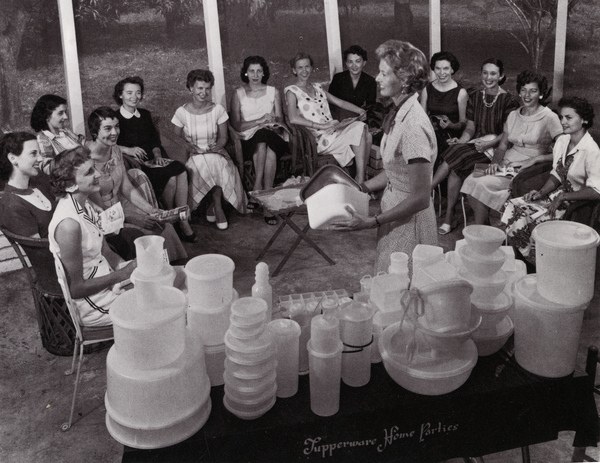

The rifle’s advertising leaned on that familiarity in one direction and against it in another. It sold the material’s toughness hard — the trappers from Hudson Bay to the Everglades, the sea-spray-proof Alaskan rifle (Volume 2) — while the rifle’s shape and colour worked to keep the word “plastic” out of the buyer’s mind. Delbert Conner had predicted exactly that problem in February 1958: “I doubt that the color or material will make much difference on the first showings. The public will refer to them as plastic.”3
6.10 Buck Rogers in a Salesman’s First Sentence
Conner’s report also contains the first recorded description of a Nylon 66’s look, and it is the one this dive’s series is named for:
My first impression of these guns was, that they were just toys – or maybe air rifles for Buck Rogers.3
Written in February 1958, by a man who then drove a station wagon over one, this is evidence that the rifle read as science fiction from the very first showing — before the advertising, before the colours beyond brown and green, and in spite of every effort to make it look conventional. His closing summary makes the split clear: “Looks like a plastic toy - performance and accuracy unbelievable.”3
The gap between those two halves is the Nylon 66’s whole reception history. Simmons, writing in 1991, said the Nylons “have been a ‘love-‘em or hate-‘em’ gun ever since they were introduced. The appearance and feel were certainly non-traditional.”3
6.11 Against the Wolverine and the XP-100
This hub covers two other 1950s and 1960s American guns whose looks are arguments about materials, and the Nylon 66 sits between them.
The Whitney Wolverine (1956) is the pure case. Its volume on the look shows that the pistol’s shape is what a one-piece aluminium casting enclosing a fixed barrel looks like, and that its makers boasted about the shapes casting made possible.1 Its “Kindred Designs” section lists the Nylon 66 as one of the Whitney’s relatives and calls it, with the Beretta Neos, a “styled moulding” as against the Whitney’s construction-driven form.7 This dive partly agrees and partly does not. The Nylon’s details — diamonds, cover, spacers, colour — are construction showing through, exactly as on the Whitney. Its silhouette is indeed styling, but styling aimed at conventionality: it is a moulding styled to look like the thing it replaced.
The Remington XP-100 (1963) is the same company, the same material and the opposite decision. Its Zytel 101 stock carries “white diamond inlays and white spacers” inherited directly from the Nylon 66, and W. E. Leek worked on both, but the XP-100’s centre-grip silhouette looks like nothing that came before it.8 Four years after the Nylon 66, Remington had learned to use the material to make a shape that could not otherwise exist. The pistol’s dive covers what that cost the company in acceptance.
So the sequence within Remington runs: 1959, a new material hidden inside an old shape; 1963, the same material driving a shape of its own.
6.12 Why It Reads as Space-Age Now
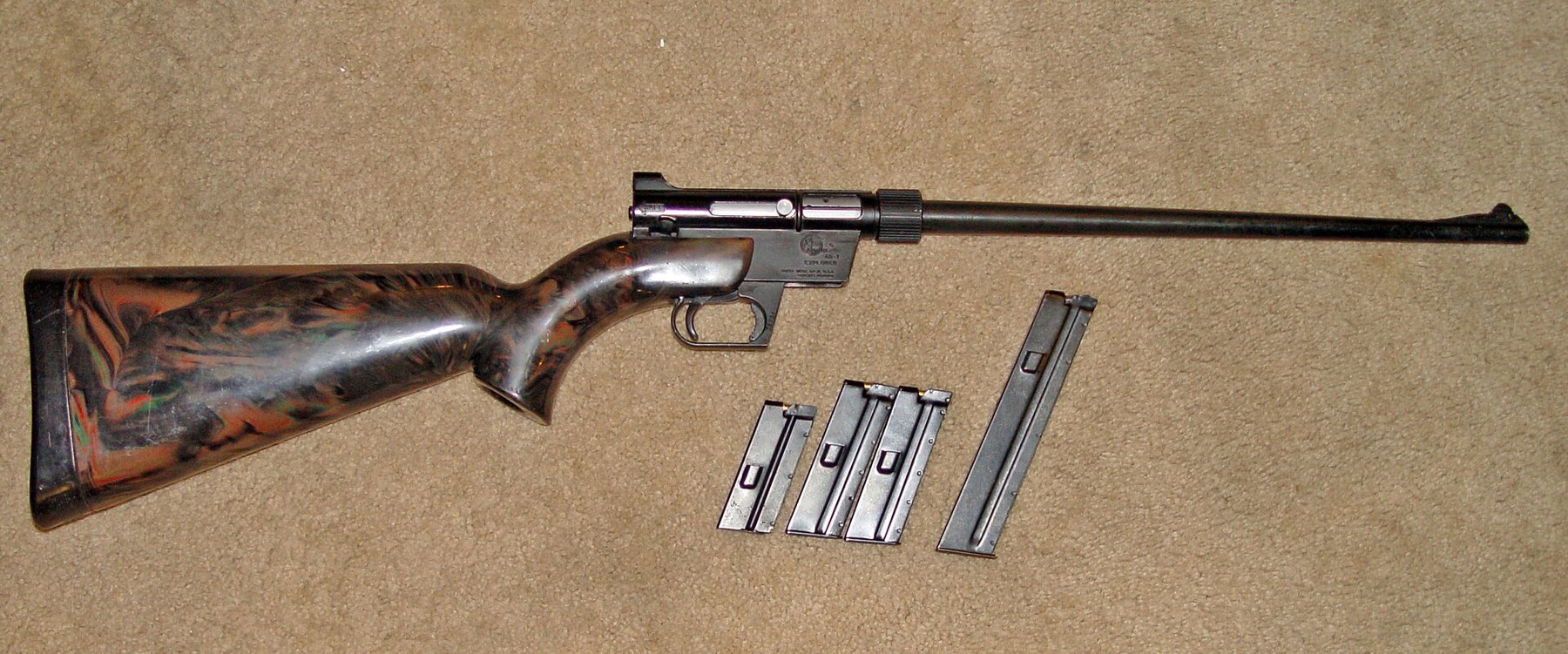
If Remington aimed at conventional, why does the Nylon 66 look like a 1960s vision of the future today? Four reasons, and none of them was a styling decision:
- The surface is wrong for wood, in an informative way. A moulded stock has a uniform gloss, a seamless transition from butt to fore-end and a colour that is the same all the way through. At a glance it is a wooden rifle; at arm’s length it is unmistakably a made object rather than a grown one.
- Time moved the reference. In 1959 a brown sporting rifle was the norm and plastic was the novelty. Today polymer stocks are the norm, and the thing that dates the Nylon 66 is the deliberately traditional outline it wears. The rifle reads as a period piece because it is a period disguise.
- The colours survived. Seneca Green, Apache Black with chrome, the mottled green Apache 77: the variants that abandoned the imitation are the ones that look most of their era, and they are the ones collectors chase (Volume 7).
- The story arrived with the object. A chemical company owned the gunmaker, wrote a twelve-point specification for a material, and invented the rifle around it. That is a space-age provenance whatever the rifle looks like, and the factory carton printed the DuPont logo under the Remington script in case anyone missed it.
The Nylon 66’s place in a survey of mid-century design is therefore not the raygun’s. It is the quieter and more common story of the era: a new material doing an old job, wearing the old job’s clothes, and being found out anyway by the first man who picked one up and said Buck Rogers.
References
Footnotes
-
This hub’s Whitney Wolverine dive, Volume 4, “The Look — A Casting, a Jet Fuselage, and ‘Modern as Tomorrow’”: /actual-firearms/pistols/whitney-wolverine/vol-4/ . ↩ ↩2 ↩3
-
Donald M. Simmons, “Those Plastic Remingtons”, The Gun Digest, 45th Edition (1991), including the twelve-point specification, the Number 66 colour account, the Apache Black “Presentation” grade and the Apache 77’s finish. Archived scan: https://web.archive.org/web/20100524123435/http://www.nylonrifles.com/Nylonpdf/PlasticRems.pdf , retrieved 2026-09-19. ↩ ↩2 ↩3 ↩4 ↩5 ↩6
-
Roy Marcot, “The Remington Nylon 66”, American Rifleman, 27 August 2009, including Delbert Conner’s report of 23 February 1958, the cover-as-disguise passage, the cross-bolt count and the nylon-stocking note. Archived: https://web.archive.org/web/20150303174642/http://www.americanrifleman.org:80/articles/2009/8/27/the-remington-nylon-66 , retrieved 2026-09-19. ↩ ↩2 ↩3 ↩4 ↩5 ↩6 ↩7 ↩8 ↩9 ↩10
-
W. E. Leek and C. H. Morse, US Patent 3,023,527, issued 6 March 1962, Fig. 3 and the cross-bolt passage. https://patentimages.storage.googleapis.com/pdfs/US3023527.pdf . ↩
-
Rock Island Auction Company lot pages, retrieved 2026-09-19, including lot 5011/1130 (Apache 77, “Parts of the stock and magazine absent”) and condition reports describing “sharp checkering”. ↩ ↩2
-
Gary McBain, “Nylon Rifles – Facts and Figures”, NylonRifles.com, 29 April 2007. Archived: https://web.archive.org/web/20100521055828/http://nylonrifles.com/NylonRifles/Articles/Entries/2007/4/29_Nylon_Rifles_-Facts_and_Figures.html . ↩ ↩2
-
The same dive, Volume 8, “Kindred Designs”: /actual-firearms/pistols/whitney-wolverine/vol-8/ . ↩
-
This hub’s Remington XP-100 dive, Volume 1, on the Zytel 101 stock, the inherited white diamonds and spacers, and W. E. Leek: /actual-firearms/pistols/remington-xp-100/vol-1/ . ↩
Comments (0)