MAS FR-F1 and FR-F2 · Volume 9
Building an FR-F2-Pattern Rifle on a MAS 36
A machinist's path from a surplus infantry rifle to a lookalike or a working precision rifle: the donor, the calibre decision and why the bolt face settles it, the receiver-strength question no one has answered, barrel, stock, sleeve, swinging bipod, safety, optic mount, and the law
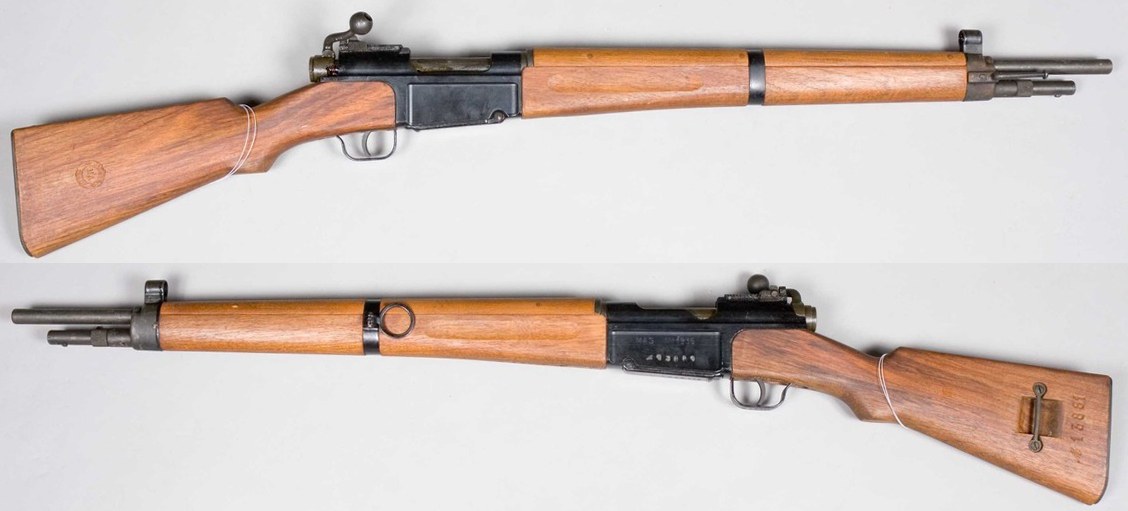
9.1 What is being built
An original FR-F2 costs $7,000 to $9,000 in the United States (Vol 8), and an FR-F1 is not available at all. A MAS 36 costs $500 to $900. Between the two lies a project well within the reach of a home shop with CNC mills, 3D printers, a laser and a full gunsmithing bench: a bolt-action rifle on a MAS 36 action with the FR-F2’s look and, at the builder’s choice, much of its function. It is a bolt-action rifle, so a complete build path is lawful and is set out here.
Two versions are worth distinguishing from the start:
- The lookalike. A MAS 36 in its own 7.5×54 calibre, restocked and dressed with an FR-F2-pattern sleeve, bipod, stock and scope. Nothing about the action’s strength or the bolt face changes. It is closer to an FR-F1 in calibre and to an FR-F2 in appearance.
- The 7.62×51 rifle. A MAS 36 rebarrelled to 7.62×51 or .308, the FR-F2’s calibre. That raises two problems that the lookalike avoids, the bolt face and the receiver’s strength, and neither has a published answer.
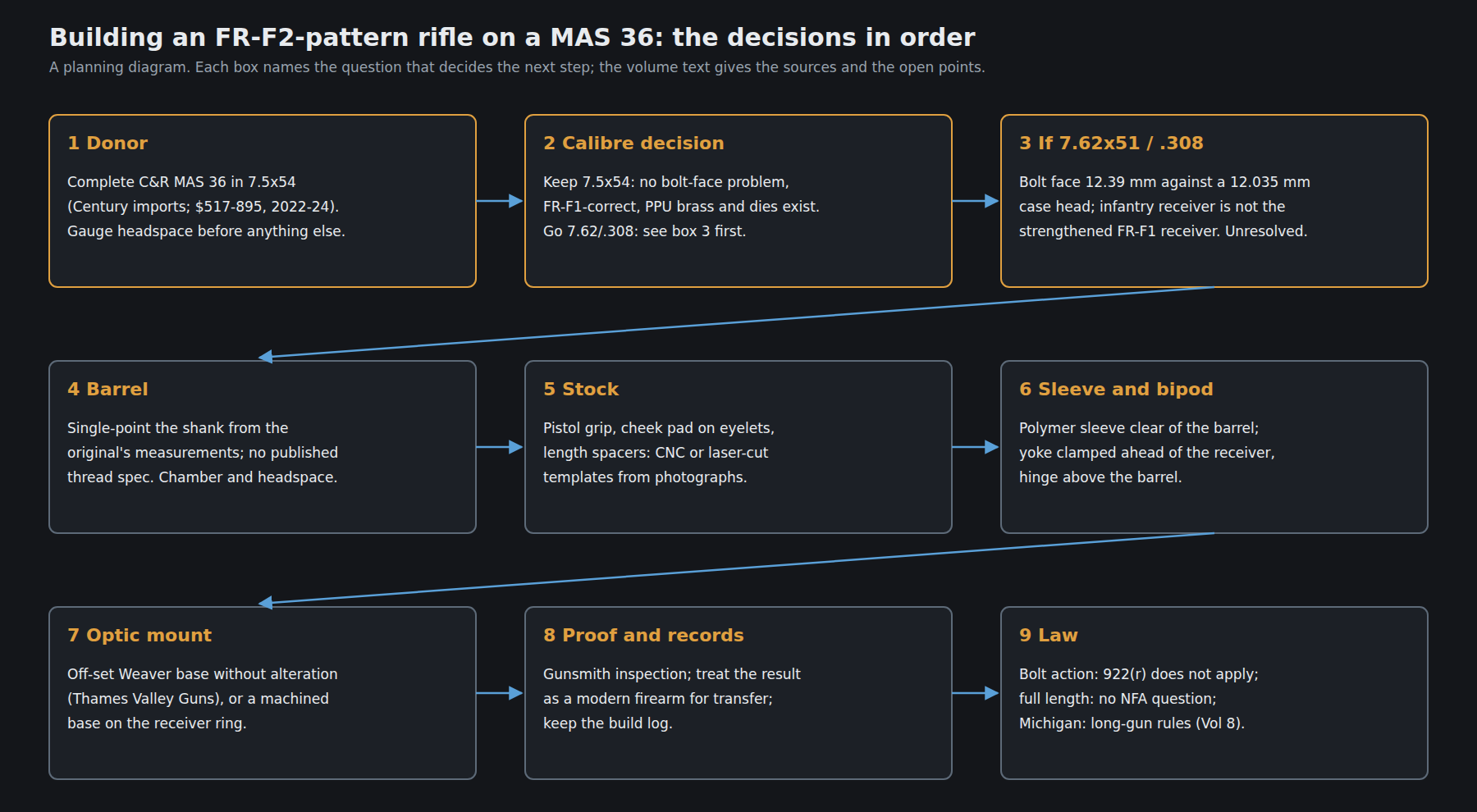
9.2 The decisions in order
The order matters because the first three decisions constrain everything else. The donor decides what is possible. The calibre decides whether the bolt face is a problem. And if the calibre is 7.62, the receiver question has to be faced before any money is spent on a barrel. Stock, sleeve, bipod and optic are then ordinary shop work.
9.3 The donor
The donor should be a complete MAS 36 bought as a curio or relic, not a loose receiver. Century Arms imported them, and dated sales run from $517.50 to $895 between 2022 and 2024 (Vol 8). A complete rifle brings its own bolt, which matters on an action where the bolt body is the locking column, and its own barrel, which is the only reference the builder will have for the barrel shank’s thread (below).
Before anything else, the donor should be gauged for headspace in its own calibre, and its bolt and receiver inspected: lug faces and seats for even bearing and no setback, the bolt body for cracks, the extractor for tension. A rifle that fails those checks is a parts rifle. Post-war production is the better donor on the face of it; Jackson’s account distinguishes pre-war and post-war rifles but gives no metallurgical difference, so that preference is a general one about age and condition, not a documented quality difference.1
A further point for a builder planning a precision rifle: the infantry MAS 36’s receiver is not the FR-F1’s. The FR-F1’s was new, “stronger and thicker in order to increase accuracy” in Jane’s words as quoted by the English Wikipedia (Vol 2).2 An FR-F2-pattern rifle on an infantry receiver will never be an FR-F2 mechanically. It can be a good rifle, but its receiver is the infantry one.
9.4 The calibre decision
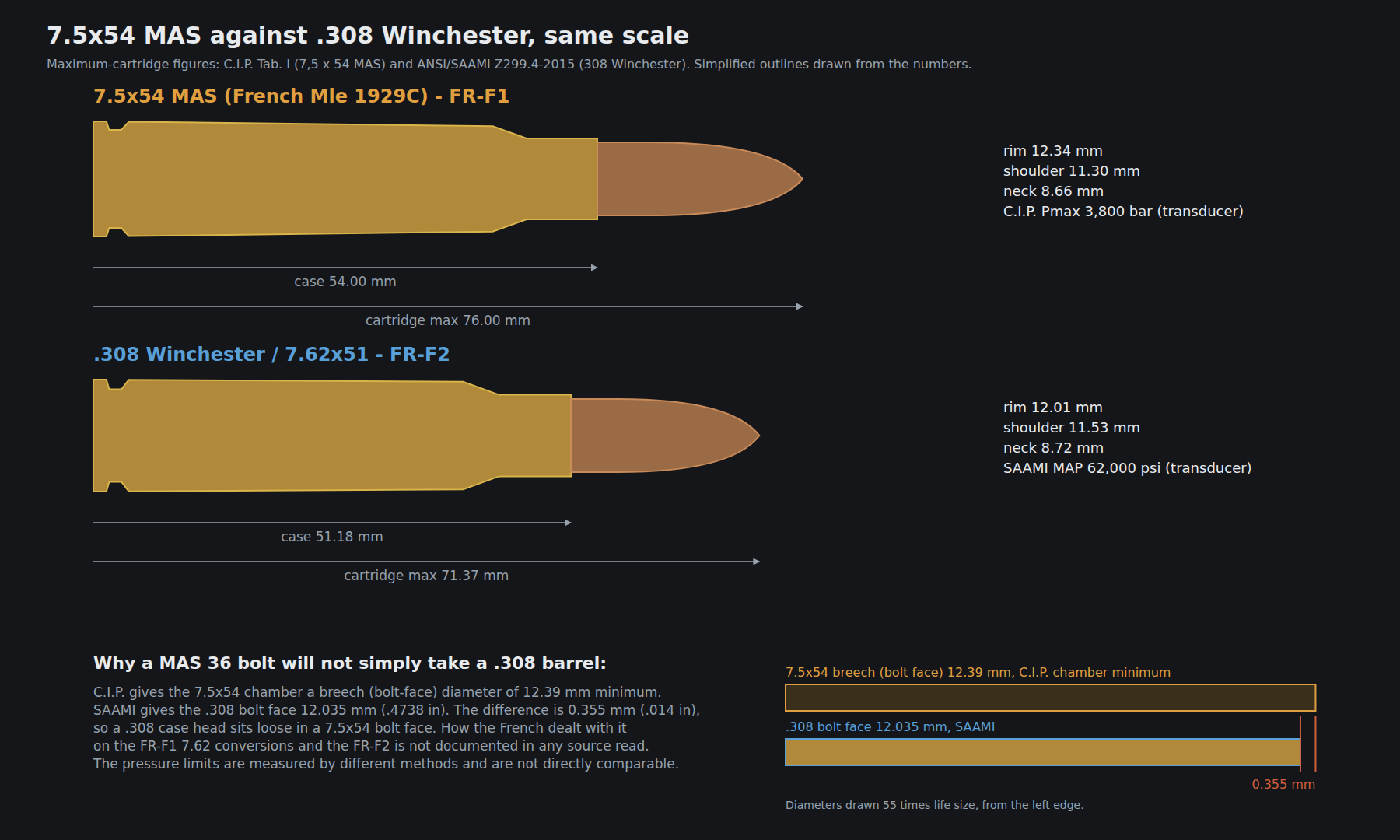
7.5×54 keeps the action exactly as the French designed it. Brass, ammunition and dies are all current: on 18 October 2026 Graf & Sons listed Prvi Partizan 7.5×54 ball at $28.39 for 20 and brass at $40.99 for 50, and Lee Precision listed a full-length die set at $46.98 (Vol 7). The bullets are standard .308 in. A 7.5×54 rifle is FR-F1-correct in calibre, and its ballistics are in the same class as the 7.62×51.3
7.62×51 or .308 gives the FR-F2’s calibre and the widest choice of ammunition and match bullets. It brings two problems.
Table 1 — The calibre decision
| Question | 7.5×54 | 7.62×51 / .308 |
|---|---|---|
| Bolt face fits the case head | Yes | No: 0.355 mm (.014 in) oversize |
| Receiver strength at the cartridge’s pressure | As designed | Unknown for an infantry receiver |
| Barrel blank and reamer availability | Reamer is a special order; blanks are ordinary .30 | Everything off the shelf |
| Ammunition and brass | PPU current; limited choice | Unlimited |
| Faithful to | FR-F1 | FR-F2 |
For a builder who wants the rifle to work without any open engineering questions, 7.5×54 is the answer. For one who wants 7.62 mm, the next two sections are the work.
9.5 The bolt face
The C.I.P. data sheet gives the 7.5×54 chamber a minimum breech, or bolt-face, diameter of 12.39 mm. SAAMI gives the .308 Winchester’s bolt face as .4738 in, 12.035 mm, and the .308 cartridge’s rim as .473 in maximum.45 A .308 case in a MAS 36 bolt face therefore sits in a recess about 0.355 mm (.014 in) too large in diameter. The English Wikipedia’s 7.5×54 article calls the French cartridge’s 12.39 mm breech “uncommon”.6
What that does depends on something no source read describes: whether the MAS 36’s bolt face is a counterbored recess, with a rim that supports the case head on all sides, or a flat face whose only lateral control of the case is the extractor claw. If it is counterbored, a .308 case can sit off-centre by up to the clearance, with the extractor pulling it to one side; the case head is then less well supported where it is not touching the counterbore wall. If it is flat, the clearance matters less to support, but the extractor alone positions the case.
The options for a builder are these:
- Measure first. Before deciding, measure the donor’s bolt face with pin gauges and a depth micrometer, and make a cast or impression of it. That single measurement decides the rest.
- Bush the bolt face. If the face is counterbored, a sleeve pressed and pinned or soldered into it can reduce the recess to .308 size. This is established practice on other actions; on a one-piece MAS bolt the work is done on the locking column itself, so it should be done without heat that could alter the bolt’s hardness, and the extractor cut must be carried through the bush.
- Re-fit the extractor. If the face is flat, the extractor’s claw and tension may need refitting for the smaller rim.
- Accept the clearance. This is what the cheap conversions appear to have done (below), and the record of extraction trouble and rim damage associated with them is the argument against it.
How the French themselves handled the bolt face on the 7.62 mm FR-F1 rebarrels, the FR-F2 conversions and the FR-G rifles is not documented anywhere read. The FR-F2’s bolt necessarily fits a .473 in rim, but whether that is a new bolt, a bushed bolt or a re-cut one is unknown. Finding out, from the French manual or from measuring an FR-F2 bolt beside a MAS 36 bolt, would be the most useful single fact for anyone attempting this build.
9.6 The receiver: what is and is not known about its strength
The argument usually made is that the French used the MAS 36 action in 7.62 NATO, so a MAS 36 is strong enough for .308. It does not follow, for two reasons.
First, the FR-F1 and FR-F2 used the strengthened FR-F1 receiver, not the infantry one (Vol 2). Their service in 7.62 mm shows that the locking system is adequate in that receiver; it says nothing about the infantry receiver.
Second, the counter-argument is the FR-G1 and FR-G2. Forgotten Weapons says the Air Force’s precision rifles of the 1990s were built “on a standard MAS 36 receiver” in 7.62 mm, and Popenker says the FR-G series used “surplus MAS M1936/51 rifle actions”.78 So the French state did build 7.62 mm rifles on infantry receivers. What it did to them first, whether it selected them, checked their hardness, re-heat-treated them or reinforced them, is not recorded in any source read. The FR-G shows that an infantry receiver can be made into a 7.62 rifle; it does not show that any infantry receiver, as found, can be.
The pressure comparison helps less than it seems. The C.I.P. gives the 7.5×54 a maximum pressure of 3,800 bar measured by transducer; SAAMI gives the .308 a maximum average pressure of 62,000 psi, also by transducer.45 Converting 3,800 bar gives about 55,100 psi, but the two bodies measure in different ways and the numbers should not be set side by side as if they were comparable. What can be said is that the MAS 36’s own cartridge is in the same pressure class as the .308, so the step is not from a low-pressure cartridge to a high-pressure one. Old receivers vary in hardness and condition, and no published proof or load test of an infantry MAS 36 at .308 pressure was found. P. O. Ackley’s well-known action tests were looked for and not located for the MAS 36.
The working position, then: a 7.62 mm build on an infantry receiver rests on judgement, not data. A builder who goes ahead should have the receiver’s hardness checked at the lug seats, should keep loads at or below standard pressure, and should have the finished rifle proof-fired by a gunsmith equipped to do it (below).
9.7 What earlier conversions teach
Three earlier groups of conversions are recorded, and they teach different things.
- Imported MAS 36s in 7.62 mm. The English Wikipedia says, without a citation, that “a few military surplus MAS-36 rifles, converted to 7.62×51mm NATO from 7.5×54mm” were imported into the United States, and that “These rifles were modified to chamber the NATO round and also had an SKS type trigger safety fitted to them”.9 Who converted them, and how, is not known.
- “Setting the barrel back.” In an AccurateReloading forum thread, posters describe a MAS conversion done by setting the barrel back and rechambering, because the shoulder angle and neck length of the two cases are “nearly identical”; one, a self-described former gunsmith, describes a rechambered MAS whose floor plate kept falling off, which he blamed on case-head expansion and gas, and advises keeping to .300 Savage-level pressures in .308 cases.10 These are anecdotes. They are consistent with what the bolt-face mismatch would predict, and they are no more than that.
- The Century MAS 49/56 conversions. A 308AR.com thread of 2011 records that Century’s conversions of the gas-operated MAS 49/56 to 7.62 mm had a poor reputation: “A number of the early conversions were done poorly and became “clubs” after a few rounds”.11 That is a different rifle, and its record should not be cited as evidence about the MAS 36.
The lesson of all three is the same. A conversion that only rechambers or sets back the barrel leaves the bolt face as it was. A conversion done properly deals with the bolt face, and none of the recorded ones says that it did.
9.8 Barrel, chamber and headspace
Barrel specification. The FR-F2’s barrel was 600 mm long, three grooves, right-hand, with a 290 mm twist (Vol 5). A commercial .308 blank with a 1 in 11 in or 1 in 12 in twist is the nearest standard equivalent; a three-groove blank is a special order. For a 7.5×54 build, the C.I.P.’s standard 7.5×54 barrel has a 7.85 mm groove diameter and a 270 mm twist, and the FR-F1’s had four grooves and a 300 mm pitch by the French Wikipedia (Vols 1 and 2).
The shank thread. No published specification for the MAS 36’s barrel shank thread was found, and no barrel maker offering a pre-threaded MAS 36 barrel was found. A forum poster reports that one large barrel maker declined MAS 36 work outright.10 The shank has to be measured from the donor’s own barrel once it is off, and the thread single-pointed on the lathe to match the receiver; the receiver’s thread should be measured too, not assumed. The barrel shoulder and the shank length set the barrel’s position relative to the lug seats, which on a rear-locking action sets headspace through the whole bolt body.
Chamber. For 7.62 mm, the choice of reamer matters. The hub’s Headspace dive gives Forster’s published NATO gauge dimensions against SAAMI’s .308 figures and explains the difference (Headspace, Vol 4); a NATO chamber suits surplus ball and matches the original “7,62.N” marking, while a .308 chamber with SAAMI headspace suits commercial ammunition and handloads. The Reloading Bench’s research makes the same point: the real difference between the two is headspace and military brass’s thicker walls, not a large pressure gap (The Reloading Bench, Vol 13).
Headspace. Set it with gauges in the finished action, with the bolt the rifle will be used with (Headspace, Vol 5). On a rear-locking action, headspace is a property of the whole action, not just of the bolt head (Headspace, Vol 9), so a bolt swap means re-checking. The hub’s volume on changing a headspace figure covers the corrective work (Headspace, Vol 13).
Free float. The barrel must be free of the stock, the sleeve and the bipod along its length. That is the FR-F2’s single most important accuracy feature after the barrel itself (Vol 5), and every later step in this volume preserves it.
9.9 The muzzle device
The FR-F1’s muzzle device was an adjustable flash-hider sleeve, and the FR-F2’s is described as tunable (Vol 5). No dimensions or adjustment instructions were found. A builder can make a slotted flash hider in the FR-F2’s pattern from photographs; a tunable one, a threaded sleeve that moves mass along the muzzle, is a reasonable feature to add, and it is set by firing groups at different positions. No source gives French settings, and none is invented here. Threading the muzzle also makes the rifle a suppressor host, which brings in the hub’s suppressor law dive (Suppressor Law).
9.10 The stock
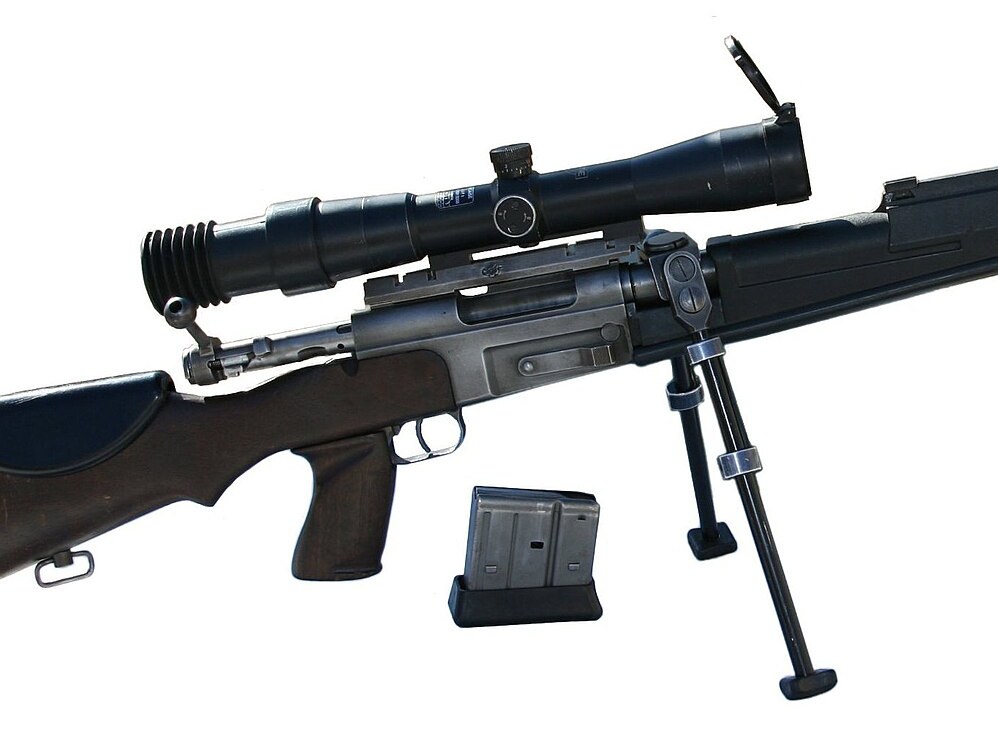
The MAS 36’s two-piece wooden stock, straight-wristed and banded, is replaced entirely. The FR-F2-pattern stock is a one-piece wooden stock with a separate pistol grip, a comb carrying cheek pads on two eyelets, and a butt lengthened by “two dovetailed extensions”, per American Rifleman; the Lithuanian Army describes them as additional wooden plates (Vol 5).1213
No published drawing of the FR-F1 or FR-F2 stock was found. A builder can work from the photographs in these volumes, scaled from the known overall length of 1,138 mm for the FR-F2 (Vol 5), or, better, from measurements of an imported rifle. The workflow in a shop like this one: draw the profile from scaled photographs; laser-cut it in MDF or acrylic as a template and test it against the barrelled action; machine the inletting on the CNC mill or router from a model of the action measured from the donor; leave the barrel channel clear for free float; bed the receiver; cut the length-of-pull plates on a dovetail so they slide on and lock; and fit the cheek pads on eyelets. A 3D-printed mock-up of the whole stock in PLA or PETG, fitted to the action before any wood is cut, catches mistakes cheaply.
The French Wikipedia records that a plastic stock was tried for the FR-F2 and rejected as too fragile (Vol 5); wood or a laminate is the faithful choice.
9.11 The thermal sleeve
The sleeve is what makes the rifle look like an FR-F2, and its construction is the least documented part of the original. No source read gives its internal construction or how it is fixed; the descriptions say only “plastic” or “polymer” and that the barrel remains free-floated (Vol 5).
A builder’s design should therefore follow the function rather than an unknown original:
- Fixed at one end only, to the receiver ring or to the bipod yoke’s mounting, so that it carries no load onto the barrel and moves with the action, not the barrel.
- Clear of the barrel along its whole length, with an air gap. A sleeve that touches a hot barrel changes its point of impact, which is the opposite of its purpose.
- Made of a material whose heat-deflection temperature is above the temperature the barrel reaches in the intended firing. No published figure for an FR-F2 barrel’s temperature was found; measure the barrel with a thermocouple after a string typical of the intended use, and choose the material from that. Printed carbon-fibre-filled nylon, or a machined or filament-wound composite tube, are the candidates a shop like this can make; ordinary PLA is not.
- Open at the muzzle end, so that air can move and moisture can drain (Vol 6).
- With a front-sight fitting if the builder wants the iron sights the English Wikipedia places on the sleeve (Vol 5).
9.12 The swinging bipod
The FR-F2’s bipod hangs from a yoke over the barrel ahead of the receiver, hinged above the bore so that the rifle swings on it, while “an overhead trunnion” keeps the barrel free-floated (Vol 5).12 A builder can machine an equivalent:
- Mounting. A clamp around the receiver ring, or a collar at the barrel shank immediately ahead of the receiver, where the barrel is stiffest and least affected by heat. Clamping it on the free length of the barrel would defeat the free float. The studio photograph shows a two-screw cap on the original’s yoke (Vol 4).
- The pivot. A horizontal pin above the bore line, so that the rifle hangs below the pivot and settles level on uneven ground. A friction washer lets the swing be stiffened.
- The legs. Telescoping, locking, folding forward, with feet. 4140 steel for the yoke and pivot, aluminium for the legs, is a reasonable choice for a shop with a CNC mill; the dimensions come from the builder’s own rifle.
- The sleeve. If the sleeve is fixed at the yoke, the two can be designed as one assembly.
9.13 Bolt handle, safety and magazine
Bolt handle. The MAS 36’s handle is bent; the FR-F2’s is straight (Vol 4). On the MAS bolt the handle sits close to the rear locking lugs, so welding or heating the handle risks altering the hardness of the lugs and the bolt body, the parts that carry the firing load. A builder who wants a straight handle should consider a replacement bolt rather than re-forging the original, or should leave the bent handle and accept the difference. The bent handle also limits scope clearance, which affects the mount (below).
Safety. The MAS 36 has no safety (Vol 1). The FR-F2 has a lever behind the trigger that blocks the trigger’s travel (Vol 5), and the imported 7.62 mm MAS 36 conversions were fitted with “an SKS type trigger safety”.9 A working FR-F2-pattern rifle should have one. A trigger-blocking lever pivoted in the trigger guard behind the trigger, as on the original, is within a machinist’s reach; it should be designed so that it cannot be partly engaged, and tested with the bolt closed on a primed empty case before the rifle is fired.
Magazine. This is where a lookalike and the original part ways. The MAS 36 has a fixed five-round box; the FR-F2 a detachable ten-round double-column box. The FR-F1 received a new receiver partly to take that magazine (Vol 2). Cutting an infantry MAS 36 receiver’s magazine well to take a detachable box removes metal from the part of the receiver that surrounds the space just ahead of the lug seats, on an action where the lug seats sit behind the magazine well. That is not advisable on a receiver whose strength is already unknown. A builder who wants the look can make a dummy magazine shell that covers the fixed box; one who wants a detachable magazine should look for a different action.
9.14 The optic mount
Thames Valley Guns, a British shop, describes a MAS 36 scope mount as “one of the few designs that I have encountered that requires no alteration of the rifle at all”, “only available as a weaver base”, and “slightly off-set to the left”, which “limits the number of scopes you can fit” because of the bolt handle.14 The page does not name the maker or give a price. A builder with a CNC mill can instead machine a base for the receiver ring, drilled and tapped, if the receiver’s hardness allows; the FR-F2’s receiver has “angled horizontal cuts” for its proprietary bases (Vol 5), which an infantry receiver does not.
For a faithful look, an APX L806 or a SCROME J8 (Vol 7). For use, any fixed or variable scope with a ranging reticle; the hub’s scope dive covers the choice and the mounting (Types of Scopes, Vol 4; Vol 8).
9.15 Proof, records and the law
Proof. The United States has no compulsory proof house. A rebarrelled rifle, and above all a 7.62 mm conversion of an infantry MAS 36, should be inspected and proof-fired by a gunsmith equipped to do it before it is fired from the shoulder, with headspace re-checked afterwards and the lug seats and bolt face examined for setback or marks. No published proof standard for a converted MAS 36 exists; the gunsmith’s own standard applies.
Records. Keep a build log: the donor’s markings and condition, the bolt-face and headspace measurements, the receiver hardness readings, the barrel and chamber specification, and the proof result. The log is what a future owner, or a future gunsmith, will need.
Federal law. The build modifies an existing, serialised, imported rifle; it does not make a new receiver. A bolt-action rifle is outside 18 U.S.C. 922(r), which concerns semi-automatic rifles and shotguns (Vol 8). At 600 mm of barrel and well over 26 in overall it raises no National Firearms Act question. A curio-or-relic licensee can acquire the donor MAS 36 as a curio; the finished rifle, altered from its original configuration, should be treated as a modern firearm for any later transfer. That last point rests on ATF’s description of curio status as applying to firearms in original configuration, which was seen only in a search summary because the ATF page refused automated reading; treat it as the safe course rather than a quoted rule.
Michigan. A long gun is outside Michigan’s pistol licensing and sales-record provisions (Remington Nylon 66, Vol 7), and a full-length rifle is outside the short-barrelled rifle section (MP 40, Vol 6). The hub’s Steyr AUG dive recorded, as of September 2026, that no Michigan serialisation requirement for a self-made firearm was found and that pending bills were not checked (Steyr AUG, Vol 6); this build makes no new receiver, so that question does not arise, but the AUG dive’s advice to re-check state law before starting stands.
9.16 What would make this easier
Table 2 — What would make this easier
| Missing fact | Where it might be found |
|---|---|
| The MAS 36 bolt face’s geometry: counterbored or flat, and its dimensions | Measuring a donor bolt |
| How the French fitted .473 in case heads to the MAS bolt on the FR-F1 7.62 rebarrels, the FR-F2 and the FR-G | The French manual (Vol 6); measuring an FR-F2 bolt |
| What was done to infantry receivers for the FR-G series | GIAT or Air Force records; the Dumas book |
| The MAS 36 barrel shank thread | Measuring a donor barrel |
| The FR-F2’s stock, sleeve and bipod dimensions | Measuring an imported rifle |
| Any proof or load test of an infantry MAS 36 at .308 pressure | Not found; the Ackley tests do not appear to include it |
References
Footnotes
-
Steve N. Jackson, “Fusil MAS Mle 1936”, virdea.net, https://www.virdea.net/french/36.html , read 2026-10-18. ↩
-
English Wikipedia, “FR F1”, read 2026-10-18, quoting Jane’s Infantry Weapons 1996–1997 (not read in the original). ↩
-
Graf & Sons and Lee Precision listings as cited in Vol 7, prices read 2026-10-18; English Wikipedia, “7.5×54mm French”, for the ballistic comparison. ↩
-
C.I.P., TDCC Tab. I, “7,5 x 54 MAS”, dated 07-05-14, revised 11-05-25, read from the archived C.I.P. copy on 2026-10-18. ↩ ↩2
-
ANSI/SAAMI Z299.4-2015, Voluntary Industry Performance Standards for Pressure and Velocity of Centerfire Rifle Ammunition, cartridge and chamber drawing for the 308 Winchester (printed p. 110) and the pressure tables, from the project Library copy, read 2026-10-18. ↩ ↩2
-
English Wikipedia, “7.5×54mm French”, read 2026-10-18. ↩
-
Ian McCollum, “French Air Force Snipers: the FR-G1 and FR-G2”, Forgotten Weapons, 4 March 2020, read 2026-10-18. ↩
-
Maxim Popenker, “FR F2”, Modern Firearms, read 2026-10-18. ↩
-
English Wikipedia, “MAS-36 rifle”, https://en.wikipedia.org/wiki/MAS-36_rifle , read 2026-10-18; uncited sentences, given as that source states them. ↩ ↩2
-
AccurateReloading forums, thread on a rechambered MAS, https://forums.accuratereloading.com/eve/forums/a/tpc/f/7811043/m/73310678 , read 2026-10-18; undated posts; anecdotes only. ↩ ↩2
-
308AR.com forum, “308 MAS”, 15–16 January 2011, https://forum.308ar.com/topic/898-308-mas/ , read 2026-10-18. ↩
-
Martin K. A. Morgan, “The French FR F2 Sniper Rifle”, American Rifleman, 18 September 2021, read 2026-10-18. ↩ ↩2
-
Lietuvos kariuomenė, “Snaiperinis šautuvas FR F-2”, page dated 2009-04-17, Internet Archive capture of 28 July 2010, read 2026-10-18. ↩
-
Thames Valley Guns, MAS 36 scope mount page, https://www.thamesvalleyguns.co.uk/page34.html , read 2026-10-18. ↩
Comments (0)