MAS FR-F1 and FR-F2 · Volume 1
Saint-Étienne, the MAS 36 and the French Marksman Before 1964
The state arms factory, the rear-locking bolt action it put into service in 1936, the short 7.5 mm cartridge it fired, and the scoped rifles the French Army made do with until it asked for a purpose-built precision rifle
1.1 Why the story starts with an infantry rifle
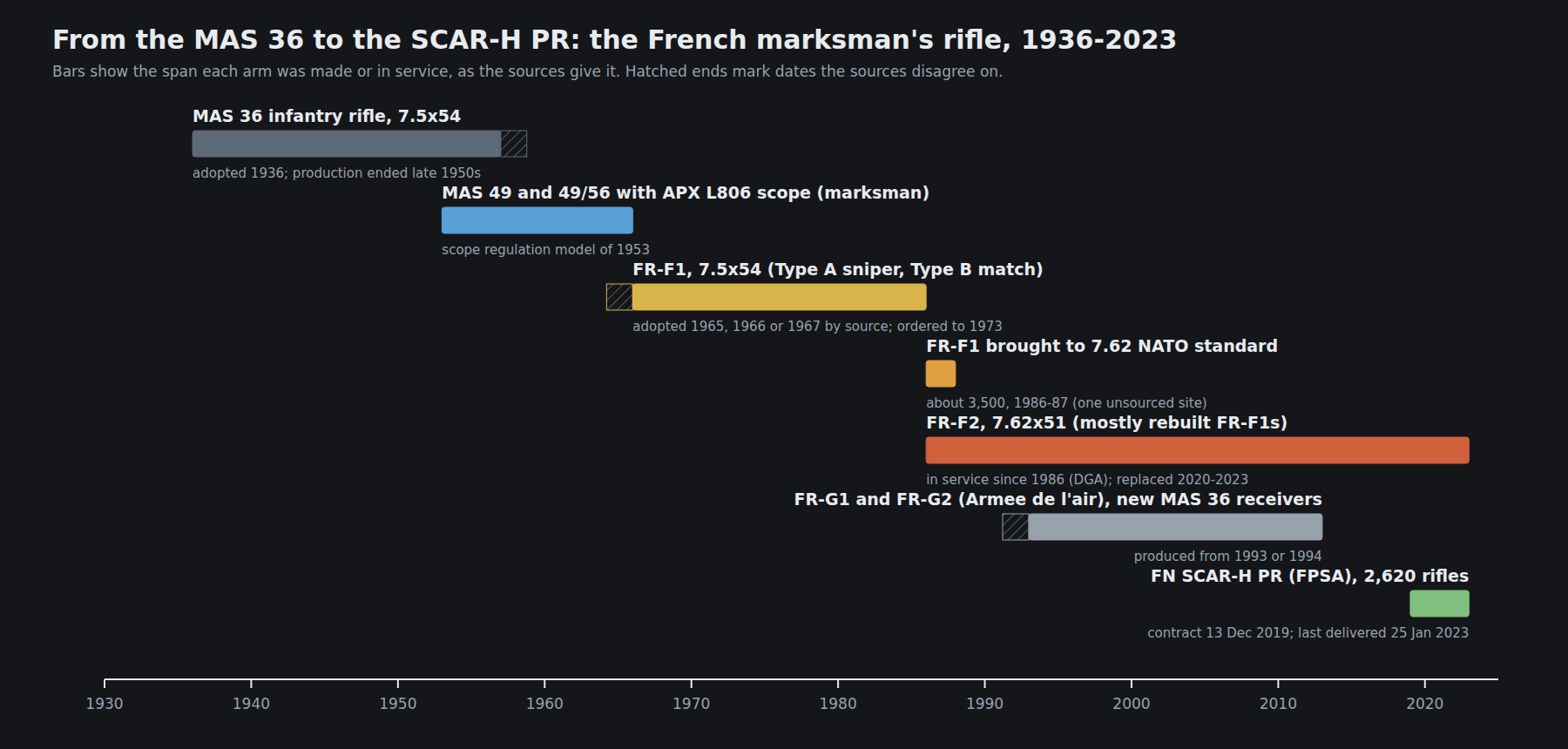
The FR-F2 that French marksmen carried from 1986 until the last FN SCAR-H PR replacements arrived in January 2023 was not a new design. The Ministry of the Armed Forces’ own history of French marksmen in Sarajevo says so in one sentence: “Toutes les compagnies d’infanterie sont dotées du fusil de précision FR-F2, évolution du FR-F1, lui-même basé sur un système dérivé du MAS 36” (“All infantry companies are equipped with the FR-F2 precision rifle, a development of the FR-F1, itself based on a system derived from the MAS 36”).1 The same page adds the fact that shapes most of what follows in these volumes: “L’essentiel des FR-F2 sont des FR-F1 modifiés par la manufacture d’armes de Saint-Étienne (MAS) dont le boîtier de culasse a été fraisé puis à nouveau usiné” (“Most FR-F2s are FR-F1s modified by the Manufacture d’armes de Saint-Étienne, whose receiver was milled and then re-machined”).1
So the rifle that served the French Army into the 2020s descends, through one rebuild programme and one earlier design, from a bolt action put into service in 1936. Its lugs are at the back of the bolt, as the MAS 36’s were. Its bolt strips into the same five parts. Its receiver, in most cases, is a 1960s FR-F1 receiver, cut and re-machined at the same factory that had made the MAS 36. Understanding the FR-F2 starts with that factory, that infantry rifle and the cartridge it was built around, and with the stopgap scoped rifles France used for marksmen until the 1960s.
1.2 The Manufacture at Saint-Étienne
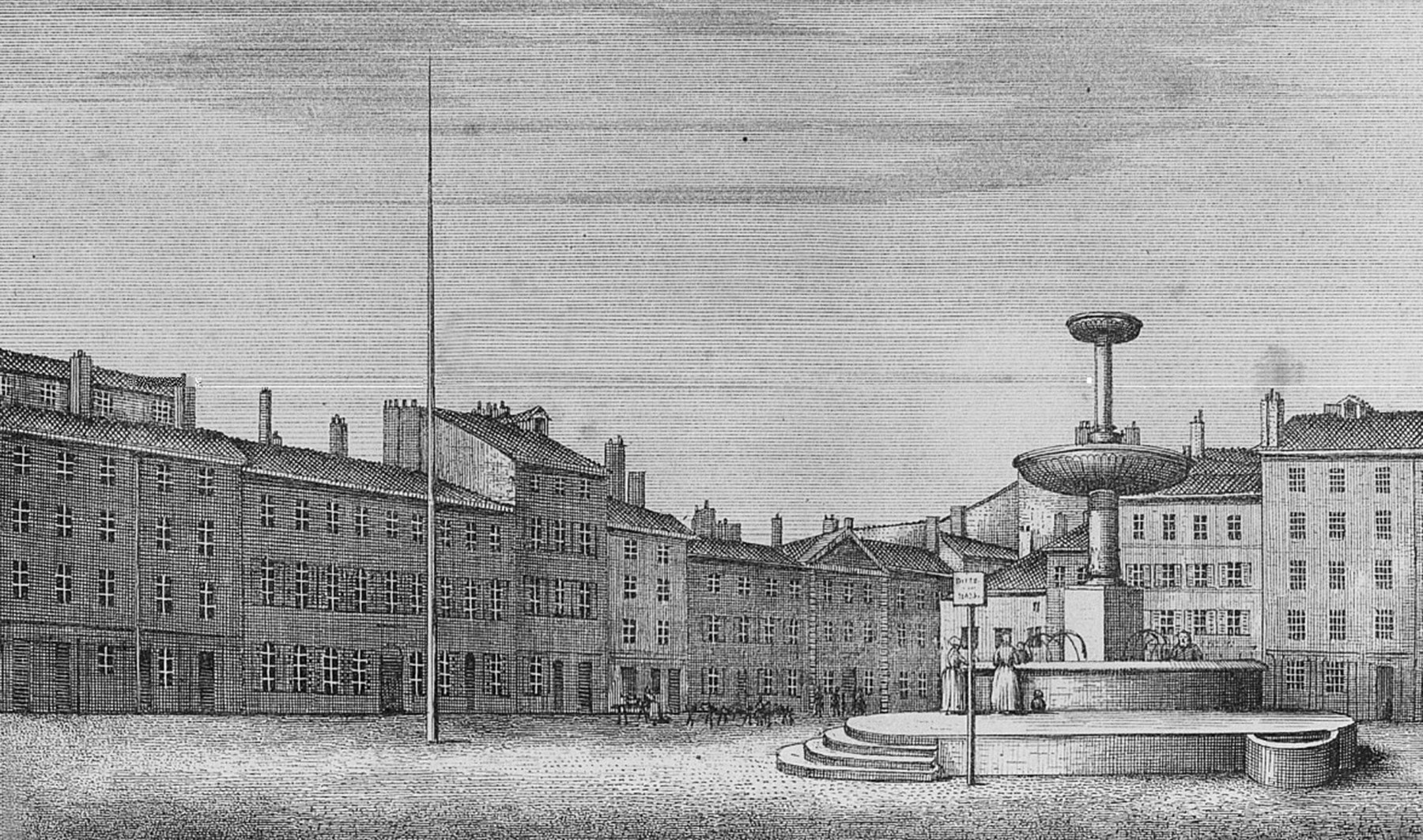
The Manufacture d’armes de Saint-Étienne, MAS in every French arms marking, was a royal and then a state arms factory in the Loire. Its founding date is given two ways. English-language summaries, and the regional heritage inventory as quoted in search results, give 1764, the year the title “Manufacture royale” was granted; the French Wikipedia gives 1765 and cites an academic study that was not read for this volume.2 Neither date is adopted here: the factory’s royal standing dates from 1764 or 1765, depending on the source.
The French Wikipedia chronology, mostly without citations, gives the outline of the next two centuries: the Jovin brothers sold the business to the government in 1838; a new factory on the Champ de Mars was decided in November 1862, its first buildings put up from 1864 and the whole completed in 1868–70; in 1894 “la Manufacture devient un établissement d’État dirigé par le ministère de la Guerre” (“the Manufacture becomes a state establishment run by the Ministry of War”); more than 11,000 people worked there in 1940; and by 1981 the figure was about 2,200.2 Those figures are given as that source states them and are not corroborated here.
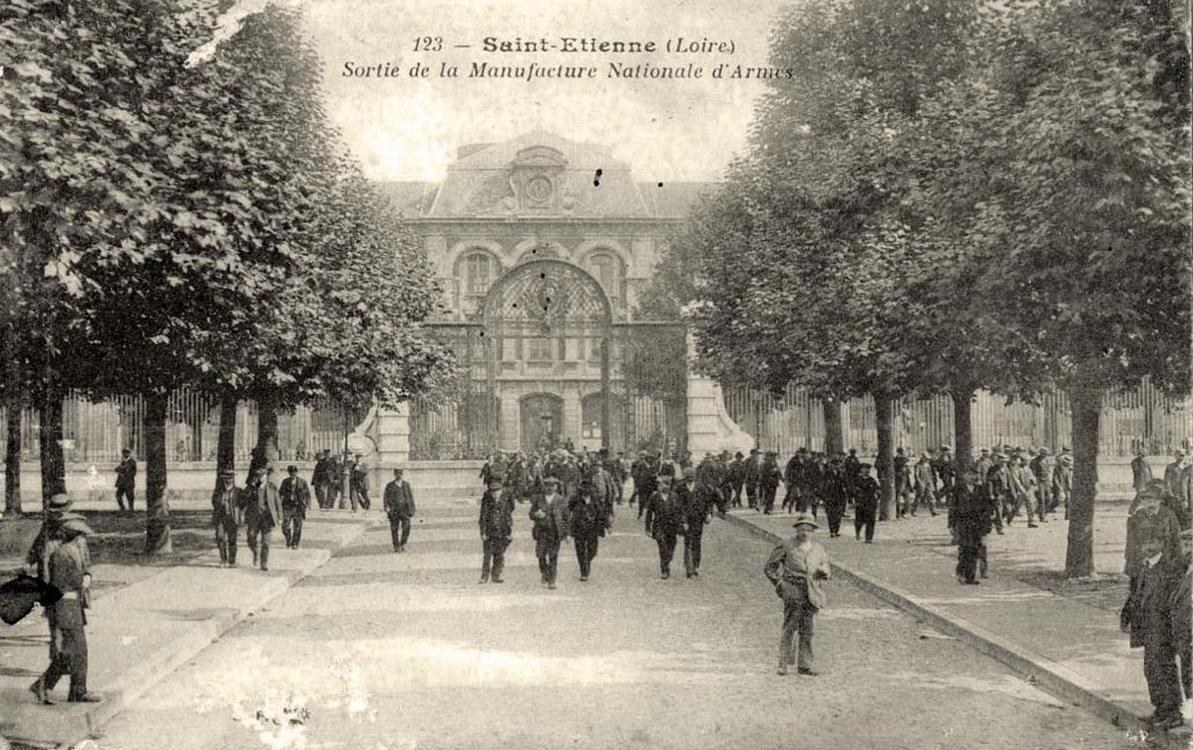
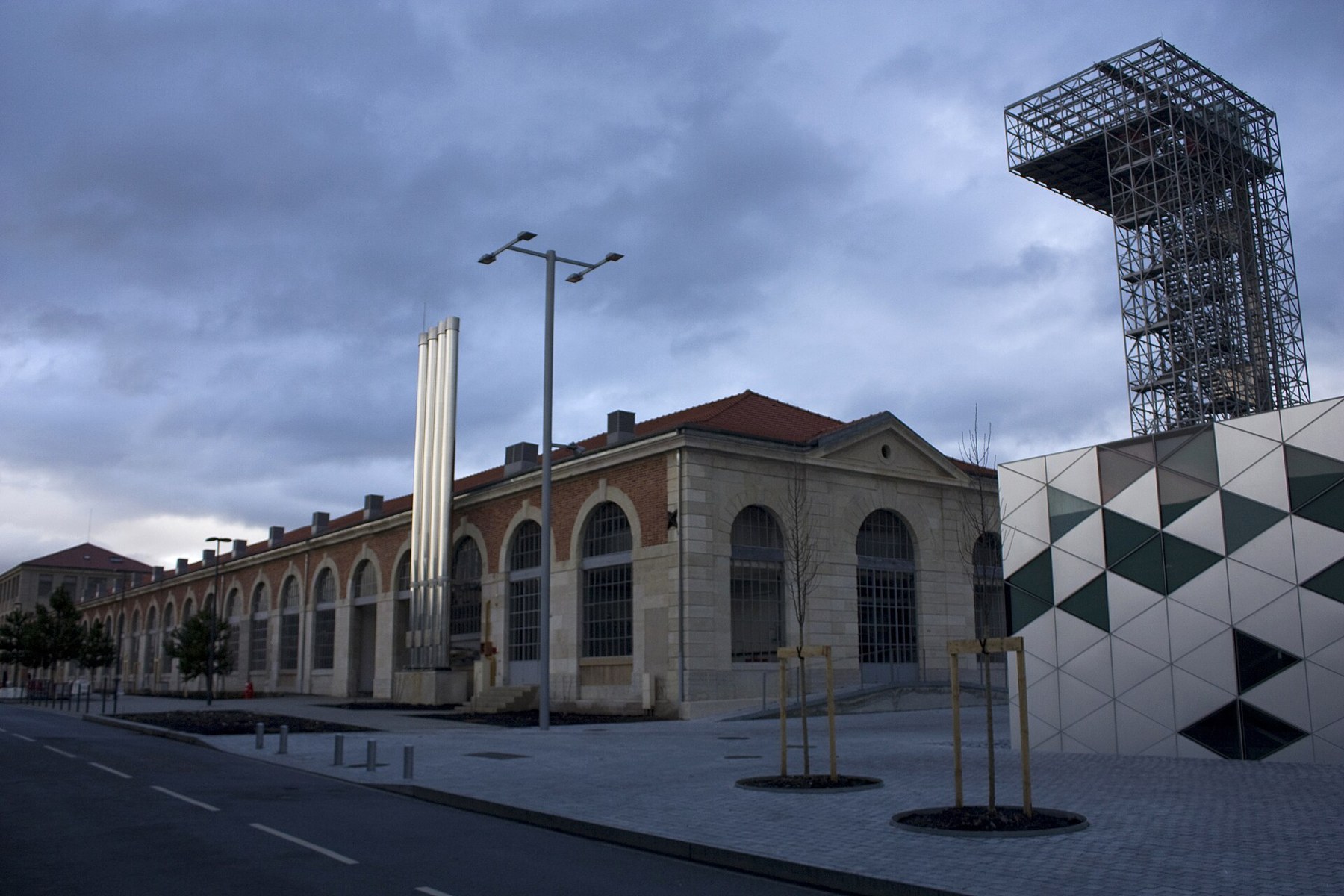
The buildings survive. The clock building, the long workshop ranges and the great gate on the Place de la Manufacture are now part of the Cité du design and the city’s school of art and design, and parts of the site were listed as a historic monument on 20 March 2006.2

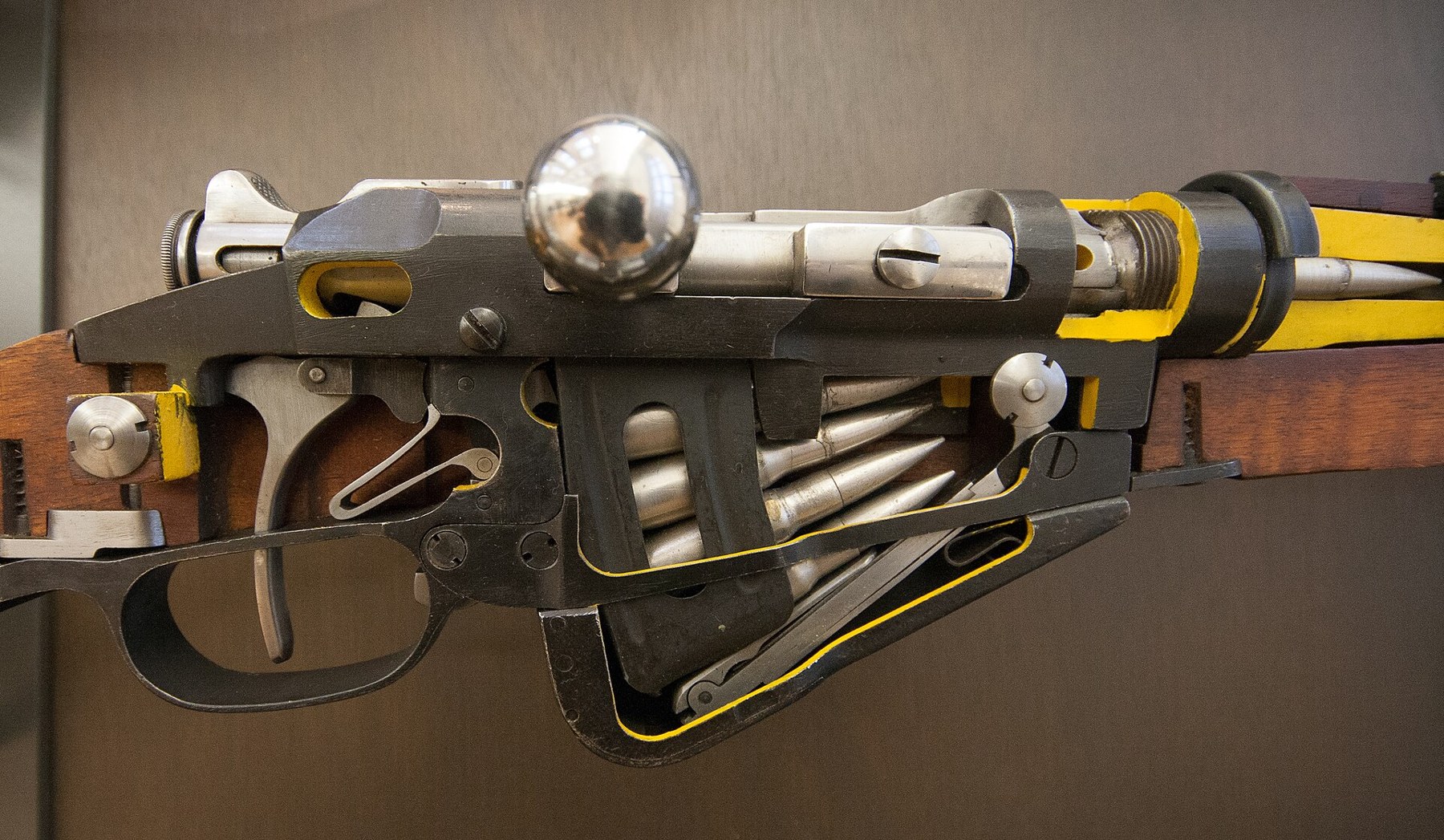
The town’s Musée d’Art et d’Industrie has a weapons department. Among the pieces photographed there is a Berthier carbine of the 1916 pattern cut open to show its action and magazine, the generation of service arm the MAS 36 was designed to replace.
1.3 From state establishment to GIAT, and the end of rifle-making
The common account says the factory became part of GIAT Industries around 1990 and closed in 2001. The parliamentary record gives a more exact picture, and it corrects the first half.
A French Senate report of 1989, written for the bill that turned the state’s land-armaments group into a company, explains that the Groupement industriel des armements terrestres had been created in 1971: “Ce double mouvement a abouti à la création en 1971, par décret, d’un “Groupement industriel” au sein de la Direction technique des armements terrestres. Cette structure regroupait tous les moyens industriels de la Direction” (“This double movement led to the creation in 1971, by decree, of an ‘Industrial Group’ within the Directorate of Land Armaments Engineering. This structure brought together all the Directorate’s industrial resources”).3 The same report lists the establishments in the group, among them “MAS : Manufacture nationale d’armes de Saint-Étienne (42) pour l’étude et la fabrication d’armes légères d’infanterie, de tourelleaux, d’armes et roquettes antichars et de dispositifs de protection contre les agents nucléaires et chimiques. 1.879 employés” (“MAS, the National Arms Factory of Saint-Étienne, for the design and manufacture of infantry small arms, small turrets, anti-tank weapons and rockets, and protection against nuclear and chemical agents; 1,879 employees”).3
So the factory was inside the GIAT structure from 1971. The FR-F1 was designed and made while it was a directly run state establishment, and the conversions that produced the FR-F2 in the 1980s were carried out by MAS as part of GIAT. The law of December 1989 and the decree of 9 July 1990 changed GIAT’s legal form into a state-owned company, GIAT Industries; they did not change which group the factory belonged to.34 English-language references that name “GIAT Industries” as the FR-F2’s maker are therefore anachronistic for conversions completed before mid-1990; “MAS (GIAT)” is the accurate attribution.
The same Senate report already saw the end coming. The small-arms sector, carried on at the national factories of Saint-Étienne and Tulle, had poor prospects; the FAMAS assault rifle programme had fallen to “19 000 en 1988 contre 36 500 en 1984” (“19,000 in 1988 against 36,500 in 1984”), and “La charge de la MAS décroit dès 1989 et la sous-activité va devenir élevée à partir de 1990” (“the MAS workload falls from 1989, and under-activity will become high from 1990”).3
The end of rifle-making at Saint-Étienne is usually dated to 2001. A National Assembly report of 2006 shows that the GIAT establishment there did not simply close that year. From 1998, the company cut its production sites from twelve to four and kept “un seul site de production d’armes … (Bourges) contre trois auparavant” (“a single weapons production site, Bourges, instead of three before”); but tank episcopes “originellement fabriqués dans l’établissement de Saint-Étienne” were still being made there until the staff, “bien que toujours inscrits dans les registres du personnel de l’entreprise, ont pratiquement cessé toute production dès 2003” (“although still on the company’s staff registers, practically stopped all production from 2003”).4 The safe statement is that small-arms production at Saint-Étienne ended around 2001 and the establishment wound down between 2003 and 2006.
1.4 The MAS 36: design and adoption
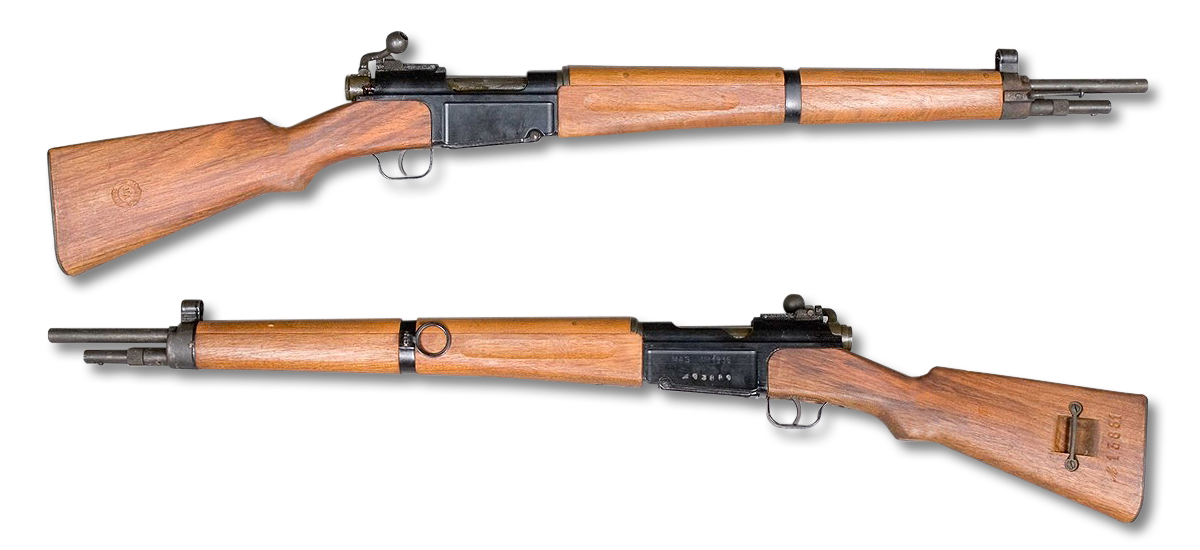
The MAS 36 was France’s answer to a problem the First World War had left: its infantry rifles, the Lebel of 1886 and the Berthier family, fired the rimmed 8 mm Lebel cartridge and carried their ammunition in tube or Mannlicher-pattern clip magazines. The collector Steve Jackson’s account, the most detailed English-language summary found, gives the sequence: the design was finished in 1932; prototypes of 1934 and 1935 were not put into series production; and “Full production was not started until 1936, with the weapon getting the designation the Fusil MAS Mle 1936”.5 A French club site gives the adoption date as 17 March 1936, after troop trials from 1933 to 1935; that page cites no source, and the date is not confirmed here.6
How many were made is uncertain. Jackson writes that “More than 200,000 were in French hands before the fall of France in 1940”, and that in total “there could have been made as many as 1.3 million rifles”, plainly an estimate.5 A figure of about 1.1 million made by 1952 circulates without a traceable source.6 Neither number is adopted; they are given as those sources state them, and they are incompatible.
The rifle itself, as the French Wikipedia records it from its cited sources, was 1,020 mm long (1,290 mm with the bayonet fixed), with a 575 mm barrel and an empty weight of 3.72 kg, fed from a fixed five-round box loaded through the top of the open action.7 Two features set it apart from the bolt rifles of its neighbours, and both survive in the FR-F2: the locking lugs sit at the rear of the bolt, and the bolt is extremely simple. A third did not survive. The French Wikipedia notes “l’absence de sûreté” (“the absence of a safety”) and explains it with the doctrine of the day: “ce fusil devait être approvisionné en munitions au tout dernier moment” (“this rifle was to be loaded only at the very last moment”).7 The FR-F1 and FR-F2 have a safety; the MAS 36 never did.
1.5 The rear-locking bolt
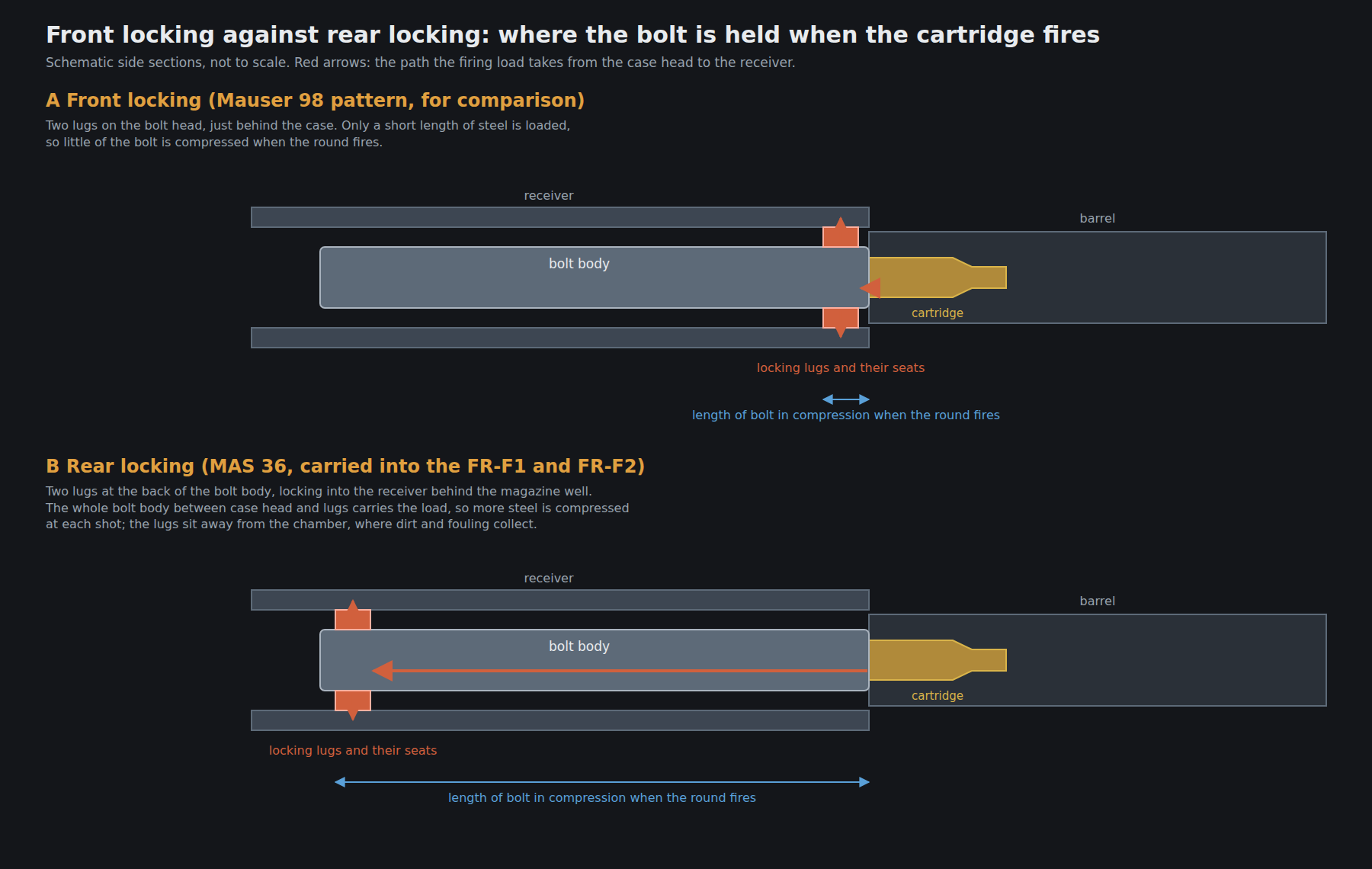
The French Wikipedia describes the MAS 36 bolt in one sentence: “elle est à corps cylindrique avec levier d’armement coudé et comporte deux tenons de verrouillage dans sa partie arrière” (“it has a cylindrical body with a bent cocking handle and carries two locking lugs at its rear”).7 Jackson puts the same fact in collector’s terms, “two bolt locking heads which fit into the rear of the rifle’s receiver”, and draws the usual conclusion: rear locking is “weaker than the Mauser design but provide[s] a more reliable lock in dirty conditions”.5
The engineering trade-off behind that verdict is simple to state. When the cartridge fires, the case head pushes back on the bolt face with the full force of the chamber pressure acting on the case’s internal area. In a front-locking bolt that thrust passes through a few millimetres of bolt head into the lugs and then into the receiver ring. In a rear-locking bolt it passes along the whole bolt body, which acts as a column in compression, before reaching the lugs. A longer column compresses more under the same load, and the receiver behind the magazine well, cut open for the magazine and the bolt’s travel, has to carry the lug seats. The result is an action that tends to give more elastic set-back at each shot and is more sensitive to receiver stiffness. The payoff is that the lug seats sit far from the chamber, where grit and fouling collect, which suited an infantry rifle meant to work in the mud.
This matters for the FR-F1 and FR-F2 in two ways. The French did not simply mount a scope on a MAS 36: they made a new, heavier receiver for the FR-F1 (Vol 2), which Jane’s Infantry Weapons, as quoted in the English Wikipedia, describes as “designed to be stronger and thicker in order to increase accuracy” and not interchangeable with the infantry receiver.8 And the strength of an infantry MAS 36 receiver is the central question for anyone who wants to build an FR-F2 lookalike on one (Vol 9). Vol 5 takes the bolt apart part by part.
1.6 The MAS 36 family
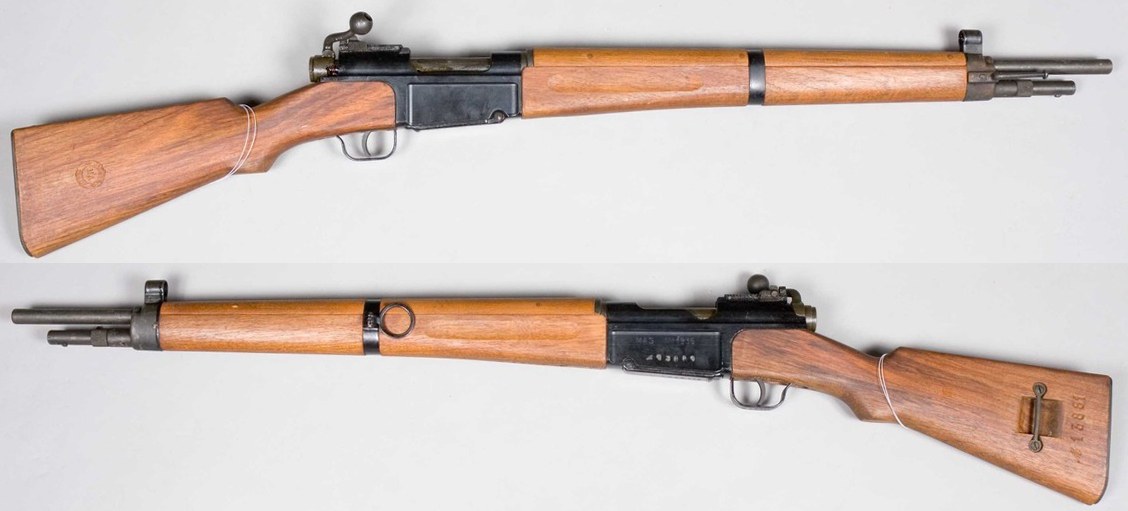
Jackson lists the variants that matter for identification:5
Table 1 — The MAS 36 family
| Variant | What it is | Source |
|---|---|---|
| MAS 36 | Standard infantry rifle, 7.5×54 | Jackson |
| MAS 36 CR39 | Paratroop model of 1939 with a folding aluminium stock | Jackson |
| MAS 36/51 | Rifle fitted for the 22 mm NATO rifle grenade, with grenade sights; most grenade-launching rifles were converted to it | Jackson |
| FR-F1, FR-F2, FR-G1, FR-G2 | Precision rifles derived from the action, on new receivers (FR-F1) or rebuilt ones | Jackson; Vol 2 |
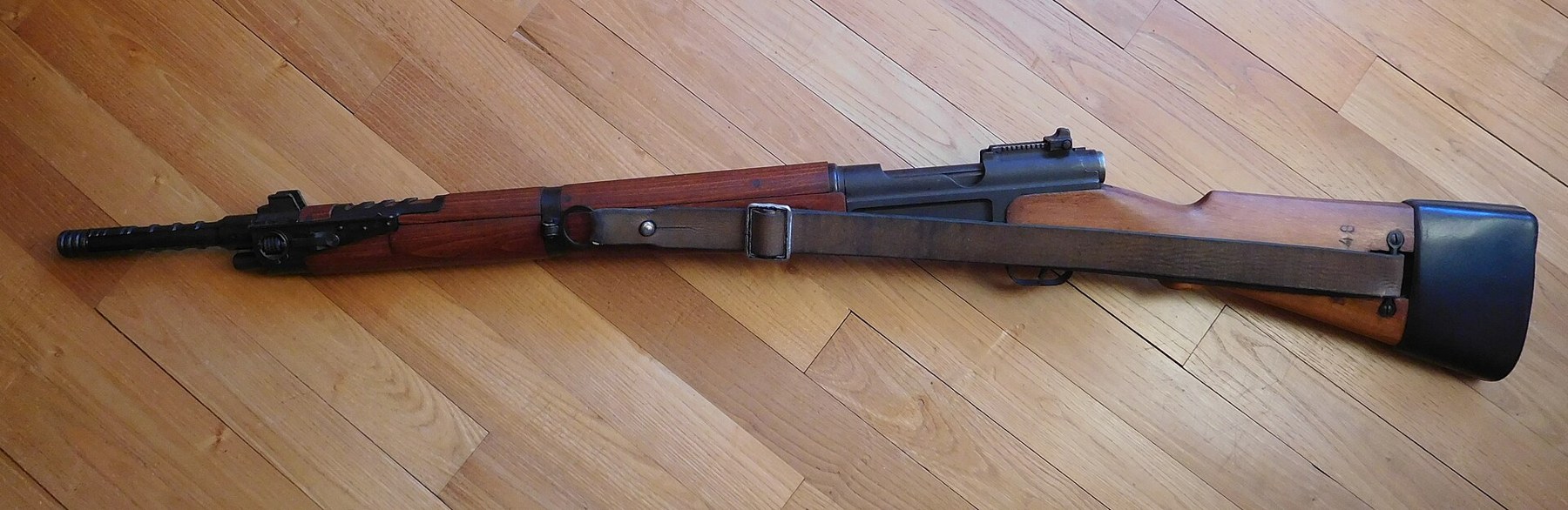
Jackson dates the end of MAS 36 production to “late 1957”, though his page also gives 1956 elsewhere, and records that the rifle stayed in service with the Gendarmerie as a riot-grenade launcher until the late 1970s.5 He adds a sentence that is the shortest possible summary of these volumes: “The 1936 remains in service with the French military in the form of the FR-F1, FR-F2, FR-G1, and FR-G2”, the precision rifles “built on new (and very high quality) receivers”.5
1.7 The cartridge: 7.5×54 Modèle 1929C
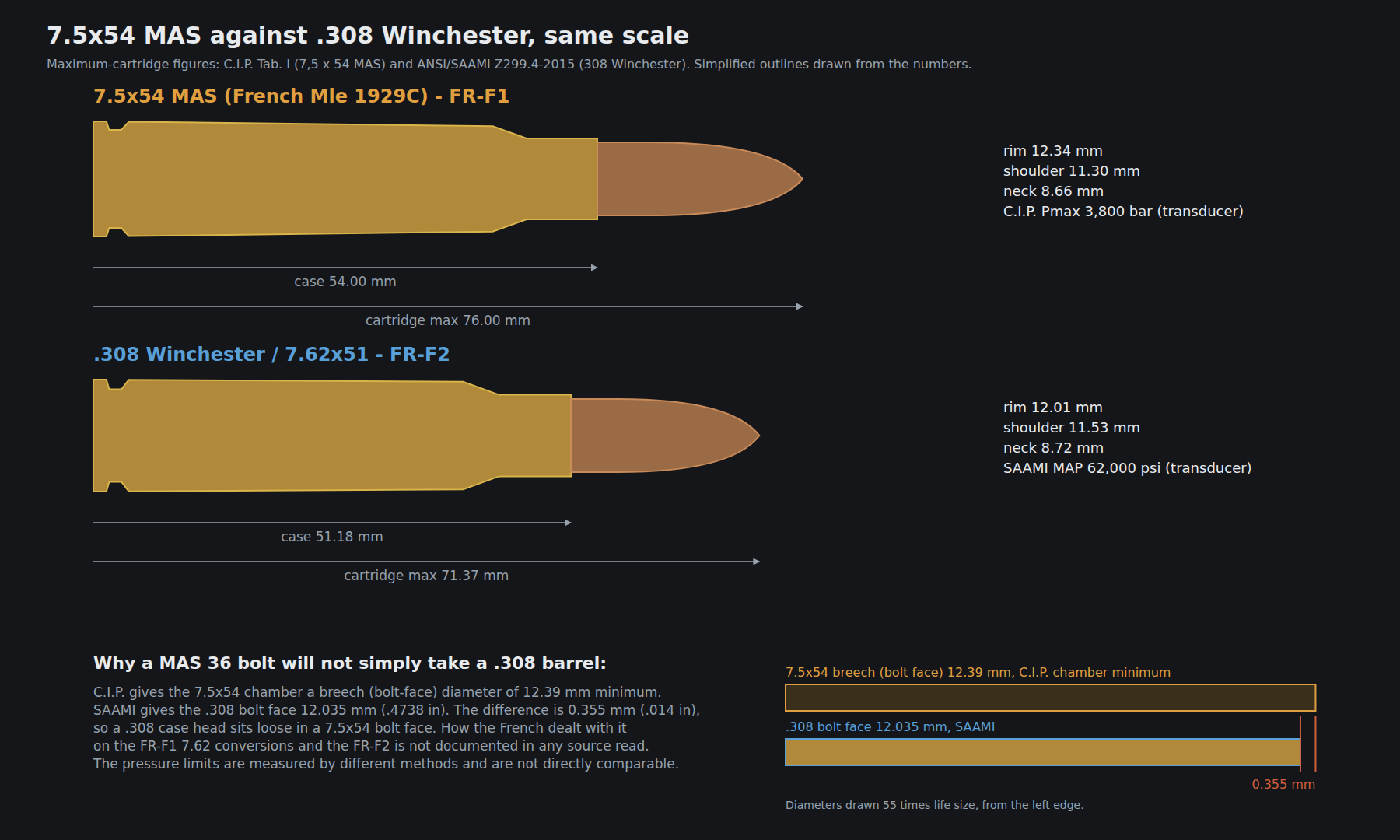
The MAS 36 was built for a rimless 7.5 mm cartridge adopted in 1924 and shortened in 1929. The English Wikipedia’s account, uncited at this point, explains the change: the 1924 cartridge, with a 57 mm case, was “very similar in size and appearance to the German 7.92×57mm Mauser”, so a soldier could chamber the wrong round, and the 54 mm case of 1929 prevented it.9 It first chambered the Châtellerault light machine gun of 1924/29.5
The dimensions that matter here come from the Commission internationale permanente’s data sheet for the “7,5 × 54 MAS”, country of origin France:10
Table 2 — The cartridge: 7.5×54 Modèle 1929C
| Dimension (C.I.P.) | Value |
|---|---|
| Case length, maximum | 54.00 mm |
| Cartridge overall length, maximum | 76.00 mm |
| Rim diameter, cartridge maximum | 12.34 mm |
| Breech (bolt-face) diameter, chamber minimum | 12.39 mm |
| Bore / groove | 7.57 / 7.85 mm, 4 grooves |
| Twist | 270 mm |
| Maximum pressure, Pmax (transducer) | 3,800 bar |
Two loadings are named in the English Wikipedia’s table: the 9.0 g (139 gr) flat-base spitzer balle C, at 820 m/s, “adopted for universal service in the MAS-36 and MAS-49 rifles”; and the 12.35 g boat-tailed balle D, at 694 m/s, with “limited specialized use” in machine guns.9 The cartridge’s ballistics put it in the same class as the 7.62×51 NATO, a point that comes back when the French moved their precision rifles to the NATO round in the 1980s (Vol 3) and when a builder weighs the pressure question (Vol 9). The C.I.P. and SAAMI pressure figures are measured by different methods and should not be set side by side as if they were comparable numbers.
1.8 French sniping before the FR-F1
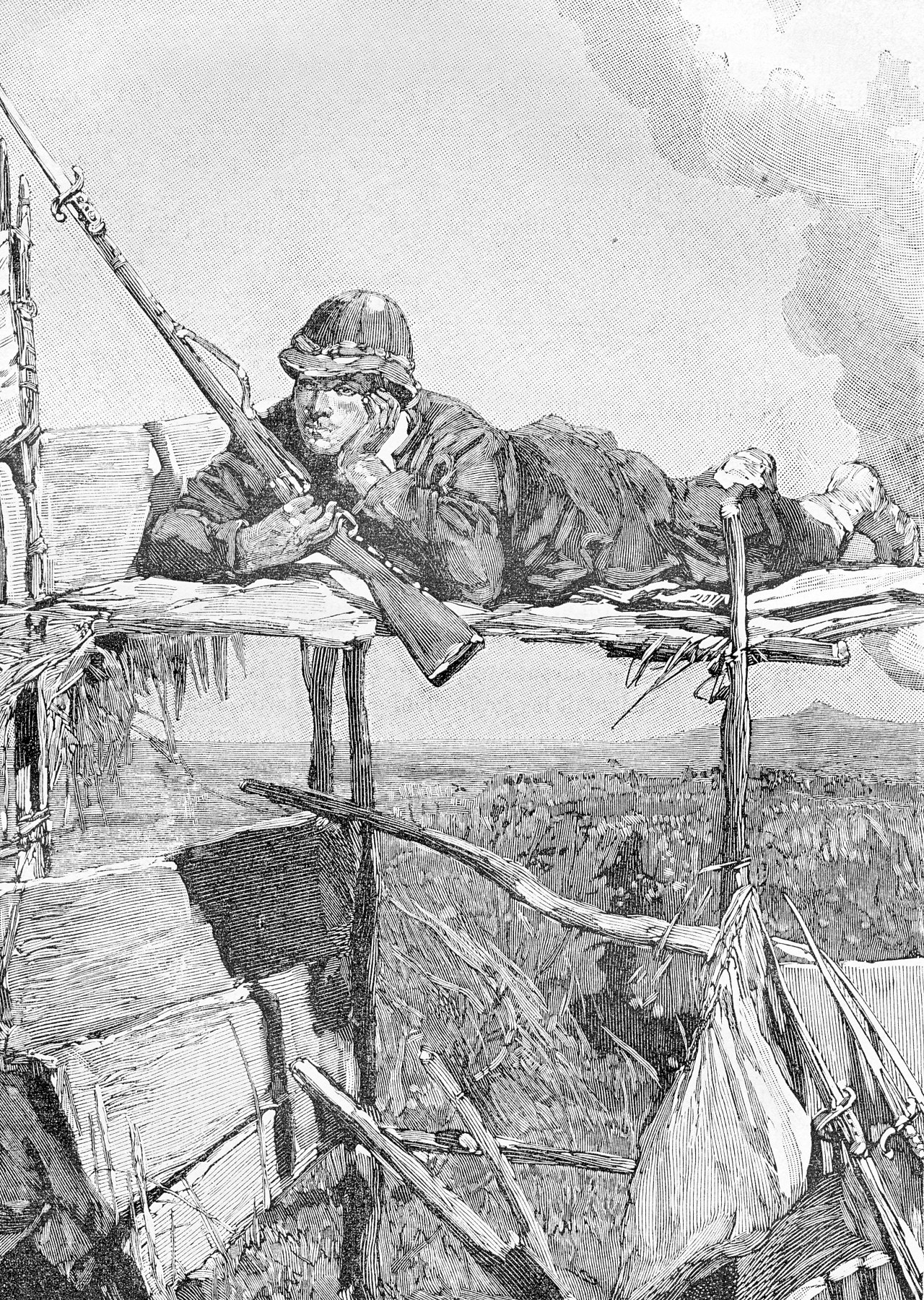
The French Army used marksmen long before it had a purpose-built precision rifle, as the Legion’s siege of Tuyen Quang shows in the illustrated histories of the 1880s. What it lacked, between the wars and for two decades after 1945, was a rifle designed for the job. The doctrine that eventually shaped the FR-F1 and FR-F2 was a platoon-level one. By the 1990s, the Ministry’s history of French marksmen in Bosnia records, “les tireurs d’élite (TE) sont constitués en équipes de trois. Chaque section de combat possède une équipe” (“marksmen are formed into three-man teams; each combat platoon has one team”).1 That is the role the FR-F1 was eventually asked to fill: one precise rifle per infantry platoon, not a specialist long-range sniping school of the kind the British and Soviet armies maintained. How that doctrine developed between 1945 and the 1960s was not established from any source read for these volumes.
1.9 The APX L806 and the scoped MAS 49/56
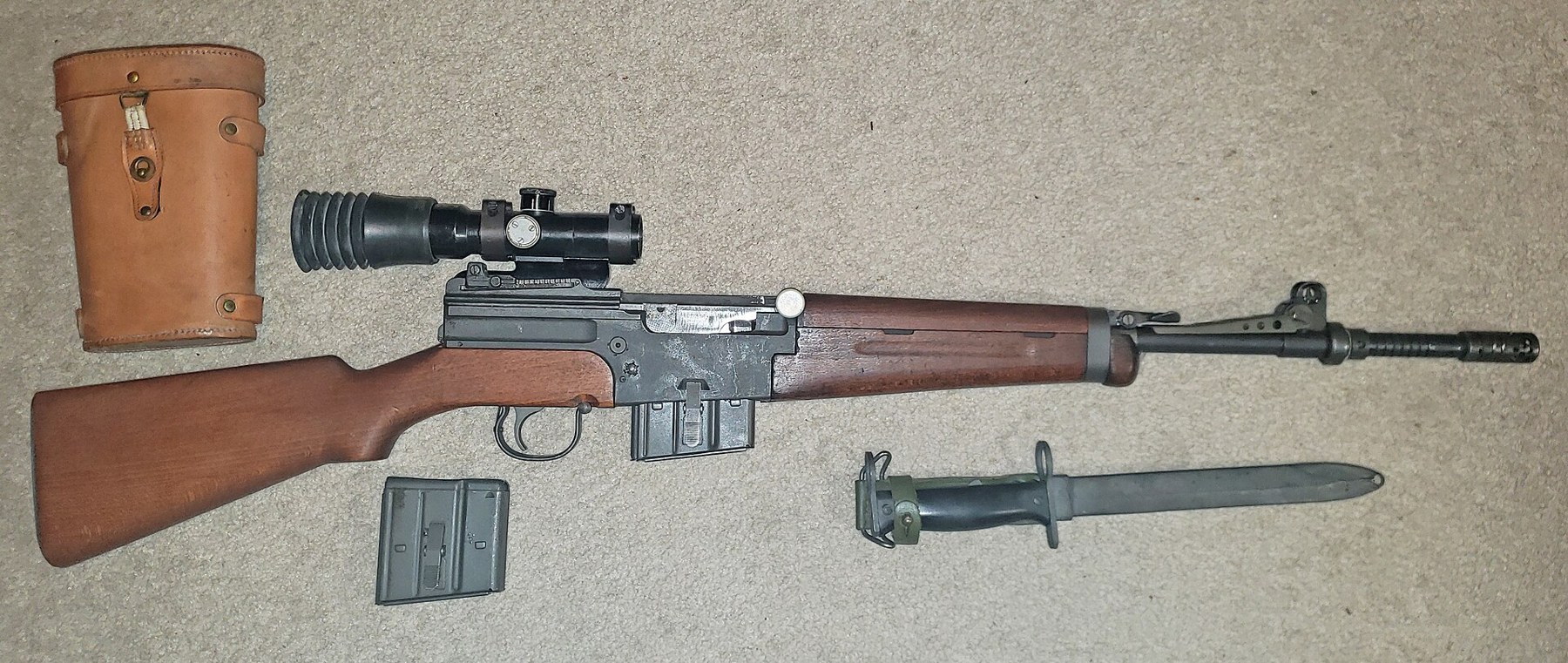
After 1945 the marksman’s rifle was the semi-automatic MAS 49, and from 1957 the shortened MAS 49/56, fitted with a telescopic sight. The scope was the APX L806. Its history rests mostly on secondary sources, and they do not agree on its starting date.
A French club site, which cites no sources, calls it the regulation model “des années 50-60, plus précisément de 1953” (“of the 1950s and 60s, more precisely of 1953”), of 3.85 magnification, made by SOM, OPL and J.N., and lists its versions: the “806” was “prévue pour le MAS 49 sélectionné TE (elle est également montée sur le 49-56)” (“intended for the MAS 49 selected for the marksman role, and also fitted to the 49/56”); the “806-03” was “conçue pour le montage sur le FR-F1 en 7,5 avec sa munition spécifique” (“designed for the FR-F1 in 7.5 mm with its specific ammunition”); and the “806-04” was “prévue pour le montage sur le FR-F2 en 7,62”.11 The Ministry’s Sarajevo history independently confirms the last: the FR-F2 was issued with “une lunette APXL 806-04 pour le tir de jour”.1
Ian McCollum of Forgotten Weapons describes the same scope as “essentially a German ZF-4” and writes that “The French Army used a single pattern of rifle scope from 1949 all the way until 1995”.12 The English Wikipedia calls it the “Modèle 1953” APX L 806.9 The 1949 and 1953 dates are recorded as their sources give them: 1949 is the year of the MAS 49, and 1953 may be the year the scope was made regulation; no primary document was found to settle it.
1.10 Why a new rifle was wanted
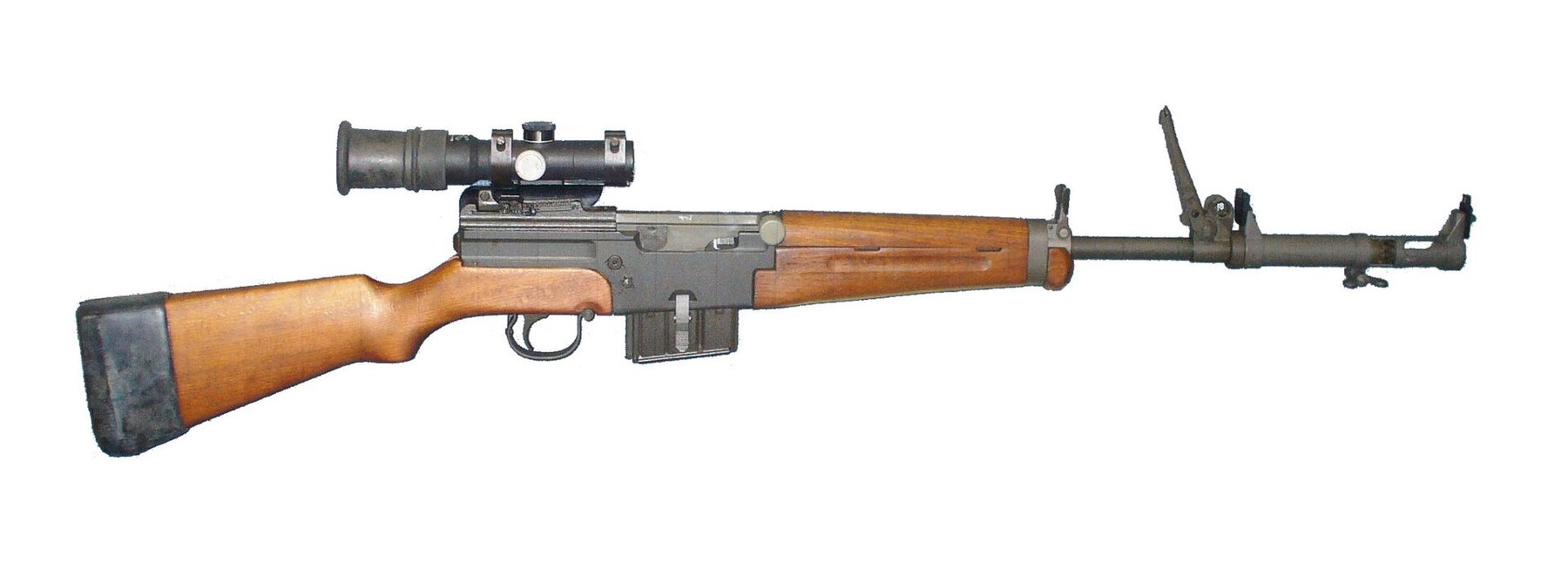
The reason most often given for the FR-F1 is that the scoped semi-automatics did not shoot well enough. Maxim Popenker’s reference site says the FR-F1 was conceived in the early 1960s to replace the sniper version of the MAS 1949/56, which “proved to be less accurate than expected”.13 No French official text stating that requirement was found. What can be said from the rifles themselves is that France went back to a bolt action, kept the cartridge, kept the scope, and built a new heavier receiver around the MAS 36’s locking system, with a free-floated barrel, a pistol-grip stock with length spacers, a cheek rest, a bipod and a ten-round detachable magazine. Vol 2 is the history of that rifle, the FR-F1.
1.11 What the record does not settle
Table 3 — What the record does not settle
| Question | What the sources say | Status |
|---|---|---|
| Founding of the Manufacture | 1764 (title of Manufacture royale) or 1765 | Two dates; neither primary source read |
| MAS 36 adoption date | 1936 (Jackson); 17 March 1936 (club site, unsourced) | Day unconfirmed |
| MAS 36 production total | ”as many as 1.3 million” (Jackson, estimate); about 1.1 million to 1952 (untraced) | Incompatible; unresolved |
| End of MAS 36 production | ”late 1957”, also 1956 (both Jackson) | Unresolved |
| End of small-arms production at Saint-Étienne | about 2001 (fr.wikipedia, unsourced); the establishment still had staff in 2003–06 (National Assembly, 2006) | Nuanced, see above |
| APX L806 start | 1949 (McCollum, the pattern) or 1953 (regulation model, club site and en.wikipedia) | Unresolved |
| Why the FR-F1 was ordered | MAS 49/56 “less accurate than expected” (Popenker) | No official text found |
References
Footnotes
-
Commandant Julien Monange, “Le tireur d’élite français à Sarajevo”, Chemins de mémoire, Ministère des Armées, PDF dated 2018, revised 2019, https://www.cheminsdememoire.gouv.fr/sites/default/files/2019-06/tireur%20%C3%A9lite.pdf , read 2026-10-18. Quotations translated for these volumes. ↩ ↩2 ↩3 ↩4
-
French Wikipedia, “Manufacture d’armes de Saint-Étienne”, read 2026-10-18, used for the chronology only and marked as unsourced where it is; the 1764 date as given in English-language summaries and the regional heritage inventory dossier IA42001265 (not read: behind a bot wall). ↩ ↩2 ↩3
-
Sénat, rapport n° 35 (1989–1990), Xavier de Villepin, for the commission des Affaires étrangères, de la défense et des forces armées, on the bill authorising the transfer of the GIAT industrial establishments to a national company, annexed to the sitting of 25 October 1989, https://www.senat.fr/rap/1989-1990/i1989_1990_0035.pdf , read 2026-10-18. ↩ ↩2 ↩3 ↩4
-
Assemblée nationale, rapport d’information n° 3170 (12th legislature), Viollet and Mignon, “Giat Industries : suivi des mesures sociales d’accompagnement”, 20 June 2006, https://www.assemblee-nationale.fr/12/pdf/rap-info/i3170.pdf , read 2026-10-18. It cites the implementing decree n° 90-582 of 9 July 1990. ↩ ↩2
-
Steve N. Jackson, “Fusil MAS Mle 1936”, virdea.net, https://www.virdea.net/french/36.html , read 2026-10-18. A collector’s page; internally inconsistent on the end of production. ↩ ↩2 ↩3 ↩4 ↩5 ↩6 ↩7
-
tirsportifchabris.fr, pages on the MAS 36 and FR-F1, read 2026-10-18 or seen in search results; a club blog with no author, date or sources. Used only for dates attributed to it. ↩ ↩2
-
French Wikipedia, “MAS 36”, read 2026-10-18; its cited sources are Martin J. Dougherty and Cibles n° 614. Quotations translated for these volumes. ↩ ↩2 ↩3
-
English Wikipedia, “FR F1”, read 2026-10-18, quoting Jane’s Infantry Weapons 1996–1997. The Jane’s text itself was not read. ↩
-
English Wikipedia, “7.5×54mm French”, read 2026-10-18, citing the C.I.P. data sheet, Frank C. Barnes, Cartridges of the World (11th ed.), and Jean Huon, Military Rifle and Machine Gun Cartridges (1988). Its history section is tagged as needing citations. ↩ ↩2 ↩3
-
C.I.P., TDCC Tab. I, “7,5 x 54 MAS”, dated 07-05-14, revised 11-05-25, from the C.I.P. database (archived copy of 19 April 2021), read 2026-10-18. Figures quoted; the drawing is not reproduced. ↩
-
tirsportifchabris.fr, “lunette de tir APX 806”, https://tirsportifchabris.fr/blog/lunette-de-tir-apx-806 , read 2026-10-18. No sources cited; internally inconsistent on the number of models. ↩
-
Ian McCollum, “Scrome J8: A Proper Scope for the FR-F2 Sniper”, Forgotten Weapons, 21 May 2022, https://www.forgottenweapons.com/scrome-j8-a-proper-scope-for-the-fr-f2-sniper/ , read 2026-10-18. ↩
-
Maxim Popenker, “FR F1”, Modern Firearms, https://modernfirearms.net/en/sniper-rifles/standart-caliber-rifles/france-standart-caliber-rifles/fr-f1-2/ , read 2026-10-18. ↩
Comments (0)