MAS FR-F1 and FR-F2 · Volume 5
How It Works: The Rear-Locking MAS Action, Part by Part
Receiver, bolt, the four movements of the cycle, trigger and safety, magazine, free-floated barrel and muzzle device, the thermal sleeve, the swinging bipod and the stock, with every dimension the sources give and where they disagree
5.1 The rifle in one paragraph
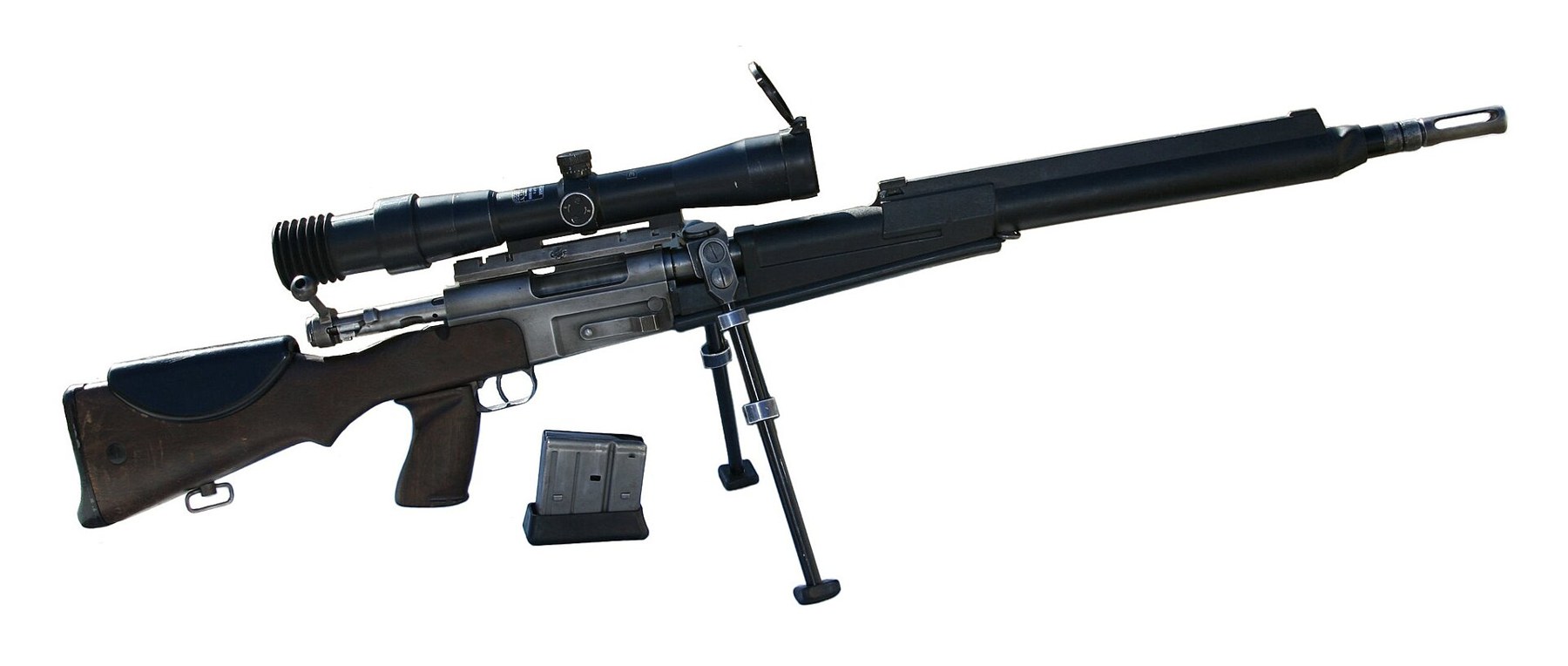
The FR-F2 is a manually operated, rotating-bolt repeating rifle in 7.62×51 NATO. Two locking lugs at the rear of the bolt body turn into seats in the receiver behind the magazine well. A ten-round, double-column detachable magazine feeds it. The 600 mm barrel is free-floated inside a synthetic thermal sleeve, and a swinging bipod hangs from a yoke over the barrel just ahead of the receiver. A two-stage trigger breaks at about two kilograms, and a lever behind the trigger blocks it. The stock is wood, with a pistol grip, cheek pads and length-of-pull extensions. The figures come from the Armée de Terre’s poster and the other sources cited below.1
5.2 What is documented, and what is not
No French manual for the FR-F1 or FR-F2 was found online (Vol 6). The mechanism has to be assembled from an identification poster, a handful of reference pages, two magazine articles, an importer’s description relayed by a blog, and photographs. Some things are therefore known well and some not at all, and the gaps are stated where they fall. Three in particular are worth naming at the start:
- Where the action cocks. No source read says whether the firing pin is cocked as the handle is lifted or as the bolt is closed. It is not stated here.
- How the bolt comes out of the receiver. No source read describes the bolt release.
- The sear geometry inside the trigger group. Not published in any source read.
5.3 The receiver
The FR-F1’s receiver was new, not a MAS 36 receiver: “designed to be stronger and thicker in order to increase accuracy”, in the words Jane’s Infantry Weapons uses as quoted in the English Wikipedia, and not interchangeable with the infantry receiver.2 The French Wikipedia adds that it has “une seule fenêtre d’éjection à droite”, a single ejection port on the right.3 Most FR-F2 receivers are FR-F1 receivers that MAS “a fraisé puis à nouveau usiné”, milled and re-machined, according to the Ministry of the Armed Forces.4 What the re-machining removed or added is not described anywhere read.
American Rifleman describes the FR-F2’s as “a reinforced MAS-36 type receiver” with “angled horizontal cuts on the top of the receiver” that accept “one of five different types of proprietary scope bases”.5 The magazine well is open below, and the trigger group sits behind it in a guard.
5.4 The bolt and its five parts
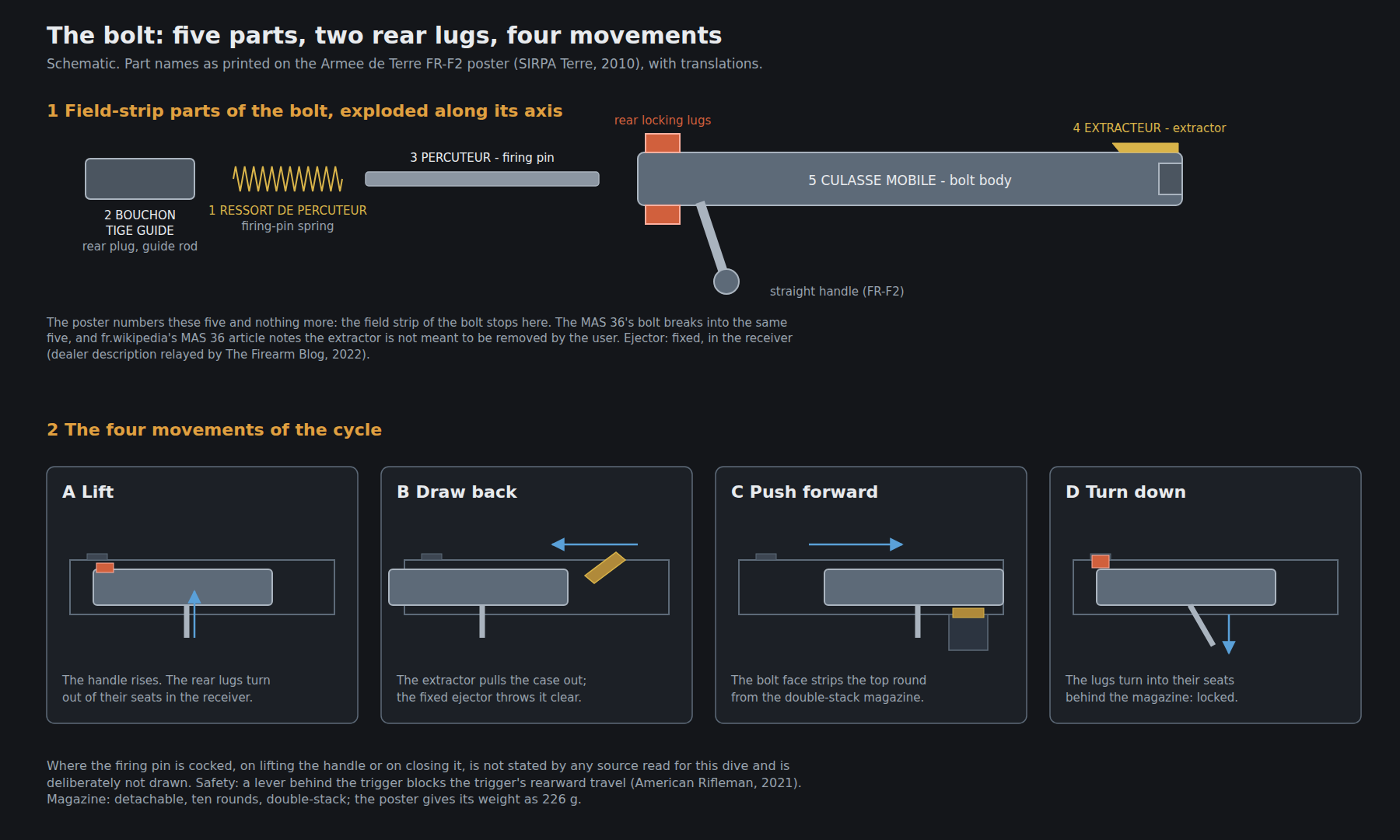
The Armée de Terre’s poster carries the only official parts nomenclature found for the FR-F2’s bolt. It numbers five parts in an exploded view:1
Table 1 — The bolt and its five parts
| No. | Poster | Translation |
|---|---|---|
| 1 | RESSORT DE PERCUTEUR | Firing-pin spring |
| 2 | BOUCHON TIGE GUIDE | Rear plug with guide rod |
| 3 | PERCUTEUR | Firing pin |
| 4 | EXTRACTEUR | Extractor |
| 5 | CULASSE MOBILE | Bolt body |
The MAS 36’s bolt, according to the French Wikipedia, “ne se compose que de cinq éléments démontables”: the bolt body, the rear plug, the firing pin, the firing-pin spring, and the extractor, “non démontable par l’utilisateur” (“not removable by the user”).6 The two lists match part for part. The FR-F2’s bolt keeps the MAS 36’s five-piece construction, at least at the level of an official illustration.
The bolt body carries the two locking lugs at its rear and the handle. On the MAS 36 the handle is bent forward; on the FR-F2 American Rifleman says it is “a straight bolt handle”, and the photographs show a straight handle with a ball knob.5 The importer’s description, as The Firearm Blog relays it, mentions “dual rear locking lugs, a large flat spring extractor, and a fixed ejector”.7 The extractor is a single claw; the ejector is fixed in the receiver and throws the case clear as the bolt reaches the end of its rearward travel. Neither the importer’s listing nor any other source gives the extractor’s dimensions or its fit.
5.5 The cycle of operation
With a loaded magazine in place and the bolt closed on an empty chamber, the cycle has four movements.
- Lift. The handle rises through its arc. The rear lugs turn out of their seats in the receiver, which unlocks the bolt.
- Draw back. The bolt slides to the rear. The extractor claw, engaged in the extractor groove of the fired case, pulls the case from the chamber; near the end of the stroke the fixed ejector strikes the case head and throws it out through the ejection port on the right.
- Push forward. The bolt face meets the rim of the top cartridge in the magazine, held by one of the magazine’s two feed lips, and strips it forward into the chamber.
- Turn down. The handle is pressed down. The lugs turn into their seats behind the magazine well, locking the bolt, and the rifle is ready to fire.
At some point in that sequence the firing pin is drawn back against its spring and held by the sear. Where, no source read says. On firing, the trigger releases the sear, the spring drives the firing pin forward through the bolt body, and the pin strikes the primer.
5.6 Rear locking and accuracy
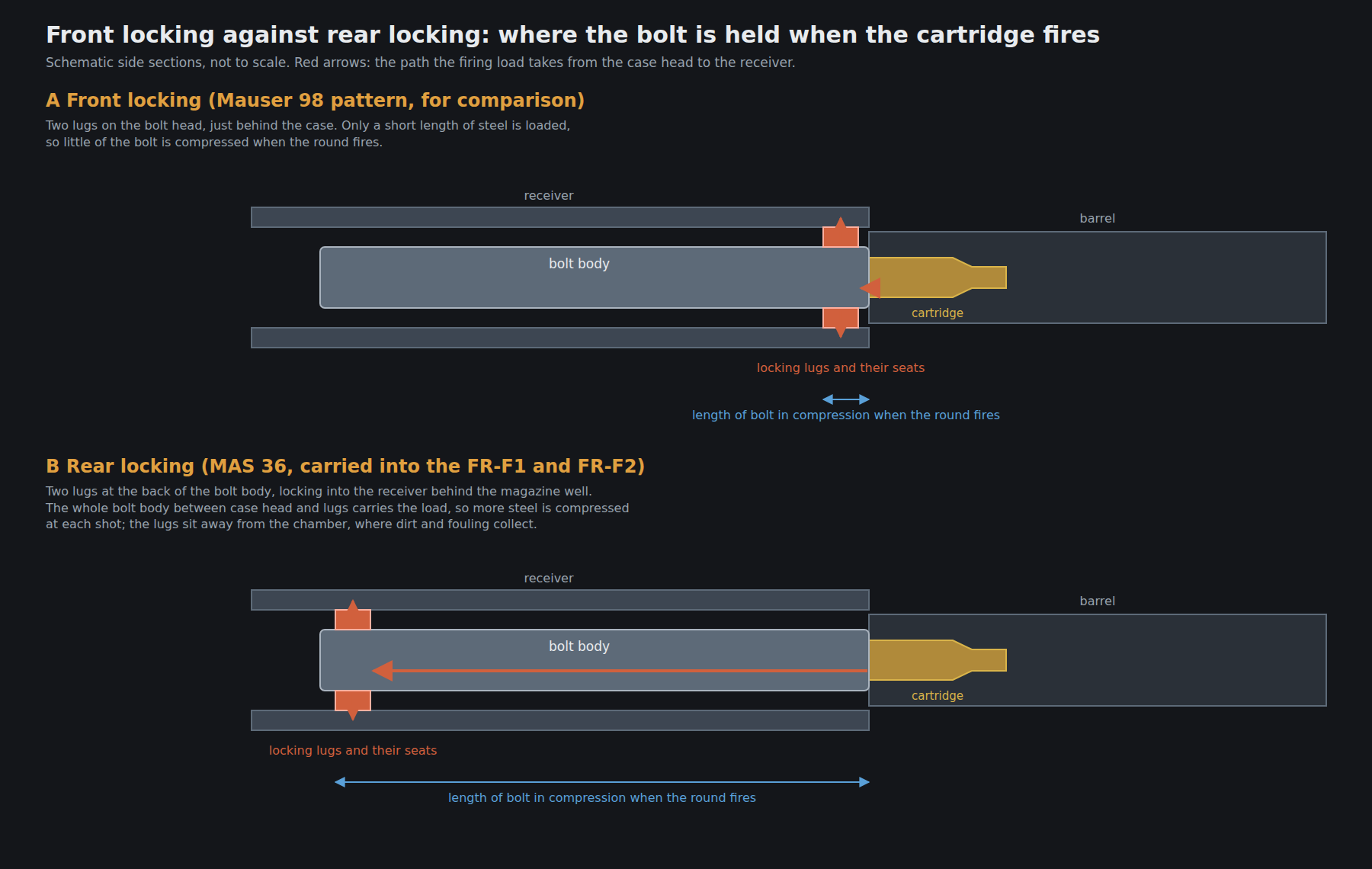
A bolt that locks at the rear puts its whole length in compression when the cartridge fires. That makes the bolt and receiver behave as a longer, more elastic column than a front-locking action does, and a precision rifle needs the action to return to exactly the same state shot after shot. The French solution, in the FR-F1, was to keep the locking system and make the receiver heavier and stiffer, “stronger and thicker in order to increase accuracy” in the Jane’s description.2 The rifle’s record suggests the answer was good enough for a platoon rifle used to 600 or 800 m (Vol 7): it served for more than thirty years. No published test compares the FR-F2’s accuracy with a front-locking rifle in the same calibre, and none is invented here.
The trade-off also has a practical side for a builder. A rear-locking action’s headspace depends on the dimensions of the whole bolt body and of the receiver between the lug seats and the barrel shoulder, not just of a short bolt head. The Headspace dive’s volume on why headspace is a property of the whole action covers that principle in general (Headspace, Vol 9); Vol 9 applies it to a MAS 36 rebarrelling.
5.7 Trigger and safety
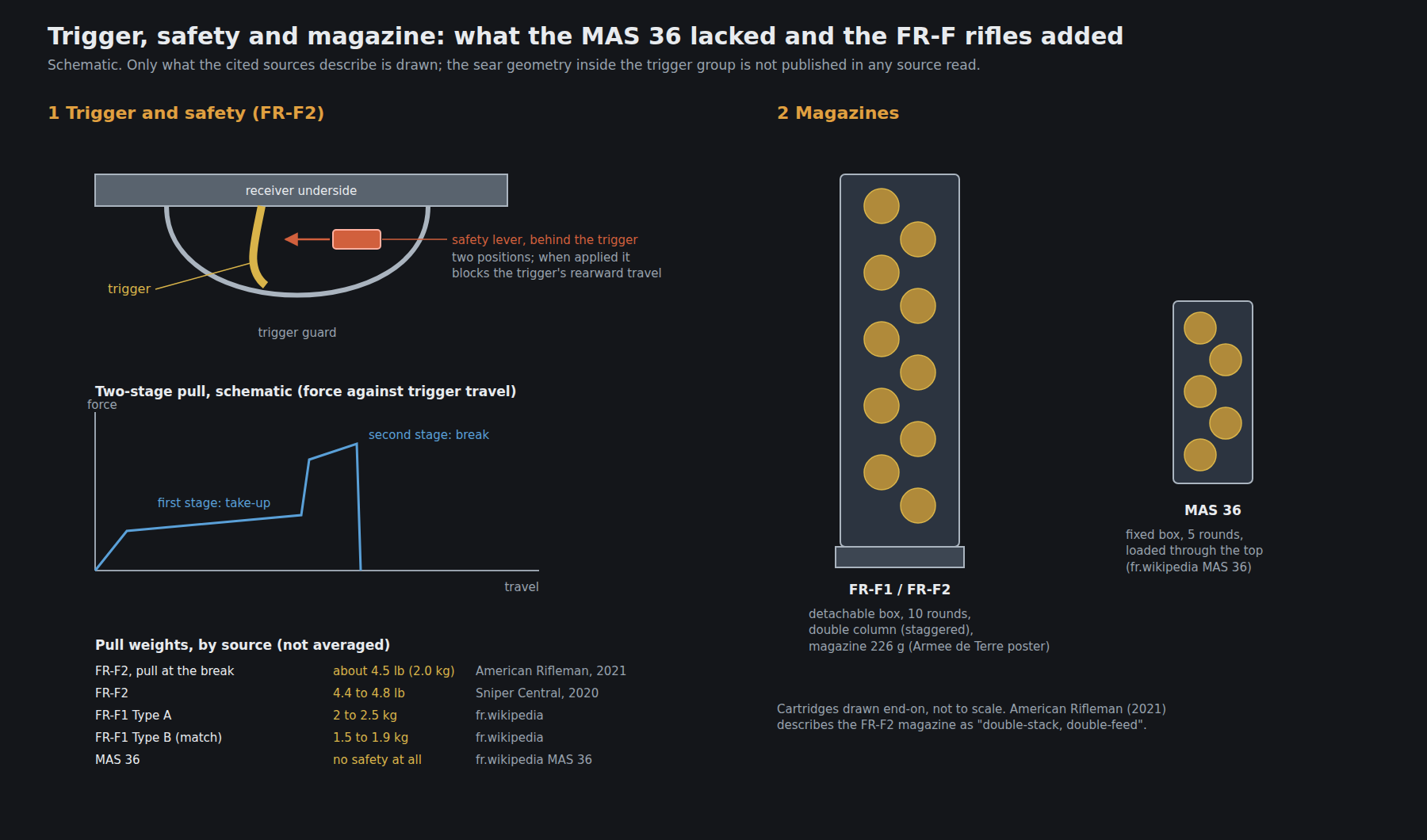
The FR-F2 has a two-stage trigger. American Rifleman says it “breaks at a crisp 4.5 lbs”, about 2.0 kg; Sniper Central gives “4.4 to 4.8 lbs”.58 The French Wikipedia gives the FR-F1 Type A’s as 2 to 2.5 kg and the Type B match rifle’s as 1.5 to 1.9 kg.3 The figures are by source and are not averaged. Whether the issue trigger was adjustable, and how, is not stated anywhere read.
The MAS 36 had no safety at all (Vol 1). The FR-F1 and FR-F2 do. Popenker places it “at the rear of the trigger”; American Rifleman describes “an SVT-40 style safety positioned behind the trigger” that “prevents its rearward travel when engaged”; the importer’s description calls it a “2-position switch located in the trigger guard”.957 Taken together: a lever in the trigger guard behind the trigger which, when applied, blocks the trigger from moving back. It is a trigger-blocking safety. Nothing read says that it locks the bolt or the firing pin, and it should not be assumed to.
5.8 The magazine
The FR-F1 and FR-F2 feed from a detachable box. McCollum and Popenker give ten rounds; American Rifleman calls the FR-F2’s a “10-round double-stack, double-feed detachable box magazine”; the poster gives “CHARGEUR – POIDS : 226 g”, a magazine weight of 226 g.10951 Double feed means the rounds feed alternately from the left and right lips. The importer supplied rifles with two magazines and, in the Morphy catalogue’s description of one imported kit, a carrier for them.11
The magazine catch’s location and form are not described in any source read.
5.9 Barrel and muzzle device
The Armée de Terre’s poster gives the FR-F2’s barrel: “Longueur du canon : 600 mm”, and “Rayures : 3 à droite à pas de 290 mm”, three grooves, right-hand, with a 290 mm (about 1 in 11.4 in) pitch.1 The French Wikipedia gives the FR-F1’s as four grooves, right-hand, “pas de 300”.3 The English Wikipedia’s FR-F2 article says the new barrel was “a new three-groove conical barrel, tapered from the throat area up to the first 100 mm and at the muzzle”; that sentence is uncited and is not adopted.12
The barrel is free-floated. Popenker says so for the FR-F1, “free floated and equipped with flash hider and adjustable harmonics compensator”, and American Rifleman for the FR-F2, whose bipod trunnion “allows the barrel to remain free floated”.95 The FR-F1’s muzzle device is described by the French Wikipedia as a “manchon cache-flamme réglable”, an adjustable flash-hider sleeve, and the importer’s FR-F2 description speaks of a “proprietary muzzle device that can be tuned”.37 An adjustable sleeve at the muzzle that changes the barrel’s effective mass at its end is the classic way of tuning barrel vibration to a load; that the French device was meant to work that way is implied by Popenker’s “harmonics compensator” and the importer’s “tuned”, but no source read explains its adjustment or gives settings.
5.10 The thermal sleeve
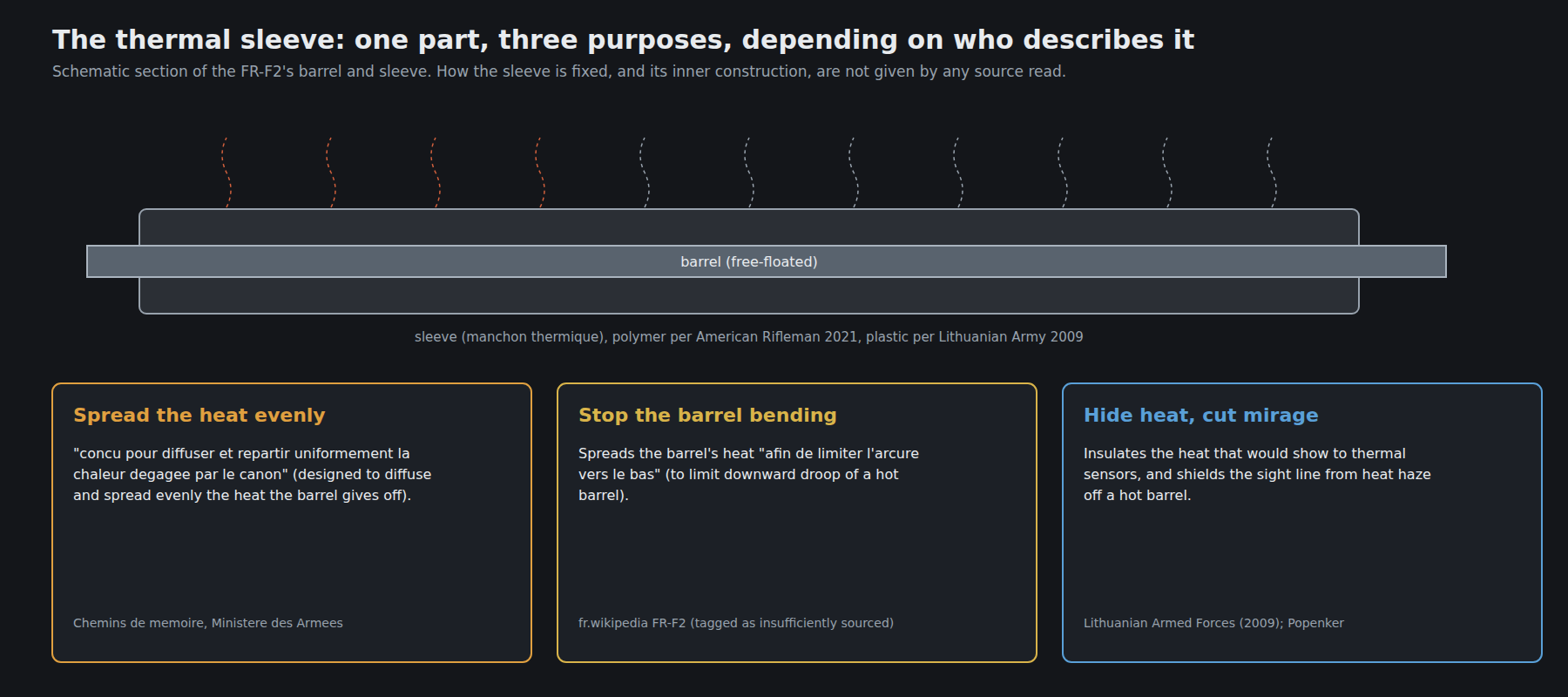
The sleeve is the FR-F2’s most visible feature, and the sources give it three different jobs:
- Spreading the heat. The Ministry’s Sarajevo history: “un manchon thermique qui a été conçu pour diffuser et répartir uniformément la chaleur dégagée par le canon” (“a thermal sleeve designed to diffuse and spread evenly the heat given off by the barrel”).4
- Stopping the barrel from drooping. The French Wikipedia: spreading the heat “afin de limiter l’arcure vers le bas” (“to limit downward bending”), and also reducing mirage and the thermal signature; the article’s technical sections are tagged as insufficiently sourced.13
- Hiding the heat and cutting mirage. The Lithuanian Army: the plastic cover “izoliuoja vamzdžio po šūvio skleidžiamą šilumą (dėl to sunkiau snaiperį aptikti termosensoriais) ir apsaugo nuo įkaitusio vamzdžio kylančių garų, galinčių sutrukdyti tiksliai prisitaikyti” (“insulates the heat the barrel gives off after firing, making the sniper harder to detect with thermal sensors, and shields against the heat haze rising from a hot barrel that can spoil precise aiming”). Popenker and American Rifleman say the same about the heat signature.495
The three are compatible. A barrel heated unevenly, hotter on top than below because hot air rises along it, bends, and the point of impact walks as it heats; a cover that evens the temperature reduces that. Heat haze rising off a bare barrel into the sight line blurs the target; a cover keeps it away. And a hot barrel is a bright line in a thermal sight. What the sleeve is made of is given only as “plastic” or “polymer”; how it is fixed, and whether it touches the barrel anywhere, is not stated in any source read. The free-floating claim implies that it does not bear on the barrel between the receiver and the muzzle, but that is an inference.
5.11 The bipod
The FR-F2’s bipod, unlike the FR-F1’s, hangs from a yoke over the barrel ahead of the receiver (Vol 4). The French Wikipedia calls the F2’s “pendulaire”, swinging, where the F1’s was fixed; the importer’s description says the rifle can “hang” from the bipod with some swivel; American Rifleman describes “an overhead trunnion that allows the barrel to remain free floated”; and Popenker describes it as attached to the receiver “with its hinge above the barrel”.3759 A rifle hung from a pivot above its bore line settles under its own weight, so a canted bipod position does not cant the rifle, and the barrel stays free of the bipod’s load. The legs adjust for length and fold forward. The Lithuanian Army credits the change with making the rifle “more stable when firing” and the support “sturdier”.14
5.12 Stock, cheek rests and length of pull
The stock is wood, with a separate pistol grip. The Ministry calls it “une crosse en bois”.4 The French Wikipedia says a plastic stock was considered and “écartée car jugée trop fragile”, rejected as too fragile.13 The poster labels “APPUIE JOUE (AU NOMBRE DE 2)”, cheek rests, two of them; American Rifleman says “a pair of eyelets secure a cheek pad to the stock comb” and that “two dovetailed extensions” adjust length of pull; the Lithuanian Army says the butt can be lengthened “papildomomis medinėmis plokštelėmis”, with additional wooden plates.1514 The Morphy catalogue’s description of an imported kit lists “stock extensions” and “cheekpieces” among the accessories.11 The importer’s listing gives a 13.5 in length of pull in its web address.7
5.13 Sights and the scope base
Popenker says back-up iron sights were standard on the FR-F1; for the FR-F2 the English Wikipedia places them on top of the sleeve, uncited.912 The photographs of the studio rifle show a small fitting on the sleeve near its front, consistent with a front sight. The day scope sat on a base on the receiver, one of the “five different types of proprietary scope bases” American Rifleman mentions.5 SCROME describes its J8 F1 as using a “Fixation OTAN”, a NATO mount interface.15 Vol 7 covers the scopes and night sights.
5.14 The dimensions, source by source
The sources disagree on the FR-F2’s basic dimensions, and the disagreements follow a pattern: several English-language sources carry FR-F1 figures into FR-F2 tables, or the reverse. The Armée de Terre’s poster is the only French official source with a full table, and it is preferred where the figures conflict.
Table 2 — The dimensions, source by source
| Source | Length | Barrel | Weight | Grooves, twist | Velocity |
|---|---|---|---|---|---|
| Armée de Terre poster, 2010 (FR-F2) | 1,138 mm | 600 mm | 5.1 kg | 3, right, 290 mm | 820 m/s |
| Ministry, Sarajevo history (FR-F2) | “plus d’un mètre” | — | “plus de 5 kilogrammes sans la lunette” | — | — |
| fr.wikipedia FR-F2 | 1,138 mm | 600 mm | 5.1 kg empty; 6.25 kg in combat order | — | 820 m/s |
| Lithuanian Armed Forces, 2009 (FR-F2) | 1,200 mm | — | 5.75 kg | 4 | 820 m/s |
| American Rifleman, 2021 (FR-F2) | 47 in (1,194 mm) | 25.5 in (648 mm) | 11 lb (5.0 kg) unloaded | — | — |
| Importer, via TFB, 2022 (FR-F2) | 45.5 in (1,156 mm) | 24 in (610 mm) | about 11 lb | — | — |
| Sniper Central, 2020 (FR-F2) | 1,200 mm | 25.57 in (650 mm) | 5.80 kg loaded | 3, right, 1 in 11.6 in | — |
| Popenker (FR-F2) | 1,200 mm | 600 mm | 5.1 kg | — | — |
| fr.wikipedia FR-F1 | 1,200 mm | 600 mm | 5.125 kg | 4, right, 300 mm | 780 m/s |
| Sniper Central, 2020 (FR-F1) | 1,138 mm | 600 mm | 5.65 kg loaded | 4, right, 1 in 11.8 in | — |
Sources: 14131457893. Metric conversions of inch figures are made here.
Two observations follow. Sniper Central’s lengths look swapped: it gives the FR-F1 the 1,138 mm that the French poster gives the FR-F2, and the FR-F2 the 1,200 mm that the French Wikipedia gives the FR-F1. And the barrel figures of 25.5 and 25.57 in (about 650 mm) in two American sources conflict with the poster’s 600 mm and with the importer’s own 24 in. A measurement of an imported rifle would settle the barrel; until then, 600 mm, from the French Army’s own poster, is the figure to use.
References
Footnotes
-
Armée de Terre, “Fusil à répétition modèle F2 — FRF2”, identification poster, SIRPA Terre 2010, read in the Internet Archive capture of 21 February 2011 on 2026-10-18 (copy in 02-inputs/manuals/). ↩ ↩2 ↩3 ↩4 ↩5 ↩6
-
English Wikipedia, “FR F1”, read 2026-10-18, quoting Jane’s Infantry Weapons 1996–1997 (not read in the original). ↩ ↩2
-
French Wikipedia, “FR-F1”, read 2026-10-18. ↩ ↩2 ↩3 ↩4 ↩5 ↩6
-
Commandant Julien Monange, “Le tireur d’élite français à Sarajevo”, Chemins de mémoire, Ministère des Armées, 2018/2019, read 2026-10-18. ↩ ↩2 ↩3 ↩4 ↩5
-
Martin K. A. Morgan, “The French FR F2 Sniper Rifle”, American Rifleman, 18 September 2021, https://americanrifleman.org/content/the-french-fr-f2-sniper-rifle , read 2026-10-18. ↩ ↩2 ↩3 ↩4 ↩5 ↩6 ↩7 ↩8 ↩9 ↩10 ↩11
-
French Wikipedia, “MAS 36”, read 2026-10-18. ↩
-
Doug E, “Newly Imported French FR F2 Sniper Rifles Available In The U.S.”, The Firearm Blog, 24 June 2022, read 2026-10-18, relaying the EuroOptic listing, which refused automated reading. ↩ ↩2 ↩3 ↩4 ↩5 ↩6
-
Melvin Ewing, “French FR-F1 & FR-F2”, Sniper Central, 21 December 2020, https://snipercentral.com/fr-f1.htm , read 2026-10-18. ↩ ↩2
-
Maxim Popenker, “FR F1” and “FR F2”, Modern Firearms, read 2026-10-18. ↩ ↩2 ↩3 ↩4 ↩5 ↩6 ↩7
-
Ian McCollum, “French FR-F1 Sniper Rifle at the Range”, Forgotten Weapons, 4 June 2020, read 2026-10-18. ↩
-
Morphy Auctions, Firearms and Militaria, 8–10 May 2024, lot 1184, https://auctions.morphyauctions.com/_M__VERY_NICE_MAS_FR_F2_BOLT_ACTION_SNIPER_RIFLE_W-LOT598829.aspx , read 2026-10-18. ↩ ↩2
-
English Wikipedia, “FR F2 sniper rifle”, read 2026-10-18; uncited sentences not adopted. ↩ ↩2
-
French Wikipedia, “FR-F2”, version of 18 May 2026, read 2026-10-18. ↩ ↩2 ↩3
-
Lietuvos kariuomenė, “Snaiperinis šautuvas FR F-2”, page dated 2009-04-17, Internet Archive capture of 28 July 2010, read 2026-10-18. ↩ ↩2 ↩3
-
SCROME S.A.R.L., “Lunettes de tir SCROME”, http://www.scrome.com/lunettes.html , Internet Archive capture of 1 May 2008, read 2026-10-18. ↩
Comments (0)