MAS FR-F1 and FR-F2 · Volume 7
Accuracy, Ammunition, Optics and Accessories
What the FR-F2 was expected to hit and at what range, by source, with no invented group sizes; the 7.5 mm and 7.62 mm cartridges it fired; the APX L806, the SCROME J8 and the night sights; and the issue kit, item by item
7.1 Accuracy: the number nobody published
Many references give the FR-F2 an accuracy figure. None found for these volumes traces to a French test, specification or acceptance standard. The figures that do circulate are these:
- Sniper Central’s review, 2020: the FR-F2 is capable of “approaching 1 MOA on a good day”. That is the author’s opinion; no test data is given.1
- The importer’s description in 2022, as relayed by The Firearm Blog: the rifle was built as a “Squad Sniper Rifle” with “a large emphasis placed on first round accuracy”. That is marketing.2
- Ian McCollum fired an FR-F2 with an APX L806-04 for Forgotten Weapons in 2021; the post gives no group sizes, and the video was not watched.3
- French-language searches for “groupement” figures at 200 m or 600 m found none.
So no accuracy figure is printed here. A French acceptance standard for FR-F1 or FR-F2 barrels must have existed, and the issue manual or a period article in Cibles may give it (Vol 6, owed). The honest statement today is that the FR-F2’s mechanical accuracy is not published in any source that could be checked.
7.2 Range: what the French Army expected
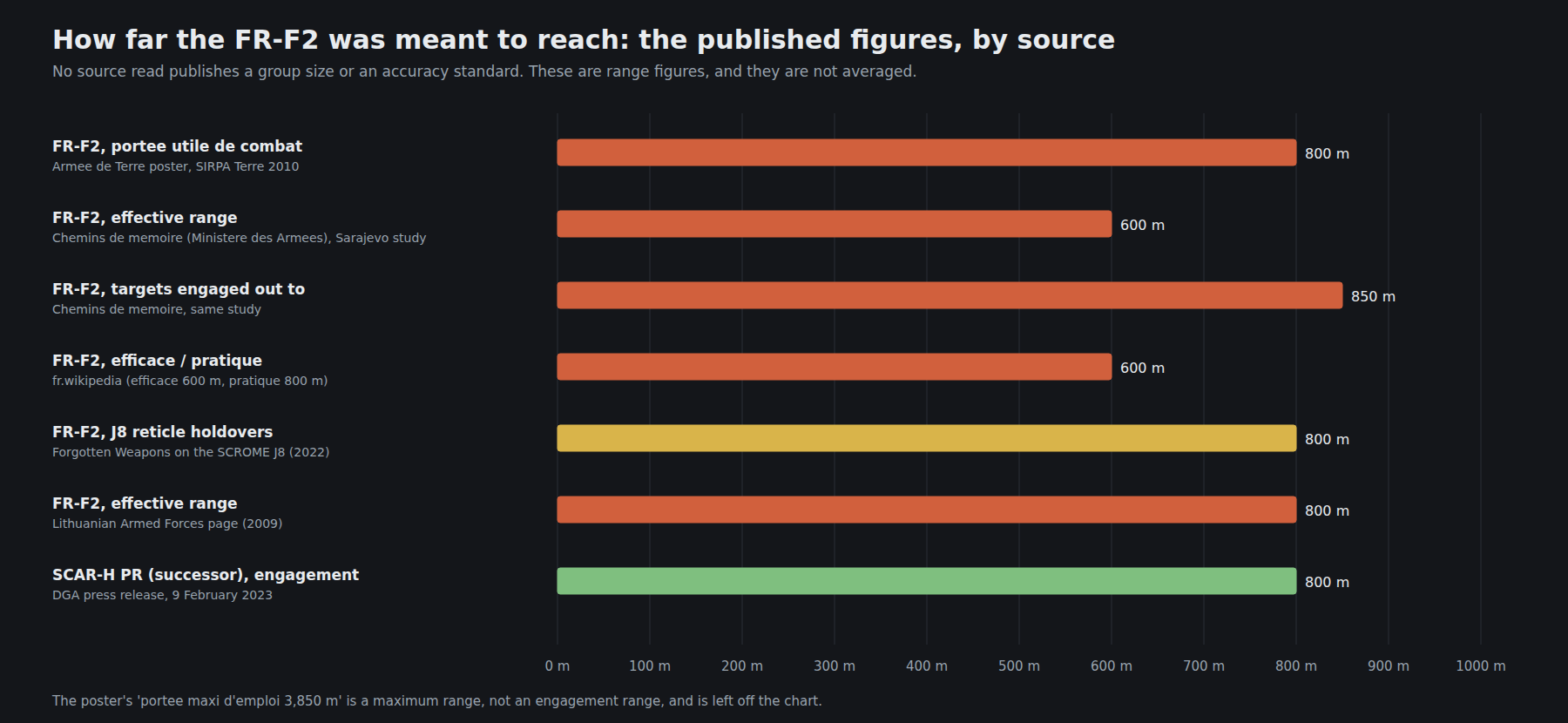
What the sources do give is the range at which the rifle was expected to be used, and the French official sources do not agree with each other:
Table 1 — What the sources do give is the range at which the rifle was expected to be used, and the French official sources do not agree with each other
| Figure | Source |
|---|---|
| ”Portée utile de combat : 800 m”; “Portée maxi d’emploi : 3850 m” | Armée de Terre poster, 20104 |
| ”d’une portée efficace de 600 mètres, son calibre en 7,62 millimètres OTAN permet d’engager des cibles jusqu’à 850 mètres” | Chemins de mémoire, Ministère des Armées5 |
| Effective 600 m, practical 800 m, maximum 3,850 m | French Wikipedia6 |
| ”Efektyvaus šūvio nuotolis 800 m” (effective range 800 m) | Lithuanian Armed Forces, 20097 |
| Reticle holdovers “out to 800m”, “the maximum effective range of the FR-F2” | Forgotten Weapons on the SCROME J8, 20228 |
| SCAR-H PR successor engages to about 800 m | DGA, 20239 |
The 3,850 m on the poster is a maximum range, the distance a bullet can travel, and has nothing to do with aimed fire. The 600 m and 800 m figures probably reflect two ideas: the distance at which a platoon marksman was expected to hit reliably, and the distance at which the rifle and scope could still be used. The Ministry’s own history puts it that way: an effective range of 600 m, with targets engageable to 850 m.5
7.3 What the barrel and the action suggest
Without a published group figure, the rifle’s design is the best guide to what it could do. It had a free-floated 600 mm barrel in a stiffened receiver, a two-stage trigger at about two kilograms, a swinging bipod that kept load off the barrel, and a sleeve meant to keep the barrel’s temperature even (Vol 5). Those are the features of a rifle built to put a first shot where it was aimed at platoon ranges, from a cold barrel, in the field. They are not the features of a benchrest rifle, and the French did not claim more.
The barrel’s 290 mm (about 1 in 11.4 in) twist suits the weights of 7.62 mm bullet in military use; how a particular bullet stabilises depends on its length and velocity as well as its weight, and the hub’s ballistics dive covers the theory (Ballistics Overview, Vol 2 for internal ballistics, Vol 5 for trajectory and zero, Vol 7 for wind).
7.4 Ammunition for the FR-F1: 7.5×54
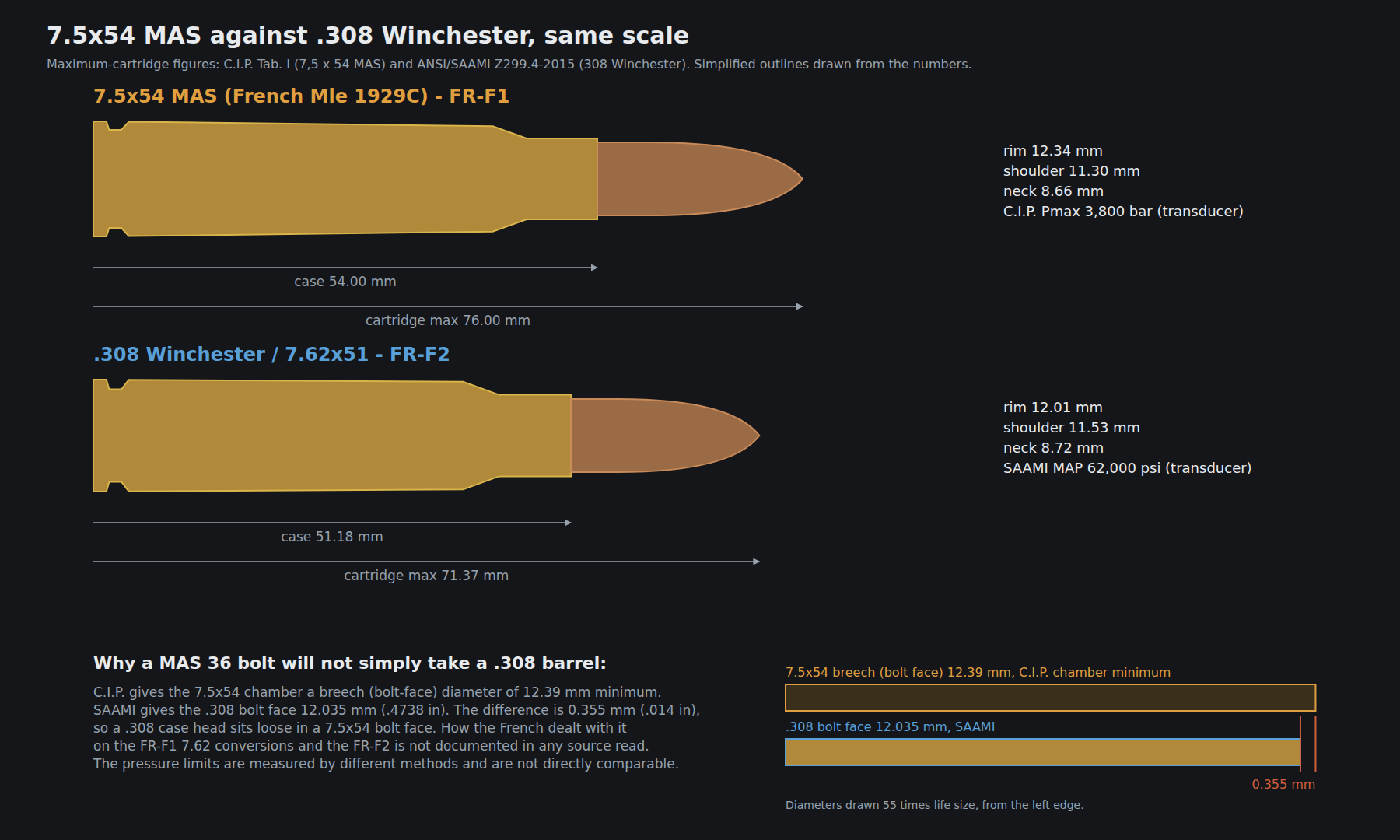
The FR-F1 fired the French service cartridge, the 7.5×54 Modèle 1929C (Vol 1). The English Wikipedia lists the standard service load as the 9.0 g (139 gr) flat-base balle C at 820 m/s, and the French Wikipedia gives the FR-F1’s muzzle velocity as 780 m/s; the difference is the barrel and the test conditions, and both figures are given as stated.1011
Whether the FR-F1 had a special precision load is unclear. The French club site that is the only source for the scope versions says the APX L806-03 was designed for “le FR-F1 en 7,5 avec sa munition spécifique” (“the FR-F1 in 7.5 mm with its specific ammunition”), which suggests a dedicated load whose ballistics the scope’s elevation cam was cut for; the site does not name it, and no other source does.12
7.5 Ammunition for the FR-F2: 7.62×51
The poster names the FR-F2’s issue round as “cartouche 7,62 mm à balle ordinaire”, the 7.62 mm ball cartridge, and notes it “existe aussi à balle perforante (pointe noire)”, also with an armour-piercing bullet, black tip.4 McCollum says the APX L806-04’s “-04” suffix indicates that its bullet-drop cam was calibrated for 7.62 mm NATO.3 The club site says the -04 was meant for “sa munition spécifique OTAN 168gr” (“its specific NATO ammunition, 168 grains”); that weight is not confirmed anywhere else.12 Which French factory loaded the FR-F2’s ammunition, and to what specification, was not found.
The replacement programme shows what the army wanted next. The 2018 tender asked for “3,15 millions munitions perforantes et 3,15 millions munitions de précision” (“3.15 million armour-piercing and 3.15 million precision rounds”) with the new rifles, and the 2023 release names MEN, the German ammunition maker, in the winning group.139 That is the SCAR-H PR’s ammunition, not the FR-F2’s, but it shows that the French Army treated precision and armour-piercing rounds as separate natures for its marksmen.
7.6 Commercial ammunition and handloading today
7.62×51 and .308. An FR-F2 is marked “7,62.N” (Vol 4), a NATO chamber. The hub has already settled the .308 and 7.62 NATO question: the real differences are headspace and the thicker walls of military brass, and the “50,000 against 62,000 psi” comparison often quoted is a crusher figure mislabelled as a transducer one. The Headspace dive gives the NATO gauge figures that Forster publishes, against SAAMI’s .308 figures (Headspace, Vol 4). A NATO chamber will accept commercial .308, with more case stretch on firing; that matters to a handloader, not to safety in a sound rifle with correct headspace.
Handloading. The hub’s reloading dive covers the whole process; the volumes on case life, trimming and load development apply directly (The Reloading Bench, Vol 13, Vol 15, Vol 21). No published load data specific to the FR-F2 was found.
7.5×54 for an FR-F1 or a MAS 36. Ammunition and brass are made today. Prvi Partizan’s own cartridge list includes “7.5 x 54 French”.14 On 18 October 2026 Graf & Sons listed PPU 7.5×54 French 139 gr FMJ at $28.39 a box of 20 and PPU brass at $40.99 for 50, both in stock.15 Lee Precision listed a 7.5×54 MAS full-length three-die set at $46.98, and a retailer listed RCBS’s 7.5×54 MAS full-length die set (RCBS 29101) at $93.14; the RCBS maker’s page was not read.1617 The cartridge takes standard .308 in bullets, its groove diameter being 7.85 mm by the C.I.P. figure (Vol 1).
7.7 The APX L806
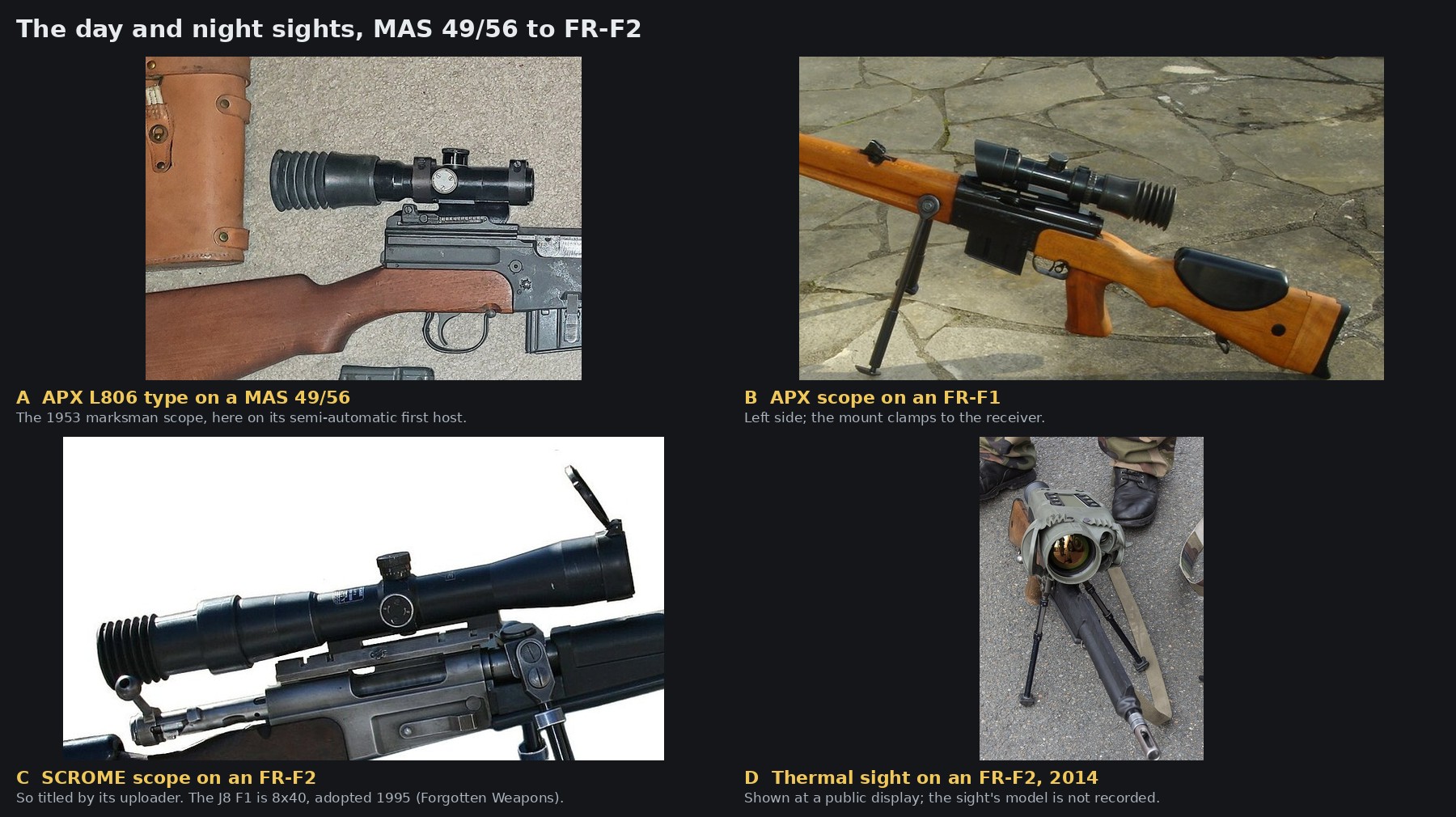
The APX L806 was the French Army’s marksman scope from the MAS 49 until 1995. McCollum describes it as “essentially a German ZF-4”, and the FR-F2 version, the -04, as “a 3.85x optic basically modeled on the German WW2 ZF-4” with “a large, simple German post reticle”.83 The versions, according to the club site that is the only source for them: the 806 for the MAS 49 and 49/56 in the marksman role; the 806-03 for the FR-F1 in 7.5 mm; the 806-04 for the FR-F2 in 7.62 mm; all at 3.85 power, differing mainly in the elevation cam, and each paired to its rifle by the number on its mount.12 The same site says the -03 is identified by a “3” engraved on the body below “APX L806”.12 The English Wikipedia says the -04’s bullet-drop compensation was calibrated from 100 to 800 m in 100 m steps; that sentence is uncited.18
The Ministry’s Sarajevo history confirms that in 1995–96 French infantry FR-F2s carried “une lunette APXL 806-04 pour le tir de jour”.5 The scope’s makers, per the club site, were SOM, OPL and J.N.12
7.8 The SCROME J8 F1
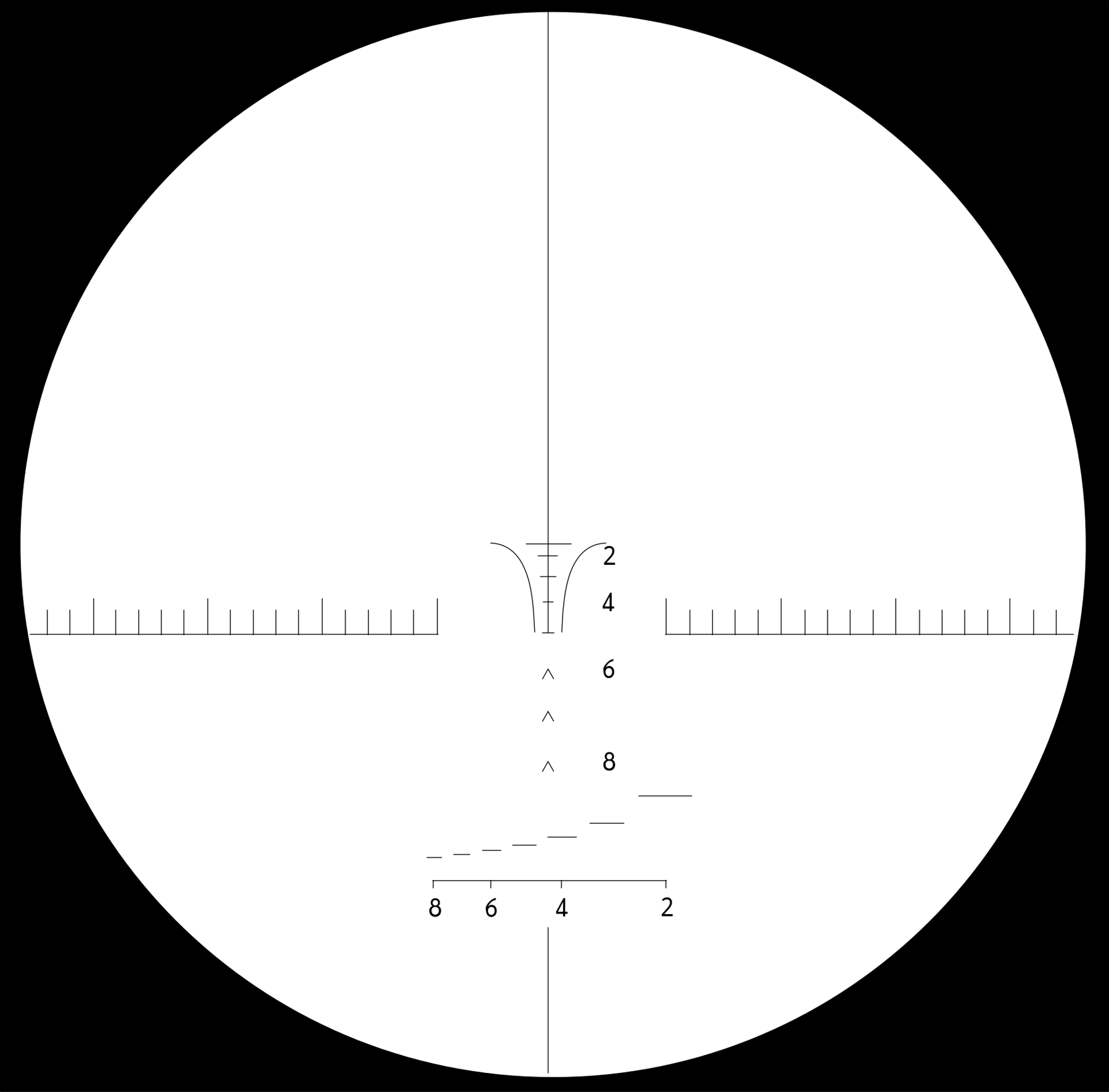
In 1995 the APX was replaced. McCollum: “It was finally replaced officially in 1995, with the adoption of the Scrome J8 F1 for use on their FR-F2 sniper rifles.”8 He describes the J8 as “a simple, robust, 8x40mm fixed-power telescope” with “a reticle that had range finding capability and etched BDC holdovers out to 800m”, and the maker, SCROME, as a company “Formed in 1987” that “specialized in electro-mechanical systems more complex than simple rifle scopes”; the army wanted a domestic scope, and SCROME was “the only suitable manufacturer to make it”.8 The Armée de Terre’s 2010 poster labels the scope on its FR-F2 “LUNETTE J8 SCHROME”, with the maker’s name misspelt.4
SCROME’s own catalogue page of about 2007 gives the specification of the “LTE J8 F1”:19
Table 2 — The SCROME J8 F1
| Item (SCROME) | J8 F1 |
|---|---|
| Magnification | 8 |
| Length | 340 mm |
| Weight | 740 g |
| Objective / eyepiece diameter | 40 mm / 40 mm |
| Field at 100 m | 45 (mils, by the page’s symbol) |
| Parallax setting | 500 (metres, by inference: the page prints the mil symbol, apparently in error) |
| Eye relief (“distance pupille”) | 90 mm |
| Elevation and windage | ± 10 mils, in 0.1 mil steps |
| Mount | ”Fixation OTAN” (NATO) |
| Endurance | 10,000 rounds |
| Body | aluminium alloy, matte black anodised, nitrogen filled, immersion tested |
The page says the scopes “équipent les unités de tireur d’élite de l’armée française” (“equip the French Army’s marksman units”), without naming the rifle. It lists accessories including a thigh container, a storage case, a black protective cover, a sunshade, lens covers and a “lunette de bouche (dispositif d’harmonisation)”, a muzzle boresighting device.19
McCollum adds that the scopes were built only to order, that “legal quirks theoretically made civilian sale of scopes with military range finding reticles illegal in France until 2012”, that a few commercial versions with mil-dot reticles were made, and that “Scrome is now making a run of military-pattern J8 scopes to take advantage of the batch of surplussed FR-F2 rifles”.8 The Morphy lot of 2024 describes an imported FR-F2 with “Scrome J8F1 scope + mount” and its case (Vol 8).20
The hub’s scope dive covers the optical theory behind a fixed-power scope with a ranging reticle (Types of Scopes, Vol 4), ranging with a mil reticle (Vol 7), and mounting and zeroing (Vol 8).
7.9 Other day optics
Other scopes appeared on FR-F2s, especially outside the army. The French Wikipedia lists a Nightforce NXS on Air Force rifles and a Schmidt & Bender 6×42 with a mil-dot reticle on Navy rifles; American Rifleman says “Nightforce and Schmidt & Bender optics have been observed as well”.621 Model numbers beyond those are not given here. The US Air Force’s photograph of an FR-F2 at Camp Morehead in 2009 (Vol 3) shows a large modern variable scope whose maker cannot be read.
The FR-F2 could also carry the FÉLIN soldier system’s SAGEM sight, which American Rifleman describes as combining telescopic, thermal and laser-rangefinder functions; The Armourers Bench photographed an FR-F2 in Ukraine with a SAGEM Sword sight.2122
7.10 Night sights
The FR-F2’s first night sight was the SOPELEM OB-50. The Ministry’s Sarajevo history names it, and ECPAD’s photograph of a marksman in Sarajevo in 1994 shows it on the rifle (Vol 3).5 Its specification was not found.
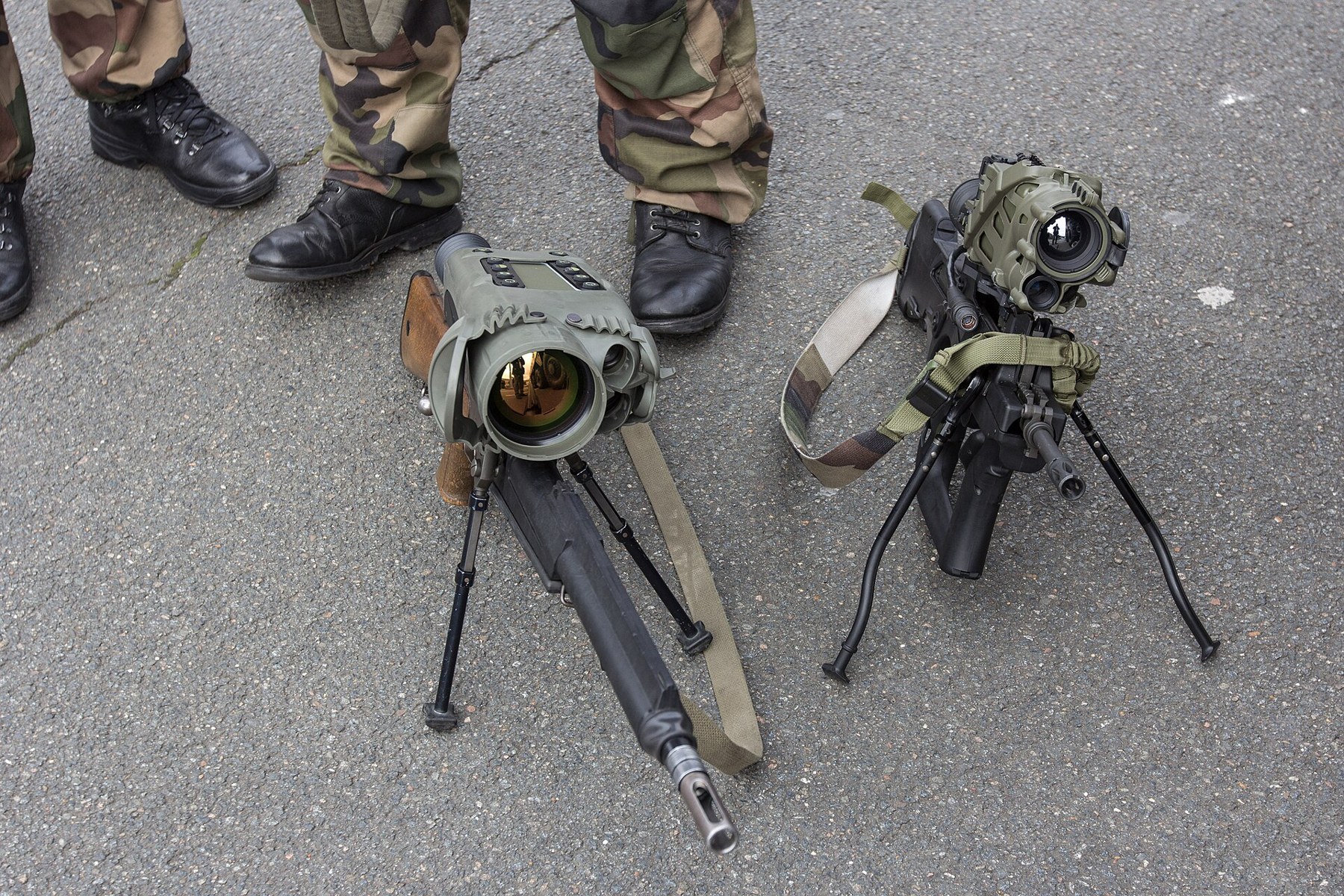
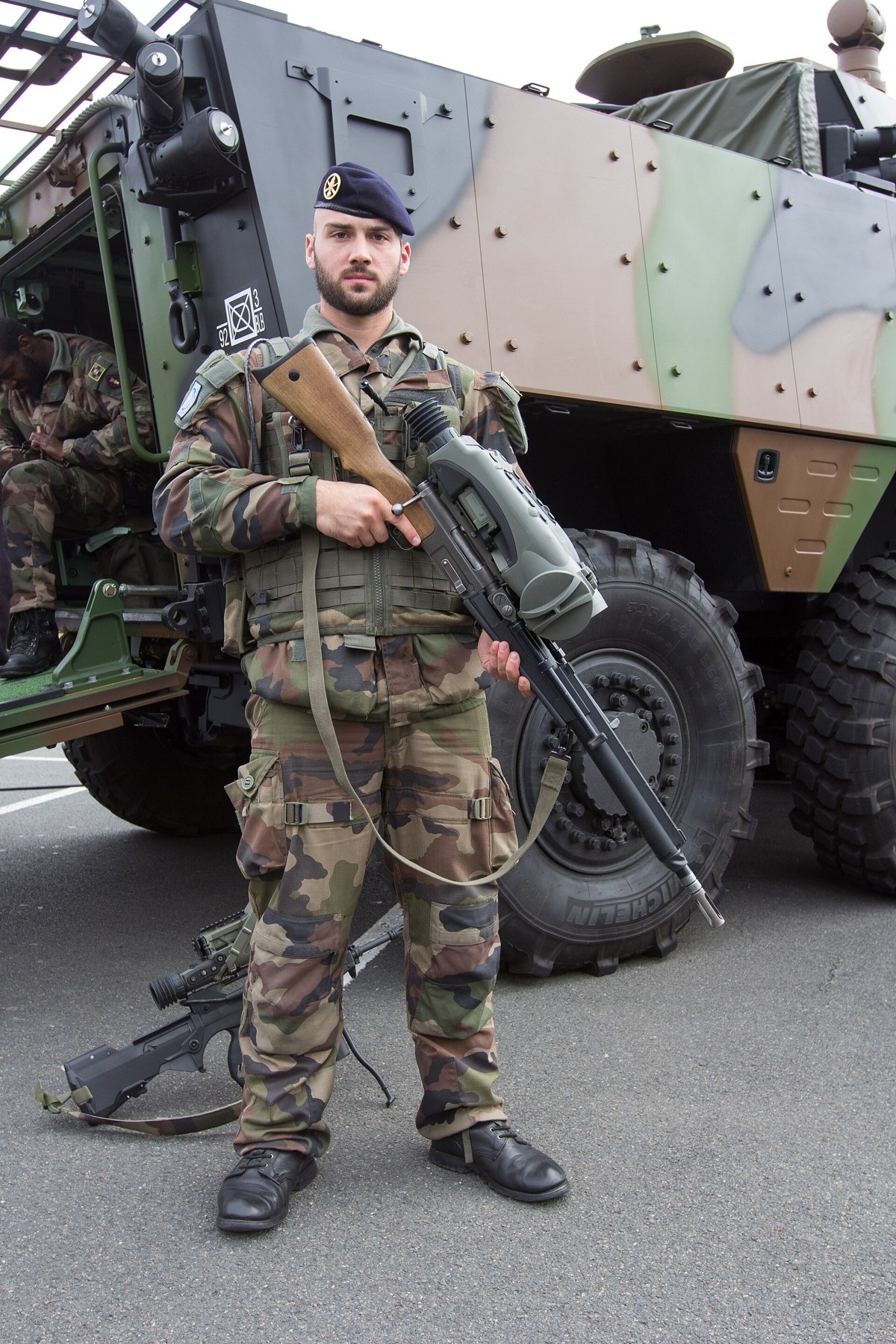
By the 2010s the army’s FR-F2s also appeared with thermal weapon sights. A soldier of the 92e régiment d’infanterie at a public display in 2014 carried an FR-F2 fitted with one, and the same display showed it on the rifle’s bipod beside a FÉLIN-equipped FAMAS.23 The photographer did not record the sight’s model, and it is not named here. The FPSA tender of 2018 shows the direction the army took: night modules “devant être montés en tandem avec la lunette de jour”, clip-on image-intensifier and thermal units in front of the day scope, so that the zero stays with the day scope.13 The hub’s scope dive covers night vision and thermal sights (Types of Scopes, Vol 6).
7.11 The issue kit
The most complete description of an FR-F2’s issue kit is in Morphy Auctions’ catalogue for an imported rifle, sold in May 2024: the rifle with bipod and “polymer shroud/forend”, a “Scrome J8F1 scope + mount” with its case, and a sealed kit containing two ten-round magazines with a carrier, stock extensions, cheek pieces, a sling, a cleaning kit and a manual.20 The poster adds that the magazine weighs 226 g and that the stock takes two cheek rests.4 SCROME’s accessory list gives the scope’s thigh container, storage case, covers and muzzle boresighter.19
No suppressor for the FR-F2 was found in any source read. The French Wikipedia mentions an AIM-DLR laser designator; that is unconfirmed.6
7.12 What is not known
Table 3 — What is not known
| Item | Status |
|---|---|
| A French accuracy or acceptance standard for the FR-F1 or FR-F2 | Not found |
| The FR-F1’s “specific” 7.5 mm load | Mentioned by one unsourced site; not named |
| The FR-F2’s issue precision load, and its bullet weight (168 gr per one unsourced site) | Unconfirmed |
| The APX L806-04’s cam graduations | One uncited sentence (100–800 m) |
| The SOPELEM OB-50’s specification | Not found |
| The thermal sights seen on FR-F2s in the 2010s | Models not recorded |
| Any FR-F2 suppressor | None found |
References
Footnotes
-
Melvin Ewing, “French FR-F1 & FR-F2”, Sniper Central, 21 December 2020, https://snipercentral.com/fr-f1.htm , read 2026-10-18. ↩
-
Doug E, “Newly Imported French FR F2 Sniper Rifles Available In The U.S.”, The Firearm Blog, 24 June 2022, read 2026-10-18. ↩
-
Ian McCollum, “FR-F2 French Sniper Rifle at the Range”, Forgotten Weapons, 27 November 2021, https://www.forgottenweapons.com/fr-f2-french-sniper-rifle-at-the-range/ , read 2026-10-18 (text only; the video was not watched). ↩ ↩2 ↩3
-
Armée de Terre, “Fusil à répétition modèle F2 — FRF2”, identification poster, SIRPA Terre 2010, read in the Internet Archive capture of 21 February 2011 on 2026-10-18. ↩ ↩2 ↩3 ↩4
-
Commandant Julien Monange, “Le tireur d’élite français à Sarajevo”, Chemins de mémoire, Ministère des Armées, 2018/2019, read 2026-10-18. ↩ ↩2 ↩3 ↩4
-
French Wikipedia, “FR-F2”, version of 18 May 2026, read 2026-10-18; technical table tagged as insufficiently sourced. ↩ ↩2 ↩3
-
Lietuvos kariuomenė, “Snaiperinis šautuvas FR F-2”, page dated 2009-04-17, Internet Archive capture of 28 July 2010, read 2026-10-18. ↩
-
Ian McCollum, “Scrome J8: A Proper Scope for the FR-F2 Sniper”, Forgotten Weapons, 21 May 2022, https://www.forgottenweapons.com/scrome-j8-a-proper-scope-for-the-fr-f2-sniper/ , read 2026-10-18. ↩ ↩2 ↩3 ↩4 ↩5
-
Direction générale de l’armement, “La DGA a réceptionné les 655 derniers fusils de précision SCAR”, 9 February 2023, read 2026-10-18. ↩ ↩2
-
English Wikipedia, “7.5×54mm French”, read 2026-10-18. ↩
-
French Wikipedia, “FR-F1”, read 2026-10-18. ↩
-
tirsportifchabris.fr, “lunette de tir APX 806”, https://tirsportifchabris.fr/blog/lunette-de-tir-apx-806 , read 2026-10-18. No sources cited. ↩ ↩2 ↩3 ↩4 ↩5
-
Nathan Gain, “Le FR-F2 est mort, vive le FPSA !”, Forces Operations Blog, 17 August 2018, read 2026-10-18. ↩ ↩2
-
Prvi Partizan, rifle ammunition list, https://www.prvipartizan.com/rifle_ammo.php , read 2026-10-18. ↩
-
Graf & Sons, PPU 7.5×54 French 139 gr FMJ (MPN PP7F), https://www.grafs.com/catalog/product/productId/77015 , and PPU 7.5×54 brass (MPN PPUC7F), https://www.grafs.com/catalog/product/productId/77282 , prices read 2026-10-18. ↩
-
Lee Precision, “7.5x54 MAS dies”, https://leeprecision.com/75x54-mas-dies , read 2026-10-18. ↩
-
KYGUNCO, RCBS 29101 full-length die set 7.5×54 French MAS, https://www.kygunco.com/product/rcbs-29101-f-l-die-set-7.5mmx54-frn-mas , read 2026-10-18. ↩
-
English Wikipedia, “FR F2 sniper rifle”, read 2026-10-18; uncited sentence. ↩
-
SCROME S.A.R.L., “Lunettes de tir SCROME”, http://www.scrome.com/lunettes.html , Internet Archive capture of 1 May 2008 (page footer ”© Copyright SCROME V01/2007”), read 2026-10-18. ↩ ↩2 ↩3
-
Morphy Auctions, Firearms and Militaria, 8–10 May 2024, lot 1184, read 2026-10-18. ↩ ↩2
-
Martin K. A. Morgan, “The French FR F2 Sniper Rifle”, American Rifleman, 18 September 2021, read 2026-10-18. ↩ ↩2
-
The Armourers Bench, “French FR2 Sniper Rifles in Ukraine”, 15 October 2023, updated 7 June 2024, read 2026-10-18. ↩
-
Poudou99, photographs of the display “Les forces armées s’invitent à Villabé”, 23–25 October 2014, Wikimedia Commons, read 2026-10-18. ↩
Comments (0)