MAS FR-F1 and FR-F2 · Volume 2
The FR-F1, 1964–1986
A precision rifle on a strengthened MAS 36 action: who asked for it, three competing adoption dates, the A, B and C types, how many were made, the GIGN's shots at Loyada, the Gendarmerie's 7.62 rebarrels, and the Air Force rifles built later on infantry receivers
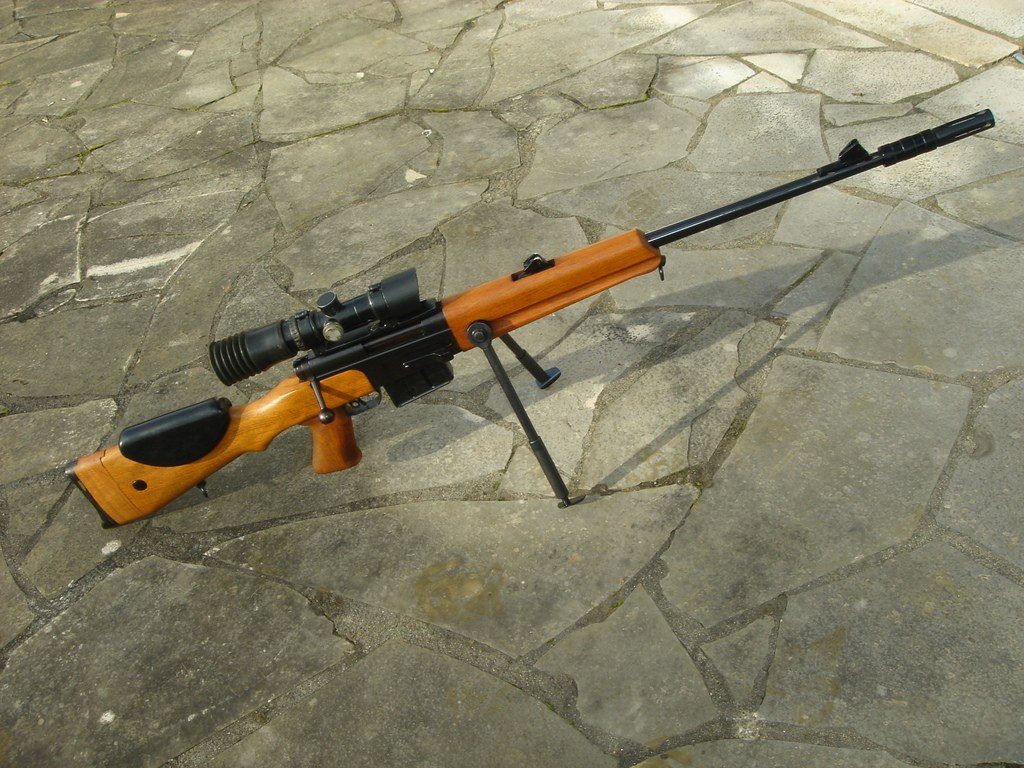
2.1 A rifle for the platoon marksman
The FR-F1 was France’s first bolt-action rifle designed from the start as a precision arm. It kept the MAS 36’s two rear locking lugs and its cartridge, the 7.5×54, and almost nothing else. Every account of it agrees on that outline. Almost every account also gets at least one date or number wrong, because the published record is thin and much of it repeats a small number of secondary sources. The plainest official statement found comes from a foreign army: the Lithuanian Armed Forces, which later bought FR-F2s, described the FR-F2 as “ankstesnio modelio FR F-1, gaminto nuo 1966 m. iki 1980 m., patobulinta versija” (“an improved version of the earlier model FR F-1, made from 1966 to 1980”).1
2.2 Who asked for it
Two sources, neither primary, credit the initiative to General Charles Ailleret, chief of staff of the French armed forces from 1962 to 1968. The English Wikipedia says that Ailleret asked the Army General Staff for a precision rifle in 1964; a French club site says the study was begun in 1964 “à l’initiative du Général Ailleret”.23 Neither cites a document, and no order or report signed by Ailleret was found. The attribution is plausible and unconfirmed.
The same sources say the rifle was developed at Saint-Étienne with advice from both military and civilian shooters, the civilians from the national shooting federation, and that a pre-series was designated FR-P.2 Forgotten Weapons published an interview in 2017 with Henri Canaple, a former armourer at Saint-Étienne and GIAT who rebuilt and tuned FR-F1s and FR-F2s for the army and its competition teams, together with documents on the FR-P; the video, in French with English subtitles, was not watched for this volume, so its content is not used.4
Why the army wanted it is given only by secondary sources: Maxim Popenker writes that it was meant to replace the sniper version of the MAS 49/56, which “proved to be less accurate than expected”.5 Vol 1 covers the scoped MAS 49 and 49/56 it replaced.
2.3 Three adoption dates
Table 1 — Three adoption dates
| Date | Source | Quality |
|---|---|---|
| 5 March 1965 (“L’arme est adoptée le 5 mars 1965”), reaching units in 1966 | tirsportifchabris.fr, a club blog with no author, date or sources3 | Specific but unsourced |
| 1966 (“entre en service en 1966”) | French and English Wikipedia; Popenker (“between 1966 and late 1980s”); Lithuanian Armed Forces (made “from 1966”)125 | Secondary, plus one foreign official page for the production start |
| 1967 (“The FR-F1 was adopted in 1967 as the French Army’s marksman or sniper’s rifle”) | Ian McCollum, Forgotten Weapons, 20206 | Secondary |
These are not necessarily contradictory. A decision to adopt in 1965, first issue in 1966 and general issue in 1967 would produce exactly this spread. But no primary document, a Journal officiel entry, a ministerial decision or a period article in Cibles or the Gazette des armes, was found to show which event each date marks. The safe statement is “adopted 1965–67, in production from 1966”.
2.4 What was new: the receiver
The FR-F1 is often described as a MAS 36 with a scope. It is not. The English Wikipedia, citing Jane’s Infantry Weapons 1996–1997, says the receiver was “designed to be stronger and thicker in order to increase accuracy” and that the two receivers “are not interchangeable”.2 The French Wikipedia describes the bolt as “dérivée du MAS 36, plus robuste, avec une seule fenêtre d’éjection à droite” (“derived from the MAS 36, sturdier, with a single ejection port on the right”).7 McCollum calls it “based roughly on the MAS-36 bolt action system, but with a heavier receiver and 10-round detachable box magazine”.6 And Steve Jackson’s MAS 36 page says the precision rifles were “built on new (and very high quality) receivers”.8
That point matters for two reasons. It explains why most FR-F2s could be made by re-machining FR-F1 receivers rather than starting again (Vol 3). And it means that the FR-F1’s service and the later 7.62 mm conversions say nothing directly about the strength of an infantry MAS 36 receiver, which is the receiver a builder in the United States can actually buy (Vol 9).
2.5 The rest of the rifle
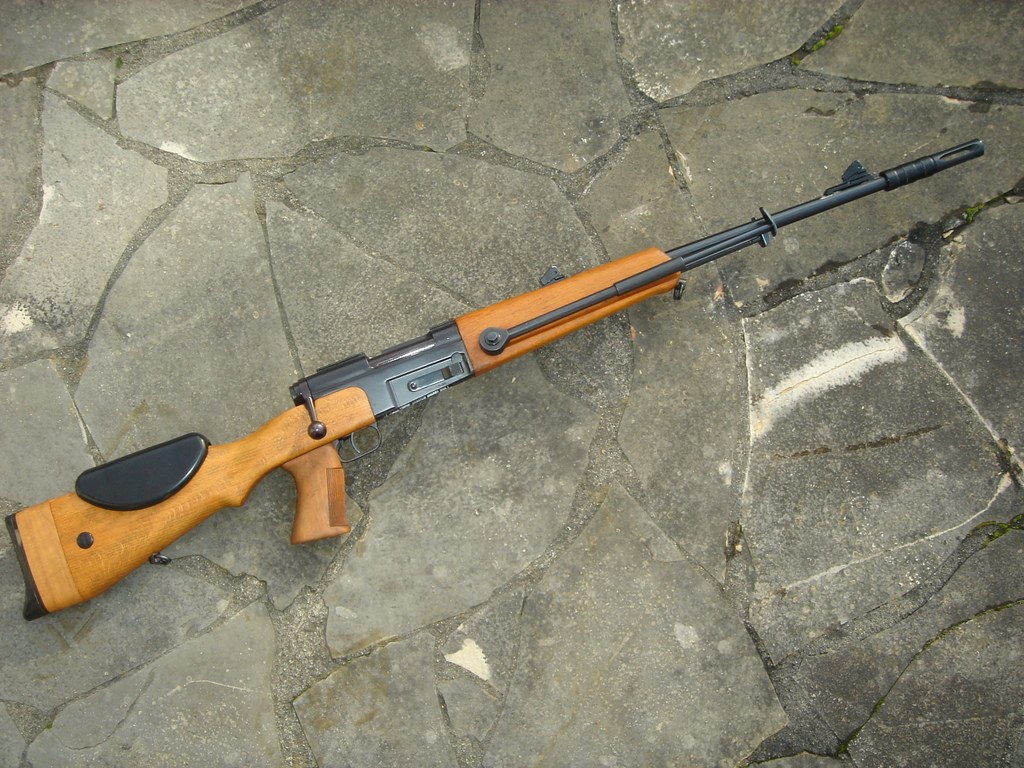
The details below come mainly from Popenker’s reference page and the French Wikipedia, since no French manual for the FR-F1 was found (Vol 6). Where they give figures, they are attributed.
Table 2 — The rest of the rifle
| Feature | Description | Source |
|---|---|---|
| Lock | ”rotary bolt with dual locking lugs at the rear of the bolt” | Popenker5 |
| Barrel | 600 mm; four grooves, right-hand, “pas de 300” (300 mm pitch) | fr.wikipedia7 |
| Barrel mounting | ”free floated and equipped with flash hider and adjustable harmonics compensator” | Popenker5 |
| Muzzle | ”manchon cache-flamme réglable” (adjustable flash-hider sleeve) | fr.wikipedia7 |
| Stock | pistol grip, adjustable by spacers, cheek rest (“à poignée pistolet, ajustable par cales, avec appui-joue”) | fr.wikipedia; Popenker57 |
| Bipod | metal, folding, legs extend and lock, “non pendulaire” (does not swing); “the FR-F2 aura un bipied pendulaire” | fr.wikipedia7 |
| Safety | ”manual safety, located at the rear of the trigger” | Popenker5 |
| Iron sights | ”Back-up iron sights are provided on each rifle”; Type A a folding night sight line | Popenker; fr.wikipedia57 |
| Magazine | detachable box, 10 rounds | McCollum; Popenker56 |
| Length / weight | 1,200 mm, 5.125 kg (fr.wikipedia); 1,200 mm, 5.1 kg (Popenker) | as stated |
| Muzzle velocity | 780 m/s | fr.wikipedia7 |
The barrel’s four grooves and 300 mm pitch differ from the C.I.P.’s standard 7.5×54 barrel, which has four grooves and a 270 mm twist (Vol 1); the C.I.P. figure is a proof standard for the cartridge, not a description of any one rifle, so the two do not conflict.
2.6 Types A, B and C
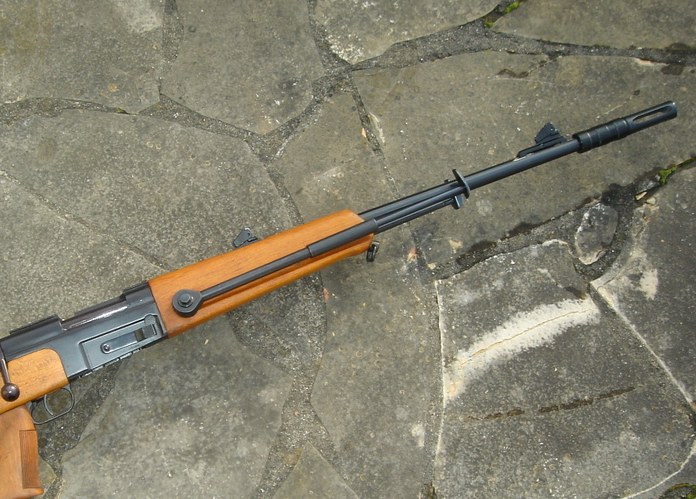
Three types were defined. Every source agrees on the roles; the French Wikipedia adds trigger weights and sights.
Table 3 — Types A, B and C
| Type | French designation | Role | Sights | Trigger (fr.wikipedia) | Bipod |
|---|---|---|---|---|---|
| A | Tir militaire de combat | Sniper / marksman | APX L806 scope; folding night sight line | 2 to 2.5 kg | Yes |
| B | Compétition militaire | Military match rifle | ”hausse micrométrique à œilleton et guidon sous tunnel” (micrometer aperture rear sight and tunnelled front sight) | 1.5 to 1.9 kg | No |
| C | Civile de chasse (projet) | Civilian hunting rifle | Folding sights to 100 m | 2 to 2.5 kg | — |
The French Wikipedia says Type C “n’a jamais dépassé le stade de projet” (“never went beyond the project stage”).7 Popenker confirms the Type B: a “special target version of the FRF1 sniper rifle featured diopter type rear sight instead of the telescope sight”.5 The French Wikipedia cites an article by Yves-Marie Dauxine, “Les fusils FR de compétition”, in Cibles n° 615 (September 2021), as its source for the competition rifles; it was not available for these volumes and is the best single lead for anyone who wants to go further.7
No photograph of a Type B was found. Vol 4 draws it from these descriptions and says so.
2.7 The APX L806-03
The Type A carried the same APX L806 scope as the scoped MAS 49/56, at 3.85 power, with the version suffix -03 for the 7.5 mm FR-F1, according to the club site that is the only source for the suffix.9 The same site says “En avril 1966, le ministère a commandé à la MAS la transformation de 5100 lunettes L.806 pour équiper les FRF1” (“In April 1966 the ministry ordered MAS to convert 5,100 L806 scopes to equip the FR-F1s”), and that “La commande initiale de 613 lunettes aurait été livrée en 1968” (“the initial order of 613 scopes is said to have been delivered in 1968”).9 Those figures are unsourced, and the 5,100 scopes come from the same site as the 5,150 rifles discussed below, so the two numbers do not corroborate each other.
The French Wikipedia adds that the GIGN, the Gendarmerie’s intervention unit, replaced the APX and its three-point mount with a two-point mount at the end of 1976; it gives no source that was read.7 Forgotten Weapons published a discussion with Christian Prouteau, the GIGN’s founder, about why the APX was used; it is a video, and its content is not used here.10
2.8 How many were made
The production figures are weak, and they conflict.
Table 4 — How many were made
| Figure | Source | Comment |
|---|---|---|
| 5,150 officially ordered; production stopped in 1973; about 50 more assembled from parts in 1976, perhaps some in 1986; perhaps 5,300 in total “en étant optimiste” | tirsportifchabris.fr3 | Unsourced; the page hedges its own figures |
| About 6,000 produced by 1980 | English Wikipedia2 | No source shown |
| Made from 1966 to 1980 | Lithuanian Armed Forces1 | A production span, no quantity |
| 7,500 FR-F1 and FR-F2 together | tirsportifchabris.fr3 | Unsourced |
| About 3,500 converted to the 7.62 NATO standard in 1986 and 1987 | tirsportifchabris.fr3 | Unsourced; see Vol 3 |
The 1973 end of production in one source and the 1980 end in two others cannot both be right, unless the later figure counts rifles assembled from stocked parts. The total lies somewhere between about 5,150 and about 6,000. Neither is adopted.
2.9 Who carried it
According to McCollum, the Army, the Navy and the Gendarmerie bought the FR-F1; the Air Force declined at first and came back to the question about twenty years later, by which time FR-F production had ended (see the FR-G below).11
The English Wikipedia lists Mauritania and the Royal Moroccan Gendarmerie as foreign users, citing a Moroccan gendarmerie resource that was not read.2 Neither is confirmed here.
2.10 Loyada, February 1976
The FR-F1’s best-documented operational use is a single morning in Djibouti, then the French Territory of the Afars and the Issas. On 3 February 1976 gunmen seized a school bus carrying the children of French servicemen and drove it to the border post at Loyada. The GIGN was flown in.
The GIGN’s historical association’s site gives the plan and the result. The marksmen were placed at dawn on 4 February (“les tireurs d’élite sont mis en place à l’aube du 4 février”); the aim was “neutraliser simultanément tous les terroristes au contact des otages” (“to neutralise all the terrorists in contact with the hostages at the same moment”); after a long wait, “toutes les cibles désignées sont enfin dans la ligne de mire des fusils FRF1” (“all the designated targets are finally in the sights of the FR-F1 rifles”); and “Cinq terroristes sont abattus au cours de la première salve” (“five terrorists are killed in the first volley”).12 The Gendarmerie’s own anniversary page, “50 ans de la Prise d’otages de Loyada”, refused automated reading; search summaries of it give six marksmen in position at 05:55, firing at 15:45, at 183 m, but those figures were not read on the page and are not confirmed here.13
Loyada is often told as a story about the rifle. It is better read as a story about the unit and the plan: a simultaneous volley at a known distance by marksmen who had waited for hours for every target to be visible. The rifle’s part was to be accurate enough at under 200 m that the plan could work. It was.
2.11 Other operations claimed for the FR-F1
Several other operations are attached to the FR-F1 in secondary sources. None was confirmed from an official text, and they are listed so that a reader knows what is claimed and on what basis.
Table 5 — Other operations claimed for the FR-F1
| Operation | Date | Claimed by | Status |
|---|---|---|---|
| Chad, heliborne operation at Guelta Maya (Ennedi), 2e REP | November 1970 | French Wikipedia, citing Soldats de France n° 12 (2020); the club site (“fin 1970”) | Not read |
| Mauritania, Opération Lamantin | 1977 | French Wikipedia, citing a forum | Weak |
| Kolwezi, Zaire, 2e REP | May 1978 | Wikipedia, club site | Not confirmed |
| Chad, Opération Tacaud | 1978–80 | English Wikipedia | Not confirmed |
| Lebanon | undated | Club site only | Weak; any use before 1986 would have been the F1, not the F2 |
2.12 The 7.62 mm rebarrels
Before the FR-F2 programme, some FR-F1s were moved to the NATO cartridge. Popenker writes that “some of FR F1 rifles used by Gendarmerie Nationale were rebarreled to 7.62×51 NATO during 1980s”, and that the gendarmes preferred the F1 to the later F2.5 A search summary of a Forgotten Weapons page adds that some FR-F1s were chambered for the NATO round for export; that page was not read. A video circulating on the Internet Archive, “FR-F1 Gendarmerie en 7,62x51 OTAN : de 100 à 400m”, shows one being fired; it was not watched for this volume.
How the conversion dealt with the bolt face is not documented in any source read. The 7.5×54 case head is larger than the 7.62×51’s, 12.39 mm against 12.035 mm at the bolt face by the C.I.P. and SAAMI figures (Vol 1), so a 7.62 conversion had to address extraction and case-head support, either with a new or bushed bolt head or by relying on the extractor. Which the French did is the most useful single fact a modern builder could find, and it is missing from the open record (Vol 9).
Externally, a rebarrelled FR-F1 looks like any other FR-F1. The marking on the receiver or barrel is the only reliable way to tell, and Vol 4 sets out what to look for.
2.13 The Air Force rifles: FR-G1 and FR-G2
The FR-G1 and FR-G2 are not FR-F variants, though they look like them. McCollum explains their origin: the Air Force, having declined the FR-F1, wanted precision rifles about twenty years later, when FR-F production had ended, so in the 1990s it had “a very similar precision rifle” built “on a standard MAS 36 receiver”; the G1 had an F1-style bipod and the G2 an F2-style one; “Only about 600 were made in total”; and they were replaced from 2013 by the HK417.11
The English Wikipedia gives different numbers: about 200 of each, developed from 1991 and produced from 1994; the French Wikipedia says GIAT Industries presented the FR-G2 in 1993.27 Popenker adds an FR-G3 sold to civilians in 7mm-08, on surplus MAS 36/51 actions.14
The FR-G series is the one place where the French state itself built 7.62 mm precision rifles on infantry MAS 36 receivers rather than on FR-F1 receivers. That makes it directly relevant to a modern lookalike build, and Vol 9 returns to it. What is not known is what the French did to those receivers before barrelling them, and whether they were selected, re-heat-treated or reinforced.
2.14 What the record does not settle
Table 6 — What the record does not settle
| Question | Range of answers | What would settle it |
|---|---|---|
| Who ordered the rifle | General Ailleret, 1964 (two secondary sources) | The order, or a period article |
| Adoption date | 5 March 1965; 1966; 1967 | Journal officiel or ministerial decision; Cibles n° 615 |
| Production total and end date | 5,150 to about 5,300, ending 1973; about 6,000 by 1980 | MAS production records; Dauxine in Cibles |
| Scope order of April 1966 | 5,100 conversions; 613 delivered 1968 | Same |
| Foreign users | Mauritania, Morocco (Wikipedia only) | Government sources |
| How the 7.62 rebarrels handled the bolt face | Not documented | A conversion instruction, or measurement of a converted rifle |
| FR-G production | about 600 in total, or about 200 of each; 1993 or 1994 | Air Force or GIAT records |
References
Footnotes
-
Lietuvos kariuomenė (Lithuanian Armed Forces), “Snaiperinis šautuvas FR F-2”, http://kariuomene.kam.lt/lt/ginkluote_ir_karine_technika/snaiperiniai_sautuvai/snaiperinis_sautuvas_fr_f-2.html , page dated 2009-04-17, read in the Internet Archive capture of 28 July 2010 on 2026-10-18. Translated for these volumes. ↩ ↩2 ↩3
-
English Wikipedia, “FR F1”, read 2026-10-18; used for leads and for the Jane’s quotation, which was not read in the original. ↩ ↩2 ↩3 ↩4 ↩5 ↩6 ↩7
-
tirsportifchabris.fr, “fusil sniper français FR-F1”, https://tirsportifchabris.fr/blog/fusil-sniper-francais-frf1 , read 2026-10-18. A club blog with no author, date or sources. ↩ ↩2 ↩3 ↩4 ↩5
-
Ian McCollum, “History of the FR-F1 and FR-F2 Sniper Rifles: Henri Canaple Interview”, Forgotten Weapons, 15 July 2017, https://forgottenweapons.com/history-of-the-fr-f1-and-fr-f2-sniper-rifles-henri-canaple-interview , read 2026-10-18 (text only; the video was not watched). ↩
-
Maxim Popenker, “FR F1”, Modern Firearms, https://modernfirearms.net/en/sniper-rifles/standart-caliber-rifles/france-standart-caliber-rifles/fr-f1-2/ , read 2026-10-18. ↩ ↩2 ↩3 ↩4 ↩5 ↩6 ↩7 ↩8 ↩9 ↩10
-
Ian McCollum, “French FR-F1 Sniper Rifle at the Range”, Forgotten Weapons, 4 June 2020, https://www.forgottenweapons.com/french-fr-f1-sniper-rifle-at-the-range/ , read 2026-10-18. ↩ ↩2 ↩3
-
French Wikipedia, “FR-F1”, read 2026-10-18. Quotations translated for these volumes. Its source for the competition rifles is Yves-Marie Dauxine, “Les fusils FR de compétition”, Cibles n° 615, September 2021, pp. 42–46, not read. ↩ ↩2 ↩3 ↩4 ↩5 ↩6 ↩7 ↩8 ↩9 ↩10 ↩11
-
Steve N. Jackson, “Fusil MAS Mle 1936”, virdea.net, https://www.virdea.net/french/36.html , read 2026-10-18. ↩
-
tirsportifchabris.fr, “lunette de tir APX 806”, https://tirsportifchabris.fr/blog/lunette-de-tir-apx-806 , read 2026-10-18. No sources cited. ↩ ↩2
-
Ian McCollum, “Christian Prouteau on the FR-F1 Rifle”, Forgotten Weapons, 5 January 2022, https://forgottenweapons.com/christian-prouteau-on-the-fr-f1-rifle , read 2026-10-18 (text only). ↩
-
Ian McCollum, “French Air Force Snipers: the FR-G1 and FR-G2”, Forgotten Weapons, 4 March 2020, https://www.forgottenweapons.com/french-air-force-snipers-the-fr-g1-and-fr-g2/ , read 2026-10-18. ↩ ↩2
-
Association GIGN historique, “[GIGN] Missions : Djibouti (02-1976)”, http://www.gign-historique.com/gign/missions-djibouti-02-1976/ , read 2026-10-18. Quotations translated for these volumes. ↩
-
Gendarmerie nationale, “50 ans de la Prise d’otages de Loyada”, gendarmerie.interieur.gouv.fr; refused automated reading (HTTP 403) on 2026-10-18. Figures attributed to it here come from search summaries and are unconfirmed. ↩
-
Maxim Popenker, “FR F2”, Modern Firearms, https://modernfirearms.net/en/sniper-rifles/standart-caliber-rifles/france-standart-caliber-rifles/fr-f2-eng/ , read 2026-10-18. ↩
Comments (0)