MAS FR-F1 and FR-F2 · Volume 4
Variants and Identification
MAS 36, FR-F1 Types A and B, the 7.62 mm FR-F1, the FR-F2, the Air Force's FR-G rifles and the lookalikes built on infantry actions: comparison plates, a tell-them-apart table, and the features a photograph cannot settle
4.1 Six rifles that get confused
Six rifles built on the MAS 36 system look alike in photographs and are mislabelled constantly, on Wikimedia Commons, in auction catalogues and in published references. One Commons photograph used in Vol 2 of an FR-F1 at a Paris display is filed under a name that calls it an FR-F2. An American blog headline called the genuine French rifles Navy Arms imported “replicas”. And English-language references regularly mix the FR-F1’s and FR-F2’s dimensions (Vol 5).
Table 1 — Six rifles that get confused
| Rifle | Calibre | Receiver | Made |
|---|---|---|---|
| MAS 36 | 7.5×54 | Infantry MAS 36 | 1936 to the late 1950s |
| FR-F1 Type A (sniper) | 7.5×54 | New, heavier receiver | 1966 to 1973 or 1980, by source |
| FR-F1 Type B (match) | 7.5×54 | Same | Same |
| FR-F1, 7.62 mm | 7.62×51 | Same, rebarrelled | 1980s (Gendarmerie and export) |
| FR-F2 | 7.62×51 | Mostly FR-F1 receivers, re-machined | From 1984; in service 1986–2023 |
| FR-G1, FR-G2 | 7.62×51 | Infantry MAS 36 receivers | 1990s |
The identification rules in this volume come from the sources cited in Vols 2, 3 and 5 and from looking at every photograph used in these volumes. They are recorded with each photograph’s identification in the photo credits.
4.2 The comparison plate
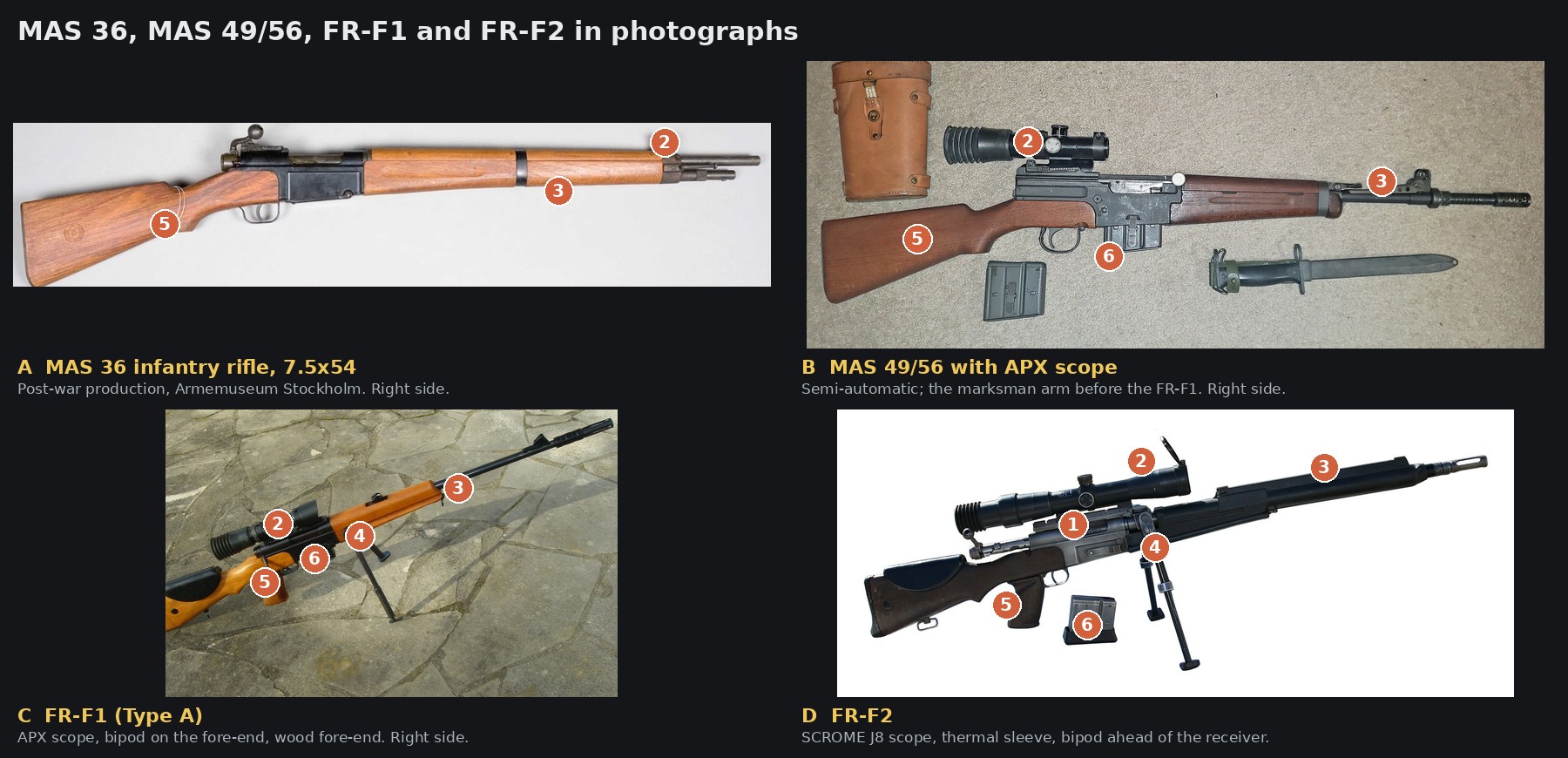
The plate shows the four rifles a reader is most likely to meet in photographs. Panels C and D are both right-side views, as is A; B is the right side of a semi-automatic and is there because its scope is the FR-F1’s scope’s ancestor (Vol 1).
4.3 The bipod: the feature that settles most photographs
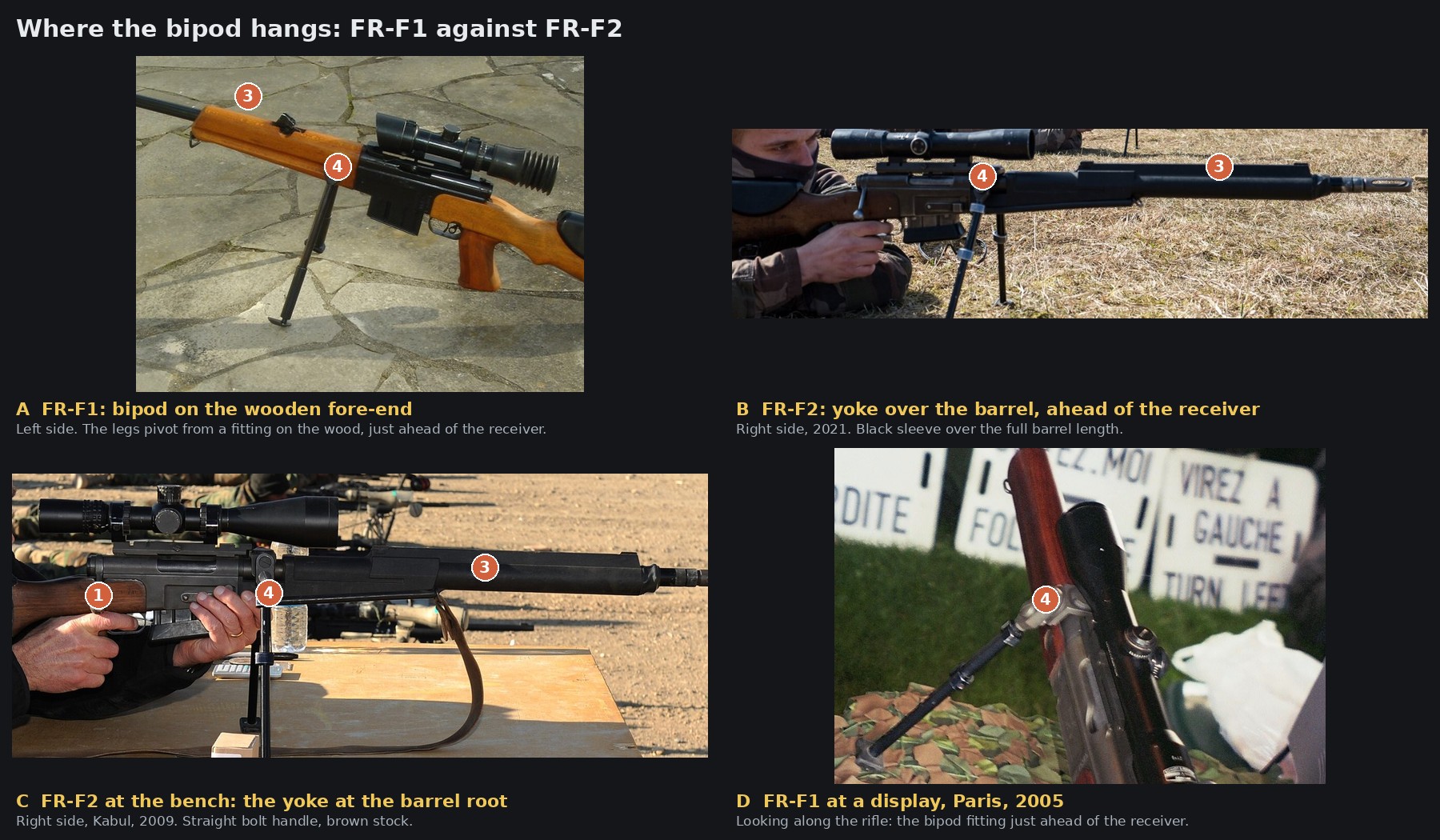
The written sources describe the change from the F1 to the F2 bipod in two ways. The French Wikipedia says the F1’s bipod is “non pendulaire” and that “le FR-F2 aura un bipied pendulaire”: the F1’s is fixed, the F2’s lets the rifle swing.1 The importer’s description, as The Firearm Blog relays it, calls the F2’s “a unique integrated bipod, which attaches to the rifle by a sleeve that sits over the barrel”, from which the rifle can hang with some swivel.2 American Rifleman puts it as legs attached near where the barrel meets the receiver, by “an overhead trunnion that allows the barrel to remain free floated”.3 The Lithuanian Army says the bipod was “moved from the front of the weapon closer to the shooter”.4
The photographs in these volumes confirm the first three descriptions and qualify the fourth. On every FR-F1 photographed here the bipod already pivots from a point just ahead of the receiver, under the wooden fore-end; it is not at the fore-end tip. On every FR-F2 it hangs from a yoke over the barrel at almost the same distance from the receiver. The visible difference is therefore how the bipod is attached, not mainly where: under the wood on the F1, over the barrel on the F2. The Lithuanian description may reflect a different F1 configuration, or simply the change from a stock-mounted to a barrel-mounted fitting; no F1 with a bipod at the fore-end tip was found.
For a reader holding a photograph, that gives the first and most reliable rule:
- Bipod hanging from a fitting under a wooden fore-end: FR-F1 (either calibre) or FR-G1.
- Bipod hanging from a yoke clamped over a black barrel cover: FR-F2 or FR-G2.
- No bipod and an aperture rear sight: FR-F1 Type B.
4.4 The barrel: exposed, or under a sleeve
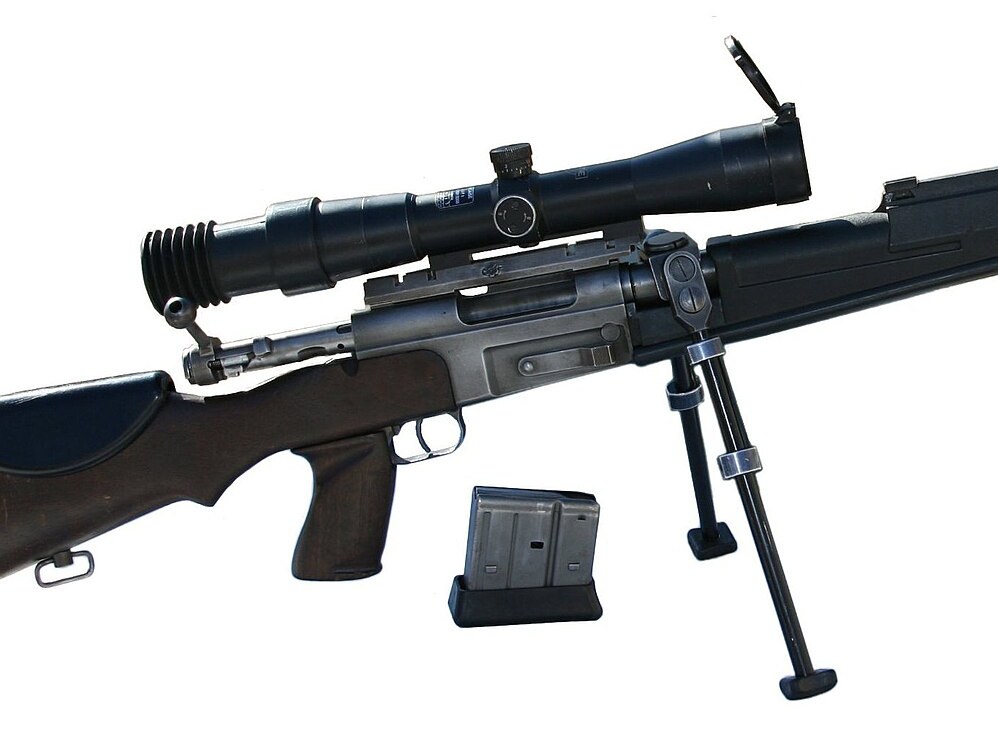
The second rule is the barrel. On the FR-F1 the barrel is exposed from the front of the wooden fore-end to the muzzle device. On the FR-F2 a black cover, the thermal sleeve, runs from the receiver nearly to the muzzle, with a synthetic fore-end below it. The Ministry describes the sleeve as “conçu pour diffuser et répartir uniformément la chaleur dégagée par le canon”; American Rifleman calls it a “polymer shroud”; the Lithuanian Army calls it plastic.534 Vol 5 covers what it does. In the field it was often wrapped in hessian or a desert cover (Vol 3), which can hide its outline, but the bulk of the wrapped barrel and the yoke in front of the receiver still show.
4.5 Stock, grip, bolt handle and magazine
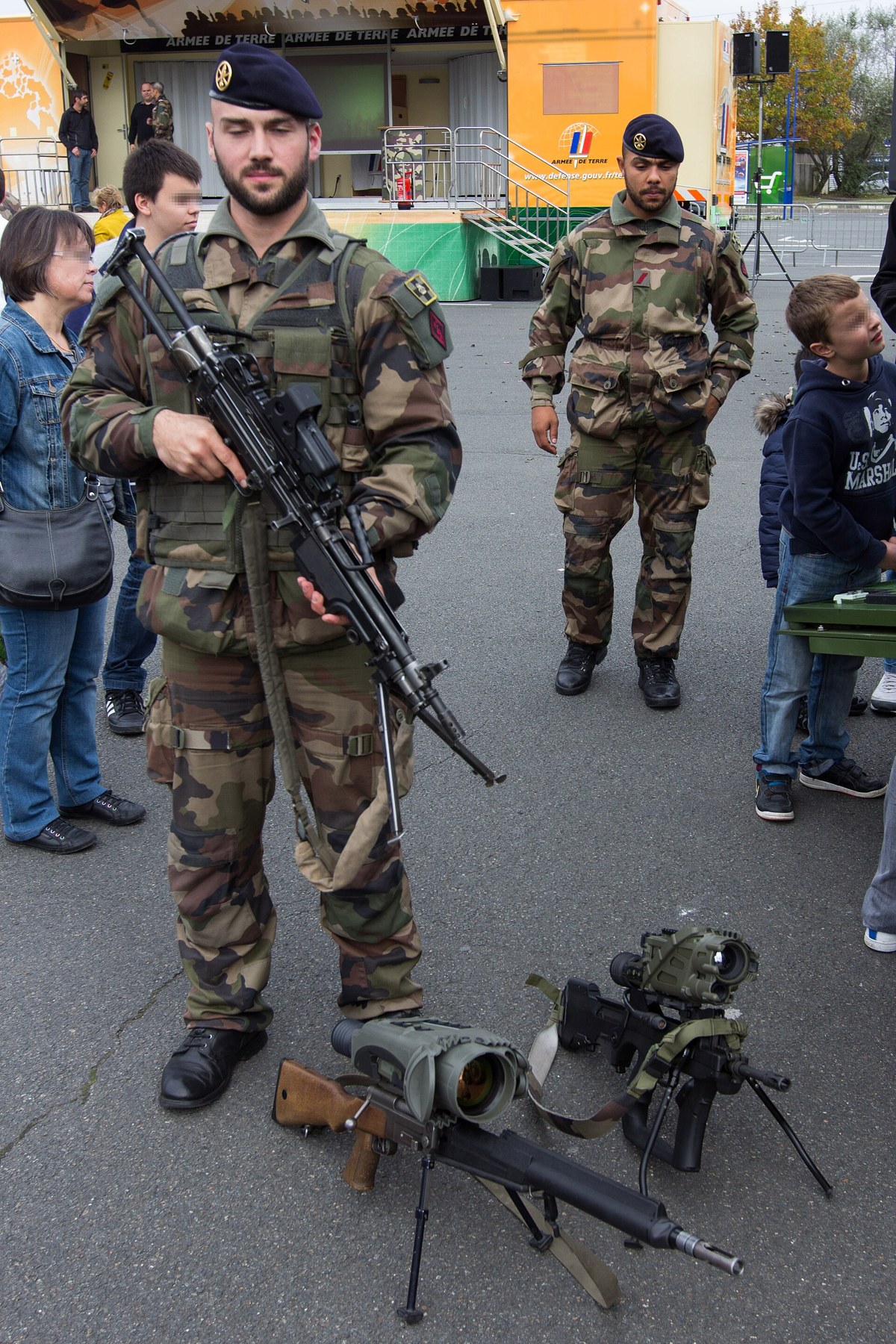
Several features separate the precision rifles from the infantry MAS 36 at a glance and are no help in separating the precision rifles from each other.
- Stock and grip. The MAS 36 has a straight stock without a pistol grip. The FR-F1 and FR-F2 have a separate pistol grip and a cheek pad; the FR-F2’s, per American Rifleman, is held by “a pair of eyelets”, with “two dovetailed extensions” for length of pull.3 The French Wikipedia says a plastic stock was tried for the F2 and rejected as too fragile.6 FR-F1 stocks in the photographs here are pale wood; FR-F2 stocks range from dark brown to near black. Stock colour is not a reliable rule: refinishing and replacement stocks are to be expected.
- Bolt handle. The MAS 36’s handle is bent forward and down. The FR-F2’s is straight, with a ball knob (American Rifleman, and visible in the photographs).3 No source read describes the FR-F1’s handle, and the photographs here do not show it clearly enough to state.
- Magazine. The MAS 36 has a fixed five-round box. The FR-F1 and FR-F2 take a detachable ten-round box; American Rifleman calls the F2’s “double-stack, double-feed”.3
- Safety. The MAS 36 has none. The FR-F1 and FR-F2 have a lever behind the trigger (Vol 5).
4.6 The variants drawn where no photograph exists
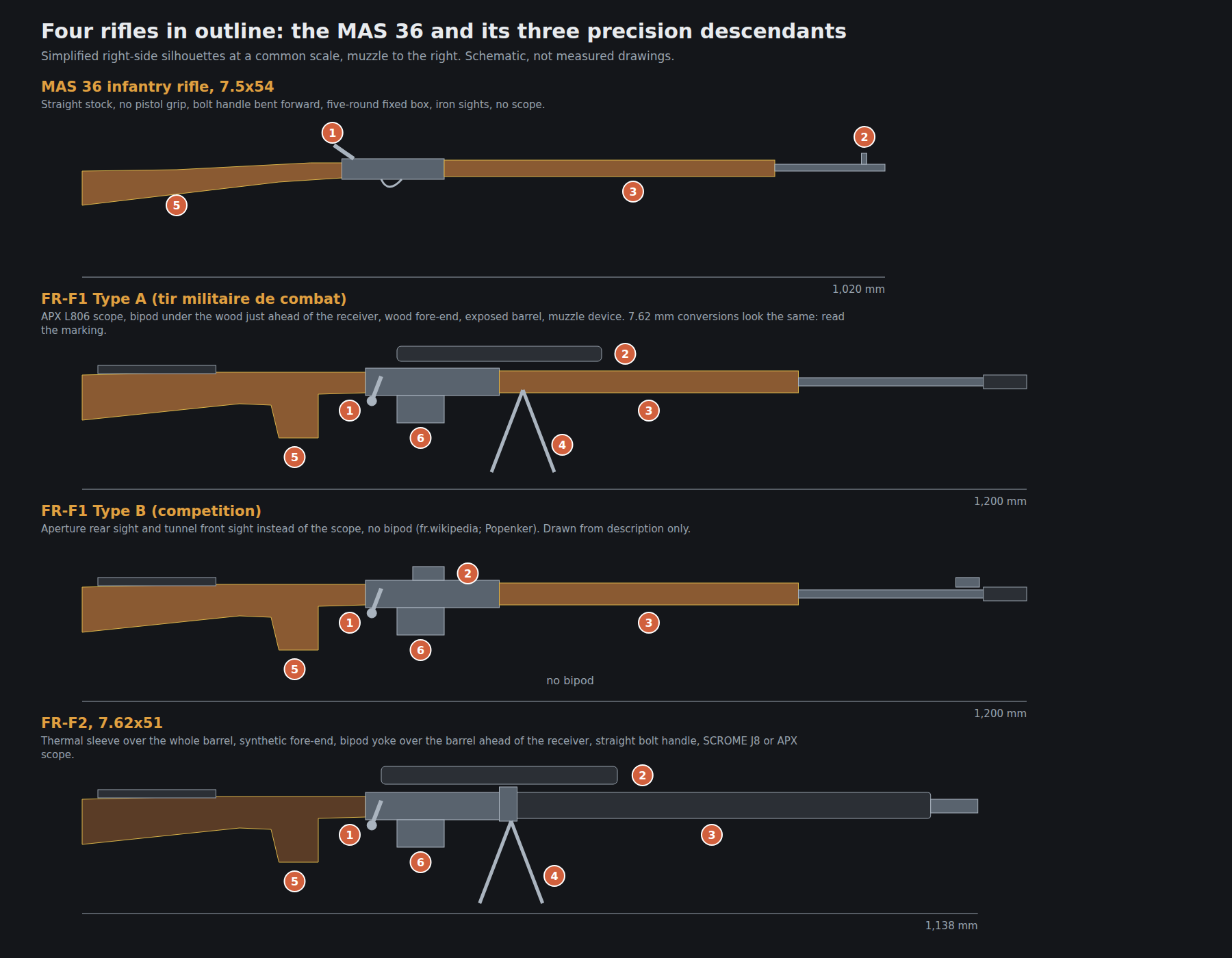
No photograph was found of an FR-F1 Type B, of a 7.62 mm FR-F1, or of an FR-G1 or FR-G2. The drawing above covers the Type B from its written descriptions, and it is labelled as such. A Type B is identified by what it lacks, a scope and a bipod, and by what it has, a micrometer aperture rear sight and a tunnelled front sight.17
4.7 Markings
The marking is the only way to separate a 7.62 mm FR-F1 from a 7.5 mm one, and the clearest way to separate an FR-F2 from an FR-G2. The record of markings is thin.
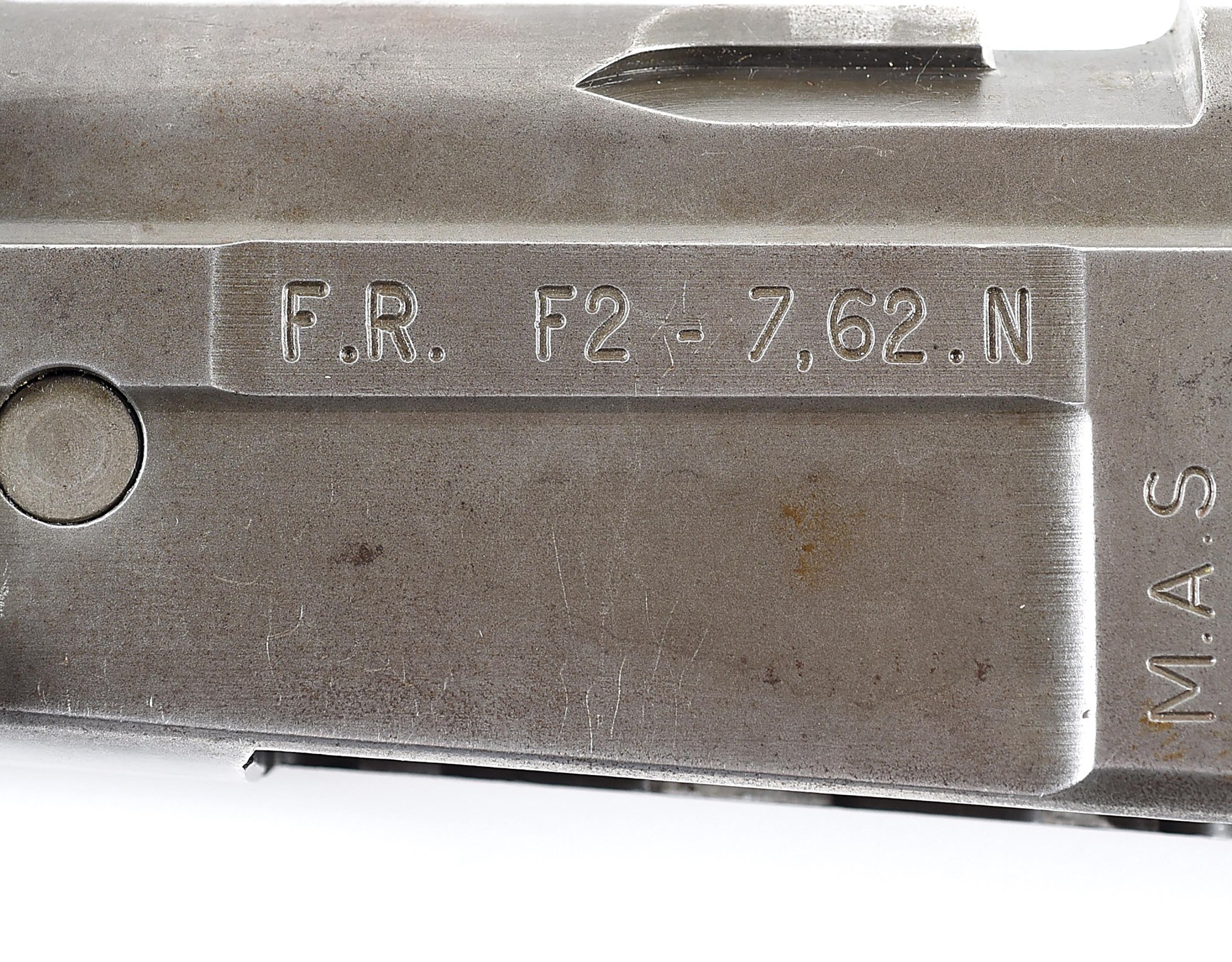
- FR-F2. Rock Island Auction’s catalogue for an imported FR-F2 transcribes “F.R. F2 - 7,62.N” on the left of the receiver and records “an import mark behind the magazine well”.8 The “,N” is the French notation for the NATO chamber. The serial in that catalogue begins with “F.”; serial numbers are not reproduced in these volumes.
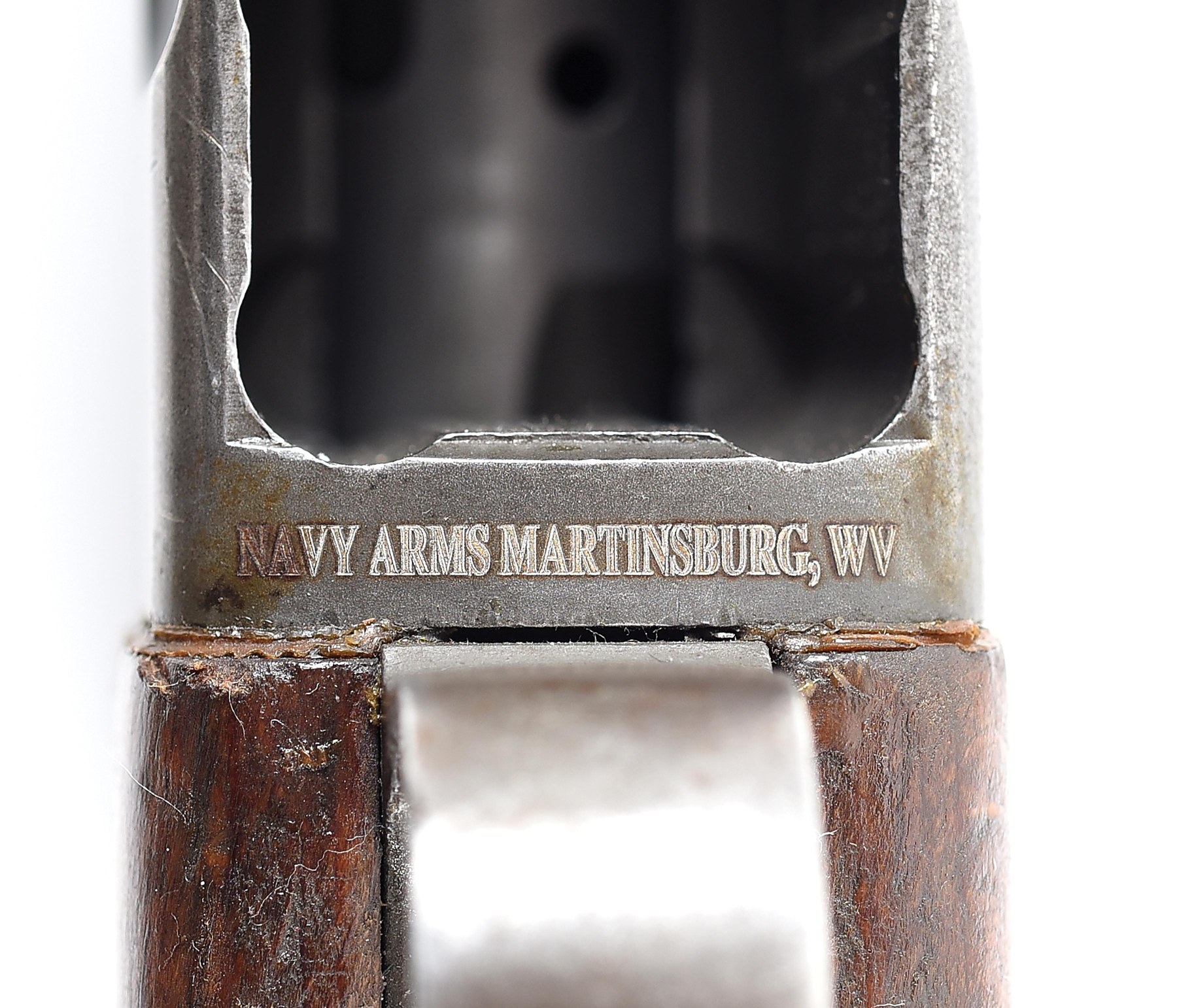
- Import mark. “NAVY ARMS MARTINSBURG, WV”, engraved on the underside of the receiver at the magazine well, as the Morphy Auctions photograph below shows. (An LSB Auctions listing spells the town “MARTINSBERG”; that page could not be read to check it.)9 Updated 2026-10-19: earlier editions called the wording unconfirmed.
- FR-F1. No transcription of an FR-F1’s receiver legend was found in any source read. The rifle was made at Saint-Étienne, and MAS markings are to be expected, but their form is not stated here.
- FR-G. No marking transcription was found.
A rifle with an FR-F2’s furniture and a receiver marked for another model, or with no model marking at all, should be treated as a composite or a lookalike until a specialist has seen it.
4.8 FR-G1, FR-G2 and the civilian FR-G3
The Air Force rifles were built in the 1990s on standard MAS 36 receivers, the G1 with an FR-F1-style bipod and the G2 with an FR-F2-style one, in numbers given as “about 600” in total by Forgotten Weapons and about 200 of each by the English Wikipedia (Vol 2).10 Externally they follow the F1 and F2 patterns closely. The practical rule is that a G1 resembles an F1 and a G2 resembles an F2, and only the receiver and its markings separate them. A reader who finds an F2-pattern rifle whose receiver has the infantry MAS 36’s outline should consider the FR-G2 first and a lookalike second.
Popenker records an FR-G3 sold to civilians in 7mm-08, built on surplus MAS 36/51 actions.11 It is the only factory-built civilian member of the family named in any source read. No FR-G3 was found on the US market.
4.9 Lookalikes and clones
FR-F1 and FR-F2 lookalikes built on infantry MAS 36 actions exist in France, and Vol 9 sets out how one could be built in a well-equipped American shop. A search summary of a Sniper’s Hide thread gives French prices of about €1,600 to €2,000 for a real FR-F1 with its APX scope and mount, against about €1,200 to €1,500 for “a clone based on a Mas36 action + Apx + mount”; the thread itself sat behind a browser challenge and was not read, so neither figure is confirmed.12
A lookalike on an infantry action can be recognised by the receiver: the precision rifles’ receivers are heavier, and the FR-F1’s is described as having “une seule fenêtre d’éjection à droite”, a single ejection port on the right.1 An infantry MAS 36 receiver under precision-rifle furniture means a lookalike or an FR-G, not an FR-F1 or FR-F2.
4.10 Tell them apart
Table 2 — Tell them apart
| Feature | MAS 36 | FR-F1 Type A | FR-F1 Type B | FR-F1 7.62 | FR-F2 | FR-G2 | Where to look |
|---|---|---|---|---|---|---|---|
| Bipod | None | Under the wooden fore-end, fixed | None | As Type A | Yoke over the barrel, swinging | F2-style | Just ahead of the receiver |
| Barrel | Exposed, wood to near the muzzle | Exposed beyond the wood | Exposed | Exposed | Black sleeve, receiver to near the muzzle | F2-style | Whole barrel |
| Fore-end | Two-piece wood with a band | Wood | Wood | Wood | Synthetic, under the sleeve | F2-style | Under the barrel |
| Stock | Straight, no pistol grip | Pistol grip, cheek pad, spacers | Same | Same | Same, dark | F2-style | Wrist and comb |
| Bolt handle | Bent forward | Not described | Not described | Not described | Straight, ball knob | Not described | Right side of the receiver |
| Sights | Iron | APX L806-03 scope; folding night sight line | Aperture rear, tunnelled front | As Type A | APX L806-04, then SCROME J8 | Various | Receiver top |
| Magazine | Fixed, 5 | Detachable, 10 | Detachable, 10 | Detachable, 10 | Detachable, 10 | Detachable | Under the receiver |
| Receiver | Infantry | Heavier, one ejection port on the right | Same | Same | Re-machined FR-F1, or new | Infantry MAS 36 | Receiver outline |
| Calibre marking | 7.5 | 7.5 (form not transcribed) | 7.5 | 7.62 (form not transcribed) | “F.R. F2 - 7,62.N” | Not transcribed | Left of the receiver |
Sources for each cell are given in the sections above and in Vols 2, 3 and 5.
4.11 An identification sequence
- Is there a pistol grip? No: a MAS 36 or one of its infantry variants (Vol 1). Yes: go on.
- What covers the barrel? A black sleeve to near the muzzle: an F2-pattern rifle (FR-F2, FR-G2 or a lookalike). Exposed barrel and a wooden fore-end: an F1-pattern rifle.
- Where does the bipod hang? A yoke over the barrel: F2 pattern. A fitting under the wood: F1 pattern. No bipod and aperture sights: an FR-F1 Type B.
- Look at the receiver. The infantry MAS 36’s outline under precision furniture: an FR-G or a lookalike. The heavier precision receiver: an FR-F1 or FR-F2.
- Read the marking. It is the only way to separate a 7.62 mm FR-F1 from a 7.5 mm one, and the clearest way to confirm an FR-F2.
- Check the import mark on any rifle in the United States. Every FR-F2 known to have been imported came through Navy Arms (Vol 8). An F2 without an import mark needs explaining.
4.12 What a photograph cannot settle
Table 3 — What a photograph cannot settle
| Question | Why a photograph fails | What settles it |
|---|---|---|
| 7.5 mm or 7.62 mm FR-F1 | Externally identical | The marking; a chamber cast |
| FR-F2 or FR-G2 | Same furniture | The receiver outline and marking, seen in hand |
| FR-F1 receiver or new receiver under an FR-F2 | The rebuild re-machined F1 receivers | Not settled from the outside by any source read |
| Original issue scope or later | Mounts and scopes moved between rifles | The scope’s own markings; the mount type |
| Original stock | Stocks were refinished and replaced | Not reliably settled |
References
Footnotes
-
French Wikipedia, “FR-F1”, read 2026-10-18. Quotations translated for these volumes. ↩ ↩2 ↩3
-
Doug E, “Newly Imported French FR F2 Sniper Rifles Available In The U.S.”, The Firearm Blog, 24 June 2022, https://www.thefirearmblog.com/blog/2022/06/24/french-fr-f2-sniper-rifles/ , read 2026-10-18, relaying the EuroOptic listing (the listing itself refused automated reading). ↩
-
Martin K. A. Morgan, “The French FR F2 Sniper Rifle”, American Rifleman, 18 September 2021, https://americanrifleman.org/content/the-french-fr-f2-sniper-rifle , read 2026-10-18. ↩ ↩2 ↩3 ↩4 ↩5
-
Lietuvos kariuomenė, “Snaiperinis šautuvas FR F-2”, page dated 2009-04-17, Internet Archive capture of 28 July 2010, read 2026-10-18. ↩ ↩2
-
Commandant Julien Monange, “Le tireur d’élite français à Sarajevo”, Chemins de mémoire, Ministère des Armées, 2018/2019, read 2026-10-18. ↩
-
French Wikipedia, “FR-F2”, version of 18 May 2026, read 2026-10-18; its technical table is tagged as insufficiently sourced. ↩
-
Maxim Popenker, “FR F1”, Modern Firearms, read 2026-10-18. ↩
-
Rock Island Auction Company, sale 4092, lot 543, https://cdn.rockislandauction.com/flipbooks/4092/BK1/files/basic-html/page472.html , read 2026-10-18. ↩
-
LSB Auctions, “France FRF2 Sniper Rifle FR-F2 7.62 Bolt Action Mags & Accessories”, https://lsbauctions.com/france-frf2-sniper-rifle-fr-f2-7-62-bolt-action-mags-accessories/ ; refused automated reading (HTTP 403) on 2026-10-18; wording from a search summary only. ↩
-
Ian McCollum, “French Air Force Snipers: the FR-G1 and FR-G2”, Forgotten Weapons, 4 March 2020; English Wikipedia, “FR F1”; both read 2026-10-18. ↩
-
Maxim Popenker, “FR F2”, Modern Firearms, read 2026-10-18. ↩
-
Sniper’s Hide forum, “French FR-F1/2 info wanted”, https://snipershide.com/shooting/threads/french-fr-f1-2-info-wanted.10817 ; not read (browser challenge); figures from a search summary only, undated. ↩
Comments (0)