MAS FR-F1 and FR-F2 · Volume 6
Field Strip, Maintenance and Repair
No French manual for the FR-F1 or FR-F2 could be found online, though one ships with every imported kit: what the open record does give, what a correct procedure has to account for, how the rifle should be inspected and kept, and how its likely faults would be diagnosed
6.1 The manual that is not online
The French Army certainly had a manual for the FR-F2. Navy Arms says so by shipping one: The Firearm Blog’s report from the 2026 SHOT Show lists “original French field manual” among the contents of each refurbished rifle’s kit, and Morphy Auctions’ description of an imported kit in 2024 lists a “manual” with the magazines, stock extensions, cheek pieces, sling and cleaning kit.12 Neither source gives its title, number or date.
No copy could be found online. That matters, because the hub’s rule for every dive is that a field strip, detail strip or maintenance procedure comes from a maker’s or military manual or is not printed at all. So this volume does not print a disassembly sequence. It sets out what the open record does say, what a correct procedure has to account for, and how a careful owner or gunsmith should approach the rifle until the manual can be read.
6.2 Where the search went
Table 1 — Where the search went
| Where | What was looked for | Result |
|---|---|---|
| Internet Archive (search API) | “MAS 36”, “FR F1”, “FR-F1”, “FR-F2”, “FR F2”, “tireur d’élite”, “fusil de précision”, titles containing “notice” and “fusil” | No manual scans; only video mirrors |
| Web searches, French and English | ”notice fusil FR F2”, “FR F1 manuel technique”, TTA and MAT numbers, “FR F1 sniper rifle manual pdf” | No manual |
| Bibliothèques numériques de la Défense (the Ministry’s digital library) | Catalogue records surfaced by search for Notice sur le fusil à répétition de 7,5 mm modèle 1936 (Charles-Lavauzelle, 1946, 176 pp.), Règlement sur l’armement de l’infanterie (1964–67), Robert Dumas, Le fusil à répétition MAS modèle 1936 et ses dérivés (2000), and Philippe Perotti (2005) on marksman training | The site refused connections on 2026-10-18; the records were seen only in search summaries and are unconfirmed |
| Armée de Terre and defense.gouv.fr | Any FR-F2 technical document | One identification poster of 2010, with a bolt exploded view and a specification table |
Source: research notes for these volumes, 02-inputs/research-mechanism-manuals.md.
The Ministry’s digital library is the best lead. If the 1946 Notice for the MAS 36 and the 1964–67 Règlement are there, the second may well cover the FR-F1. A reader with access to a French military library, or to an imported kit’s manual, could settle most of what follows.
6.3 What the open record does give
The Armée de Terre poster (2010). An identification poster, not a manual. It shows the FR-F2’s bolt broken into five numbered parts: “1 RESSORT DE PERCUTEUR, 2 BOUCHON TIGE GUIDE, 3 PERCUTEUR, 4 EXTRACTEUR, 5 CULASSE MOBILE” (firing-pin spring, rear plug with guide rod, firing pin, extractor, bolt body).3 It gives no procedure.
The MAS 36’s bolt. The French Wikipedia, citing its sources, says the MAS 36 bolt “ne se compose que de cinq éléments démontables”: “le corps de la culasse ; le bouchon arrière ; le percuteur ; le ressort du percuteur ; l’extracteur (non démontable par l’utilisateur)” (“bolt body, rear plug, firing pin, firing-pin spring, and the extractor, not removable by the user”).4 The two lists match.
The rifle’s documented features (Vol 5): a detachable ten-round magazine; a trigger-blocking safety behind the trigger; a free-floated barrel inside a thermal sleeve; a bipod yoke clamped over the barrel ahead of the receiver; a muzzle device that can be adjusted; a wooden stock with cheek pads on eyelets and dovetailed length-of-pull extensions; a scope on one of five types of base.
That is all. Everything else in this volume follows from those facts and from general bolt-action practice, and is labelled as such.
6.4 What a correct field strip has to account for
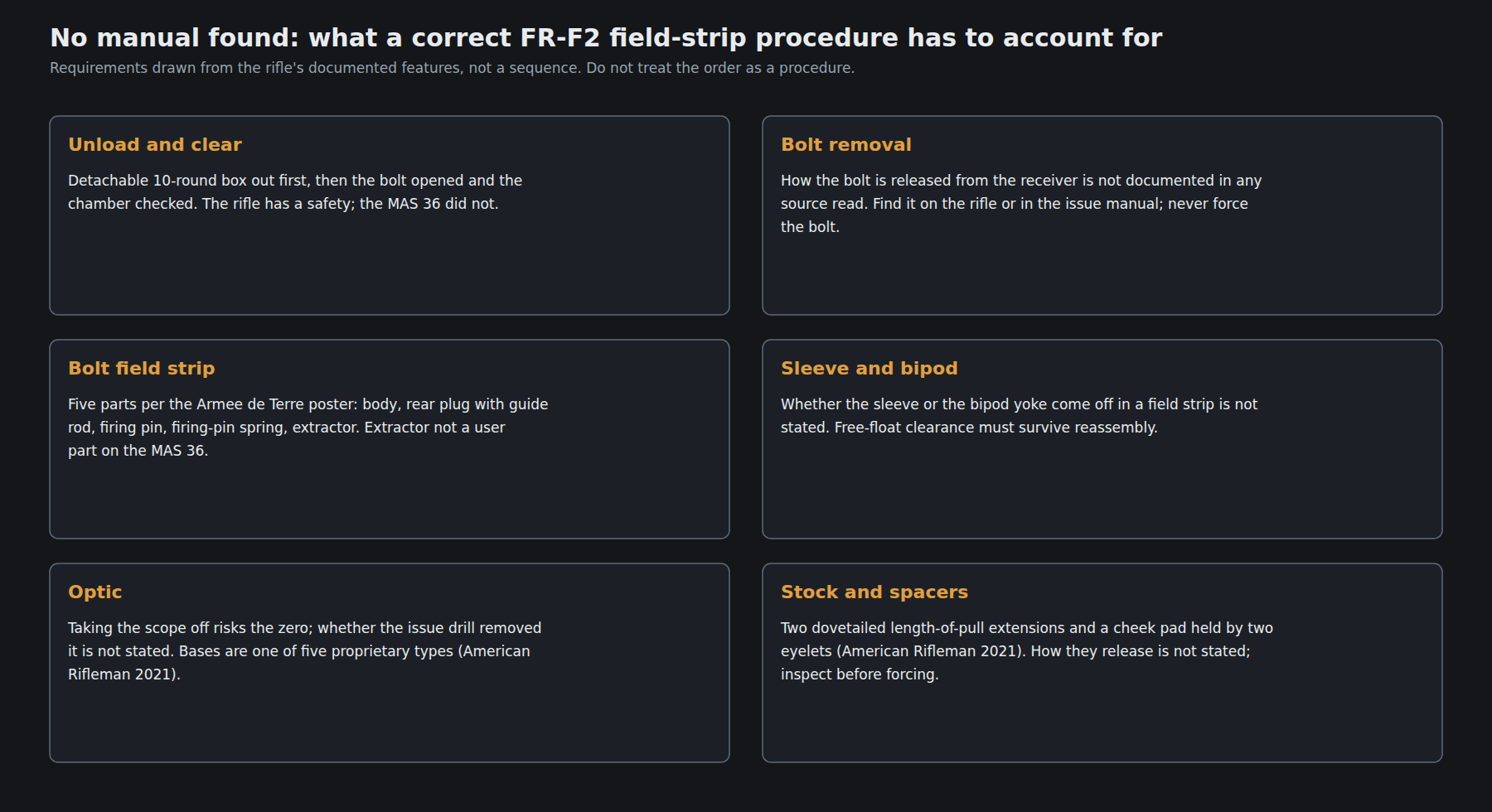
A correct field strip for the FR-F2, as it will appear in the French manual when it is found, has to deal with at least these points:
- Unloading. Magazine out, bolt opened, chamber and magazine well checked. The MAS 36 had no safety and was meant to be loaded only at the last moment (Vol 1); the FR-F2 has one, and the manual will say when it is applied during unloading.
- Bolt removal. How the bolt is released from the receiver is not described in any source read. It must not be forced. Find the release on the rifle or in the manual.
- Bolt disassembly. The poster shows five parts. The rear plug carries the guide rod; the firing pin and its spring come out of the body. How the plug is released is not described. The extractor, if the FR-F2 follows the MAS 36, is not a user part.
- The sleeve and the bipod. Whether either comes off in a field strip is not stated. The bipod yoke on the studio rifle has a two-screw cap (Vol 4), which suggests it clamps on and comes off with tools, not by hand. Removing either disturbs the free-float clearance and possibly the zero.
- The optic. The day scope sits on a base; removing it risks the zero. Whether the field drill removed it is not stated.
- The stock. Length-of-pull extensions on dovetails and cheek pads on eyelets adjust, but how is not stated.
- The muzzle device. If it is adjustable, its setting must be recorded before anything is done to it.
6.5 The bolt
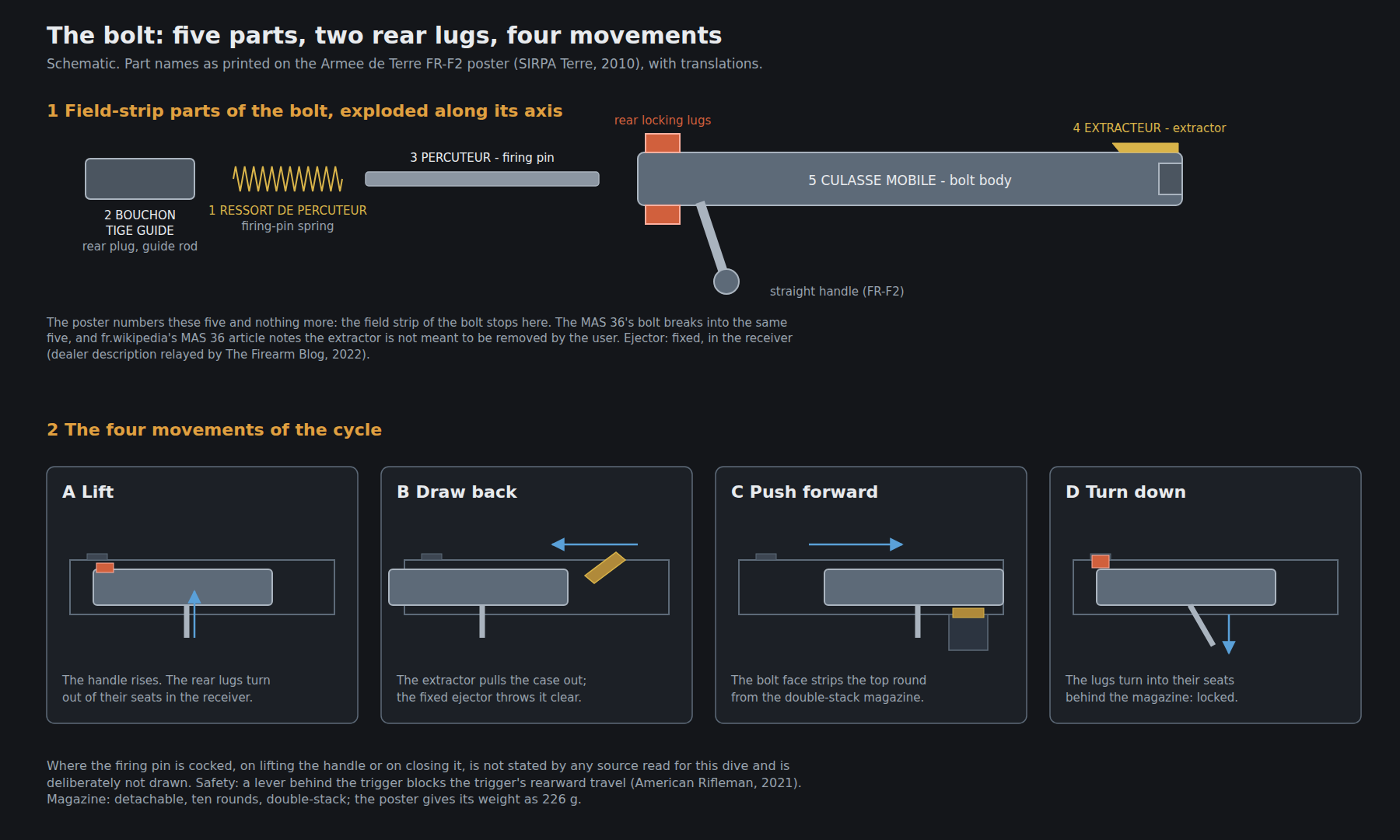
The bolt is the part an owner will clean most often, and its five-part construction makes it simple. Two cautions apply. First, the rear plug, firing pin and spring are under the spring’s load when assembled; whatever releases the plug, it should be done with the bolt held and the plug controlled, as with any striker-fired bolt. Second, the extractor: on the MAS 36 it is not removed by the user, and the same should be assumed on the FR-F2 until the manual says otherwise. A claw extractor that is sprung out and back by hand can lose its tension.
6.6 Detail strip: what to leave alone
A detail strip of the trigger group, the safety, the magazine catch and the receiver fittings is armourer’s work, and no source read describes it. For an owner, the rule is to stop at the field strip. Three places in particular should be left to a gunsmith with the manual:
- The trigger group. A two-stage precision trigger, weight set in service at about two kilograms (Vol 5). Its sear engagement is a safety matter.
- The bipod yoke and the sleeve. They govern the free-float clearance.
- The muzzle device. A tuned device’s setting is part of the rifle’s zero.
6.7 Cleaning and lubrication
No FR-F2 cleaning instruction was found. The following is general practice for a rear-locking bolt rifle, applied to this rifle’s parts, and is labelled as such.
- Bore and chamber. Clean from the breech with the bolt out, using a rod guide, so the rod does not rub the throat. The FR-F2’s three-groove barrel has a 290 mm twist (Vol 5); nothing about the rifling needs special treatment.
- Ammunition history. Surplus 7.62×51 and 7.5×54 of unknown origin may have corrosive priming. The hub’s M1 Garand dive sets out the rule the US Army used and the cleaning it needs (M1 Garand, Vol 12); the same applies to any rifle fed old surplus.
- Lug seats. The rear lugs bear on seats in the receiver behind the magazine well. They are out of the chamber’s fouling but in the path of grit that falls through the action. They should be clean and lightly lubricated, as should the lugs’ rear faces.
- Bolt face and extractor claw. Brass and carbon collect under the claw. Clean with a brush; do not pry.
- Firing pin channel. Keep dry or very lightly oiled; oil in a striker channel thickens in cold and slows the pin.
- Sleeve and barrel. Moisture trapped between the sleeve and the barrel is the rifle’s one unusual corrosion risk. How the sleeve is fixed is not known (Vol 5), so whether the space can be reached without removing the sleeve is not known either. A rifle that has been rained on should be dried and its muzzle end checked.
- Wood. The stock is wood; the extensions are wooden plates on dovetails. Keep solvent off them.
6.8 Inspection
A rifle bought on the surplus market (Vol 8) should be inspected before it is fired, and a few checks are specific to this design.
Table 2 — Inspection
| Check | What to look for | Why it matters here |
|---|---|---|
| Headspace | GO and NO-GO with 7.62 NATO gauges; the original FR-F2 chamber is marked as a NATO chamber (“7,62.N”) | The Headspace dive covers the NATO gauges and their figures (Headspace, Vol 4) and the procedure (Vol 5). On a rear-locking action, headspace depends on the whole bolt body and the receiver between lug seats and chamber (Vol 9) |
| Lug seats and lug faces | Bright, even bearing on both lugs; no peening, burrs or setback | Rear lugs bear on a receiver re-machined from an older FR-F1 receiver (Vol 3) |
| Bolt face | Pitting, erosion around the firing-pin hole | Primer gas cutting |
| Extractor | Claw sharp, tension firm, no cracks | Not a user part |
| Firing pin | Tip shape, protrusion consistent | No protrusion figure was found; compare with a known good bolt |
| Free float | The barrel clear of the sleeve, the fore-end and the bipod yoke along its length | The rifle’s accuracy depends on it |
| Bipod yoke | Clamp screws tight; legs lock; the swing free | Loose clamp means the rifle moves on its support |
| Muzzle device | Secure; setting recorded | Part of the zero |
| Magazines | Feed lips undamaged, follower free, spring strong | Double-feed lips (Vol 5) are the usual cause of feeding faults in any box |
| Scope and mount | Mount tight on the base; scope tube unmarked by over-tightened rings | Bases were one of five proprietary types |
The importers described the rifles as used but serviceable. EuroOptic said in 2022 they “may show some signs of wear but are 100% fully functional”; American Rifleman in 2024 reported “strong, tight actions and sharply rifled barrels” and wrote that “these guns haven’t seen a lot of service”.56 Those are sellers’ and a magazine’s impressions, not inspection reports, and each rifle should be checked on its own.
6.9 Faults and their diagnosis
No published record of FR-F2 malfunctions or failures was found: no service report, no armourer’s notes, no failure rate. The table below is therefore a general bolt-action diagnosis mapped onto this rifle’s parts. It is not a list of documented FR-F2 faults.
Table 3 — Faults and their diagnosis
| Symptom | Likely causes on this rifle | First check |
|---|---|---|
| Failure to feed | Magazine lips bent or spread; follower binding; magazine not seated | Try another magazine |
| Double feed | Feed lip damage on a double-feed magazine | Inspect lips against a good magazine |
| Failure to extract | Extractor claw chipped or weak; rough or dirty chamber; overpressure | Clean the chamber; inspect the claw |
| Weak or no ejection | Ejector worn or obstructed; bolt not drawn fully back | Run the bolt fully; inspect the ejector |
| Light strikes | Weak firing-pin spring; oil or debris in the firing-pin channel; short protrusion | Clean and dry the channel |
| Hard bolt lift | Dirty lug seats; overpressure; excessive headspace on reloaded brass | Clean seats; check ammunition |
| Group walks as the barrel heats | Sleeve or fore-end contacting the barrel; loose bipod yoke | Check free float, yoke clamp |
| Zero shift between sessions | Loose scope base or rings; muzzle device moved; bipod yoke moved | Witness-mark each and recheck |
| Safety does not block the trigger | Worn or damaged safety or trigger parts | Stop. Gunsmith |
6.10 Bench work and gunsmith work
At the bench, without the manual: magazine maintenance; cleaning and lubrication of the bolt, lug seats and bore; tightening of scope rings and the base to the maker’s figure where one is known (none was found for the French bases); witness-marking the muzzle device, bipod yoke and scope mount; replacing a cheek pad or spacer.
For a gunsmith with the manual: headspace correction; extractor and firing-pin replacement; any work on the trigger or safety; removal and refitting of the sleeve, fore-end or bipod yoke with the free-float clearance restored; muzzle device adjustment; rebarrelling.
Not for anyone without proof facilities: any repair that alters the bolt body, the lug faces or the lug seats. On a rear-locking action those surfaces carry the firing load (Vol 5).
6.11 Parts
No dated listing for loose FR-F2 parts, magazines, bipods, sleeves or stocks, was found. What was found:
- Complete kits. Navy Arms sold FR-F2s from 2022 with a Picatinny mount and two magazines (EuroOptic), and in 2026 offered refurbished rifles with a scope mount, bipod, magazines, a carrying bag and the French manual at $8,995 (The Firearm Blog, 22 January 2026).51
- The SCROME J8. McCollum reported in May 2022 that “Scrome is now making a run of military-pattern J8 scopes to take advantage of the batch of surplussed FR-F2 rifles”; no price was given.7
- The APX L806. Sold occasionally on the collector market; one Canadian listing seen only in a search summary was for the MAS 49/56 version, not the FR-F2’s -04 (Vol 7).
For anything else, the owner of an imported FR-F2 should start with Navy Arms, the only known importer (Vol 8).
6.12 What is owed
Table 4 — What is owed
| Item | Why |
|---|---|
| The French field manual supplied in the Navy Arms kits: title, number, date, and its field-strip and maintenance chapters | The only source that can replace the requirements list above with a procedure |
| The 1946 Notice sur le fusil à répétition de 7,5 mm modèle 1936 and the 1964–67 Règlement sur l’armement de l’infanterie, from the Ministry’s digital library | The MAS 36 and possibly FR-F1 procedures |
| Robert Dumas, Le fusil à répétition MAS modèle 1936 et ses dérivés (2000) | A French book on the whole family, including the derivatives |
| Firing-pin protrusion, headspace figures and trigger specification for the FR-F2 | Inspection standards |
References
Footnotes
-
Zac K, “[SHOT 2026] Navy Arms Raids France’s MilSurp Supply”, The Firearm Blog, 22 January 2026, https://www.thefirearmblog.com/blog/shot-2026-navy-arms-raids-france-s-milsurp-supply-44825590 , read 2026-10-18. ↩ ↩2
-
Morphy Auctions, Firearms and Militaria, 8–10 May 2024, lot 1184, https://auctions.morphyauctions.com/_M__VERY_NICE_MAS_FR_F2_BOLT_ACTION_SNIPER_RIFLE_W-LOT598829.aspx , read 2026-10-18. ↩
-
Armée de Terre, “Fusil à répétition modèle F2 — FRF2”, identification poster, SIRPA Terre 2010, read in the Internet Archive capture of 21 February 2011 on 2026-10-18 (copy in 02-inputs/manuals/). ↩
-
French Wikipedia, “MAS 36”, read 2026-10-18; its sources are Martin J. Dougherty and Cibles n° 614. Quotations translated for these volumes. ↩
-
Doug E, “Newly Imported French FR F2 Sniper Rifles Available In The U.S.”, The Firearm Blog, 24 June 2022, https://www.thefirearmblog.com/blog/2022/06/24/french-fr-f2-sniper-rifles/ , read 2026-10-18, quoting EuroOptic. ↩ ↩2
-
“I Have This Old Gun: French FRF2 Sniper Rifle”, American Rifleman, 13 March 2024, https://americanrifleman.org/content/i-have-this-old-gun-french-frf2-sniper-rifle , read 2026-10-18. ↩
-
Ian McCollum, “Scrome J8: A Proper Scope for the FR-F2 Sniper”, Forgotten Weapons, 21 May 2022, https://www.forgottenweapons.com/scrome-j8-a-proper-scope-for-the-fr-f2-sniper/ , read 2026-10-18. ↩
Comments (0)