Whitney Wolverine · Volume 8
Collecting, the Law, and the Ray Gun in Popular Culture
Every dated auction result located, what drives the top of the market, C&R status and Michigan, a buyer's checklist, the Star Wars claim tested, and the pistol's kindred designs
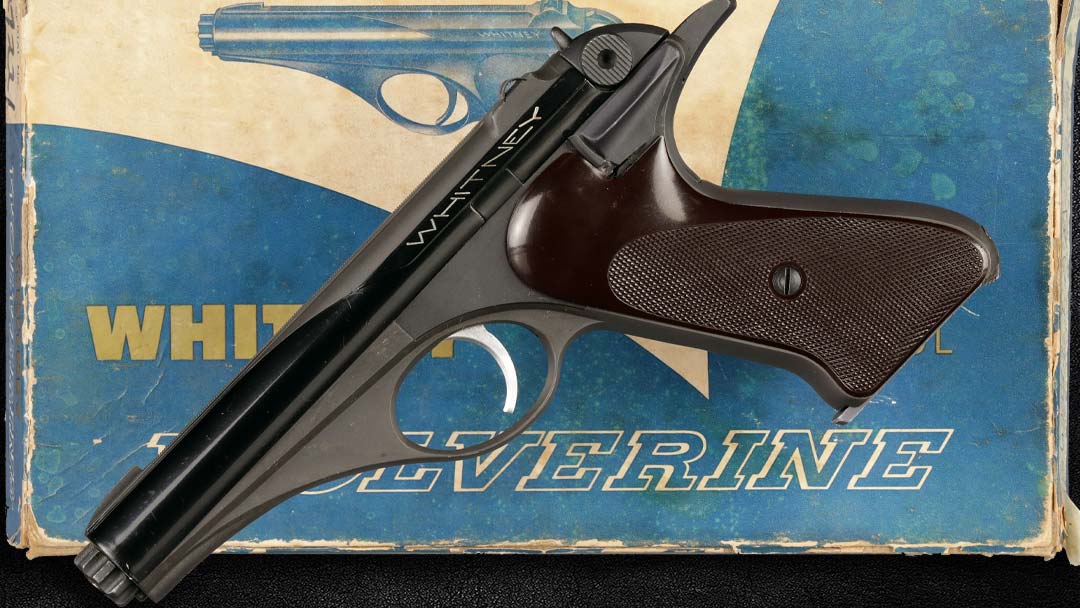
The Whitney now sells for roughly forty-five to two hundred times its 1956 price of $39.95, and it is valued for the reason it failed: it looks like nothing else. This volume sets out what it actually sells for, on dated and attributed records only; what the law says about owning one; how to buy one without buying a reissue or a refinish by mistake; and what is true about its reputation as the ancestor of film blasters.
8.1 What the Record Is, and Is Not
The prices below are Rock Island Auction Company results only. They are hammer prices, read from each lot page’s data, and they exclude RIA’s buyer’s premium; where RIA’s own blog reports a “sold for” figure including the premium, it is given alongside. RIA’s lot pages render the realised price as an image, and the hammer figure is taken from the same page’s data. Three of RIA’s blog figures can be checked against the hammer prices, and each matches a premium of 17.5 per cent ($8,000 → $9,400; $6,000 → $7,050; $5,500 → $6,464).1
No GunBroker sold listings were obtained. GunBroker’s completed-sale records are not available without an account and a browser session, and they were not accessed. No GunBroker price appears here, and no price from an asking listing is presented as a sale. The Blue Book of Gun Values entry for the original pistol could not be read; its entry for the reissue is covered in Volume 7.
8.2 Every Dated Sale Located
Table 1 — Every Dated Sale Located
| Date | RIA lot | What sold | Estimate | Hammer |
|---|---|---|---|---|
| 8 Sep 2017 | 71/936 | Inc.; 98% original anodized; original box; with Taglienti’s book | $1,600–2,500 | $2,000 |
| 11 Dec 2022 | 87/3683 | ”Attractive” example; factory-style replacement box, manual, pamphlet, warranty card | $4,500–6,500 | $3,750 |
| 14 Feb 2023 | 1042/638 | With box | $3,000–4,000 | $4,000 |
| 26 Aug 2023 | 89/1617 | Custom bright polish; “ALCOA/G” under right grip; reproduction box | $2,250–3,500 | $3,000 |
| 17 May 2024 | 4091/666 | 98%+ original black; box inscribed by Hillberg to Charles Petty; spare trigger parts | $3,000–5,000 | $4,750 |
| 17 May 2024 | 4091/663 | Target prototype “T2”, 1957, with Findley letter | $6,500–9,500 | $8,000 |
| 21 Jun 2024 | 1046/945 | With box | $1,300–1,900 | $1,800 |
| 24 Aug 2024 | 4092/1580 | 95% original black; reproduction box | $2,500–4,000 | not sold / not shown |
| 21 Feb 2025 | 1048/993 | Professional custom bright polish; white grips; box | $2,000–3,000 | $5,500 (RIA blog: $6,464 with premium) |
| May–Jun 2025 | 5013/474 | With box (online auction) | $1,200–1,800 | $2,500 |
| 15 Aug 2025 | 4095/565 | Professionally bright polished; white grips; box, manual | $4,000–6,000 | $7,500 |
| 6 Dec 2025 | 4096/1596 | Presentation series, serial 27; 99% original black and grey | $8,500–13,000 | $8,000 (RIA blog: $9,400) |
| 6 Dec 2025 | 4096/1598 | Inc.; professional bright polish; white grips; box labelled 34026; extra magazine | $4,500–7,000 | $6,000 (RIA blog: $7,050) |
| 9 May 2026 | 4097/1561 | Inc.; professional bright polish; white grips; Wolverine box | $4,000–6,000 | not sold / not shown |
| 8 Jan 2020 | 2028/764 | Olympic Arms reissue, with case | $200–300 | $500 |
All figures from the lot pages, retrieved 2026-09-19.2 Descriptions are abbreviated from RIA’s; the words “custom” and “professional” are RIA’s own, and mean a finish applied after the pistol left the factory (Volume 3).
8.3 What the Numbers Show
With fourteen lots over nine years, and the pistols differing in condition, finish and extras, this is a record to read carefully rather than to average. What it supports:
- A plain, boxed original in good standard finish sold at RIA for between $1,800 and $4,000 hammer in 2023–2025 ($1,800 in June 2024; $2,500 in 2025; $4,000 in February 2023). The 2017 result of $2,000 for a 98% gun with box sits at the bottom of that band.
- Provenance adds money. The box inscribed by Hillberg to a gun writer took $4,750 against a band that otherwise topped out near $4,000.
- The rarities sit at $8,000. The presentation pistol and the target prototype each brought $8,000 hammer — about $9,400 with the premium.
- Bright polish sells high — whether or not it is original. The three professionally polished pistols sold in 2025 brought $5,500, $7,500 and $6,000 — well above the standard-finish band, although RIA describes all three as refinished. The market is paying for the look. A buyer who wants the scarce factory bright finish (Volume 3) is paying the same money for something harder to prove, and should demand the evidence.
- The reissue is a different market. The one reissue sale located was $500 hammer in 2020.
What it does not support: a trend line. Lots of different quality at different sales cannot be joined into a price curve, and none is drawn here.
8.4 Earlier and Informal Prices
For context only, and not as sale records:
- 2006. An owner bought an original for $295 from a dealer, having seen bids “in the $500 range” on GunBroker and Auction Arms; the Olympic reissue then listed at $279.50.3
- 2021. The Firearm Blog gave “blued versions: ~$1,800” and “nickel-plated with white grips: $3,400+ starting bid, often reaching ~$4,000”, without dates or sources for the sales.4
- 2022. American Rifleman declined to price originals — “odds are good those prices are much higher” than the $1,000-plus it gave for used reissues.5
The 1956 retail price was $39.95 blued, and $44.95 bright by the factory’s advertisement (Volume 3).6
8.5 Curio and Relic Status
Under federal law a firearm is a curio or relic if, among other routes, it was “manufactured at least 50 years prior to the current date” (27 CFR 478.11), not counting replicas. The original Whitney pistols were made between 1955 and early 1958 (Volume 2). Every original Whitney is therefore a curio or relic by age, and has been since about 2008 at the latest. The hub’s M1 Garand dive sets out the definition and what C&R status allows a licensed collector to do; nothing about the Whitney changes it.
Two points specific to the Whitney:
- The Olympic Arms reissue is not a curio or relic. It was made from 2004 or 2005 to 2017–18, and it is in any case a modern re-creation of an old design. The earliest examples will not reach 50 years until the mid-2050s. That is one more practical reason to identify a pistol correctly (Volume 7) before buying it on a collector’s licence.
- C&R status changes how a licensed collector may acquire one; it does not change what the pistol is. An original Whitney is an ordinary Title I handgun. It has nothing to do with the National Firearms Act.
8.6 Buying and Owning One in Michigan
A Whitney is a pistol under Michigan law, and buying or transferring one follows the same pistol-licensing and sales-record statutes as any other handgun, MCL 28.422 and 28.422a. The hub’s Remington XP-100 dive quotes both statutes and explains the licence, the exemptions for concealed pistol licence holders and the pistol sales record, and it applies here unchanged. Nothing about a 1950s .22 automatic, or its C&R status, alters that position, and it is not restated.
8.7 A Buyer’s Checklist
Drawn from Volumes 3, 5, 6 and 7:
- Original or reissue? Look at the rib (vents mean a reissue), the rear sight (dovetail means a reissue), the material and the markings. Do this on the listing photographs before anything else (Volume 7).
- Which company? The right-side address line: “Whitney Firearms Inc.” before the 1957 sale; “Co.” after (Volume 3).
- Which finish, and is it original? Standard two-tone anodizing, a factory bright finish, or a later polish. Read any auction lot text for “custom” or “professional”; look for the gold trigger the factory advertised for its bright pistols, and for sharp edges and crisp markings; treat a matching box as weak evidence (Volume 3).
- Is it complete? Barrel nut, locking plunger and spring, barrel seat (inside the frame), barrel key, firing-pin lock, and a magazine. The small parts are the ones that go missing (Volume 6).
- Does it work? With the pistol unloaded, check that the hammer will not fall without a magazine in place (the disconnect), that the safety goes down to safe and holds, and that the cocking stroke is smooth. Inspect the magazine lips — they are the feed ramp (Volume 5).
- Is the paperwork plausible? A presentation-range serial (1–37) or a prototype needs documentation; Taglienti’s book is the reference, and not every number in the presentation range was built up (Volume 3).
- Can it be kept running? No current parts source was confirmed (Volume 6). A missing part on an original is a real problem, not a catalogue order.
8.8 The Ray Gun Reputation
The ray-gun comparison is as old as the pistol. In August 1956 Guns captioned the company’s drawing of the proposed target model “With racy appeal of Buck Rogers ray gun” (Volume 4).7 Rock Island Auction’s current lot descriptions call it “the ‘Buck Rogers pistol’”; its blog places it “with Buck Rodgers, the crew of ‘Lost in Space’, or in the pages of an old ‘Speed Carter’ or ‘Flash Gordon’ comic book”, and a lot description compares it with The Jetsons.21 Those are comparisons of style. The question worth checking is whether the pistol itself was used to make, or to model, any screen weapon.
8.9 Star Wars and Other Props: the Claim Tested
The Whitney is widely said to have inspired Star Wars blasters or other science-fiction props. No source located supports any specific version of that claim, and three checks were made.
- The Internet Movie Firearms Database catalogues the real guns used on screen, including the donor guns inside prop blasters. Queried through its interface in September 2026, it had no page for the Whitney Wolverine and no page listing one in any film or television production. Its full-text search found the pistol mentioned on exactly two pages, both of them video games (below).8
- Wookieepedia, the Star Wars reference wiki, returned no result for “Whitney Wolverine” or for “Hillberg”.9
- The hub’s own Star Wars prop dives document the real guns inside the two most famous blasters: the DL-44, built on the Mauser C96, and the E-11, built on the Sterling submachine gun. Neither involves a Whitney.
On that evidence the claim is unconfirmed. It is fair to say that the Whitney looks like the ray guns of the science-fiction films and comics of its era, and that later designers of fictional guns have drawn on it (the video-game example below is explicit). It is not supported to say that any named Star Wars prop, or any screen-used prop in the sources checked, was built on or modelled from a Whitney. If a documented case exists, it will be in a prop-maker’s own account; none was found.
8.10 Where the Wolverine Does Appear
The documented appearances are later and smaller than the legend:
- Vampire: The Masquerade – Bloodhunt (video game). A weapon added in the game’s “Tremere” update, the “Double Tap”, is “a fictional double-barreled handgun based on the Whitney Wolverine”, according to the Internet Movie Firearms Database.8 It is the one explicit case located of a fictional gun designed from the Whitney.
- NCIS: The Video Game. An Olympic Arms Whitney Wolverine appears among the pistols on a gun poster in the game, per the same database.8
- Maker culture. The Internet Archive holds a Thingiverse upload, “Whitney Wolverine Rubber Band Gun”, a 3D-printable toy on the pistol’s silhouette — a small sign that the outline is recognisable on its own.10
- The gun press. The pistol was a Guns magazine cover in March 1958, beside a portrait of Eli Whitney (Volume 3).11
8.11 Kindred Designs
The Whitney was not alone. A companion research note in this hub, docs/space-age-candidates.md, surveys other American and foreign firearms of the same look, with sources, and several are the Whitney’s direct contemporaries or descendants. The details below are taken from that note and its cited sources; they are summaries, not independent research.12
- High Standard Sentinel (1955). A .22 revolver introduced with a die-cast aluminium frame — at the company Hillberg had just left, the year after he designed the Whitney. Its 1957–62 “Dura-Tone” snubs in anodized gold, turquoise and pink, with faux-ivory grips, are the space-age look expressed in colour rather than shape. No source connects Hillberg to the Sentinel, whose design the note credits to Harry Sefried.
- Remington Nylon 66 (1959). Stock and receiver in one moulded shell of DuPont Zytel nylon; over a million made. The consumer-plastics answer to the question the Whitney answered with aluminium.
- ArmaLite AR-7 Explorer (1959) and the Charter Arms Explorer II pistol. An aerospace company’s aluminium-and-moulded-plastic survival rifle, from the Eugene Stoner shop, and its bulbous pistol offshoot.
- The Remington XP-100 (1963). A Zytel-stocked, centre-grip single-shot pistol that the hub already covers in its XP-100 dive.
- MBAssociates Gyrojet (mid-1960s). A rocket-firing pistol, and the most literal ray gun ever sold.
- Beretta U22 Neos (2002). The one modern factory .22 deliberately styled as a space gun, by Giugiaro Design — the natural “then and now” partner to the Whitney.
- Mauser HSc (1930s–1977). The streamline-moderne precursor, described by American Rifleman as having “the sleek Art Deco look of the period”.
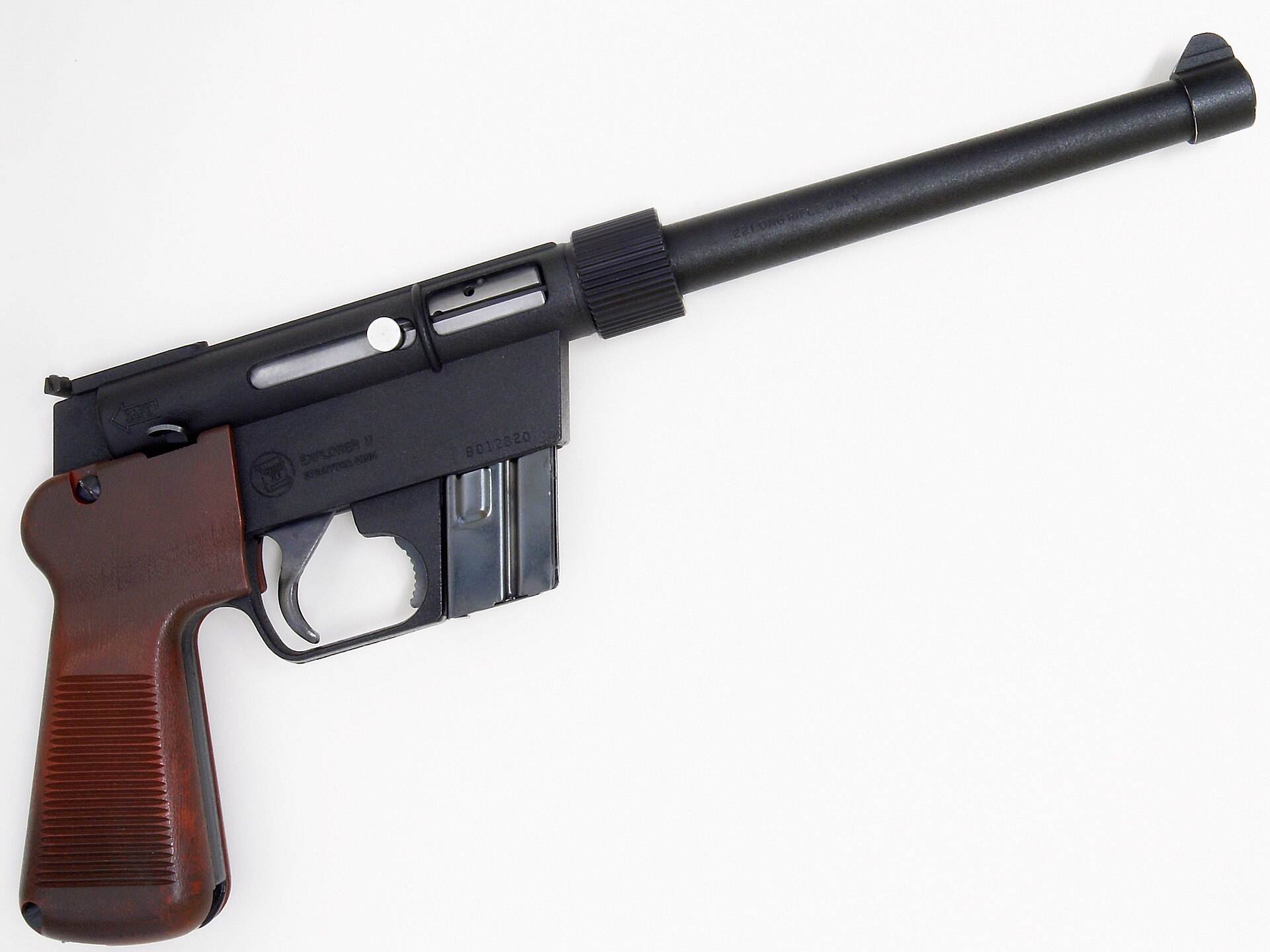
What separates the Whitney from all of them is the argument of Volume 4: in the Whitney, the look and the construction are the same decision. The Nylon 66 and the Neos are styled mouldings, and the Sentinel’s colour is a finish. The Whitney’s curves are what a precision-cast frame enclosing a fixed barrel looks like when an aircraft armament engineer draws it — and he said so in 1956.
References
Footnotes
-
Rock Island Auction Company, “Rise and Fall of the Whitney Wolverine” (first published 30 May 2014; updated with sales to December 2025), https://www.rockislandauction.com/riac-blog/rise-and-fall-of-the-whitney-wolverine , retrieved 2026-09-19. ↩ ↩2
-
Rock Island Auction Company lot pages, each at https://www.rockislandauction.com/detail/{auction}/{lot}/ with the auction and lot numbers given in the table; retrieved 2026-09-19 through the shared fetch engine. Hammer prices and estimates are from each page’s data; dates are the sale dates printed on each page. “Not sold / not shown” means the page’s hammer field was zero. ↩ ↩2
-
“Whitney Wolverine Range Report”, Nurse With a Gun blog, 10 January 2006, http://xavierthoughts.blogspot.com/2006/01/whitney-wolverine-range-report.html , retrieved 2026-09-19. ↩
-
Luke C., “The Rimfire Report: The Space Age Whitney Wolverine 22LR Pistol”, The Firearm Blog, 18 October 2021, https://www.thefirearmblog.com/blog/2021/10/18/whitney-wolverine/ , consulted 2026-09-19. ↩
-
Guy J. Sagi, “Whitney Wolverine: Hillberg’s Space-Age Rimfire Pistol”, American Rifleman, 31 August 2022, https://www.americanrifleman.org/content/whitney-wolverine-hillberg-s-space-age-rimfire-pistol/ , consulted 2026-09-19. ↩
-
Whitney and Galef period advertising, as reproduced in the RIA blog above. ↩
-
William B. Edwards, “The Oldest Name in Guns Comes Back”, Guns, August 1956, https://web.archive.org/web/20160304110716/http://www.gunsmagazine.com/1956issues/G0856.pdf , retrieved 2026-09-19. ↩
-
Internet Movie Firearms Database, queried through its MediaWiki interface (https://www.imfdb.org/api.php) on 2026-09-19: no page titled “Whitney Wolverine”; full-text matches only on “Vampire the Masquerade: Bloodhunt” and “NCIS: The Video Game”. ↩ ↩2 ↩3
-
Wookieepedia (https://starwars.fandom.com), queried through its MediaWiki interface on 2026-09-19 for “Whitney Wolverine” and “Hillberg”: no results. ↩
-
Internet Archive item
thingiverse-1286244, “Whitney Wolverine Rubber Band Gun (1286244)”, https://archive.org/details/thingiverse-1286244 , located 2026-09-19 (metadata only). ↩ -
Guns, March 1958, cover, https://web.archive.org/web/2016/http://www.gunsmagazine.com/1958issues/G0358.pdf , retrieved 2026-09-19. ↩
-
Firearms hub working note
docs/space-age-candidates.md(2026-09-19), which cites for these entries, among others: American Rifleman, “This Old Gun: Mauser HSc Pistol” (2017); Wikipedia, “Remington Nylon 66”; American Rifleman, “A Look Back at the ArmaLite AR-7 Explorer”; unblinkingeye.com on the High Standard Sentinel, citing Spacek; American Rifleman, “Beretta’s U22 Neos” (2023). Not independently re-checked here. ↩
Comments (0)