Whitney Wolverine · Volume 5
How It Works — A Fixed Barrel, a Sleeve, and a Magazine That Guides the Bullet
The full cycle of operation part by part, from the patent, the 1956 description and the maker's parts lists: why the recoil ends up squeezing the frame, how one spring does two jobs, and the disconnector the sleeve works
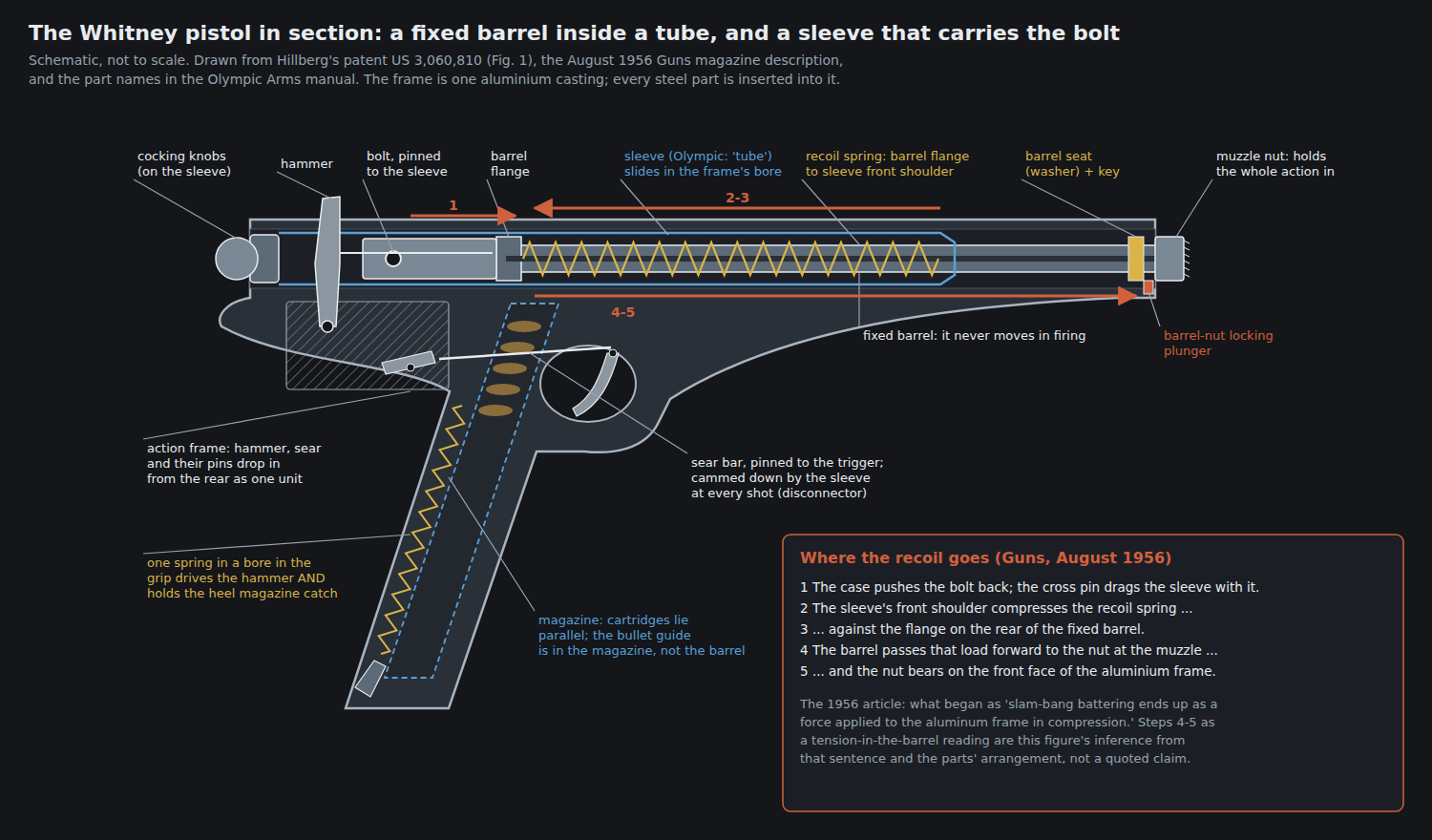
The Whitney’s mechanism is a straight blowback .22 like dozens of others, and it is also unlike any of them. It has no slide, and its barrel never moves. The breechblock is carried inside the frame by a sleeve that surrounds the barrel, and the recoil spring sits around the barrel, between a flange at the barrel’s rear and the front of the sleeve. Everything that moves, and the barrel, slides into the frame from the back as one assembly and is held by one nut at the muzzle. This volume follows a round through the pistol from the magazine to the ground and names every part that touches it.
5.1 The Sources for the Mechanism
No original Whitney instruction sheet or factory drawing was located (Volume 6). The description here rests on four sources, and each is used for what it can support:
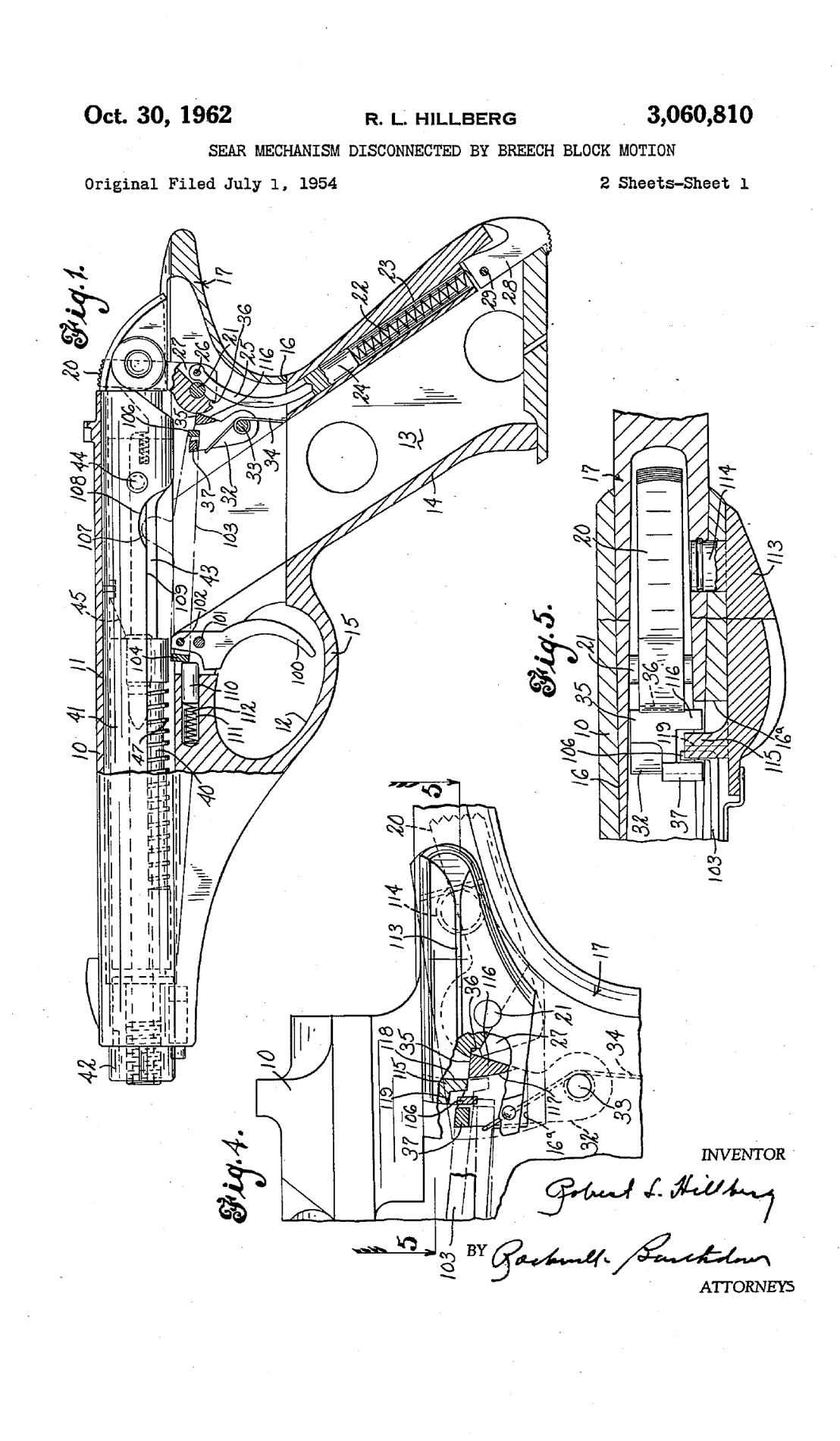
- Hillberg’s patent, US 3,060,810. Filed as part of an application of 1 July 1954, divided in 1959 and issued in 1962. It describes and claims the frame, the barrel-and-sleeve arrangement, the fire control, the disconnector and the safety, with reference numerals used below in brackets.1 A patent shows the design as filed, which may differ in detail from production; where production evidence exists it is preferred.
- William B. Edwards’s account in Guns, August 1956, written from production pistols, which gives the load path and the magazine design in the company’s own terms.2
- The exploded view and text page reproduced by Rock Island Auction (Volume 6), which shows an original pistol’s parts with part numbers.3
- The Olympic Arms owner’s manual (Rev 7/05) for the reissue, whose parts list names every part. Olympic warns that its schematic “will not accurately represent parts for original pistols”, so it is used for names and for the architecture both share, not for dimensions.4
The own-work section drawing below brings these together. It is a schematic, not a scale drawing.
5.2 The Parts, and What They Are Called
The same parts carry different names in each source. This table is the key to the rest of the volume.
Table 1 — The Parts, and What They Are Called
| Part | Patent | Olympic manual | Also called |
|---|---|---|---|
| Frame | frame [10] | Frame (JLM-016) | “monobloc” / “receiver” (1956) |
| Barrel | barrel [40] | Barrel (005) | — |
| Sleeve | sleeve [41] | Tube (009) | “moving slide”, “tubular slide” (1956); “carrier tube” (owners) |
| Bolt | bolt [43] | Breech Block (010) | breechblock |
| Cross pin | pin [44] | Breech Pin (014) | “breech block retaining pin” |
| Firing pin | striker [45] | Firing Pin (012), held by a Firing Pin Lock (015) | — |
| Recoil spring | spring [47] | Mainspring (032-1) | — |
| Barrel nut | nut [42] | Nut (008), with Barrel Locking Plunger (045) | “muzzle bushing”, “plunger-locked sleeve or bushing” (1956) |
| Barrel seat and key | — | Barrel Seat (006), Barrel Key (038), Barrel Index Pins (049) | “a separate internal washer and key” (exploded-view page) |
| Cocking knobs | — | Cocking Piece (027) | “serrated knobs” (RIA) |
| Fire-control unit | action frame / auxiliary frame [17] | Action Frame (017) | — |
| Hammer | hammer [20] | Hammer (018) | — |
| Hammer spring | spring [22] in bore [23] | Hammer Spring (032-3), Hammer Spring Plunger (029), Strut (028) | — |
| Sear | sear [32] | Sear (019) | — |
| Trigger | trigger [100] | Trigger (020) | — |
| Sear bar | sear bar [103] | Sear Bar (021) | trigger bar |
| Magazine catch | latch [28] | Magazine Catch (031) | heel catch |
| Safety lever | member [113] | Safety (050) | — |
| Magazine disconnect | not in the patent | Magazine Disconnect (043) | “magazine disconnector” (period ad) |
Olympic’s part numbers are not arbitrary. On the original pistol’s exploded view reproduced by RIA the same parts carry the same three-digit numbers — 004 the magazine, 005 the barrel, 006 the washer, 008 the nut, 009 the tube, 010 the breech block, 016 the frame, 017 the action frame, 027 the cocking piece, 031 the magazine catch — which shows the reissue kept the original factory numbering.34
5.3 The Architecture in One Paragraph
The frame is a single casting with a cylindrical bore along its top [11], a trigger opening, a magazine well in the grip, an integral trigger guard, and a rear-facing pocket [16] below the bore into which the fire-control unit is fitted.1 The barrel lies in the bore and does not move: its muzzle projects through the front of the frame and is held by a knurled nut, which a spring-loaded plunger in the frame face locks against turning; inside the frame a barrel seat (washer) and key position and align it.234 Around the barrel runs the sleeve, a tube “narrowed at the front end” that slides in the bore.2 Its rear portion carries the bolt, fastened by “a large pin” through both — “Crosswise through the bolt is a large pin, which fastens it to the tubular slide.”2 The recoil spring sits around the barrel “between slide construction and a flange around the rear of the barrel”. “All these parts assemble from the back inside the tubular-topped receiver.”2 The cocking knobs are fixed to the rear of the sleeve. The hammer, sear and their pins sit in a separate action frame that slides into the pocket below the bore and is held by the hammer and sear pivot pins.1
5.4 Loading and Cocking
The magazine is loaded with the help of a hole in its follower. The 1956 article describes the method the factory intended: the magazine “uses .22 cartridge stuck through magazine follower hole to depress it for easy loading”.2 There is no follower button. Olympic’s manual for the reissue supplies a loader tool that doubles as the takedown tool and says to load “one round at a time by inserting the round rim first”, easing the follower down with the tool as each round goes in.4
The loaded magazine goes into the grip from below and is held by the heel catch at the bottom rear of the grip. To remove it, in Olympic’s words, the shooter “releas[es] the lock on the bottom-rear of the grip, and pull[s] down on the magazine tab on the bottom-front”.4
To chamber a round, the shooter pulls the cocking knobs fully to the rear and lets go. Olympic is emphatic on the reissue: “Do not ease the cocking piece forward by hand, as it will not properly load a cartridge into the pistol chamber.”4 The knobs are on the sleeve, so pulling them draws the sleeve and bolt back together, compresses the recoil spring, and — as the bolt’s rear passes the hammer — cocks it. Released, the spring drives the sleeve and bolt forward; the bolt face picks up the top cartridge and pushes it into the chamber.
The 1956 article found this stroke unusually free: “On chambering the first shot the slick breech operation of the Whitney is so free from any resistance that I opened the bolt to see if it had picked up a cartridge. It had”.2
5.5 Firing
The trigger [100] pivots on a pin [101] in the main frame. Pinned to it at [102] is the sear bar [103], a strip of metal that runs back along the frame to the fire-control unit. At its rear end the bar has “a laterally turned lug [106] adapted to lie rearwardly of the lug [37]” on the sear. When the trigger is pulled, the bar moves forward and its lug drags the sear’s lug with it, swinging the sear off the hammer’s notch [36].1
The hammer [20] pivots in the action frame and is driven by a coil spring [22] in a bore in the grip, acting through a plunger [24] and a curved link [25] — the strut. Released, it swings forward and strikes the rear of the firing pin [45], which “is slidably mounted in the bolt and projects slightly from the rear end thereof so as to be engaged by the hammer”.1 The pin strikes the rim.
J. B. Wood, writing of the reissue, notes that “the firing pin is a full-reach type, so don’t carry the Wolverine with the chamber loaded and the hammer fully down” — a pin long enough to reach the rim whenever the hammer rests on it.5 The same architecture on the original is shown in the patent, and the same caution applies. Olympic’s manual recommends against keeping a round chambered at all when the pistol is not about to be fired.4
5.6 Recoil, and Where the Load Goes
A blowback .22 has no lock. The case pushes the bolt rearward, and the mass of the moving parts and the force of the spring keep the breech closed long enough for the pressure to fall. In the Whitney the moving mass is the bolt and the sleeve, pinned together, so the whole assembly — “the bolt 43 together with the sleeve 41 will be blown rearwardly”.1
The 1956 article singles out what happens to that energy, and it is the key to how an aluminium frame survives a steel action:
“Aluminum frame pistols like the Whitney have an inherent problem of battering. The harder steel parts slamming against the softer alloy will hammer and damage it. But the Whitney is a little different. … The stresses of firing are carried through the recoil spring to the barrel flange, up the flange to the muzzle bushing, and from the muzzle bushing to the entire frame structure. What started out as a slam-bang battering ends up as a force applied to the aluminum frame in compression.”2
Traced step by step, with the parts named:
- The case drives the bolt back; the cross pin carries the sleeve with it.
- The sleeve’s narrowed front end moves back toward the barrel’s rear flange, compressing the recoil spring between them.
- The spring pushes back on the flange — that is, on the barrel.
- The barrel is held at the front by the nut, which bears on the front face of the frame. The spring’s load therefore pulls the barrel rearward against the nut, and the nut presses on the frame’s nose.
- The frame takes the load at its front, spread over the face under the nut, instead of as an impact from a steel block at its rear.
Steps 4 and 5, read as “the barrel in tension, the frame nose in compression”, are this volume’s interpretation of the 1956 sentence together with the arrangement of the parts; the article itself says only that the force reaches “the entire frame structure … in compression”. The design intent is clear either way: the steel parts do not hammer the aluminium. The same article reports, as the company’s claim, that “the early Trimatic-Whitney fired 200 proof loads and 40,000 regular shots without any damage or significant wear.”2
The patent does not describe a buffer or a stop for the rearward travel, and none is named in the Olympic parts list; how the sleeve’s travel is limited in production was not found in any source.
5.7 Extraction, Ejection and Re-cocking
As the bolt moves back, the spring-loaded extractor in the bolt face — Olympic lists an extractor, extractor plunger and extractor spring — draws the empty case out of the chamber.4 The ejector is fixed to the barrel: Olympic’s manual says “it is recommended that the ejector be left attached to the barrel. If it must be removed, use caution not to bend it.”4 The case strikes it and is thrown out through the port in the top tube.
On the same stroke the rear of the bolt rides over the hammer and “rotate[s] the hammer in a clockwise direction about its pivot 21 so as to move it from the firing position … to the cocked position”.1 The sear re-engages the hammer notch — provided the disconnector has done its work.
5.8 The Disconnector
A semi-automatic needs a way to stop the trigger from releasing the hammer again until it has been let go. Hillberg’s solution uses the sleeve itself, and it is the invention the patent is named for: “Sear mechanism disconnected by breech block motion”.1
The sear bar carries a second lug [107], standing up from its middle. When the sleeve is forward, this lug sits in a recess [108] in the underside of the sleeve, which lets the bar ride high enough for its rear lug [106] to engage the sear. When the gun fires and the sleeve moves back, “the upper edge of the lug 107 will be engaged by the straight surface or longitudinal edge 109 of the sleeve and the rear end of the sear bar will be cammed downwardly”, out of engagement with the sear. The sear is then free to catch the hammer. And “the lug 106 of the cam bar 103 cannot return to the firing position because of its engagement with the lower surface of the sear lug 37. Consequently, the trigger has to be released before the gun can be re-fired.”1
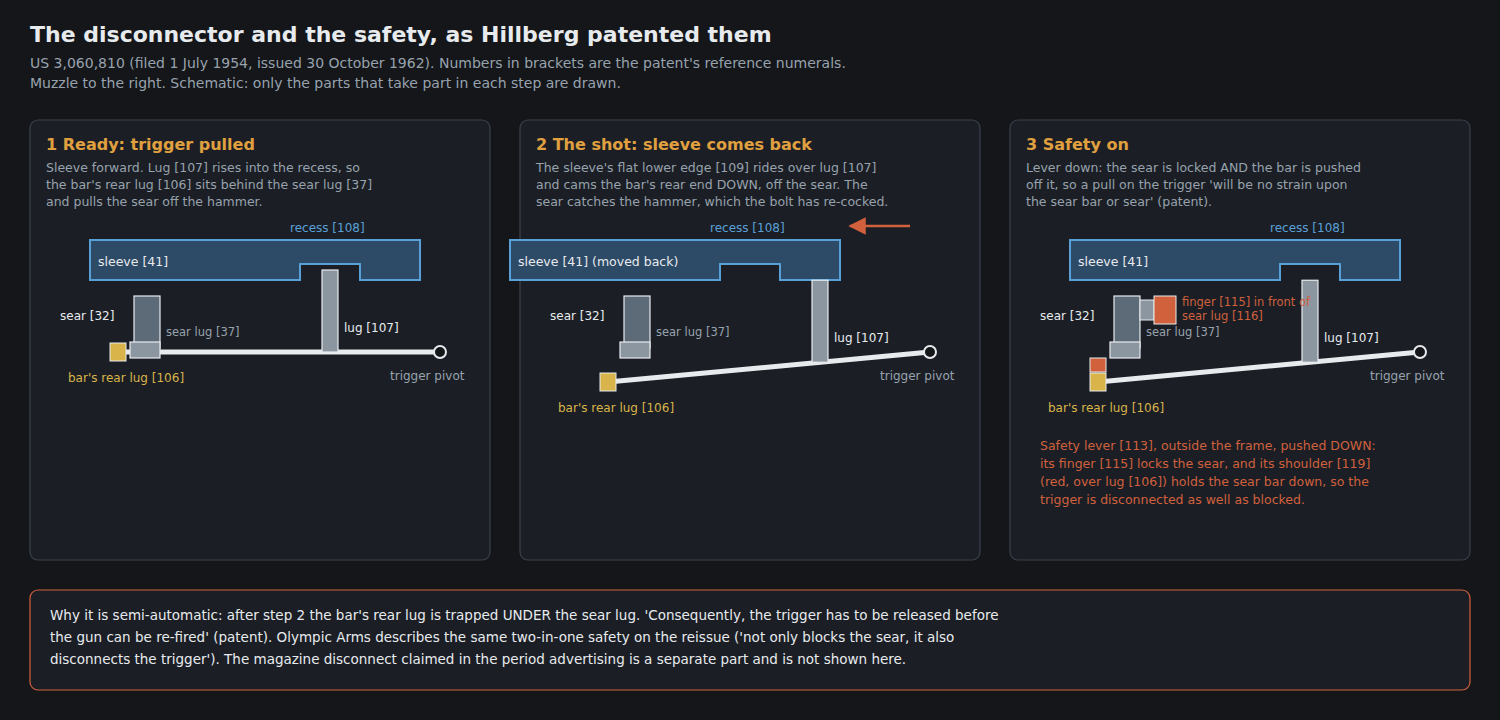
A plunger [110] and spring [112] in the frame press on the front of the sear bar, which both returns the trigger forward and lifts the bar’s rear end back up behind the sear lug once the trigger is released.1 It is a small number of parts doing a great deal, which is characteristic of the whole design.
5.9 Feeding: the Magazine Does the Barrel’s Job
The Guns writer thought the magazine the best thing about the pistol — “the best designed clip in a handgun today” — and the reasons are specific.2
The cartridges lie parallel. A .22 Long Rifle case has a rim larger than its body. Stacked in a straight magazine, each rim sits in front of or behind the one below, and if one rides in front of the rim beneath it — rim-lock — the top round cannot be stripped. The Whitney’s answer, in 1956: “The case bodies rest parallel, with the clip wider at the back than front and the rims staggered, making the feed as easy as with a rimless round.” The magazine is tapered in side view to match, and so is the well: “In the Whitney the side walls are tapered. This makes the clip very easy to insert without fumbling.”2
The bullet guide is in the magazine, not on the barrel. Most .22 automatics have a feed ramp at the rear of the barrel or frame that lifts the bullet’s nose into the chamber, and the soft lead nose of a .22 is easily deformed on it. The Whitney has none: “There is no bullet guide ramp, source of much .22 difficulty, on the barrel. Instead, the barrel is faced off and the bullet guide is built into the clip.”2 The magazine therefore guides each round directly into line with the chamber. It is a design that makes the magazine critical: a bent or damaged magazine lip is a damaged feed ramp.
It comes apart. “Unlike most other .22’s, the Whitney clip can easily be disassembled for cleaning.”2 Olympic’s parts list for the reissue names a magazine shell, bottom, follower, bottom lock and insert.4
The 1956 claim that “since 1908 designers have tried to solve the problem of a rimmed case in an automatic; the new Whitney is the solution” is the company’s.2 Owners’ experience, in Volume 6, is that the Whitney is still sensitive to ammunition.
5.10 The Safeties
The manual safety is a lever on the left rear of the frame, below the cocking knobs, and it works the opposite way to most: down is safe. The 1956 caption: “Thumb safety is fast, snaps off by thumb pressure upwards.” The exploded-view page: “The mechanical safety on the Whitney is engaged by pushing it down, not up. This is contrary to the usual practice with semi-automatic pistols.”23
What it does is described in the patent. The lever [113] carries a finger [115] that passes into the frame. Pushed down, the finger moves in front of a locking lug [116] on the sear, “so as to lock the sear against forward movement”, and “at the same time a shoulder [119] on the finger [115] will engage the lug [106] of the sear bar [103] and move the sear bar downwardly so that it will no longer be in position to exert a pull upon the sear. Thus when the safety is ‘on’ and the trigger is pulled, there will be no strain upon the sear bar or sear”.1 It blocks the sear and disconnects the trigger in one movement. Olympic’s manual describes the reissue’s safety in the same terms — “When engaged, the safety not only blocks the sear, it also disconnects the trigger from the firing mechanism” — and adds that it “can only be engaged with the hammer fully cocked”.4 Whether that last restriction applied to the original is not stated in a source for the original.
The magazine disconnect. The period advertising claims it outright: “The Wolverine is the only .22 Pistol that cannot be fired with the magazine removed”, and a later advertisement, “With a visible hammer and magazine disconnector, it is doubly safe.”6 The patent does not show one — it was filed in 1954, before production — but the original’s exploded view carries a part numbered 043, which in Olympic’s list of the same numbering is the “Magazine Disconnect”.34 Owners of originals confirm it from experience: one who reassembled an original could not make the hammer fall “until I inserted the magazine”.7 With the magazine out, the pistol will not fire even with a round in the chamber — which is also why an owner who has just reassembled one and cannot make it fire should insert a magazine before concluding something is broken.
The visible hammer was sold as a safety feature too: a hammer standing in the frame shows whether the pistol is cocked. One collector notes that with the hammer down it intrudes on the sight picture, giving a visual signal that the pistol is not ready to fire.8
5.11 One Spring, Two Jobs
A detail of the patent that is easy to miss shows Hillberg’s economy. The hammer spring [22] sits in a bore [23] in the grip, pushing up on the hammer through the plunger and strut. Its lower end bears on the magazine catch [28] at the heel: “At its lower end the spring … reacts against a catch or latch member 28 pivoted at 29 to the handle and ordinarily maintains this latch in a position to hold the magazine”.1 One coil spring powers the hammer and holds the magazine in.
The collector who took one apart counted the screws: “There are only three screws used on the gun, two for the grips and one for the sideplate. Most parts are held in by other parts, kind of like the Mauser broomhandle.”8 The comparison is apt. Like the C96, the Whitney is a puzzle of interlocking parts in which each holds the next — elegant in manufacture, and demanding at the bench (Volume 6). The hub’s Mauser C96 dive is the classic example of that school.
5.12 Sights and Trigger
Sights. The front sight is a fixed blade on the frame’s matted top rib. The rear, on the original, is “a thin piece of sheet metal, adjustable for windage zeroing only, and sprung in a curve into two cuts across the top of the frame. The sight base is heavy enough to be milled for a target sight.”2 Because both sights sit on the frame, and the barrel is fixed to the frame, the sight line and the bore never move relative to one another — the source of the 1956 claim of “an advantage in accuracy over some other designs”.2 The reissue replaced the sprung leaf with a dovetailed rear sight (Volume 7).
Trigger. The 1956 article: “The grooved trigger has some slack but let-off is very good for a ‘sport’ pistol. It is adjusted at the factory between 2½ and 4 pounds. Three sample guns handled had good trigger pulls, crisp and regular.”2 Reviewers of the reissue measured 3 lb 6 oz (American Rifleman, 2014) and 3 lb 15 oz (Wood, 2013) — within the original factory range.95
5.13 What It Does Not Have
- No slide and no moving barrel. Everything that moves is inside the frame.
- No last-round hold-open. Noted by an owner; the bolt closes on an empty chamber.8
- No feed ramp. The magazine carries the bullet guide.
- No external slide stop or takedown lever. The action comes out of the back after the nut comes off the front (Volume 6).
- No adjustable sights on the standard pistol; the target prototype had them (Volume 3).
References
Footnotes
-
R. L. Hillberg, US Patent 3,060,810, “Sear Mechanism Disconnected by Breech Block Motion”, original application filed 1 July 1954 (Ser. No. 440,601, abandoned), this application filed 22 June 1959, issued 30 October 1962, assigned to Charles E. Lowe Sr., https://patentimages.storage.googleapis.com/pdfs/US3060810.pdf , retrieved 2026-09-19. Bracketed numbers in this volume are the patent’s reference numerals. ↩ ↩2 ↩3 ↩4 ↩5 ↩6 ↩7 ↩8 ↩9 ↩10 ↩11 ↩12
-
William B. Edwards, “The Oldest Name in Guns Comes Back”, Guns, August 1956, pp. 24–27, 66–69, https://web.archive.org/web/20160304110716/http://www.gunsmagazine.com/1956issues/G0856.pdf , retrieved 2026-09-19. ↩ ↩2 ↩3 ↩4 ↩5 ↩6 ↩7 ↩8 ↩9 ↩10 ↩11 ↩12 ↩13 ↩14 ↩15 ↩16 ↩17 ↩18
-
Exploded view and takedown text page for the original Whitney pistol, as reproduced by Rock Island Auction, “Rise and Fall of the Whitney Wolverine”, https://www.rockislandauction.com/riac-blog/rise-and-fall-of-the-whitney-wolverine ; read from the image 2026-09-19. The original publication is not identified by RIA. ↩ ↩2 ↩3 ↩4 ↩5
-
Olympic Arms, Whitney Wolverine Owner’s Manual, Rev 7/05, parts list and sections “Loading”, “Safety”, “Disassembly”, “General Notes”, https://web.archive.org/web/2016/https://www.vintagegunleather.com/gun-manuals/pdf_O/olympic_whitney_wolverine.pdf , retrieved 2026-09-19. ↩ ↩2 ↩3 ↩4 ↩5 ↩6 ↩7 ↩8 ↩9 ↩10 ↩11 ↩12
-
J. B. Wood, “Writer gets his Whitney Wolverine after long wait for unusual .22”, TheGunMag, 29 July 2013, https://web.archive.org/web/20160407182905/http://www.thegunmag.com/writer-gets-his-whitney-wolverine-after-long-wait-for-unusual-22/ , retrieved 2026-09-19. ↩ ↩2
-
Galef and Whitney period advertising, as reproduced in the RIA blog above; read from the images 2026-09-19. ↩
-
“Whitney Wolverine Range Report”, Nurse With a Gun blog, 10 January 2006, http://xavierthoughts.blogspot.com/2006/01/whitney-wolverine-range-report.html , retrieved 2026-09-19. Owner testimony. ↩
-
“Ahead of its time: The Whitney Wolverine pistol”, Smith & Wesson Forum, archived 7 April 2015, https://web.archive.org/web/20150407043719/http://smith-wessonforum.com/lounge/210508-ahead-its-time-whitney-wolverine-pistol-pics-box-now-included.html . Owner testimony. ↩ ↩2 ↩3
-
B. Gil Horman, “Olympic Arms Whitney Wolverine .22 LR Pistol”, American Rifleman, 20 June 2014, https://www.americanrifleman.org/content/olympic-arms-whitney-wolverine-22-lr-pistol/ , consulted 2026-09-19. ↩
Comments (0)