Whitney Wolverine · Volume 7
The Olympic Arms Reissue — Polymer, 2004 to 2017
Robert Schuetz's revival: what Schuetzen Gun Works, Olympic Arms and Schuetzen Pistol Works were, what changed from the original and why, how the two are told apart, and why it ended
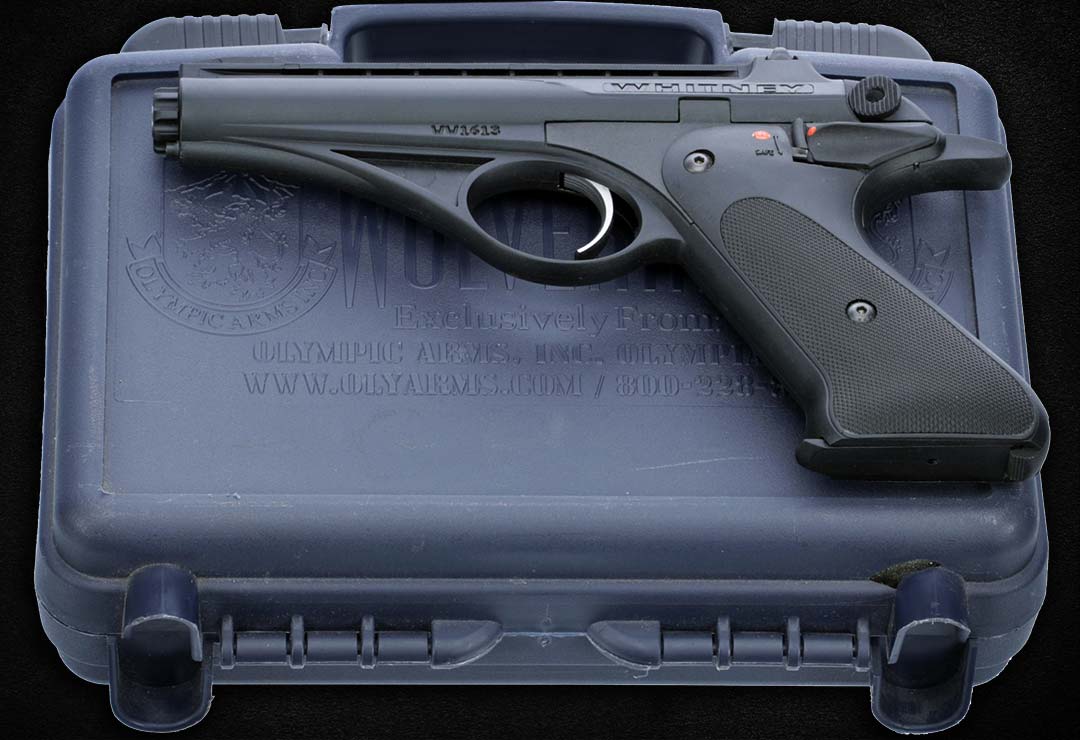
Fifty years after Whitney Firearms stopped making the pistol, a barrel maker in Washington state put it back into production. The Olympic Arms Whitney Wolverine kept the original’s silhouette, its architecture and even its part numbers, and replaced the cast aluminium frame with a moulded polymer shell. It was sold from the mid-2000s until Olympic Arms closed. It is the version most people who have fired a Wolverine have fired, and it is the reason the original is now so often misidentified in photographs.
7.1 The Reissue in One Table
Table 1 — The Reissue in One Table
| Maker | Olympic Arms, Inc., 624 Old Pacific Hwy SE, Olympia, Washington (manual) |
| Introduced | 2004 (American Rifleman, 2014 and 2022; a 2006 owner); 2005 (Olympic’s own manual; J. B. Wood); 2002 (Wikipedia) — see below |
| Ended | Closure announced January 2017; “Disc. 2018” (Blue Book); company sold remaining products to late 2020 (Blue Book) |
| Frame | One-piece polymer shell, with the fire-control parts in an internal “action frame” |
| Colours | Matte black; pink (bright pink from late 2010); desert tan and coyote brown (from 2011) (Blue Book) |
| Weight | 19.2 oz (American Rifleman 2014; Blue Book); 23 oz (Wood, 2013) |
| Dimensions | Length 9 in; height 5.5 in; width 1.1 in; barrel 4.625 in (American Rifleman, 2014) |
| Sights | Fixed blade front; dovetailed, drift-adjustable square-notch rear; cross-grooved rib with vents |
| Magazine | 10 rounds, blued steel, heel catch |
| Trigger | 3 lb 6 oz (American Rifleman); 3 lb 15 oz (Wood) |
| MSRP | $279.50 (reported 2006); $294 (American Rifleman, 2014 and 2022) |
| Marking | ”Olympic Arms” on the frame side (Blue Book) |
Sources in the text below.123456
7.2 Olympic Arms, Schuetzen Gun Works and Schuetzen Pistol Works
The maker’s history is best documented by the Blue Book of Gun Values, whose manufacturer note reads:
“Olympic Arms, Inc. was founded by Robert C. Schuetz, and began as Schuetzen Gun Works (SGW) in 1956, manufacturing barrels in Colorado Springs, CO. Prior to that, Mr. Schuetz had been partnered in business with well-known gunsmith, P.O. Ackley. In 1975, the company moved to Olympia, WA. While its business in rifle barrels and barrel blanks thrived, it also began manufacturing complete custom bolt action rifles. In 1982, Schuetzen Gun Works began to manufacture AR-15/M16 rifles and components under the trade name of Olympic Arms, Inc., while custom bolt action rifles continued to be produced under the SGW brand. In late 1987, Olympic Arms, Inc. acquired Safari Arms of Phoenix, AZ. As of Jan. 2004, the Safari Arms product name was discontinued and all 1911 style products were manufactured in the Olympic Arms facility in Olympia, WA. Schuetzen Pistol Works was the in-house custom shop of Olympic Arms.”5
Three names are therefore in play, and they should not be confused:
- Schuetzen Gun Works (SGW) — the original barrel business, from 1956 — the year the Whitney went into production in Connecticut — and later the brand for Olympic’s bolt-action rifles.
- Olympic Arms, Inc. — the trade name from 1982, best known for AR-15s, and the name on the Wolverine reissue.
- Schuetzen Pistol Works (SPW) — in the Blue Book’s words, “the in-house custom shop of Olympic Arms”. Other summaries treat it as another name for the Safari Arms pistol line that Olympic acquired in 1987; the difference could not be resolved from a primary source. Rock Island Auction has sold pistols catalogued as “Olympic Arms/Schuetzen Pistol Works”, which shows the name was used on Olympic’s pistols.7
Was the Wolverine a Schuetzen Pistol Works product? No source located says so. The Blue Book describes the reissue as “marked ‘Olympic Arms’ on side of frame”; Olympic’s own manual is titled “Olympic Arms Whitney Wolverine” throughout; and American Rifleman’s review is headed “Olympic Arms Whitney Wolverine”.531 On the evidence, the reissue was an Olympic Arms pistol. If some were built or marked by the pistol shop, that is not documented in anything seen here, and it should not be assumed from the company’s structure.
Robert Schuetz is the person behind the revival. Olympic’s manual: “In the late 1990’s Robert Schuetz, owner of Olympic Arms Inc, began plans to bring the Whitney Wolverine pistol back.”3 An earlier start is given in Wikipedia’s article on Hillberg, citing American Rifleman: “In the late 1980s, Hillberg and Robert Schuetz … worked together to bring the Whitney Wolverine back to the market”, and Hillberg “received one of the first production models”.8 Those two dates may describe a long gestation rather than a contradiction. That Hillberg lived to see the reissue is not in doubt: he died in 2012.
7.3 From an Aluminium Casting to a Polymer Shell
J. B. Wood, who had wanted a Whitney since 1955, recorded a detail that shows the revival was first conceived in the original material:
“At a SHOT Show in the late 1990s, he showed me an aluminum frame casting, and told me he was going to bring it back. Some things delayed this. There were other important projects, and there was a damaging fire at the factory out in Washington state. However, in 2005, the Wolverine returned.”4
and on the change of material: “Actually, it’s not alloy this time. Schuetz decided, wisely, to go with high-tech polymer. In many ways, it’s really better than light metal.”4 Olympic’s own manual gives the delays as “several years of development, setbacks and natural disasters”.3 The fire, the disasters and the date of the switch from aluminium to polymer are not further documented in the sources located. Where the aluminium casting Schuetz showed came from — a new casting, or original stock — is not recorded either (Volume 2 covers the claims about original tooling).
7.4 When Did It Appear? Three Dates
Table 2 — When Did It Appear? Three Dates
| Date | Source |
|---|---|
| 2002 | Wikipedia (“began production in 2002”), unsourced for that date9 |
| 2004 | American Rifleman, B. Gil Horman (2014) and Guy J. Sagi (2022); a 2006 owner’s account (“entered production in 2004. It is priced at $279.50”)126 |
| 2005 | Olympic Arms’ own manual (“the Whitney arrived in 2005”); J. B. Wood (2013)34 |
The maker’s own manual says 2005, and it is dated July 2005. The 2004 date is the one given by the NRA’s journal twice, and by a buyer writing in January 2006 about a pistol already on sale. The likeliest reading is announcement or first deliveries in 2004 and general availability in 2005, but no source says that, and the two dates are given here as each source gives them. The 2002 date has no support.
7.5 What Changed
Olympic’s manual describes the reissue as “very much like the original” and names the changes: “Today we use a polymer frame rather than the aluminum alloy. Other minor enhancements include a ventilated rib and safety mechanisms.”3 Wood adds: “During the preliminary design set-up, some of the internal parts were slightly altered, to make them stronger. On the outside, though, it’s all just like the original.”4 In detail:
- Frame. “Its single-piece polymer frame, or shell … makes up almost the entire exterior surface of the pistol, including the vented rib and front sight” (American Rifleman).1 Olympic’s parts list adds an internal action frame and a side plate, which carry the fire-control parts inside the shell.3
- Rib. A cross-grooved top rib with “nine cross-vents” under it: “Unnecessary, but they look cool” (Wood).4 The original’s rib is matted and solid.
- Rear sight. A dovetailed rear sight, drift-adjustable for windage, in place of the original’s thin spring leaf sprung into two cuts in the frame.1410
- Safety. Retained in the original sense — down for safe, blocking the sear and disconnecting the trigger — and described by Olympic as engageable only with the hammer fully cocked.3 The magazine disconnect is retained: “There is, alas, a magazine-disconnect safety” (Wood).4 Olympic’s “safety mechanisms” enhancement is not specified further.
- Weight. 19.2 oz in the American Rifleman review and the Blue Book, against the original’s 23 oz.15 Wood gives the reissue’s unloaded weight as 23 oz; that conflicts with the other two sources, and may be a carried-over original figure.4
- Magazine. Blued steel with a heel catch, marked at 5 and 10 rounds on both sides, with the follower hole that takes an empty case as a loading aid.14
- Colour. The original was black-grey or bright. The reissue was moulded black at first, and later pink, desert tan and coyote brown.5
- Accessories. Olympic offered cocobolo grips, a ballistic-nylon holster, a hard case “with the Wolverine icon molded to the lid” and, “for those legally enabled, a full length silencer made from titanium”. It planned “interchangeable barrel assemblies for .17MK2” — the .17 Mach 2 — “limited edition color theme frames and sight mounts”.3 Whether the .17 Mach 2 barrels or the sight mounts were ever sold could not be confirmed. A suppressor is regulated under the National Firearms Act; the hub’s Suppressor Law dive covers the process and the 2026 change in the tax.
What did not change: the silhouette, the fixed barrel held by a nut at the muzzle, the tube assembly that slides out of the back, the part numbering, the takedown, and the calibre.
7.6 Why Polymer Suits This Design
The 1956 design made the frame a housing, not a stressed slide or a locking structure (Volume 5). American Handgunner, reviewing the reissue, put the consequence plainly:
“The design of the original Wolverine makes it ideally suited to the use of polymers. The Wolverine frame is simply a housing for the operating components and is not subject to heavy impacts or stresses. Molded in one piece of high-strength polymer, the Wolverine frame houses the steel barrel and bolt in an upper tube, while the grip portion houses the magazine and lock work.”11
The same review makes the economic point that echoes 1956: “although equipment to make polymer frames is expensive, actual production cost per unit is low.”11 The Bellmore-Johnson booklet had made the identical argument for aluminium casting (Volume 4). Moulding is to the 2000s what precision casting was to the 1950s — an expensive tool that makes compound curves free on every part after the first. The reissue changed the material and kept the logic.
It is worth noting what the Handgunner sentence implies about the original. If the frame “is not subject to heavy impacts or stresses”, the credit belongs to Hillberg’s arrangement of the recoil load through the barrel flange and the muzzle nut, which the 1956 article described as its reason for existing.
7.7 How It Shot
- American Rifleman, 2014. At 15 yards the best five-shot group average was 1.71 in, with CCI Mini-Mag; the trigger broke cleanly at 3 lb 6 oz. It cycled reliably with Federal, CCI and Remington ammunition and jammed repeatedly with Winchester.1 The review’s summary, as quoted by Wikipedia: “This polymer revival of R. Hillberg’s 1950s rimfire ‘ray gun’ is sleek, light and fun to shoot.”8
- J. B. Wood, 2013. About 100 rounds of CCI Mini-Mag without a malfunction; trigger 3 lb 15 oz with “a tiny bit of take-up, a clean break, and some overtravel”; “an amazing 1.5-inch well-centered group” at 25 yards from a casual rest when new, a 2.5-inch average later. He warned that standard-velocity loads “may not fully cycle the bolt”.4
- Olympic’s own recommendation: high-velocity .22 LR, not economy ammunition, and not steel cases (Volume 6).3
7.8 Reliability, and the Revised Parts
The reissue’s reputation was uneven, and the evidence is owner testimony rather than a maker’s statement. Reader comments on a 2006 owner’s blog record:
- a buyer in 2005 whose original magazine worked but whose three extra magazines “all repeatedly jam”, and whose replacements from the factory also jammed;
- another owner whose new pistol “will not feed, chamber nor fire a round of ammunition” and who called the maker’s satisfaction guarantee “equally worthless”;
- and a later owner reporting that “Olympic Arms has updated a number of parts to solve feeding issues, including a different bolt, barrel, and magazine design”, that the factory’s Whitney shop would replace them free of charge with test firing, and that “the new magazines/hard parts updates are not interchangeable with the old Oly Arms magazines”.6
None of that is confirmed by an Olympic document located, and none of the posters can be identified. Taken together, the comments describe a pistol whose early production had feeding problems centred on the magazine, and a maker that revised the bolt, barrel and magazine to fix them. That fits the design: the Whitney’s bullet guide is in the magazine (Volume 5), so a magazine that is slightly wrong is a feed ramp that is wrong. It also means that there are at least two generations of Olympic magazine, and, by the one report, they do not interchange.
7.9 Parts Between the Two
Owners of originals naturally ask whether reissue parts will fit, and the honest answer is that no source says.
- Olympic’s manual: “The design of the current Whitney Wolverine is slightly altered from the original Whitney Wolverine. The parts schematic on the facing page will not accurately represent parts for original pistols.” And, separately, “Many of the parts from the original Whitney Wolverine are available through Olympic Arms” — that is, original parts for original pistols, not reissue parts.3
- The part numbering is the same in the original’s exploded view and in Olympic’s list (Volume 5). The same number for a part is not evidence that the parts are interchangeable, particularly as Wood reports internal parts were “slightly altered, to make them stronger”.4
- Frames cannot interchange in any useful sense: one is aluminium carrying the fire control directly, the other a polymer shell with an internal action frame.
- Magazines between original and reissue: not documented. Between early and late Olympic magazines: not interchangeable, per one owner (above).
Volume 6 sets out what this means for keeping an original running.
7.10 Telling Them Apart
In photographs the two are near-identical, because the reissue copies the original’s silhouette. That is why this volume’s identification chart leads with features that do not depend on lighting or finish.
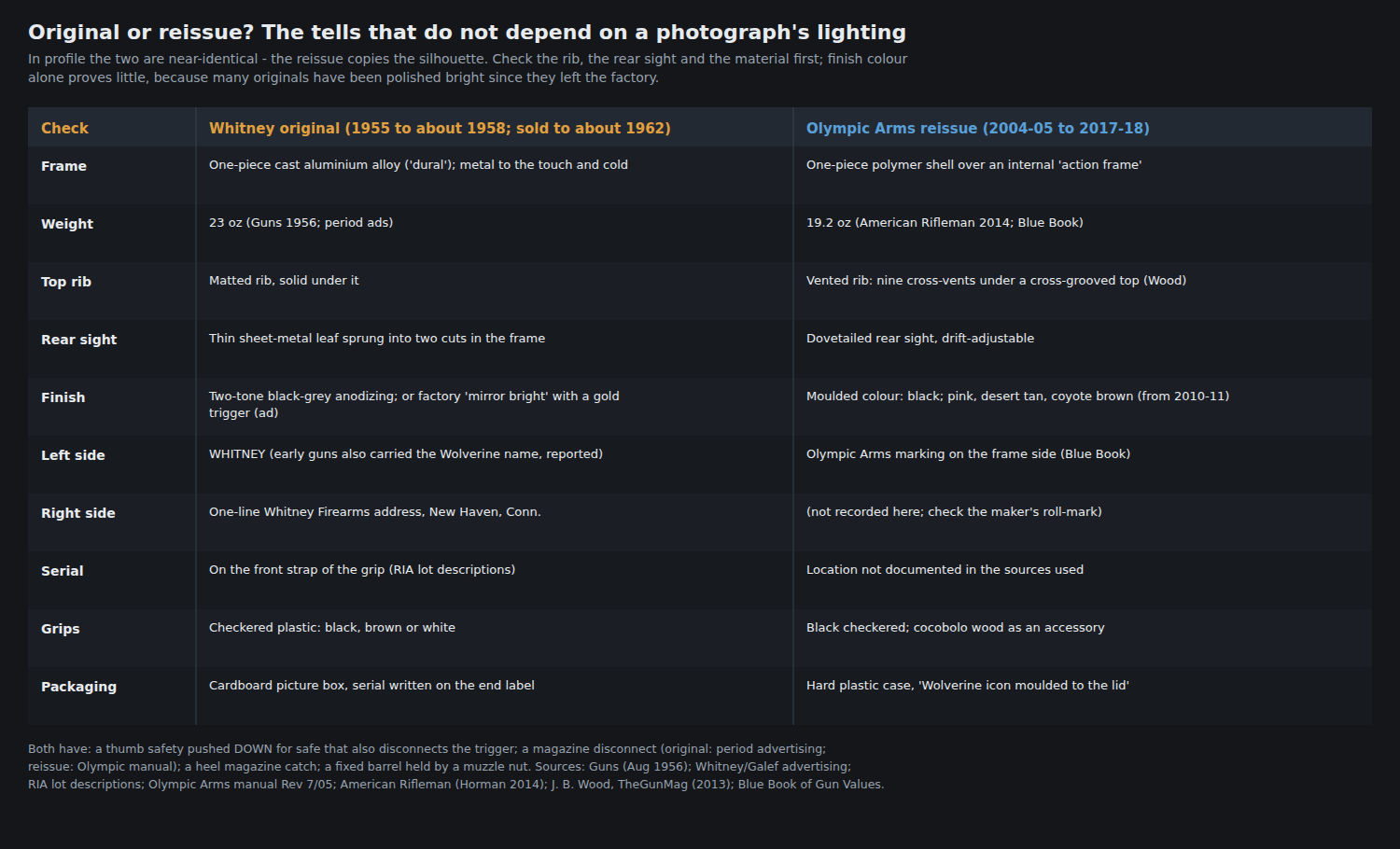
In order of reliability:
- The rib. Vents under the rib mean a reissue. The original’s rib is solid.
- The rear sight. A dovetailed sight means a reissue; a thin spring leaf in two cuts, an original.
- The material. Polymer against aluminium: the reissue shell is non-metallic and lighter (19.2 oz against 23, by the majority of sources).
- The marking. “Olympic Arms” on the frame side (Blue Book) against “WHITNEY” and a Whitney Firearms address.
- Colour. Pink, tan or coyote brown is always a reissue. Black can be either, and a bright pistol is an original, factory or refinished (Volume 3).
These tests work on a photograph at normal resolution, which is how most misidentifications happen: listings and articles that use a reissue picture to illustrate the 1956 pistol.
7.11 Why It Ended
The reissue ended with its maker. Olympic Arms announced in January 2017 that it was going out of business (Guns.com, as cited by Wikipedia); the Blue Book records that the company “remained open and was selling most of the semi-auto SKU’s that it did prior to 2017 until late 2020”, and gives the Wolverine as “Disc. 2018”.95 American Rifleman in 2022 says it was discontinued in 2017 and the company closed in 2020.2 The reasons for Olympic’s closure are not examined in the sources used here and are not speculated on. Nothing located suggests the Wolverine was ended for its own sake; it went with the company.
Value. Sources disagree widely, and none is a record of sales:
Table 3 — Value. Sources disagree widely, and none is a record of sales
| Figure | Source |
|---|---|
| $500 hammer, estimate $200–300, with case | Rock Island Auction, auction 2028 lot 764, 8 January 202012 |
| ”used Olympic Arms models commanding over $1,000” | American Rifleman, 20222 |
| $105–295 value range | Blue Book of Gun Values page, read September 2026; methodology and date not stated5 |
The one documented sale located is $500 before the buyer’s premium in January 2020. Volume 8 compares that with the originals.
References
Footnotes
-
B. Gil Horman, “Olympic Arms Whitney Wolverine .22 LR Pistol”, American Rifleman, 20 June 2014, https://www.americanrifleman.org/content/olympic-arms-whitney-wolverine-22-lr-pistol/ , consulted 2026-09-19. ↩ ↩2 ↩3 ↩4 ↩5 ↩6 ↩7 ↩8
-
Guy J. Sagi, “Whitney Wolverine: Hillberg’s Space-Age Rimfire Pistol”, American Rifleman, 31 August 2022, https://www.americanrifleman.org/content/whitney-wolverine-hillberg-s-space-age-rimfire-pistol/ , consulted 2026-09-19. ↩ ↩2 ↩3 ↩4
-
Olympic Arms, Whitney Wolverine Owner’s Manual, Rev 7/05, https://web.archive.org/web/2016/https://www.vintagegunleather.com/gun-manuals/pdf_O/olympic_whitney_wolverine.pdf , retrieved 2026-09-19. ↩ ↩2 ↩3 ↩4 ↩5 ↩6 ↩7 ↩8 ↩9 ↩10 ↩11
-
J. B. Wood, “Writer gets his Whitney Wolverine after long wait for unusual .22”, TheGunMag, 29 July 2013, https://web.archive.org/web/20160407182905/http://www.thegunmag.com/writer-gets-his-whitney-wolverine-after-long-wait-for-unusual-22/ , retrieved 2026-09-19. ↩ ↩2 ↩3 ↩4 ↩5 ↩6 ↩7 ↩8 ↩9 ↩10 ↩11 ↩12
-
Blue Book of Gun Values, “Olympic Arms Whitney Wolverine”, with manufacturer note on Olympic Arms, https://bluebookofgunvalues.com/products/olympic-arms-whitney-wolverine , read 2026-09-19. ↩ ↩2 ↩3 ↩4 ↩5 ↩6 ↩7
-
“Whitney Wolverine Range Report”, Nurse With a Gun blog, 10 January 2006, and reader comments, http://xavierthoughts.blogspot.com/2006/01/whitney-wolverine-range-report.html , retrieved 2026-09-19. Owner testimony; anonymous comments are not confirmed. ↩ ↩2 ↩3
-
Rock Island Auction Company, auction 2054, lot 404, “Olympic Arms/Schuetzen Pistol Works Westerner Pistol”, https://www.rockislandauction.com/detail/2054/404/olympic-armsschuetzen-pistol-works-westerner-pistol (title only; the page was not read). ↩
-
Wikipedia, “Robert Hillberg”, consulted 2026-09-19, citing Horman (2014). ↩ ↩2
-
Wikipedia, “Whitney Wolverine”, consulted 2026-09-19, citing Chris Eger, “Longtime AR Maker Olympic Arms Going Out of Business”, Guns.com, 26 January 2017 (not read directly). ↩ ↩2
-
William B. Edwards, “The Oldest Name in Guns Comes Back”, Guns, August 1956, https://web.archive.org/web/20160304110716/http://www.gunsmagazine.com/1956issues/G0856.pdf . ↩
-
“Whitney Wolverine .22”, American Handgunner, https://americanhandgunner.com/better-shooting-our-experts/whitney-wolverine-22/ , consulted 2026-09-19 (author and date not captured). ↩ ↩2
-
Rock Island Auction Company, auction 2028, lot 764, “Olympic Arms Whitney Wolverine Semiautomatic Pistol with Case”, 8 January 2020, https://www.rockislandauction.com/detail/2028/764/olympic-arms-whitney-wolverine-semiautomatic-pistol-with-case , retrieved 2026-09-19. Hammer price from the page’s data. ↩
Comments (0)