Whitney Wolverine · Volume 3
Serial Numbers, Markings, Finishes and the Rare Ones
The presentation series, the five-digit production numbers and what they can and cannot prove, the factory bright finish against the professional polish, and the target pistol that never shipped
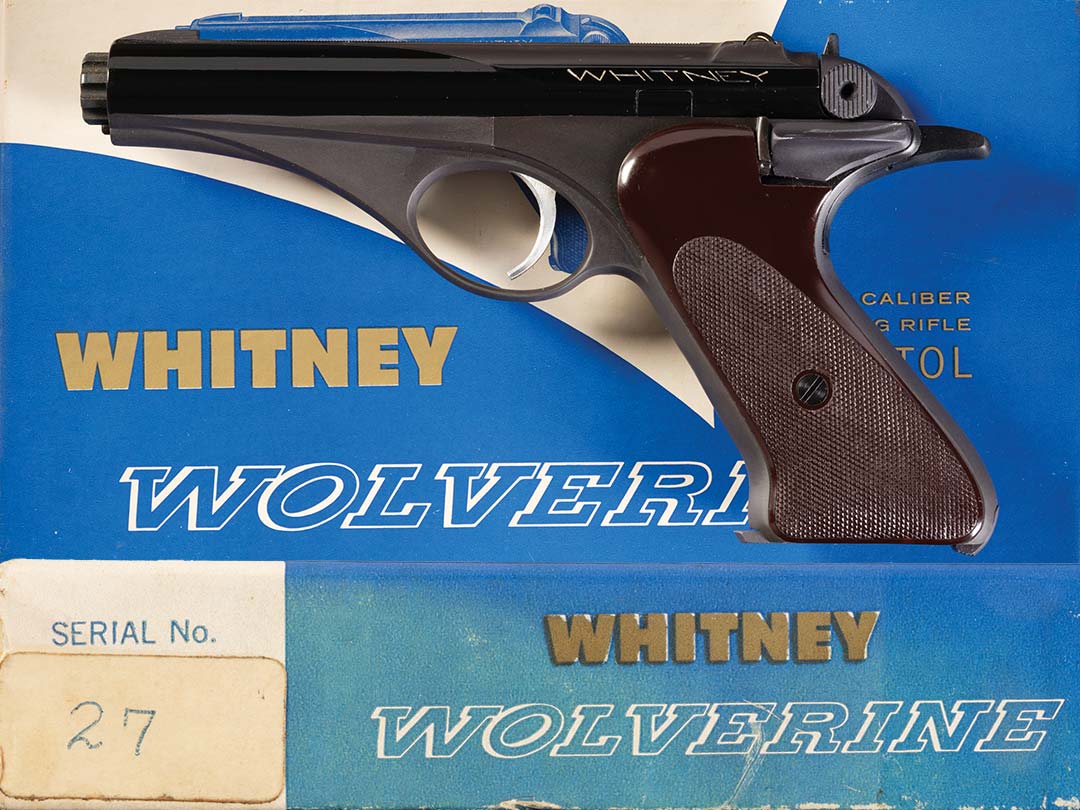
A Whitney pistol carries very little writing. There is a maker’s name on one side, an address on the other and a serial number on the front strap. There are no proof marks to read, no inspector’s stamps, no date code. The questions collectors ask of one — which company made it, when, in which finish, and whether the finish is original — therefore have to be answered from a few markings, from boxes that were often replaced, and from a serial listing that exists in one book.
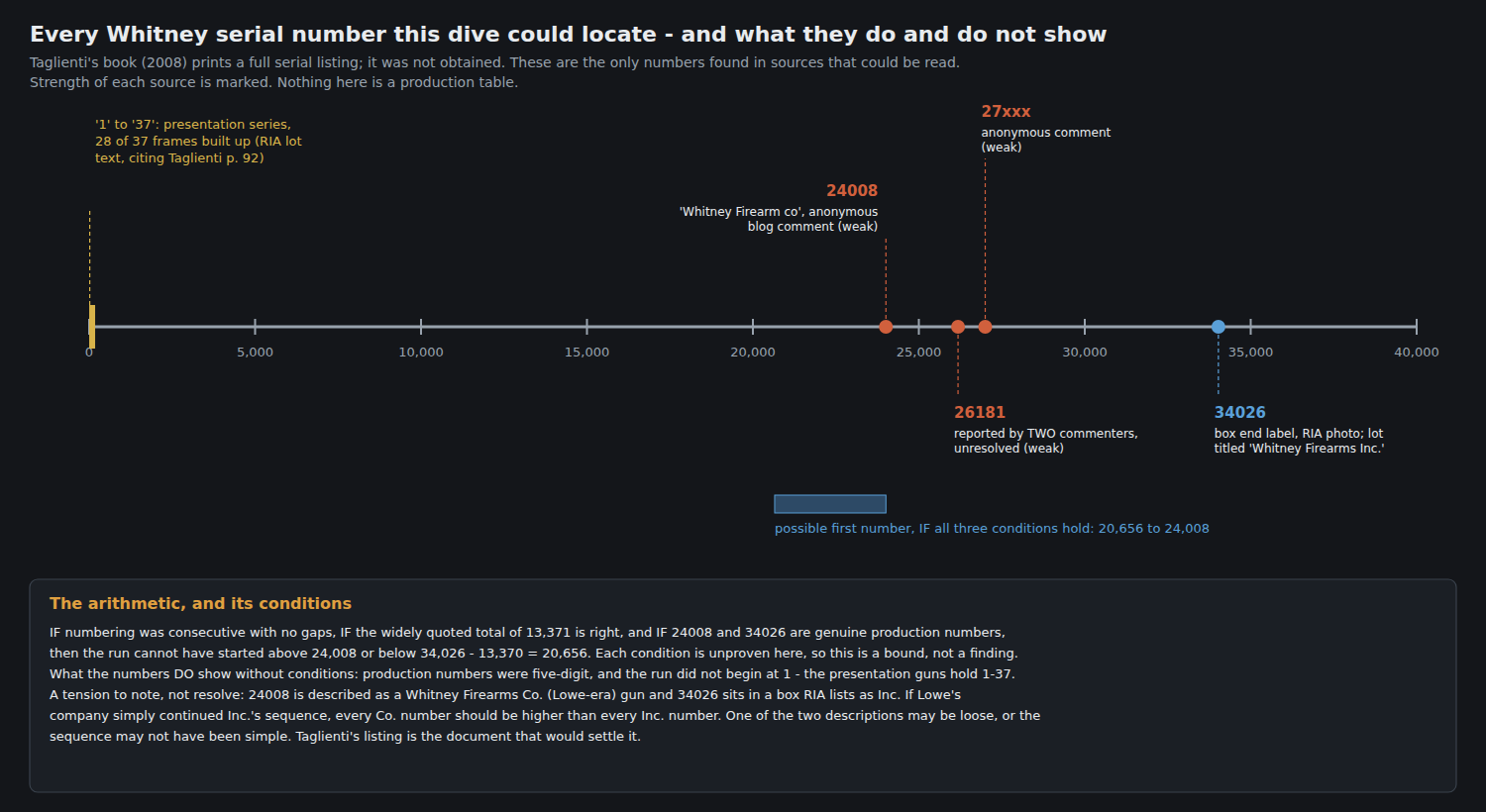
That book is Antonio Taglienti’s The Whitney Wolverine (2008). Its reviewer at Forgotten Weapons noted that it includes “a full listing of the serial numbers produced over the pistol’s lifespan”.1 It could not be obtained for these volumes, and every attempt to reach its text second-hand failed. This volume therefore does something narrower and more honest than print a serial table: it sets out every serial number that could be read in a source, says how strong each source is, and shows what those numbers can and cannot establish. Where a range is given, it is given with its source.
3.1 What Can Be Read on a Whitney
Rock Island Auction’s lot descriptions, written with the pistols in hand, are the most consistent record of the markings. A standard example, sold in December 2025:
“the one-line ‘WHITNEY FIREARMS INC.’ address marked on the right of the frame with ‘WHITNEY’ on the left side, a cylindrical bolt with serrated knobs at the rear, subdued hammer and thumb safety, and serial number on the front strap.”2
The same wording, with small variations, runs through the lots of 2023 to 2026. The period photographs and the lot photographs agree: “WHITNEY” is marked on the left side of the top tube, forward of the cocking knobs.
3.2 Markings: Wolverine, Whitney, Inc. and Co.
Three marking changes are reported, and they track the company’s history in Volume 2.
- The Wolverine name. A collector who owned an early pistol wrote that it “has the earlier Wolverine name on the side of the pistol and was made in May, 1956”, and that after the agreement with Lyman “it was then simply called the ‘Whitney pistol’.”3 That is a single collector’s post. RIA’s lot descriptions of the 2020s all describe “WHITNEY” on the left side and do not mention a Wolverine marking on any pistol they sold.4 Whether, and on how many pistols, the word “Wolverine” was cut into the frame could not be confirmed. It certainly appeared on the early boxes, as the photographs in this volume show.
- Inc. and Co. RIA uses the address line to separate the two companies: pistols marked “WHITNEY FIREARMS INC.” are, in its lot text, among the “10,793 Wolverine pistols completed prior to the company being sold and changing names to ‘The Whitney Firearms Co.’ in mid to late-1957”.2 A pistol marked “Co.” would therefore be one of Charles Lowe’s. One owner reports such a pistol: “made by the Whithney Firearm co New Haven Conn serial #24008”.5 That is an anonymous comment, and the spelling is the commenter’s; it is the only report of a Co.-marked serial located.
- “Whitney Autoloader”. One blog post of 2006 says that “later pistols were stamped with the name ‘Whitney Autoloader’”.5 No other source mentions it, and no photograph showing it was found. It is recorded here as an unconfirmed claim so that it can be checked, not as a fact.
The address reads New Haven, although the factory was in North Haven (Volume 2).
3.3 The Serial Numbers: What Is Known
These are every serial number found in a source that could be read, with the strength of each:
Table 1 — These are every serial number found in a source that could be read, with the strength of each
| Serial | What it is | Source | Strength |
|---|---|---|---|
| 1 (prototype) | First prototype, made by hand at Bellmore-Johnson in 1955, “still dubbed a Tri-Matic” | RIA blog, following Taglienti6 | Book, reported second-hand |
| ”1” to “37” | Presentation series; 28 of the 37 frames built up | RIA lot 4096/1596, citing Taglienti p. 927 | Book, reported second-hand |
| 27 | A presentation pistol, sold December 2025 | RIA lot 4096/1596; end label in the lot photograph7 | Auction house, pistol in hand |
| T2 | Prototype target pistol, 1957, marked on the front strap and grip panels | RIA lot 4091/663; Findley, The Whitney Pistol, pp. 164–1698 | Auction house, pistol in hand |
| 24008 | ”Whitney Firearm co” | Anonymous blog comment5 | Weak |
| 26181 | Reported by two different commenters as their own pistol | Anonymous blog comments5 | Weak, and contradictory |
| 27xxx | — | Anonymous blog comment5 | Weak |
| 34026 | Hand-written on the end label of the box of a pistol RIA titles “Whitney Firearms Inc.” | RIA lot 4096/1598 photograph2 | Box label, not the pistol |
The auction house’s own serial fields are rendered as images and could not be read automatically, and its lot text rarely states the number for standard pistols. That is why the list is short.
3.4 The Presentation Series, 1 to 37
The one serial range that can be stated with a source is the presentation series. RIA’s description of serial 27, sold on 6 December 2025:
“one of a reported total of just 28 Wolverine pistols made outside of the standard production serial ranges specifically for special presentation … Earmarked by Hillberg himself as a special series to be reserved as gifts, the presentation pistols were taken from regular production and were identical to the standard pistols, with the exception of a special ‘1’ to ‘37’ serial number range, though reportedly only 28 of the 37 frames were built up into complete pistols as discussed on page 92 of ‘The Whitney Wolverine’ by Antonio J. Taglienti.”7
Four things follow, and each is worth stating because each is easily misread:
- The presentation pistols are low-numbered, but they are not early. They were taken from regular production and given a separate number. A two-digit Whitney is not one of the first made.
- Nine numbers in the range were never used on a complete pistol, if Taglienti’s 28-of-37 is right. A presentation number between 1 and 37 is therefore not proof in itself — the auction house quotes the book for which numbers were built up, and that list was not available here.
- The prototype’s “serial number 1” (1955) and presentation “1” are two different uses of the same number, as far as the sources go. Whether the prototype survives, and how it is marked, is not recorded in anything seen here.
- The serial is two digits on the front strap, per RIA, and matched on the box’s end label for serial 27.
Serial 27 also brought the highest hammer price located for any Whitney, equal to the target prototype’s below: a hammer price of $8,000 against an estimate of $8,500–13,000, which RIA reports as $9,400 with the buyer’s premium.76
3.5 The Production Numbers, and a Bound
What the located numbers show without any assumption is limited but real:
- Production numbers were five digits. No production pistol with a number below 10,000 was found.
- The run therefore did not start at 1 and run to about 13,371. The presentation series holds 1 to 37, and every production number seen is far above 13,371.
What they show with assumptions is a bound. If the numbering was consecutive with no gaps, if the total of 13,371 is correct, and if 24008 and 34026 are genuine production numbers, then the run began no higher than 24,008 (because 24008 exists) and no lower than 34,026 − 13,370 = 20,656 (because it had to reach 34026). None of the three conditions is established, and the weakest — 24008 — is an anonymous comment. The bound is stated so that it can be tested against Taglienti’s listing, not as a finding.
A tension the evidence cannot resolve. If Lowe’s Whitney Firearms Co. simply continued the Inc. sequence, every Co. number should be higher than every Inc. number. But the one Co. pistol reported is 24008, and the highest Inc.-attributed number is 34026. Either one description is loose — the commenter may have meant “company” in the ordinary sense, or the box may not be original to the pistol RIA sold with it — or the sequence was not a simple continuation. Both are possible, and only the serial listing can settle it.
What collectors infer, and what they should not. In the lot descriptions, RIA dates pistols by the address marking, not by the serial: “Inc.” means before the 1957 sale.2 That is the safer practice given the evidence. A serial number alone, on the evidence located, cannot place a Whitney in 1956 or 1957, cannot separate the two companies, and cannot identify a factory-bright pistol, because no source located gives the serial ranges of the bright guns (below).
3.6 Boxes, and Why a Box Number Proves Little
Whitney boxes were a printed picture box with the serial written by hand on an end label. Two designs appear in the lot photographs: a blue box lettered “WHITNEY” and, in outline script, “WOLVERINE”, and a blue-and-cream box with a large “WHITNEY” and no Wolverine name. The Wolverine-lettered box goes with the presentation series and with early pistols; the Whitney-only box with serial 34026. That the box design followed the name change is an inference from the photographs, consistent with the history in Volume 2, not a documented fact.
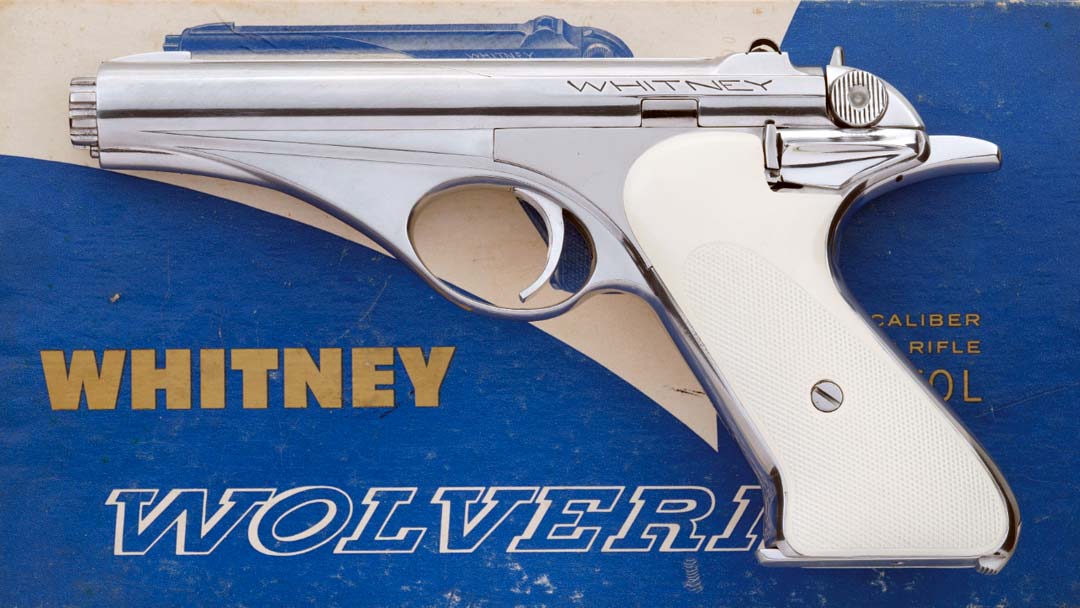
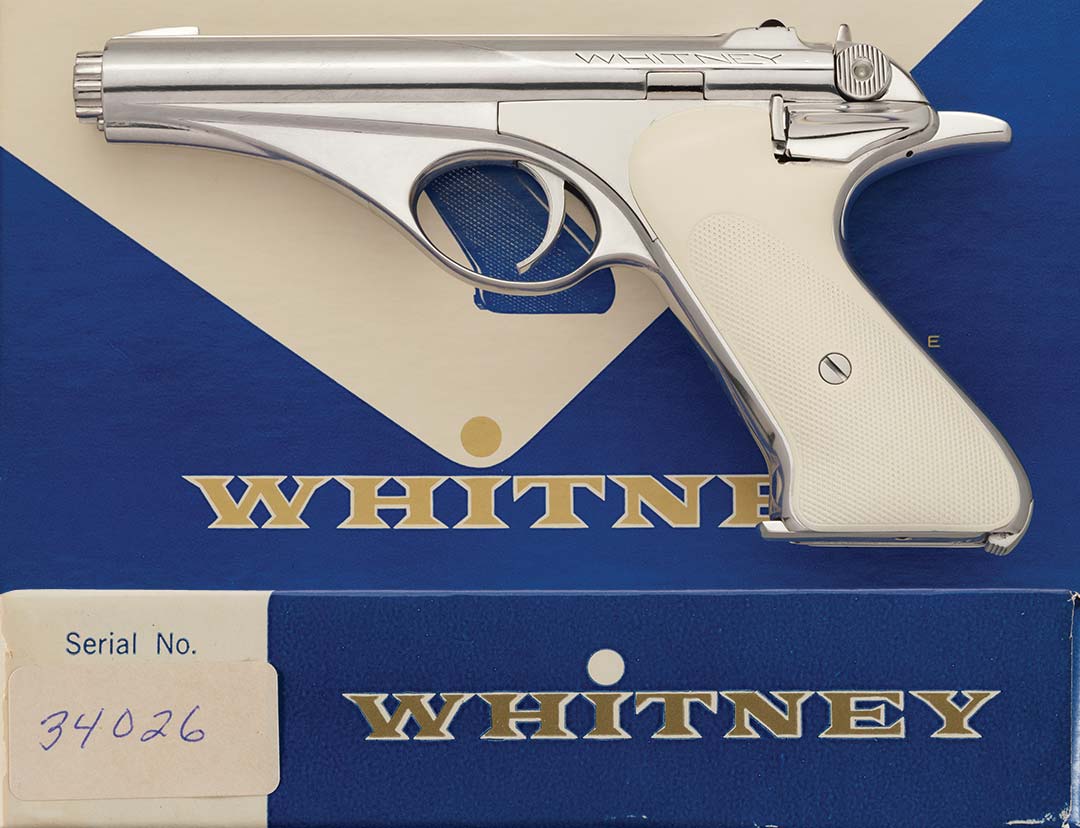
A box is weak evidence of a pistol’s number, for a reason the auction lots make plain: boxes were reproduced. RIA’s descriptions include “a reproduction Whitney box”, “an exceptional reproduction Whitney picture box hand numbered to gun”, and “factory style replacement box, instruction manual, promotional pamphlet, and warranty card”.4 A hand-written number on an end label is the easiest thing in the world to add to a reproduction. A matching box helps a sale; it does not prove a history.
3.7 The Standard Finish: Two-Tone Anodizing
The standard finish was not blueing — an aluminium frame cannot be blued — but anodizing. Guns described it in August 1956 in the only period account located:
“The Whitney finish is black-gray anodizing with a sand-blast and polished surface contrast.”9
and captioned a photograph: “Futuristic styling of production Whitney automatic is enhanced by two-tone black anodizing finish.”9 The two tones come from the surface under the anodizing, not from two colours of dye: areas left polished and areas sand-blasted take the same black anodize differently, one glossy and dark, the other matte and grey. The presentation pistol above is described by RIA as retaining “99% original black and grey anodized finishes”, plural.7 Advertising called it “the two-tone Blue” and priced it at $39.95.10
Wikipedia, following Taglienti, says the non-nickel pistols were “finished in varying shades of anodized blue”.11 Dyed anodizing can fade with age and exposure to light, and a faded Whitney can look grey-blue or brown. The shade of a surviving pistol is therefore not a variant.

3.8 The Bright Pistols: How Many, and What They Were
The rare factory finish is the one collectors pay most for, and the sources disagree on three separate points: what it was, how many were made, and what it cost.
What it was. The maker’s own advertising does not say “nickel”. Two Whitney advertisements read:
- “Loaded with safety features! Blued $39.95 Bright $44.95”
- “There is a choice of finish … the two-tone Blue, or the mirror bright, the latter having a gold trigger.”10
Later sources call the same pistols nickel-plated: Wikipedia and The Firearm Blog, following Taglienti; the Olympic Arms manual (“about 900 were made in nickel”); J. B. Wood (“Around 900 of them were in nickel”); American Rifleman in 2022 (a “nickel version”).1112131415 One owner of such a pistol calls it “one of just 900 silver anodized models”.5 Nickel plating on aluminium is possible but requires special preparation, and “mirror bright” in an advertisement could describe either plating or a polished, clear-finished surface. The sources located do not settle which process the factory used, and the process is therefore not stated here as fact. The word used in these volumes for the factory finish is the factory’s own: bright.
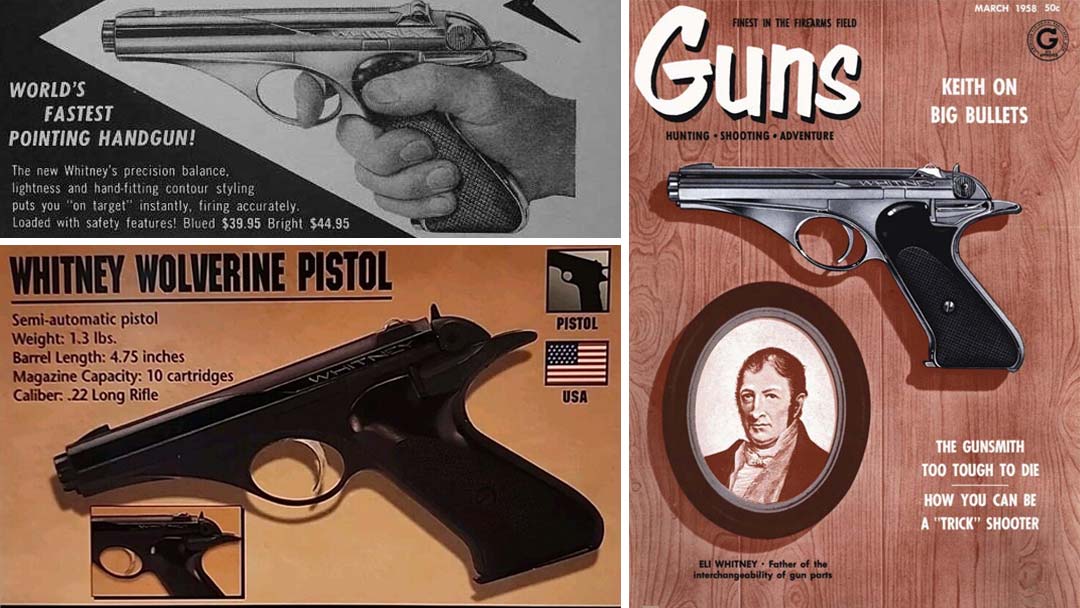
How many. Two figures, and they cannot both be right:
Table 2 — How many. Two figures, and they cannot both be right
| Figure | Source |
|---|---|
| ”approximately 500 nickel-plated according to company records” | Wikipedia, citing Taglienti (2008); repeated by The Firearm Blog (2021) and a collector’s forum post (“500 were reported”)11123 |
| “about 900 were made in nickel” | Olympic Arms owner’s manual (2005); J. B. Wood (2013); Wikipedia’s own infobox (“~900 produced”)131411 |
The 500 figure is the one attributed to company records, through the book that had access to them. The 900 figure appears first in the reissue maker’s manual, in a history paragraph that also gives the production total only as “roughly thirteen thousand”. Neither is averaged here.
Which serial ranges. No source located gives the serial numbers or ranges of the bright pistols. The owner’s question — which ranges were plated — cannot be answered from anything available, and no range is suggested. Taglienti’s listing may carry it; its review does not say.
What it cost. $44.95, a $5 premium, in the factory advertisement and in the collector literature that follows Taglienti; $49.95 in American Rifleman’s 2022 article.1015 The advertisement is the primary source; the 2022 figure may be a transcription error and is shown only as a variant.
3.9 Factory Bright or Later Polish?
This is the most useful thing in this volume for anyone buying one, and it rests on a single observation from the auction record.
Most bright Whitneys sold at auction in recent years are not factory finishes, by the auction house’s own description. Rock Island Auction, describing bright pistols it sold between 2023 and 2026, wrote:
Table 3 — Most bright Whitneys sold at auction in recent years are not factory finishes, by the auction house's own description. Rock Island Auction, describing bright pistols it sold between 2023 and 2026, wrote
| Sale | RIA’s words | Hammer |
|---|---|---|
| Aug 2023 (89/1617) | “custom bright highly polished finish” | $3,000 |
| Feb 2025 (1048/993) | “all of the professional custom bright polished finish remaining” | $5,500 |
| Aug 2025 (4095/565) | “Exceptionally fine as professionally bright polish finished” | $7,500 |
| Dec 2025 (4096/1598) | “a professional bright polished finish” | $6,000 |
| May 2026 (4097/1561) | “a professional bright polished finish” | not sold or not shown |
“Custom” and “professional” are the auction house’s way of saying the finish was applied after the pistol left the factory — the aluminium stripped of its anodizing and polished. RIA’s blog captions the same kind of photograph “Whitney Wolverine pistols with nickel-plated finish are particularly valued in the collecting community”, and a reader of the caption alone would take the pistols pictured for factory guns.6 The lot descriptions, written with the pistols in hand, say otherwise.
The market, on these figures, pays well for a polished pistol regardless: in 2025 the three professionally polished pistols RIA sold brought hammer prices of $5,500, $7,500 and $6,000, against $2,500 for a boxed pistol in standard finish sold the same year.4 Volume 8 gives the full price table. A buyer should know which is being bought.
How to tell, as far as the evidence allows:
- The trigger. The factory’s own advertisement says the mirror-bright pistol had “a gold trigger”.10 Every bright pistol examined in the RIA photographs for this volume — five of them — has a bright steel-coloured trigger. That is consistent with the auction house’s description of them as refinished. A gold trigger is a point in a bright pistol’s favour, and its absence counts against it — but triggers can be changed and gold is easily added, so neither is proof. How the factory coloured the trigger is not recorded.
- The auction description. Where a pistol has been through a major house, read the lot text, not the headline or the blog caption. “Professional”, “custom” and “refinished” all mean the same thing.
- The edges and markings. Any polish that removes anodizing removes metal. In general, a hand-polished refinish rounds the edges of flats and the margins of cut markings; a factory finish on a pistol that has not been refinished leaves the “WHITNEY” lettering and the address sharp-edged. This is a general principle of refinishing, not a Whitney-specific test documented in a source.
- Paperwork. No factory letter service for Whitney pistols was found. Original sales paperwork naming the finish, if it survives with a pistol, is the only strong evidence.
- What not to rely on. A magnet does not help: some nickel deposits are magnetic and some are not, and aluminium never is. A box, as above, proves little. White grips do not prove anything either: RIA’s polished pistols almost all wear them.
3.10 Grips
The grips are checkered plastic. Wikipedia, following Taglienti, gives three colours — black, dark brown and white — and says “the white grips are found mostly on the nickel-plated models”.11 American Rifleman in 2022 gives “black or white polymer grips”.15 Brown grips appear on the presentation pistol and on standard pistols in the lot photographs, and black on the pistol on the March 1958 Guns cover. Grips are held by a single screw and are easily exchanged, so a grip colour dates or proves nothing on its own; the association of white with the bright finish is a tendency, not a rule.
3.11 The Target Pistol That Never Shipped
Guns reported in August 1956 that “a target model .22 ‘will definitely be available’”, and printed “an artist’s study of target model” whose “styling incorporated muzzle brake for rapid fire with front take-down bushing”, adding the caption “With racy appeal of Buck Rogers ray gun”.9 The article also quoted Hillberg acknowledging “Whitney experimental models in other calibers, some of them locked breech types”.9
One target pistol survives. Rock Island Auction sold it in May 2024:
“Manufactured in 1957 as a prototype of an unreleased Whitney target pistol based on the beloved Wolverine design. It’s fitted with Patridge blade front and Micro-click adjustable rear sights, a compensator, and factory thumbrest grips. The included letter from author Don Findley describes the pistol as ‘a one-of-a-kind factory original prototype’ with the prototype serial number ‘T2’ marked on the front strap and thumb rest grip panels. The letter also states that the project was scrapped due Whitney Firearms Inc. ceasing production of all firearms in 1957.”8
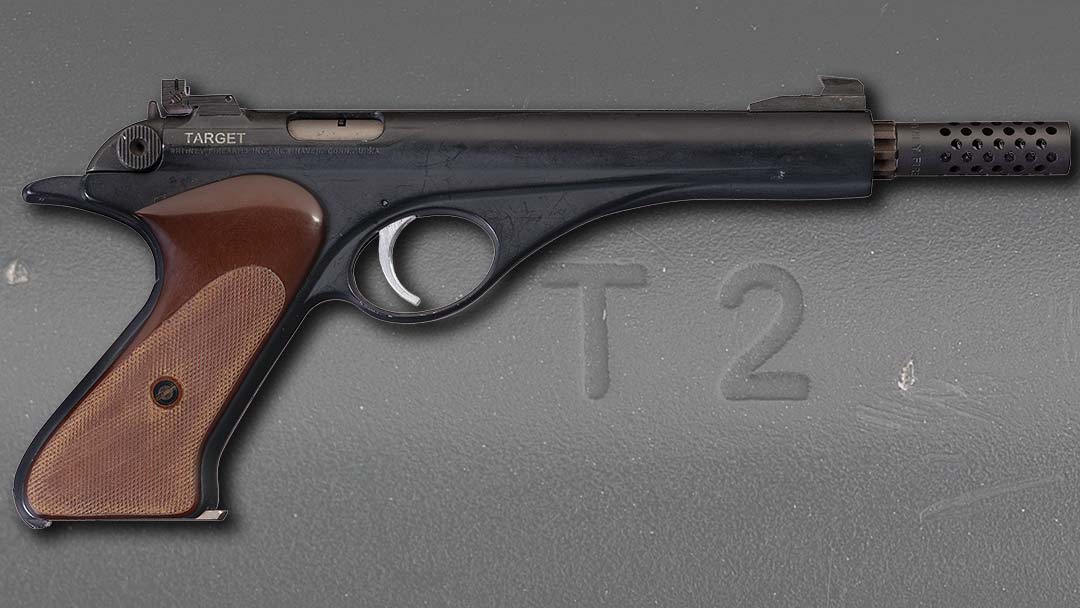
The “T2” suggests a T1, which is not recorded in any source located. The pistol is pictured on the cover and on pages 164–169 of Findley’s book.8 Its compensator doubles as the muzzle nut — the takedown “bushing” the 1956 caption describes — which is the Whitney’s architecture used for a second purpose (Volume 5).
3.12 What Remains Unknown
Stated plainly, so that none of it is later filled in from memory:
- The production serial range — first and last numbers, and the break between Inc. and Co. Taglienti’s listing is the source; it was not seen.
- The serial ranges of the bright pistols, and whether bright pistols were made by both companies.
- Whether the factory bright finish was nickel plate or another bright finish, and how the trigger was gold-coloured.
- How many pistols carried “Wolverine” on the frame, as distinct from the box.
- “Whitney Autoloader” as a marking: one unconfirmed claim.
- Whether serial 26181 is one pistol claimed twice, a transcription error or a duplicated number.
References
Footnotes
-
Ian McCollum, “Book Review: The Whitney Wolverine”, Forgotten Weapons, https://www.forgottenweapons.com/book-review-the-whitney-wolverine/ , consulted 2026-09-19. ↩
-
Rock Island Auction Company, auction 4096, lot 1598, “Whitney Firearms Inc. Wolverine Rimfire Pistol with Box”, 6 December 2025, https://www.rockislandauction.com/detail/4096/1598/whitney-firearms-inc-wolverine-rimfire-pistol-with-box , retrieved 2026-09-19. The same description appears for auction 4097, lot 1561 (9 May 2026). ↩ ↩2 ↩3 ↩4
-
“Ahead of its time: The Whitney Wolverine pistol”, Smith & Wesson Forum, archived 7 April 2015, https://web.archive.org/web/20150407043719/http://smith-wessonforum.com/lounge/210508-ahead-its-time-whitney-wolverine-pistol-pics-box-now-included.html . A collector’s post. ↩ ↩2
-
Rock Island Auction Company lot pages for Whitney pistols, auctions 71/936 (2017), 87/3683 (2022), 1042/638 and 89/1617 (2023), 4091/666, 1046/945 and 4092/1580 (2024), 1048/993, 5013/474, 4095/565 and 4096/1598 (2025), 4097/1561 (2026), each at https://www.rockislandauction.com/detail/{auction}/{lot}/ , retrieved 2026-09-19. Hammer prices are from each page’s data and exclude the buyer’s premium. ↩ ↩2 ↩3
-
“Whitney Wolverine Range Report”, Nurse With a Gun blog, 10 January 2006, and reader comments, http://xavierthoughts.blogspot.com/2006/01/whitney-wolverine-range-report.html , retrieved 2026-09-19. Anonymous comments; testimony only. ↩ ↩2 ↩3 ↩4 ↩5 ↩6
-
Rock Island Auction Company, “Rise and Fall of the Whitney Wolverine” (first published 30 May 2014; updated), https://www.rockislandauction.com/riac-blog/rise-and-fall-of-the-whitney-wolverine , retrieved 2026-09-19. Draws on Taglienti (2008). ↩ ↩2 ↩3
-
Rock Island Auction Company, auction 4096, lot 1596, “Presentation Wolverine Whitney Firearms Inc. Pistol with Box”, 6 December 2025, https://www.rockislandauction.com/detail/4096/1596/presentation-wolverine-whitney-firearms-inc-pistol-with-box , retrieved 2026-09-19. Hammer price from the page’s data; estimate $8,500–13,000. ↩ ↩2 ↩3 ↩4 ↩5
-
Rock Island Auction Company, auction 4091, lot 663, “Prototype Whitney Target Semi-Automatic Pistol with Letter”, 17 May 2024, https://www.rockislandauction.com/detail/4091/663/prototype-whitney-target-semiautomatic-pistol-with-letter , retrieved 2026-09-19. Citing Don Findley, The Whitney Pistol, cover and pp. 164–169. ↩ ↩2 ↩3
-
William B. Edwards, “The Oldest Name in Guns Comes Back”, Guns, August 1956, https://web.archive.org/web/20160304110716/http://www.gunsmagazine.com/1956issues/G0856.pdf , retrieved 2026-09-19. ↩ ↩2 ↩3 ↩4
-
Period Whitney and Galef advertising as reproduced by Rock Island Auction in the blog above; read from the images 2026-09-19. Undated in the reproductions. ↩ ↩2 ↩3 ↩4
-
Wikipedia, “Whitney Wolverine”, consulted 2026-09-19, citing Taglienti (2008) for the 500 figure; its infobox gives “~900”. ↩ ↩2 ↩3 ↩4 ↩5
-
Luke C., “The Rimfire Report: The Space Age Whitney Wolverine 22LR Pistol”, The Firearm Blog, 18 October 2021, https://www.thefirearmblog.com/blog/2021/10/18/whitney-wolverine/ , consulted 2026-09-19. ↩ ↩2
-
Olympic Arms, Whitney Wolverine Owner’s Manual, Rev 7/05, “Whitney History”, https://web.archive.org/web/2016/https://www.vintagegunleather.com/gun-manuals/pdf_O/olympic_whitney_wolverine.pdf , retrieved 2026-09-19. ↩ ↩2
-
J. B. Wood, “Writer gets his Whitney Wolverine after long wait for unusual .22”, TheGunMag, 29 July 2013, https://web.archive.org/web/20160407182905/http://www.thegunmag.com/writer-gets-his-whitney-wolverine-after-long-wait-for-unusual-22/ , retrieved 2026-09-19. ↩ ↩2
-
Guy J. Sagi, “Whitney Wolverine: Hillberg’s Space-Age Rimfire Pistol”, American Rifleman, 31 August 2022, https://www.americanrifleman.org/content/whitney-wolverine-hillberg-s-space-age-rimfire-pistol/ , consulted 2026-09-19. ↩ ↩2 ↩3
Comments (0)