Whitney Wolverine · Volume 4
The Look — A Casting, a Jet Fuselage, and 'Modern as Tomorrow'
Why the Whitney looks the way it does, argued from how it was made: the cast aluminium envelope, the fixed barrel, the 1956 company's own case for styling, and where the pistol sits among streamline moderne, the jet age and Googie
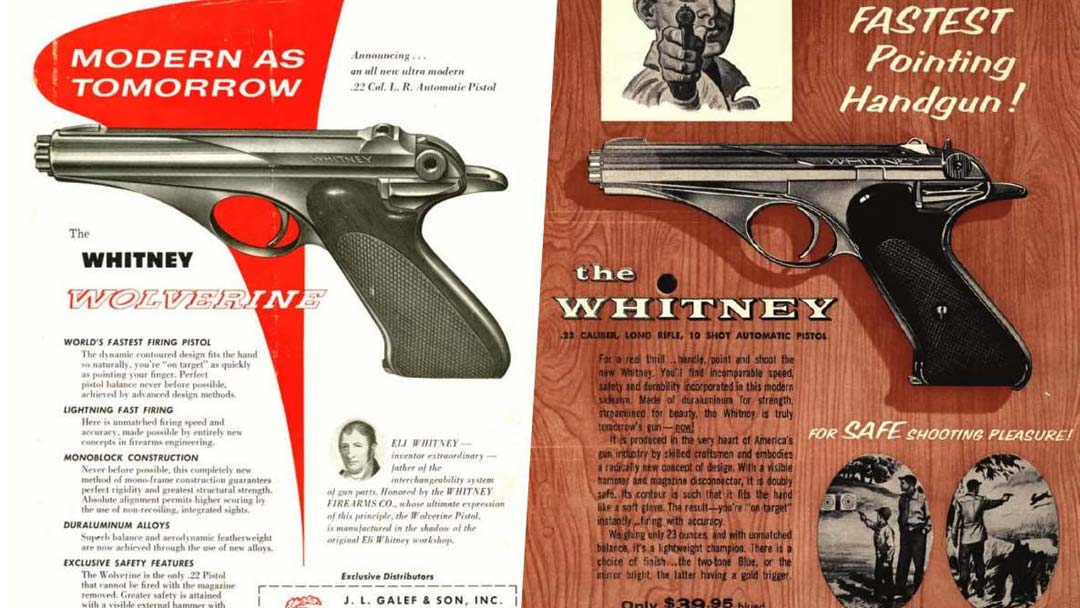
The Whitney is the best-known example of “space age” styling in an American firearm, and it is usually described in adjectives: futuristic, retro-futuristic, Buck Rogers, Jetsons, raygun. Those words describe the effect. This volume is about the cause. Its argument, set out below and tested against the sources, is that the Whitney’s look was not a styling exercise applied to a pistol, but the visible result of one manufacturing decision — to make the frame a single aluminium casting that encloses every working part — and of the fixed-barrel action that decision allowed. The company said as much in 1956, in its own promotional booklet. The jet-age vocabulary was real too, and the designer chose it deliberately. But it rode on the method.
4.1 The Claim This Volume Tests
Put as a claim that can be checked: the features that make the Whitney look “futuristic” are, in each case, either consequences of casting the frame in one piece around a fixed barrel, or choices that casting made free. If that is right, a machined-steel pistol of the period could not have looked like this at a comparable price, and the sources should say so. They do.
4.2 What the Makers Said They Were Doing
The best evidence of intent is what the company and its designer said while the pistol was being made. The August 1956 Guns article, written with the company and quoting its booklet, is explicit on every point.
On styling as a goal. Hillberg: “Progress in pistol design and styling has just about stood still. We have new dishwashers, refrigerators, cars, even railroads, but many guns built today are 30 years behind the times.” And: “I know of designs which have been turned down by gun companies today solely on the basis of their appearance.” The article adds that “‘conventional’ is a four-letter word around the Whitney shop”, and that “Whitney is out to see if something new can be done about conservatism in firearms styling.”1
The list Hillberg chose is telling. Dishwashers, refrigerators, cars and railroads are the objects of American industrial design in the 1930s to 1950s — the domain of streamlining and of the consumer-product styling of the post-war years. He was measuring pistols against appliances and locomotives, not against other pistols.
On the jet. The article opens by describing a gun “translating into the field of firearms the swept-back, streamlined styling of the newest jet planes.”1 The man who drew it had led the armament group on the F-84 Thunderjet (Volume 1).
On the connection between look and method. This is the sentence that matters most. From the Bellmore-Johnson booklet, as Guns quoted it:
“This type of (cast aluminum frame) construction enabled the Trimatic-Whitney to have the bulk and solidness of a gun so absent with the sheet metal construction and at a considerable cost saving. It also enabled many noteworthy style variances hitherto impossible with practical machining methods on solid forgings, thus enhancing the graceful contour lines.”1
The makers, in other words, claimed three things for the casting: solidity that stamped sheet-metal construction lacked, lower cost than machining a forging, and shapes that machining could not practically produce. The styling is the third, and they named it as a product of the process.
The article’s own summary: “The Whitney’s graceful moulded contours make it seem to fly while standing still. By using a die-cast receiver, tricky shapes can be made without costly machining.”1
4.3 The Frame: One Casting, and What Kind
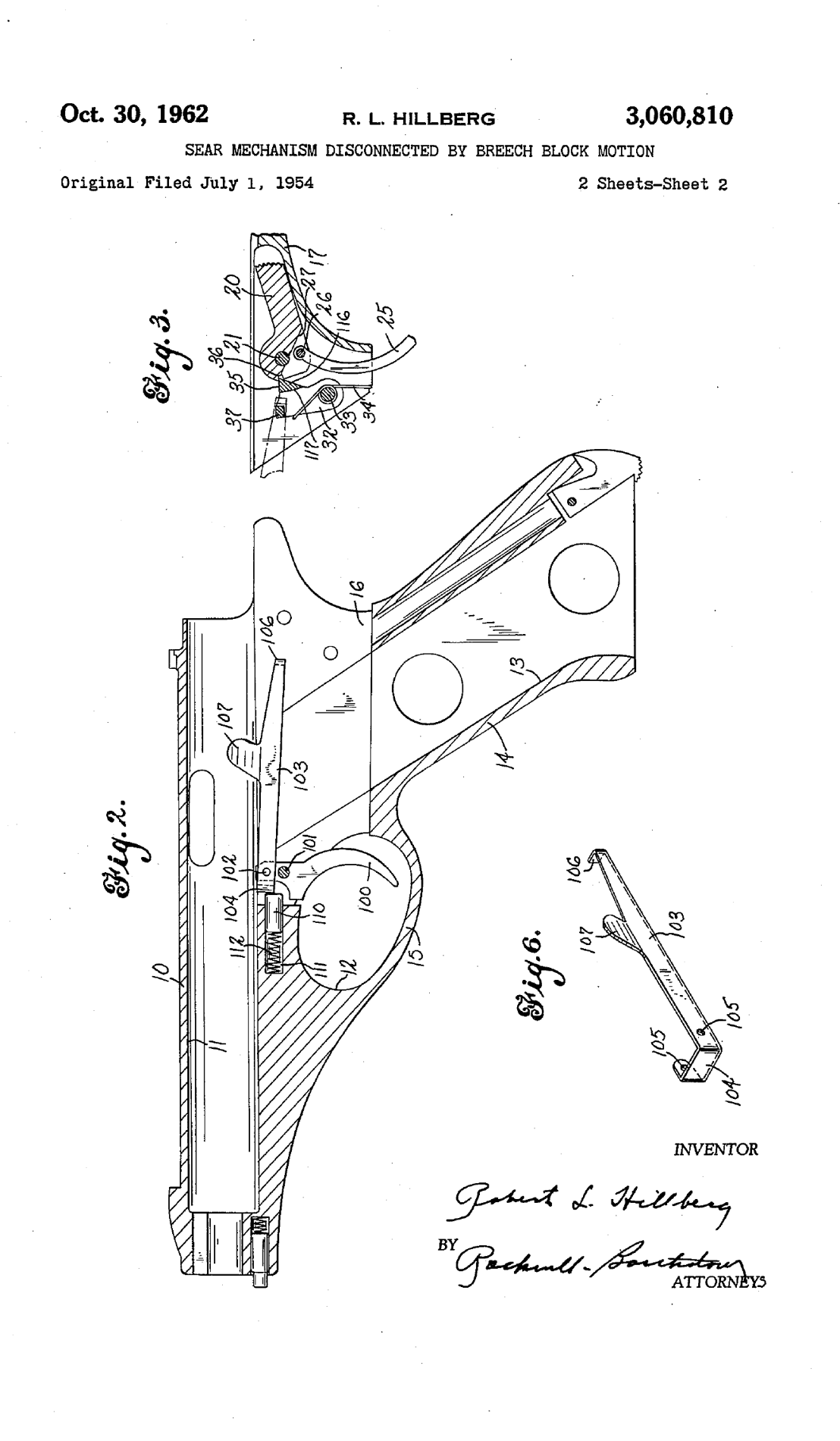
One piece. Every source agrees the frame is one aluminium-alloy part. Guns in 1956: “monobloc cast-aluminum frame”; “All the parts of the new Whitney gun are assembled into it.” The advertising called it “monobloc” and “mono-frame” construction.12 The drawing in Hillberg’s patent (first filed in 1954) shows the frame in section as a single part with a cylindrical bore along the top and the trigger guard “formed integrally with the frame”.3
Which alloy, and which process: the sources disagree.
Table 1 — Which alloy, and which process: the sources disagree.
| Source | Process | Alloy |
|---|---|---|
| Guns, Aug 1956, text | ”high-strength dural precision cast frame" | "dural” |
| Guns, Aug 1956, captions and text | ”precision die-cast frame unit”; “a die-cast receiver” | — |
| Galef advertising | ”monobloc construction" | "Duraluminum alloys”; “made of duraluminum” |
| American Rifleman editors, quoted in Galef advertising | ”fabricated from lightweight but rough dural" | "dural” |
| Wikipedia (citing Holt Bodinson, Guns, 2009); The Firearm Blog (2021) | “investment casting of the frame by Alcoa” | — |
| RIA lot descriptions | ”a ‘monobloc’ frame made from cast duraluminum" | "duraluminum” |
| RIA lot 89/1617 (2023) | — | “‘ALCOA/G’ under the right grip panel” |
Three terms are in play, and they are different processes. Die casting forces molten metal into a steel die under pressure; investment casting pours it into a ceramic shell formed around a wax pattern that is melted out; “precision casting” is a looser trade term that was often used for investment casting in the 1950s. The 1956 article uses both “precision cast” and “die-cast” for the same frame, so it cannot settle the question on its own. The Alcoa connection is supported by one physical observation — the “ALCOA/G” mark reported under a grip panel — and the investment-casting attribution comes through a 2009 magazine article that could not be read directly (its host refused the request).45 The process is therefore given here as precision-cast, by Alcoa on the evidence of the frame marking, and described as investment casting in later sources — not as a settled fact.
The alloy name has a similar looseness. “Duralumin” is strictly a family of wrought aluminium-copper alloys, used for aircraft sheet and forgings; “dural” in 1950s advertising was used for high-strength aluminium alloys generally. Nothing located gives the Whitney frame’s alloy designation.
The Olympic Arms manual adds one more piece of evidence, from the company that later re-created the design: “Its radical design employed the frame merely as an envelope for the internal working parts”.6 Wikipedia’s claim that investment casting of a frame “was a new idea for the gun industry at the time” and “now … widely used by almost every major gun manufacturer” is tagged by Wikipedia’s own editors as failing verification, and is not repeated here as a fact.5
4.4 Why a Casting Looks Like That
The 1956 article made the cost argument with a pointed example: “One leading handgun maker used to widely publicize the fact that their guns were literally ‘carved from solid steel.’ The frame forging weighed 40 ounces; after drilling, turning and milling, the frame weighed 13. The Whitney’s new design avoids such a fundamental absurdity. Except for slight trimming the Whitney receiver is almost as it comes from the mould.”1
The same fact is the styling argument. Consider what each process makes cheap:
- Machining from a forging or bar is cheap for planes, cylinders and straight slots, because a mill cuts a plane in one pass and a lathe turns a cylinder in one. A compound curve — a surface that bends in two directions at once — is expensive, because it needs a form cutter, a profiling machine or hand work, and it needs it on every frame. The conventional pistols of the 1950s are flat-sided, with parallel faces, square-cut edges and straight lines for exactly this reason. That is a general principle of machining, not a quotation.
- Casting inverts the cost. A curve costs the pattern-maker’s time once, when the pattern or die is made; after that every frame arrives with it for nothing. A flat surface is no cheaper than a swept one. Parts that would be separate on a machined gun — a trigger guard, a grip frame, a sight base — can be one piece, as the patent drawing shows.
So a designer with a casting has, for the first time, no economic reason to draw a straight line. The Bellmore-Johnson booklet’s “style variances hitherto impossible with practical machining methods on solid forgings” is this argument in the company’s own words.1 The curves are free.
4.5 The Fixed Barrel Makes the Silhouette
Casting explains why the surfaces can curve. The action explains the overall shape, and this is the part most descriptions miss.
A conventional automatic pistol has a slide: the upper part of the gun reciprocates. Its outline is therefore two assemblies — a frame below and a moving box above — with a visible parting line, an ejection port cut into the side of the moving part, and a shape dictated by the need for the slide to run on rails. On the Ruger Standard the barrel is fixed but exposed, and a bolt reciprocates inside a separate tubular receiver joined to a grip frame; High Standard’s .22s use a slide. Either way there is a joint and a moving part in view.
The Whitney has neither. Its barrel is fixed — held at the muzzle by a nut and at the rear by the frame — and the moving parts, a sleeve and the bolt pinned to it, travel inside the frame’s top tube (Volume 5). The only moving parts that show are the cocking knobs at the rear and the hammer. The consequence for the outline:
- The top is one continuous tube from the cocking knobs to the muzzle, without a parting line. That is the fuselage in the “jet plane” comparison.
- There is no slide to shape, so the frame can be one smooth envelope, and its sides can carry the long swept curves the casting makes free.
- The ejection port is a small opening in the tube, not a cut across a slide.
- The front of the frame can be drawn forward under the barrel almost to the muzzle, because nothing needs to move there.
The fixed barrel was chosen for accuracy — “Since barrel and sights are in a fixed relationship to one another when assembled, the new Whitney has an advantage in accuracy”, in the 1956 article’s words, and the advertising’s “non-recoiling, integrated sights” — but its effect on the look is at least as large.12
4.6 Reading the Form Part by Part
With the method and the action established, each of the Whitney’s signature features can be read for what it is. Where the reading is an inference from the construction rather than a statement in a source, it says so.

- The unbroken top line and the cocking knobs. A consequence of the internal sleeve (above). The knobs recall the Luger’s toggle knobs, as one collector noted, but they are the ends of a sleeve, not a toggle.7
- The long, deep curve under the barrel, sweeping back from near the muzzle to the trigger guard. On a machined gun this would be expensive metal with no purpose. On the Whitney it is the web that joins the barrel tube to the grip, and it is in the load path: the recoil spring’s load reaches the frame at the muzzle nut and is carried back through the front of the frame “in compression”, as Guns described (Volume 5).1 That this swept web is structural is this volume’s reading of the construction, not a statement in a source. It is the feature most often compared with a jet’s swept wing or a car’s tail fin, and it is the one where form and function are hardest to separate.
- The integral trigger guard, a closed loop cast in the same piece as the frame, in the patent and on the pistol.3
- The grip and the spur. The grip is steeply raked — collectors compare it to the Luger’s — and the frame runs back over the web of the hand as a long spur. Guns in 1956: “the long spur which lies over the back of the hand like a ‘free pistol’ grip”, with the result that “muzzle rise is minimized because of the extremely natural pointing”. The advertising built its main claim on it: “World’s fastest pointing handgun!”12 That is ergonomics, and the casting made the shape affordable.
- The shrouded hammer, which sits in the frame between the knobs rather than standing proud of a slide.
- The tapered magazine well. Invisible from outside, but it is the casting again: “Most automatic pistols have straight magazine wells. In the Whitney the side walls are tapered.”1
The 1956 article’s caption for Hillberg’s wartime carbine is the final piece: it “used style curves which were later dominant in Whitney pistol”.1 The curves were Hillberg’s before they were the Whitney’s (Volume 1). The casting let him put them on a gun that sold for $39.95.
4.7 The Finish as Part of the Design
An aluminium frame cannot be blued, and the Whitney’s finishes followed from the metal. The standard finish was “black-gray anodizing with a sand-blast and polished surface contrast” — a two-tone effect produced by finishing different areas of the same casting differently before anodizing — and the factory’s option was “mirror bright” with “a gold trigger” (Volume 3).12 Both are finishes of the consumer-product and automotive world of the 1950s, not of the gun trade: anodized aluminium was the finish of the period’s kitchenware and trim, and bright work with a gold accent is the language of the decade’s chrome. That comparison is this volume’s, but the company invited it when it set pistols beside dishwashers and cars.
4.8 Streamline Moderne, the Jet Age, and Googie
Three design movements are regularly named in connection with the Whitney. They are worth separating, because they are different things, and the pistol relates to each differently.
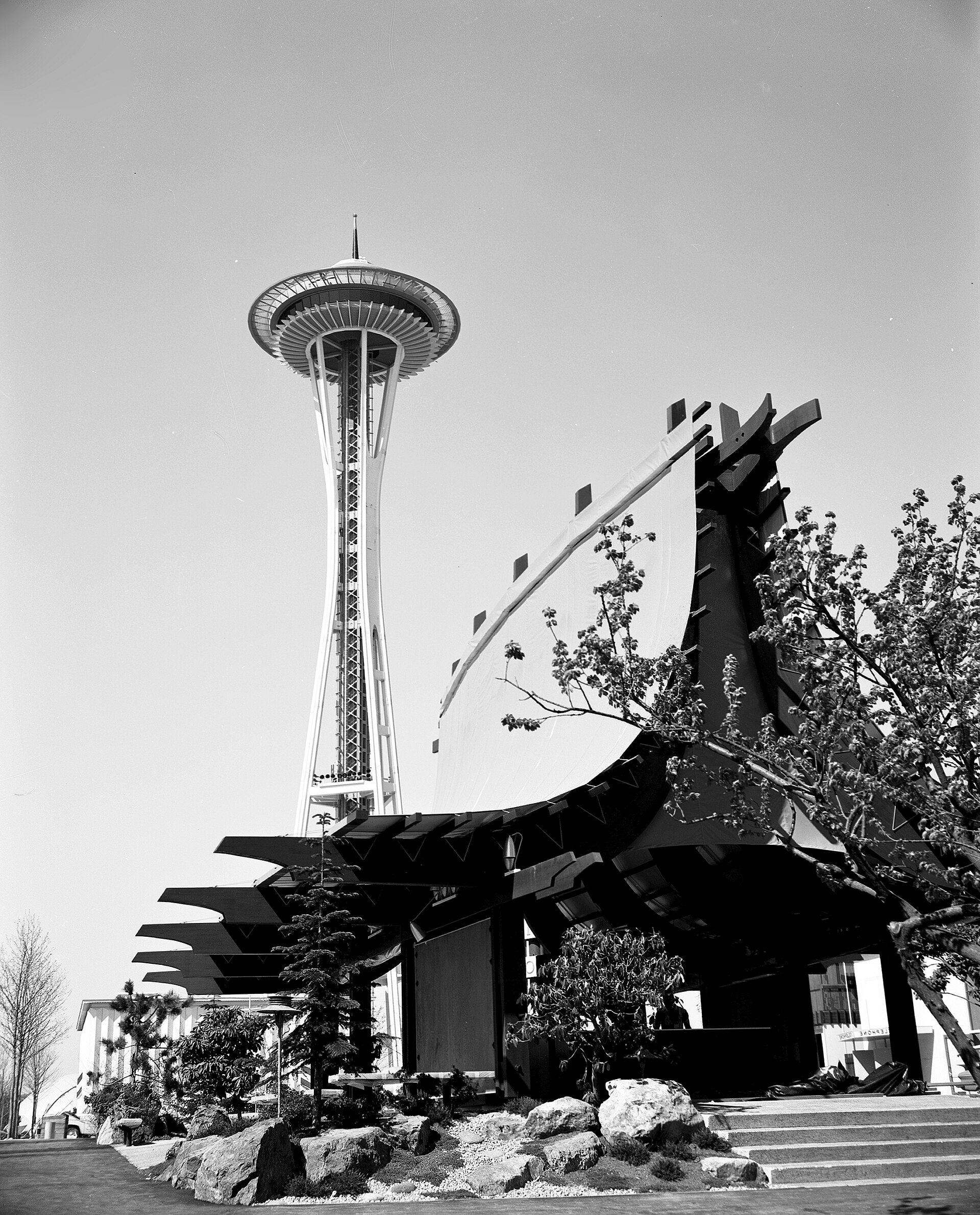
Streamline moderne (1930s). A late form of Art Deco in which industrial designers stripped ornament in favour of aerodynamic curves and long horizontal lines, applied to locomotives, buses, telephones and appliances “to give the impression of sleekness and modernity”.8 Hillberg’s list — “dishwashers, refrigerators, cars, even railroads” — is a list of streamlined objects. In firearms the style arrived early in Europe: the Mauser HSc of the late 1930s is described by American Rifleman as having “the sleek Art Deco look of the period”.9 The Whitney belongs to the streamline tradition in its intent — the long horizontal tube, the rounded forms, speed expressed in a static object (“seem to fly while standing still”).

The jet age (late 1940s–1950s). Streamlining in the 1930s borrowed the look of propeller aircraft and airships. After the war the reference was the jet: swept wings, long tubular fuselages, tail fins. This is the comparison the 1956 article made directly, and it is the one the pistol’s own designer was best placed to make, having spent 1947 to 1951 on the F-84.1 The swept web under the barrel and the tubular top are jet vocabulary.
Googie (c. 1949 to the early 1960s). Googie is a Southern Californian roadside architecture — coffee shops, motels, car washes, gas stations — of upswept roofs, boomerangs, parabolas, atomic motifs and neon, named after John Lautner’s Googie’s Coffee Shop in Hollywood (1949). The name was popularised in 1952, when the architecture editor Douglas Haskell wrote about it in House and Home.10 It is the style most often invoked for the Whitney today, and the association is the least direct. Googie was a West Coast vernacular of commercial buildings; the Whitney was designed in 1954 in a Connecticut tool shop by an aircraft armament engineer. No source connects Hillberg to it. The two share an ancestry — streamlining — and a moment, and they drew on the same jet-and-atom imagery, so they look related; they are siblings, not parent and child.

The term “raygun gothic”, which is also applied to the Whitney, is later still: it was coined by William Gibson in his 1981 story “The Gernsback Continuum” for the retro-futurist imagery of that era — “a tomorrow that never was”, in Lance Olsen’s phrase.11 Applied to the Whitney it is a retrospective label, not a period one.
4.9 Buck Rogers in 1956
The ray-gun comparison is not a modern collector’s joke; it is as old as the pistol. The same August 1956 article captioned an artist’s study of the proposed target model: “With racy appeal of Buck Rogers ray gun”.1 Buck Rogers, the newspaper strip hero of 1929, and his ray guns were the fixed image of the science-fiction sidearm for the generation that bought the pistol, and the comparison was being made in the gun press while the factory was running.
Rock Island Auction’s lot descriptions now call the Whitney “the ‘Buck Rogers pistol’”, and one of them compares its lines to The Jetsons, “which first aired during the last year of Wolverine production in 1962”.12 The Jetsons comparison is apt as imagery, but the dating is not: the evidence in Volume 2 puts the end of production in 1957–58, and 1962 as a retail date. The Jetsons is a picture of the style the Whitney belongs to, not a contemporary of its manufacture.
Volume 8 takes up the pistol’s later life in films, games and props.
4.10 Did the Look Sell It, or Sink It?
The collector literature argues both ways. Rock Island Auction suggests the market “may not have been ready” for the style, and that an aluminium frame “may have felt ‘cheap’ and light to a market accustomed to heavy steel which was associated with durability and quality”.13 J. B. Wood thought “a science-fiction look may not have gone over so well with the good-old-boys”.14 Against that, the gun press of 1956 praised it without reservation, and the advertising made the look its first selling point.
The honest answer, on the sources, is that the look cannot be shown to have sunk it, because something else demonstrably did: a contract that paid the maker $16.53 for a pistol that needed about $3 more, sold by mail through a distributor that stopped buying (Volume 2). The styling’s commercial effect is unmeasured. Its lasting effect is not in doubt — it is the reason the pistol was reissued fifty years later, and the reason this pistol, of the tens of thousands of American .22 automatics of the 1950s, is the one people ask about.
References
Footnotes
-
William B. Edwards, “The Oldest Name in Guns Comes Back”, Guns, August 1956, pp. 24–27, 66–69, https://web.archive.org/web/20160304110716/http://www.gunsmagazine.com/1956issues/G0856.pdf , retrieved 2026-09-19. Quotations from the scan’s OCR, checked against context; the booklet quoted is Bellmore-Johnson’s promotional booklet for the “Trimatic-Whitney”, which was not located. ↩ ↩2 ↩3 ↩4 ↩5 ↩6 ↩7 ↩8 ↩9 ↩10 ↩11 ↩12 ↩13 ↩14 ↩15
-
Galef and Whitney advertising as reproduced by Rock Island Auction, “Rise and Fall of the Whitney Wolverine”, https://www.rockislandauction.com/riac-blog/rise-and-fall-of-the-whitney-wolverine ; read from the images 2026-09-19. ↩ ↩2 ↩3 ↩4
-
R. L. Hillberg, US Patent 3,060,810, filed 1 July 1954, issued 30 October 1962, https://patentimages.storage.googleapis.com/pdfs/US3060810.pdf . ↩ ↩2
-
Rock Island Auction Company, auction 89, lot 1617, 26 August 2023, https://www.rockislandauction.com/detail/89/1617/whitney-wolverine-semiautomatic-pistol-with-box , retrieved 2026-09-19. ↩
-
Wikipedia, “Whitney Wolverine”, consulted 2026-09-19, citing Holt Bodinson, “Space gun Redux: return of the Whitney Wolverine”, Guns, July 2009 (the Free Library copy returned HTTP 403 and was not read). Wikipedia marks its own “widely used” sentence “failed verification”. ↩ ↩2
-
Olympic Arms, Whitney Wolverine Owner’s Manual, Rev 7/05, https://web.archive.org/web/2016/https://www.vintagegunleather.com/gun-manuals/pdf_O/olympic_whitney_wolverine.pdf , retrieved 2026-09-19. ↩
-
“Ahead of its time: The Whitney Wolverine pistol”, Smith & Wesson Forum, archived 7 April 2015, https://web.archive.org/web/20150407043719/http://smith-wessonforum.com/lounge/210508-ahead-its-time-whitney-wolverine-pistol-pics-box-now-included.html . ↩
-
Wikipedia, “Streamline Moderne”, consulted 2026-09-19. A general reference for the movement. ↩
-
American Rifleman, “This Old Gun: Mauser HSc Pistol”, 11 May 2017, https://www.americanrifleman.org/content/this-old-gun-mauser-hsc-pistol/ , as summarised in the hub’s working note
docs/space-age-candidates.md(2026-09-19). ↩ -
Wikipedia, “Googie architecture”, consulted 2026-09-19, citing Alan Hess, Googie: Fifties Coffee Shop Architecture (1985), and “Art: Googie”, Time, 25 February 1952. ↩
-
Wikipedia, “Raygun Gothic”, consulted 2026-09-19, citing William Gibson, “The Gernsback Continuum” (1981), and Lance Olsen. ↩
-
Rock Island Auction Company lot descriptions, auction 4095, lot 565 (15 August 2025) and auction 4096, lots 1596 and 1598 (6 December 2025), https://www.rockislandauction.com/detail/4095/565/ etc., retrieved 2026-09-19. ↩
-
Rock Island Auction Company, “Rise and Fall of the Whitney Wolverine”, https://www.rockislandauction.com/riac-blog/rise-and-fall-of-the-whitney-wolverine , retrieved 2026-09-19. ↩
-
J. B. Wood, “Writer gets his Whitney Wolverine after long wait for unusual .22”, TheGunMag, 29 July 2013, https://web.archive.org/web/20160407182905/http://www.thegunmag.com/writer-gets-his-whitney-wolverine-after-long-wait-for-unusual-22/ , retrieved 2026-09-19. ↩
Comments (0)