Whitney Wolverine · Volume 1
Robert Hillberg — From Aircraft Gun Decks to a .22
The designer of the Whitney pistol, what twenty years of aircraft armament and High Standard taught him, and the insurgency guns that came after
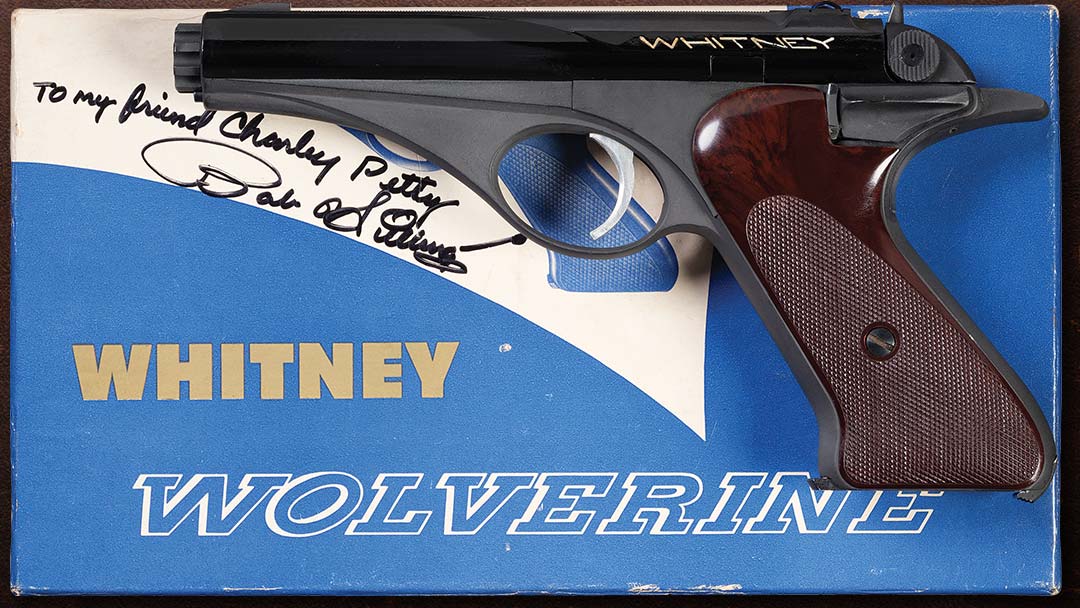
The Whitney pistol of 1956 is remembered for how it looks. It has been called a ray gun since the year it appeared, it is the pistol collectors reach for when they want to show what “space age” meant in American industrial design, and it was sold under at least five names in the two years it was in production. Behind the look is a single designer, Robert Lee Hillberg, who had spent the previous fifteen years designing gun mounts, feed systems and cannon installations for aircraft companies. That career is the key to the pistol. The frame is a precision aluminium casting because Hillberg had worked with aluminium castings in aircraft armament. The action is a self-contained tube slid into that casting because a gun deck is built the same way. And the styling is not a skin applied to a conventional pistol: the look is what the construction method produced.
This volume follows Hillberg from a boyhood in Minnesota to the Whitney and past it. Volume 2 takes up the company, its financing and its collapse; Volume 4 takes up the styling as design history.
1.1 The Pistol in One Table
Figures for the original are from the period record: the August 1956 Guns magazine report, which was written with the company’s cooperation, and the period advertising. Later figures are attributed where they differ.
Table 1 — The Pistol in One Table
| Designer | Robert L. Hillberg (1917–2012) |
| Makers | Whitney Firearms, Inc., North Haven, Connecticut (marked New Haven), a subsidiary of the Bellmore-Johnson Tool Co.; then Whitney Firearms Co. under Charles E. Lowe Sr. (Volume 2) |
| Designed | ”late spring of 1954” (Guns, 1956); 1953 (Olympic Arms manual, and later secondary sources) |
| In production | 1956 to 1957 or 1958; sold at retail until about 1962 (Volume 2 gives each source’s dates separately) |
| Made | 13,371 (the figure most sources give, traced to Taglienti’s 2008 book); “slightly more than 13,000” (American Rifleman, 2022); 10,793 of them before the company was sold (RIA, citing Taglienti) |
| Cartridge | .22 Long Rifle |
| Operation | Straight blowback; fixed barrel; bolt pinned to a sleeve that reciprocates inside the frame (Volume 5) |
| Magazine | 10-round single column, heel catch |
| Barrel | 4⅝ in |
| Overall length | 9 in |
| Weight | 23 oz |
| Frame | One-piece “dural precision cast” aluminium alloy; “die-cast” in the same article’s captions; investment cast by Alcoa in later accounts (Volume 4) |
| Finishes | Two-tone black-grey anodizing; a “mirror bright” option with a gold trigger (Volume 3) |
| Price, 1956 | $39.95 blued. The bright finish: $44.95 in a Whitney advertisement; $49.95 in American Rifleman, 2022 (Volume 3) |
| Reissue | Olympic Arms, Olympia, Washington, polymer frame, 2004 or 2005 to 2017 (Volume 7) |
The pistol was never a commercial success, and Volume 2 explains why a well-received pistol at a competitive price still failed. It is the design that has lasted, which is why the design gets the space.
1.2 Why Begin With the Designer
Most pistols are the product of a company that had made pistols before. The Whitney was not. It was designed by one man, tooled by a machine shop, sold by a mail-order distributor and made in a factory that had not existed a year earlier. Its unusual features — the cast one-piece frame, the fixed barrel held by a nut at the muzzle, the tube that carries the action and slides out of the back, the magazine that carries its own bullet guide — are each decisions that a conventional pistol maker, with conventional machine tools already paid for, had no reason to take. They make sense from Hillberg’s side, and the record of his career is unusually good, because he gave long interviews in 1956 and in his last years, and because two firearms historians, Don Findley and Antonio Taglienti, wrote about him at book length.
The sources used here, and their limits:
- William B. Edwards, “The Oldest Name in Guns Comes Back”, Guns, August 1956. A contemporary account written after visiting the company, with long quotations from Hillberg and from the company’s promotional booklet. It is not independent — it reads in places as a press release — but it is the only account written while the pistol was being made, and it is the source for most of what follows about Hillberg’s own view of his work.1
- Don Findley, profile in Gun Digest (2008, republished 2012) and “Remembering Gun Designer Robert Lee Hillberg”, American Rifleman, 2024. Findley wrote The Whitney Pistol, a book that could not be obtained for these volumes.23
- Antonio J. Taglienti, The Whitney Wolverine .22 Caliber Semi-Automatic Pistol (Andrew Mowbray, 2008). Described by Rock Island Auction as “the authoritative work”. It was not obtained either; it is cited here only where Rock Island Auction’s lot descriptions and blog quote it, and those quotations are attributed as such.4
1.3 Minneapolis, a Friend’s Collection, and a .38 Super Submachine Gun
Hillberg was born on 27 August 1917 in Anamosa, Iowa, and grew up in Minneapolis.3 The sources describe his father differently. Guns in 1956 calls him “the son of a Minneapolis banker who used to spend much time hunting and fishing”.1 Rock Island Auction’s account, drawn from Taglienti, credits the father as an outdoorsman whose “accomplishments as an artist and draftsman” gave the boy his start in mechanical drawing, and records the gift of a 20-gauge shotgun that the high-school junior took apart and reassembled “countless” times.4 The two are not incompatible, and neither is corroborated by a document seen here.
Guns gives the credit for his introduction to gun design to a friend: “middle-western marksman Bill Schutte, had a gun collection. Young Bob studied the ideas and mechanical principles of the many pistols. The ideas, good and bad, stuck with him.”1 He studied engineering at the University of Minnesota for several years — the School of Mines, as a mining-engineering student, in the RIA account — and did not take a degree in firearms design, which did not exist.4
The first gun he designed was a submachine gun. The 1956 article says he “designed a .38 Super caliber tommy gun, and sent it in to Colt in 1937.”1 RIA, following Taglienti, adds that he built the working model in 1936–37 in the machine shop of the Naval Air Station at Wold-Chamberlain Field, Minneapolis, to which his duties as a naval reservist gave him access, and took it to Hartford in the summer of 1938.4 Findley’s 2024 obituary piece gives “1937: U.S. Navy Reservist; designed .38-cal. machine gun prototype”.3 One widely copied summary calls the gun a .357 Magnum submachine gun; the two sources closest to Hillberg both say .38 Super, and that is the calibre used here.
Colt did not want the gun. It wanted the designer.
1.4 Colt, Pratt & Whitney and Bell: the Aircraft Years
At Colt from 1938, Hillberg worked in engineering, assembly, inspection and manufacturing. Findley records two design jobs from those years: a short action for a Colt revolver, and a seven-eighths-scale .22 version of the Single Action Army.2 Guns put the value of the period plainly: “As an assembler he learned the fine points of putting a gun together.”1
In 1940 he moved to the engineering department of Pratt & Whitney Aircraft in East Hartford, working on engine components and experimental aircraft installations, and began two projects of his own: a 20 mm aircraft cannon and a .30 calibre carbine.2 In 1942 he went to Bell Aircraft’s ordnance division as a project engineer — Findley places it in Burlington, Vermont — where the work, in Taglienti’s list as quoted by RIA, was “Boeing B-17 turrets, .50 cal machine gun feeding systems, gun mounts, boosters, gun sight systems, bomb racks, rocket releases, and a 20 mm continuous belt feed mechanism for submarines and anti-aircraft guns.”42
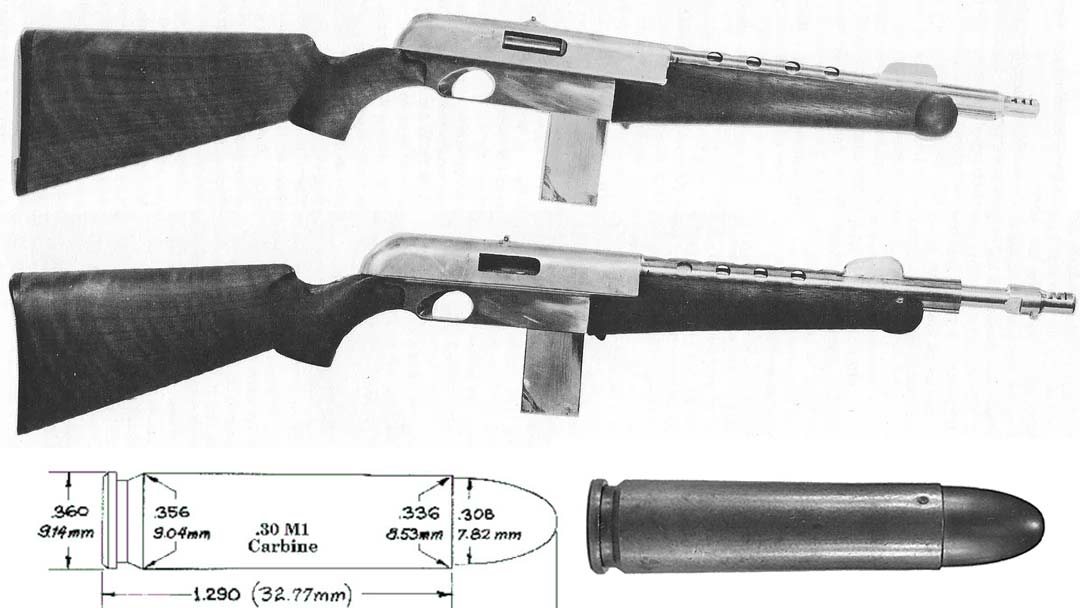
The carbine was completed at Bell. It was a semi- and full-automatic .30 calibre shoulder arm “with the barrel as the only moving part”, and Hillberg was emphatic about what it was: “the gun was not a ‘blow forward’, so much as a lock-breech type with a gas-operated forward moving barrel.”1 Findley says it lost to Winchester’s design in the Army’s light-rifle competition, which produced the M1 carbine; RIA adds that Canada and the Soviet Union showed interest before the war ended.24
The 1956 caption to a photograph of this carbine contains the first recorded link between Hillberg’s wartime work and the Whitney’s look: the carbine “used style curves which were later dominant in Whitney pistol”.1 The pistol’s shape, in other words, was not invented for the pistol. It was a designer’s habit that predates it by a decade.
1.5 Republic Aviation and the Tri-Matic
Bell closed its ordnance division at the end of the war. In 1947 Hillberg went to Republic Aviation at Farmingdale, Long Island, and was placed in charge of its armament group.31 Findley’s account lists the work: the gun deck of the F-84 Thunderjet, armament unit leader on the F-91 programme, rocket systems and bomb racks, and consultancy on armament for advanced fighters.2
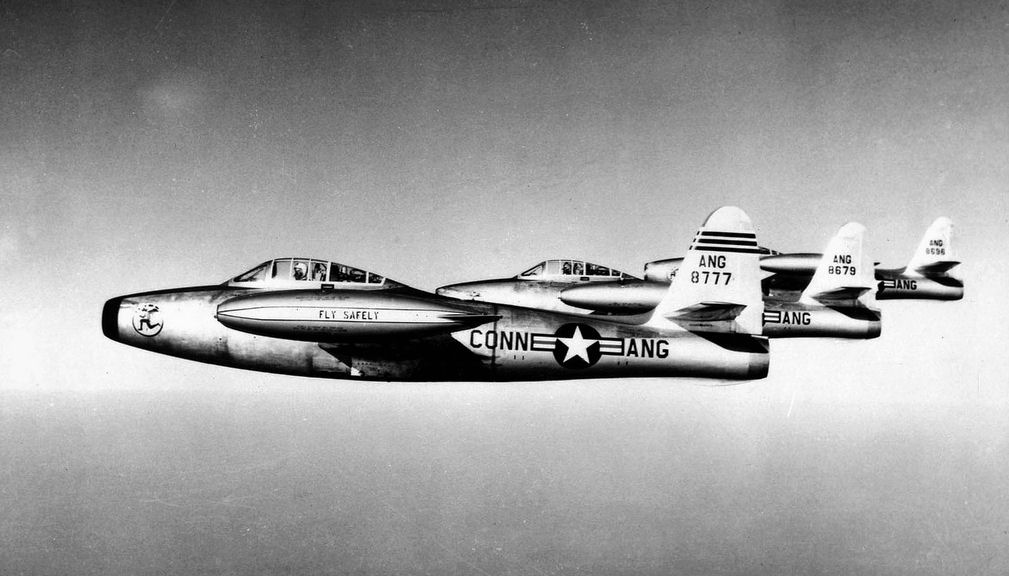
He described it to Guns as “one of the most important jobs I have ever held”:
“We learned that ground weapons don’t necessarily work when carried up into the air. Feed problems had to be corrected. In one project the muzzle blast ripped off the cowling and we had to do some extensive redesigning.”1
Three lessons of that work are visible in the Whitney. Aircraft armament is installed, not built in place: a gun, its feed and its mount go into a structure as units and come out as units for service. Aircraft structure is aluminium, and in the war years a great deal of it was cast. And feed is where aircraft guns failed. Every one of those shows up in the pistol: the whole action is a self-contained unit that slides into an aluminium casting from the rear and comes out the same way (Volume 5), and the magazine was designed around the feed problem of a rimmed .22 cartridge to a degree no contemporary .22 was (Volume 5).
The link between the aircraft years and aluminium castings is also the one secondary sources repeat. Wikipedia’s article says Hillberg “learned about aluminum casting during WWII while working with aircraft guns”; a collector’s account on a Smith & Wesson forum puts the same claim on the P-47 fighter.5 No primary source seen here names a specific cast part he worked on, and the P-47 detail is unsupported, but the general point — that his wartime work was in an aluminium-structure industry — is not in doubt.
At home, at Republic, he designed pistols. The one that mattered was the Tri-Matic: a pocket pistol with a hinged barrel whose chamber could be loaded without pulling back the slide, and whose barrels, magazines and ejectors could be exchanged to fire three calibres. Guns gives .22, .32 and .380; RIA gives .25, .32 and .380, and adds that Hillberg had noticed the three cartridges’ overall lengths were nearly the same.14 The 1956 article presented it as the solution to a problem “studied since at least 1908”, when the White-Merrill experimental pistols were patented with interchangeable barrels for several calibres, and said the change could be made in 30 seconds.1
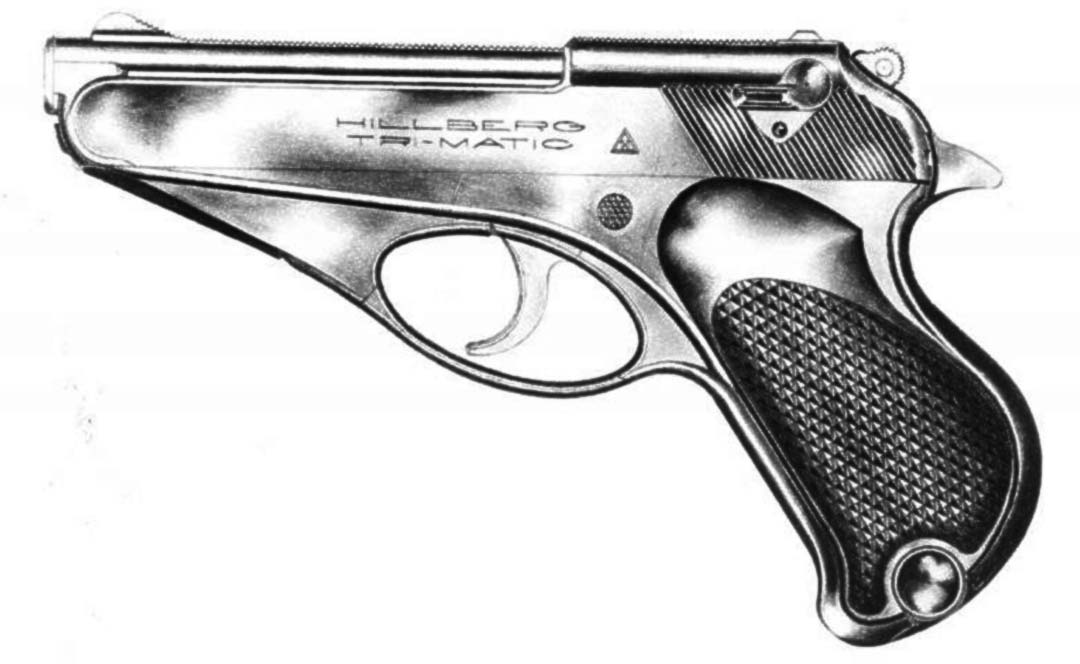
The Tri-Matic “never got off the ground, but the name was borrowed later”, Guns reported: applied to the sporting .22 that became the Whitney, “it served to keep competitors guessing”.1 It is the first of the pistol’s five names.
Hillberg’s calibre opinions from the same interview show the engineer who would later spend three decades on shotguns and expert-witness work: “All the companies underload the .380 miserably,” he argued. “The .380 with a 90-grain bullet could, considering improved powders we have developed since John Browning designed the little pill fifty years ago, be boosted along to give darn near the muzzle energy of a .45.”1 That is a period opinion, reproduced as one, and not a load recommendation.
1.6 High Standard, 1951
Hillberg left the aircraft industry in 1951 for the High Standard Manufacturing Company in Hamden, Connecticut, as head of research and development.3 RIA says he went intending to put the Tri-Matic into production and was kept busy with other work instead.4 Findley lists that work: the T-152 tank machine gun, which became the M37; a 9 mm T-3 double-action pistol for the Army’s trials of a replacement for the M1911A1; a .22 semi-automatic rifle; and what Findley calls the “world’s first commercial gas-operated semi-auto shotgun”.2 Guns added that the job meant coordinating designs for Sears, Roebuck’s J. C. Higgins line, which High Standard made.1
Two claims attached to this period in secondary sources could not be confirmed and are not repeated as fact. Wikipedia’s lead lists the M60 machine gun among Hillberg’s designs, without a source; Findley’s list, which is the fullest available, credits him with the High Standard tank gun that became the M37, not with the M60. And the same lead lists the Wildey gas-operated .45 pistol, again without support in the sources seen here.
The High Standard period supplied the last ingredient the Whitney needed: it put Hillberg in contact with a machine shop. In developing military arms, RIA records, he “became familiar with a machining company called Bellmore-Johnson Tool Company”.4
1.7 Bellmore-Johnson and the Whitney
Guns described the Bellmore-Johnson Tool Co. as “a name unknown outside the gun industry” that “makes tools for production and builds experimental firearms from pocket pistols to aircraft cannon for private firms, inventors and government agencies”.1 Hillberg joined it as chief engineer in 1954, according to RIA and Findley, and “finally had a chance to work on some of his pet ideas”.431 The partner who matters in what follows is Howard (“Howie”) Johnson of the firm.
Guns dates the design of the Whitney precisely: “a truly new design, developed in the late spring of 1954 at Bellmore Johnson”.1 Hillberg’s own patent application for its action was filed on 1 July 1954, which fits.6 The Olympic Arms manual, and many sources after it, say 1953; RIA’s account has Hillberg “putting pen to paper” after joining the firm in 1954 and working out the kinks into 1955, when the first prototype — still called the Tri-Matic — was made by hand and given serial number 1.74 The difference is small and the 1954 filing date is the one fixed point.
Findley, who knew him, gives Hillberg’s title at Whitney Firearms as vice-president and chief engineer from 1954 to 1957.2 Volume 2 tells the business story. The design story is short: the pistol was finished in 1955, went into production in 1956, and was praised by every gun-press editor its distributor chose to quote — Firearms Directory, American Rifleman, Guns, Sports Afield and Outdoor Life all appear in the advertising (Volume 2).
1.8 After the Whitney: Liberator, Defender, COP
When Whitney Firearms was sold in 1957, Hillberg stayed at Bellmore-Johnson — by then at Cheshire, Connecticut — as chief engineer until 1980, running what Findley calls a firearm consultancy and design service whose clients included major American gun makers and Pentagon agencies.2 The work Findley lists includes combat and sporting shotguns, rifles, handguns, double-action revolvers for Browning and Winchester, and a pump-action shotgun, the Model J, with selectable ejection ports, which was tested in Vietnam.2
The designs he is best remembered for from this period are small, multi-barrelled and aimed at unusual users:
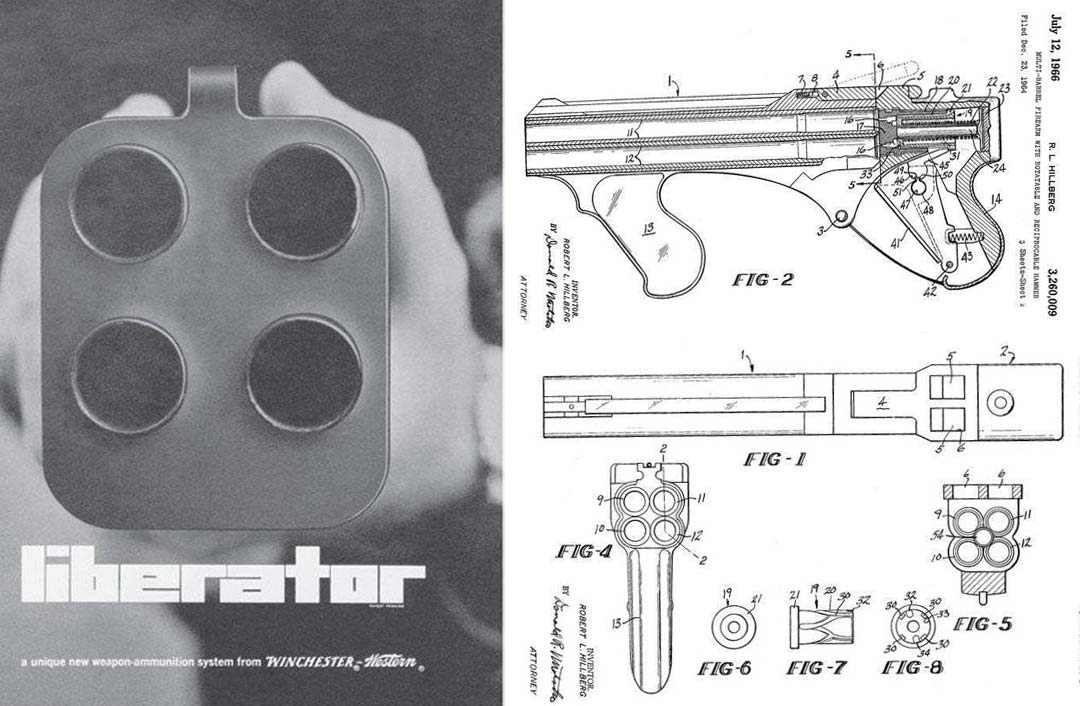
- The Winchester Liberator. A multi-barrel shotgun designed, like Hillberg’s other insurgency weapons, to be distributed covertly to partisan forces (Wikipedia’s summary of Houze). RIA dates the concept to 1962 and says Hillberg took his inspiration from the Ethan Allen pepperbox; Herbert Houze’s history of Winchester treats the programme at length.48 Hillberg’s patent US 3,260,009, “multi-barrel firearm with rotatable and reciprocable hammer”, issued in 1966 and was assigned to Olin Mathieson, Winchester’s parent.9 In RIA’s phrase it “saw no real lifespan”.
- The Colt Defender Mark I. An eight-barrelled 20-gauge shotgun for law enforcement, introduced — in RIA’s account — during a recession and dropped in 1971.4
- The COP .357 Derringer. A four-barrelled .357 Magnum pistol for police back-up use, designed in 1980 and made by COP Inc. of Torrance, California. It was produced, but was judged too heavy and bulky for its role, with a heavy double-action pull that Hillberg regarded as essential for simplicity.410
From 1980 he worked as an independent expert witness in firearms litigation, and he was, at his death, a retired deputy sheriff.211 Findley credits him with more than 36 domestic and foreign patents.2 He died on 12 August 2012, aged 94.3 Asked late in life which of his designs he was proudest of, he answered, “The Whitney pistol.”2
1.9 Two Liberators, No Connection
The hub carries a dive on the FP-45 Liberator, the single-shot .45 pistol stamped out by General Motors’ Guide Lamp division in 1942 for dropping to resistance forces; it is set out in the FP-45 Liberator dive’s history volume, which credits the design to George Hyde. Hillberg’s Winchester Liberator had the same purpose twenty years later and uses the same name, and the resemblance invites the assumption that Hillberg had something to do with the first one.
No source consulted connects Hillberg to the FP-45. In 1942 he was at Bell Aircraft working on B-17 turrets and belt feeds. The shared name reflects a shared mission — an arm for partisans — not a shared designer, and nothing here should be read as asserting a link.
1.10 What the Career Explains About the Pistol
Read in order, Hillberg’s jobs explain the Whitney’s four defining features without needing any appeal to fashion:
- Aluminium, cast. Twelve years in aircraft armament, in an industry built on light alloys, made a cast aluminium frame an ordinary choice to him and an eccentric one to the gun trade. The company’s own booklet argued the case in cost terms (Volume 4).
- The action as an installed unit. Gun decks, turrets and mounts are assemblies that go into a structure and come out for service. The Whitney’s barrel, sleeve, bolt and spring slide into the frame from the back as one unit and are held by one nut (Volume 5).
- Feed as the first problem. At Bell and Republic the recurring failures were feed failures. The Whitney’s magazine carries its own bullet guide and holds its cartridges parallel so that rims cannot lock (Volume 5).
- Curves. The 1956 article saw the Whitney’s lines already in his wartime carbine, and they are visible in the Tri-Matic. The styling is his, and it came before the pistol (Volume 4).
And one feature of his career explains the business failure that follows in Volume 2. Hillberg was an employee engineer for twenty years before the Whitney. The company that made it was organised by engineers, financed by a bank on the strength of one distributor’s letter, and sold through that one distributor. Guns called him “a novice manufacturer, yet anything but a novice about guns”.1 Both halves of that sentence turned out to be true.
References
Footnotes
-
William B. Edwards, “The Oldest Name in Guns Comes Back”, Guns, August 1956, pp. 24–27, 66–69. Retrieved 2026-09-19 from the Internet Archive copy of the publisher’s PDF, https://web.archive.org/web/20160304110716/http://www.gunsmagazine.com/1956issues/G0856.pdf . Text taken from the scan’s OCR and checked against context; the article was written with the company’s cooperation and quotes its promotional booklet. ↩ ↩2 ↩3 ↩4 ↩5 ↩6 ↩7 ↩8 ↩9 ↩10 ↩11 ↩12 ↩13 ↩14 ↩15 ↩16 ↩17 ↩18
-
Don Findley, profile of Robert L. Hillberg, Gun Digest (2008 annual), republished as “Robert Hillberg, Firearms Designer, 1917–2012”, 4 September 2012, https://gundigest.com/article/robert-hillberg-1917-2012 , consulted 2026-09-19. ↩ ↩2 ↩3 ↩4 ↩5 ↩6 ↩7 ↩8 ↩9 ↩10 ↩11 ↩12 ↩13
-
Don Findley, “Remembering Gun Designer Robert Lee Hillberg”, American Rifleman, 8 January 2024, https://www.americanrifleman.org/content/remembering-gun-designer-robert-lee-hillberg/ , consulted 2026-09-19. ↩ ↩2 ↩3 ↩4 ↩5 ↩6 ↩7
-
Rock Island Auction Company, “Rise and Fall of the Whitney Wolverine” (first published 30 May 2014, updated with sales to December 2025), https://www.rockislandauction.com/riac-blog/rise-and-fall-of-the-whitney-wolverine , retrieved 2026-09-19. Relies throughout on Antonio J. Taglienti, The Whitney Wolverine .22 Caliber Semi-Automatic Pistol (Woonsocket, RI: Andrew Mowbray, 2008), which was not obtained. ↩ ↩2 ↩3 ↩4 ↩5 ↩6 ↩7 ↩8 ↩9 ↩10 ↩11 ↩12 ↩13 ↩14
-
“Ahead of its time: The Whitney Wolverine pistol”, Smith & Wesson Forum, Lounge thread 210508, archived 7 April 2015, https://web.archive.org/web/20150407043719/http://smith-wessonforum.com/lounge/210508-ahead-its-time-whitney-wolverine-pistol-pics-box-now-included.html . A collector’s post; cited only for what it claims, not as evidence. ↩
-
R. L. Hillberg, US Patent 3,060,810, “Sear Mechanism Disconnected by Breech Block Motion”, original application filed 1 July 1954 (Ser. No. 440,601), issued 30 October 1962, https://patentimages.storage.googleapis.com/pdfs/US3060810.pdf , retrieved 2026-09-19. ↩
-
Olympic Arms, Inc., Whitney Wolverine Owner’s Manual, Rev 7/05, “Whitney History”, retrieved 2026-09-19 from https://web.archive.org/web/2016/https://www.vintagegunleather.com/gun-manuals/pdf_O/olympic_whitney_wolverine.pdf . ↩
-
Herbert G. Houze, Winchester Repeating Arms Company (Iola, WI: Gun Digest Books, 2011), pp. 309–312, as cited by the Wikipedia article on Hillberg; not consulted directly. ↩
-
US Patent 3,260,009 (Hillberg, 1966, assigned to Olin Mathieson Chemical Corporation), as listed in Wikipedia, “Robert Hillberg”, https://en.wikipedia.org/wiki/Robert_Hillberg , consulted 2026-09-19. The patent itself was not opened. ↩
-
Internet Movie Firearms Database, “COP 357 Derringer”, queried through its API 2026-09-19. ↩
-
Wikipedia, “Robert Hillberg”, consulted 2026-09-19, citing Hillberg’s obituaries in the Republican-American (Waterbury) and New Haven Register, 16 August 2012. ↩
Comments (0)