Springfield Armory XD(M) .40 · Volume 7
Working Parts — the Cycle of Operation, Wear, Malfunctions and Repair
What happens between trigger and ejection, what wears, what breaks, and where the maker's own documentation stops
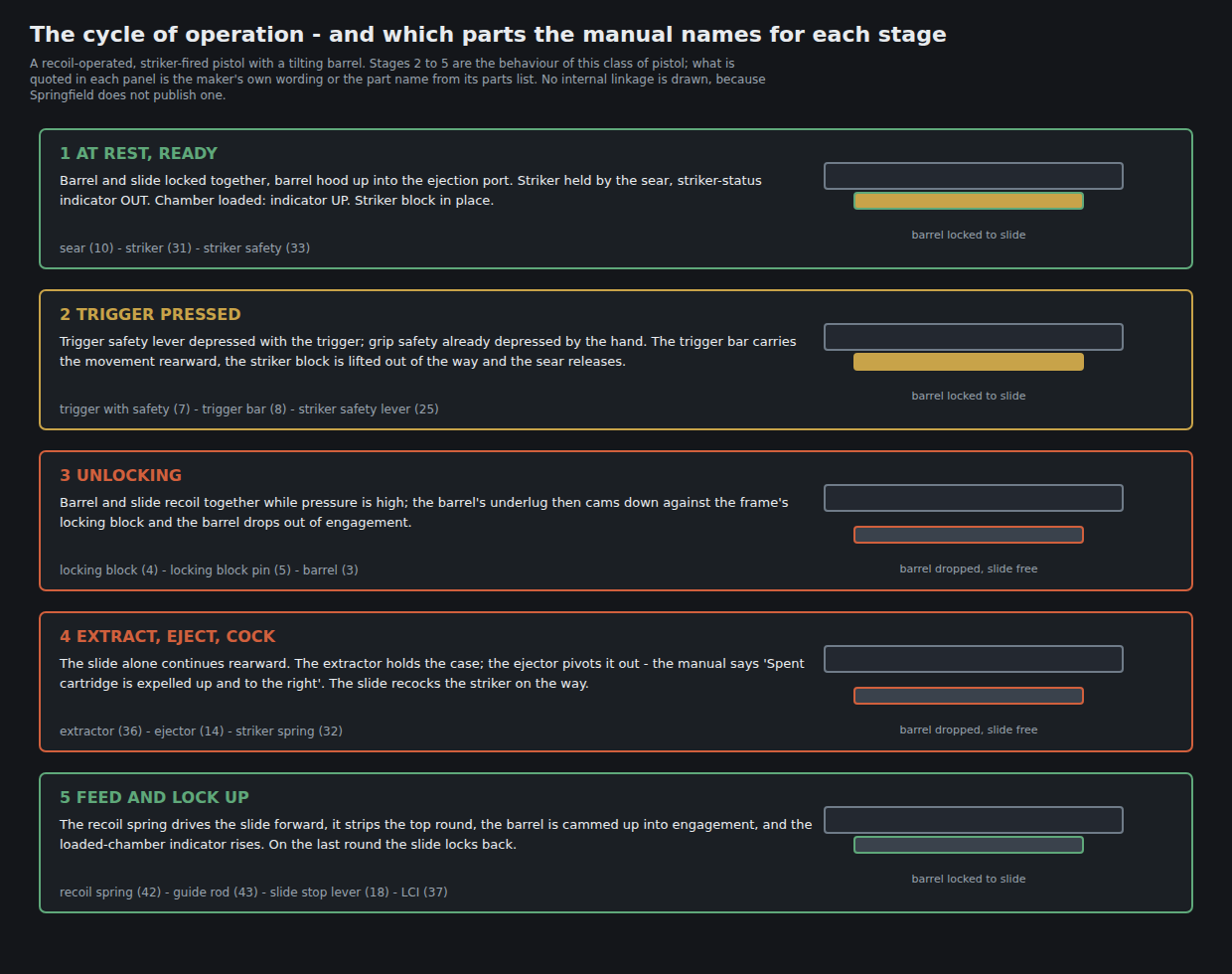
Volume 2 took the XD(M)‘s controls one at a time, from the maker’s own manual, and stopped where the manual stops. This volume goes round the cycle: what moves, in what order, from a loaded chamber to a fresh round in it — then what that cycle costs in wear, what goes wrong, how the maker says to diagnose it, and who is allowed to fix what.
The theme of both volumes is the same. Springfield publishes an owner’s manual and nothing deeper. There is no armourer’s manual, no exploded engineering drawing with a text description, and no patent was obtainable for this work. A great deal of confident internal description circulates anyway. None of it is repeated here.
7.1 What Is Documented, and What Is Not
Documented, and used below: the manual’s statements about each control, its parts lists and part numbers, its loading, firing, unloading, malfunction, field-strip, reassembly, magazine and cleaning procedures, and its warranty; Springfield’s published specifications per model; and one description of the action type from the American press — “This pistol is a recoil-operated, striker-fired semi-automatic that’s manufactured in Croatia.”1
Not documented anywhere consulted: which part blocks which, the sear geometry, the exact path of the trigger bar, the shape of the striker safety lever’s cam, or any spring rate. Google Patents’ query service returned an error to every request made for this work, so no patent is cited. Where §7.2 describes a stage in terms of what a recoil-operated tilting-barrel pistol does, it says so; the part names in each panel come from the manual’s list, and the quoted phrases are the manual’s.
7.2 The Cycle of Operation, Stage by Stage
Stage 1 — at rest, ready. A round is chambered, the barrel is locked to the slide, and the loaded-chamber indicator is up. The slide has cocked the striker; the striker-status indicator protrudes from the rear of the slide.2 The striker is held by the sear (10), and the internal striker safety (33) — the striker block — stands in the striker’s path until the trigger is pulled.2
Stage 2 — the trigger is pressed. Three conditions must be met at once, and Volume 2 §2.3 sets them out: the grip safety depressed by the hand, the trigger safety lever depressed by the finger, and the trigger itself pulled through. The trigger bar (8) carries that movement rearward; the striker safety lever (25) lifts the striker block clear; the sear releases the striker. The manual states the result of all three conditions rather than the linkage that produces it.
Stage 3 — unlocking. The cartridge fires; barrel and slide recoil together for the first fraction of an inch, while pressure in the case is still high. Then the barrel’s underlug meets the frame’s locking block (4), which is pinned into the frame by the locking block pin (5), and the barrel is cammed downward out of engagement with the slide. This is the Browning-type unlocking the family inherited: the HS 95, the XD’s direct ancestor, is described in the Croatian account as having adopted “Browning-derived locking with oscillating barrel”.3 That the frame parts list contains a locking block and its pin is the evidence for it here — Springfield describes no lockwork.
Stage 4 — extract, eject, recock. The slide alone now runs rearward. The extractor (36) holds the case head against the breech face until the case meets the ejector (14), which pivots it out of the port; the manual says where it goes — “Spent cartridge is expelled up and to the right.”2 On the way back, the slide recocks the striker against the striker spring (32), which is why the striker-status indicator is out again before the slide has returned.
Stage 5 — feed and lock up. The recoil spring (42) on its guide rod (43) drives the slide forward; the breech face strips the top round from the magazine and runs it up the feed ramp; the barrel is cammed back up into engagement; the loaded-chamber indicator rises. The manual: “Pistol will automatically be ready to fire again after each shot until all cartridges loaded in magazine have been fired,” and “When last cartridge has been fired, slide will lock open and remain to rear” — the slide stop lever (18) being raised by the empty magazine’s follower.2
Two properties of the cycle matter to the owner of this particular pistol. The trigger must be released and allowed to reset between shots — the “minimal reset” Springfield advertised and the shorter reset the aftermarket kit claims (Volume 4 §4.3). And the cycle does not care whether a magazine is present: “This firearm is able to fire with or without the magazine in place.”2
7.3 Where the Safeties Sit in That Cycle
Three points, all from Volume 2, restated here because they are cycle events rather than static facts:
- The grip safety must be held depressed for the whole cycle. Release it between shots — a very light, high grip on a pistol with a heavy .40 impulse — and the manual’s own statement applies: the pistol will not fire even if the trigger is pulled.2
- The striker block is lifted only while the trigger is pressed. It returns as the trigger resets, so a cocked pistol at rest is blocked again.
- The trigger safety is not a cycle event; it simply has to be depressed at the same time as the trigger, every time.
7.4 Detail Strip — Where the Manual Stops
Volume 6 §6.3 gives the field strip, exactly as Springfield prints it. What Springfield does not print is any further disassembly. Its own words, at the end of the field-strip sequence: “Further dismantling is not necessary and should only be done by Springfield, Inc. or a qualified pistolsmith.”2
No detail-strip sequence is reproduced here, because no citable one was obtained. The 2009 manual matching this pistol’s vintage could not be retrieved intact; no armourer’s manual exists publicly; and a plausible-sounding sequence written from memory is precisely the failure this hub has committed before.
What a reader who obtains a procedure should check it accounts for:
- The striker assembly in the slide. The parts list names a striker locking plate (27), a striker spring guide (28), a striker dampening spring (30) and a striker retainer pin (35). A procedure that does not mention a retaining plate at the rear of the slide and a spring under compression behind the striker is not describing this pistol.
- The striker safety (33) and its spring (34), which sit in the slide above the striker’s path and are small, easy to lose and easy to reassemble backwards.
- The extractor (36) and whatever retains it.
- In the frame: the sear (10) and sear pin (11), the trigger and trigger bar with their pins, the grip safety (15) and grip safety pin (16), the ejector and ejector pin, and the locking block and its pin. The Powder River Precision kit fitted to this pistol replaces two of those frame parts and three springs (Volume 4 §4.2), which means fitting that kit is a frame disassembly, not a field strip.
- The loaded-chamber indicator (37) with its pin (38) and spring (39), which lives in the slide and is a part most owners never see.
A note that follows from that list rather than from any source: the fire-control parts of this pistol are small, spring-loaded and mostly captive under other parts. An owner who has never had the frame apart should not first attempt it on a pistol that is carried or kept loaded.
7.5 What Wears, and the Intervals Nobody Publishes
🔴 Springfield publishes no replacement interval for any part of this pistol. The manual’s only wear statement is about dry fire: “Extensively dry firing can accelerate component wear/stress. Use snap caps if dry firing on a regular basis.”2 No round count for the recoil spring, no magazine spring life, nothing. No interval is invented here. What follows is a list of what wears on this design and how to tell, not a schedule.
Table 1 — 7.5 What Wears, and the Intervals Nobody Publishes
| Part | How it shows | Notes |
|---|---|---|
| Recoil spring (42) | Brass thrown further and harder than it used to be; slide returning to battery sluggishly; increasing battering at the frame’s rear | A consumable on every recoil-operated pistol. No Springfield interval exists; the .40’s impulse is harder on it than 9 mm’s |
| Magazine spring and follower | Last-round failures to lock back, rounds nosing up under the feed lips, sluggish feeding when fully loaded | The manual’s own malfunction list points here first: check that the spring “should hold the follower tightly against the lips of the magazine” |
| Magazine feed lips | The manual: check they “are free of nicks and burrs and are not deformed” | A dropped loaded magazine is the usual cause |
| Extractor (36) and its spring | Erratic ejection, cases left in the port, extractor marks changing character | The manual names the extractor as a place to clean, not to adjust |
| Striker spring (32) | Light strikes — and on this pistol the aftermarket kit has already changed this spring (Volume 4 §4.5) | Any light strike here is a question about which spring is fitted before it is a question about primers |
| Striker safety (33) and lever (25) | Nothing visible; a failure here is a safety failure, not a function one | The kit lightened this spring too; Volume 4 §4.4 |
| Melonite finish | Wear at the muzzle, breech face, rails and holster contact points | A salt-bath nitride surface treatment, not a plating; wear is cosmetic until it exposes bare steel that then rusts |
| Backstrap roll pin | A backstrap that rattles or shifts | Removed and refitted every time the backstrap is changed (Volume 6) |
| Polymer frame rails | Slide play; unusual wear tracks in the frame inserts | The one wear item that ends a polymer pistol’s life rather than being replaced at the bench |
The sensible practice that follows is the one that costs nothing: write down the round count and what was replaced, with dates. Volume 6 §6.10 lists what else is worth recording about this pistol.
7.6 An Inspection Schedule Assembled From the Manual
There is no maker’s schedule, so the list below is assembled from the manual’s own instructions and says where each line comes from. It is a schedule of inspections, not of replacements.
- Every time the pistol is picked up: confirm its state from the two indicators (Volume 2 §2.7) — chamber indicator for a round, striker indicator for the striker.
- Before firing: “Before shooting, be sure the barrel is clear of obstructions, including excessive oil and grease.”2 And, if a shot ever sounds weak: “it could mean a bullet is in the chamber/bore. The gun should be immediately unloaded and the chamber/bore checked for obstructions before refiring.”2
- After each range session: the cleaning sequence in Volume 6 §6.6, with attention to the four places the manual names for malfunction cleaning — breech face, extractor, chamber and feed ramp.
- Every three to four months, or sooner if dirty: strip and clean the magazines — the manual’s only stated interval.2
- At every cleaning, by eye: magazine feed lips and follower; extractor and breech face; the frame rails; the muzzle crown; the striker channel dry (the manual: “DO NOT APPLY OIL OR GREASE TO STRIKER”).2
- After any reassembly, and after any parts change: the behaviour checks in Volume 4 §4.6, each of which is a statement the manual makes about how the pistol must behave.
- Whenever the pistol is dropped: “If it falls, it may fire. If you do drop it, unload it and examine it to be sure it works correctly. Do not attempt to fire it again until you have completed this safety check.”2
7.7 Malfunctions and Their Diagnosis
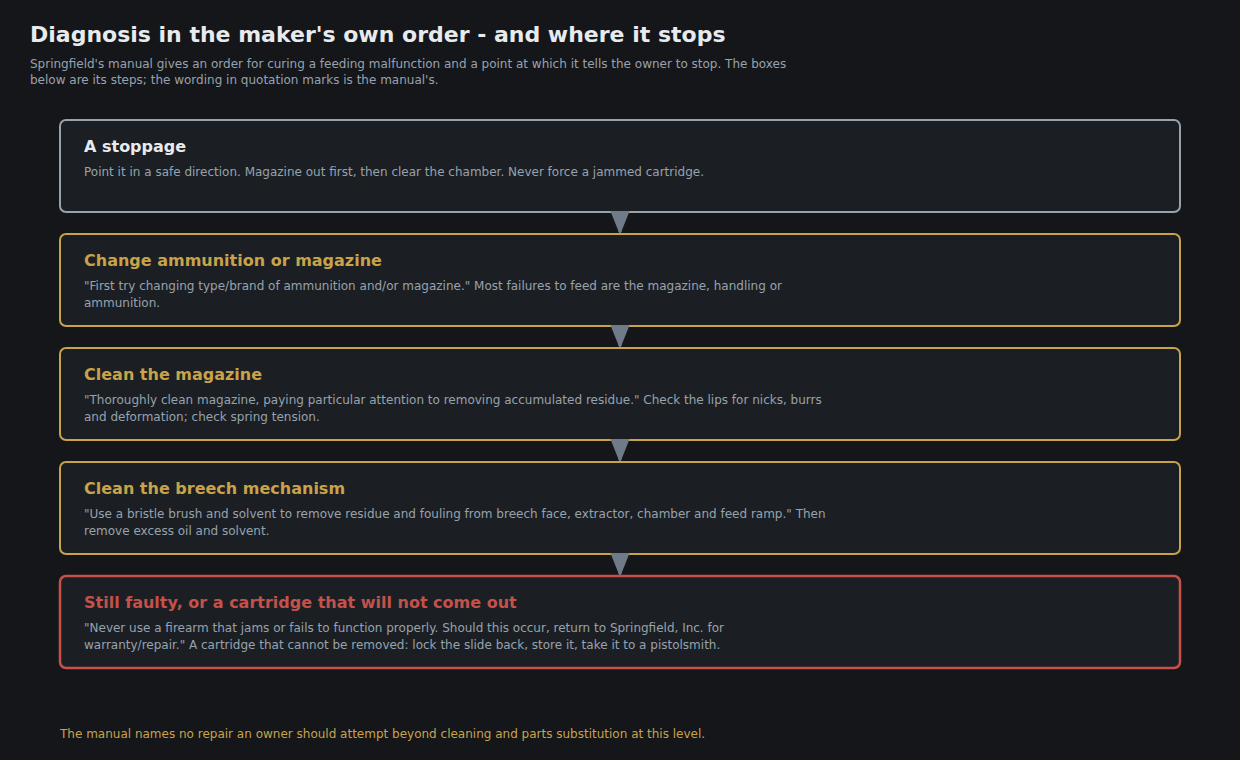
The manual’s diagnostic order is unusual in a good way: it starts with the ammunition and the magazine, not with the pistol. “Most failures to feed or chamber a cartridge are the result of a damaged magazine, improper firearm handling or defective ammunition,” and the first remedy offered is “changing type/brand of ammunition and/or magazine.”2 Only then does it reach cleaning, and it reaches the factory before it reaches any adjustment by the owner.
Four failure modes deserve more than the manual gives them, because each has a cause specific to this pistol or this cartridge.
A failure to fire with a good primer strike is not a light strike; it is ammunition. A failure to fire with a shallow strike, on a pistol with the aftermarket kit, is the striker spring question of Volume 4 §4.5, and the diagnostic order there is: which striker spring is fitted first, primer seating second, primer hardness third. Either way, the manual’s hang-fire rule applies before the action is opened: keep it pointed at the target for at least 30 seconds.2
A failure to extract or eject sends attention to a dirty chamber before the extractor. On a .40 fed handloads, the chamber is also where over-long or bulged brass shows up — The Reloading Bench’s culling rules are in Volume 15, and §3.8 of this dive asks the owner to look at this pistol’s own fired cases for a base bulge.
A failure to feed that follows a magazine change is the magazine, and numbering the magazines turns a mystery into a retired part. Volume 6 §6.7.
A failure of the slide to lock back on the last round is a magazine follower or spring question before it is a slide-stop question — the same first suspect.
Three things the manual forbids, worth restating because each is a way owners convert a small problem into a large one: do not force a jammed cartridge into the chamber by pushing or striking the slide; do not chamber a round by dropping it into the chamber by hand (“may cause accidental discharge and possible damage to the extractor”); and do not cover the ejection port with a hand while loading or unloading.2
7.8 Repair: Bench, Gunsmith, Factory
What the manual leaves to the owner is, in effect: cleaning, lubrication, magazine disassembly and cleaning, backstrap changes, field strip and reassembly, and swapping ammunition and magazines to cure a malfunction. Nothing else is described.
What it sends to a gunsmith is anything further: “Further dismantling is not necessary and should only be done by Springfield, Inc. or a qualified pistolsmith”; and a cartridge that cannot be removed — “lock slide back, carefully store your firearm and magazines and take it to a pistolsmith.”2 Fitting the aftermarket trigger kit is in this class by the manual’s own logic (§7.4), whatever its “drop-in” name suggests.
What it sends to the factory is a pistol that does not work and a barrel that is damaged: “Never use a firearm that jams or fails to function properly. Should this occur, return to Springfield, Inc. for warranty/repair”; and “An obstructed, cracked or damaged barrel should never be used and the firearm should be returned to Springfield for inspection.”2
The warranty route, from the manual: notify Springfield by telephone (800-680-6866), email ([email protected]), fax or mail to Geneseo, Illinois, with a written description of the defect; “Once we receive Your notification … we will provide You with a shipping coupon (so that we can pay for the shipping) and instructions on how to return Your Product for service.” The warranty runs for as long as the original retail purchaser owns the pistol, and proof of purchase is required.2 A separate Consumer Safety Department number, (309) 944-5631, is printed for questions about the manual itself.
And the boundary that matters on this pistol: the warranty “does not cover any damage or condition determined by Springfield to be caused by: unauthorized repairs, disassembly, adjustments or modifications … hand-loaded, reloaded, remanufactured, or defective ammunition.”2 The pistol documented here has a modified fire control and is fed handloads. That does not void the warranty by itself — the exclusion is about damage Springfield attributes to those causes — but it does mean a failure argued over would be argued on exactly that ground. Keeping the factory parts (Volume 4 §4.7) is what makes a return to standard configuration possible before any such conversation.
No recall or safety notice affecting the XD(M) was found on the Springfield pages read for this dive. That is a report of what was read — product pages, the support manuals index and a press-release page — and not an exhaustive search of the maker’s notices.
7.9 Parts Availability
Magazines: the maker still sells them. Springfield’s own store lists an “XD-M® 16-Round Magazine - .40 SW” at $36.99, read 20 September 2026 — the full-size .40 magazine for a pistol the same company no longer catalogues.4 Compact .40 magazines and X-Tension sleeved versions are listed too.
⚠ A method note that nearly produced a wrong sentence. The store’s own filter for model “XD-M” returned twelve listings and did not include that magazine; paging through all six pages of the XD-series magazine category found it. A filtered search returning nothing does not prove a part is gone — the hub’s standing lesson, met again on a shop page.
Fire-control parts: not from the factory, so far as the store shows. No trigger, sear, spring, extractor or striker for the XD or XD(M) appeared in the XD-series pages read. Owners needing those parts are, in practice, in the aftermarket or at the factory’s service department.
The aftermarket is healthy for this pattern. Powder River Precision lists, for the original XD(M), a sear upgrade at $55.95, drop-in aluminium triggers at $49.95, an extended grip safety kit at $58.95 and the trigger kits of Volume 4 — prices from its own pages on 19 September 2026.5 That matters more than it looks: a discontinued pistol with a live aftermarket is a maintainable pistol.
7.10 What Would Improve This Volume
Three documents would replace reasoning with sources, and none was obtainable for this work: the 2009-era XD(M) manual matching this pistol; a Springfield armourer’s or service manual, if one exists outside the factory; and the patent family behind the HS2000 fire control, which would settle the linkage questions §7.1 leaves open. A reader who has any of the three is holding something this dive could not get.
Sources
Footnotes
-
B. Gil Horman, “Review: Springfield Armory XD-M Elite 3.8” Compact”, American Rifleman, 23 April 2021, https://www.americanrifleman.org/content/review-springfield-armory-xd-m-elite-3-8-compact/ . Accessed 20 September 2026. ↩
-
Springfield Armory, XD-M® & XD-M® Elite Operation & Safety Manual, 2022 edition (V16), https://www.springfield-armory.com/wp-content/uploads/XDmManual_V16.pdf — safety rules pp. 5–10; loading and firing pp. 16–17; malfunctions pp. 20–21; field strip pp. 24–26; magazine disassembly p. 32; parts lists pp. 36–39; care and cleaning pp. 56–57; limited warranty pp. 58–59. Accessed 19–20 September 2026. ↩ ↩2 ↩3 ↩4 ↩5 ↩6 ↩7 ↩8 ↩9 ↩10 ↩11 ↩12 ↩13 ↩14 ↩15 ↩16 ↩17 ↩18 ↩19 ↩20
-
Dubravko Gvozdanović, “Kako je HS Produkt osvojio Ameriku”, Hrvatski vojnik no. 640, 30 September 2021, https://hrvatski-vojnik.hr/kako-je-hs-produkt-osvojio-ameriku/ — read in translation. Accessed 19 September 2026. ↩
-
Springfield Armory online store, “XD Series Magazines”, https://store.springfield-armory.com/magazines/xd-series-magazines/ — all six pages read 20 September 2026; prices as listed that day. ↩
-
Powder River Precision, “XDM — Parts for your original XDM”, https://powderriverprecision.com/shop-all/xdm/ . Accessed 19 September 2026. ↩
Comments (0)