Springfield Armory XD(M) .40 · Volume 4
The Trigger Kit — What Powder River Precision Changes, and What It Costs in Margin
Two parts replaced, four springs lightened, one claimed pull weight, and a maker's manual that warns against exactly this
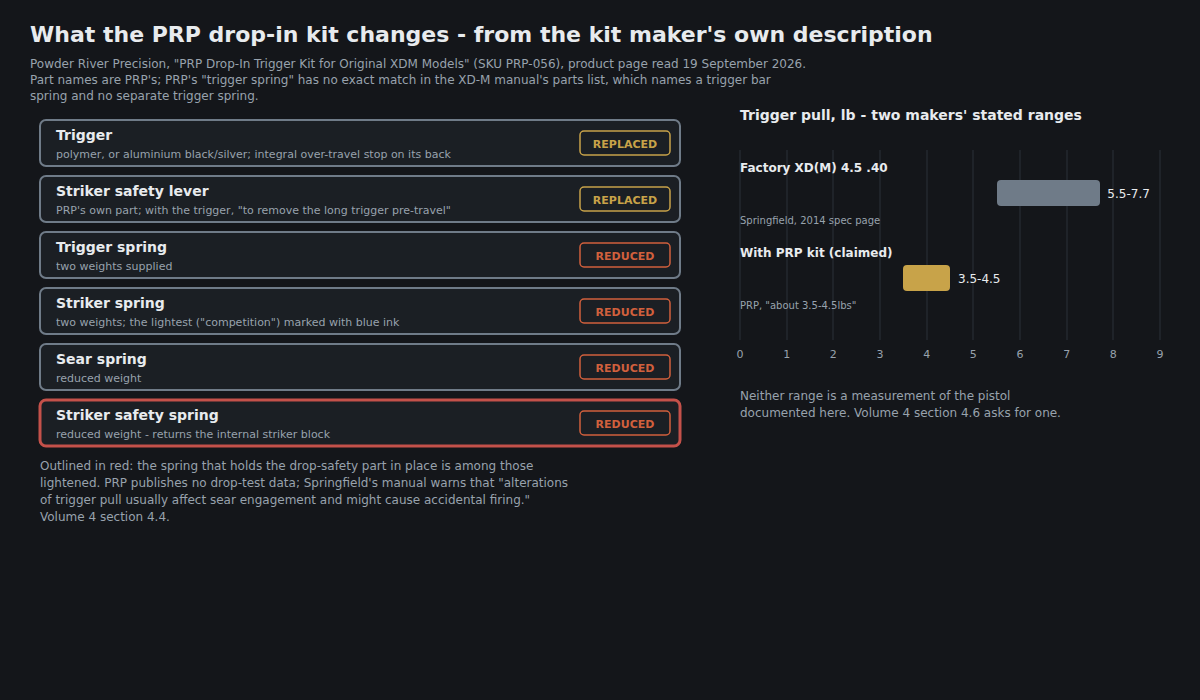
The trigger is the part of the XD(M) its owners most often change, and the pistol documented here has had it changed. That makes it the most consequential of the three modifications recorded on this pistol, because it is the only one that works inside the firing chain. The sights and the light (Volume 5) sit on the outside of the pistol and can be removed in minutes. The trigger kit changes springs whose job, in part, is to keep the pistol from firing.
This volume says what the kit is, what its maker says it does, what the pistol’s maker says about changes of this kind, and where the published record simply runs out.
4.1 What Is Fitted, and How Sure the Identification Is
As documented in September 2026, the owner’s inventory records a “Powder River Precision (PRP) XDM 9/40 Drop in trigger kit”, marked installed.
Powder River Precision, of Clark, South Dakota, sells several trigger products for the original XD(M). The one whose name and options match the inventory’s description is the “PRP® Drop-In Trigger Kit for Original XDM Models”, catalogue SKU PRP-056, offered in a “9mm/.40 cal” or a “10mm/.45 ACP” version, with a choice of trigger: “Pre-fit Polymer”, “Pre-fit Aluminum Black” or “Pre-Fit Aluminum Silver”. PRP’s page listed it at $131.95 to $152.95, depending on the trigger chosen, on 19 September 2026.1
That identification is a match on name, not on a receipt. The same maker’s XD(M) catalogue also lists an Extreme Trigger Kit, an Ultimate Match Target Trigger Kit, a flat-faced aluminium drop-in kit, an Ultimate Easy Fit kit, a sear upgrade and a trigger-only upgrade.2 The inventory’s wording — “9/40 drop-in trigger kit” — fits PRP-056 best, and this volume is written about PRP-056. Which trigger face was chosen, and which of the supplied springs were fitted, are not recorded and are listed as questions for the owner.
The kit is for the original XD(M) only. PRP states plainly that it is “Not compatible with XDM® Elite series.”1 The pistol documented here is an original-pattern XD(M) (Volume 1 §1.2), so that is consistent.
4.2 What the Kit Contains, in the Kit Maker’s Words
PRP’s description, in full on the point of what is in the box:1
“This PRP® Drop-In Trigger Kit contains our famous striker safety lever and trigger to remove the long trigger pre-travel on the original series XDM® trigger with two different weight trigger springs and striker springs (the competition weight springs (the lightest weight) are marked with blue ink). The other reduced weight springs are the sear spring and the striker safety spring which helps lower the pull weight. To help speed up the reset, our trigger is made of tough light weight polymer or now available in aluminum anodized black or silver. It also has an integral over travel stop on the back of the trigger.”
Set against the parts list in Springfield’s manual (Volume 2 §2.9), that is:
Table 1 — Set against the parts list in Springfield's manual (Volume 2 §2.9), that is
| PRP’s item | Manual’s part | Change |
|---|---|---|
| Trigger (polymer or aluminium), integral over-travel stop | 7 Trigger with Safety | Replaced |
| Striker safety lever | 25 Striker Safety Lever | Replaced |
| Striker spring, two weights (lightest marked blue) | 32 Striker Spring | Lighter |
| Sear spring | 13 Sear Spring | Lighter |
| Striker safety spring | 34 Striker Safety Spring | Lighter |
| ”Trigger springs”, two weights | no exact match | Lighter |
The last row is a real gap, not a formatting one. Springfield’s parts list names a trigger bar spring (9) and no separate “trigger spring”; PRP speaks of “trigger springs” and does not say which factory part they replace. The two vocabularies do not map one to one, and this dive does not guess.
Two further details from PRP’s page are worth recording because they are specific claims:
- On the over-travel stop: “Using this method of over travel stop removes added stress on the trigger bar that are present with any of the other over travel stop methods.”1 That is the kit maker’s engineering claim, not tested here.
- On the polymer trigger: “The polymer trigger is a Springfield Armory® OEM part available on production for XD® & XDM® pistols from the factory (see APPENDIX D4 21.6 Production Division Rules).”1 The reference is to a competition rulebook’s production-division equipment rules. PRP’s claim is recorded; the rulebook itself was not checked for this dive.
4.3 What It Claims to Change
PRP’s stated result: “When installed correctly, this kit will give you a short, crisp trigger pull (about 3.5-4.5lbs) with a fast reset and shorten the total trigger pull length.”1
Springfield’s own specification for the pistol as delivered is 5.5 to 7.7 lb.3 On those two makers’ figures, the kit takes something like two to three pounds out of the pull. Neither range is a measurement of the pistol documented here, and §4.6 asks for one.
Three separate things are being changed, and they are worth separating because they have different consequences:
- Pre-travel. The replacement trigger and striker safety lever are, in PRP’s words, there “to remove the long trigger pre-travel”. Pre-travel is the slack taken up before the trigger meets resistance.
- Pull weight. Lighter springs — sear, striker, striker safety and the trigger spring PRP supplies — lower the force at the break.
- Over-travel and reset. The integral over-travel stop limits movement after the break; the lighter trigger is said to reset faster.
The factory XD(M) was already sold on its trigger: Springfield’s 2014 copy calls it a “minimal reset trigger” that “breaks crisply and cleanly”.3 The kit is refining a trigger that was the model’s selling point, not rescuing a bad one.
One purchaser’s review on PRP’s own page — for the .45 version, dated 11 August 2026 — is worth quoting only as an illustration of how much the spring choice matters, and only as one person’s account. Starting from 5 lb 2 oz, the reviewer reports reaching about 2 lb 4 oz with the lightest springs, finding it lacked “a consistent wall”, and settling on the factory trigger spring for “a controllable 3 lb 6 oz pull”. The same reviewer notes the kit arrived with “No instructions”.1 One review proves nothing about the kit; it does show that the kit is not one configuration but several, and that the owner’s choice among its springs decides the result.
4.4 Drop Safety: Which Margins Move, and What Nobody Has Published
Springfield’s manual addresses this class of modification directly, in its safety rules:4
“Do not try to change your firearm’s trigger pull, because alterations of trigger pull usually affect sear engagement and might cause accidental firing.”
and elsewhere: “Do not alter or modify your firearm.”4 It also says, of every XD-M, “Do not drop your firearm … If it falls, it may fire.”4 That is boilerplate, and it is not evidence that the factory pistol is unsafe. But it means the pistol’s maker has never promised drop safety in writing, even for the unmodified gun, and has specifically warned against changing the trigger.
Against that, the kit makes four changes that bear on the margins involved:
The striker safety spring is lighter. This is the change outlined in red in the figure. The manual describes the striker block as the part that “will prevent the firearm from firing until the grip safety is depressed and the trigger is pulled” (Volume 2 §2.4). Its spring is what keeps it in the blocking position. A lighter spring holds it there with less force. How much less, and how much force an impact would need to overcome it, is not published by PRP or by Springfield, and no drop-test data for this kit was located from any source.
The sear spring is lighter. The manual’s warning is specifically about sear engagement. A lighter sear spring is the most direct way to lower pull weight and, for the same reason, the change the manual’s warning is about.
The striker safety lever is a different part. PRP pairs it with its trigger “to remove the long trigger pre-travel”.1 PRP does not describe the lever’s geometry, and Springfield does not describe the factory lever’s function beyond naming it. Whether removing pre-travel means the internal block is cleared earlier in the trigger’s travel than in the factory arrangement is a reasonable question and cannot be answered from the sources available. It is recorded here as a question, not a finding.
The striker spring is lighter. That reduces the energy stored in the striker, which if anything reduces the energy available in an accidental release; its real consequence is on ignition (§4.5).
What the kit does not change is also worth stating. It does not touch the grip safety or its spring (Volume 2 §2.3). The pistol still will not fire, per the manual, unless the grip safety is depressed. Whether the grip safety alone would prevent an inertial discharge in a drop depends on internal linkage the manual does not describe, so this dive does not claim that it would.
The honest summary is short. The kit lightens two springs that exist, in part, to keep the pistol from firing when it should not. Its maker publishes no data on the margin that remains, the pistol’s maker warns against the change in writing, and no independent test was found. That does not make the modified pistol unsafe. It means its safety margin after modification is unmeasured, and the owner is the person who has accepted that.
4.5 The Lighter Striker Spring and Handloaded Primers
PRP supplies two striker-spring weights and calls the lightest — marked with blue ink — the “competition weight”.1 Supplying two weights is itself informative: a maker that thought the lightest spring suited every use would not bother to supply a heavier one.
A lighter striker delivers less energy to the primer. That matters more to the owner of this pistol than to most, because the owner handloads. The failures a light striker produces are the same ones a handloader’s process can produce:
- A high primer — one not seated fully to the bottom of the pocket — absorbs part of the striker’s energy seating itself the rest of the way before it fires, or instead of firing.
- A hard primer cup needs more energy to indent. Primer makers differ in cup hardness; a lot that fires every time with the factory spring may not with the lightest spring in the kit.
The two together are the classic light-strike combination. The symptom is a round that does not fire, leaving the pistol with the chamber indicator up and the striker indicator in — the state Volume 2 §2.7 says to treat as loaded, with the manual’s 30-second hang-fire rule applying.
The diagnostic order that follows from this is the owner’s to apply: a light strike in this pistol is first a question about which striker spring is installed, and only then about the primers. The inventory does not record which spring was fitted. It is on the list of questions for the owner, because it decides how this pistol should be treated with handloads.
4.6 Checking the Installation
No function-check procedure appears in Springfield’s manual, and none is invented here. What can be done is to check the behaviours the manual itself states, because each is a claim about the pistol that a modified pistol should still satisfy. Every check below is performed with the pistol unloaded, the magazine out and the chamber verified empty by sight and by the loaded-chamber indicator, with no ammunition in the room.
Table 2 — 4.6 Checking the Installation
| Manual’s statement (Volume 2) | What it predicts for an unloaded, cocked pistol |
|---|---|
| ”Unless the grip safety is properly depressed … the firearm will not fire even if the trigger is pulled.” | With the grip safety not depressed, a full trigger pull does not release the striker; the striker indicator stays out. |
| ”Grip safety must also be depressed to allow slide to be pulled to the rear.” | With the grip safety not depressed, the slide does not retract. |
| ”The trigger can only be pulled if depressed together with the trigger safety lever.” | Pressure on the trigger that does not depress the lever does not move the trigger through. |
| Striker status indicator: “When the firearm is cocked, the pin will protrude.” | After cycling the slide, the indicator protrudes; after a dry-fire snap with all conditions met, it is flush. |
A pistol that fails any of those after a trigger job is not a pistol to load. It goes to a gunsmith.
Two measurements are owed and would turn this volume’s two makers’ ranges into a fact about one pistol:
- Pull weight, measured with a trigger-pull gauge at the same point on the trigger face, averaged over several pulls, and recorded with which springs are fitted.
- Which striker spring is installed, since §4.5 turns on it.
4.7 Warranty, and Why the Factory Parts Are Worth Keeping
Springfield’s limited warranty lasts for the original retail purchaser’s ownership, and “does not cover any damage or condition determined by Springfield to be caused by: unauthorized repairs, disassembly, adjustments or modifications”.4 A pistol with an aftermarket trigger, striker safety lever and springs is, on any reading, a modified pistol.
That has one practical consequence. The replaced factory parts — the trigger, the striker safety lever and the springs — are worth keeping, bagged and labelled, with the pistol. They make a return to factory configuration possible, whether for warranty service, for sale, or because a lighter trigger turns out to be the wrong trigger for the pistol’s use. Whether they were kept is a question for the owner.
The Michigan position on a modified trigger is uneventful: nothing in the statutes read for this dive (Volume 6 §6.8) regulates trigger pull on a semi-automatic pistol, and a drop-in trigger kit does not change the pistol’s legal character in any way the statutes consulted address.
Sources
Footnotes
-
Powder River Precision, “PRP® Drop-In Trigger Kit for Original XDM Models”, SKU PRP-056, https://powderriverprecision.com/prp-drop-in-trigger-kit-for-original-xdm-models/ — description, options, price and one customer review. Accessed 19 September 2026. ↩ ↩2 ↩3 ↩4 ↩5 ↩6 ↩7 ↩8 ↩9
-
Powder River Precision, “XDM — Parts for your original XDM”, https://powderriverprecision.com/shop-all/xdm/ . Accessed 19 September 2026. ↩
-
Springfield Armory, product page “XD(M)® 4.5” .40SW Handgun”, captured 24 May 2014, http://web.archive.org/web/20140524050034/http://www.springfield-armory.com/products/xdm-4-5-40-cal/ . Accessed 19 September 2026. ↩ ↩2
-
Springfield Armory, XD-M® & XD-M® Elite Operation & Safety Manual, 2022 edition (V16), https://www.springfield-armory.com/wp-content/uploads/XDmManual_V16.pdf — safety rules pp. 5, 8, 10; safety devices pp. 14–15; parts list pp. 36–39; limited warranty p. 58. Accessed 19 September 2026. ↩ ↩2 ↩3 ↩4
Comments (0)