Springfield Armory XD(M) .40 · Volume 2
How It Works — Three Safeties, Two Indicators and a Grip That Gates the Slide
The XD(M)'s mechanism as Springfield's own manual describes it, and the handling consequences a Glock owner does not expect
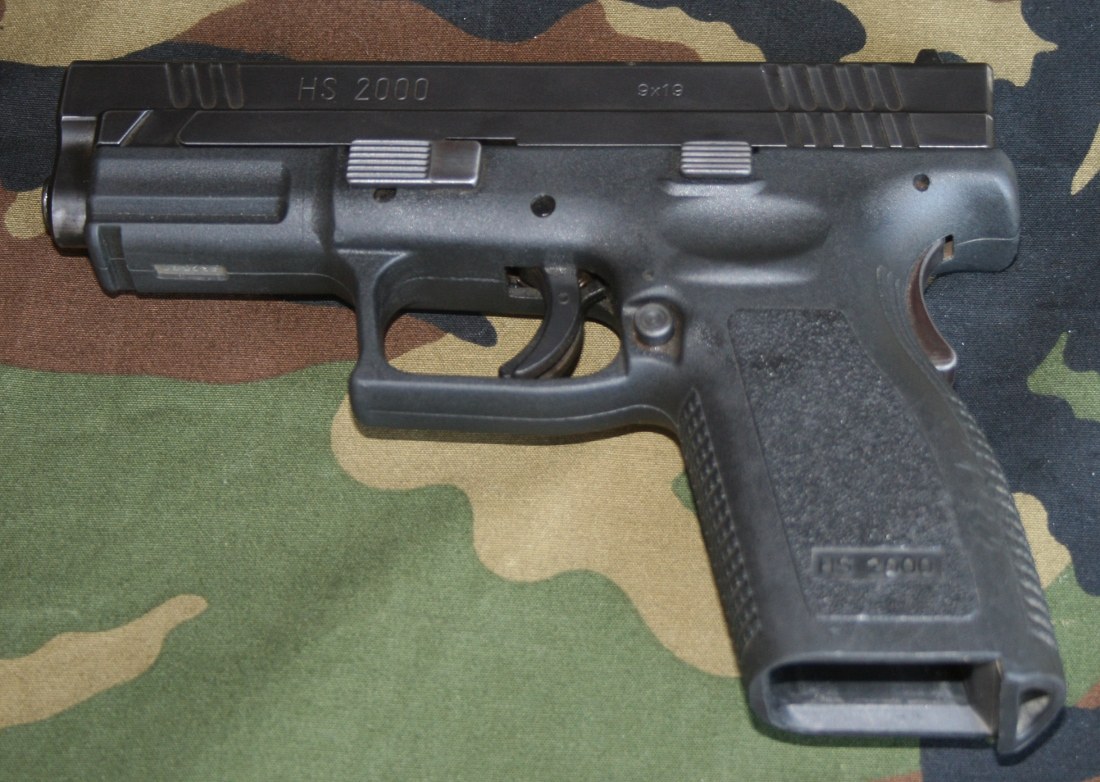
The XD family is usually filed alongside the Glock as a polymer-framed striker pistol, and at the level of the slide and barrel that is fair. At the level of the controls it is a different animal. It has a grip safety, in the manner of a 1911. That grip safety blocks the slide as well as the shot. It has two separate visual and tactile indicators — one for the chamber and one for the striker — and they answer different questions. An owner who handles it on Glock habits will, sooner or later, try to rack a slide that will not move.
This volume describes the mechanism from the one source that can be held to account for it: Springfield’s own manual.
2.1 The Source for This Volume, and Its Limit
Everything stated here about what a control does is taken from Springfield’s XD-M® & XD-M® Elite Operation & Safety Manual, 2022 edition (V16), cross-checked against the 2020 edition.12 The manual is explicit that it is “FOR XD-M® & XD-M® ELITE FIREARMS ONLY” and should not be used for the XD, XD Mod.2, XD-E or XD-S.
Its limit is that it describes behaviour, not linkage. It says what each safety prevents; it does not say which internal part blocks which, or in what sequence the trigger bar, sear and striker block interact. Explanations of that linkage circulate widely, often with confidence, and this volume does not reproduce them, because none was located in a source that could be held to account for it. Where a statement below goes beyond the manual’s text it is labelled as reasoning.
A second limit: the current manual postdates the pistol documented here, which is an early-pattern XD(M). The 2009 XD(M) safety manual that would match its vintage exists in the Internet Archive, but every retrieval attempt returned a truncated file, so it has not been read. Section 2.9 notes the one place where the 2020 and 2022 editions themselves disagree.
2.2 The Action in Outline
The XD(M) is a short-recoil, locked-breech, tilting-barrel pistol. The locking principle descends from the HS 95, which Croatian sources describe as having abandoned the Walther-type locking of the first Croatian pistol for “simpler and more reliable Browning-derived” locking with an oscillating barrel (Volume 1 §1.3).3
It is striker-fired. The slide cocks the striker as it cycles; the manual’s own language describes the pistol as “cocked” when the striker-status indicator protrudes (§2.6), and it calls the trigger system the “Ultra Safety Assurance (USA) Trigger System™”.1 Springfield’s 2014 specification gives the factory trigger pull as 5.5 to 7.7 lb.4
The recoil spring rides on a full-length guide rod — “One Piece Full Length Guide Rod” in Springfield’s 2014 specification for this model.4 Whether the 4.5-inch spring assembly is captive is a point on which the maker’s own manuals disagree, taken up in Volume 6 §6.2 where it matters, at disassembly.
The frame carries an accessory rail under the dust cover, which on the pistol documented here holds the weapon light (Volume 5), and a takedown lever above the trigger guard (Volume 6).
2.3 The Grip Safety, and Its Second Job
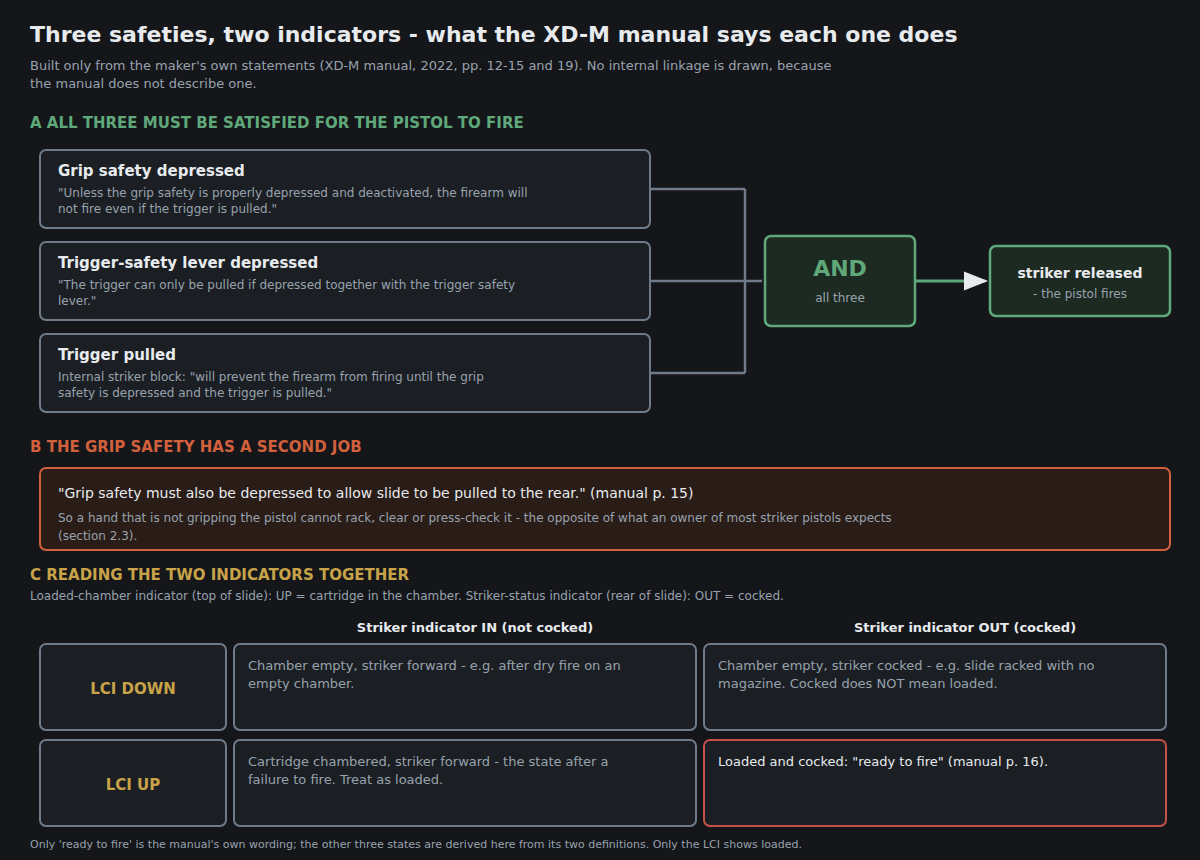
The manual describes the grip safety in three sentences, and the third is the one that matters most in handling:1
“The grip safety is located at the top rear of the firearm grip … The grip safety must be depressed to be deactivated. Unless the grip safety is properly depressed and deactivated, the firearm will not fire even if the trigger is pulled. Grip safety must also be depressed to allow slide to be pulled to the rear.”
It repeats the point in capitals in the unloading procedure: “GRIP SAFETY MUST BE DEACTIVATED TO ALLOW THE SLIDE TO BE PULLED TO ITS REARWARD (OPEN) POSITION.”1
American Rifleman’s Wiley Clapp described the same part in 2009 as “a grip safety in the backstrap set up to prevent striker movement unless the gun is held in a positive grasp.”5 That is consistent with the manual’s statement that the pistol will not fire; neither source describes the linkage.
2.3.1 What the second job means in practice
The consequences below are reasoning from the manual’s statement, not text from it.
- A pistol that is not gripped cannot be cleared. Racking the slide with the frame held by the dust cover, or by the trigger guard, or pinned against a table, will not work unless the hand holding it also depresses the backstrap. Every clearing and loading action in the manual begins from a firing grip for this reason.
- Single-handed slide manipulation against a belt or holster edge still works, because the firing hand is gripping the pistol while the rear sight is pushed against the edge. What will not work is any technique that holds the pistol by something other than its grip.
- A press check — drawing the slide back slightly to see brass — is done with the firing hand in a grip, which is how most shooters do it anyway. On this pistol it is also unnecessary for the question it answers, because the loaded-chamber indicator answers it (§2.5).
- A weak or high grip can fail to depress it. The manual: “The grip safety is designed to be deactivated when the firearm is properly gripped to fire … To assure the most reliable function, it is necessary to properly grip firearm.”1
2.3.2 What the grip safety does not do
It is not a manual safety. Any hand holding the pistol by its grip depresses it — including the hand that is holstering it. The grip safety therefore offers no protection against something entering the trigger guard while the pistol is gripped, which is exactly the situation during reholstering. It protects against the pistol firing when it is not being held: dropped, snagged, or handled by the slide. That is a real protection, and it is a different one from what a thumb safety provides.
Volume 4 returns to the grip safety from a different direction: an aftermarket trigger kit does not replace it, but the kit’s lighter springs sit in the same firing chain.
2.4 The Trigger Safety and the Striker Block
The trigger safety is the lever in the face of the trigger. The manual:1
“The trigger safety blocks the trigger from moving backward. A lever incorporated into the trigger deactivates the safety when completely depressed while pulling the trigger. The trigger can only be pulled if depressed together with the trigger safety lever.”
and, in capitals, “DEPRESSING THE TRIGGER SAFETY AND PULLING THE TRIGGER WILL NOT ALLOW THE FIREARM TO FIRE UNLESS THE GRIP SAFETY IS DEPRESSED.”1
The trigger safety guards against a trigger struck off-centre from the side — the classic snag — rather than against a finger. Anything that presses squarely on the trigger face depresses the lever too.
The striker block is internal and has no control. The manual lists it as the third safety device: “As an added safety feature, an internal striker block will prevent the firearm from firing until the grip safety is depressed and the trigger is pulled.”1 The parts list names the likely participants — a striker safety and striker safety spring in the slide, and a striker safety lever and striker safety lever spring in the frame — but, as §2.1 said, it does not describe how they interact.1
That spring list matters later. The striker safety spring is one of the springs the aftermarket kit fitted to this pistol replaces with a lighter one (Volume 4 §4.4), and the striker safety lever is one of the two parts it replaces outright.
2.5 The Loaded-Chamber Indicator
The manual:1
“Your XD-M® firearm has a loaded chamber indicator. The indicator allows you to observe whether a cartridge is in the chamber. When a cartridge is in the chamber the indicator raises above the barrel. When the loaded chamber indicator is up, the firearm is loaded and is ready to fire.”
It sits on top of the slide, behind the ejection port, and it can be both seen and felt. It answers exactly one question — is there a cartridge in the chamber — and the manual is careful to say what it does not answer: “Even though the chamber is empty there may be cartridges in the magazine. The firearm is not completely unloaded until the magazine is removed and the chamber is empty.”1
2.6 The Striker-Status Indicator
The manual calls it a “cocking indicator” in the text and a “Striker Status Indicator” in its labelled diagram and parts list:1
“Your XD-M® firearm has a cocking indicator in the rear of the slide. When the firearm is cocked, the pin will protrude out of the rear of the slide. (The cocking indicator does not always mean that the firearm is loaded). However, when the pin is out, always treat the firearm as if it is loaded. Only the Loaded Chamber Indicator will show if the firearm is loaded.”
The last sentence is the one to keep. The striker indicator reports the striker; it knows nothing about the chamber. The two are independent because the slide cocks the striker on every cycle, whether or not it chambered a cartridge on the way forward.
2.7 Reading the Two Indicators Together
Because each indicator answers a different question, together they describe four states. Panel C of the figure in §2.3 sets them out. Only one of them — indicator up and striker out — is described by the manual in these words (“ready to fire”); the other three are derived here from the manual’s two definitions:
Table 1 — Because each indicator answers a different question, together they describe four states. Panel C of the figure in §2.3 sets them out. Only one of them — indicator up and striker out — is described by the manual in these words ("ready to fire"); the other three are derived here from the manual's two definitions
| Striker indicator in (not cocked) | Striker indicator out (cocked) | |
|---|---|---|
| Chamber indicator down | Chamber empty, striker forward — for example after dry-firing an empty chamber | Chamber empty, striker cocked — for example after racking with no magazine. Cocked is not loaded. |
| Chamber indicator up | Cartridge chambered, striker forward — the state after a failure to fire. Treat as loaded, because it is. | Loaded and cocked: “ready to fire” |
The bottom-left cell is the one worth rehearsing. A cartridge that fails to fire leaves the chamber indicator up and the striker indicator in. The manual’s instruction for that event is general and applies here exactly: “If firearm fails to fire when the trigger is pulled, keep it pointed at the target for at least 30 seconds. Remove the magazine before opening the action … Sometimes slow primer ignition will cause a ‘hang fire’ and the cartridge will go off after a short pause.”1
For an owner who handloads, as the owner of the pistol documented here does, that cell is also where a seated-too-high primer or a hard primer cup meeting a lightened striker spring will show itself. Volume 4 §4.5 takes that up.
2.8 What the Pistol Does Not Have
Two absences, both stated by the manual, deserve plain statement.
No magazine disconnect. “The firearm is able to fire both with and without the magazine in place. REMOVING THE MAGAZINE DOES NOT UNLOAD THE FIREARM NOR DOES IT ENGAGE A SAFETY.”1 That sentence appears in the manual more than once, in capitals.
No manual safety on this model. The manual lists three safety devices — trigger safety, grip safety and striker block — and none is a lever the shooter applies.1 The XD line has offered manual-safety variants; this is not one of them.
One more statement from the manual belongs here because it bears on the aftermarket parts in Volume 4. Among the general safety rules: “Do not drop your firearm … If it falls, it may fire.”1 That is boilerplate a manufacturer prints for every pistol, and it is not evidence that the XD(M) is unsafe when dropped. It is, however, the maker declining in writing to promise drop safety, and it is the baseline against which any change to the springs that hold the striker block in place has to be judged.
2.9 The Parts, by the Manual’s Own Names
The manual’s parts list uses consistent numbers across its editions for the full-size XD-M.1 The fire-control parts named there are the reference vocabulary for Volume 4, which needs to say exactly which of them the aftermarket kit replaces.
Table 2 — 2.9 The Parts, by the Manual's Own Names
| No. | Part (manual’s name) | Where | Relevance in this dive |
|---|---|---|---|
| 7 | Trigger with Safety | frame | replaced by the PRP kit |
| 8 | Trigger Bar | frame | — |
| 9 | Trigger Bar Spring | frame | the manual names no separate “trigger spring” |
| 10 | Sear | frame | — |
| 13 | Sear Spring | frame | lightened by the PRP kit |
| 15 | Grip Safety | frame | — |
| 17 | Grip Safety Spring | frame | — |
| 25 | Striker Safety Lever | frame | replaced by the PRP kit |
| 55 | Striker Safety Lever Spring | frame | — |
| 29 | Striker Status Indicator | slide | §2.6 |
| 30 | Striker Dampening Spring | slide | — |
| 31 | Striker | slide | — |
| 32 | Striker Spring | slide | lightened by the PRP kit |
| 33 | Striker Safety | slide | the internal block, §2.4 |
| 34 | Striker Safety Spring | slide | lightened by the PRP kit |
| 37 | Loaded Chamber Indicator | slide | §2.5 |
| 42–44 | Recoil Spring, Guide Rod, Recoil Spring Assembly | slide | ”Captive Style On 3.8” Model” per the list |
The PRP kit’s own description speaks of “trigger springs” — two weights of them — and the manual’s list has a trigger bar spring and no separately named trigger spring. The two vocabularies do not map one to one, and this dive does not guess which part PRP means (Volume 4 §4.2).
Sources
Footnotes
-
Springfield Armory, XD-M® & XD-M® Elite Operation & Safety Manual, 2022 edition (V16), https://www.springfield-armory.com/wp-content/uploads/XDmManual_V16.pdf — Know Your Gun p. 4; safety rules pp. 5–10; loaded chamber indicator p. 12; striker status indicator p. 13; safety devices pp. 14–15; loading p. 16; unloading p. 19; parts lists pp. 36–39. Accessed 19 September 2026. ↩ ↩2 ↩3 ↩4 ↩5 ↩6 ↩7 ↩8 ↩9 ↩10 ↩11 ↩12 ↩13 ↩14 ↩15 ↩16 ↩17
-
Springfield Armory, XD-M® Operation & Safety Manual, 2020 edition, https://www.springfield-armory.com/wp-content/uploads/XD-M-Manual.pdf . Accessed 19 September 2026. ↩
-
Dubravko Gvozdanović, “Kako je HS Produkt osvojio Ameriku”, Hrvatski vojnik no. 640, 30 September 2021, https://hrvatski-vojnik.hr/kako-je-hs-produkt-osvojio-ameriku/ — read in translation. Accessed 19 September 2026. ↩
-
Springfield Armory, product page “XD(M)® 4.5” .40SW Handgun”, captured 24 May 2014, http://web.archive.org/web/20140524050034/http://www.springfield-armory.com/products/xdm-4-5-40-cal/ . Accessed 19 September 2026. ↩ ↩2
-
Wiley Clapp, “The State of the Springfield Armory XD”, American Rifleman, 23 July 2009, https://www.americanrifleman.org/content/the-state-of-the-springfield-armory-xd/ . Accessed 19 September 2026. ↩
Comments (0)