Ruby Pistol · Volume 7
The 7.65 mm Browning Cartridge and the Magazine Problem
The .32 ACP from SAAMI's own drawing and tables, what a century-old Eibar pistol should be fed, and why a Ruby magazine fits its own pistol and often no other, with how to fit or make one
7.1 One cartridge, five names
The Ruby’s cartridge is John Browning’s 7.65 mm pocket-pistol round, introduced with FN’s first pistol and in production since 1899, according to English Wikipedia.1 It has five names that mean the same cartridge: 7.65 mm Browning (the European name, and the one on French boxes), 7.65×17 mm SR (the semi-rimmed metric designation), .32 ACP (Automatic Colt Pistol), and .32 Auto or .32 Automatic (SAAMI’s names).12 The French Army’s pistols were stamped “Cal 7,65”, and its instruction calls them the 7 mm 65 automatic pistols.3
The Mauser HSc dive covers the same cartridge in a 1930s German double-action pistol, and its notes on calibre and capacity apply here too.
7.2 The cartridge, from SAAMI
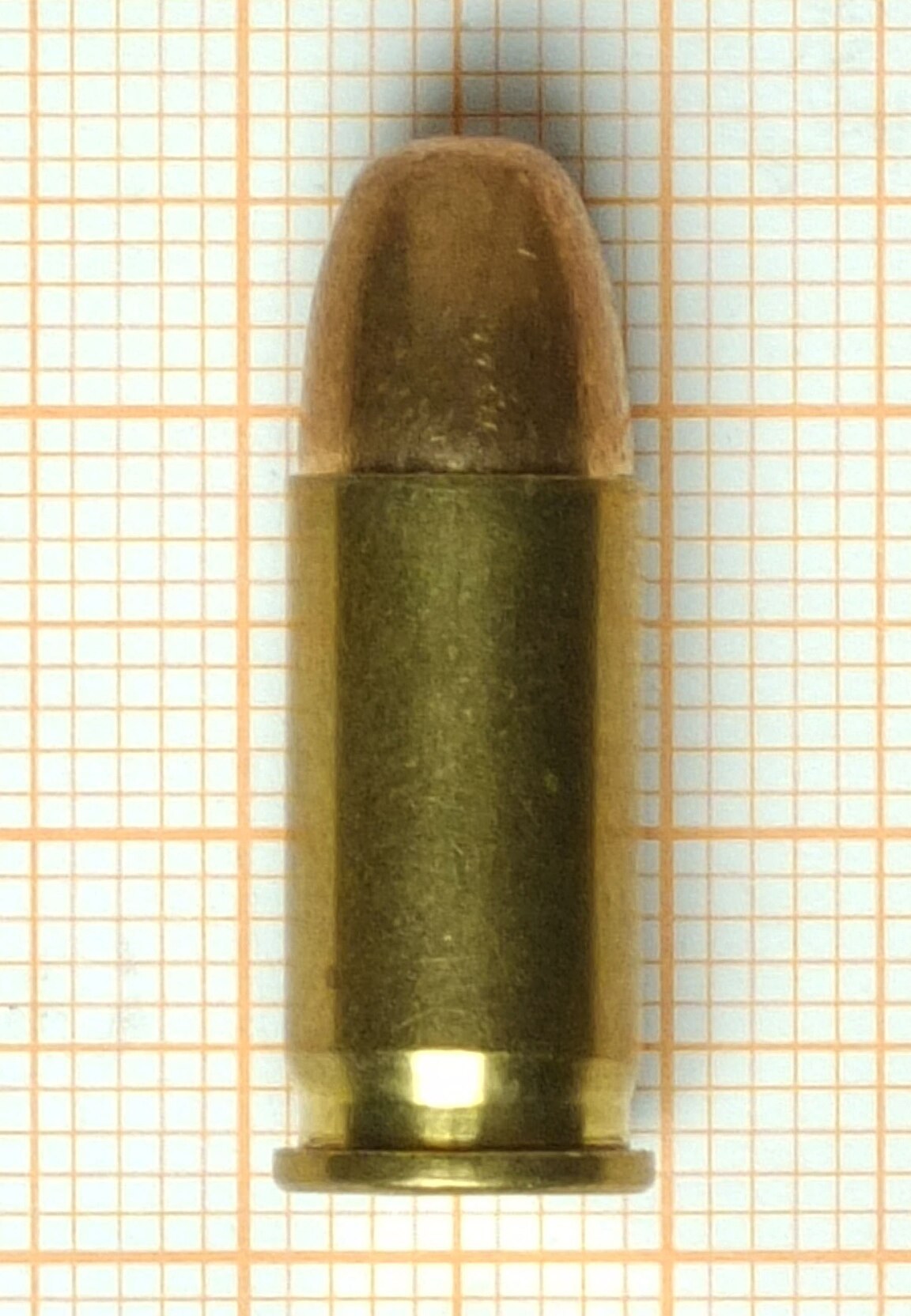
The governing American standard is ANSI/SAAMI Z299.3-2022, whose cartridge and chamber drawing for the “32 Automatic (32 Auto)” was issued on 29 May 1979 and revised on 1 July 2021. Its dimensions, in inches:2
Table 1 — The cartridge, from SAAMI
| Dimension | Cartridge | Chamber |
|---|---|---|
| Rim diameter | .358 (−.008) | .362 (+.012) |
| Rim thickness | .045 (−.011) | headspace .045 min, .055 max |
| Body at head | .3373 | .3428 |
| Body at mouth | .3366 | .3397 |
| Case length | .680 (−.020) | .693 (reference) |
| Bullet diameter | .3125 (−.0060) | groove .311, bore .304 |
| Cartridge overall length | .890 min, .984 max | |
| Rifling | 6 grooves, .106 wide; twist 16 in, left-hand, “optional” |
The chamber has a 15° leade from the case mouth into the bore, and the drawing gives the twist as 16 in, left-hand, marked “optional”, so either hand of rifling conforms.
7.3 Semi-rimmed, and headspaced on the rim
The rim is only about .02 in larger than the body at the head, but it is the rim, not the case mouth, that sets headspace in SAAMI’s chamber: the drawing marks the head-space dimension at the rim recess, .045 to .055 in.2 Two practical consequences follow for a Ruby-type:
- Case length matters less than rim thickness. A case trimmed short will still headspace; a rim worn thin, or a chamber recess cut deep by a careless maker, will not. A pistol that misfires with light strikes on good ammunition may have excess headspace at the rim, which a GO/NO-GO gauge for the .32 Auto will show.
- The extractor must hold a small rim. The semi-rim gives the extractor little to grip, and a Ruby with a tired extractor spring (Vol 6) shows it first as cases left in the chamber.
7.4 Pressure and velocity
SAAMI’s figures for the .32 Automatic:2
Table 2 — Pressure and velocity
| Crusher (CUP) | Transducer (psi) | |
|---|---|---|
| Maximum average pressure | 15,000 | 20,500 |
| Maximum probable lot mean | 15,500 | 21,100 |
| Maximum probable sample mean | 16,200 | 22,100 |
| Proof load range (71 gr) | 22,000 to 24,000 | 27,500 to 30,500 |
Listed velocities, measured 15 ft from the muzzle of SAAMI’s test barrel: 60 gr, 970 ft/s; 65 gr, 925 and 1,000 ft/s (two loads); 71 gr, 900 ft/s.2 A Ruby barrel of 81 to 94 mm (Vol 3) is far shorter than a test barrel, and real velocities from one will be lower; no measured figure from a Ruby-type was found for this dive.
The European C.I.P. figure for the 7.65 mm Browning was not obtained. English Wikipedia’s 1,600 bar is uncited, and the C.I.P. data sheet was not found at the address tried.1
7.5 What to feed a Ruby-type
The pistols were made of steel that contemporaries called poor (Vol 1) and are now a century old. That argues for the mildest ammunition that cycles them:
- Standard-pressure, SAAMI-conforming .32 Auto or C.I.P. 7.65 mm Browning, full metal jacket. The cartridge is still in production. A US distributor lists, for example, “Sellier & Bellot Pistol Ammo 32 Auto/7.65 Browning 73gr. FMJ 50 rd.”, its item 1102546.4 Velocities quoted by retailers for that load disagree (900 and 1,043 ft/s on two retail pages), and neither is quoted here as the maker’s.
- Not loads sold as “+P” or high-velocity. SAAMI lists no +P .32 Automatic, so any such load is outside the standard to which the chamber and proof were related.2
- Hollow points with care. Round-nose FMJ is what the magazines and feed ramps were made for. Hollow points may feed poorly in a pistol never designed for them, and that should be found on the range with an empty pistol and dummy rounds first.
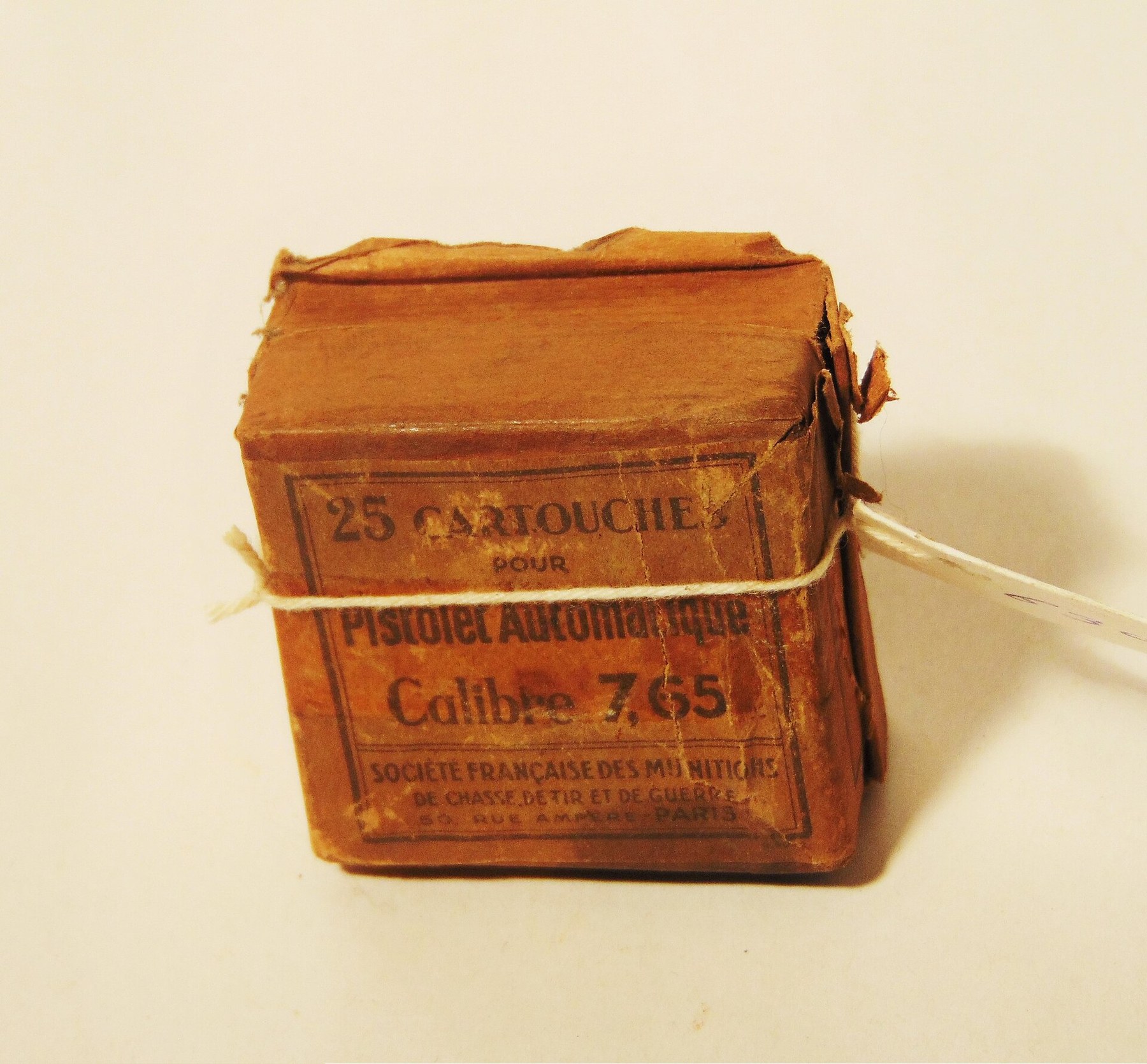
- Old ammunition. Wartime and inter-war 7.65 mm loads (the French box below is one) are collectors’ items. Their primers may be corrosive, and old powder can be unpredictable; they are not for shooting.
7.6 Calibres other than 7.65 mm
The Ruby-type was a 7.65 mm pistol, but the type was made in other calibres. English Wikipedia says some makers supplied the French “in a variety of calibres, barrel lengths and magazine capacities”, and French Wikipedia gives “7.65 Browning or 9 mm court” (.380 ACP) for the Basque derivatives.56 A Ruby-type’s calibre is whatever is marked on it and, more reliably, whatever a chamber cast says. The larger 9 mm Kurz will not enter a 7.65 mm chamber; the reverse mistake, a 7.65 mm round in a 9 mm Kurz chamber, may go in, and is a mistake to avoid. A pistol of unknown calibre should be measured before it is fed.
7.7 The magazine problem
Every source agrees that a Ruby magazine fits its own pistol and often no other:
- Forgotten Weapons: the Ruby-types “had the same general configuration … None of them shared interchangeable parts (or magazines), though.”7
- Jaeger Platoon, from the Finnish Army’s experience: parts from different makers “simply did not necessarily have any part, that was compatible … and in some cases this included even magazines, which is why the French … had marked both pistol and magazines supplied by each manufacturer with similar markings reserved for each manufacturer”.8
- English Wikipedia (citing Jaeger Platoon): French officials “quickly became aware that few of the Spanish Ruby-types had interchangeable magazines, and insisted the manufacturers mark the base of all magazines”, to avoid “either not being able to insert a new magazine, or having a loaded magazine detach from the gun in action”.5
- The French instruction: magazines held “7 or 9 cartridges (according to its capacity)”, so even capacity was not standard in service.3
- Monforte: France’s first order was for pistols “with three magazines” each, three magazines tied to each pistol from the start.9
TFB’s gunsmith adds the modern note: “Most Ruby pistols are marked by their maker on both the frame and magazine so ideally a magazine from that exact company would be able to replace a damaged one. My pistol and its magazine do not match up but luckily it still works.” He also found the magazines fragile: “the floorplate is not easily removed and the feed lips are terribly thin”.10
7.8 Why one maker’s magazine does not fit another’s pistol
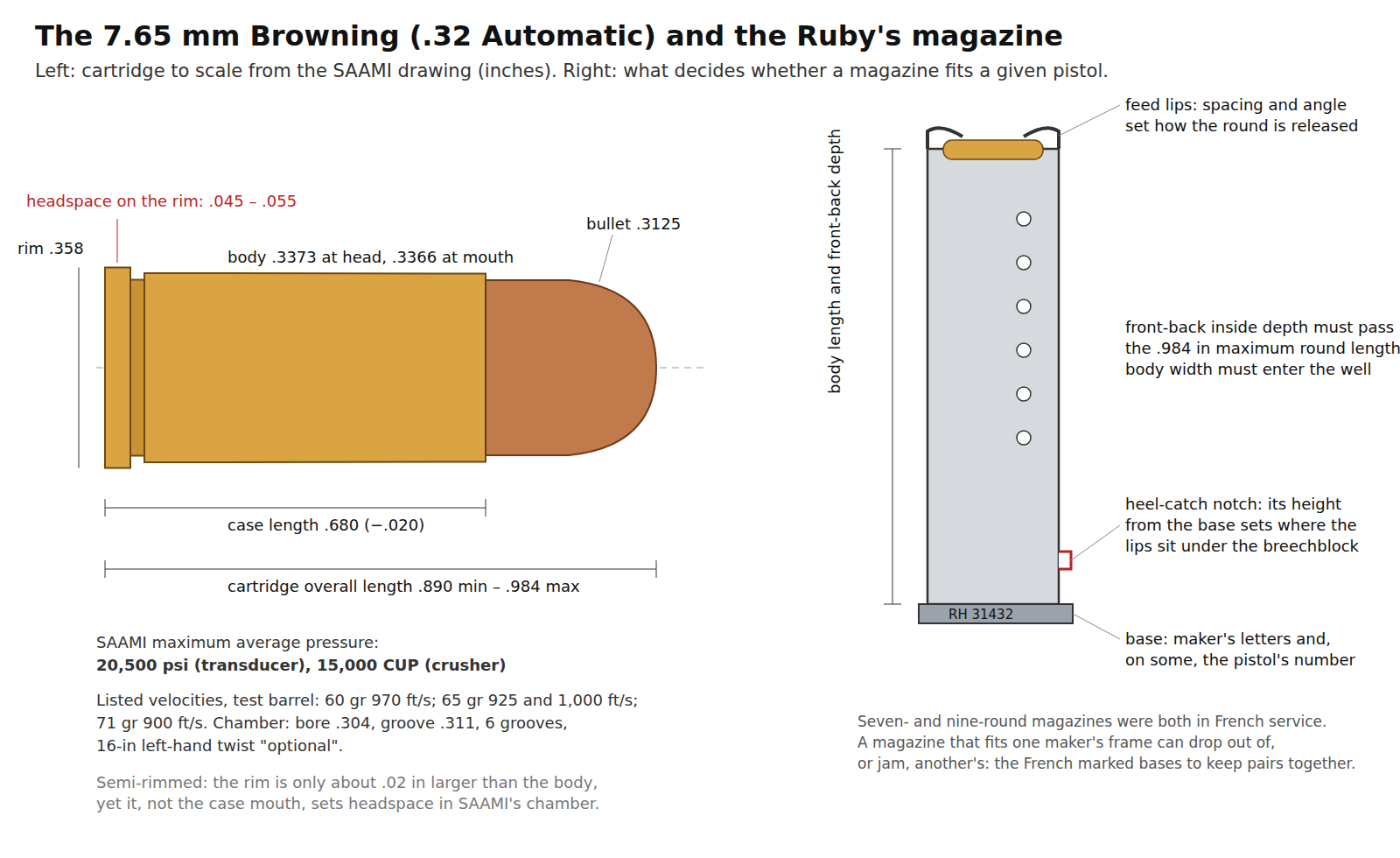
No source measured the differences, so this section is mechanics rather than measurement. A single-column magazine for a pistol of this kind must agree with the pistol in five things, and a hand-fitted Eibar pistol of 1916 can differ from its neighbour in any of them (see the diagram above):
- Body width and depth. It has to enter the magazine well without binding and without rattling. Too wide, it will not go in, which was the French fear.
- Overall length and catch notch. The heel catch engages a notch or the base at the rear of the magazine. The height of that engagement above the base decides how high the magazine sits. Too low a notch, the magazine stands proud and the catch may not hold it, and it drops out, which was the other French fear. Too high, the lips sit below the breechblock’s stripping face and the slide rides over the top round.
- Feed lips. Their spacing and angle decide when the round is released into the chamber. A round released too early nose-dives into the feed ramp; too late, it is pushed straight into the chamber face.
- Inside depth front to back. It must pass the cartridge’s maximum overall length of .984 in with clearance.2
- Follower and spring. Nine rounds in a short grip need a strong spring; a tired one gives last-round failures to feed.
A magazine that is close in all five may work, as the gunsmith’s did. One that is off in any of them will not, and the remedy is fitting.
7.9 Fitting a magazine
There is no published procedure for these pistols. The sequence below is ordinary practice for fitting a single-column magazine to an old pistol; it is offered as practice, not as a sourced method.
- Start with the right maker. A magazine with the same maker’s letters as the frame’s code (Vol 5) is the most likely to be close.
- Seat it empty. It should enter without force and latch with a positive click; pull down on the base to confirm it holds. If it stands proud or drops out, the catch engagement is wrong.
- Check lip height. With the slide removed, load one dummy round and compare the top of the round with the breechblock’s stripping face (or with the original magazine’s top round). The breechblock face must catch the rear of the case rim area squarely.
- Correct the catch engagement, by filing the notch or (rarely) building it up, until the lip height matches.
- Dress the lips only by small amounts, testing with dummy rounds after each.
- Test with dummy rounds by hand-cycling the full capacity, then live rounds one at a time, then two, then full.
Mark a fitted magazine to its pistol, as the French did, so the pair stays together.
7.10 Making a magazine
No current maker of Ruby-type magazines was found for this dive; a search for one turned up only a nine-round .32 ACP magazine made by Triple K for the Beretta Model 70, a different pistol.11 For a reader with a sheet-metal shop, a magazine is a reasonable job: a folded and seam-welded or brazed tube of spring-temper steel sheet, a formed follower, a wound spring, and a floorplate. The pistol’s original magazine, if it has one, is the pattern; without one, the five dimensions above can be taken from the magazine well and the breechblock directly. Vol 9 sets out how such parts are made.
7.11 What could not be established
- The C.I.P. maximum pressure for the 7.65 mm Browning.
- Velocity from any Ruby-type barrel.
- Whether French wartime 7.65 mm loads were corrosive.
- Any measured comparison of magazines between makers.
- A current source of Ruby-type magazines.
References
Footnotes
-
“.32 ACP”, English Wikipedia, https://en.wikipedia.org/wiki/.32_ACP, consulted 2026-10-19. Used for names and the 1899 introduction; its pressure figures are uncited. ↩ ↩2 ↩3
-
ANSI/SAAMI Z299.3-2022, Voluntary Industry Performance Standards for Pressure and Velocity of Centerfire Pistol and Revolver Ammunition, approved 13 December 2022: velocity and pressure table, proof table, and the “32 Automatic (32 Auto)” cartridge and chamber drawing (issued 05/29/1979, revised 07/01/2021), https://saami.org/wp-content/uploads/2025/05/SAAMI-Z299.3-2022-Centerfire-Pistol-Revolver-Approved-12-13-2022.pdf, consulted 2026-10-19. ↩ ↩2 ↩3 ↩4 ↩5 ↩6 ↩7
-
French Army instruction on the 7.65 mm automatic pistols in service, as transcribed by Tir Sportif Chabris, https://tirsportifchabris.fr/blog/pistolet-ruby-7-65-demontage, consulted 2026-10-19. ↩ ↩2
-
Kinsey’s Inc., “Sellier & Bellot Pistol Ammo 32 Auto/7.65 Browning 73gr. FMJ 50 rd.”, item 1102546, https://webstore.kinseysinc.com/Sellier-Bellot-Pistol-Ammo-32-Auto-7.65-Browning-73gr.-FMJ-50-rd./1102546, consulted 2026-10-19. ↩
-
“Ruby pistol”, English Wikipedia, revision 1362866939, https://en.wikipedia.org/w/index.php?title=Ruby_pistol&oldid=1362866939, consulted 2026-10-19. ↩ ↩2
-
“Pistolet Ruby”, French Wikipedia, https://fr.wikipedia.org/wiki/Pistolet_Ruby, consulted 2026-10-19. ↩
-
Ian McCollum, “Spanish Eibar/Ruby Pistols”, Forgotten Weapons, 19 October 2012, https://www.forgottenweapons.com/spanish-eibarruby-pistols/, consulted 2026-10-19. ↩
-
Jaeger Platoon, “Revolvers & Pistols part 3: 7,65 mm Pistol M/19 ‘Spanish’”, http://www.jaegerplatoon.net/PISTOLS3.htm, consulted 2026-10-19. ↩
-
Manfredo Monforte Moreno, “Arma corta española”, Academia de las Ciencias y las Artes Militares, 27 February 2026, https://www.acami.es/wp-content/uploads/2026/04/2026-04-09-CMN-PTM-Arma-corta-espanola-web.pdf, consulted 2026-10-19. ↩
-
Sam S., “TFB Armorer’s Bench: Commentary on The 1915 Spanish Ruby Pistol”, The Firearm Blog, 27 August 2023, https://www.thefirearmblog.com/blog/2023/08/27/tfb-armorers-bench-commentary-1915-spanish-ruby-pistol/, consulted 2026-10-19. ↩
-
Midwest Gun Works, “Triple K Beretta 70T .32 ACP 9 Round Magazine”, https://www.midwestgunworks.com/page/mgwi/prod/2046m, consulted 2026-10-19. ↩
Comments (0)