Ruby Pistol · Volume 1
A Trademark, Not a Design: Gabilondo's Ruby, 1904 to 1915
Eibar's copy trade, a four-man workshop, the Victoria it was built on, and why the one thing Gabilondo owned in the Ruby was its name
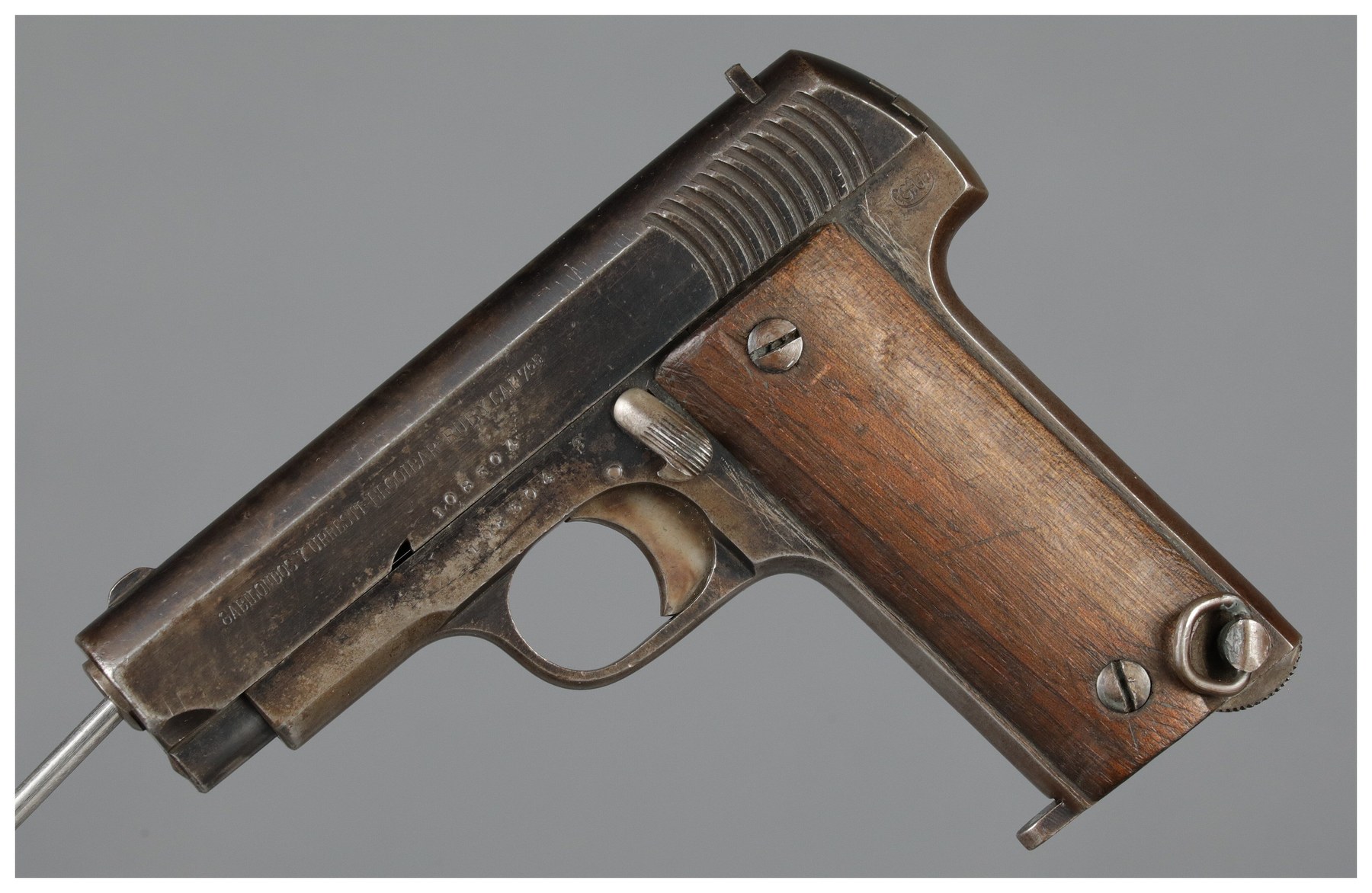
1.1 What this dive covers
The Ruby is a 7.65 mm (.32 ACP) blowback pocket pistol of John Browning’s 1903 pattern, made in the Basque gun towns of northern Spain. The name belongs to one firm, Gabilondo y Urresti of Eibar, which registered it in 1914. The pistol it describes was made by dozens of firms, because in 1915 the French Army adopted it as the pistolet automatique de 7 millim. 65 genre “Ruby”, the Ruby-type automatic pistol, and then bought far more of them than Gabilondo could ever make.
That double meaning, one name and many makers, runs through every volume:
- Vol 1 (this volume): where the Ruby came from, and what Gabilondo actually owned in it.
- Vol 2: the French contracts of 1915 to 1918, the subcontractors and the independent makers, and the totals, which are quoted everywhere and sourced almost nowhere.
- Vol 3: the other armies, the post-war flood of Eibar pistols, and how Gabilondo became Llama.
- Vol 4: how the pistol works, from Browning’s patent and the French Army’s own instruction.
- Vol 5: identifying a Ruby-type: makers, markings, the French maker codes and acceptance stars, with photo plates.
- Vol 6: field strip, detail strip, maintenance and repair, including the failures these pistols are known for.
- Vol 7: the 7.65 mm Browning cartridge and the magazine problem: why a Ruby magazine fits its own pistol and often no other.
- Vol 8: owning one: the market, the curio-and-relic status and the law in Michigan.
- Vol 9: making one, from parts and from scratch, and where the law bites.
Two published dives share ground and are linked rather than repeated. The Mauser HSc dive covers the German side of the 7.65 mm pocket-pistol market a generation later. The Borchardt C-93 dive quotes the federal and Michigan law on old pistols in full, and Vol 8 here relies on it.
1.2 A pistol that most people have never heard of
The American Rifleman television series called the Ruby “the most popular handgun you’ve never heard of”.1 The phrase is fair. Ruby-types were bought by the French Army in the hundreds of thousands (Vol 2), served on into the Second World War, and crossed the world afterwards as surplus and as new commercial pistols; yet they carry dozens of different names, few of them “Ruby”, and most collectors meet them as an anonymous “Spanish .32”.
What makes the Ruby worth a dive is less the pistol than the evidence about it. The common story is told in nearly the same words in many places: Gabilondo builds a better-than-average Browning copy with a nine-round magazine in 1914, France orders 10,000 a month in May 1915, the order rises to 30,000 and then 50,000, Gabilondo subcontracts, some forty-five other firms join in, and something like 700,000 to a million pistols result. Some of those figures have a primary source behind them and some do not. This dive separates them.
1.3 Eibar and the copy trade
Eibar, in Gipuzkoa, and the towns around it (Elgoibar, Ermua, Guernica across the provincial line in Bizkaia) had made arms for centuries. By 1900 the trade was a cloud of small workshops, many of them making only parts, and the products were cheap copies of foreign revolvers and, increasingly, of Belgian and American automatic pistols.
The usual explanation for why copying was open to them is Spanish patent law. Forgotten Weapons puts it this way: “a Spanish patent was only valid if the device in question was actually manufactured in Spain within three years of patent being granted. The major arms designers of the time had their factories in France, Germany, Great Britain, and elsewhere, but not in Spain. So new firearms developments were, practically speaking, not patented in Spain and could be copied there without legal penalty.”2 The article gives no statute or case, and this dive did not locate the Spanish law of the period to check it; the working requirement is plausible (many countries had one) but it is stated here as Forgotten Weapons’ explanation, not as established law.
The quality of what came out of the towns was, to an English writer of 1920, the problem. Major Hugh Pollard, in Automatic Pistols, called the larger Spanish “police or military models” made during the war “badly made, badly designed, badly finished, and of the most inferior material and workmanship”, “mostly chambered to take the .32 auto pocket pistol cartridge”, and said that “split barrels in proved pistols have been frequent”. His advice was “to refuse to have a Spanish pistol of any kind at any price”.3 He wrote that “All Spanish pistols were withdrawn from the British Service as unreliable and dangerous in 1917”.3 That last claim is his alone in the sources read for this dive; no British purchase of Ruby-types was found to check it against. Pollard is a witness to reputation, written by a man selling a book on better pistols, and is quoted here as that.
1.4 Browning’s 1903 pattern
The design the Eibar shops copied most was John Browning’s 1903 pocket pistol, made by Colt in .32 ACP as the Pocket Hammerless and, in a larger version for the 9 mm Browning Long cartridge, by Fabrique Nationale as the FN Model 1903. Forgotten Weapons notes that the Colt and the FN “were different guns, but used the same basic design”.4
That design is described in Browning’s United States patent 747,585, “Automatic firearm”, filed on 3 April 1902 and granted on 22 December 1903.5 Its essentials, in the patent’s words, are the ones every Ruby keeps:
- a fixed barrel, held against moving fore and aft by “a series of transverse segmental ribs … projecting downwardly from the under side of the barrel near its rear end and fitting into a series of corresponding segmental grooves” in the frame;
- a slide that carries the breech-bolt and rides on ribs in the frame;
- a firing mechanism “entirely inclosed and concealed in the arm”, that is, a concealed hammer;
- a magazine in the grip with its catch; and
- a dismounting method in which the slide “is pressed rearward until the locking-ribs b may be turned into the recess c, after which the breech-slide, with the barrel, may be drawn from the frame”.
Browning’s patent also has two safeties that the Ruby drops or moves: a grip safety at the back of the grip, which also shows by its projection whether the hammer is cocked, and a manual safety lever with a hook that locks the slide.5 Vol 4 sets out what the Spanish pistols did instead.
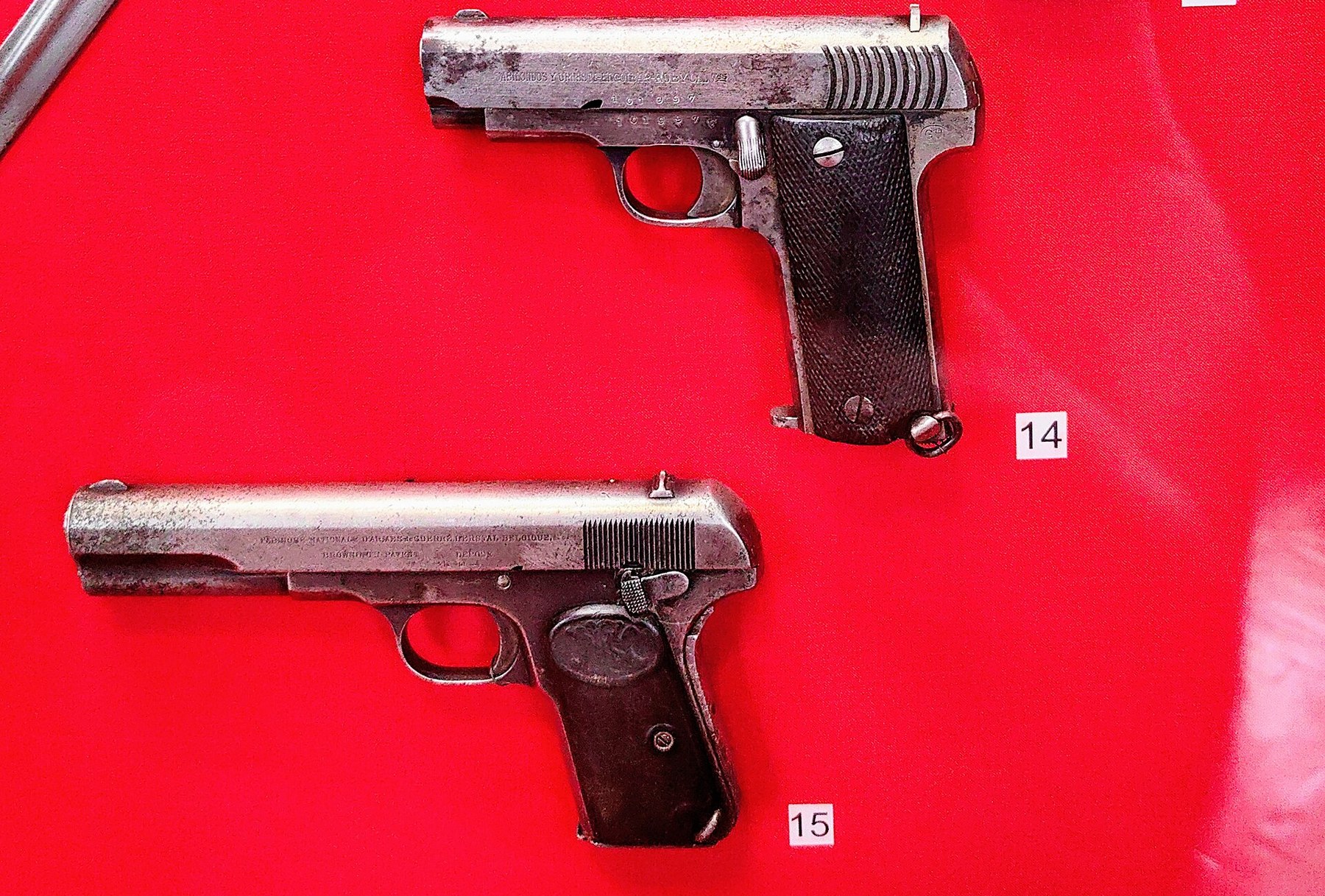
1.5 Gabilondo y Urresti: what the records show
Two Spanish accounts of the firm’s early years were read for this dive. They agree on the outline and disagree on two points that matter.
Juan L. Calvó, the historian of the Eibar arms industry, wrote the most careful one in 2008, from Eibar’s Matrícula Industrial, the municipal register of businesses for the industrial tax.6 He found that the firm “claimed to have been founded in 1904, with the business name of ‘Gabilondo y Urresti’, but does not appear in the Matrícula Industrial of Eibar until the year 1907, as owner of a workshop with four workers, eight in the period 1908–14”. It was not among the makers who met in 1912 to answer threats from Fabrique Nationale over copying. It began making “Eibar-type” pistols only in 1913, under the trademark Radium: a 6.35 mm Browning copy using a loading system patented that year by Guillermo Echeverría and Valentín Vallejo, which had no conventional magazine; cartridges were loaded one by one through an opening revealed by sliding one grip panel down.6 A 1916 Madrid writer, Vázquez de Aldana, mocked it as a pistol “with the advantage of having the disadvantage of having done away with the magazine”.6
Manfredo Monforte Moreno’s 2026 paper for the Spanish Academia de las Ciencias y las Artes Militares gives the same 1904 foundation in Eibar, adds that the firm began with Velo-Dog revolvers, “Nagant” revolvers and copies of Colt types, and gives the same 1913 Radium.7 Forgotten Weapons says that when the French order came the shop had “less than 10 employees (between 5 and 8, depending on which source you read)”, which matches Calvó’s register figure.4
In 1914 the name changed. Calvó says the firm became “Gabilondos y Urresti”, the plural marking the entry of another partner named Gabilondo.6 Monforte names them: José Gabilondo’s children Lorenzo, Estanislao, Eustaquia and Manuel joined their father.7 The plural is on the pistols. The slide in the frontispiece reads “GABILONDOS Y URRESTI”, and so does the Gabilondo Ruby at Hrodna above. A Ruby marked “Gabilondo y Urresti”, singular, would therefore be either an early pistol or a mis-reading of the stamp; this dive found none photographed.
1.6 The Victoria, and Pedro Careaga
The Ruby was not Gabilondo’s design. Calvó is explicit: the Ruby differed from the Victoria, a seven-shot 7.65 mm pistol made by Esperanza y Unceta, “only by the greater length of its grip, to hold a magazine with capacity for nine cartridges”.6 Esperanza y Unceta, the firm later known as Astra, used in the Victoria “the patents of Pedro Careaga and perhaps some of their own, obtained in 1911 and 1912”.6 Calvó illustrates two Victorias, both marked “7,65 1911 MODEL AUTOMATIC PISTOL / ‘VICTORIA’ PATENT”: one a seven-shot pistol with the “VICTORIA EU” logo, the other a nine-shot Ruby-type with the “EU” logo alone, so Esperanza y Unceta made the long-gripped version too.6
Pedro Careaga Garagarza, an Eibar engineer, is credited in the Spanish Wikipedia with sixteen patents between 1906 and 1920 and with a 1911 design built “on the Browning 1903 and 1906” with the safety beside the trigger.8 That article cites nothing for the patent count, and the Spanish historical patent register was not searched for this dive. What the Careaga patents covered is therefore not established here. The English Wikipedia’s guess that they “may have covered the frame-mounted safety (instead of a grip safety), and an internal striker (instead of a hammer)” is half wrong on its face: the French Army’s own instruction on these pistols describes a hammer (chien), not a striker (Vol 4).910
1.7 The Ruby: a longer grip and nine rounds
In 1914, then, the new Gabilondos y Urresti registered the trademark RUBY for a pistol that was, in Calvó’s account, the Victoria with a longer grip.6 A nine-round magazine was unusual for a pocket .32; the Victoria it was built on held seven.6 Calvó photographs a Ruby marked “GABILONDOS Y URRESTI . EIBAR – RUBY CAL. 7,65”, nine shots, with an 88 mm barrel.6
The Eibar address on that pistol and the Elgoibar address on the two pistols illustrated in this volume record a move. Calvó says that in 1917 many Eibar workshops disappeared from the Matrícula, which “some explain by arguing that they worked exclusively for ‘Gabilondos y Urresti’, which had installed its factory in Elgoibar”.6 Monforte puts the move after the war.7 The pistols settle part of it: a Gabilondos y Urresti slide, with the wartime plural name, already reads ELGOIBAR. The move came before the firm became Gabilondo y Cía, and the Rock Island pistol also carries the GU code associated with French contracts (Vol 5). Calvó’s dating is the better supported.
1.8 Patent or trademark?
Here the two Spanish sources disagree outright. Monforte writes that in 1914 the firm “patenta la pistola Ruby”, patented the Ruby pistol, “a modification of the ‘Victoria’ model of Esperanza y Unceta with a longer grip”.7 Calvó, who worked from the registers, writes: “In the name of ‘Gabilondo y Urresti’ or ‘Gabilondos y Urresti’ no patent appears; the ‘RUBY’ trademark was the only thing about this pistol that was their exclusive property.”6
Calvó gives his basis and Monforte gives none, so this dive follows Calvó: the Ruby was a registered name on another firm’s design. That matters for the rest of the story. When the French adopted the “Ruby” they adopted a type, not a patent, and nothing stopped any Eibar shop from making it.
1.9 Who the Ruby was for
Why a small Eibar firm made a nine-shot .32 in 1914 is not documented by any primary source read for this dive. The secondary accounts disagree:
- English Wikipedia, citing Gene Gangarosa’s Spanish Handguns (2001), says the pistol “was intended for export to the Americas, and despite the small calibre it was designed with military and police sales in mind”.9
- The Firearm Blog says Gabilondo “had been marketing a military version of the Eibar Type to the Balkans”, with a lanyard ring as its only unique feature.11
Neither cites a document, and Gangarosa’s book was not available to check. Both claims are recorded here as unverified.
1.10 Popular numbers, and what stands behind them
Every popular account of the Ruby carries numbers, and they disagree. They are collected in Vol 2 with what stands behind each. In summary:
Table 1 — Every popular account of the Ruby carries numbers, and they disagree. They are collected in Vol 2 with what stands behind each. In summary
| Claim | Where it appears | What stands behind it |
|---|---|---|
| Ruby-types accepted by France: about 710,000 | English Wikipedia, citing Gangarosa (2001); Jaeger Platoon | A book not read for this dive |
| ”709 775” pistols inventoried by the French reception commission | French Wikipedia | No citation |
| 950,000 delivered to the French Army, 1915–1918 | French Wikipedia infobox | No citation |
| ”more than 900,000” Ruby-types supplied | Calvó (2008) | An estimate: se calcula, “it is calculated” |
| About a million made in Spain | Forgotten Weapons | No citation |
| 968,000 | Italian Wikipedia infobox | No citation; the page is flagged unreliable by its own editors |
| Gabilondo’s own share: 250,000 to 300,000 | English Wikipedia, citing Gangarosa | A book not read |
No archival count was found. The figure closest to a document is 709,775, because it is oddly exact and attributed to a named body, the French reception commission, but the page that gives it cites nothing.
1.11 What could not be established
- The Spanish patent law of 1900–1914 and whether a working requirement voided foreign patents (Forgotten Weapons’ explanation, unverified).
- What Pedro Careaga’s 1911 patents claimed; the patent count of sixteen.
- Whether the Ruby was first aimed at the Americas, the Balkans or neither.
- The date of Gabilondos y Urresti’s move to Elgoibar (by 1917 per Calvó; after the war per Monforte; the pistols favour Calvó).
- Pollard’s 1917 British withdrawal of Spanish pistols.
References
Footnotes
-
NRA Family, “Throwback Thursday: Spanish ‘Ruby’ Pistols of WWI” (introducing the American Rifleman “I Have This Old Gun” episode), https://www.nrafamily.org/content/throwback-thursday-spanish-ruby-pistols-of-wwi/, consulted 2026-10-19. ↩
-
Ian McCollum, “Spanish Eibar/Ruby Pistols” (Vault page), Forgotten Weapons, https://www.forgottenweapons.com/other-handguns/eibar-ruby/, consulted 2026-10-19. ↩
-
Major Hugh B. C. Pollard, Automatic Pistols (London: Sir Isaac Pitman & Sons, 1920), pp. 29–31; Internet Archive full text, https://archive.org/details/automaticpistolspollard1920, consulted 2026-10-19. ↩ ↩2
-
Ian McCollum, “Spanish Eibar/Ruby Pistols”, Forgotten Weapons, 19 October 2012, https://www.forgottenweapons.com/spanish-eibarruby-pistols/, consulted 2026-10-19. ↩ ↩2
-
John M. Browning, “Automatic firearm”, US Patent 747,585, filed 3 April 1902, granted 22 December 1903, https://patents.google.com/patent/US747585, consulted 2026-10-19. ↩ ↩2
-
Juan L. Calvó, “Automáticas eibarresas en la Gran Guerra” (Eibar, October 2008), 4 pp., catalogacionarmas.com, http://www.catalogacionarmas.com/public/39-ruby.pdf, consulted 2026-10-19. Quotations translated for this dive. ↩ ↩2 ↩3 ↩4 ↩5 ↩6 ↩7 ↩8 ↩9 ↩10 ↩11 ↩12
-
Manfredo Monforte Moreno, “Arma corta española”, Comunicaciones académicas, Academia de las Ciencias y las Artes Militares, Sección de Prospectiva de la Tecnología Militar, 27 February 2026, https://www.acami.es/wp-content/uploads/2026/04/2026-04-09-CMN-PTM-Arma-corta-espanola-web.pdf, consulted 2026-10-19. Quotations translated for this dive. ↩ ↩2 ↩3 ↩4
-
“Pedro Careaga Garagarza”, Spanish Wikipedia (read through the hispanopedia mirror), https://es.hispanopedia.com/wiki/Pedro_Careaga_Garagarza, consulted 2026-10-19. Uncited on the points used. ↩
-
“Ruby pistol”, English Wikipedia, revision 1362866939, https://en.wikipedia.org/w/index.php?title=Ruby_pistol&oldid=1362866939, consulted 2026-10-19. Used only as a record of what is claimed and whom it cites. ↩ ↩2
-
French Army instruction on the 7.65 mm automatic pistols in service (title, date and issuing authority not given), as transcribed by Tir Sportif Chabris, https://tirsportifchabris.fr/blog/pistolet-ruby-7-65-demontage, consulted 2026-10-19. The original was not located. ↩
-
“France’s WWI ‘Ruby’”, The Firearm Blog, 16 October 2014, https://www.thefirearmblog.com/blog/2014/10/16/frances-wwi-ruby/, consulted 2026-10-19. ↩
Comments (0)