Ruby Pistol · Volume 2
The French Contracts, 1915 to 1918: One Name, Dozens of Makers
What France ordered and when, how Gabilondo subcontracted, how the independent Eibar shops joined in, the two French categories of 7.65 mm pistol, and every total with what stands behind it
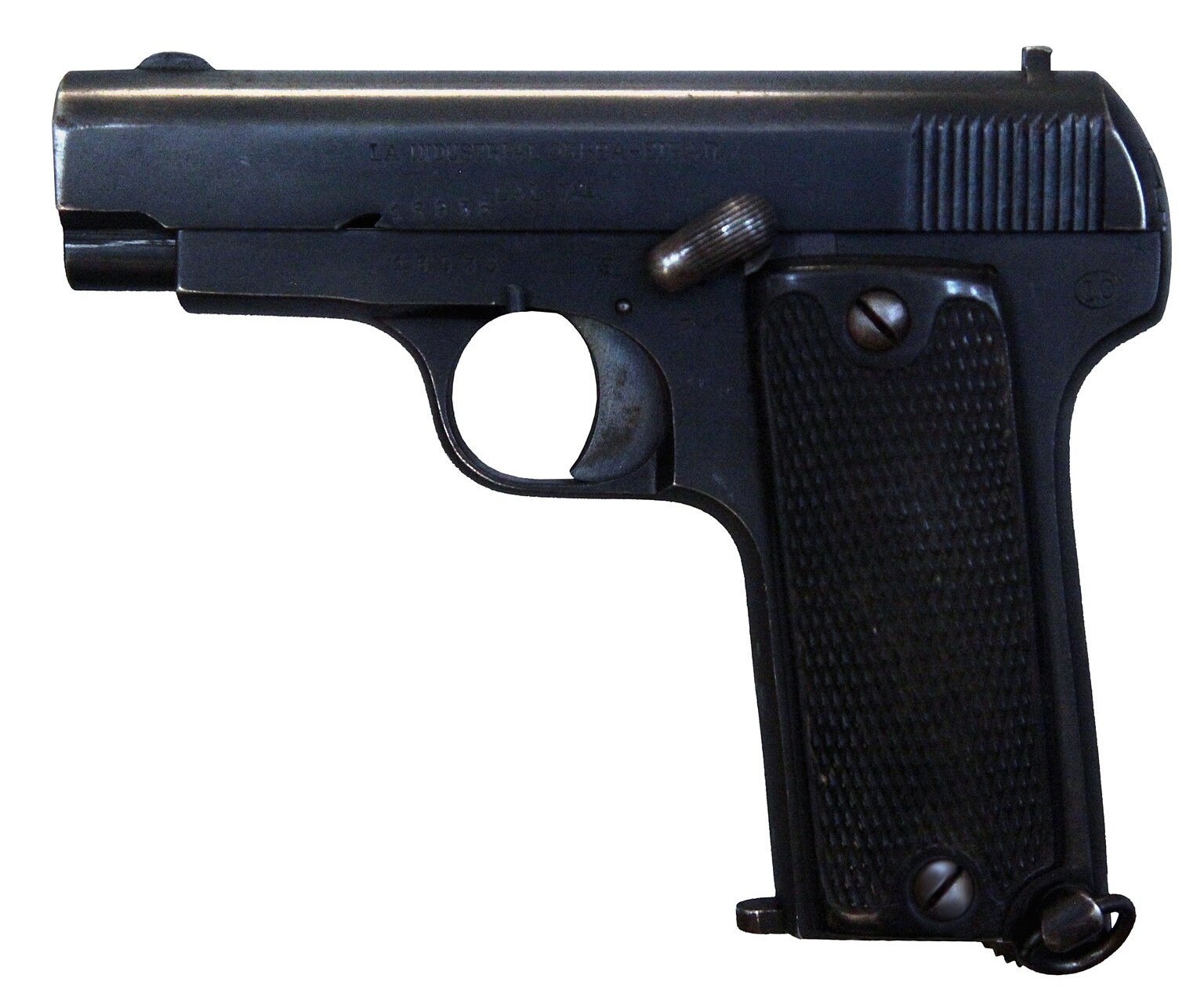
2.1 France’s pistol problem
France went to war in 1914 with the Modèle 1892 revolver as its service handgun. TFB’s gunsmith-writer Sam S. sums up the difficulty: the revolver was good but “expensive and time-consuming to make”, the government arsenals were needed for rifles and machine guns, and the Savage Model 1907 pistols France ordered from the United States “were slow to produce and ship”.1 Calvó, writing from the Spanish side, adds the other half: the Allies wanted their own industry on heavy matériel, “and turned to the Eibar arms industry to provide themselves with handguns, which were proving very useful in the hand-to-hand fighting brought on by trench warfare”.2
Eibar needed the work. When war broke out, Calvó writes, the closing of markets and the moratorium on international credit were “a drama for the Eibar arms makers”; the town council put unemployed mechanics to work with pick and shovel building the Eibar–Aguinaga road and opened a soup kitchen selling food at cost. “This situation changed radically during the second half of 1915.”2
2.2 The order
The sources agree on the first rate and on the first increase:
Table 1 — The sources agree on the first rate and on the first increase
| Point | Calvó (2008) | Monforte (2026) | Forgotten Weapons (2012) |
|---|---|---|---|
| Opening rate | 10,000 a month | 10,000 a month | 10,000 a month |
| When | contract leading to deliveries; tripled “from August 1915” | 1915 | ”standing order in May 1915” |
| First increase | tripled, i.e. 30,000 a month, from August 1915 | ”later tripled” | 30,000 a month by August 1915 |
| Second increase | not mentioned | not mentioned | ”would later jump again to 50,000 per month” |
| Magazines per pistol | not mentioned | three | not mentioned |
Sources: Calvó,2 Monforte,3 Forgotten Weapons.4
The 50,000-a-month figure appears in Forgotten Weapons, Jaeger Platoon, The Firearm Blog and English Wikipedia, none with a citation; neither Spanish historian mentions it.4567 It is stated in this dive as reported, not as established. Monforte’s three magazines per pistol is the only statement of the issue scale found; it is uncited too.3
The French service name, as the French Army’s own instruction uses it, was pistolet automatique de 7 mm 65 genre “Ruby”: the 7.65 mm automatic pistol of the “Ruby” kind.8 The word genre is the point. France was not buying a Gabilondo product; it was buying anything of that kind that passed inspection.
2.3 Gabilondo’s partners
Gabilondo could not make 10,000 pistols a month with eight workers. Forgotten Weapons gives the arrangement most accounts repeat: Gabilondo “contracted with four other gunmakers in the city of Eibar: Armeria Elgobaressa y Cia, Echealasa y Vincinai y Cia, Hijos de Angel Echeverria y Cia, and Iraola Salaverria y Cia”. Each was “to produce 5000 pistols per month for Gabilondo, who would control overall QC and deliver the guns to France”; subcontractors “would be fined for any failure to meet the monthly quota, and any pistols over the required 5000 would be purchased by Gabilondo at the standard rate”.4 Jaeger Platoon says Gabilondo eventually had seven partner companies.5 English Wikipedia, citing Gangarosa, puts delivery at Bayonne.7
None of these sources reproduces a contract, and the terms (5,000 a month, fines, overage purchased at the standard rate) are uncited in all of them. Calvó, who had the Eibar registers, supports only the general fact: “‘Gabilondos y Urresti’ was far from being able to meet [the French Army’s] demand in the quantity required and resorted to subcontracting its production to other workshops.”2 His register evidence for the 1917 disappearance of workshops into exclusive work for Gabilondo is in Vol 1.
2.4 The independents
What turned the Ruby from a product into a type was the arrival of firms dealing directly with France. Forgotten Weapons: “Shops around Eibar in need of work saw the French as a golden opportunity, and jumped into the fray. Some worked with Gabilondo, while many others negotiated their own deals directly with French purchasing agents.”4
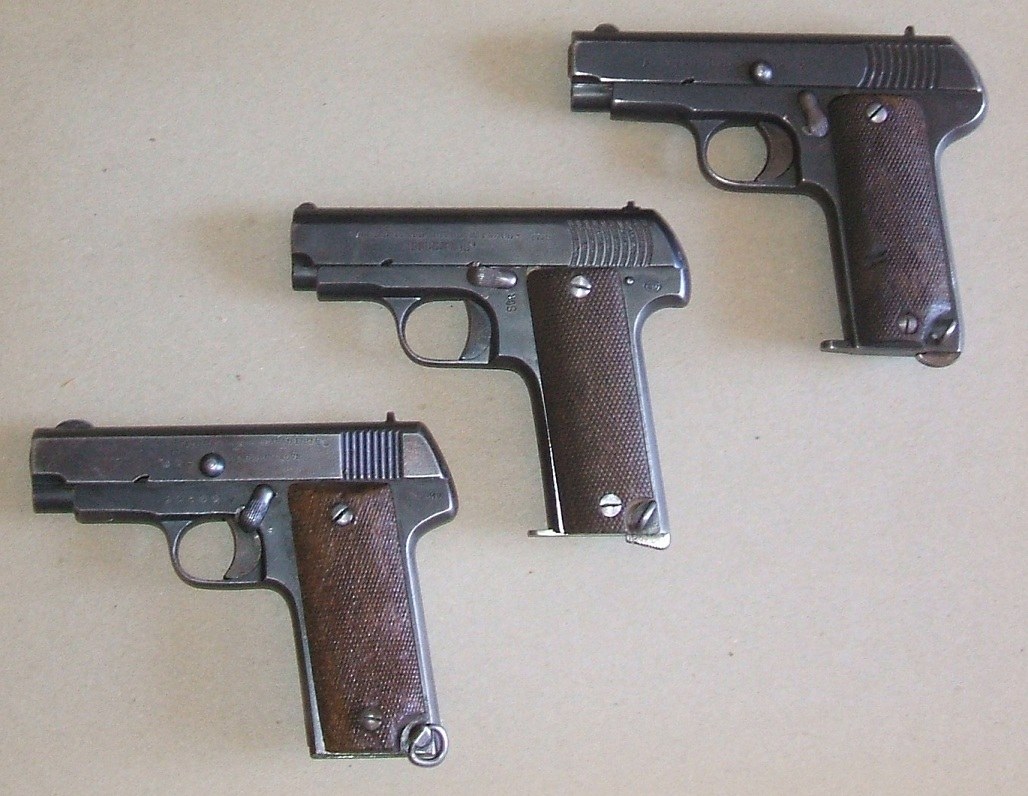
Calvó names the trademarks registered for these pistols at the time: ASTRA (Esperanza y Unceta, 1914), ALKAR and PANAMA (Alkartasuna S.A., 1914 and 1915), EXPRESS (Garate, Anitua y Cía, 1917), IZARRA (Bonifacio Echeverría, 1917), ERRASTI (Antonio Errasti) and M. ZULAICA (Marcelo Zulaica). “Hence, rather than speaking of ‘Ruby’ pistols, one should recognise the existence of ‘Ruby-type’ pistols, not all with the RUBY mark.”2 His photographs show Ruby-types marked by Esperanza y Unceta (Astra Mod. 1915 and 1916 Model), Alkartasuna, M. Zulaica, Arizmendi Zulaica with a Beistegui Hermanos “CEBRA” legend, Bonifacio Echeverría’s Izarra, Garate Anitua, and Isidro Gaztañaga’s “Destroyer”.2
How many firms took part has no documented answer. Forgotten Weapons says “at least 45 different small companies made these pistols”; Jaeger Platoon says France “ended up making contracts with at least 45 Spanish companies total”; English Wikipedia says “at least 45 other companies contracted with the French directly”.457 One collector, commenting on Forgotten Weapons in 2022, reported identifying 39 maker codes plus ten more companies that supplied pistols or parts without a code.9 That is a collector’s working count, not a record, and is given here as such.
2.5 Genre Ruby, genre Star: the two French categories
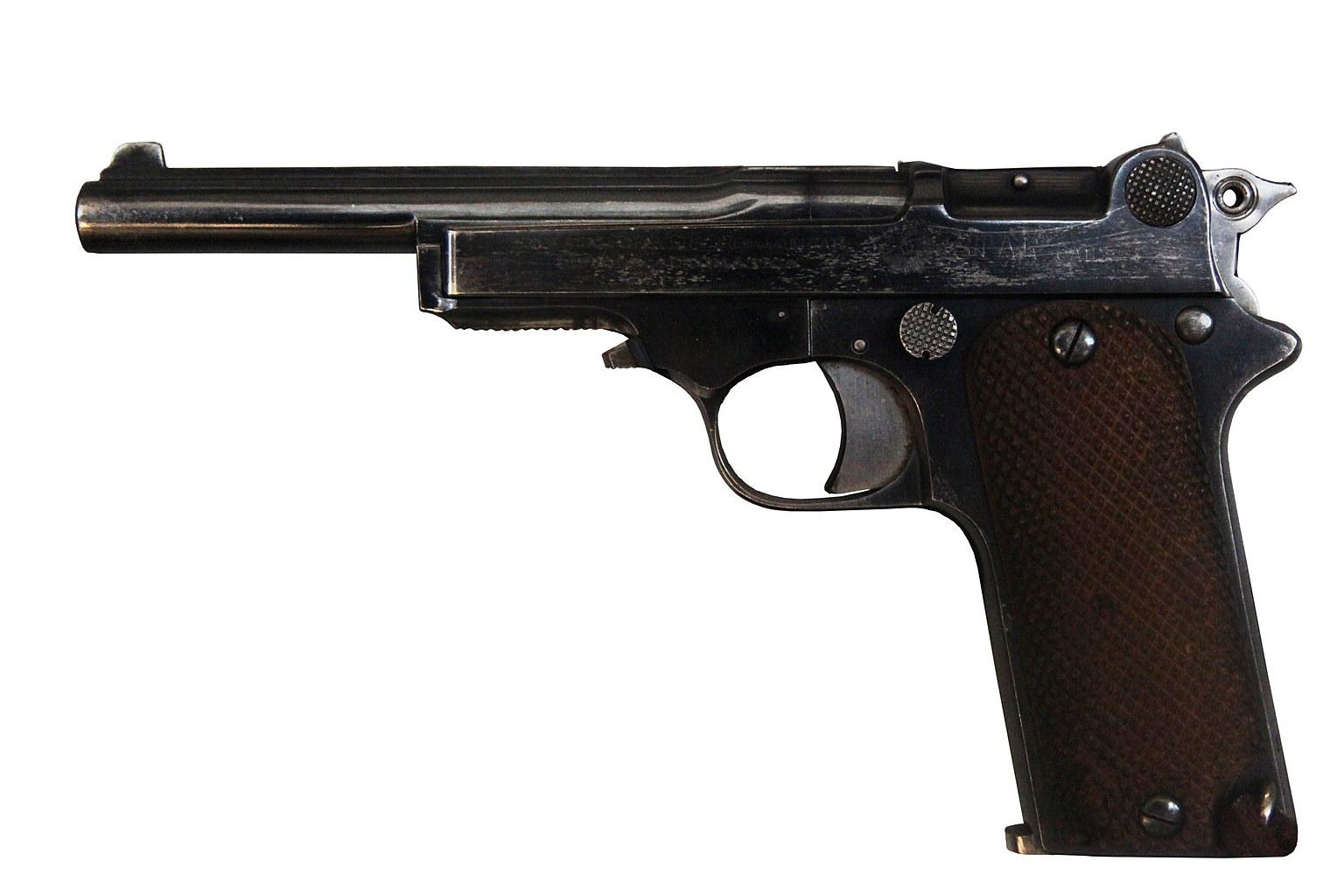
The French Army’s instruction on its 7.65 mm automatic pistols opens with a classification: “Les pistolets automatiques de 7 mm 65 en service se divisent en deux catégories: 1° les pistolets genre «Ruby» ; 2° les pistolets genre Star.” The 7.65 mm automatic pistols in service fall into two categories: first, the Ruby kind; second, the Star kind.8
The first category, it says, “includes a fairly large number of arms of various makes: Action, Aéro, Alkar, Astra, Destroyer, Fiel, Impérial, Mortiem, Premier, Stossel, Teuf-teuf, Titanic, Victoria, etc. These arms differ from one another only in details of arrangement or in the way they are dismounted.”8 The second was Bonifacio Echeverría’s Star Model 1914, a different pistol on Echeverría’s own patents, with an external hammer and a safety that is lowered against a stop.82 Calvó gives France’s Star purchase as 24,700, “tiny in comparison with the Ruby-types”.2
The Musée de l’Armée’s Star 1914 is catalogued on Wikimedia Commons by its photographer as a “Star type 2 pistol”,10 which matches the instruction’s second category; the instruction’s own wording is 1° and 2° and genre. No source read for this dive describes two marking types on Ruby pistols.
The instruction itself is known to this dive only through a transcription on a French shooting club’s website. Its title, date and issuing authority are not given there, and the original was not found in Gallica or the Internet Archive. Its content (numbered figures, “in service”, brand lists) is plainly a military instruction, and it is used throughout this dive as the closest thing to a primary French source available, with that caveat.8
2.6 Acceptance at Bayonne
English Wikipedia, citing Gangarosa, says Gabilondo was to “arrange delivery to the French authorities in Bayonne”.7 A longer account of acceptance appears in an unsigned French collector text, apparently a translation of an English article: pistols went to the “Commission de réception française au Parc d’artillerie des armées à Bayonne” in lots of 1,000; bore and grooves were gauged; a full magazine was fired; pistols were re-inspected for broken, cracked or worn parts; if 10 per cent failed, the lot was rejected; later, to save ammunition, only one or two in ten were fired; and the pistols “were intended to have a service life of 500 rounds”.11 None of that is sourced, and none of it is repeated elsewhere in the sources read. It is recorded here as a collector’s account that a French archive (the Service historique de la Défense at Vincennes would be the place to look) could confirm or refute.
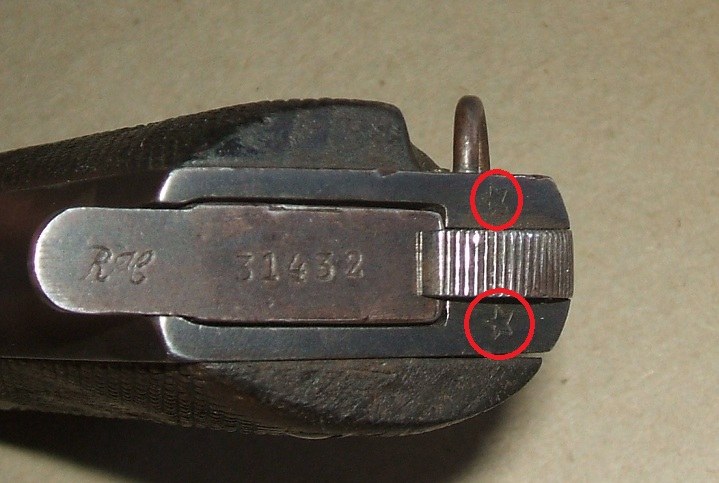
The physical evidence of acceptance is better. Forgotten Weapons: pistols formally accepted for French service “were supposed to be marked with a star or pair of stars on the bottom of the frame alongside the magazine well”. “Not all of them received this depending on how urgent the need for guns was when a shipment arrived.”4 Jaeger Platoon calls them a “pair of stars stamped next to magazine release”.5 A collector commenting on Forgotten Weapons reports an IS-coded pistol with the French holster stud but no stars.9 Stars therefore prove acceptance; their absence does not disprove French service.
2.7 The maker codes, and where the list comes from
Pistols made for France “typically had a one- or two-letter mark in an oval on the rear left of the frame. These letters identified the manufacturer, irrespective of trademark name.”4 Jaeger Platoon adds that the French marked the magazines to match, and photographs two: one stamped with I in a circle (Izarra), one with I.G in a circle (Isidro Gaztañaga).5
The full list of codes circulating on the internet (Forgotten Weapons’ Vault page, English Wikipedia, French collector sites) is one list, copied. Forgotten Weapons says plainly where it came from: “We are unable to verify much of this list, as we found it copied from a since-deleted web page and we have no source for the information. It does check out when compared to the handful of Eibar pistols in our reference collection, so we provide it here to be considered suggestive but not definitive.”12 English Wikipedia’s copy differs in places (Victor Bernedo as VB where Forgotten Weapons gives both BC and VB; Martin Bascaran as MB where Forgotten Weapons gives MA and MB; Durango’s “Vencedor” as VD where Forgotten Weapons has VD “unknown”), and none of its codes is cited to a primary record.712
This dive therefore treats each code as reported unless a photographed pistol pairs it with a maker’s name. Vol 5 tabulates the codes with that confirmation, and the pairs confirmed for this dive so far are GU with Gabilondos y Urresti, IO with La Industrial Orbea, and AZ with Arizmendi, Zulaica (a dealer’s description of a Cebra).
When the codes were applied is also unsettled. The unsigned French collector text offers two theories: that wartime pistols were stamped in an oval and post-war ones without, with magazines marked late in the war or after; or that pistols and magazines were coded together during overhauls in the early 1920s.11 Neither is sourced.
2.8 The holster stud
Many French-service Ruby-types have a large round stud on the left of the slide. Forgotten Weapons explains it as a fix for “tight French military holsters catching and disengaging the safety lever when the guns were drawn”, blamed for accidental discharges: the stud held the leather away from the lever. “The knob was clearly added after manufacture, as it will typically cover part of the serial number or other markings on the slide.”4 Forgotten Weapons ties it to wartime service; the French collector text dates it to “sometime in the early 1920s, during the overhaul period”.11 The Musée de l’Armée’s Orbea pistol in this volume’s frontispiece has one; the two Gabilondo pistols in Vol 1 do not.
2.9 How many?
Table 2 — How many?
| Figure | What it counts | Source | Status |
|---|---|---|---|
| 10,000 / 30,000 / 50,000 a month | contract rates | Calvó; Monforte; Forgotten Weapons | 10,000 and 30,000 agreed by all; 50,000 uncited |
| 24,700 | Star 1914 pistols bought by France | Calvó | stated without a document |
| ”about 710,000” | Ruby-types accepted by France from all sources | English Wikipedia citing Gangarosa (2001) | book not read |
| 709,775 | ”inventoried” by the French reception commission | French Wikipedia | uncited |
| ”about 580,000” | still serviceable in French stores by 1920 | English Wikipedia citing Gangarosa | book not read |
| 950,000 | delivered to the French Army 1915–1918 | French Wikipedia infobox | uncited |
| ”more than 900,000” | supplied to France, Romania, Greece and Italy | Calvó | an estimate (se calcula) |
| “about a million” | made in Spain | Forgotten Weapons | uncited |
| 250,000–300,000 | made by Gabilondo | English Wikipedia citing Gangarosa | book not read |
Sources: as cited in the table.234713
Two observations. First, the French figures (about 710,000 accepted, 709,775 inventoried) and the larger ones (900,000, a million) are not in conflict: the larger ones include other buyers and post-war production. They are not averaged here. Second, no figure in the table was traced to an archive. The most promising primary sources, the French reception commission’s registers and Spanish export records, were not reached.
2.10 Quality
The quality story is told in nearly the same words everywhere: Gabilondo’s early shipments were good and the contract terms then rewarded quantity over quality.4 The French collector text goes further, saying some pistols from smaller firms fired as the slide chambered a round, fired when the safety was moved to fire, “or even went to full automatic”.11 TFB’s gunsmith, writing from one pistol on his bench, found boogered screws, a slide notch peened by the harder safety, thin magazine feed lips, a tired extractor spring and a firing pin of the kind that “may become lodged” and make a “runaway” gun.1 Vol 6 takes up the failures as a repair matter.
The other side of the record is that France kept these pistols. Jaeger Platoon notes they “remained in French use in World War 2 and beyond”, and Finland, which bought 10,000 in 1919, kept them in inventory until 1986 (Vol 3).5
2.11 What could not be established
- Any contract document, its date (May or August 1915), or its terms (5,000 a month per partner, fines, overage).
- The 50,000-a-month rate.
- The Bayonne acceptance procedure and the 500-round service life.
- The original French instruction (title, date).
- An archival total for pistols accepted.
- When the maker codes and magazine marks were applied.
References
Footnotes
-
Sam S., “TFB Armorer’s Bench: Commentary on The 1915 Spanish Ruby Pistol”, The Firearm Blog, 27 August 2023, https://www.thefirearmblog.com/blog/2023/08/27/tfb-armorers-bench-commentary-1915-spanish-ruby-pistol/, consulted 2026-10-19. ↩ ↩2
-
Juan L. Calvó, “Automáticas eibarresas en la Gran Guerra” (Eibar, October 2008), http://www.catalogacionarmas.com/public/39-ruby.pdf, consulted 2026-10-19. Quotations translated for this dive. ↩ ↩2 ↩3 ↩4 ↩5 ↩6 ↩7 ↩8 ↩9
-
Manfredo Monforte Moreno, “Arma corta española”, Academia de las Ciencias y las Artes Militares, 27 February 2026, https://www.acami.es/wp-content/uploads/2026/04/2026-04-09-CMN-PTM-Arma-corta-espanola-web.pdf, consulted 2026-10-19. ↩ ↩2 ↩3
-
Ian McCollum, “Spanish Eibar/Ruby Pistols”, Forgotten Weapons, 19 October 2012, https://www.forgottenweapons.com/spanish-eibarruby-pistols/, consulted 2026-10-19. ↩ ↩2 ↩3 ↩4 ↩5 ↩6 ↩7 ↩8 ↩9 ↩10
-
Jaeger Platoon, “Revolvers & Pistols part 3: 7,65 mm Pistol M/19 ‘Spanish’”, http://www.jaegerplatoon.net/PISTOLS3.htm, consulted 2026-10-19. ↩ ↩2 ↩3 ↩4 ↩5 ↩6
-
“France’s WWI ‘Ruby’”, The Firearm Blog, 16 October 2014, https://www.thefirearmblog.com/blog/2014/10/16/frances-wwi-ruby/, consulted 2026-10-19. ↩
-
“Ruby pistol”, English Wikipedia, revision 1362866939, https://en.wikipedia.org/w/index.php?title=Ruby_pistol&oldid=1362866939, consulted 2026-10-19. ↩ ↩2 ↩3 ↩4 ↩5 ↩6
-
French Army instruction on the 7.65 mm automatic pistols in service (title, date and issuing authority not given), as transcribed by Tir Sportif Chabris, https://tirsportifchabris.fr/blog/pistolet-ruby-7-65-demontage, consulted 2026-10-19. ↩ ↩2 ↩3 ↩4 ↩5
-
Ian McCollum, “Serbian/Yugoslav Ruby Pistol”, Forgotten Weapons, 2 March 2022, and reader comments, https://www.forgottenweapons.com/serbian-yugoslav-ruby-pistol/, consulted 2026-10-19. ↩ ↩2
-
“Star type 2 pistol-Inv 32146-IMG 7362”, photograph by Rama of Musée de l’Armée Inv. 32146, Wikimedia Commons, https://commons.wikimedia.org/wiki/File:Star_type_2_pistol-Inv_32146-IMG_7362-white.jpg, consulted 2026-10-19. ↩
-
Unsigned collector text on the Ruby pistol, Tir Sportif Chabris, https://tirsportifchabris.fr/blog/vue-eclatee-pistolet-ruby, consulted 2026-10-19. No author or sources given; used only as a record of claims. ↩ ↩2 ↩3 ↩4
-
Ian McCollum, “Spanish Eibar/Ruby Pistols” (Vault page with the maker-code list), Forgotten Weapons, https://www.forgottenweapons.com/other-handguns/eibar-ruby/, consulted 2026-10-19. ↩ ↩2
-
“Pistolet Ruby”, French Wikipedia, https://fr.wikipedia.org/wiki/Pistolet_Ruby, consulted 2026-10-19. ↩

Comments (0)