Ruby Pistol · Volume 5
Identifying a Ruby-Type: Makers, Markings and the French Codes
How to tell a Ruby-type from the pistols it resembles, how to read a slide legend, what the oval on the frame does and does not mean, the acceptance stars and the holster stud, and the maker-code list with what confirms each entry
5.1 The type in one paragraph
A Ruby-type is a 7.65 mm Browning (.32 ACP) blowback pistol of Browning’s 1903 pattern (Vol 4) with these four features together, as Forgotten Weapons lists them: a shrouded hammer, a “lumpy-looking safety lever above trigger”, “longitudinal grooves around the muzzle for disassembly”, and a “long 9-round magazine with heel release”. Everything else varies: “slide length, slide serrations, lanyard loop, sights, magazine release, grip panels, and exact frame profile”.1 The French instruction adds that some in service took seven rounds, not nine (Vol 7).2
5.2 Six Ruby-types side by side
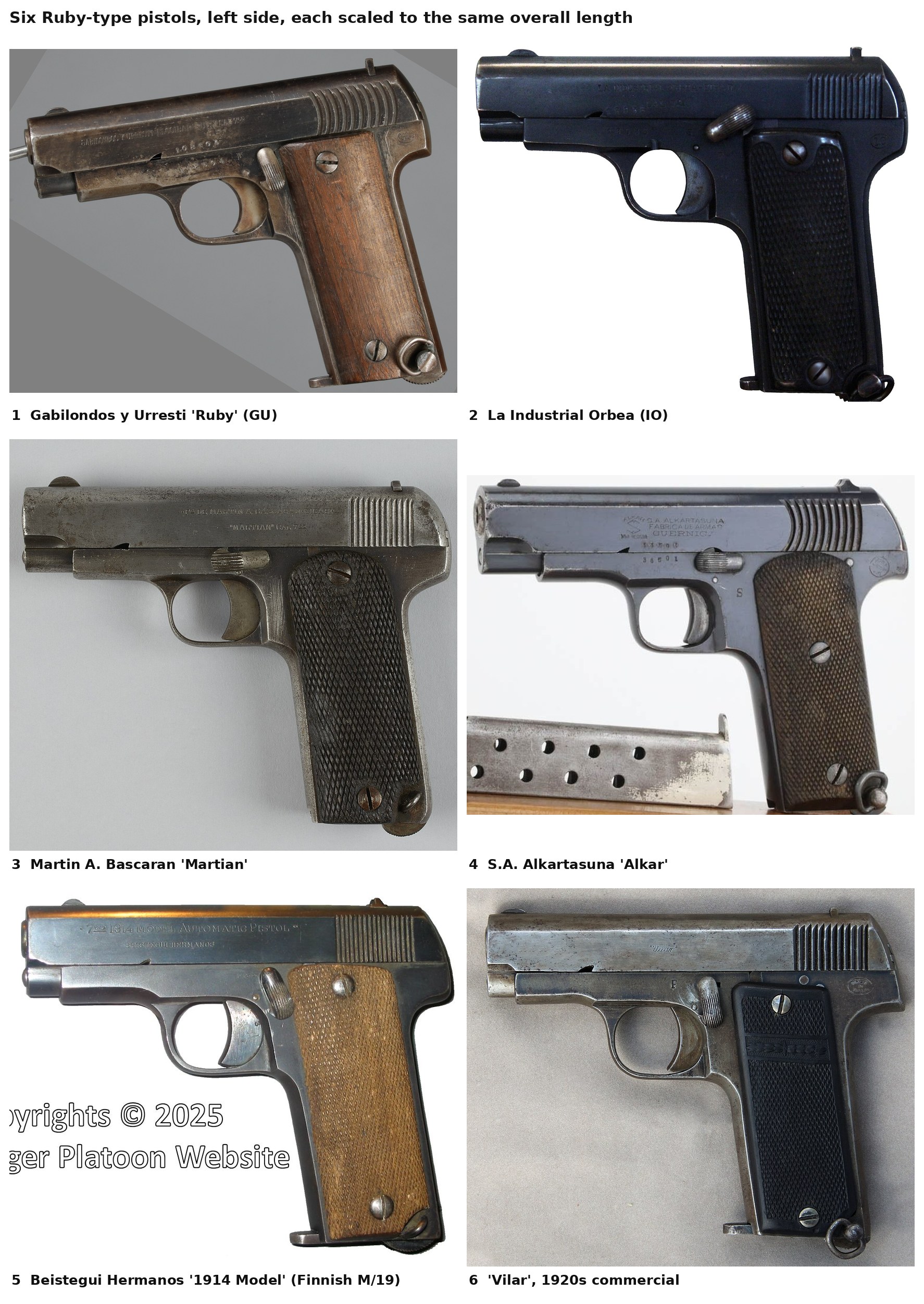
Look along the six for the shared features (the safety lever ahead of the grip, the long grip, the heel catch, the muzzle grooves), then at what differs:
- Slide serrations. Straight vertical cuts on 2, 3, 5 and 6; on 1 and 4 they are curved, following the slide’s rear contour.
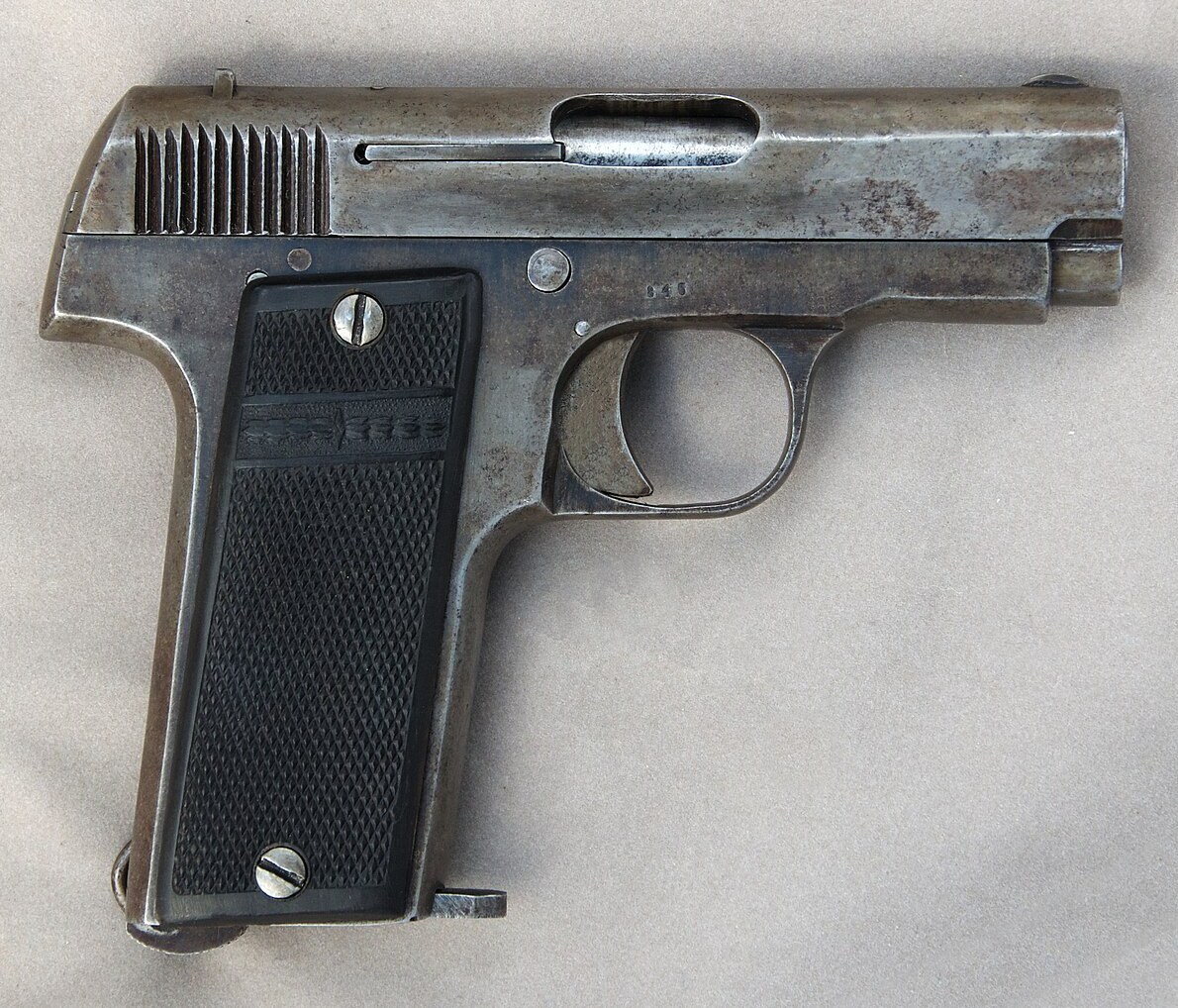
- Slide length against grip. The commercial Vilar (6) has a visibly shorter slide in proportion to its grip than the wartime pistols.
- Lanyard fitting. All six have one at the heel of the butt, but its form differs: a ring hanging from a loop on 1, 2, 4 and 6, a flatter fitting seen edge-on on 3 and 5.
- Holster stud. Only the Orbea (2) has one, at the front of the slide.
- Legend. Every maker words it differently (below).
5.3 Ruby-type or something else?
Four pistols are mistaken for Ruby-types, and a Ruby-type for them:
Table 1 — Four pistols are mistaken for Ruby-types, and a Ruby-type for them
| Pistol | What it shares | How to tell it from a Ruby-type |
|---|---|---|
| FN Model 1903 and Colt Pocket Hammerless | the whole 1903 pattern (Vol 4) | a grip safety at the back of the grip; the thumb safety at the rear of the frame above the grip, not forward above the trigger guard; maker’s legends of FN or Colt3 |
| Star Model 1914 | French service, 7.65 mm, Eibar make | an external hammer; a safety lever lowered against a stop; the French classed it as the second category, “genre Star” (Vol 2)2 |
| Esperanza y Unceta Victoria (seven-shot) and other short-grip Eibar .32s | the same mechanism | a shorter grip for a seven-round magazine; Calvó: the Ruby differed from the Victoria “only by the greater length of its grip”4 |
| 6.35 mm Eibar pocket pistols (Baby-Browning types, Gabilondo’s Radium) | the same makers and names | a smaller pistol in 6.35 mm (.25 ACP); the Radium has no detachable magazine at all (Vol 1)4 |
The FN 1903 at Hrodna in Vol 1 shows the first row’s differences directly; the Star 1914 in Vol 2 the second.
5.4 Reading a slide legend
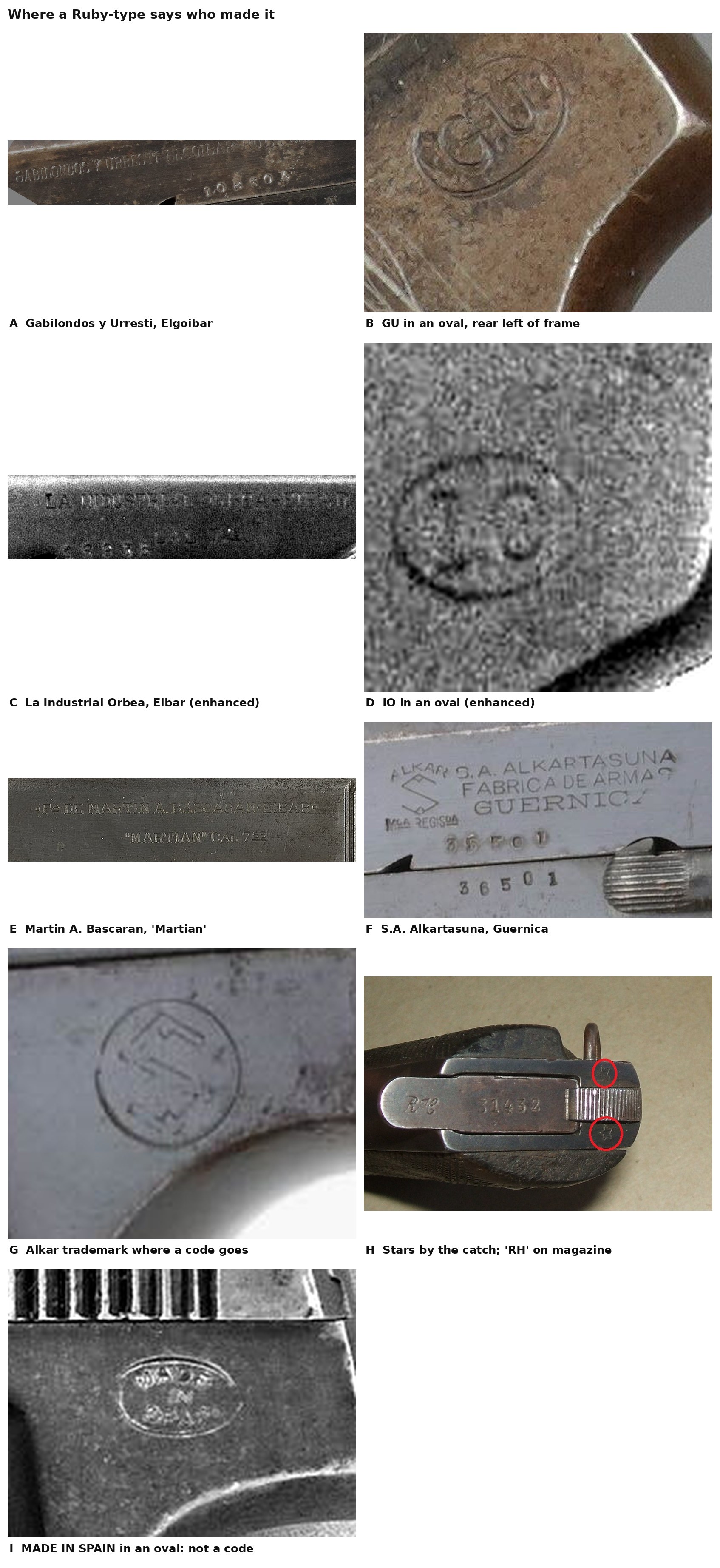
The left of the slide carries the maker’s legend, sometimes with a trade name, sometimes a generic one. The legends below were read from photographs for this dive, or are given by Calvó from his own photographs.
Table 2 — Reading a slide legend
| Legend as stamped | Maker | Read from |
|---|---|---|
| GABILONDOS Y URRESTI – ELGOIBAR – RUBY CAL 7.65 | Gabilondos y Urresti | RIA 5021/1012 (Vol 1); Hrodna pistol (Vol 1) |
| GABILONDOS Y URRESTI . EIBAR – RUBY CAL. 7,65 | Gabilondos y Urresti, Eibar address | Calvó’s photograph4 |
| LA INDUSTRIAL ORBEA – EIBAR / CAL 7,65 | La Industrial Orbea | Musée de l’Armée pistol (Vol 2) |
| Fª DE MARTIN A. BASCARAN – EIBAR / “MARTIAN” CAL 7.65 | Martin A. Bascaran | Saint-Étienne pistol |
| S.A. ALKARTASUNA / FABRICA DE ARMAS / GUERNICA, with ALKAR logo and “Mca Registda” | Alkartasuna | Legacy Collectibles 36083; also Calvó4 |
| 7,65 1914 MODEL AUTOMATIC PISTOL / BEISTEGUI HERMANOS | Beistegui Hermanos | Jaeger Platoon’s Finnish M/195 |
| 7,65 1914 MODEL AUTOMATIC PISTOL / M. ZULAICA & Cº EIBAR | Marcelo Zulaica | Calvó’s photograph4 |
| PISTOLET AUTOMATIQUE CEBRA / BEISTEGUI HERMANOS Cª – ESPAÑA, with AZ logo | Arizmendi, Zulaica y Cía (under a Beistegui legend) | Calvó’s photograph;4 a Collectors Firearms pistol described the same way6 |
| BONIFACIO ECHEVERRIA (ESPAÑA) EIBAR / PISTOLA AUTOMATICA / “IZARRA” CAL 7,65 | Bonifacio Echeverría | Calvó’s photograph4 |
| CAL 7,65 PISTOLET AUTOMATIQUE “DESTROYER” / I. GAZTAÑAGA – EIBAR | Isidro Gaztañaga | Calvó’s photograph4 |
| JUAN ESPERANZA Y PEDRO UNCETA – GUERNICA … “ASTRA” MOD. 1915; and 7,65 1916 MODEL AUTOMATIC PISTOL / ASTRA PATENT | Esperanza y Unceta | Calvó’s photographs4 |
| ”Vilar” (script) | not established | Self Loader’s photograph, Commons |
Three cautions follow from the table:
- “1914 Model Automatic Pistol” is not a maker. Beistegui and Zulaica both used it; Forgotten Weapons’ list also gives it to Retolaza Hermanos.7 The maker’s name, if any, is on the line below.
- A legend can belong to someone else. The Cebra was an Arizmendi, Zulaica pistol, yet carries Beistegui Hermanos’ name; Forgotten Weapons notes that some AZ pistols “may be over stamped ‘Beistegui Hermanos’”.76
- “Ruby” on the slide is not Gabilondo. Calvó: “not all pistols with the ‘RUBY’ mark have ‘Gabilondos y Urresti’ as their maker”.4 Trust the firm’s name, not the trade name.
5.5 The oval on the frame
Forgotten Weapons: pistols made for the French Army “typically had a one- or two-letter mark in an oval on the rear left of the frame. These letters identified the manufacturer, irrespective of trademark name.”1 Two of the pistols photographed for this dive bear that out: GU on the Gabilondo, IO on the Orbea.
The same place on the frame carries other things, and the photographs show three:
- A trademark. The Alkartasuna carries its ALKAR mark in a circle (panel G), not the code AK that the internet list gives the firm.7 Whether Alkartasuna pistols for France carried an AK code as well, on another pistol or another side, is not settled by one example.
- An export mark. The 1920s Vilar carries an oval reading MADE IN SPAIN (panel I). It is a country-of-origin mark for export, not a French code.
- A code on the other side. A Collectors Firearms Cebra had AZ in an oval on the right rear of the frame and on the magazine base.6
So an oval is not by itself evidence of French service. The letters inside it are, if they are a code and if a legend or other mark agrees.
5.6 French service: stars, stud, magazine marks
Three marks point to French service. None is proof on its own.
- Acceptance stars: one on each side of the magazine catch at the base of the frame (plate, panel H). Forgotten Weapons says pistols formally accepted “were supposed to be marked with a star or pair of stars”, but “not all of them received this”.1 One collector reports an IS-coded pistol with the holster stud but no stars.8
- The holster stud: a large rivet-like knob on the left of the slide, added after manufacture and often over the serial or legend (Vol 2).1 Its date, wartime or early-1920s overhaul, is disputed.9
- Magazine base marks: the maker’s letters, sometimes with the pistol’s number. Jaeger Platoon photographs Finnish magazines stamped I in a circle and I.G in a circle; Forgotten Weapons’ photograph shows RH and a number (panel H).51 A magazine whose letters match the frame’s code belongs with that pistol; a mismatch is common and does not by itself mean the magazine will not work (TFB’s gunsmith’s pistol ran with a non-matching magazine), but it is the first thing to check if feeding is poor (Vol 7).10
The unsigned French collector text adds that pistols carry assembly numbers, distinct from the serial, on hand-fitted parts: barrel underside, safety underside, inside the slide near the firing-pin well, the left frame by the grip, the magazine catch, the trigger and the disconnector.9 That is unsourced but checkable on any pistol at the bench, and it matters: a pistol whose small parts carry a different number from each other has been assembled from several.
5.7 The maker codes, with what confirms each
The table below gives the codes of the “military manufacturers” from the list on Forgotten Weapons’ Vault page, which Forgotten Weapons itself calls “suggestive but not definitive” and says was “copied from a since-deleted web page” with “no source for the information”.7 English Wikipedia’s variants are noted where they differ.11 The last column says what, if anything, confirms the pairing for this dive.
Table 3 — The maker codes, with what confirms each
| Code | Maker (Forgotten Weapons list) | Trade names given | Confirmation for this dive |
|---|---|---|---|
| A | Gaspar Arizaga, Eibar | Arizaga, Pinkerton, Warwinch | none |
| AA | Azanza y Arrizabalaga, Eibar | A.A. Reims, Modelo 1916 | none |
| AE | La Armería Elgoibaresa | Lusitania | none |
| AG | Francisco Arizmendi y Goenaga, Eibar | Ideal, Roland, Brunswig | none |
| AH, AR | Acha Hermanos | Looking Glass (thought post-war) | none |
| AK | Alkartasuna, Guernica | Alkar, Kapitan | one Alkartasuna shows its trademark, not AK, at that place |
| AL | Aldazabal, Leturiondo y Cía, Eibar | Aldazabal | none |
| AZ | Arizmendi, Zulaica y Cía, Eibar | Cebra (some over-stamped Beistegui Hermanos) | dealer’s description of a Cebra with AZ on frame and magazine6 |
| BA | Berasaluce, Arietio, Aurteña y Cía | Allies | none |
| BC / VB | Victor Bernedo y Cía | Bernedo; Wikipedia gives VB only | none |
| BH | Beistegui Hermanos, Eibar | 1914 Model, B.H., Bulwark and others | none |
| CU, CZ, RG, TM | unknown | none | |
| EA | Eulogio Arostegui, Eibar | Azul, E.A. | none |
| EC | Erquiaga y Cía, Eibar | Fiel | none; Wikipedia “possibly EC” |
| EU | Esperanza y Unceta, Guernica | Model 1915/1916, Astra Patent, Brunswig, Victory | Calvó shows an EU logo on a nine-shot Victoria4 |
| GB | Gregorio Bolumburu, Eibar | Gloria, Regent, Regina, Rex and others | none |
| GN | Garate, Anitua y Cía, Eibar | Express, Danton, L’Eclair and others | none |
| GU | Gabilondo y Urresti, Eibar or Elgoibar | Ruby, Ruby Extra, Radium, Bufalo, Tauler | photograph: GU oval on a GABILONDOS Y URRESTI pistol (RIA 5021/1012) |
| HE | Hijos de A. Echeverría, Eibar | Vesta, Izarra | none |
| I | Bonifacio Echeverría, Eibar | Izarra, Star | Jaeger Platoon: magazine with I in a circle “belonged to pistol with trade mark Izarra”5 |
| IG | Isidro Gaztañaga, Eibar | Destroyer, Indian | Jaeger Platoon: magazine with I.G in a circle from a Gaztañaga pistol5 |
| IO | La Industrial Orbea, Eibar | none | photograph: IO oval on a LA INDUSTRIAL ORBEA pistol (Musée de l’Armée) |
| IS | Iraola Salaverria y Cía | none | none (one collector’s IS pistol mentioned on Forgotten Weapons)8 |
| JE | Javier Echaniz, Eibar | Defender | none |
| LC | Laplana y Capdevila | unknown | none |
| LH | Lasangabaster Hermanos, Eibar | Douglas | none |
| MA / MB | Martin A. Bascaran, Eibar | Martian | none; the Saint-Étienne Martian has no code at the rear left of its frame |
| MS | Modesto Santos, Eibar | Action, M.S. | none |
| RH | Retolaza Hermanos, Eibar | Liberty, Stosel, Titanic, 1914 Model and others | an RH magazine base (FW photo); its pistol’s legend not shown |
| UC | Urrejola y Cía, Eibar | U.C., Urrejola | none |
| VD | unknown (Wikipedia: Durango, “Vencedor”) | none | |
| ZC | Zulaica y Cía, Eibar | Royal, Vincitor, Zulaica M1914 | none |
Sources: Forgotten Weapons’ Vault list,7 English Wikipedia,11 and the photographs and descriptions cited.
The pattern of the codes is the maker’s initials, which is why the list “checks out” against most pistols. That also means a code can be guessed from a maker’s name, which may be how parts of the circulating list were built. Three pairings (GU, IO, AZ) and two magazine marks (I, IG) are confirmed by evidence for this dive; the rest are reported. A collector who can photograph a coded frame beside a legible legend adds a confirmation.
5.8 Wartime, post-war or commercial?
Table 4 — Wartime, post-war or commercial?
| Feature | Wartime French contract | Post-war commercial (1920s) |
|---|---|---|
| Grip and magazine | long, nine rounds (some seven) | often shorter; seven or eight |
| Slide | standard length | often shortened (the Vilar) |
| Oval on rear left of frame | maker’s code, often | absent, or a trademark, or MADE IN SPAIN |
| Acceptance stars by the catch | if formally accepted | absent |
| Holster stud | if overhauled in French service | absent |
| Lanyard ring | usual | variable |
| Legend | maker, often “Cal 7,65” | trade names, sometimes English (“Automatic Pistol”) |
| Country-of-origin mark | none needed | MADE IN SPAIN or SPAIN, for export |
Sources: the photographs in this volume; Forgotten Weapons;1 the Collectors Firearms Cebra, whose frame is also marked SPAIN at mid-grip, which shows that a French-coded wartime pistol could be marked for export later.6
5.9 Tell them apart: a checklist
Table 5 — Tell them apart: a checklist
| Look at | What you are looking for | Where |
|---|---|---|
| Safety lever | forward, above the trigger guard, left side: Ruby-type. At the rear of the frame with a grip safety: FN or Colt 1903 | left of frame |
| Hammer | none visible: Ruby-type. External hammer: Star 1914 or a later Eibar model | rear of slide |
| Grip length | long, nine rounds: wartime type. Short: Victoria or commercial | grip |
| Legend | the firm’s name, not the trade name; “1914 Model Automatic Pistol” is generic | left of slide |
| Oval on frame | letters = possible French code; a logo or MADE IN SPAIN = not a code | rear of frame, usually left |
| Stars | one each side of the magazine catch = French acceptance | base of frame |
| Stud | round knob on the slide = French holster fix | left front of slide |
| Magazine base | letters matching the frame code, sometimes a number | magazine floor |
| Assembly numbers | matching numbers on barrel, safety, slide interior | underside and inside |
| Proof marks | Eibar proof house marks, if present | barrel, frame (not covered here) |
The proof marks of the Eibar proof house (Banco Oficial de Pruebas) are not covered in this dive; no source on their dates was read.
5.10 What could not be established
- A primary record of the French maker codes; all but three pairings.
- Whether codes were applied in wartime or during the early-1920s overhauls.
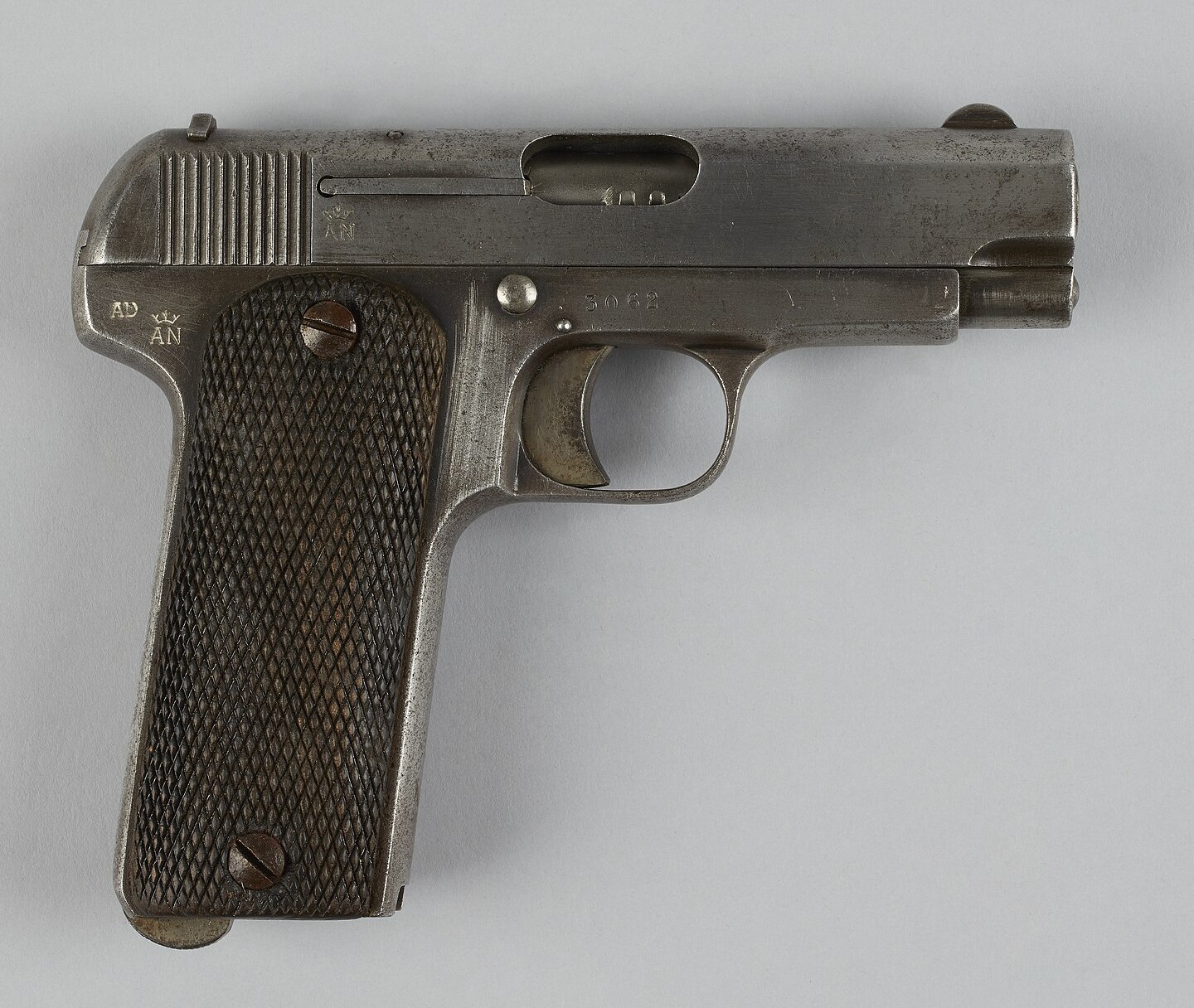
- The meaning of AD and a crown over AN on the Saint-Étienne Martian.
- The Vilar’s maker.
- The dating of Eibar proof marks.
References
Footnotes
-
Ian McCollum, “Spanish Eibar/Ruby Pistols”, Forgotten Weapons, 19 October 2012, https://www.forgottenweapons.com/spanish-eibarruby-pistols/, consulted 2026-10-19. ↩ ↩2 ↩3 ↩4 ↩5 ↩6
-
French Army instruction on the 7.65 mm automatic pistols in service, as transcribed by Tir Sportif Chabris, https://tirsportifchabris.fr/blog/pistolet-ruby-7-65-demontage, consulted 2026-10-19. ↩ ↩2
-
John M. Browning, “Automatic firearm”, US Patent 747,585, granted 22 December 1903, https://patents.google.com/patent/US747585, consulted 2026-10-19. ↩
-
Juan L. Calvó, “Automáticas eibarresas en la Gran Guerra” (Eibar, October 2008), http://www.catalogacionarmas.com/public/39-ruby.pdf, consulted 2026-10-19. ↩ ↩2 ↩3 ↩4 ↩5 ↩6 ↩7 ↩8 ↩9 ↩10 ↩11
-
Jaeger Platoon, “Revolvers & Pistols part 3: 7,65 mm Pistol M/19 ‘Spanish’”, http://www.jaegerplatoon.net/PISTOLS3.htm, consulted 2026-10-19. ↩ ↩2 ↩3 ↩4
-
Collectors Firearms, Houston, “WWI French Army ‘Ruby’ Pistol (PR56239)”, https://collectorsfirearms.com/156994-wwi-french-army-ruby-pistol-pr56239.html, consulted 2026-10-19. ↩ ↩2 ↩3 ↩4 ↩5
-
Ian McCollum, “Spanish Eibar/Ruby Pistols” (Vault page with the maker-code list and its disclaimer), Forgotten Weapons, https://www.forgottenweapons.com/other-handguns/eibar-ruby/, consulted 2026-10-19. ↩ ↩2 ↩3 ↩4 ↩5
-
Ian McCollum, “Serbian/Yugoslav Ruby Pistol”, Forgotten Weapons, 2 March 2022, reader comments, https://www.forgottenweapons.com/serbian-yugoslav-ruby-pistol/, consulted 2026-10-19. ↩ ↩2
-
Unsigned collector text on the Ruby pistol, Tir Sportif Chabris, https://tirsportifchabris.fr/blog/vue-eclatee-pistolet-ruby, consulted 2026-10-19. No author or sources. ↩ ↩2
-
Sam S., “TFB Armorer’s Bench: Commentary on The 1915 Spanish Ruby Pistol”, The Firearm Blog, 27 August 2023, https://www.thefirearmblog.com/blog/2023/08/27/tfb-armorers-bench-commentary-1915-spanish-ruby-pistol/, consulted 2026-10-19. ↩
-
“Ruby pistol”, English Wikipedia, revision 1362866939, https://en.wikipedia.org/w/index.php?title=Ruby_pistol&oldid=1362866939, consulted 2026-10-19. ↩ ↩2
Comments (0)