Ruby Pistol · Volume 3
Other Armies, the Post-War Flood, and How Gabilondo Became Llama
Italy, Romania, Greece, Serbia and Yugoslavia, Finland and Poland; French service into the 1940s and beyond; the 1920s export trade; and the firm's road from the Ruby to the Llama
3.1 Beyond France
France was the Ruby’s great customer, but not its only one, and after 1918 it was also a seller: its surplus went to the armies of new and allied states. The evidence for these other users is thinner than for France and is graded below by what stands behind it. Where a claim rests only on an uncited encyclopedia entry it says so.
3.2 Italy
Every serious account names Italy. Calvó lists it among the buyers of Ruby-types with France, Romania and Greece; Monforte says Italy, Romania and Greece placed orders alongside France; Forgotten Weapons says “many were also sold to the Italian Army, as that country struggled to keep up with domestic production of military pistols”; Jaeger Platoon says that during the war “both French and Italian Armed Forces had shortage of pistols and were buying this quite heavy 7,65 mm blowback pistol”.1234
None of them gives a contract, a date, a quantity or an Italian designation. French Wikipedia says Astra (Esperanza y Unceta) was “the principal supplier of Italy”, without a citation.5 English Wikipedia cites a 2006 Luger-forum thread titled “Italian contract Ruby” for Italian use, which was not read for this dive.6 What an Italian-contract Ruby looks like (inspection marks, crests, a calibre or unit stamp) is therefore not established here, and a pistol sold as one should be judged on its markings, not its story.
3.3 Romania and Greece
Calvó and Monforte both name Romania and Greece as buyers.12 A reader writing on Forgotten Weapons adds context for Romania: its army “lost access to their supplier of regulation guns (Steyr) when the country entered the war on the Entente side”, and the Basque firms sold it pistols and revolvers.3 No quantity, date or marking was found for either country.
3.4 Serbia and Yugoslavia
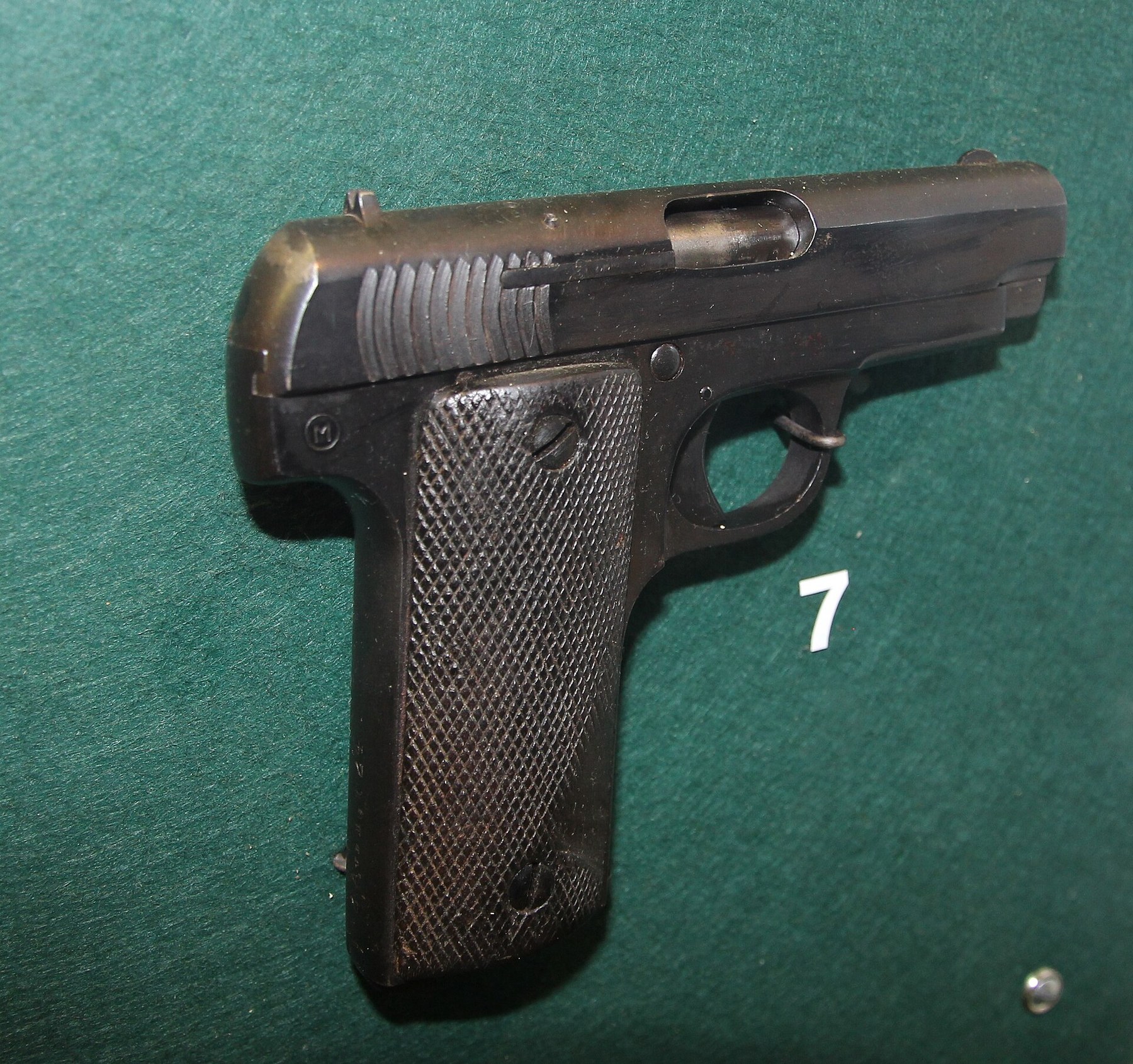
Forgotten Weapons gives the clearest account of a smaller user. The Serbian Army “was essentially destroyed in 1915” and was “rebuilt with French assistance and reequipped with French arms in 1917, including about 5,000 Ruby pistols”. Those that survived the war stayed in the armouries of the new Kingdom of Yugoslavia “well into the 1930s”; the pistol Ian McCollum examined, lent by Mike Carrick of Arms Heritage magazine, had been “refurbished and remarked by Yugoslavia in 1933”.7
Two other sources go further and disagree with each other. Jaeger Platoon says that “later Yugoslavian military bought more between 1931 - 1933 - naming the pistol as Pistolj 7,65 mm/VTZ 1933”; French Wikipedia says the Kingdom of Yugoslavia “produced it locally as the VTZ M1933 pistol”.45 Neither cites anything. Bought, made or refurbished, the 1933 remarking is the one thing a primary-photographed pistol supports.
English Wikipedia also credits the Ruby with directly influencing the FN Model 1910/22, a nine-shot lengthening of Browning’s 1910 pistol “developed for Yugoslavia (who had previously been issued Ruby-type pistols)”, with a “citation needed” on the wider claim about French pistols.6 The 1910/22’s longer grip and nine rounds match the Ruby’s, but no source read here documents that Yugoslavia asked for them because of the Ruby.
3.5 Finland: the M/19
Finland’s story is documented in more detail than any other user’s, by the Finnish military-history site Jaeger Platoon.4
- About 10,000 were bought from France in 1919 and shipped in July of that year. They were the first standard pistol of the Finnish Army.
- Official abbreviations were “7,65 pist/19” and “765 PIST 19”. Jaeger Platoon gives the length as “160 mm (typically, varies from one pistol to another)”, barrels of 81 to 94 mm, about 850 g, and nine-round magazines.
- They proved “maintenance nightmares”. Parts made by different manufacturers “simply did not necessarily have any part, that was compatible with pistol M/19 manufactured by other any other manufacturer - and in some cases this included even magazines”. Some were so poorly made “that it made even properly disassembling the pistol for basic maintenance either difficult or impossible”.
- They came with French triangular brown leather holsters, which the Finnish Army kept.
- In 1943 about 4,500 remained; by 1951, 2,581. Around 1965–1971, 2,342 were sold to military personnel and collectors. The last were removed from inventory in 1986, when some went to museums and “the very last 68 pistols” were sold and exported.
Jaeger Platoon gives no archive references, but its figures are specific and consistent, and it is the source every other account of the Finnish pistols repeats. The 81–94 mm barrel range is useful in itself: it is a measured spread across one army’s mixed stock, and it agrees with Calvó’s 88 mm Gabilondo barrel.1
3.6 Poland and the new states
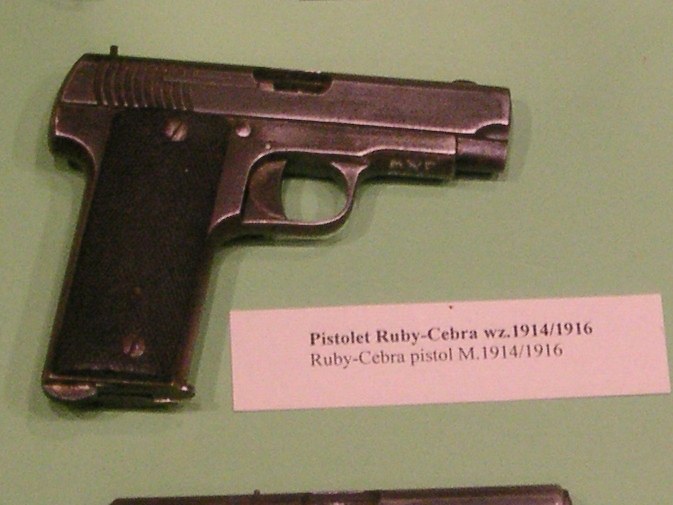
French Wikipedia says France delivered Ruby-types between 1916 and 1920 to Finland, Greece, Poland (arms of the Blue Army, Haller’s army raised in France) and Serbia, and lists the Polish–Lithuanian, Polish–Soviet and Polish–Ukrainian wars among their conflicts.5 The Polish Army Museum in Warsaw displays one, labelled “Pistolet Ruby-Cebra wz.1914/1916”.8 English Wikipedia adds Lithuania, Norway, Denmark, Turkey and Belgium to its list of users, some cited and some not.6 None of these was checked further for this dive.
3.7 France after 1918
English Wikipedia, citing Gangarosa, says that by 1920 “about 580,000 were still serviceable and in French army stores” (Vol 2).6 French Wikipedia lists post-war French use in the Rif War, the suppression of the Druze revolt, the Second World War (by the Armistice Army, the Milice, the Free French and the FFI), and the Indochina War, and says the Police nationale and the Gendarmerie carried them from 1920 to 1945.5 It gives the French service period as 1915–1962 and the English article says the French Army “decommissioned it in 1958”; neither date is cited, and they are left side by side.56
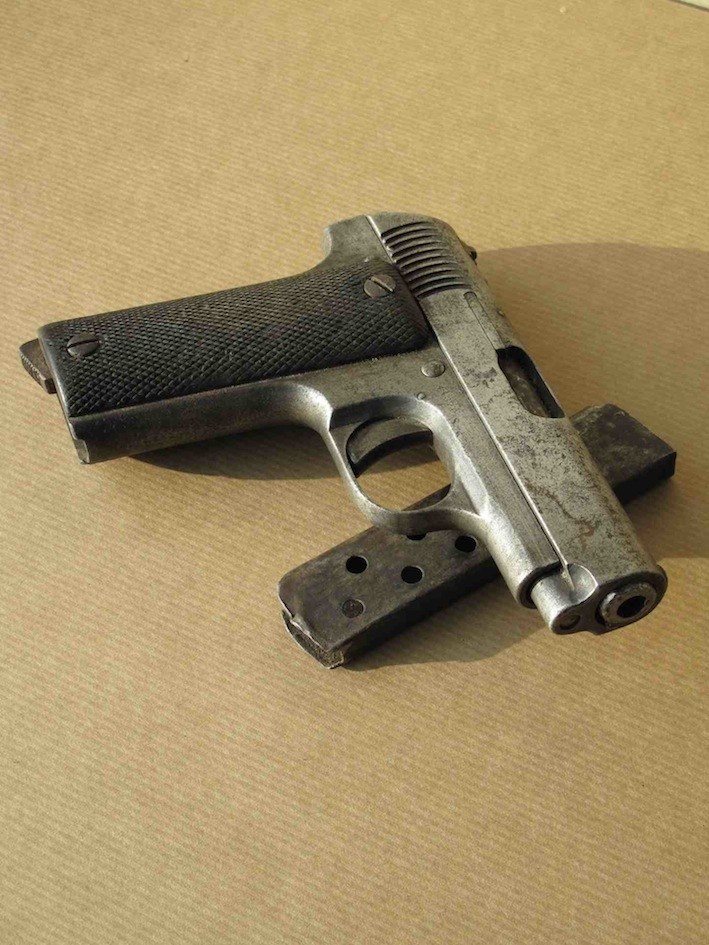
One pistol has a documented Resistance history. The Musée de la Résistance nationale at Champigny-sur-Marne holds the 7.65 mm Ruby-type used under the Occupation by Celestino Alfonso, a Spanish-born member of the Manouchian group.9
English Wikipedia says the Germans designated captured French Ruby-types Pistole 624(f), citing a C&Rsenal video.6 The German foreign-equipment register (the Kennblätter fremden Geräts, D 50) was not consulted for this dive, so the designation is recorded as unverified.
3.8 Further afield: China and Japan
English Wikipedia cites two books for Chinese use: Shih Bin’s China’s Small Arms of the 2nd Sino-Japanese War (2021), and Ian McCollum’s Pistols of the Warlords (2021), pp. 516–517, for Ruby-types imported in the warlord era and domestic copies made at the Hanyang Arsenal.6 It cites Harry Derby’s Japanese Military Cartridge Handguns for “a small number of Ruby pattern pistols with Imperial Japanese Navy markings”.6 Neither book was read for this dive. Monforte says the later Ruby Plus Ultra (below) was popular in China and Japan and sold in Japanese military shops, but not officially adopted.2
3.9 The post-war flood
The war left the Basque towns with tooling, trained men and a product, and the 1920s market took them all. Gabilondo stopped making the military Ruby in 1919, according to English Wikipedia citing Gangarosa, “but other firms continued to produce the Ruby-type until the Great Depression wiped out many arms producers”.6 Forgotten Weapons: “Production of the guns continued into the 1920s.”3
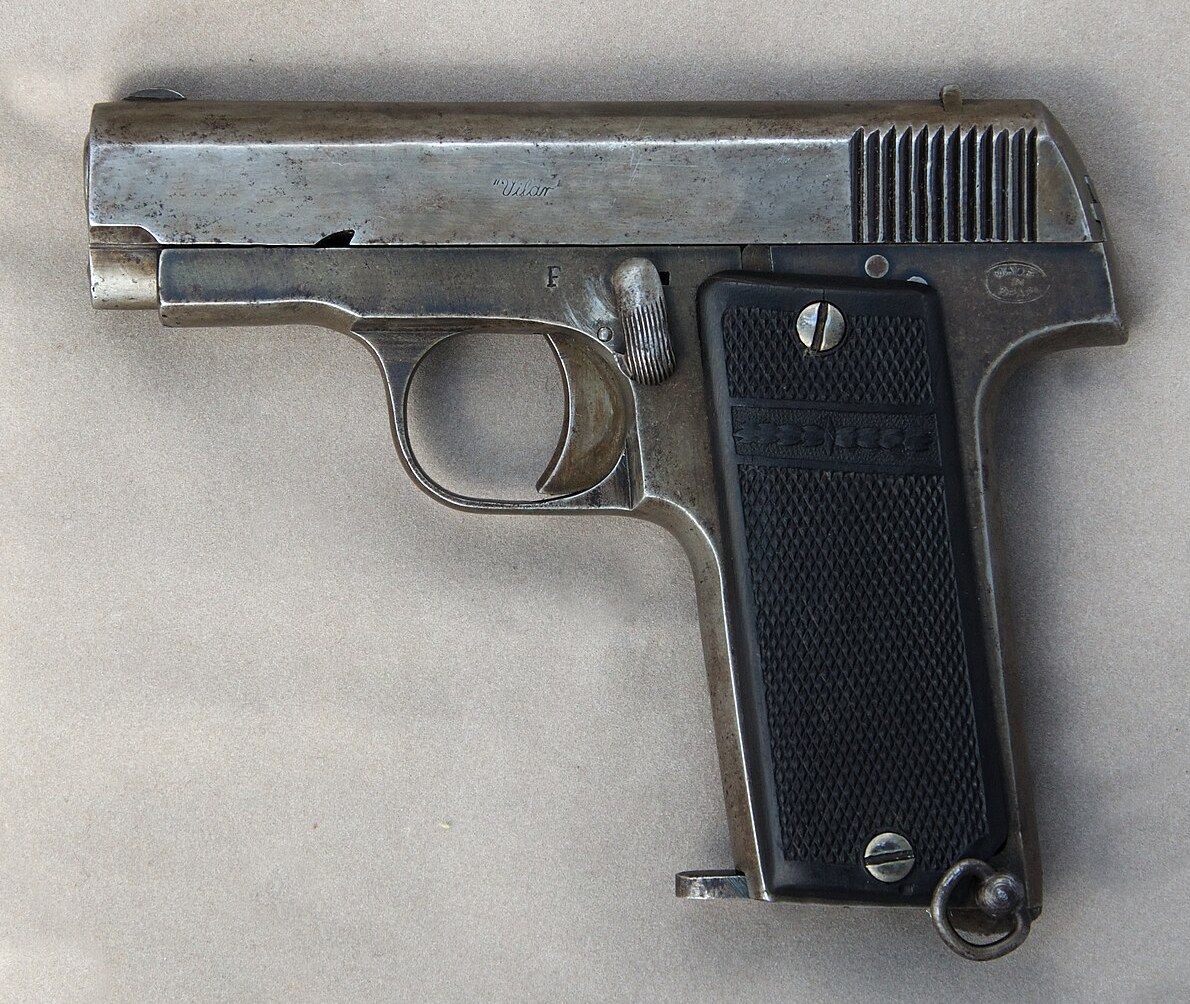
Two kinds of 1920s Ruby-type reached buyers. Military surplus, sold off by France and others, and new commercial pistols, many shorter in the slide or grip, under an endless list of names. Forgotten Weapons’ Vault list (with its own warning that the list is unsourced) runs to about 90 entries (firms, plus unknown codes and unattributed names) and more than 250 distinct trade names.10 Pollard in 1920 listed some of them, “Destroyer, Victoria, Star, Vincitor, Royal, Imperial”, “remarkable for the variety of their names, the similarity of their appearance and the indifferent quality of their material and workmanship”. “Some are external imitations of F.N.’s … many are copies of one another.” He allowed that “the Star and Victoria are possibly the best of the batch”.11
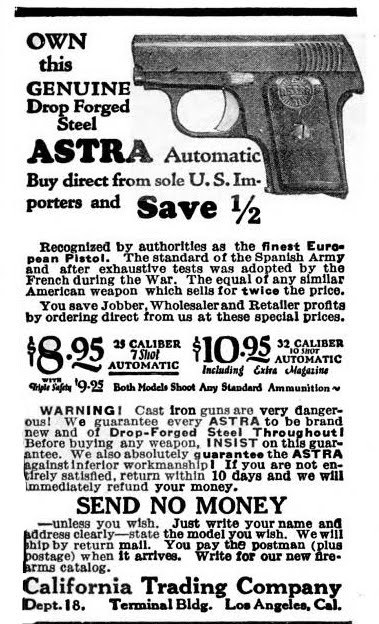
In the United States the selling point was the war itself. A 1923 Popular Science advertisement from the California Trading Company of Los Angeles offered the Astra “direct from sole U.S. Importers” at $8.95 for a .25 seven-shot and $10.95 for a “.32 caliber 10 shot automatic including extra magazine”, claiming that “after exhaustive tests was adopted by the French during the War”, and warning buyers off “cast iron guns”.12 The ten-shot claim is the advertiser’s; it is not a capacity documented for any wartime Astra in the sources read here.
3.10 The firm after the war, and the Llama
Monforte’s paper gives the firm’s later history in one sequence.2
- After the war it moved to Elgoibar and changed its name to Gabilondo y Cía. (Calvó places the Elgoibar factory by 1917, and the wartime GABILONDOS Y URRESTI slides already read ELGOIBAR: Vol 1.)1
- 1919: the Búfalo, a Browning-type pistol “inspired by the FN of 1910”, with a concealed hammer and a safety of the firm’s own design.
- 1925: the Danton, replacing the Búfalo, “of similar characteristics but built in 6.35 mm”; dropped in 1933. (Jaeger Platoon and Forgotten Weapons’ list put a “Danton” under Garate, Anitua y Cía instead; Forgotten Weapons lists it under both firms. The conflict is left open.)410
- 1928: the Ruby Plus Ultra, “an improved version of the Ruby model, with a 20-round magazine and a 140 mm barrel”. Monforte says it was popular in Asia and widely used by the International Brigades in the Spanish Civil War. A reader of Forgotten Weapons mentions Ruby variants “with extended magazines and full auto mode”; any Ruby-type that fires automatically is a machine gun in US law, outside this dive’s build volumes by the hub’s rule, and touched on in Vol 8.3
- 1931: the Llama, a pistol “based on the Colt 1911 model”. 1932: the Llama trademark registered, “leaving the term ‘Ruby’ for revolver models”. The firm became Llama, Gabilondo y Cía.
- After the Second World War the works moved to Vitoria. The Llama M-82 was declared of “necessary uniformity” in the Spanish Army on 13 June 1984. The firm closed in 2000, succeeded by Fabrinor, which lasted until 2006.
ATF’s curio-and-relic list records one Gabilondo pistol of the inter-war years by name: the “Tauler Military and Police Model pistol, cal. 9mm Steyr, manufactured by Gabilondo Y Cia, Elgoibar, Spain, between 1930 and 1936”.13 It confirms the firm’s name and address in the early 1930s.
So the name that began on a nine-shot .32 ended on revolvers, and the firm that once had eight workers made a Spanish service pistol seventy years later. The Ruby’s lasting effect on the firm was the money and the plant the French contracts left behind.
3.11 What could not be established
- Any Italian, Romanian or Greek contract, quantity or marking.
- Whether Yugoslavia bought, made or only refurbished Ruby-types around 1931–1933; the designation “VTZ 1933”.
- The German designation Pistole 624(f).
- French service end (1958 or 1962).
- Chinese and Japanese use (books cited by Wikipedia, not read).
- Who made the Danton.
References
Footnotes
-
Juan L. Calvó, “Automáticas eibarresas en la Gran Guerra” (Eibar, October 2008), http://www.catalogacionarmas.com/public/39-ruby.pdf, consulted 2026-10-19. ↩ ↩2 ↩3 ↩4
-
Manfredo Monforte Moreno, “Arma corta española”, Academia de las Ciencias y las Artes Militares, 27 February 2026, https://www.acami.es/wp-content/uploads/2026/04/2026-04-09-CMN-PTM-Arma-corta-espanola-web.pdf, consulted 2026-10-19. Quotations translated for this dive. ↩ ↩2 ↩3 ↩4
-
Ian McCollum, “Spanish Eibar/Ruby Pistols”, Forgotten Weapons, 19 October 2012, and reader comments, https://www.forgottenweapons.com/spanish-eibarruby-pistols/, consulted 2026-10-19. ↩ ↩2 ↩3 ↩4
-
Jaeger Platoon, “Revolvers & Pistols part 3: 7,65 mm Pistol M/19 ‘Spanish’”, http://www.jaegerplatoon.net/PISTOLS3.htm, consulted 2026-10-19. ↩ ↩2 ↩3 ↩4
-
“Pistolet Ruby”, French Wikipedia, https://fr.wikipedia.org/wiki/Pistolet_Ruby, consulted 2026-10-19. ↩ ↩2 ↩3 ↩4 ↩5
-
“Ruby pistol”, English Wikipedia, revision 1362866939, https://en.wikipedia.org/w/index.php?title=Ruby_pistol&oldid=1362866939, consulted 2026-10-19. ↩ ↩2 ↩3 ↩4 ↩5 ↩6 ↩7 ↩8 ↩9
-
Ian McCollum, “Serbian/Yugoslav Ruby Pistol”, Forgotten Weapons, 2 March 2022, https://www.forgottenweapons.com/serbian-yugoslav-ruby-pistol/, consulted 2026-10-19. ↩
-
“MWP Ruby Cebra”, photograph by Halibutt in the Museum of the Polish Army, Wikimedia Commons, https://commons.wikimedia.org/wiki/File:MWP_Ruby_Cebra.JPG, consulted 2026-10-19. ↩
-
“Pistolet alfonso”, photograph by CoqHardi, Musée de la Résistance nationale, Wikimedia Commons, https://commons.wikimedia.org/wiki/File:Pistolet_alfonso.jpg, consulted 2026-10-19. ↩
-
Ian McCollum, “Spanish Eibar/Ruby Pistols” (Vault page), Forgotten Weapons, https://www.forgottenweapons.com/other-handguns/eibar-ruby/, consulted 2026-10-19. ↩ ↩2
-
Major Hugh B. C. Pollard, Automatic Pistols (London: Pitman, 1920), p. 50 (list of Spanish pistols; OCR of the Internet Archive copy is garbled and names are given only where legible), https://archive.org/details/automaticpistolspollard1920, consulted 2026-10-19. ↩
-
California Trading Company advertisement for the Astra, Popular Science, 1923, Wikimedia Commons, https://commons.wikimedia.org/wiki/File:Astra_ad_1923.jpg, consulted 2026-10-19. ↩
-
ATF, Firearms Curios or Relics List — January 1972 through April 2025 (ATF P 5300.11), Section II, p. 17, read from the Internet Archive copy https://web.archive.org/web/20260426215034if_/https://www.atf.gov/media/19856/download, consulted 2026-10-19. ↩


Comments (0)