Ruby Pistol · Volume 4
How It Works: Browning's 1903 Pattern, the Spanish Way
The parts the French Army named, the blowback cycle step by step, what holds the barrel, what the safety lever does, and what the Eibar makers left out
4.1 Two sources for one mechanism
No Spanish maker’s drawing of a Ruby-type was found for this dive, and none may survive for most of them. The mechanism is described here from two documents that do survive:
- John Browning’s US patent 747,585 (filed 3 April 1902, granted 22 December 1903), which describes the Colt and FN 1903 pattern the Eibar shops copied, part by part.1
- The French Army’s instruction on its 7.65 mm automatic pistols, which names the parts of the “genre Ruby” pistol and describes how it loads, fires, is made safe and is stripped. It is known here only through a transcription whose title and date are not given (Vol 2).2
Where the two agree, the description is firm. Where they differ, the difference is the Spanish change. Points that rest only on collectors’ accounts are marked.
4.2 The parts, in the French Army’s words
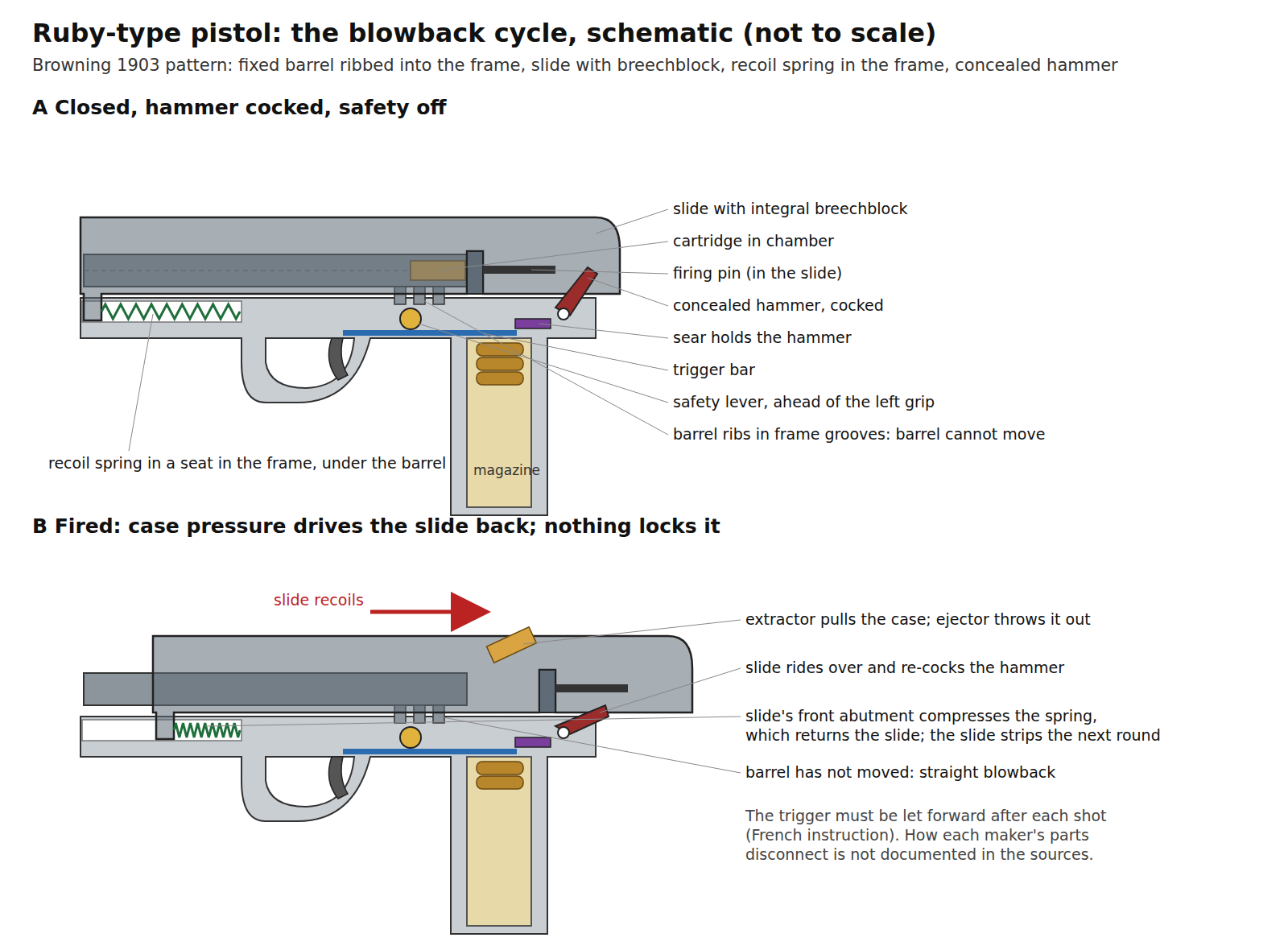
The instruction divides the “genre Ruby” pistol into its principal parts:2
- The barrel (canon).
- The breech block (bloc de culasse), which is the slide: it carries “the extractor, the firing pin and its rebound spring, the rear sight and the front sight”.
- The frame (carcasse), with the grip.
- The lock mechanism (mécanisme de platine), “composed of the trigger and its bar, the sear and the hammer with their springs”.
- The recoil spring (ressort récupérateur).
- The magazine (chargeur-magasin), held by its catch (crochet d’arrêt) at the bottom of the grip.
- The safety, a lever “mounted on the left side of the frame”.
Every one of these is in Browning’s patent under its own letter: barrel a, breech-slide with breech-bolt, frame, hammer h, sear g, trigger i, reaction spring e, magazine with catch p, safety lever o.1 The French “firing pin and its rebound spring” is Browning’s two-piece firing pin with its “retraction-spring k … confined between the firing-pin head and the fixed front bushing”.1 The Ruby is the 1903 pattern, not a new design.
4.3 The cycle
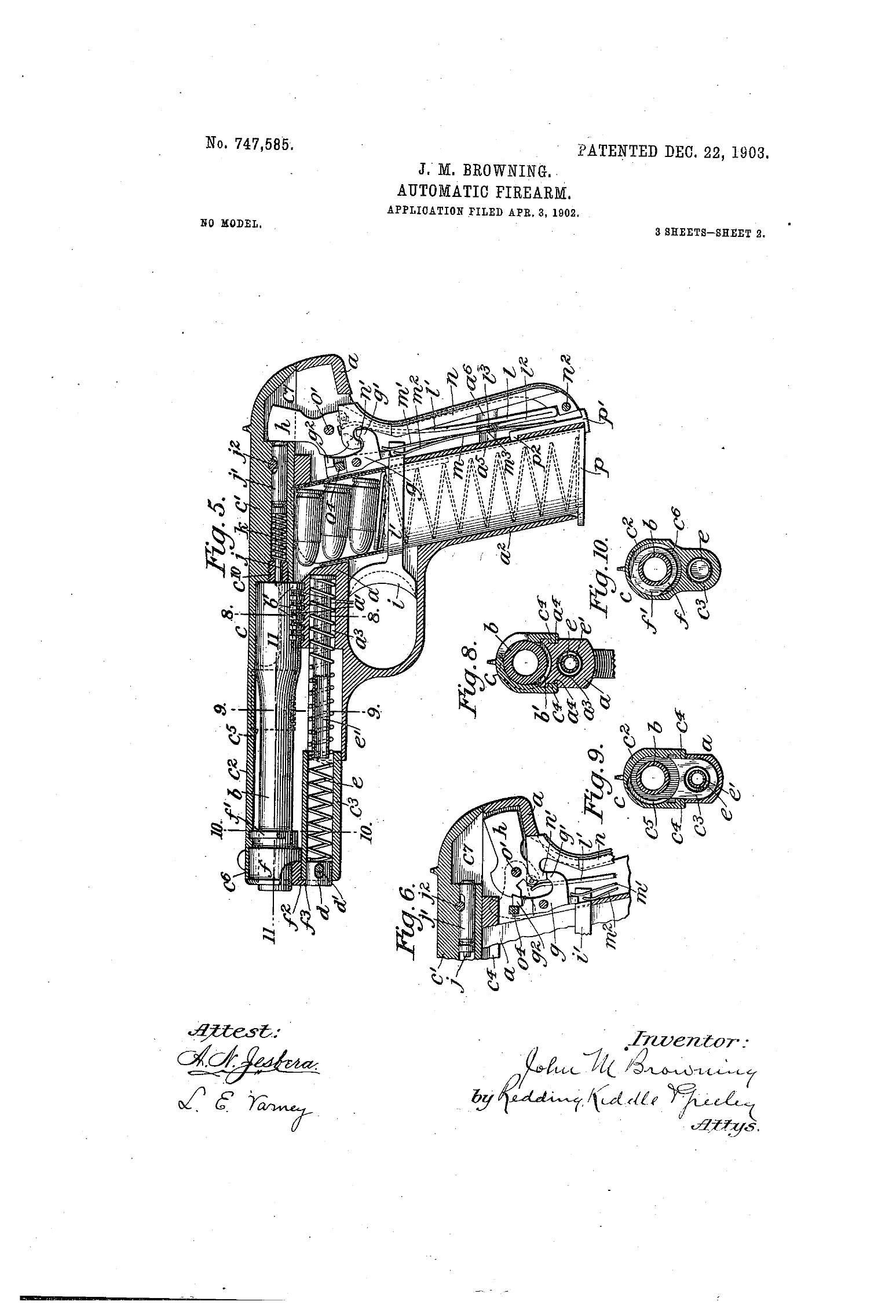
The instruction gives the cycle in four sentences, and they are worth having in the original order.2
- Loading. “Withdraw the magazine from the grip by acting on its catch. Insert one by one into the magazine 7 or 9 cartridges (according to its capacity) and replace it in the grip.” Then “draw the breech block fully to the rear, a movement which results in cocking the hammer and compressing the recoil spring. Let go of the block, which, returning forward under the action of its spring, introduces the top cartridge of the magazine into the chamber.”
- Firing. “If the trigger is then pressed, the shot goes off and the powder gases, acting on the block, drive it back; at the same time the empty case, seized by the extractor, is ejected.”
- Repetition. “The block comes forward again and the movements described above are repeated as long as cartridges remain in the magazine or in the chamber, provided that the firer takes care, after each shot, to let the trigger come forward.”
- Safe. See the safety lever, below.
Browning’s patent says the same of hand-cycling: drawing the slide back once “opens the chamber of the barrel, extracts the empty cartridge-shell, and ejects the same, cocks the hammer, presents a cartridge in front of the breech-bolt, and compresses the reaction-spring”.1 Ejection is “by the action of a shoulder in the receiver”, a fixed ejector the case strikes as the slide comes back.1
Two features of the cycle matter for the rest of this dive. The slide does all the work: it is the breech, it carries the firing pin and extractor, it cocks the hammer and it feeds. And there is no hold-open: when the magazine is empty the slide closes on an empty chamber. Forgotten Weapons notes that the Eibar pistols all “lack a last-round holdopen”.3
4.4 Why a blowback is enough
Nothing locks the slide to the barrel. Browning’s patent says so directly: the breech-bolt “is not positively locked to the barrel in its closed position, but is yieldingly held in the closed position by the reaction-spring”. The slide is made heavy on purpose: “the weight is a reliable safeguard which retards the opening of the breech until the bullet has passed from the muzzle”.1
That works because the cartridge is modest. SAAMI’s maximum average pressure for the .32 Automatic is 20,500 psi by transducer, with listed loads of 60 to 71 grains at 900 to 1,000 ft/s from the test barrel (Vol 7).4 A slide of a few hundred grams and a recoil spring can hold that case against the chamber long enough. The Ruby’s slide is, if anything, heavier than it needs to be. Jaeger Platoon attributes the pistol’s bulk partly to “low quality steel used in production, which resulted pistols to be rather bulky”, and TFB’s gunsmith says “the metallurgy was lackluster so the Spanish made these some thick boys”.56 Those are opinions about steel nobody has analysed in the sources read, but they agree with Pollard’s complaint of 1920 (Vol 1).
4.5 What holds the barrel
The barrel does not move in firing. Browning’s patent holds it “against longitudinal movement” by “a series of transverse segmental ribs” under its rear end, which sit in “a series of corresponding segmental grooves” in the open top of the frame. The slide fits closely over the barrel and keeps it from turning. To strip the pistol the slide “is pressed rearward until the locking-ribs b may be turned into the recess c”, a clearance cut, “after which the breech-slide, with the barrel, may be drawn from the frame”.1 In firing, “the breech-slide is always in motion at the place where the locking-ribs b correspond with the recess, and it is carried rapidly beyond that position, so as to give the barrel no chance to rotate”.1
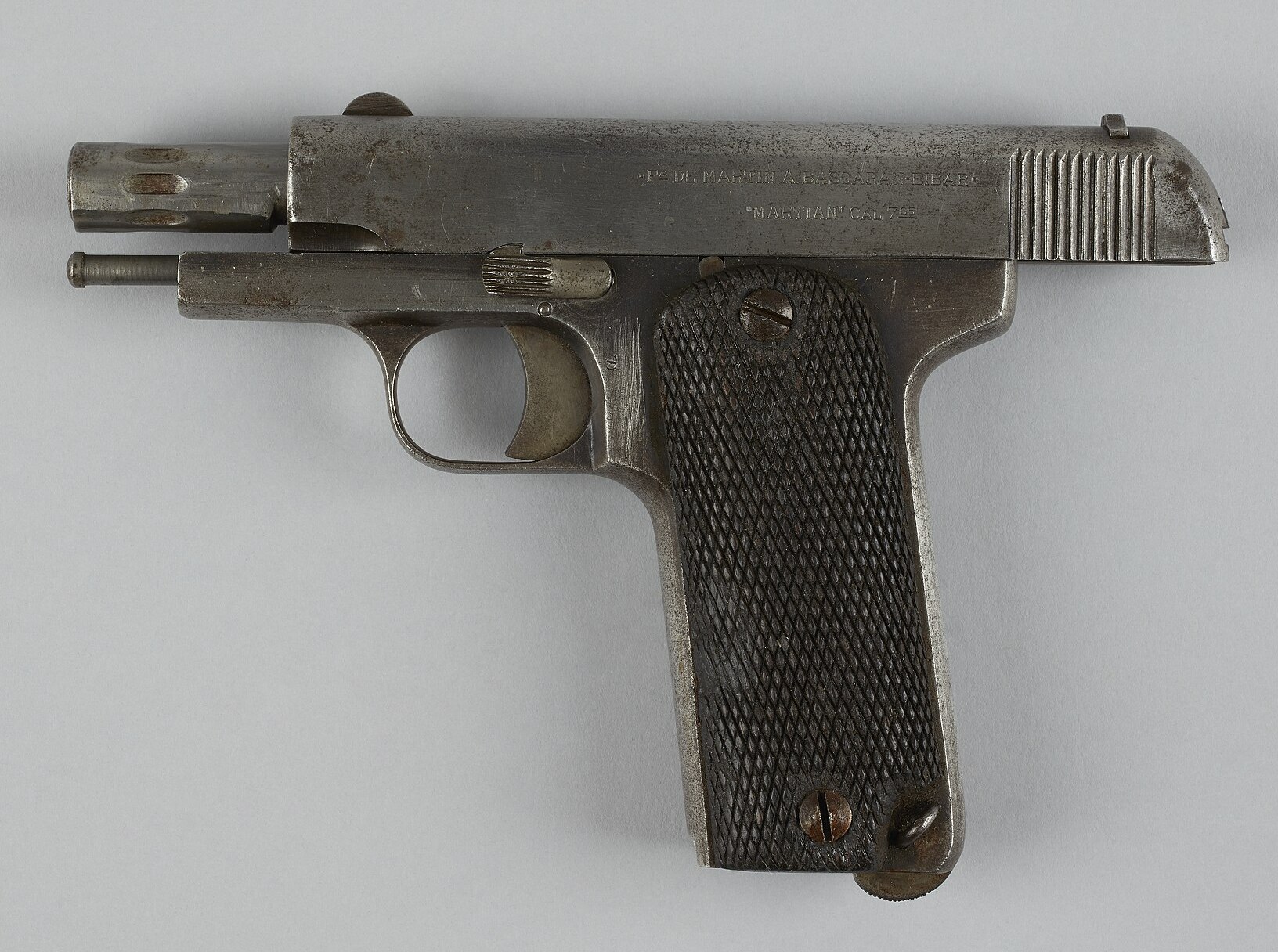
The Ruby-types keep this system. The French instruction strips them by turning the barrel (Vol 6), and the Martian below, slide held back, shows the grooved collar at the muzzle by which it is turned.
How many ribs a Ruby barrel has is reported, not established. An unsigned French collector text says the barrel is locked to the frame “by three large lugs and grooves instead of the six used in the Model 1903”.7 Browning’s patent says only “a series”. No photograph of a Ruby barrel’s underside was available for this dive. A reader with a pistol in hand can settle it for that maker, and it may differ between makers.
4.6 The recoil spring and the slide’s front abutment
Browning put the recoil spring in the frame. The breech-slide “carries the depending front abutment c, tubular in form and parallel to the axis of the barrel”; the frame “is provided in longitudinal seat a for the reaction spring e”, the forward part of which is “enlarged and opened at the top, so that the depending abutment can enter and slide therein when the breech-slide moves rearward”. The same shoulder stops the slide’s rearward travel, which the patent presents as “an abutment of great strength capable of absorbing the shock should the breech-slide be thrown rearward with unusual violence, such as might be caused by the firing of cartridges containing excessive powder charges”.1 Because of it the slide can be put on and taken off “only from the front”.1
The French instruction agrees in sequence: in field stripping one removes “the block, then the recoil spring” (Vol 6), so the spring stays with the frame when the slide comes off.2 The Saint-Étienne Martian above shows the guide standing out of the frame’s front. The unsigned French collector text adds that the Ruby spring is held between two stops riveted on its guide, so that a worn spring cannot be replaced without replacing the assembly; it is unsourced and not repeated elsewhere.7
4.7 Hammer, sear and firing pin
The hammer is concealed in the frame behind the magazine well, and the slide has “in rear of the breech-bolt a recess to receive the hammer, whereby the hammer is always covered” (claim 15).1 When the slide is drawn back it rides over the hammer and rotates it to full cock, where the sear’s nose enters its notch. Pulling the trigger moves the trigger bar, which turns the sear out of the notch; the mainspring drives the hammer onto the rear of the firing pin, which projects through the breech face to strike the primer, and the rebound spring then pulls the firing pin back.12
Browning’s springs are leaf springs: a V-shaped mainspring, and a single “combined sear and trigger-spring” that also holds the magazine catch.1 Whether every Eibar maker kept leaf springs is not established. A reader on Forgotten Weapons says “the Ruby uses a coil spring” for the magazine catch and sear “rather like the Big Brother Colt 1911”; it is a single reader’s statement and may hold for some makers and not others.8 The same reader identifies a common fault: a bent sear that leaves the hammer short of full cock, so that the slide will not come off for cleaning (Vol 6).8
How the trigger is disconnected while the slide is out of battery, so that one pull gives one shot, is not described in either document read for this dive. The instruction states the requirement (“let the trigger come forward” after each shot), not the means.2 Vol 9 treats this as the first thing a builder must get right.
4.8 The safety lever
The Ruby’s single manual safety is a lever on the left of the frame, just above the trigger guard and ahead of the grip panel. The instruction: “To put the arm on safe, when a cartridge is in the chamber, set the lever mounted on the left side of the frame so as to hide the letter F and leave the letter S visible. To make ready to fire the arm set at safe, act in the opposite direction on the lever to cover the letter S or make the letter F visible.”2 F is feu, fire; S is sûreté, safe. The Alkartasuna in Vol 5 shows an S stamped on the frame behind the lever, and a dealer describes a Cebra whose “safety is marked in French”.9
The lever does three jobs, according to the sources that have handled these pistols:
- Blocks the lockwork. On safe it prevents firing; the French collector text says it blocks the trigger.7
- Locks the slide. On safe the slide cannot be drawn back.7 Browning’s lever does the same, “locking the combined breech-slide and breech-bolt in its closed forward position, at the same time positively locking the cocked firing mechanism”.1
- Holds the slide for stripping. With the slide drawn back to a notch, the lever is turned up so that its nose engages the notch and holds the slide open; TFB’s gunsmith: “lock the slide back by flipping the safety up into the locking notch”.6 The French instruction says to set the lever to show F and draw the slide back as far as it will go.2
That third job is also the pistol’s notorious weakness. A lever placed where a holster flap or a hand can move it, with nothing else between a cocked hammer and the primer, is why the French added the holster stud (Vol 2) and why TFB’s gunsmith says that soldiers “had the potential to flip the pistol off safe and also flip it on safe when it was needed most”.6
4.9 What the Ruby leaves out
Against Browning’s patent, the Ruby-types drop:
- The grip safety. Browning’s grip lever locked the sear unless the grip was squeezed and showed by its projection whether the hammer was cocked.1 Forgotten Weapons: the Eibar pistols “lack a last-round holdopen feature or grip safety”.3 With a concealed hammer and no grip safety, a Ruby gives no outward sign of whether it is cocked.
- The thumb safety’s position. Browning’s lever sits at the rear of the frame above the grip, where the thumb lies (compare the FN 1903 in Vol 1). The Ruby’s lever is forward, above the trigger guard.
- Any magazine safety. None of the sources describes one, and The Firearm Blog’s description of the type, “a shrouded hammer, single stack detachable mag, slide operated, blowback action, with an under barrel spring”, lists none.10
The simplifications are what made the pistol quick to make. They also make it the least forgiving of the 1903 family to carry loaded, which is exactly what the French found.
4.10 Where makers differed
The instruction says the “genre Ruby” brands “differ from one another only in details of arrangement or in the way they are dismounted”, and singles out the Fiel (Erquiaga y Cía), “of which only a small number exist in service”, as stripping differently: its slide and barrel come off together and are then separated by turning the barrel and withdrawing it through the bottom of the slide (Vol 6).2 Forgotten Weapons lists the details that vary between any two makers: “slide length, slide serrations, lanyard loop, sights, magazine release, grip panels, and exact frame profile”.3 Jaeger Platoon’s Finnish stock shows barrels from 81 to 94 mm.5 Vol 5 photographs those differences; Vol 7 explains why the one difference that mattered most in service was the magazine.
4.11 What could not be established
- A maker’s drawing of any Ruby-type.
- The number of barrel ribs (three, per an unsigned collector text; not checked).
- Leaf or coil springs, maker by maker.
- How any Ruby-type’s disconnector works.
- Whether the Ruby spring guide is a riveted assembly on all makers.
References
Footnotes
-
John M. Browning, “Automatic firearm”, US Patent 747,585, filed 3 April 1902, granted 22 December 1903, https://patents.google.com/patent/US747585, consulted 2026-10-19. ↩ ↩2 ↩3 ↩4 ↩5 ↩6 ↩7 ↩8 ↩9 ↩10 ↩11 ↩12 ↩13 ↩14 ↩15
-
French Army instruction on the 7.65 mm automatic pistols in service (title, date and issuing authority not given), as transcribed by Tir Sportif Chabris, https://tirsportifchabris.fr/blog/pistolet-ruby-7-65-demontage, consulted 2026-10-19. Quotations translated for this dive. ↩ ↩2 ↩3 ↩4 ↩5 ↩6 ↩7 ↩8 ↩9
-
Ian McCollum, “Spanish Eibar/Ruby Pistols”, Forgotten Weapons, 19 October 2012, https://www.forgottenweapons.com/spanish-eibarruby-pistols/, consulted 2026-10-19. ↩ ↩2 ↩3
-
ANSI/SAAMI Z299.3-2022, Voluntary Industry Performance Standards for Pressure and Velocity of Centerfire Pistol and Revolver Ammunition, approved 13 December 2022, velocity and pressure table and the 32 Automatic drawing, https://saami.org/wp-content/uploads/2025/05/SAAMI-Z299.3-2022-Centerfire-Pistol-Revolver-Approved-12-13-2022.pdf, consulted 2026-10-19. ↩
-
Jaeger Platoon, “Revolvers & Pistols part 3: 7,65 mm Pistol M/19 ‘Spanish’”, http://www.jaegerplatoon.net/PISTOLS3.htm, consulted 2026-10-19. ↩ ↩2
-
Sam S., “TFB Armorer’s Bench: Commentary on The 1915 Spanish Ruby Pistol”, The Firearm Blog, 27 August 2023, https://www.thefirearmblog.com/blog/2023/08/27/tfb-armorers-bench-commentary-1915-spanish-ruby-pistol/, consulted 2026-10-19. ↩ ↩2 ↩3
-
Unsigned collector text on the Ruby pistol, Tir Sportif Chabris, https://tirsportifchabris.fr/blog/vue-eclatee-pistolet-ruby, consulted 2026-10-19. No author or sources; used only as a record of claims. ↩ ↩2 ↩3 ↩4
-
Ian McCollum, “Serbian/Yugoslav Ruby Pistol”, Forgotten Weapons, 2 March 2022, reader comments, https://www.forgottenweapons.com/serbian-yugoslav-ruby-pistol/, consulted 2026-10-19. ↩ ↩2
-
Collectors Firearms, Houston, “WWI French Army ‘Ruby’ Pistol (PR56239)”, https://collectorsfirearms.com/156994-wwi-french-army-ruby-pistol-pr56239.html, consulted 2026-10-19. ↩
-
“France’s WWI ‘Ruby’”, The Firearm Blog, 16 October 2014, https://www.thefirearmblog.com/blog/2014/10/16/frances-wwi-ruby/, consulted 2026-10-19. ↩
Comments (0)