MBAssociates Gyrojet · Volume 8
Handling, Maintenance and Repair — MBA's Own Instructions, a Zinc Frame, and No Spare Parts
What MBA told its buyers about loading, misfires and cleaning; why no takedown procedure can be given and what a correct one must respect; the faults auction records show again and again, what causes each on this mechanism, and what can and cannot be repaired
8.1 The Source: MBA’s Instruction Sheet
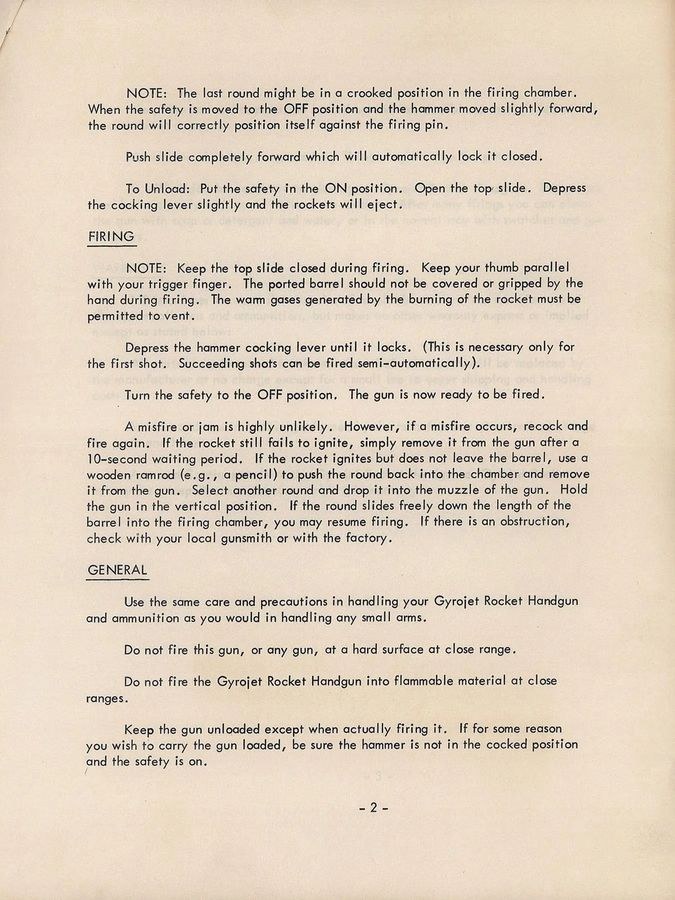
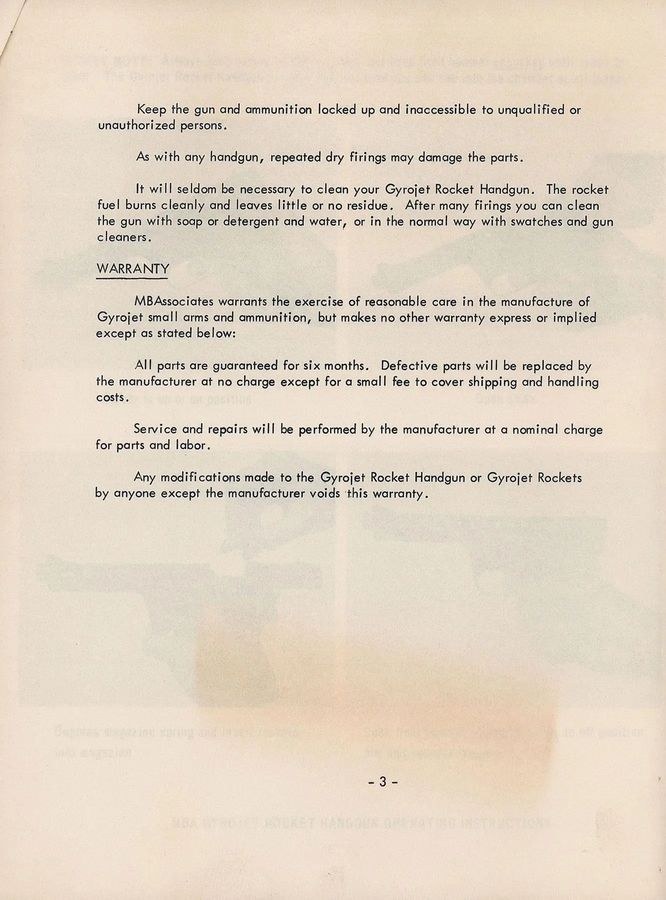
The only factory document on handling and upkeep located is MBA’s own instruction sheet of the Model B period: a letter from Mainhardt, three typed pages headed “Operating Instructions”, and a sheet of photographs. Rock Island Auction photographed a complete copy with a Model B pistol it sold in November 2012, and those photographs are the source for everything in this volume attributed to MBA.1 The sheet covers loading, unloading, firing, misfires, general precautions, cleaning and the warranty. It contains no disassembly procedure.
Carpenter’s book has an appendix titled “Handgun Instructions and Components”, which may reproduce this sheet and a parts list; it was not obtained.2 The nearest thing to a parts diagram in print is the exploded view in MBA’s patent, US 3,412,641 (reproduced below and in Volume 3).3 The mechanism itself is described in Volume 3; this volume assumes it.
8.2 Safe Handling
MBA’s own cautions, in order:1
- “Use the same care and precautions in handling your Gyrojet Rocket Handgun and ammunition as you would in handling any small arms.”
- “Do not fire this gun, or any gun, at a hard surface at close range.”
- “Do not fire the Gyrojet Rocket Handgun into flammable material at close ranges.” Mendenhall reports that MBA literature gave the propellant’s burning temperature as 5,000 °F, and Mainhardt himself compared a round at five feet to “a miniature blow torch” (Volume 2).45
- “Keep the gun unloaded except when actually firing it. If for some reason you wish to carry the gun loaded, be sure the hammer is not in the cocked position and the safety is on.”
- “Keep the gun and ammunition locked up and inaccessible to unqualified or unauthorized persons.”
- “As with any handgun, repeated dry firings may damage the parts.”
Two points specific to this design follow from the patent and should be understood before a Gyrojet is handled loaded.
- The safety covers the firing pin; it is not described as a hammer block. In US 3,412,641 the safety element slides over the fixed pin and presents “a flat face … to the butt end of the rocket”, so that a round driven back by the hammer meets flat steel instead of the point.3 On that design, a hammer that falls with the safety on is not in itself a malfunction; what matters is that the safety face is fully over the pin. Nothing in MBA’s sheet says whether production guns added a hammer block, and a gun’s safety should be checked, unloaded, before it is trusted.
- Dry firing sends the hammer into an empty bore. With no round in the chamber, nothing stops the hammer’s swing but the gun’s own structure. MBA’s warning about dry firing should be taken literally on a sixty-year-old zinc casting.
8.3 Loading, Unloading and Clearing
MBA’s procedure, with its own emphasis:1
Loading. “BE SURE THAT THE SAFETY IS IN THE ON POSITION AND THAT THE HAMMER IS RELEASED (NOT COCKED) DURING LOADING.” Then:
- “Depress slide latch on the right side of the gun. Draw back the slide as far as possible.”
- “Depress the magazine spring by means of the tab lever on the magazine follower to the left of the hand grip.”
- “Slide the rounds nose-first into the top opening. Continue sliding rounds into the chamber and depressing the magazine spring until the magazine is fully loaded, or loaded with the desired number of rounds.”
- “The last round might be in a crooked position in the firing chamber. When the safety is moved to the OFF position and the hammer moved slightly forward, the round will correctly position itself against the firing pin.”
- “Push slide completely forward which will automatically lock it closed.”
Firing. “Keep the top slide closed during firing. Keep your thumb parallel with your trigger finger. The ported barrel should not be covered or gripped by the hand during firing. The warm gases generated by the burning of the rocket must be permitted to vent.” Cock the hammer by its lever for the first shot only; turn the safety off.
Unloading. “Put the safety in the ON position. Open the top slide. Depress the cocking lever slightly and the rockets will eject.” The follower spring throws them upward. Kirschbaum’s complaint about exactly this — that the rounds “all want to come springing out” — is in Volume 3; unloading should be done over a soft surface, with a hand over the opening.
Clearing check. MBA’s photograph sheet calls the gun “extra safe because you can see into the chamber at all times”, and the vents and follower slot do let an empty chamber be confirmed by eye.1 With the slide open, the chamber and the top of the follower are directly visible.
8.4 Misfires, Hang Fires and a Stuck Rocket
MBA’s instructions, which are the only published procedure:1
“A misfire or jam is highly unlikely. However, if a misfire occurs, recock and fire again. If the rocket still fails to ignite, simply remove it from the gun after a 10-second waiting period. If the rocket ignites but does not leave the barrel, use a wooden ramrod (e.g., a pencil) to push the round back into the chamber and remove it from the gun. Select another round and drop it into the muzzle of the gun. Hold the gun in the vertical position. If the round slides freely down the length of the barrel into the firing chamber, you may resume firing. If there is an obstruction, check with your local gunsmith or with the factory.”
Three comments from the evidence:
- “Highly unlikely” was not true of old ammunition. In the 2002 test, four of ten rounds failed on the first strike and fired when re-cocked, and one hung fire for “several seconds” (Volume 2).4 With any surviving round, a misfire should be assumed possible and the ten-second wait treated as a minimum, with the muzzle held safe; a hang fire in a Gyrojet launches a rocket.
- The re-strike works because of the design. The hammer drives an unsupported round onto a fixed pin, and a light strike is the likeliest cause of a failure; a second blow often lights it. That is an inference from the mechanism, consistent with the 2002 result.
- The drop test is the only bore check MBA gives. A round of the correct size should slide the length of the tube under its own weight. Anything that stops it — a bent tube, debris, a lodged spent round, a damaged vent edge — means the gun should not be fired.
8.5 Field Breakdown: There Is None
A Gyrojet has no field breakdown in the usual sense. MBA’s instructions describe no takedown for cleaning or inspection, and the mechanism explains why none was needed: there is no slide or bolt to remove, no barrel to lift out, no recoil spring, and nothing that fouls the action the way a cartridge gun’s powder fouling does (Volume 3). Routine access is exactly what loading gives: with the safety on and the top slide drawn back, the chamber, the top of the follower and the fixed firing pin are exposed, and the tube can be seen through from both ends and through its vents.
Anything beyond that means separating the frame halves.
8.6 Detail Strip: No Manual, and What a Correct Procedure Must Respect
No factory or armourer’s disassembly procedure for the Gyrojet was located, and none is reconstructed here from memory. What can be said, from the patent’s description and exploded view, is what any correct procedure has to take into account.3
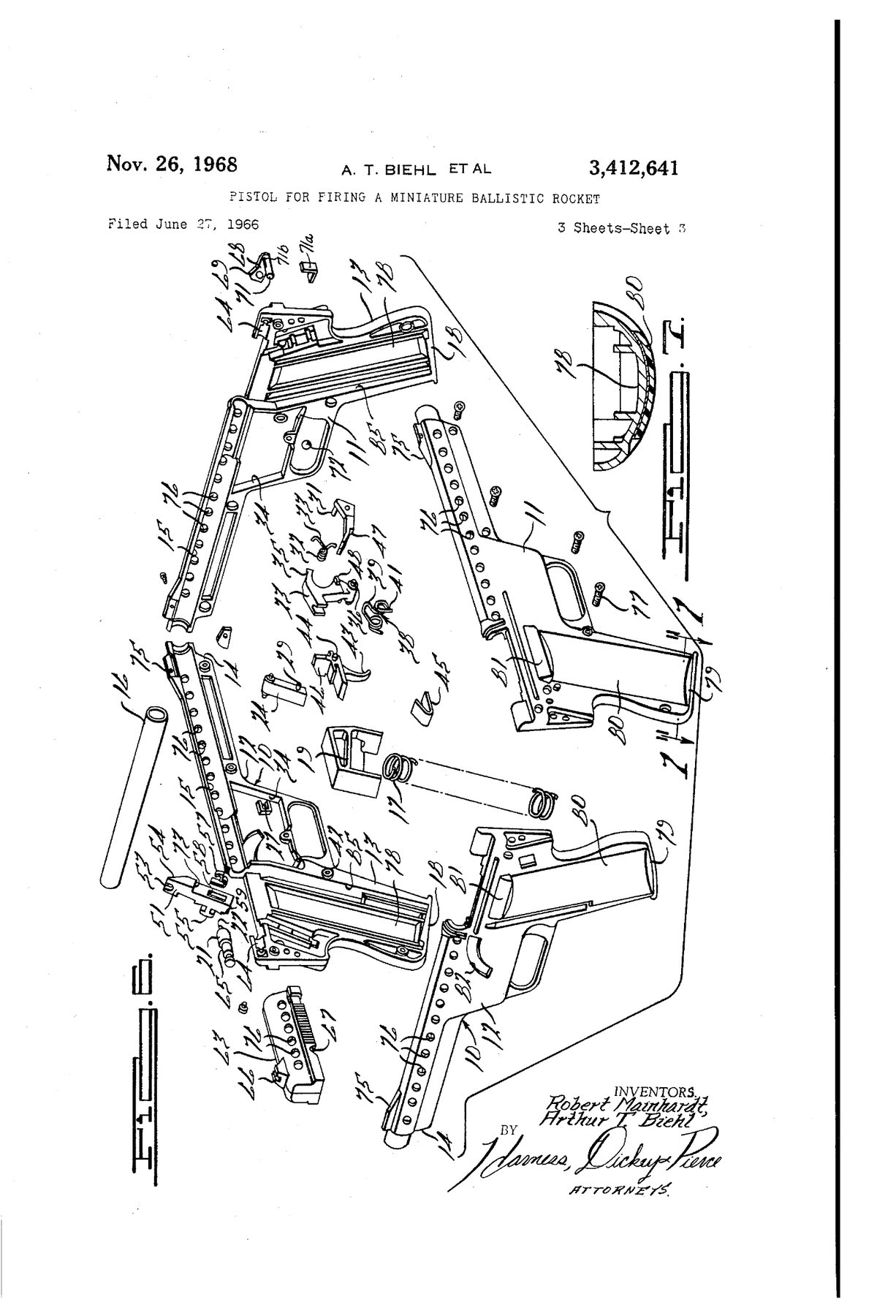
- The frame is two halves held by screws. “A plurality of screws 77 connect the two halves 11 and 12 of the receiver together in firm fixed relation to each other.” Every internal part is trapped between the halves.
- Several springs are under load inside. The magazine spring (17) is long and compressed against the base plate (18) and follower (19); the hammer spring (38) is a double coil bearing on the hammer and a pin; the pawl spring (32), the trigger’s flat U-spring (45), the latch spring (71a) and the safety’s flat spring (57) are all small and easily lost. Separating the halves without controlling them risks losing parts and damaging the castings.
- The barrel is glued in. The stainless tube is “bonded with a plastic or other suitable bonding material” into its recess. It is not designed to be removed, and attempting to remove it risks cracking the frame.
- The grips may be glued on. The patent’s grip panels are “secured by a suitable adhesive”. Some production guns had grip screws — Rock Island described one “screw … absent from the right side of the grip” — so a gun must be examined before a grip is forced.6
- The screws thread into zinc. A screw in a zinc-alloy boss strips far more easily than one in steel. No tightening torque was ever published, and none is suggested here; the practical rule is to use a correctly fitting screwdriver and very little force.
- The firing pin is fixed in one half, supported by a metal portion (64) under the slide. It is not a replaceable drift-pinned part in the ordinary sense.
Anyone who does not have to open a Gyrojet should not. For a collector’s gun, the safer course for anything beyond external cleaning is a gunsmith who has done it before, and photographs of every stage.
8.7 Cleaning
MBA: “It will seldom be necessary to clean your Gyrojet Rocket Handgun. The rocket fuel burns cleanly and leaves little or no residue. After many firings you can clean the gun with soap or detergent and water, or in the normal way with swatches and gun cleaners.”1 Popular Science, reporting MBA’s claims in 1965, added that the guns “require no lubrication and won’t freeze in cold weather”.7 Carpenter’s list of MBA’s claims includes “cool operation”: most of the propellant burns outside the gun, so there is little heat or fouling in it.8
Soap and water was reasonable advice for a new gun whose owner was expected to report back to the factory. On a surviving gun it needs two qualifications, both inferences from the materials rather than MBA statements. First, the frame is a zinc-alloy casting and the springs, screws and pin are steel; water left in the follower slot, the hammer slot or between the frame halves can corrode both, and a gun washed must be dried completely, including inside. Second, the exhaust residue of a double-base propellant and a primer is not documented as corrosive in any source located, but the primers of the 1960s were not all non-corrosive, and MBA bought them locally without much care about type (Volume 2). After firing any original round, cleaning the tube, vents and chamber area promptly with ordinary gun solvent and swabs, as MBA’s second option allows, is the conservative course.
8.8 Lubrication
MBA’s position was that the gun needed none.7 No lubrication chart or points were published. For a gun kept as a collector’s piece, a thin protective film on exposed steel — springs, screws, the pin, the hammer pivot — is ordinary preservation practice, not MBA’s advice, and oil should be kept off grips that may be glued and off plated finishes that are already blistering.
8.9 Storage and Inspection
MBA published no inspection schedule and no replacement intervals for any part. What the auction record suggests a keeper should watch:
- Finish. Rock Island descriptions record “pin prick blistering” of the nickel on carbine barrels, “moderate frosting” on nickel guns, “exposed undercoat” on a black one, and fire controls that “have turned to a brassy/copper patina”.6 Blistering of plating on a die casting is consistent with the casting’s porosity or with corrosion under the plate; either way it progresses, and a stable, dry environment slows it.
- Grips. Two lots record grips detached or separated from the frame.6
- Cracks. See below; inspect the area round the follower slot and the loading port.
- Springs. Do not store the gun loaded. The magazine spring is long and fully compressed when six rounds are in; nothing in the record shows spring failure, but there is no reason to test it.
- Ammunition. Store rounds out of the gun, dry and cool, and away from anything flammable. Their seals are sixty years old (Volume 2); rounds show verdigris on copper cases and white oxidation on aluminium ones in Rock Island’s descriptions.6
8.10 The Faults the Record Shows
Across the 84 Rock Island lots read for this dive, the descriptions record the following faults. The diagnoses are this dive’s, from the patent’s mechanism; they are the places to look, not confirmed causes in any particular gun.
Table 1 — The Faults the Record Shows
| Recorded fault | Lot(s) | Where to look on this mechanism |
|---|---|---|
| ”The hammer does not stay cocked, mechanically needs adjustment” | 4095/566 (2025) | The sear edge (25) on the pawl and the hammer’s notch (35); the pawl spring (32); wear of the hammer pivot hole in the zinc frame letting the hammer sit out of line with the sear |
| ”The hammer drops with the safety activated” | 4095/564 (2025), carbine | By the patent’s design the safety covers the firing pin and is not a hammer block; check that the safety face fully covers the pin point when on |
| ”Safety needs adjustment” | 86/3649 (2022) | The safety element’s slideway (52), its spring (57) and locking notch (59); the interlock ball (72) with the slide latch |
| ”Mechanically needs adjustment” | 1048/996 (2025) | Unspecified |
| ”Slightly loose loading gate” | 81/694 (2020), Model A carbine | The gate’s hinge or pivot in the casting |
| ”Safety knob absent” | 58/290 (2013), carbine | The knurled knob (55) is a separate part |
| Grip panel detached or separated | 75/835 (2018), 83/3641 (2021) | Adhesive failure (patent: grips “secured by a suitable adhesive”) or a missing screw |
| Frame cracks | 48/3820 (2009), 65/1934 (2015); “the cracks that usually form” noted in 52/680 (2011) | See next section |
The pattern is what the design predicts: faults cluster in the sear, safety and small parts, which are all held in zinc, and in the adhesive joints. The rocket itself puts little load on the gun, so there is little of the wear that a cartridge gun’s recoil produces.
8.11 The Zinc Frame: Cracks and What Can Be Done
The most important condition note in the record is a negative one. Rock Island, describing a Model B in 2011, wrote that it was “mechanically excellent, lacking the cracks that usually form around the cutout for the magazine follower”.6 Another pistol had “a crack [that] runs down the left side of the frame from the loading port to the butt”, and a Model B carbine “a thin crack partially covered by the grip”.6
Where they form is consistent with how the frame is built, though no source analyses it. The follower slot is a long cut through the wall of the grip, the thinnest and least supported section of the casting, and the magazine spring pushes the follower against that wall; the loading port is another opening in the same region. Zinc die-casting alloys are much less ductile than steel, and a crack that starts at the end of a slot has an easy path to run. That explanation is this dive’s inference from the construction.
Two facts limit what a crack means and what can be done about it.
- A crack is not a containment failure. Because the frame carries no chamber pressure (Volume 4), a crack in the grip does not create the risk it would in a cartridge gun’s receiver. It does matter if it reaches the hammer pivot, the firing-pin support or the screw bosses that hold the halves together.
- Zinc castings are hard to repair well. They cannot be welded like steel, and heat enough to repair them can distort or ruin a casting. Any repair — low-temperature soldering or brazing by a specialist in zinc die-cast repair, or stabilising with an adhesive — changes an original collector’s piece. For most collectors, the right course with a stable crack is to document it, stop it being loaded, and leave it.
Old zinc castings made from impure alloys can also suffer intergranular corrosion that swells and crumbles them, a failure well known in toys and car trim of the 1920s–40s. No source located reports it in a Gyrojet, and the 1960s alloys were far purer; it is mentioned only so that a buyer does not mistake it for a crack if it is ever seen.
8.12 Parts
There are no spare parts in the ordinary sense.
- MBA’s warranty was six months on parts, with repairs “by the manufacturer at a nominal charge”, and was void if anyone else modified the gun.1 MBA’s gun business ended in the early 1970s, and the companies that sold off its stock, Trebor and PSI, were gone by about 1992 (Volume 1).
- No reproduction parts for any Gyrojet were located. No dealer listing for new-old-stock parts was found.
- Castings — frame halves, hammer, trigger — cannot be replaced except from another gun, and a donor 13 mm frame raises the legal question in Volume 6, because it carries its own serial.
- Springs and screws are the parts most likely to be made new: a spring maker can wind a replacement to match an original, and screws can be matched by thread. Neither should be attempted without the original to copy.
- Grips can be remade in wood by any competent grip maker, from the original’s outline; the Model 137’s cast-in grip is part of the frame.
8.13 Bench, Gunsmith, or Leave It
Table 2 — Bench, Gunsmith, or Leave It
| Job | Who |
|---|---|
| Unloading, clearing, the drop test for the bore | Owner, following MBA’s sheet |
| External cleaning; drying; protective film on exposed steel | Owner |
| Re-seating a loose grip with a suitable adhesive, or replacing a missing grip screw | Owner, carefully; note what was original |
| Checking that the safety covers the pin, unloaded | Owner |
| Sear, hammer, trigger, safety or latch faults | A gunsmith willing to open the frame, with photographs of every step |
| Replacing springs | A gunsmith, with a spring maker |
| Cracked frame | A specialist in zinc die-cast repair, or leave it and stop loading it |
| Anything that touches the serial number, the bore or the markings | No one. Altering or obscuring a serial is a federal crime (18 U.S.C. § 922(k)), and on a 13 mm gun the serial decides its legal status (Volume 6). |
8.14 Should It Be Fired?
The mechanism works, and MBA’s instructions explain how to use it. But every argument points the other way: the rounds are irreplaceable, cost hundreds of dollars each and are worth more unfired (Volume 7); old rounds misfire and hang fire (Volume 2); the frame is a sixty-year-old zinc casting that cracks where the magazine spring bears; and parts cannot be bought. A Gyrojet is a collector’s piece to be kept, not a pistol to be shot. If one is fired, MBA’s own sheet is the procedure to follow, including the ten-second wait, and the target must be safe for a round that arrives hot.
References
Footnotes
-
MBAssociates, letter from Robert Mainhardt and “Operating Instructions” (three pages and a photograph sheet), Model B period; photographed with Rock Island Auction Company auction 57, lot 1886, “MBA Mark I Model B Gyrojet Semi-Automatic Pistol with Box”, 30 November 2012, https://www.rockislandauction.com/detail/57/1886 , retrieved 2026-09-19. ↩ ↩2 ↩3 ↩4 ↩5 ↩6 ↩7
-
Mel Carpenter, An Introduction to MBA Gyrojets and Other MBA Ordnance (2010), contents page listing Appendix 3, “Handgun Instructions and Components”, gyrojet.net, Wayback capture of 21 July 2018, retrieved 2026-09-19. ↩
-
A. T. Biehl and R. Mainhardt, US Patent 3,412,641, “Pistol for Firing a Miniature Ballistic Rocket”, filed 27 June 1966, issued 26 November 1968, cols. 2–4 and sheet 3, https://patentimages.storage.googleapis.com/pdfs/US3412641.pdf . ↩ ↩2 ↩3
-
Monty Mendenhall, “Gyrojets — Review” (part 2), deathwind.com, Wayback capture of 20 February 2003, retrieved 2026-09-19. ↩ ↩2
-
Leonardo M. Antaris, “The Gyrojet Rocket Handguns: An Early Exploration Into The Future”, Gun Journal, January 1997, read from photographs with Rock Island Auction lot 57/1886, retrieved 2026-09-19. ↩
-
Rock Island Auction Company lot descriptions: auctions 48/3820, 52/680, 53/611, 58/284, 58/290, 65/1934, 75/835, 81/694, 83/3641, 86/3649, 87/646, 1048/996, 4095/564 and 4095/566, and ammunition lots, https://www.rockislandauction.com/detail/ followed by auction and lot number, retrieved 2026-09-19. ↩ ↩2 ↩3 ↩4 ↩5 ↩6
-
“More punch than a .45: Rocket-firing small arms”, Popular Science vol. 187 no. 6 (December 1965), p. 113, Internet Archive, retrieved 2026-09-19. ↩ ↩2
-
Mel Carpenter, Chapter 6, “Introduction to Gyrojets”, sample chapter, gyrojet.net, retrieved 2026-09-19. ↩
Comments (0)