MBAssociates Gyrojet · Volume 7
Trials, the Screen, and the Market — ARPA, Vietnam, You Only Live Twice, and What Gyrojets Sell For
What the military actually did with the Gyrojet, what is documented and what is only repeated about Vietnam, the films and games it appears in, and eighty-four dated auction results, with the reason the ammunition now costs more per round than the guns once cost whole
7.1 ARPA and the H. P. White Tests, 1963
The only contemporary military test report located is the Advanced Research Projects Agency’s Project AGILE quarterly report for April to June 1963, once CONFIDENTIAL and now released. Project AGILE was ARPA’s remote-area-conflict programme, and its “Microrocket Pistol” task aimed “to develop a very low cost, defensive weapon suitable for use by indigenous paramilitary or civilian forces against guerrilla attacks.” The report records that “under contract to ARPA, the H. P. White Laboratory conducted engineer design tests on the MB Associates caliber .49 gyrojet pistol and ammunition. MB Associates furnished 101 pistols and 1,000 rounds of ammunition for the tests. Preliminary report of tests indicates problems on reliability and accuracy were encountered which require correction before additional production is undertaken.”1
The same report shows ARPA pursuing the idea on a second track: a feasibility study run through the Navy’s Bureau of Naval Weapons, with the Naval Ordnance Test Station, the Naval Weapons Laboratory, the Army Ballistic Research Laboratory and MBA, into “small caliber microrocket projectiles” for “hand-held or vehicle-mounted, salvo-fired weapons designed for suppressive, quick-reaction fire to be used in countering ambushes”. In a separate note on area-fire weapons, the Army Limited War Laboratory is reported as finding that “up to this time the use of Gyrojets (small rockets of .25 to .50 caliber) as projectiles in area-fire armament systems has not shown any great promise.”1
The H. P. White final report was not located. Carpenter’s book has a section on “1965 ARPA Field Tests”, which was not seen.2
7.2 The Other Government Customers
- The CIA, 1960–62. MBA offered its “Microjet” to the agency’s Technical Services Division in 1960; the Weapons Panel judged it of possible use but “not of sufficient use for us to underwrite an expensive R&D program”. In July 1962 Mainhardt offered an “Evaluation Quantity of the Low Cost, Highly Effective Caliber .50 Gyrojet Hand Weapon”, and the agency forwarded it elsewhere (Volume 1).34
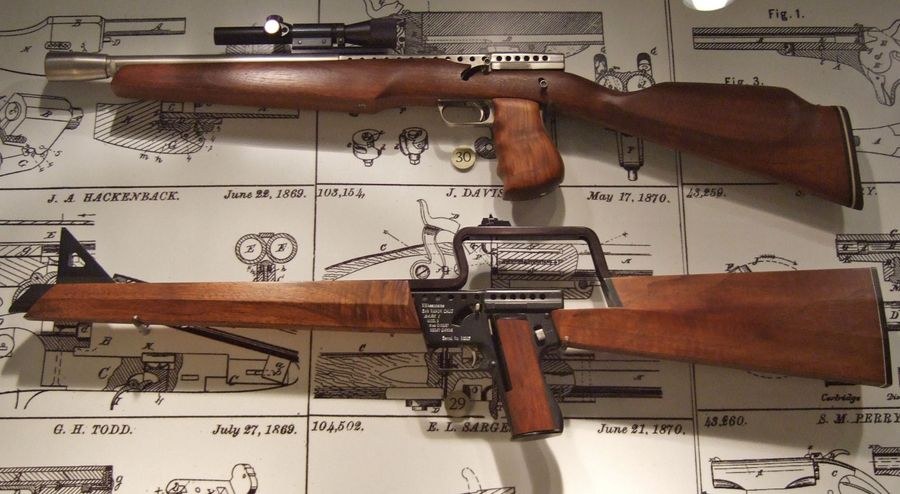
- White Sands, 1966. The Wikimedia Commons description of the carbine at the National Firearms Museum, apparently taken from the museum’s placard, says the carbine “was tested at White Sands Missile Range, New Mexico in 1966. The intent was to man the Gyrojet to test an electronic tracking system designed to track a rocket at launch when it undergoes extreme acceleration.” No other source was found, and the rest of that description garbles its numbers (Volume 2); the White Sands use is recorded as the museum’s statement.5
- The 1971 review. Carpenter quotes a government reviewer of an AAI Corporation study of small-arms rocket ammunition for ARPA in 1971: “[It’s] Gyrojet all over again. If the target is close enough to hit, you can’t kill it. If you can kill it, you can’t hit it.”6 That sentence is the military verdict in one line.
No source located records a U.S. service adopting the Gyrojet pistol or carbine. Mendenhall, who researched the guns in the early 2000s, wrote that he was “unaware of any authorized use of Gyrojet rocket guns by military personnel.”7
7.3 Vietnam: What Is Documented
The documented Vietnam connection is narrower than the legend.
- The programme was for Vietnam. ARPA’s AGILE task was explicitly for “indigenous paramilitary or civilian forces against guerrilla attacks”, and Spangler traces MBA’s first rocket-gun work to a 1961 idea of cheap weapons for “Vietnamese peasants to defend themselves against Viet Cong attackers”.18
- Test guns. Carpenter’s serial census lists a Model 137 described as “The first production gyrojet … Vietnam test gun”, and two others marked “U.S. Experimental 1965”. Carpenter’s book has a section titled “First Gyrojets in Vietnam”, which was not seen.92 Rock Island described one Model 137 as “the model that was submitted for U.S. military trials for the Vietnam War”.10
- Privately carried guns. Mendenhall’s article reports two Gyrojets used in Vietnam by individuals: one belonging to Army Lieutenant Douglas G. Magruder, who was killed there, whose engraved Mark II was returned with his effects; and one carried by David Kirschbaum, a reconnaissance soldier, whose account Mendenhall quotes at length (Volume 3 quotes his view of the feed system). Kirschbaum: “As a Recon man I liked the weapon just fine: light, quiet, low-maintenance, and a hell of a punch. It was not silent, not like the true silenced .22 Hi-standards we often carried. But it was quiet, made a sort of ‘Psssssst!’ … I fired it in camp several times, demonstrating it, never got any attention at all.”7 These are personal accounts relayed by one author, not records; they are given as his.
7.4 Vietnam: What Is Only Repeated
- The SOG test. Wikipedia states that the Studies and Observations Group tested a Gyrojet in 1967, firing through a truck door into a water-filled drum and through sandbags and tree trunks, citing John L. Plaster, SOG: The Secret Wars of America’s Commandos in Vietnam, p. 78. The book was not seen, and the account is given here only as Wikipedia’s citation of it.11
- Navy SEALs. Accounts of SEAL use circulate widely. No primary document, and no secondary source consulted for this dive, describes it. Nothing about SEAL use is stated here as fact.
- Tests on the enemy dead. Carpenter reports, from “a reliable source”, that MBA’s extended-length 13 mm rounds were a response to penetration judged insufficient “during tests on enemy corpses in Vietnam”. It is second-hand and is recorded as his.12
- “Rocketeer” service model. Wikipedia calls the pistols “Rocketeer” models, of which “about one thousand” were produced and “a few saw service”. “Rocketeer” was a box legend and a certificate title (Volume 5), not a model name.11
7.5 The Product That Worked: Flares
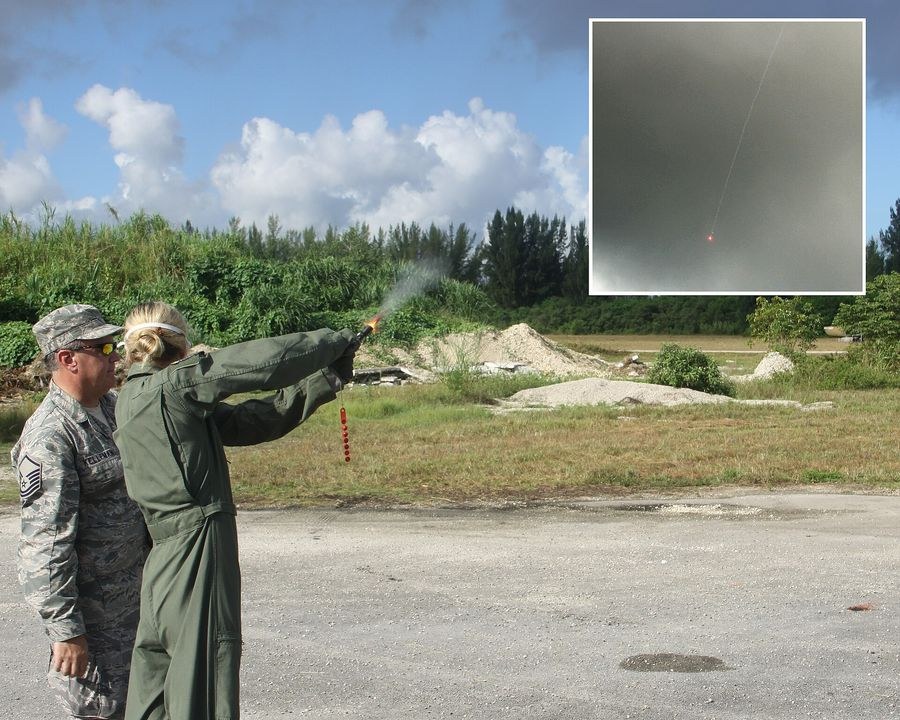
The Gyrojet’s lasting military success was not a weapon. Spangler describes Gyrojet flares developed in 1965 for the survival pistol, “proven to be very effective at penetrating jungle foliage”, leading to the Model 201 flare “launched from a simple launcher without Gyrojet pistols”: a two-stage round in which a flare section separates from a Gyrojet motor. It replaced the older “Penguin” flare, was made by other contractors after MBA, and “remains in service today”.8 Carpenter writes of “millions of 13mm Gyro-Signal survival flares and launchers” and describes a pen-shaped launcher, the Model 207, marked with MBA’s manufacturer code 27934.612 Wikipedia, citing Small Arms Review (not seen), names the U.S. Air Force A/P25S-5A kit, with a bandolier of seven flares; that designation could not be checked against a primary source.11
7.6 Soviets, a Governor, and a Brigadier General
- The Soviet attachés. Life’s three-page story of 27 May 1966, “Deadly Zip Gun for the Missile Age”, reported that the guns’ commercial availability “prompted two Soviet military attaches to travel to California to try to buy one in a San Jose gun store. They were turned down because they were aliens.” The quotation is Spangler’s, from Life p. 45; the magazine itself was not obtained.8
- Ronald Reagan. Spangler writes that Reagan “owned a Gyrojet pistol and is also known to have shot it”. Mendenhall transcribes two letters of 1977, when Reagan was between the governorship and the presidency: Mainhardt sending “twelve rounds of ‘precious’ 13mm Gyrojet ammo” from his own “special stock pile”, and Reagan replying, “I’ll guard my gyro-rockets carefully”. The letters are given as Mendenhall transcribed them; the originals were not seen.87
- Brigadier General Erik H. Nelson. Rock Island sold a cased Model B in 2020 as the property of Nelson, one of the pilots of the U.S. Army Air Service’s round-the-world flight of 1924 (Volume 5).10
7.7 On Screen
You Only Live Twice (1967). The Gyrojet’s best-known appearance. Spangler describes the scene at the ninja training camp, where Bond is shown “a table covered with Mark 1 Model B Gyrojets including two pistols, two military carbines, and two sporter carbines”, and the head of the Japanese secret service demonstrates “a Finjet rocket in a cigarette which Bond later uses to blast his way out of the evil villain’s headquarters”. Spangler adds that Finjets were not explosive and that the vault door they blow open in the film is special effects.8 The Internet Movie Firearms Database lists the pistol with Tetsuro Tamba as Tiger Tanaka and with Karin Dor as Helga Brandt, noting that she “held this gun in the promotional materials”, and lists both military and sporter carbines with the ninja commandos.13 Carpenter’s census records a Mark I pistol that Mainhardt associated with The Man with the Golden Gun; nothing located confirms any Gyrojet in that film.9
Murderers’ Row (1966). Released by Columbia on 20 December 1966, the Matt Helm film starring Dean Martin. Carpenter identifies the gun Karl Malden fires at Ann-Margret as “an MBA Mark I Model B 13mm survival pistol”, grey-finished, later lent to the NRA’s National Firearms Museum by a California firm that supplied firearms to film productions, and pictured in American Rifleman in June 2010. The film also has a Finjet fired from a cigarette. IMFDB lists a pistol and a pepperbox prop.1213
Later films. IMFDB lists the pistol in Collision Course (1989), with Tom Noonan; Carpenter’s chapter on “MBA at the Movies” covers You Only Live Twice, “The Hunter” and “Collision Course”, of which only the contents titles were seen.132
Repeated but not confirmed. Wikipedia says the Gyrojet features in the You Only Live Twice novel and in the Man from U.N.C.L.E. novel The Monster Wheel Affair, and that a twelve-barrelled Gyrojet pepperbox was planned for the Bond film but not used, citing Life and Esquire; none of these was checked. Its story that a friend of Mainhardt’s pitched the Gyrojet to Gene Roddenberry for Star Trek, and that Roddenberry wanted “a ‘ray gun’” instead, rests on a citation that cannot be identified, and is not repeated as fact.11
7.8 In Games
IMFDB lists the pistol in Shellshock: Nam ‘67 (2004, where it “incorrectly only has a 2-round magazine”), 7.62: High Calibre (2007, six rounds, alongside a Mark I carbine), World of Guns: Gun Disassembly (a Mark I Model B added on 22 December 2023), Phantom Doctrine, Resident Evil Village (2021, “incorrectly holds 7 rounds and fires explosive projectiles”) and Military Conflict: Vietnam (2022), and the carbine as the “UPR-17 Gyro Rifle” in Depth.13 The interactive disassembly in World of Guns is a game model, not a source for the real gun’s takedown (Volume 8).
7.9 The Market: Eighty-Four Lots
Rock Island Auction Company sells more Gyrojets than anyone, and its lot pages carry the hammer price. For this dive, 84 Gyrojet lots from September 2009 to December 2025 were read — every one that the Internet Archive’s index of Rock Island’s lot pages could find — and each result below is dated and linked by auction and lot number. Hammer prices exclude the buyer’s premium, which is added on top. Some lots were unsold or show no price. Rock Island is one auction house, and its sale results are not a price guide for private sales.10
Table 1 — The Market: Eighty-Four Lots
| Family | Hammer results located | Low | Median | High (date, lot) |
|---|---|---|---|---|
| Mark I Model B pistol | 34 | $1,000 (Apr 2010, 49/874) | $2,500 | $16,000 (15 Aug 2025, 4095/566, cased with certificate) |
| Mark II Model C pistol (12 mm) | 15 | $1,200 (Sep 2013, 59/915) | $2,000 | $3,000 (Dec 2016, 69/3807; Jun 2020, 79/1771) |
| Mark I (“Model A” or “Experimental”) pistol | 8 | $2,250 (Jun 2021, 1037/1090) | $4,125 | $8,500 (Sep 2020, 80/591) |
| Model 137 type | 3 | $900 (Dec 2009, 48/3820) | $4,750 | $10,000 (25 Aug 2023, 89/598, gold plated) |
| Mark I Model A carbine | 2 | $8,500 (Dec 2020, 81/694) | — | $9,000 (11 Sep 2020, 80/588) |
| Mark I Model B carbines | 5 | $1,200 (Apr 2013, 58/290) | $3,000 | $9,000 (25 Aug 2023, 89/597, sporter with scope) |
| Ammunition lots | 15 | $1,700 (Sep 2020, 23 rounds, 80/590) | $3,500 | $22,500 (5 Oct 2025, 48 rounds, 1049/3798) |
The families are this dive’s, assigned from each lot’s photographs and text rather than from Rock Island’s titles, which often call any 13 mm gun a “Mark I”. Lot 48/3820, for instance, was titled a 13 mm Mark I, but its photographs show the Model 137’s cast-in checkered grip and continuous top and its description notes “grips … molded into the gun” and a frame crack; it is counted as a Model 137 type, possibly one of the converted frames Carpenter describes (Volume 5).
Two trends are clear. Prices rose. The median hammer price of a Model B pistol was $1,800 in the eleven sales before 2016 and $2,750 in the nineteen sales from 2020 on; the Model B carbines went from $1,200–3,000 in 2013–15 to $8,500–9,000 in 2023–25. Presentation and early guns lead. The highest Model B price by far is a cased presentation set with its certificate; the early Mark I and Model 137 guns generally sell for well above a plain Model B.
The individual sales also show what moves a price:
- Completeness. Case, medallion, dummies, certificate, box, instructions and ammunition all add. Rock Island’s highest pistol price, $16,000, was a Model B described as “one of the first 1,000 produced, as authenticated by the included matching numbered MBAssociates certificate, signed by company president Robert Mainhardt and dated January 6, 1966”, with its case and ten unfired rounds — and its description admitted that “the hammer does not stay cocked, mechanically needs adjustment”.10
- Provenance. The Nelson gun brought $5,000 in 2020 against a $3,000–5,000 estimate.10
- Condition and finish. Polished guns sell low: two Model B pistols “polished bright” brought $2,250 (2018) and $1,300 (2019).10
Carpenter’s figures from 2010 give the earlier baseline: “about $3000 for a cased Mark I Model B 13mm pistol in exc-mint condition to about $1,300 for a Mark II Model C 12mm pistol in its original cardboard box”, and a mint Mark II Model C at “$2,100 on September 12, 2010, at the Rock Island Auction” — a figure that matches Rock Island’s $1,900 hammer price on lot 50/2036 two days earlier once a premium is added, which suggests Carpenter was quoting the total.14 The “above $4,000” for “even the most common model” in Wikipedia is not supported by the auction record for plain pistols.11
7.10 Why the Ammunition Is the Scarce Part
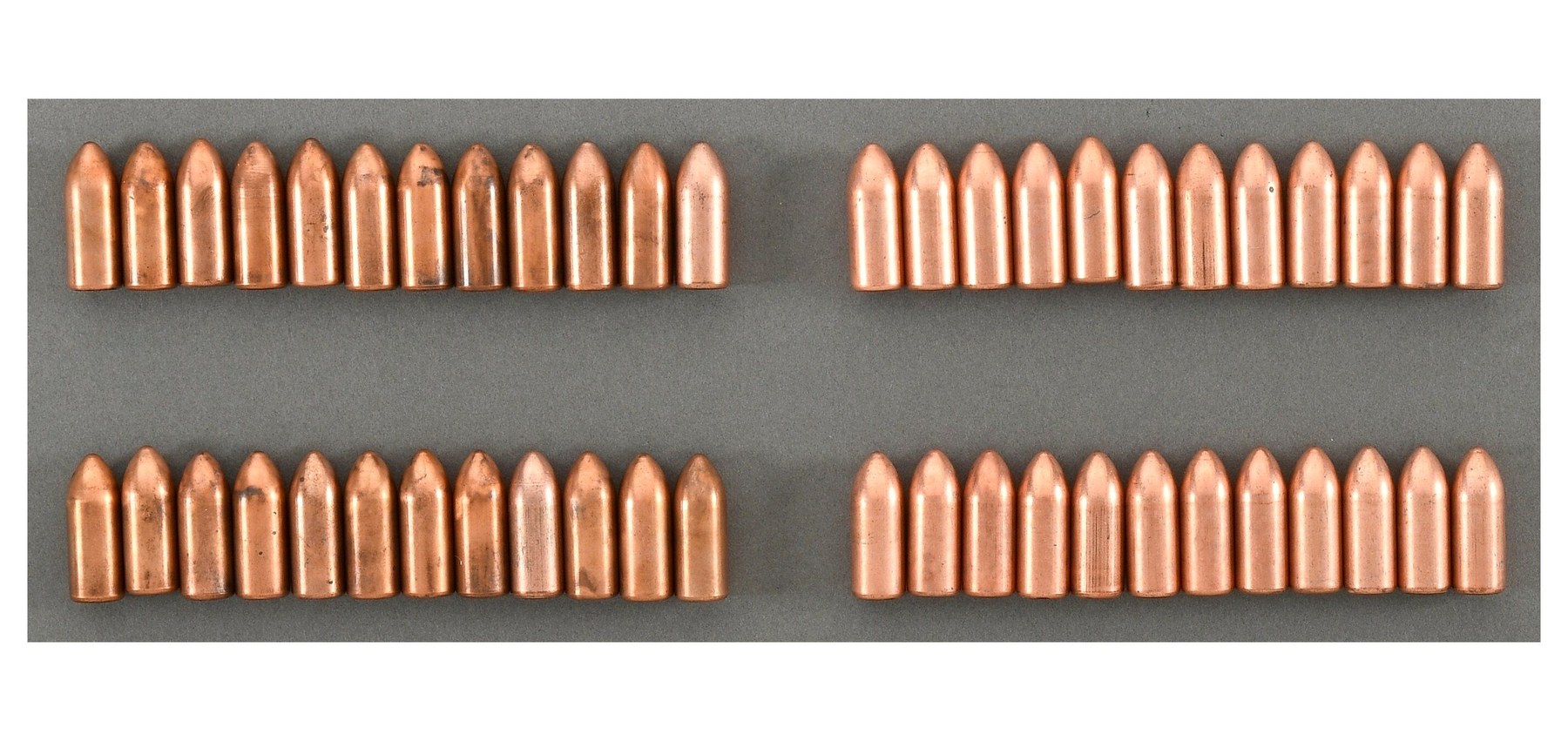
The dated record of what a single 13 mm round has cost:
Table 2 — The dated record of what a single 13 mm round has cost
| Date | Price per round | Source |
|---|---|---|
| 1965 | $1.35 | Spangler |
| mid-1960s | $1.30 in a 24-round box ($31.20); $1.50 in a six-round box | Carpenter |
| dealer stock, 1960s–70s | ”$1.50 EA”, “$36.00/BOX” on surviving boxes | Rock Island lots 69/3810, 71/935 |
| c. 2002 | ”$50.00 per round or higher” | Mendenhall |
| 2010 | $35–65 for a standard round, by condition | Carpenter |
| 2015 | about $115–135 (24-round boxes at $2,750 and $3,250 hammer) | Rock Island 65/1935, 65/972 |
| 2023 | about $271 (24 rounds, $6,500 hammer) | Rock Island 89/600 |
| 2025 | about $469 (48 rounds, $22,500 hammer) | Rock Island 1049/3798 |
The reasons are structural.
- It was never made in quantity. Every round was hand-assembled (Volume 2), MBA never reached the production volume that would have justified automatic machinery, and the pistols it was made for number fewer than two thousand.6
- Nobody makes it now, and it cannot be reloaded. A Gyrojet round is a complete rocket motor; firing it expends the whole thing. There is no case to refill, and no current maker. Supply is fixed at whatever MBA, Trebor and PSI left behind (Volume 1).
- Every shot destroys one. Each round fired reduces a fixed supply, so the collector’s incentive is never to fire at all. A fired round is a collectable spent motor, worth much less.
- Old rounds are unreliable. Four of ten rounds in the 2002 test failed to fire on the first strike, and one hung fire (Volume 2). A buyer paying hundreds of dollars a round is buying a display piece whose ignition cannot be promised.
- The 12 mm round is rarer still in practice. Very few 12 mm rounds appear at auction; Rock Island’s 12 mm guns came with four, two or one rounds at most.10
The result is that a box of twenty-four rounds has sold for more than the pistol it fits, and the guns are, in practice, display pieces. Wikipedia’s figure of “over $800 per round” cites a Swedish collectors’ page and was not confirmed; the dated auction figures above are the better guide.11
7.11 Buying Well
- Identify the family first (Volume 5) and, for any 13 mm gun, read the serial against ATF’s list yourself (Volume 6).
- Expect mechanical faults. Rock Island’s descriptions record hammers that will not stay cocked, safeties that need adjustment, a hammer that “drops with the safety activated”, loose loading gates and missing safety knobs.10 Volume 8 explains what they mean on this mechanism.
- Look for cracks. One description notes a pistol “lacking the cracks that usually form around the cutout for the magazine follower”, another a crack “from the loading port to the butt”.10 Volume 8 explains why the zinc frame cracks where it does.
- Value the paper. Certificates, instructions, boxes and correspondence make a large difference, and they identify the gun’s era.
- Do not plan to shoot it. Even a mechanically perfect Gyrojet fires ammunition that is irreplaceable, unreliable with age, and worth more than most guns.
References
Footnotes
-
ARPA, Project AGILE: Remote Area Conflict, Quarterly Report 1 April – 30 June 1963, issued by Battelle Memorial Institute, 15 July 1963, Tab 1 pp. 15–16 and later tasks, DTIC AD338491, approved for public release; Wayback copy of http://www.dtic.mil/dtic/tr/fulltext/u2/338491.pdf , retrieved 2026-09-19. ↩ ↩2 ↩3
-
Mel Carpenter, An Introduction to MBA Gyrojets and Other MBA Ordnance (2010), contents page, gyrojet.net, Wayback capture of 21 July 2018, retrieved 2026-09-19. ↩ ↩2 ↩3
-
CIA, DD/P/TSD memorandum “Microjet Proposal”, 17 January 1961, CIA-RDP78-03642A002400020027-4, Internet Archive, retrieved 2026-09-19. ↩
-
Mainhardt to Scoville, 10 July 1962, and reply of 21 July 1962, CIA-RDP66R00638R000100060028-7 and -0029-6, Internet Archive, retrieved 2026-09-19. ↩
-
Wikimedia Commons, “File:Gyrojet Rocket Carbine at the National Firearms Museum.jpg”, description, retrieved 2026-09-19. ↩
-
Mel Carpenter, An Introduction to MBA Gyrojets and Other MBA Ordnance (2010), Chapter 6, sample chapter, retrieved 2026-09-19. ↩ ↩2 ↩3
-
Monty Mendenhall, “Gyrojets — Review” (part 2), deathwind.com, Wayback capture of 20 February 2003, https://web.archive.org/web/20030220110005/http://www.deathwind.com/review_2.htm , retrieved 2026-09-19. ↩ ↩2 ↩3
-
John Spangler, “MBA Gyrojet Mark I Model B Pistols and Carbines: Rocket Science Meets Reality”, ASAC Bulletin 105 (2012), pp. 58–66, retrieved 2026-09-19. ↩ ↩2 ↩3 ↩4 ↩5
-
Mel Carpenter, “Gyrojet Census by Serial Number” (PDF, c. 2013), gyrojet.net, retrieved 2026-09-19. ↩ ↩2
-
Rock Island Auction Company, 84 Gyrojet lot pages, September 2009 to December 2025, hammer prices from each page’s embedded sale record; https://www.rockislandauction.com/detail/ followed by auction and lot number, retrieved 2026-09-19. The full table is in the dive’s working file research-market.md. ↩ ↩2 ↩3 ↩4 ↩5 ↩6 ↩7 ↩8 ↩9
-
Wikipedia, “Gyrojet”, consulted 2026-09-19. ↩ ↩2 ↩3 ↩4 ↩5 ↩6
-
Mel Carpenter, Chapter 28 (June 2012), gyrojet.net, https://web.archive.org/web/20180721025145/http://www.gyrojet.net/ch28.pdf , retrieved 2026-09-19. ↩ ↩2 ↩3
-
Internet Movie Firearms Database, “MBA Gyrojet”, page text read through the site’s API, https://www.imfdb.org/wiki/MBA_Gyrojet , retrieved 2026-09-19. ↩ ↩2 ↩3 ↩4
-
Mel Carpenter, “Questions and Answers” (updated 2 November 2010), gyrojet.net, retrieved 2026-09-19. ↩
Comments (0)