MBAssociates Gyrojet · Volume 4
The Look — Zinc Die Casting, Vented Tubes, and Why There Is No Breech
Why the Gyrojet looks the way it does, argued from how it was made: a gun that is not a pressure vessel, two cast halves bolted together, a row of gas vents that became its signature, and a company that set out to make a rocket look like a .45
4.1 The Claim This Volume Tests
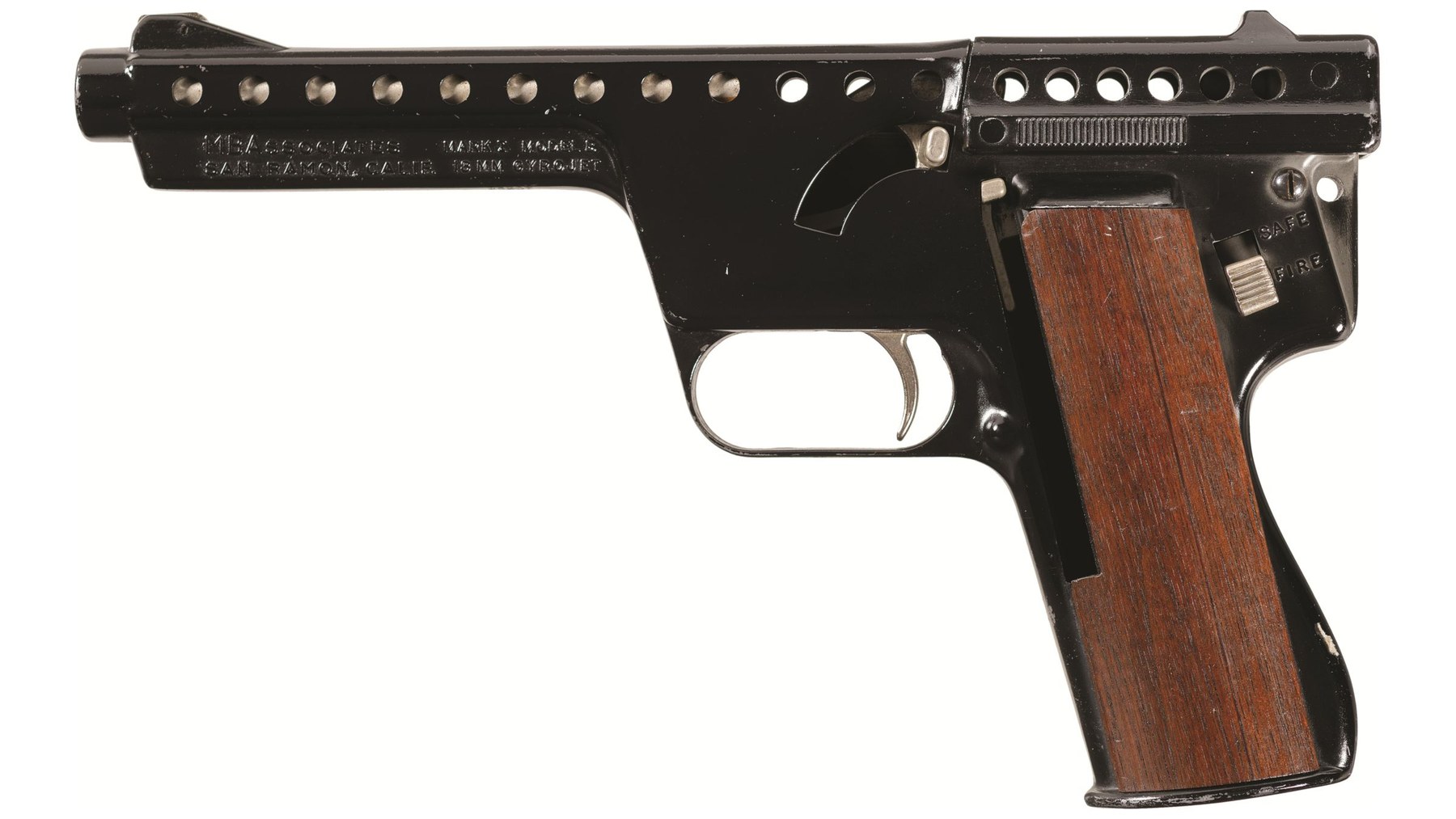
The Gyrojet is routinely called the most futuristic-looking gun of the 1960s, and the adjectives stop there. This volume argues from the construction, as the hub’s Whitney Wolverine Vol 4 did for the Whitney. The claim, put so that it can be checked, is this: almost every feature that makes the Gyrojet look like a ray gun is either a direct consequence of firing a rocket instead of a cartridge, or a consequence of the cheap casting that a rocket allowed — and the one feature that is not, its outline, was chosen deliberately to make the strange thing look familiar.
4.2 Step One: the Gun Is Not a Pressure Vessel
In a cartridge pistol, the propellant burns in the chamber, behind the bullet, and the peak pressure acts on the chamber walls and on the breech face. For .45 ACP the SAAMI maximum average pressure is 21,000 psi, the figure the hub’s FP-45 Liberator replica dive builds its whole design around; acting on the 0.1605 sq in of a 0.452 in bore, that is about 3,370 lbf on the breech face, for a millisecond or so, every shot. The barrel, the breech and whatever holds the breech closed are sized for that load, and in a conventional pistol they account for most of the steel.
In a Gyrojet, the propellant burns inside the round. The pressure acts on the rocket’s own steel case and escapes through its canted ports (Volume 2). The gun sees the exhaust, vented through holes in its walls, the blow of its own hammer, and the brief reaction of the hold-down (Volume 3). MBA’s patent put it in one sentence: “As the miniature rockets employed do not require containment of hot gases nor high pressures in the launcher, launcher materials may be lightweight plastics or metals.”1 Carpenter’s summary of MBA’s own sales claims says the same: “A Gyrojet’s vented barrel was not pressurized during firing, so the gun could be made of lightweight alloys of aluminum, magnesium, and even plastics.”2 Rock Island Auction’s standard description puts it in collector’s terms: “As the rocket does not need a solid chamber or extractor equipment, the entire pistol can be greatly simplified and made from lightweight materials.”3
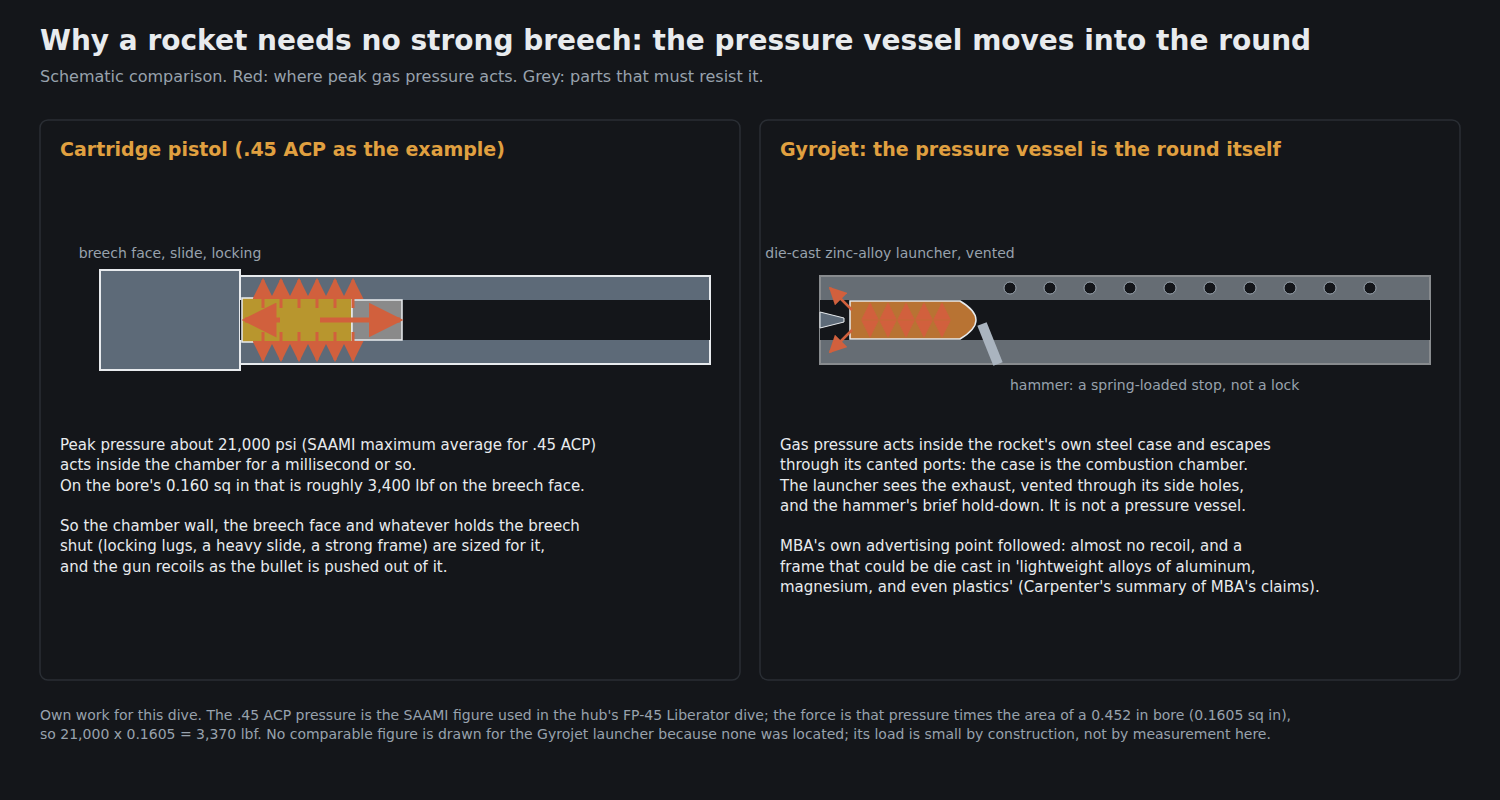
No published source gives a measured load on a Gyrojet launcher, and none is invented here. The argument does not need one: the launcher’s load is small by construction, because the part of the system that carries the pressure leaves the gun.
4.3 Step Two: So It Can Be Cast
A gun that carries no chamber pressure can be made by the cheapest metal-forming process there is. The earliest official description of the pistol, in ARPA’s Project AGILE report of July 1963, says that “the gun is to be die cast of zinc or aluminum alloy”, and it expected the result “to cost an order of magnitude less than any equivalent small arm presently available”.4 Spangler: “Because there is no pressure in the barrel, the pistol could be made from cheap pot metal castings. Initially, there was not even a barrel; instead there were merely guide ribs that were cast into the frame.”5 Carpenter: Gyrojets could have cost much less than conventional firearms “because of their lightweight materials, very simple designs, generous tolerances, and few parts, which were easily made by die casting.”2
Die casting forces molten metal under pressure into a hardened steel die. It is expensive to set up — the die is a precision tool — and almost free per part afterwards; it produces near-finished surfaces, crisp detail such as cast-in checkering and lettering, and holes and slots that come out of the die with the part. It suits low-melting alloys of zinc and aluminium. It is the process of the period’s toy cars, carburettors, door handles and appliance housings, which is to say that the Gyrojet’s frame was made the way a Matchbox car was made.
The Whitney Wolverine of 1956 was also cast, but its frame had to carry a fixed barrel and take the recoil load of a blowback .22, passed into it through the barrel nut and the front of the frame. The Gyrojet’s frame had to carry almost nothing. That difference, not styling, is why the Gyrojet could be cast in zinc and look like a casting.
4.4 What It Was Cast In
The sources name two alloy families and a trade name.
Table 1 — What It Was Cast In
| Source | Material |
|---|---|
| ARPA report, July 1963 | ”die cast of zinc or aluminum alloy” |
| US 3,412,641 (filed 1966) | frame halves of “cast material which may be plastic, white metal and the like”; barrel “a tube of hard material, such as stainless steel” bonded in |
| Spangler (2012) | “cheap pot metal castings” |
| Antaris (1997) | “later pistols of aluminum or zinc diecast alloy”; steel “reserved for the springs, screws, barrel liner, and firing pin” |
| Carpenter census | Model 137 examples listed as “Black zamak”, “Gold zamak” and “Silver aluminum”; black and gold “die proofs” |
| Rock Island Auction, lot 4095/564 (2025) | carbine “constructed mostly from a lightweight material called Zamac (a zinc alloy)” |
Zamak (also spelled Zamac) is the trade family of zinc die-casting alloys containing a few per cent of aluminium, and “white metal” and “pot metal” are the older, looser names for the same class of cheap castings. The weight of the evidence is that the production frames were zinc-alloy die castings, with some aluminium examples early. The exact alloy has not been published, and no metallurgical analysis of a Gyrojet frame was located.465789
Antaris also says that “early pistols were fabricated of sheet metal”, and that “the first 150” Model B pistols were “fabricated out of sheet metal”. That conflicts with ARPA’s 1963 description, with Carpenter’s die proofs, and with every photograph examined for this dive, all of which show cast frames with cast-in detail. It is recorded as Antaris’s statement and not relied on.7
The choice of zinc has consequences for the owner today — cracking, and what can and cannot be repaired — that Volume 8 takes up.
4.5 Step Three: Two Halves Make a Slab
The patent says the frame “has a frame 10 made of two halves 11 and 12”, joined by screws, each half a single casting.6 The patent’s exploded view (Volume 3) shows them as mirror-image shells, and the photographs in Volume 5 show the screw heads in the flat sides.
A two-piece die parts most easily on a flat plane, and a frame made as two shells split along the gun’s vertical centre plane comes out as two flat-sided halves. The result is the Gyrojet’s most obvious formal trait: it is slab-sided, like a stamped or folded object, with its detail on its faces rather than in its section. Every feature on the side of the gun — the address, the model line, the hammer’s cocking slot, the follower slot, the cast checkering of the Model 137’s grip — sits in a flat panel, legible from one side like the lettering on a toy. That reading of the construction is this dive’s, not a statement in any source, but it follows directly from the patent’s two halves.
The other consequence is that nothing curves in plan. The Whitney’s designer used his casting to make curves free (Whitney Vol 4); the Gyrojet’s designers used theirs to make the gun cheap, and the shapes that are cheapest to cast in two flat halves are flat.
4.6 The Vents: Function That Became the Signature
The Gyrojet’s defining visual feature is the row of round holes along the top of the gun, from the rear of the slide to the muzzle. They are functional. The patent: “the slide 63 and barrel portions have apertures 76 in side walls to permit the escape of the hot gases.”6 MBA’s instructions: “The ported barrel should not be covered or gripped by the hand during firing. The warm gases generated by the burning of the rocket must be permitted to vent.”10 The round lights in the chamber and burns as it travels down the tube; its exhaust has to go somewhere, and the vents let it out sideways, away from the shooter, before it can build up behind the round. Rock Island’s description: the action cover “is ported to direct the escaping gas to the sides, away from the shooter.”3
The vents also make the gun lighter and let the shooter see the rounds. MBA’s own safety note claimed that “the Gyrojet Rocket Handgun is extra safe because you can see into the chamber at all times.”10 But their effect on the look is larger than any of their functions. A row of evenly spaced round holes along a tube is the visual vocabulary of the 1950s and 1960s space gun: the cooling jackets of machine guns, the perforated shrouds of ray-gun toys and film props, the lightening holes of aircraft structure. On the Gyrojet they are not ornament; they are the exhaust system. That is the whole case of this volume in a single feature.
4.7 Step Four: Make It Look Like a .45
If the construction explains the surfaces, it does not explain the outline. A rocket launcher could be any shape. The Gyrojet is a conventional pistol shape — a horizontal top line, a raked grip at the back, a trigger guard in front of it — because MBA wanted it to be. Carpenter records the reason. MBA’s customer was the U.S. military, which showed “a strong reluctance … to adopt a totally new small arms weapons technology unlike anything it had seen before”. Mainhardt quoted Biehl asking, “Why don’t we make it look like a .45 ACP?” — the round and the pistol both — and “MBA designed its firearms specifically to look like then-current military rifles and pistols.”2 Spangler adds that the Model B’s top slide “made the pistol seem more like the Colt Model 1911 pistol, potentially making it more attractive for military sales.”5
The same logic produced the first carbine. Spangler: “Given the interest in the (then) new AR15/M16 rifle, Mainhardt’s first attempt was a Mark 1 Model A military carbine imitating the appearance of the M16.” Its carry handle carries the rear sight exactly as the AR-15’s does (Volume 5).5
The result is the Gyrojet’s peculiar character. It is a familiar outline — a .45, an M16 — rendered in the materials and details of something else entirely: a zinc casting, a perforated tube, no slide to speak of, no ejection port, no visible barrel. It reads as a gun from a future in which guns had become appliances. It is also why the Gyrojet photographs so well as a prop: the outline says “pistol” at once, and every detail inside it says “not quite”.
4.8 Reading the Form Part by Part
With the construction established, each feature can be read for what it is. Where the reading is an inference, it says so.
- The top line is one straight horizontal from sight to muzzle. On the Model 137 and Mark I it is unbroken; on the Model B and Mark II a break marks the front of the rear top slide (Volume 5). There is no reciprocating slide, so there is no parting line to break the form in the usual place.
- The tube and its vents — the exhaust system, as above.
- The lug under the tube runs forward almost to the muzzle as a flat web of the frame, and carries the address and model markings. It joins the tube to the frame and is where the barrel is bonded in; that it doubles as the label panel is an inference from where the markings sit.
- The square trigger guard and flat grip frame — shapes that cast easily in a two-part die and need no finishing.
- The exposed hammer slot — the curved slot on the left through which the hammer’s cocking finger projects (Volume 3). It is a working part in plain view, and it gives the side of the gun the look of a machine with its cover off.
- The follower slot and tab — another working part in view, the magazine’s round counter.
- The grip — cast-in checkering on the Model 137, making grip and frame one piece; separate panels, “secured by a suitable adhesive” according to the patent, on the later guns.6
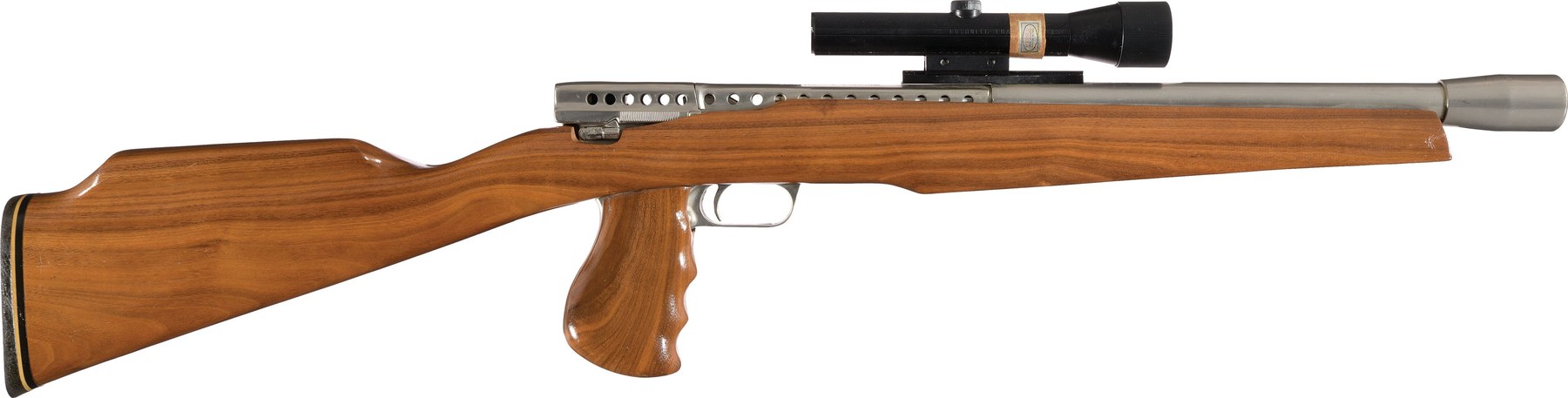
- The carbines’ shrouds and stocks — the sporter carbine’s “bulky barrel shroud” and flared muzzle, and its one-piece walnut stock with a roll-over cheekpiece, turn the tube into something closer to a jet engine nacelle than a rifle barrel (Volume 5).
4.9 Finishes and Presentation
Spangler lists the Model B finishes as mostly black, some “antique nickel”, a few gold plated, and “other colors”; the survival pistol came in “jungle green”. Antaris adds satin nickel, “black anodized”, bright nickel and olive drab, with grips integral or separate in walnut, black or white “pearlite”, or imitation ivory.57 Carpenter’s census adds grey, “chrome silver” and “bright aluminum” on early guns.8 Rock Island’s descriptions of internal parts record “98% of the original chrome” and fire controls that “have turned to a brassy/copper patina”.3
The word “anodized”, which Rock Island and Antaris both use for black guns, needs care. Anodising is an electrochemical process for aluminium; it does not apply to zinc alloys, which are normally painted, lacquered or plated. On a zinc frame “black anodized” is almost certainly a description of appearance, not process. Rock Island’s text for one Model B mentions “exposed undercoat on the balance”, which fits a painted or coated finish over a casting.3 No MBA finishing specification was located.
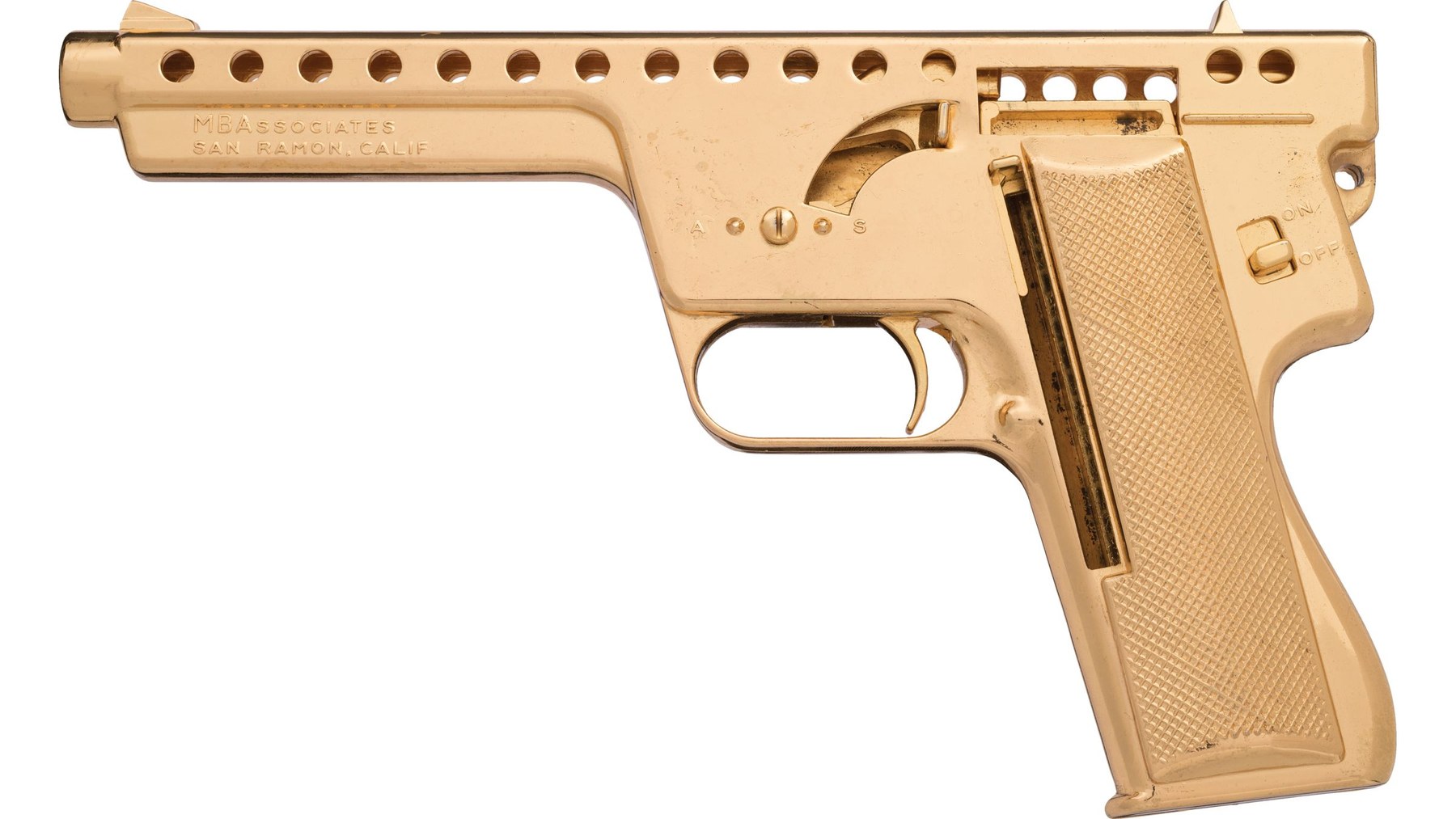
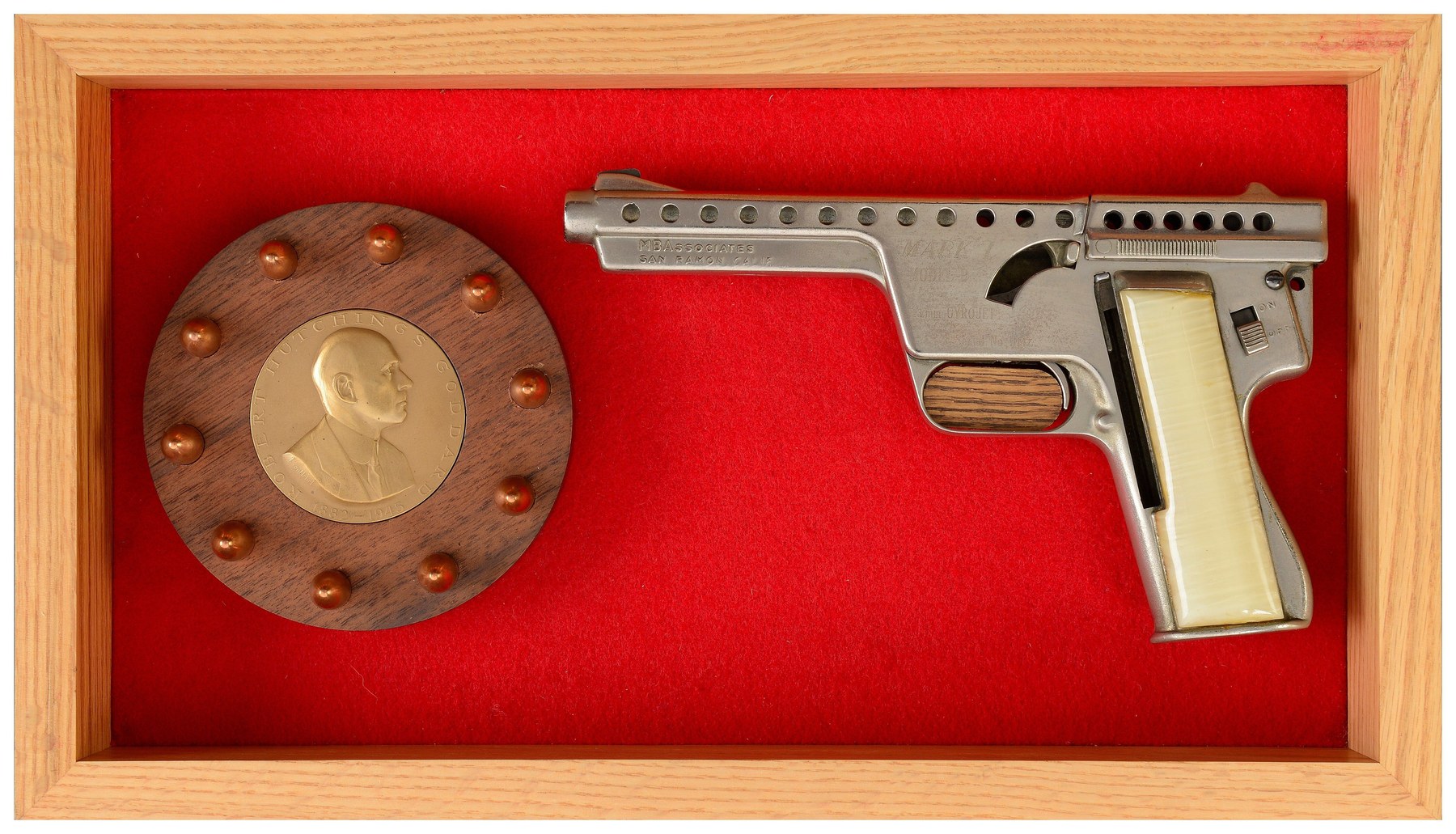
The presentation guns are where MBA’s commemorative strategy shows. Spangler describes the idea: Mainhardt saw Colt “selling a lot of ‘commemorative’ pistols to collectors”, and cased his pistols in walnut boxes “the same ones as used for Gerber knives”, with a medallion of Robert Goddard, the American rocket pioneer, and a ring of ten dummy rounds.5 The medallion ties the product to rocketry rather than to guns, and to American rocketry specifically. The red felt, the brass plate reading “MBA Gyrojet Rocket Handgun” and the circle of nickel-plated dummies around Goddard’s head are as much a part of the look as the vents.
4.10 The Selling of the Space Age
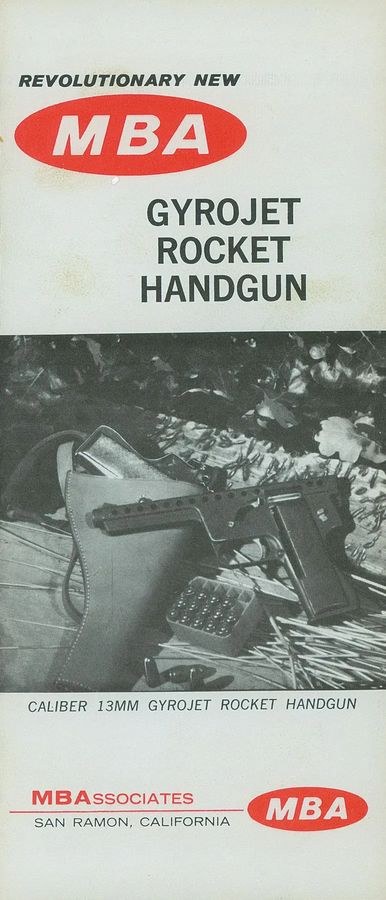
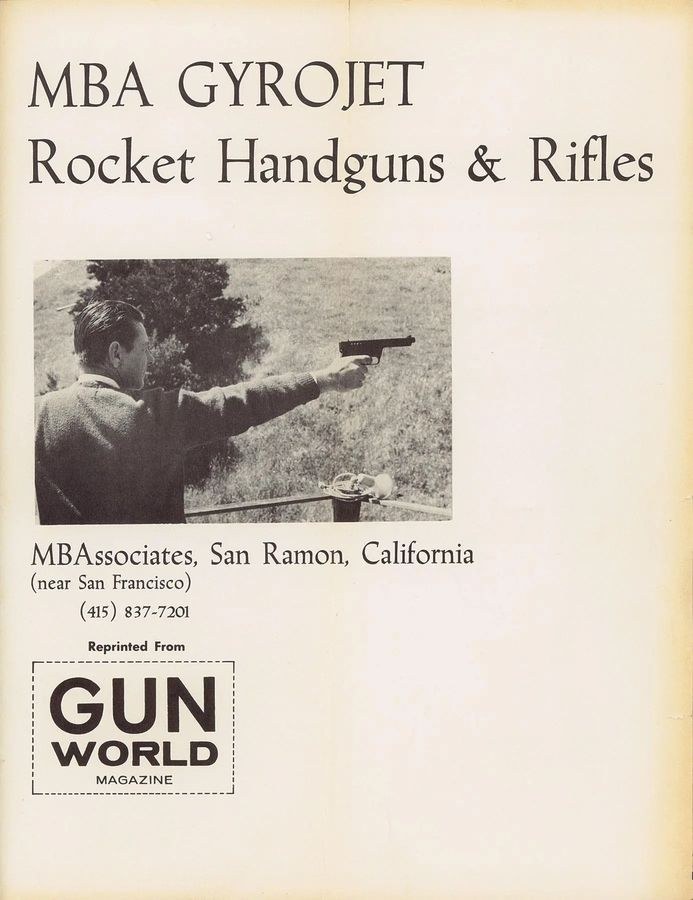
The Gyrojet appeared at the moment American consumer culture was most taken with rockets. MBA’s printed material leaned into it. Its brochure was headed “Revolutionary new MBA Gyrojet Rocket Handgun”; its boxes read “Automatic Rocket Pistol” and “Semi Automatic Rocket Pistol”, and early ones “Rocketeer”; its certificate declared the holder “qualified as a rocketeer”; its trademark was “GYRO-JET”.32 Life ran a three-page story on 27 May 1966 titled “Deadly Zip Gun for the Missile Age”.5 Gun World’s September 1965 cover announced “Exclusive: Handguns for Rockets!”, and MBA reprinted the article as a brochure.3
MBA’s founders came from Los Alamos, Livermore and the reactor business, and its plant stood on a former Nike missile site. The space-age association was not borrowed styling: the company was in the missile business, and its gun was a missile.
4.11 The Gyrojet and the Whitney: Two Castings, Two Looks
The Whitney Wolverine and the Gyrojet are the two most “space-age” American pistols of their period, and both owe their look to casting. They reached opposite looks by opposite routes.
Table 2 — The Gyrojet and the Whitney: Two Castings, Two Looks
| Whitney Wolverine (1956) | Gyrojet (1962–72) | |
|---|---|---|
| Frame | One precision-cast aluminium piece | Two die-cast halves, zinc alloy (with some aluminium early) |
| What the frame carries | A fixed barrel and an internal bolt and sleeve, and a .22’s recoil | Almost nothing: a guide tube and a hammer |
| What casting made free | Curves: swept webs, a jet-fuselage top line | Cost: flat panels, cast-in holes, lettering, checkering |
| Form | Streamlined, organic, “modern as tomorrow” | Flat, perforated, mechanical |
| Intent stated by the makers | Styling as a goal (“dishwashers, refrigerators, cars”) | Familiarity as a goal (“make it look like a .45”) |
| Reference | The jet aircraft | The rocket, the service pistol, the M16 |
The Whitney’s designers wanted a pistol that looked like the future and used casting to get there. MBA wanted a rocket that looked like the present and got the future anyway, because the materials and details of a cheap cast rocket launcher were themselves the future’s vocabulary. The hub’s Whitney Vol 8 lists the Gyrojet among its kindred designs as “the most literal ray gun ever sold”; this volume’s argument is that it is also the most honest one, because nothing on it was drawn to look like a ray gun.
4.12 Did the Look Help?
The sources are split, and the look’s effect on sales cannot be separated from price and performance. Antaris concluded that “their unusual appearance, unadorned construction, suboptimal accuracy, and use of prohibitively expensive ammunition served to limit acceptability”, and that “perhaps there exists some part in every consumer which requires security through convention.”7 Against that, the look was the product for the buyers MBA actually found: collectors, and the studios that put Gyrojets on screen (Volume 7). A gun salesman quoted by Mendenhall summed up the effect of the look without meaning to: “Everybody wanted to shoot my Gyrojet, but nobody wanted to buy one.”11 Sixty years later, the look is the reason the guns sell for more than they ever did new.
References
Footnotes
-
M. C. Hengel, A. T. Biehl and R. Mainhardt, US Patent 3,212,402, “Hand Weapon”, filed 29 November 1962, issued 19 October 1965, col. 2, https://patentimages.storage.googleapis.com/pdfs/US3212402.pdf . ↩
-
Mel Carpenter, An Introduction to MBA Gyrojets and Other MBA Ordnance (2010), Chapter 6, sample chapter, https://web.archive.org/web/20120904025322/http://www.gyrojet.net/Gyrojet_Book_Sample_Chapter_6.pdf , retrieved 2026-09-19. ↩ ↩2 ↩3 ↩4
-
Rock Island Auction Company lot descriptions and photographs, including auctions 47/3814, 56/902, 57/1886, 65/971, 75/835, 80/588, 87/646 and 4095/566, https://www.rockislandauction.com/detail/ followed by auction and lot number, retrieved 2026-09-19. ↩ ↩2 ↩3 ↩4 ↩5 ↩6
-
ARPA, Project AGILE Quarterly Report, 1 April – 30 June 1963, DTIC AD338491, p. 15 and sub-project summary, Wayback copy of http://www.dtic.mil/dtic/tr/fulltext/u2/338491.pdf , retrieved 2026-09-19. ↩ ↩2
-
John Spangler, “MBA Gyrojet Mark I Model B Pistols and Carbines: Rocket Science Meets Reality”, ASAC Bulletin 105 (2012), pp. 58–66, retrieved 2026-09-19. ↩ ↩2 ↩3 ↩4 ↩5 ↩6 ↩7
-
A. T. Biehl and R. Mainhardt, US Patent 3,412,641, filed 27 June 1966, issued 26 November 1968, cols. 2–4, https://patentimages.storage.googleapis.com/pdfs/US3412641.pdf . ↩ ↩2 ↩3 ↩4
-
Leonardo M. Antaris, “The Gyrojet Rocket Handguns: An Early Exploration Into The Future”, Gun Journal, January 1997, read from photographs with Rock Island Auction lot 57/1886, retrieved 2026-09-19. ↩ ↩2 ↩3 ↩4
-
Mel Carpenter, “Gyrojet Census by Serial Number” (PDF, c. 2013), https://web.archive.org/web/20130728124742/http://www.gyrojet.net/census.pdf , retrieved 2026-09-19. Individual serial entries are not reproduced in this dive. ↩ ↩2
-
Rock Island Auction Company, auction 4095, lot 564, “MBAssociates Mark I Model B Gyrojet Carbine with Box and Optic”, 15 August 2025, https://www.rockislandauction.com/detail/4095/564 , retrieved 2026-09-19. ↩
-
MBAssociates, “Operating Instructions” and photograph sheet, Model B period, photographed with Rock Island Auction lot 57/1886, retrieved 2026-09-19. ↩ ↩2
-
Monty Mendenhall, “Gyrojets — Review” (part 2), deathwind.com, Wayback capture of 20 February 2003, retrieved 2026-09-19. ↩
Comments (0)