MBAssociates Gyrojet · Volume 5
Variants and Identification — Model 137 to Mark II Model C
Every Gyrojet pistol and carbine family, what the guns themselves are marked, and how to tell them apart from a listing photograph: comparison plates, marking close-ups, and a feature-by-feature table
5.1 Two Corrections First
There is no 13 mm “Model C”, and the 12 mm gun is a Mark II. The post-1968 12 mm pistol is marked, in the factory’s own rolled lettering on the left side, “MARK II MODEL C / 12 MM GYROJET” (the close-up plate below shows it), and its right side carries the granted patent number, “U.S. PAT 3,412,641”. Antaris, Carpenter’s census and Rock Island Auction all call it the Mark II Model C. Spangler’s paper calls it the “Mark 1 Model C” and describes it as “identical to the Mark 1 Model B” except for bore, rifling and markings; the description is useful, but the name is not what the guns say.123 So the sequence is Model 137 → Mark I → Mark I Model B → Mark II Model C, and “Mark I Models A, B and C” is a conflation of two different things.
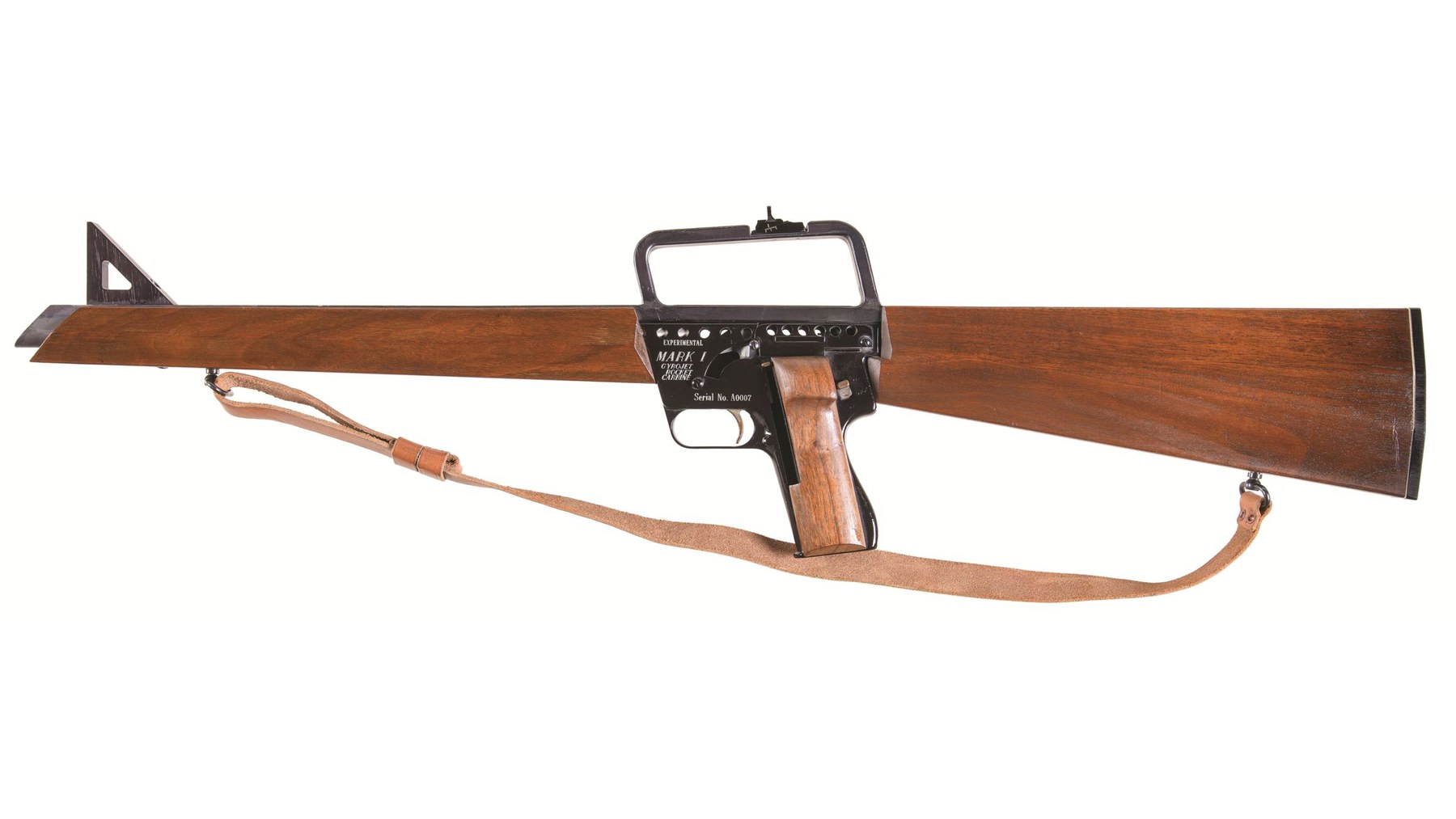
“Model A” is a collectors’ name. The first 13 mm pistols are marked “MARK I” and an A-prefix serial, and some “EXPERIMENTAL / MARK I”, with no model letter; the carbine of the same series is marked “EXPERIMENTAL / MARK I / GYROJET / ROCKET / CARBINE”.4 The letter A appears only in the serial. Spangler, Antaris and Rock Island all use “Mark I Model A” for these guns by back-formation from the lettered Model B, and this dive does the same for convenience, but a listing that describes a gun as “marked Model A” should be checked.
5.2 The Family at a Glance
Table 1 — The Family at a Glance
| Family | Bore | Years (sources) | Loading | Serials | Made (sources, not averaged) |
|---|---|---|---|---|---|
| Model 137 | .49 cal. (the later “12 mm”); marked “CAL. 49” | 1962–63 (Spangler); production from early 1963 (Carpenter) | Open port, then a swivelling gate | ”Butt numbers” stamped under the grip | ~45 (Spangler); 32 est. (Antaris); ~150 (RIA); 101 furnished to ARPA’s tester (ARPA 1963) |
| Mark I (“Model A”) | 13 mm (first few .49) | 1963–65 | Hinged or swivelling gate, left side | A + number | ~100 (Spangler); fewer than 100, 85 cased (Antaris) |
| Mark I Model B | 13 mm | 1965–68 | Rear top slide | B + number | ~1,100 pistols and carbines (Spangler) |
| — snub-nose | 13 mm | late | Top slide | S-suffixed or separate series | fewer than 50 (Antaris) |
| — survival | 13 mm | from 1965 | Top slide; telescoping barrel | S-suffixed | a few dozen (Spangler) |
| Mark I Model A carbine | 13 mm | 1963–64 | Gate | A + number | ”small number” (Spangler) |
| Mark I Model B military carbine | 13 mm | 1965–68 | Top slide under a lengthened handle | B + number | fewer than 100 (Spangler) |
| Mark I Model B sporter carbine | 13 mm | 1965–68 | Top slide | B + number | ~300 (Spangler) |
| Mark II Model C | 12 mm | 1969–72 (Spangler); to 1972 (Antaris) | Top slide | plain numbers, underneath | ~600 (Spangler, Antaris); gun logs to 606 (Carpenter) |
Sources for every row are quoted in Volume 1’s production table and below.
5.3 The Four Pistol Families Side by Side
The four pistol families are easiest to separate from the right side, where the patent line and the slide latch sit. The plate below sets four guns side by side at the same scale and orientation; the numbered key inside the plate explains each callout.
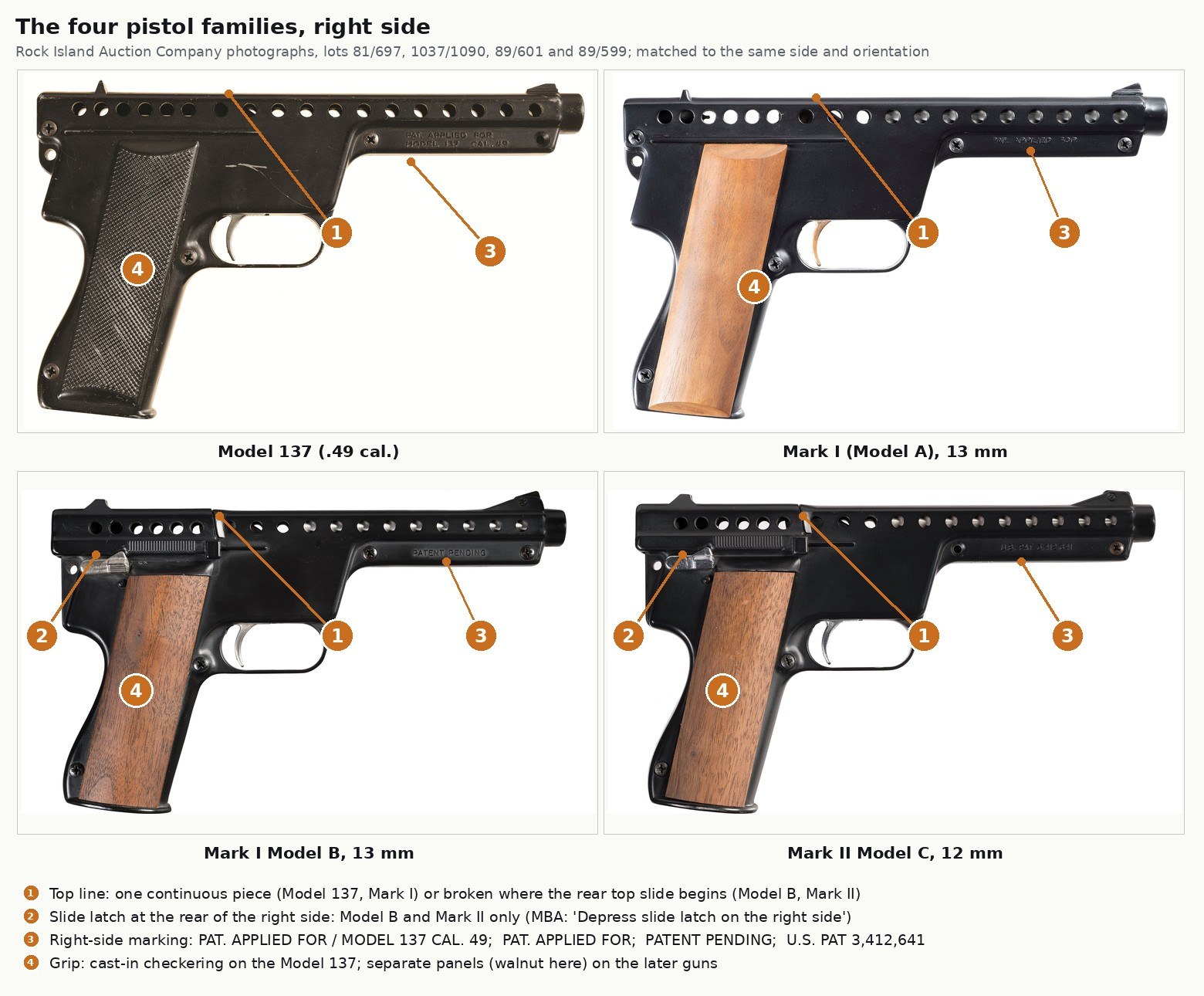
Read in order, the four guns show the design’s evolution. The Model 137 is one casting with the grip checkering cast in, a continuous top, and no latch. The Mark I adds separate grips but keeps the continuous top, because its magazine is loaded through a gate in the side. The Model B introduces the rear top slide, which breaks the top line just above the front of the grip and needs a latch at the back of the right side. The Mark II Model C is the Model B’s frame in the smaller bore, and from the right side it differs only in its patent line.
5.4 The Quickest Tell: the Right-Side Patent Line
The single most reliable tell in a photograph is the line of lettering on the right side of the barrel lug, because it follows the progress of the patent itself.
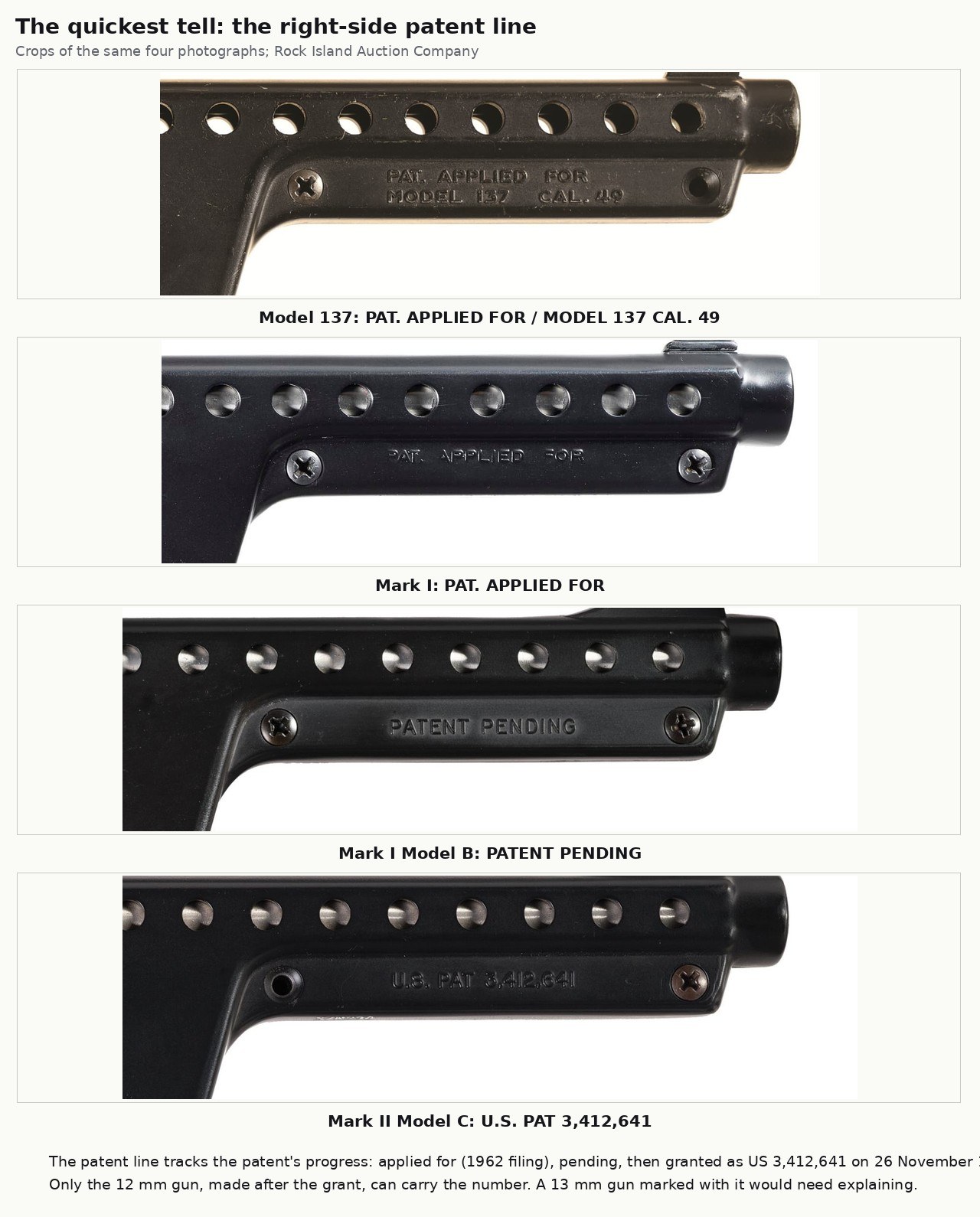
Table 2 — The Quickest Tell: the Right-Side Patent Line
| Right-side marking | Family | Why |
|---|---|---|
| PAT. APPLIED FOR / MODEL 137 CAL. 49 | Model 137 | The only family whose model and calibre are on the right |
| PAT. APPLIED FOR | Mark I | Before the Model B |
| PATENT PENDING | Mark I Model B | 1965–68, before the grant |
| U.S. PAT 3,412,641 | Mark II Model C | US 3,412,641 was issued on 26 November 1968 |
Rock Island’s descriptions confirm the pattern across many lots: Model B pistols “PATENT PENDING” on the right, Model C pistols “U.S. PAT 3.412.641”.4 A 13 mm gun carrying the granted number would be out of sequence and would need explaining; none was seen.
5.5 The Left Side: What the Frame Says
The left side carries the maker’s address on every family, and the model and serial on most.
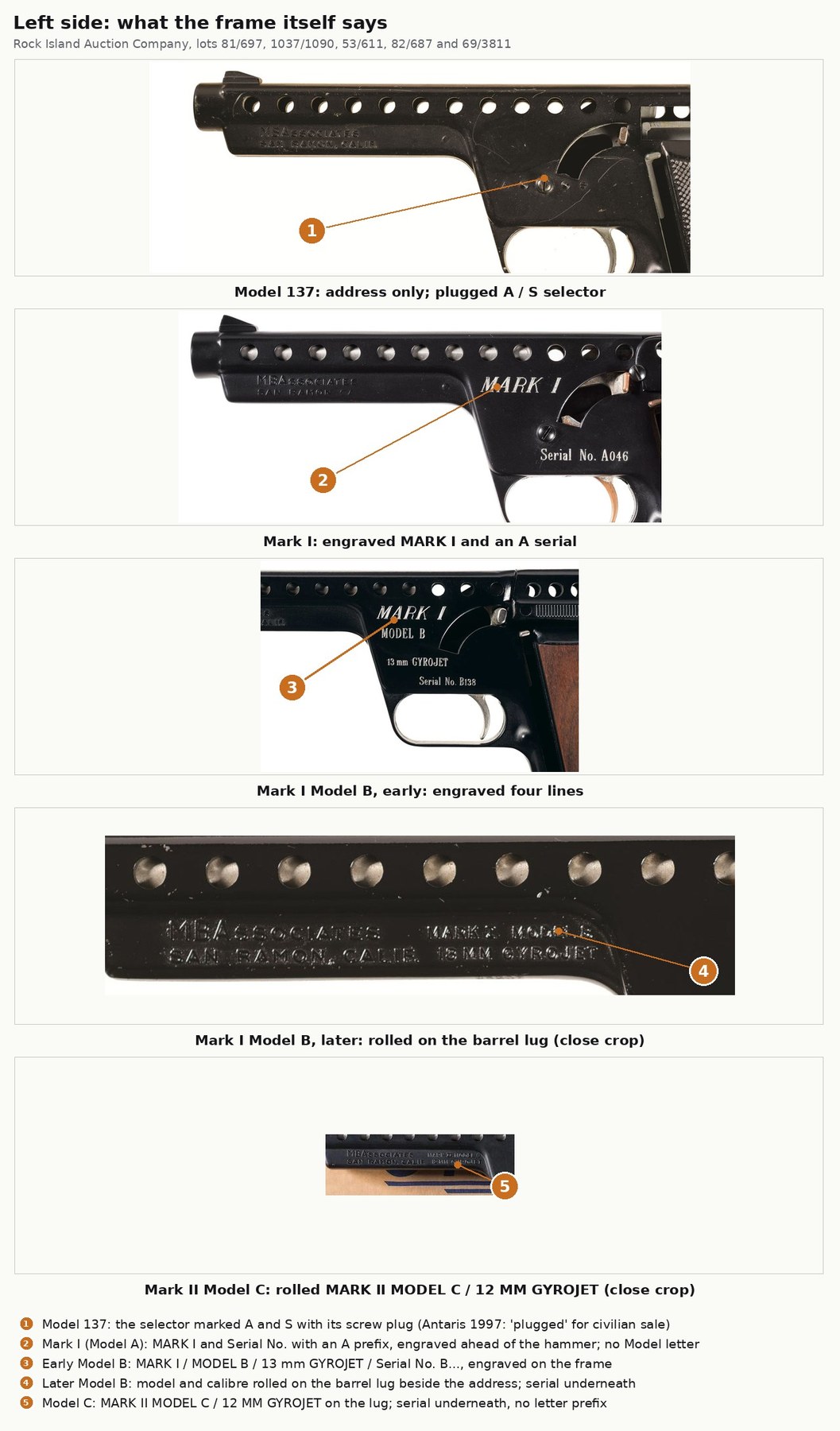
Two points about the Model B’s left side. First, the marking moved during production: early guns were engraved on the frame ahead of the hammer, later guns rolled on the lug beside the address with the serial underneath. Rock Island’s text for one early gun notes that “the changed position of manufacturer and model markings are commonly seen on the early Model B pistols which were typically engraved with the original owner’s name before leaving the factory”.4 Second, an owner’s name engraved on the frame — two examples sold at Rock Island carried one — is an early-production feature, not a later personalisation, on this evidence.4
5.6 Model 137
The first production Gyrojet, in .49 calibre. Spangler describes its frame as “cheap pot metal castings” and says that at first “there was not even a barrel; instead there were merely guide ribs that were cast into the frame”, with tubes added later for accuracy.3 Antaris adds that the earliest guns had an open loading port, that rounds dropping out of it led MBA to add a swivelling gate, and that all were fitted with a selector marked “A” and “S”, “plugged” with a screw on guns sold to the public.1
Identification:
- Right side: “PAT. APPLIED FOR / MODEL 137 CAL. 49”.
- Left side: the MBAssociates San Ramon address only; the selector plug marked A and S below the hammer slot.
- Grip: checkering cast into the frame; no separate panels.
- Top: continuous, no rear slide, no latch.
- Serial: a “butt number” stamped under the grip, when present; Rock Island sold one with “no visible serial number, meaning it may be a pre-production example”.4 Carpenter warns that “butt numbers” were stamped as the frames came out of the die and that some Model 137 frames were later converted to Mark I guns.2
- Finish: black, gold, “jungle green”, chrome silver, bright aluminium (Carpenter’s census).2
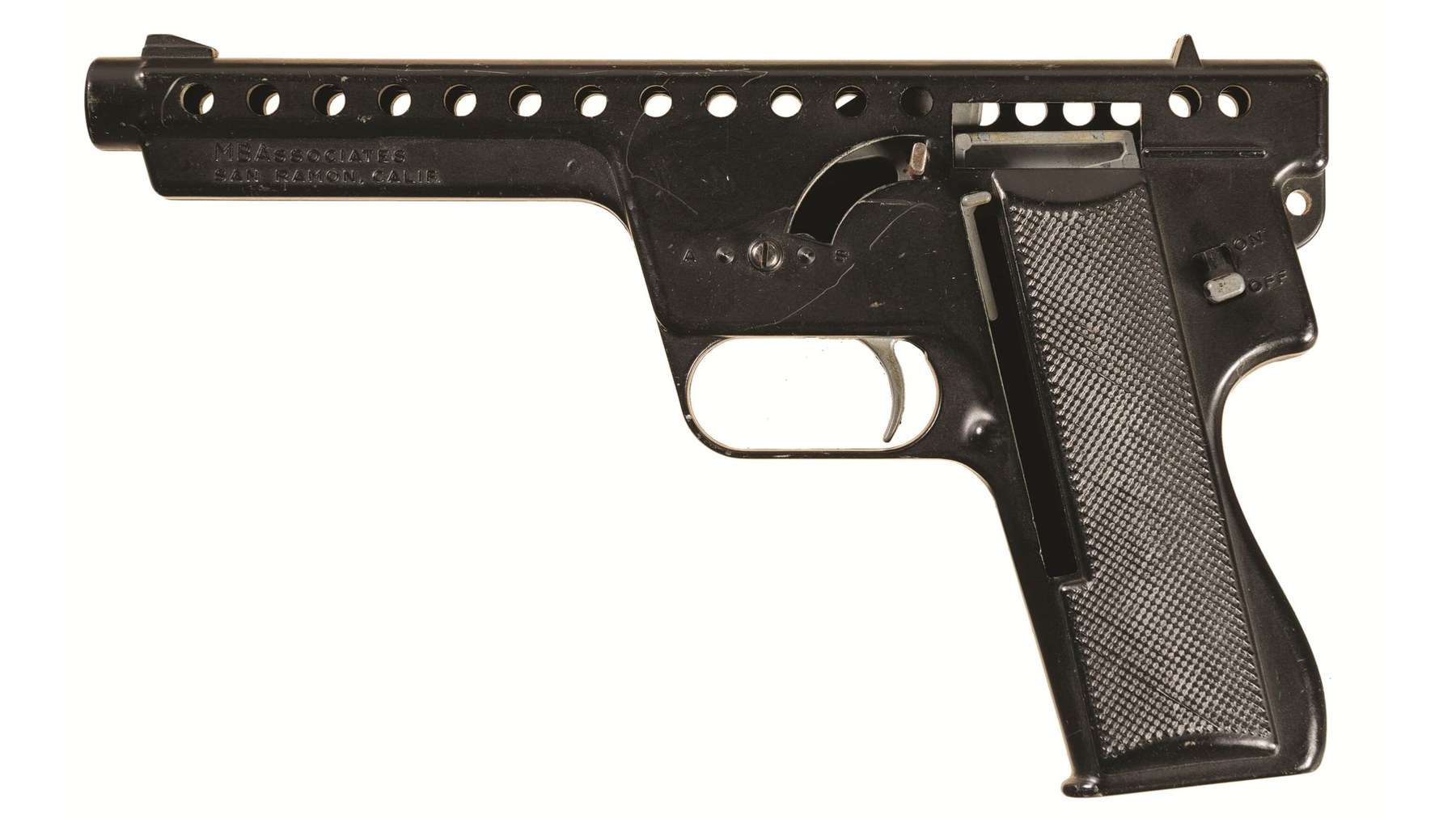
Rock Island described one Model 137 as “the model that was submitted for U.S. military trials for the Vietnam War”, and Carpenter’s census lists one gun as a “Vietnam test gun” and two marked “U.S. Experimental 1965”.42 ARPA’s report confirms that .49-calibre pistols were tested for its programme in 1963 (Volume 7).
5.7 Mark I (the “Model A”)
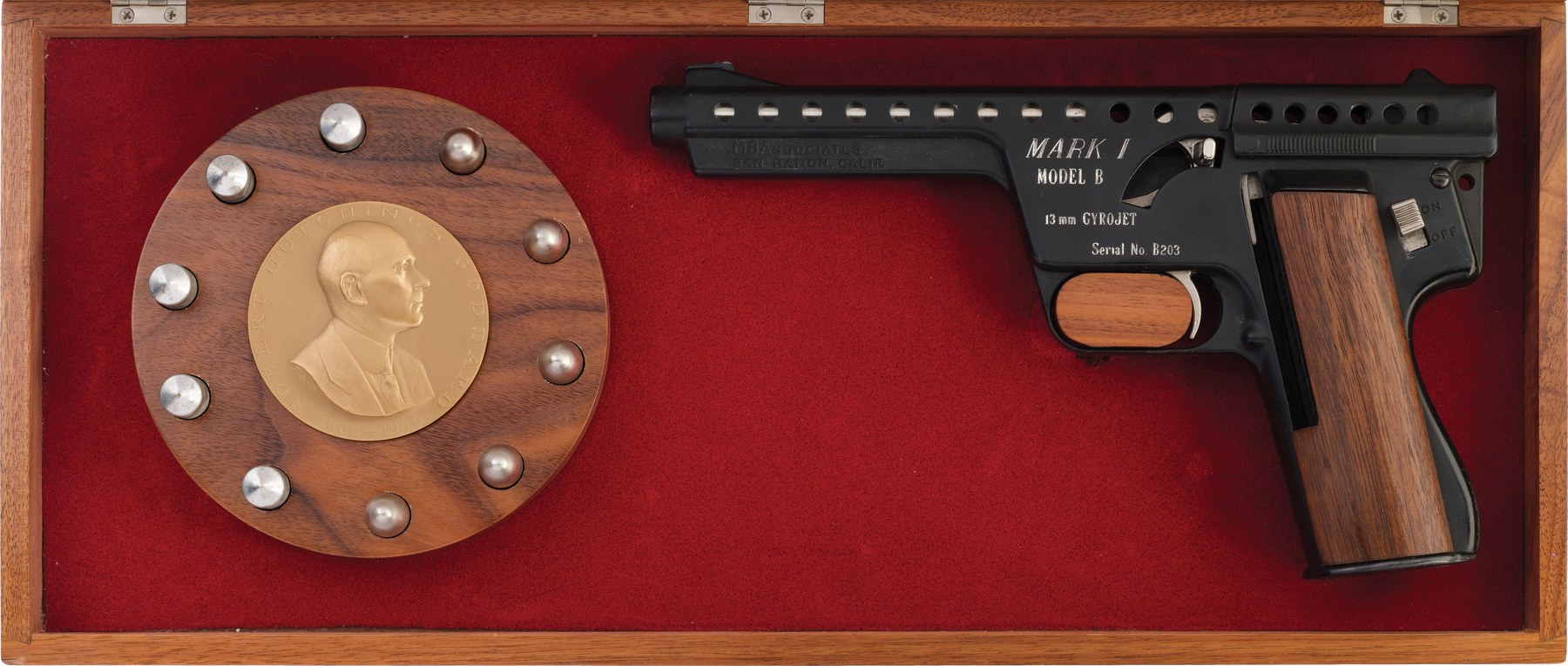
The first 13 mm pistols. Spangler dates them 1963–65 and gives about 100; Antaris says MBA announced plans to build “at least 1,000” numbered from A-001, that the first few were assembled from Model 137 parts in .49 calibre, and that “only 85 were actually assembled for presentation”. They were sold mostly in walnut presentation cases with the Goddard medallion; Antaris says the early cases held twenty dummy rounds and later ones ten. Spangler: “‘EXPERIMENTAL’ markings on the guns were also used to justify higher prices of approximately $250 to $300.”31
Identification:
- Right side: “PAT. APPLIED FOR” alone.
- Left side: “MARK I” engraved ahead of the hammer and “Serial No.” with an A prefix; some also “EXPERIMENTAL” above “MARK I”.
- Loading: a side gate — Rock Island: “a hinged loading gate on the left side to access the internal magazine, as opposed to the sliding cover seen on later models”.4
- Top: continuous; no latch at the rear right.
- Grips: separate panels, usually walnut.
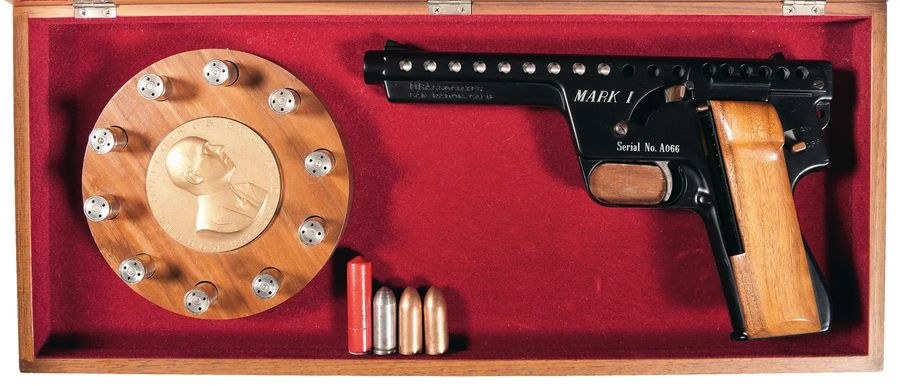
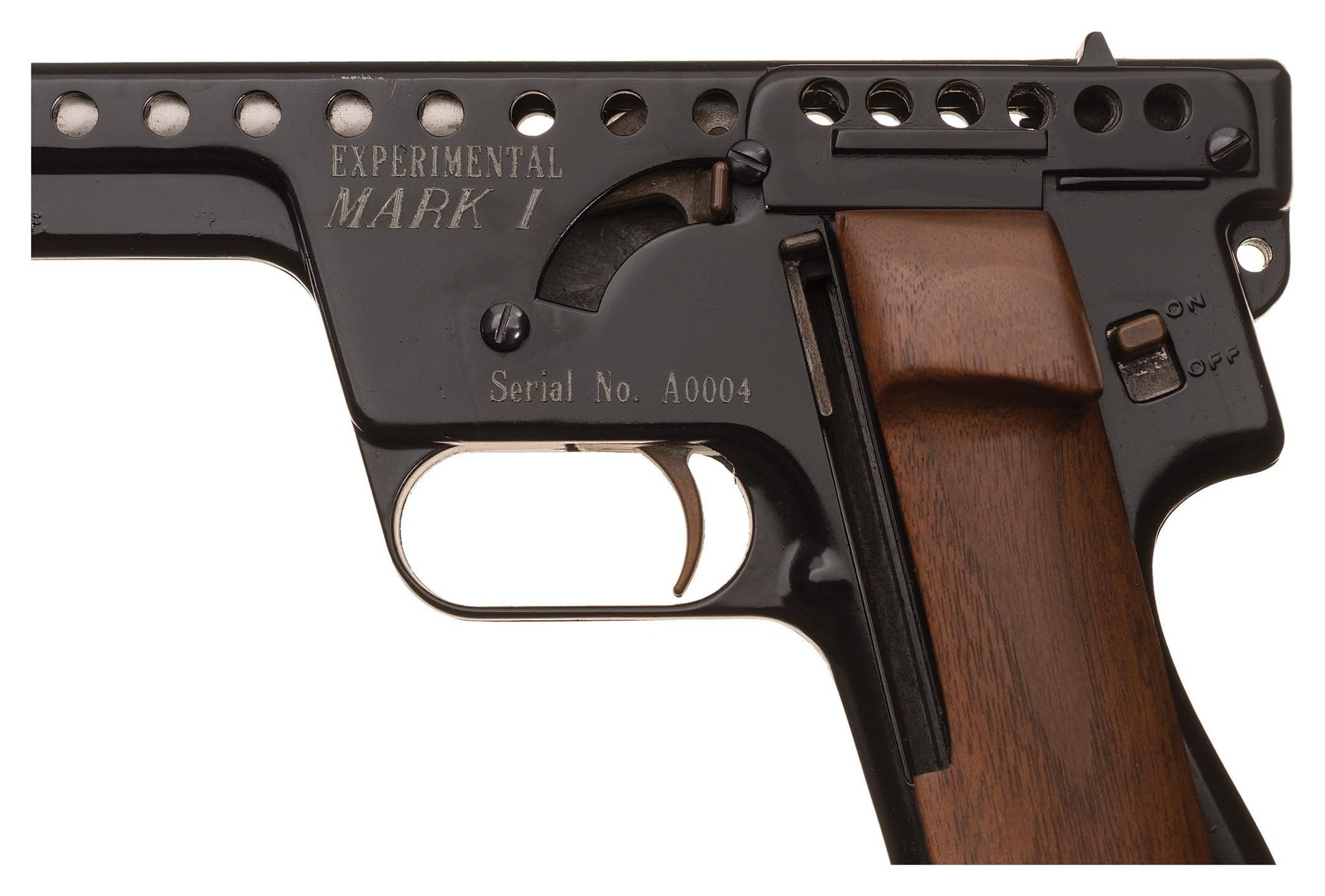
Carpenter’s census also lists a small group of Mark I prototypes with target walnut grips and, on one, a Williams adjustable rear sight “mounted in front of standard rear sight”. Carpenter’s book has a section on “13mm Mark I Model B Transition Pistols”, which were not seen; a gun that mixes Mark I and Model B features may be one of them.25
5.8 Mark I Model B
The production Gyrojet: the pistol of the Las Vegas show of September 1965, of the Bond film, and of most collections. Antaris says that “by June 27, 1966 the updated MARK I pistols were marked in a ‘B’ prefix serial range”, that “the swiveling cover was deleted” and that “in its stead was an interrupted slide. Once the pistol was put on safe and the manual latch disengaged, the rear section of the slide could be retracted for loading.”1 That is exactly the mechanism of US 3,412,641, filed the same day, 27 June 1966 (Volume 3).
Identification:
- Right side: “PATENT PENDING”; the slide latch at the rear.
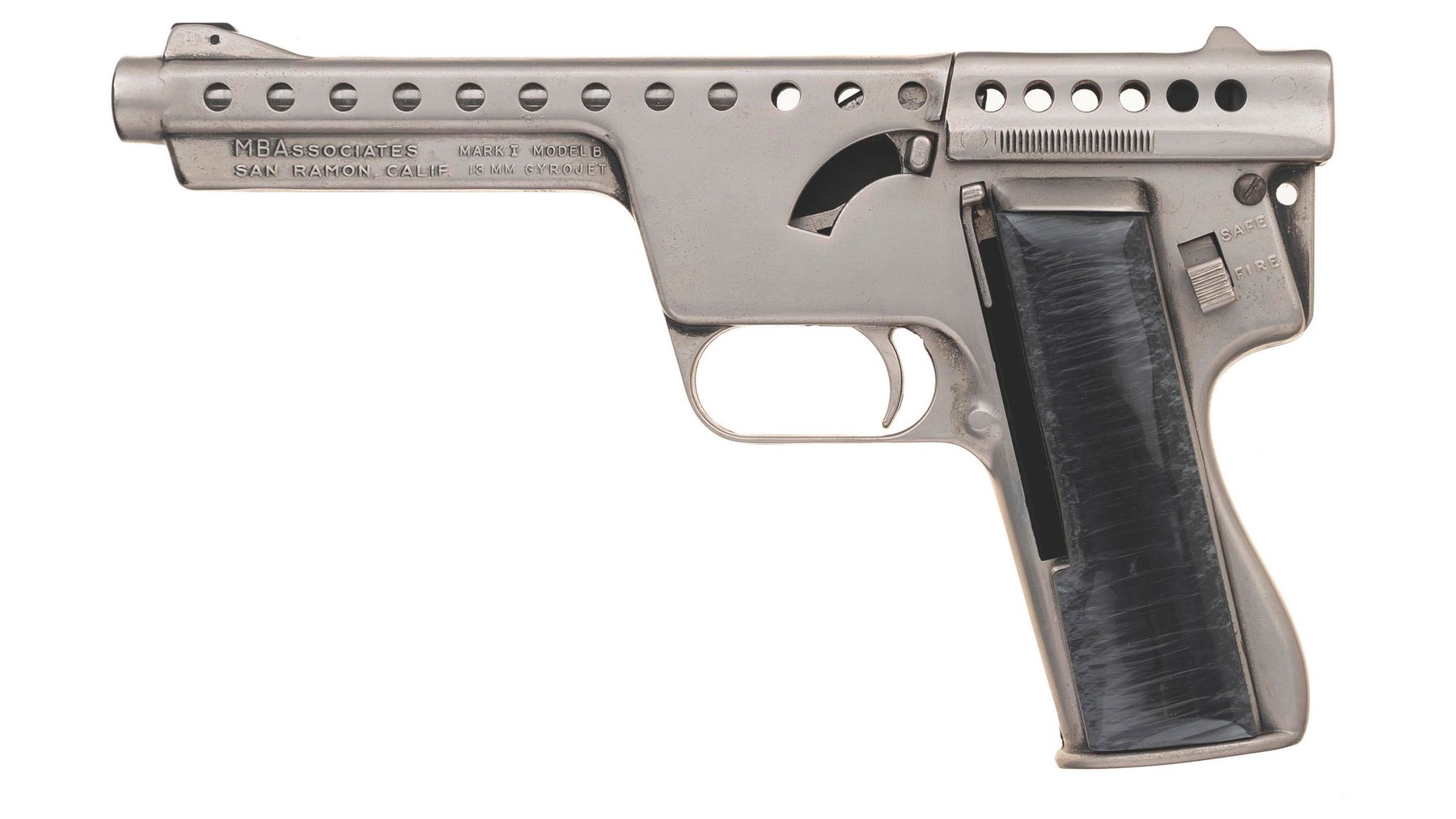
- Left side: either engraved MARK I / MODEL B / 13 mm GYROJET / Serial No. B…, or the same rolled on the lug with the serial beneath.
- Top: broken above the front of the grip where the rear slide begins; the slide has a ribbed grip area.
- Safety: “a safety lever on the left rear portion of the frame” (Rock Island).4
- Magazine: “internal single-stack box magazine with viewing slit in the left side of the grip” (Rock Island), with the follower tab in it.4
- Barrels: Rock Island records 5, 6½, 6¾, 8 and 8¼ in.4
5.9 Snub-Nose and Survival Pistols
Two short-barrelled Model B variants are documented in writing, but no licensed photograph of either was located, so they are drawn here from the descriptions and nothing else.
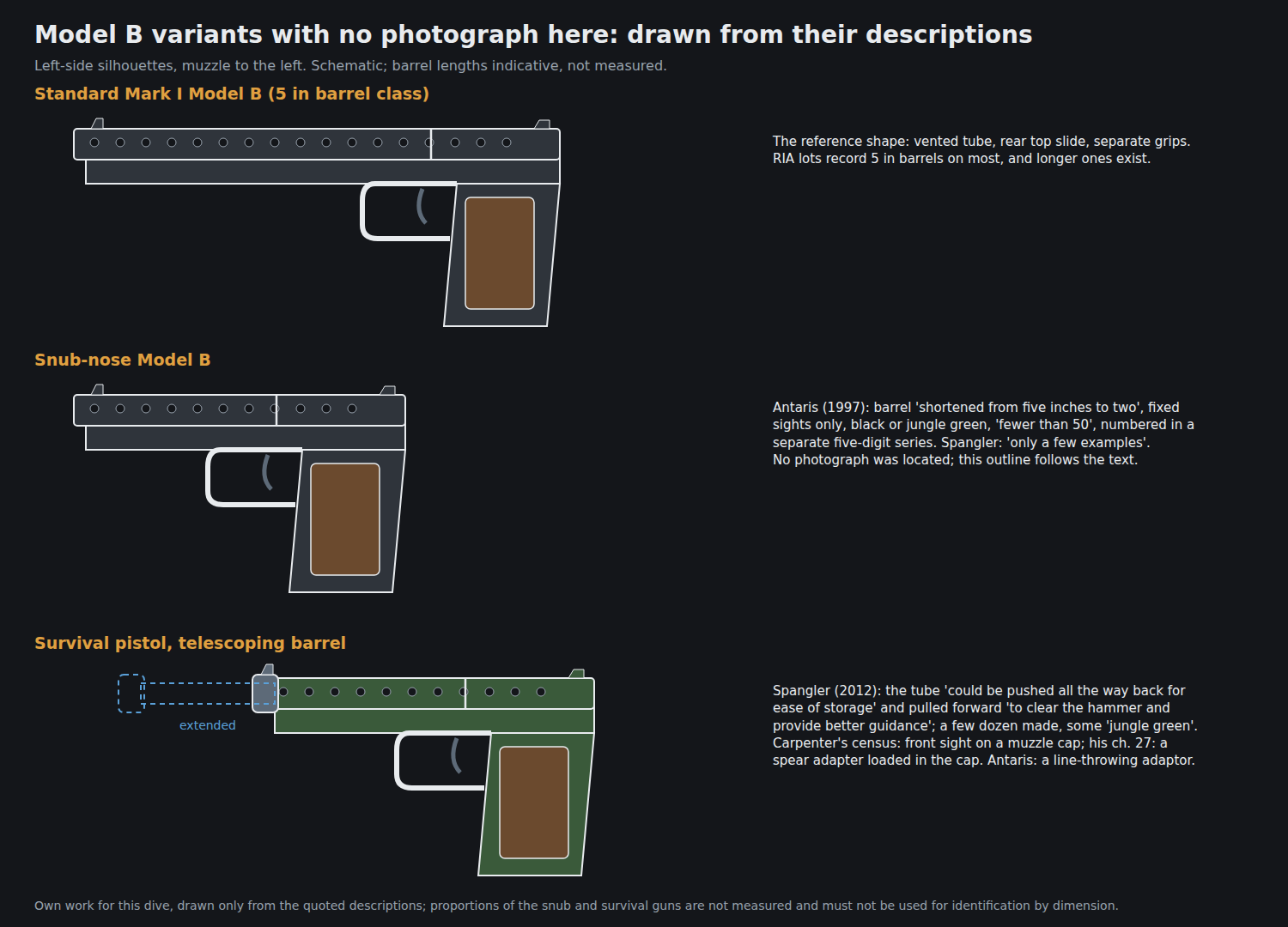
- Snub-nose. Spangler: “a ‘Snub Nose’ version with a very short barrel of which only a few examples were produced”. Antaris: barrel “shortened from five inches to two”, fixed sights only, “customarily offered in black or jungle green”, “fewer than 50”, numbered “with a separate five digit serial number”, all seen “in the B56,XXX range”.31 Carpenter’s census lists one snub-nose with a four-digit number and an S suffix, which does not fit Antaris’s statement.2
- Survival pistol. Spangler: “a ‘Survival’ pistol with a telescoping barrel … of which maybe a few dozen made. The barrel tube could be pushed all the way back for ease of storage, but for use, it could be pulled forward to clear the hammer and provide better guidance.” Carpenter’s census notes describe “standard survival layout with sliding barrel, front sight on cap”, finishes in jungle green, black and grey, and serials with an S suffix; one gun in the film Murderers’ Row was a grey survival pistol (Volume 7). Carpenter’s supplementary chapter describes a cased survival pistol with a spear adapter loaded through the muzzle cap. Antaris describes a “Gyrojet Rocket Gun Survival Kit” with an extendable-barrel pistol, standard and long rounds, flare rockets, a line-throwing adaptor and an underwater spear.3261
Both variants matter legally: the S-suffixed serials recorded by collectors do not appear in any of ATF’s printed 13 mm ranges (Volume 6).
5.10 Mark II Model C
The 12 mm pistol made after the Gun Control Act. Spangler: MBA “reduced the caliber to the earlier .49 caliber”, “the barrels were dutifully given very light rifling”, about 600 were made “circa 1969–1972”, and the price was cut to $99. Antaris: a new serial range beginning at 1, made “until 1972”, reaching “approximately 600 guns”. Carpenter’s census: MBA’s gun logs show a Mark II Model C numbered 606, “and the log shows several spoiled guns. An estimate that there were about 600 Mark II Model C pistols produced and released for sale is probably very accurate.”312
Identification:
- Right side: “U.S. PAT 3,412,641”.
- Left side: rolled “MARK II MODEL C / 12 MM GYROJET” beside the address.
- Serial: on the underside, a plain number, no letter prefix.
- Mechanism and outline: the Model B’s; top slide and latch.
- Barrels: Rock Island records 5, 5¼, 8 and 8½ in.4
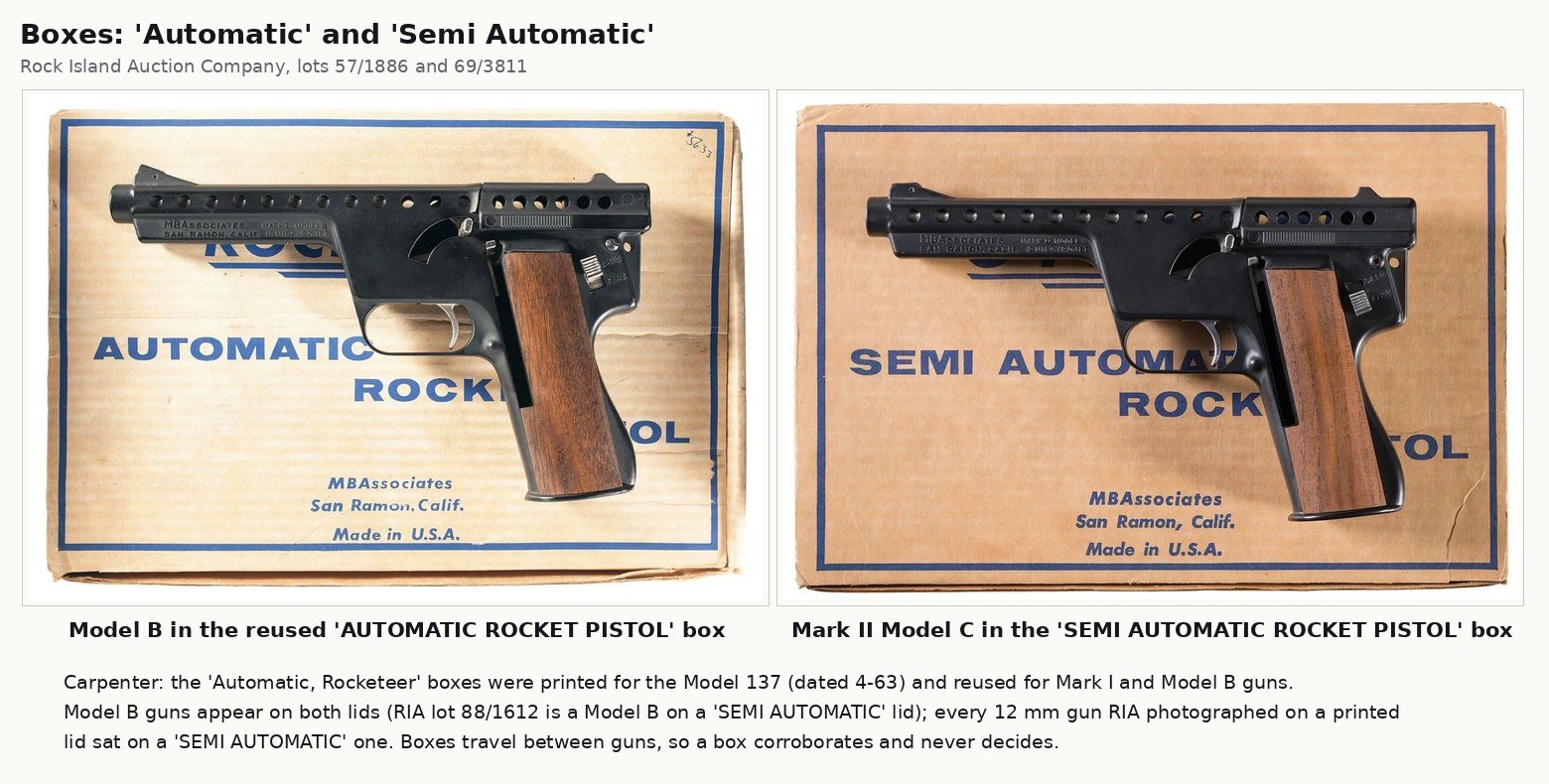
- Box: printed “SEMI AUTOMATIC ROCKET PISTOL”, often hand-numbered to the gun, with a shipping sleeve marked “Gyro-Jet / ROCKET GUN”, and a printed instruction sheet (Rock Island).4
Rock Island’s description of one of these guns gave its calibre as 13 mm while its own photograph showed “12 MM GYROJET” on the frame; a listing’s calibre field is not evidence, the frame is.4
5.11 The Carbines
Three carbine families, all built on pistol frames.
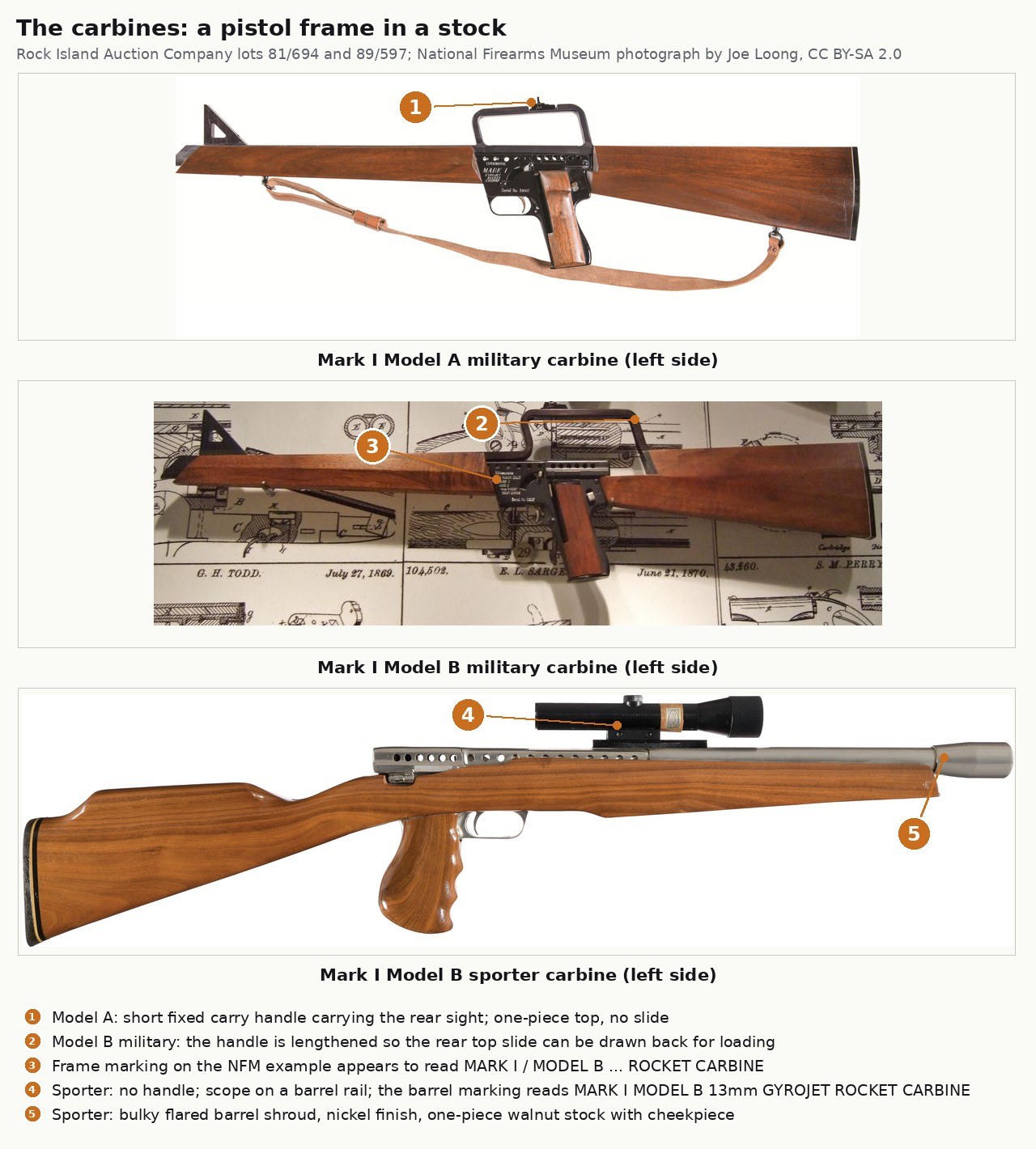
- Mark I Model A military carbine. Spangler: “imitating the appearance of the M16. Only a ‘small number’ of these were made circa 1963–1964.” Antaris: built on “standard pistol frames”, with an 18-inch barrel “largely shrouded by a forend”, a buttstock “attached to the pistol frame via a modified lanyard loop”, and “a carry handle, reminiscent of that used on the Colt AR-15, [which] served as a mounting for the rear sight”. Rock Island: “a high flat-top front sight, fixed carry handle with Williams adjustable rear notch sight, full aluminum construction, full length handguard, contoured pistol grip”, marked “EXPERIMENTAL/MARK I/GYROJET/ROCKET/CARBINE” over the serial; two sold in 2020 at hammer prices of $9,000 and $8,500 (Volume 7).314
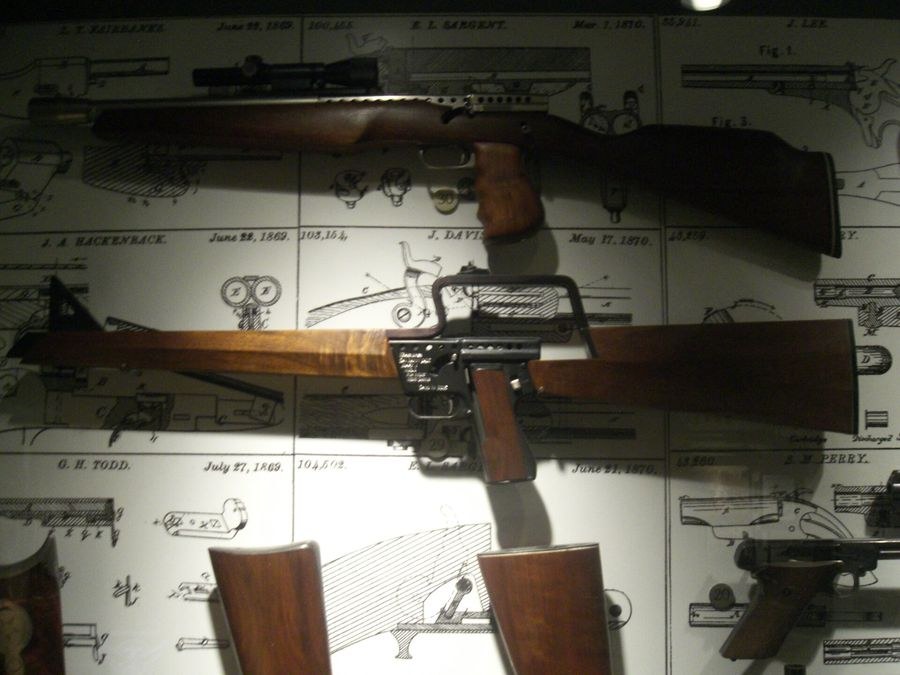
- Mark I Model B military carbine. Spangler: “similar to the earlier carbine except for the extended handle and cut out area to allow operation of the slide for loading. Less than 100 of these were made circa 1965–1968, and a few of those were sold with matching serial numbered pistols as matched sets”, of which he knew of four sets. Antaris: “a small number of very early ‘B’ carbines had the carry handle of the ‘A’ carbine elongated to allow function of the rearward sliding loading gate.”31
- Mark I Model B sporter carbine. Spangler: introduced at Las Vegas in September 1965, “a sporter style walnut stock with cheek rest, a Bushnell Phantom scope, and a bulky barrel shroud. The standard finish was a nickel plate. Approximately 300 of these were made … making these the most common of all Gyrojet carbines.” Rock Island: the top of the barrel marked “MBAssociates San Ramon, Calif.” with the serial over “MARK I MODEL B 13MM GYROJET ROCKET CARBINE”; one-piece walnut stock with a roll-over cheekpiece and a Pachmayr White Line recoil pad; Bushnell Phantom 1.3×. Barrel lengths in Rock Island’s records vary from 16½ to 20 in, which probably reflects measurement practice rather than models.34
Wikipedia and several secondary sources also mention a Gyrojet “rifle” or “assault rifle” firing 6 mm rockets from a detachable magazine in the grip, tested by the Army. No primary source for it was located, and Spangler’s and Antaris’s surveys do not describe one; it is not listed here as a production type.7
5.12 Presentation Guns and Finishes
The presentation sets — walnut case, red felt, brass plate, Goddard medallion, ten dummies, certificate — were made for both the Mark I and the Model B (Volume 4). Finishes included black, satin or “antique” nickel, bright nickel, gold, olive drab, jungle green and grey; grips walnut, black or white “pearlite”, imitation ivory, or cast-in checkering on the Model 137.312 Wikipedia’s figure of “approximately less than 150” gold-plated guns is unsourced there and is not repeated.7
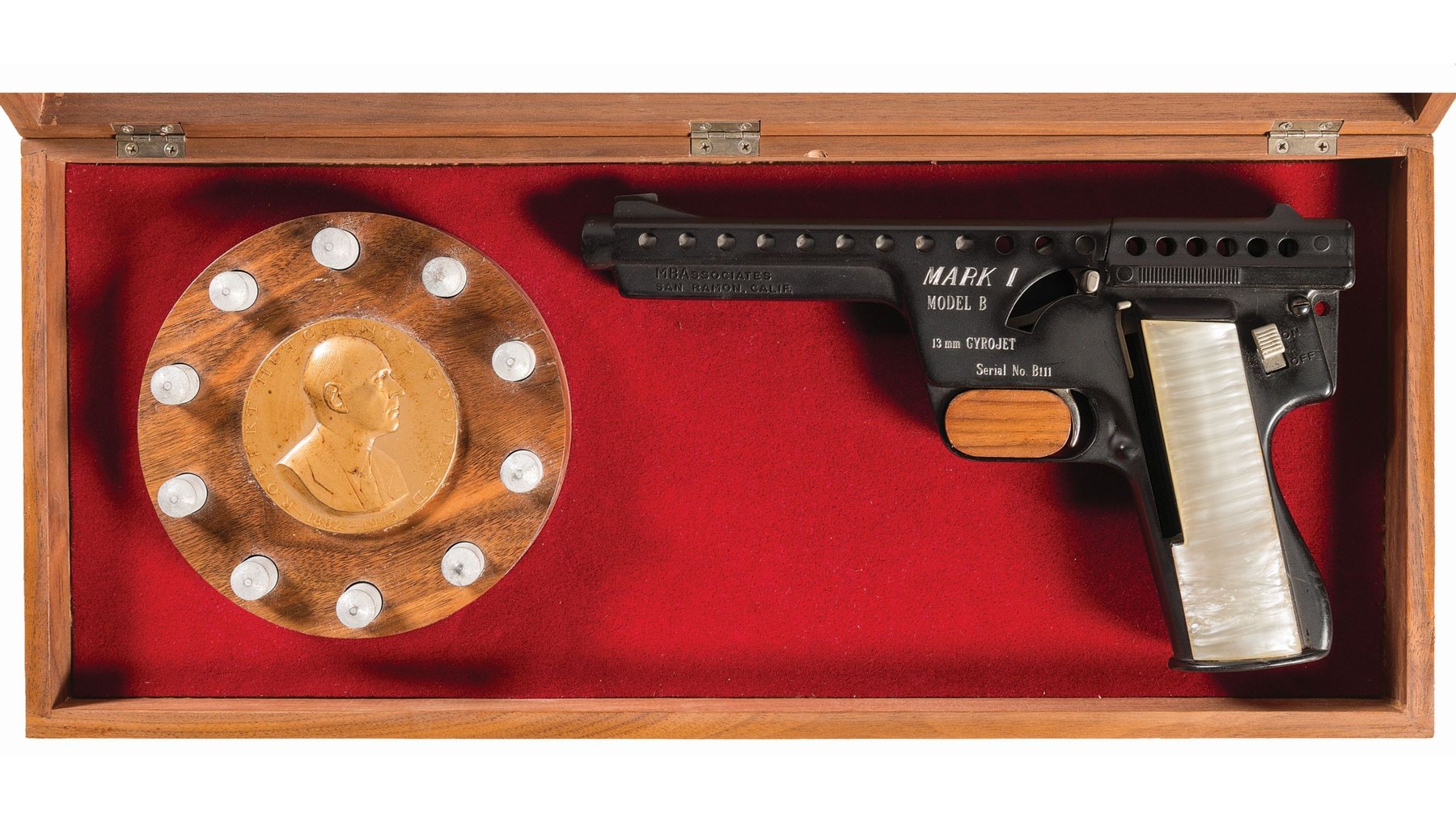
Polished and refinished guns occur. Rock Island described two Model B pistols as having been “polished bright” with traces of the original black in protected areas, and one early Mark I as “refinished blue”.4 A bright gun is not evidence of a factory nickel finish without the factory’s surface and the plating’s colour to support it.
5.13 Boxes, Papers and Serial Formats
Boxes corroborate; they do not decide. Carpenter explains that the “Automatic, Rocketeer” boxes were printed for the Model 137 — dated “4-63” on the back — and that because MBA “did not sell anywhere near enough Model 137s”, the leftover boxes were used for the Mark I, the transition guns and the Model B, which is why their cut-outs do not fit the later guns’ sights. The word “Automatic” referred, he says, to the full-automatic prototypes (Volume 3).8
Serial formats seen in the sources, which a reader can compare with a gun without anyone’s specific number being needed:
Table 3 — Serial formats seen in the sources, which a reader can compare with a gun without anyone's specific number being needed
| Format | Family |
|---|---|
| ”Butt number” stamped under the grip, or none | Model 137 |
| A + three digits, or A + four digits with a leading zero | Mark I pistols and Model A carbines |
| B + three digits | Model B pistols, early |
| B + four digits | Model B pistols and carbines (carbine numbers are often written with a leading zero) |
| B + digits + S | Survival and snub-nose pistols (Carpenter’s census) |
| Plain number, underside | Mark II Model C |
The four printed ranges on ATF’s list, and why they are not the same thing as this table, are in Volume 6.
5.14 Tell Them Apart
Table 4 — Tell Them Apart
| Feature | Model 137 | Mark I | Mark I Model B | Mark II Model C | Where to look |
|---|---|---|---|---|---|
| Right-side lug marking | PAT. APPLIED FOR / MODEL 137 CAL. 49 | PAT. APPLIED FOR | PATENT PENDING | U.S. PAT 3,412,641 | Right side, under the tube, ahead of the frame |
| Left-side model marking | none (address only) | MARK I, engraved | MARK I / MODEL B / 13 mm GYROJET, engraved or rolled | MARK II MODEL C / 12 MM GYROJET, rolled | Left side, ahead of the hammer or on the lug |
| Serial | butt number or none | A + digits, left | B + digits, left or underneath | plain number, underneath | Left side, under the frame, butt |
| Top line | continuous | continuous | broken by the rear slide | broken by the rear slide | Top, above the front of the grip |
| Slide latch, right rear | no | no | yes | yes | Right side, rear top |
| Loading | open port or gate | gate on the left | top slide | top slide | — |
| Grip | cast-in checkering | separate panels | separate panels | separate panels | — |
| Selector plug marked A / S | yes | no | no | no | Left side, below the hammer slot |
| Bore | .49 | 13 mm | 13 mm | 12 mm | Marking; bore over 0.5 in is 13 mm |
| Box lid | ”Automatic, Rocketeer" | "Automatic” (reused) | “Automatic” or “Semi Automatic" | "Semi Automatic” | Corroborative only |
For the carbines: a carry handle and no slide is a Model A; a lengthened handle over a top slide is a Model B military; no handle, a scope rail, a nickel shroud and a cheekpiece stock is the sporter.
5.15 Things That Do Not Identify a Model
- Barrel length. Model B and Model C pistols both occur with 5 in and 8 in barrels in Rock Island’s records.4
- Finish. Black, nickel and gold occur across families.
- The box. Boxes were reused and swapped (above).
- The listing’s calibre field. At least one Rock Island listing called a gun marked “12 MM GYROJET” a 13 mm (above).
- A dealer’s word “Mark I”. Several Rock Island titles call a Model B simply “Mark I”, which it is; it does not tell a Model B from a Mark I (A-series) gun.
5.16 Other MBA Guns a Collector May Meet
Carpenter’s census lists guns MBA owned or adapted that are not Gyrojets in the usual sense: conventional revolvers and a Colt AR-15 SP-1 used in the company’s work, Röhm and Western revolvers and derringers adapted to fire 12 mm or 13 mm rounds, a 13 mm speargun (the “Lancejet”), and a Ruger in 13 mm.2 Antaris shows a Röhm derringer conversion whose upper barrel fired a Gyrojet round and lower barrel a .38 Special, and the Lancejet speargun “shot a Gyrojet driven harpoon”.1 Carpenter’s book also has a section on “13mm ‘Indigenous’ Pistols”, which was not seen; the name suggests the cheap pistol ARPA wanted for indigenous forces (Volume 1).5 None of these is covered further here, and any of them would need the same legal care as a 13 mm Gyrojet.
References
Footnotes
-
Leonardo M. Antaris, “The Gyrojet Rocket Handguns: An Early Exploration Into The Future”, Gun Journal, January 1997, including its “Gyrojet Production” table; read from photographs with Rock Island Auction lot 57/1886, https://www.rockislandauction.com/detail/57/1886 , retrieved 2026-09-19. ↩ ↩2 ↩3 ↩4 ↩5 ↩6 ↩7 ↩8 ↩9 ↩10 ↩11
-
Mel Carpenter, “Gyrojet Census by Serial Number”, web page and PDF (c. 2013), gyrojet.net, https://web.archive.org/web/20180721025140/http://www.gyrojet.net/census.htm and https://web.archive.org/web/20130728124742/http://www.gyrojet.net/census.pdf , retrieved 2026-09-19. Individual serial numbers are not reproduced here. ↩ ↩2 ↩3 ↩4 ↩5 ↩6 ↩7 ↩8 ↩9 ↩10
-
John Spangler, “MBA Gyrojet Mark I Model B Pistols and Carbines: Rocket Science Meets Reality”, ASAC Bulletin 105 (2012), pp. 58–66, https://americansocietyofarmscollectors.org/wp-content/uploads/2022/04/2012-B105-MBA-Gyrojet-Mark-I-Model-B-Pistols-and-C.pdf , retrieved 2026-09-19. ↩ ↩2 ↩3 ↩4 ↩5 ↩6 ↩7 ↩8 ↩9 ↩10
-
Rock Island Auction Company lot descriptions and photographs, 84 Gyrojet lots from September 2009 to December 2025, located through the Internet Archive’s index of rockislandauction.com and read on the lot pages; lots cited include 50/2036, 52/680, 56/898, 57/1886, 58/284, 58/290, 59/915, 69/3807, 69/3811, 75/835, 78/1957, 79/1772, 80/588, 80/591, 81/694, 81/697, 87/642, 88/1612, 89/597, 89/598, 89/602, 1035/5087, 4095/564, 4095/566 and 4096/1599, https://www.rockislandauction.com/detail/ followed by auction and lot number, retrieved 2026-09-19. ↩ ↩2 ↩3 ↩4 ↩5 ↩6 ↩7 ↩8 ↩9 ↩10 ↩11 ↩12 ↩13 ↩14 ↩15 ↩16 ↩17
-
Mel Carpenter, An Introduction to MBA Gyrojets and Other MBA Ordnance (2010), contents page, gyrojet.net, Wayback capture of 21 July 2018, retrieved 2026-09-19. ↩ ↩2
-
Mel Carpenter, Chapter 27 (June 2011), gyrojet.net, retrieved 2026-09-19. ↩
-
Mel Carpenter, “Questions and Answers” (updated 2 November 2010), gyrojet.net, Wayback capture of 21 July 2018, retrieved 2026-09-19. ↩
Comments (0)