MBAssociates Gyrojet · Volume 6
The Law — Destructive Devices, the 1968 Redesign, and ATF's Serial Ranges
Why a 13 mm Gyrojet is a destructive device unless its serial number sits inside one of four ranges on ATF's Curios or Relics List, what the list actually prints in its April 2025 edition, why the 12 mm gun exists, and what a buyer in Michigan should check
6.1 Not Legal Advice
This volume is a map of the federal and Michigan provisions that touch a Gyrojet, built from the statutes and from ATF’s own published list. It is not legal advice. For any real purchase, the authority is ATF — in writing — and a lawyer who practises firearms law. The hub’s general treatment of the National Firearms Act is in the MP 40 dive, Volume 6, and the Suppressor Law dive explains the 2025 tax change; neither is restated here.
6.2 The Short Version
- A 13 mm Gyrojet pistol or carbine has a bore of more than half an inch and fires a projectile propelled by a propellant. On the face of the statute it is a destructive device under the National Firearms Act.
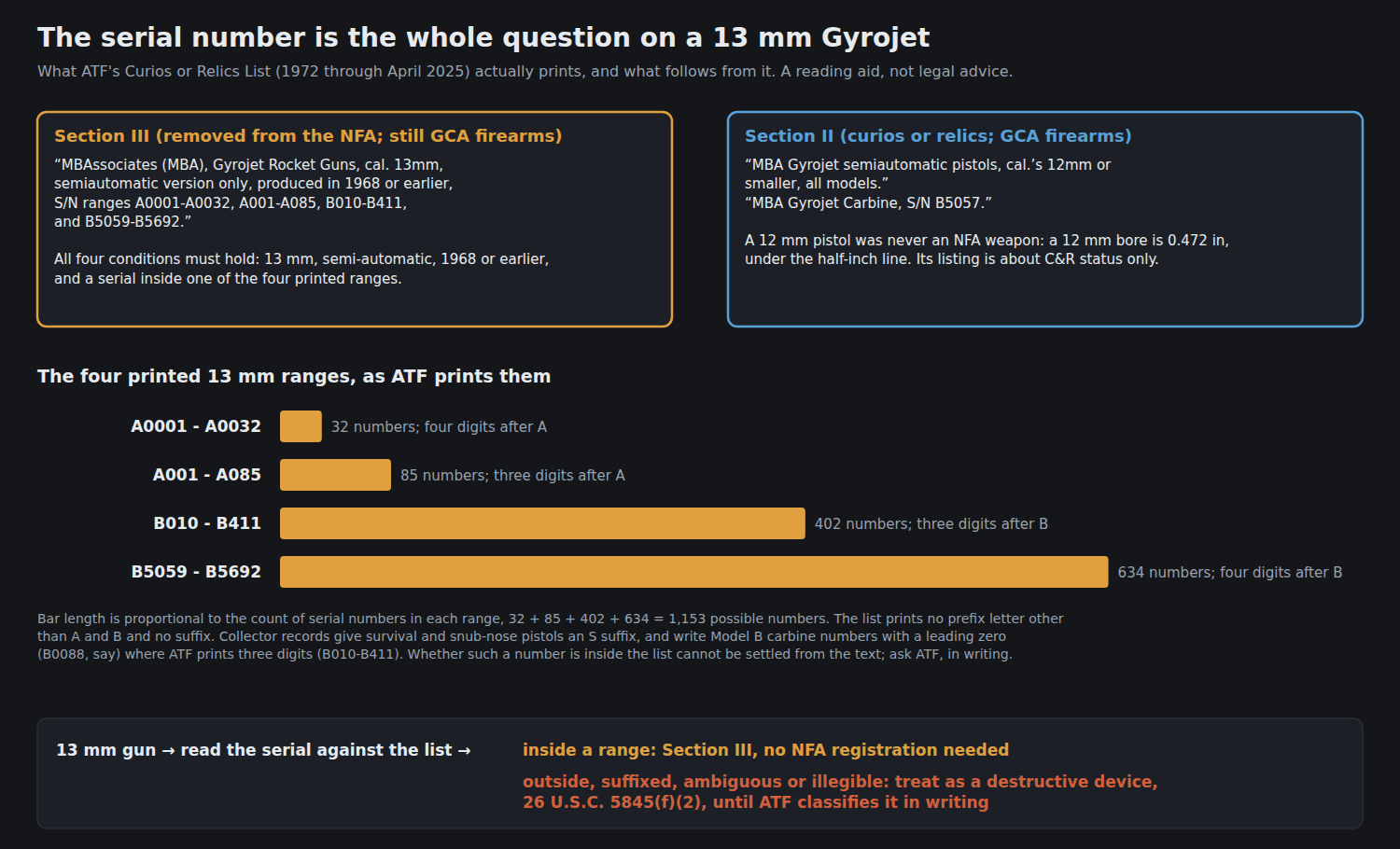
- ATF has removed some of them from the Act as collector’s items. Its Curios or Relics List, in the edition current through April 2025, lists “MBAssociates (MBA), Gyrojet Rocket Guns, cal. 13mm, semiautomatic version only, produced in 1968 or earlier, S/N ranges A0001-A0032, A001-A085, B010-B411, and B5059-B5692.”
- A 13 mm gun inside a printed range is outside the NFA and is an ordinary Title I firearm and a curio or relic. A 13 mm gun outside them — or whose number is ambiguous or illegible — should be treated as a destructive device until ATF classifies it in writing.
- A 12 mm Mark II Model C is not a destructive device: its bore is under half an inch. ATF lists all 12 mm and smaller Gyrojet pistols as curios or relics.
- The serial number is the whole question on any 13 mm purchase, and those four ranges are ATF’s published ranges, not the numbers of any particular gun.
6.3 Why a 13 mm Gyrojet Is a Destructive Device
The National Firearms Act defines “destructive device” in 26 U.S.C. § 5845(f). The part that catches the Gyrojet is (f)(2):
“(2) any type of weapon by whatever name known which will, or which may be readily converted to, expel a projectile by the action of an explosive or other propellant, the barrel or barrels of which have a bore of more than one-half inch in diameter, except a shotgun or shotgun shell which the Secretary finds is generally recognized as particularly suitable for sporting purposes”.1
Three conditions, and a 13 mm Gyrojet meets all three. It is a weapon. It expels a projectile “by the action of an explosive or other propellant” — the Gyrojet’s propellant is inside the projectile, but the statute does not ask where the propellant burns. And 13 mm is 0.512 in; MBA’s own “13 mm” rounds measure about 0.509 in (Volume 2), so the bore that passes them is over the half-inch line. It is not a shotgun. The hub’s Hand Mortars dive, Volume 15 walks through the same clause for a much larger bore.
The destructive-device category was added to the NFA by Title II of the Gun Control Act of 1968. Before 1968, a large-bore gun of this kind was not an NFA weapon at all, which is why MBA could sell 13 mm pistols over the counter in 1965.
6.4 Why the Round Itself Is Not
Section 5845(f)(1) separately makes certain projectiles destructive devices, including an explosive or incendiary “rocket having a propellent charge of more than four ounces”.1 A Gyrojet round is a rocket, but the whole round of about 185 grains weighs about 0.42 ounce, and its propellant is only part of that. It is nowhere near the four-ounce line, and it carries no explosive or incendiary warhead. The Gyrojet’s problem under the NFA is its gun’s bore, not its ammunition.
6.5 1968: What Happened to MBA
The sources describe the reaction to the new law from MBA’s side, and they do not agree in detail.
- Spangler (2012): after the Act, the Bureau “was confused by the .51 caliber and smoothbore barrels of the Gyrojets, and their unconventional ammunition. After initially deciding that they were newly prohibited ‘destructive devices,’ the BATF later decided that they were not, and attempts to register them as such were returned stamped ‘Registration not required.’ Subsequently they were reclassified as Curios and Relics. However, at the time, MBA was told to stop making the 13-mm Mark 1 Model B pistols and carbines because they would be considered to be destructive devices.”2
- Carpenter (2010): the Act “had placed the entire Gyrojet line in jeopardy by classifying 13mm Gyrojet guns (but not flare launchers) as destructive devices”, and 13 mm pistol and carbine production ended.3
- Antaris (1997): the 13 mm rocket’s “.51 inches in diameter … alone categorized the rocket as a destructive device, relegating production of the Gyrojets to fall under the National Firearms Act, a category that would require owner’s registration and commercially prohibitive licensing fees. To comply with the new regulation, MBAssociates offered to convert all previous guns from 13mm (.51 caliber) to 12mm (.49 caliber).”4
What all three agree on is the result: MBA stopped making 13 mm guns and made a 12 mm pistol instead, marked “MARK II MODEL C” (Volume 5). The conversion offer in Antaris’s account could not be confirmed from any other source; no converted gun is described anywhere located. Spangler’s “Registration not required” stamps are his account and could not be checked.
Carpenter’s parenthesis — “but not flare launchers” — matches the statute. Section 5845(f) excludes “any device, although originally designed for use as a weapon, which is redesigned for use as a signaling, pyrotechnic, line throwing, safety, or similar device”.1 MBA’s 13 mm flare launchers, which became its one profitable Gyrojet product (Volume 7), fall on the signalling side of that line.
6.6 The Way Out: Collector’s Items
There are two exits in the statute, and only one of them fits. Section 5845(a) excludes from the definition of “firearm” any device that the Secretary “finds by reason of the date of its manufacture, value, design, and other characteristics is primarily a collector’s item and is not likely to be used as a weapon” — but that sentence expressly does not apply to “a machinegun or destructive device”. For destructive devices the exit is the last sentence of § 5845(f): the term “shall not include … any other device which the Secretary finds is not likely to be used as a weapon, or is an antique”.1 ATF’s collector’s-item procedure is in 27 C.F.R. § 479.25, which refers to § 5845(a) and to the destructive-device determination procedure of § 479.24:
“The Director shall determine in accordance with 26 U.S.C. 5845(a), whether a firearm or device, which although originally designed as a weapon, is by reason of the date of its manufacture, value, design, and other characteristics primarily a collector’s item and is not likely to be used as a weapon.”5
ATF publishes the weapons it has removed from the Act in Section III of its Curios or Relics List, headed in the 1998 edition “Weapons removed from the NFA as collector’s items”; which statutory sentence it relied on for the Gyrojet is not stated in the list. The 1998 edition’s introduction explains what that section means: “Weapons in this section are excluded entirely from the provisions of the National Firearms Act (NFA) … Thus, approval from ATF to transfer these weapons is not required. They need not be registered in the National Firearms Registration and Transfer Record and there is no transfer tax liability. However, these weapons are still ‘firearms’ under Chapter 44, and remain subject to regulation”.6
6.7 What ATF’s List Prints
ATF publishes the list as ATF P 5300.11. The current edition located is the electronic Curios or Relics List — January 1972 through April 2025, issued by ATF’s Firearms and Ammunition Technology Division, which says that ATF “is no longer publishing a hard copy of the C&R List”. ATF’s own download address refused this dive’s requests, and the text below was read from the Internet Archive’s capture of that file taken in April 2026.7
Section III — “Firearms removed from the provisions of the National Firearms Act and classified as curios or relics, still subject to the provisions of 18 U.S.C. Chapter 44, the Gun Control Act of 1968” — page 43:
“MBAssociates (MBA), Gyrojet Rocket Guns, cal. 13mm, semiautomatic version only, produced in 1968 or earlier, S/N ranges A0001-A0032, A001-A085, B010-B411, and B5059-B5692.”
Section II — “Firearms classified as curios or relics, still subject to the provisions of 18 U.S.C. Chapter 44, the Gun Control Act of 1968” — page 12:
“MBA Gyrojet Carbine, S/N B5057.”
“MBA Gyrojet semiautomatic pistols, cal.’s 12mm or smaller, all models.”
The same entries appear, word for word apart from the maker’s name (“MBA, Gyrojet Rocket Guns” in the older editions), in the list cumulative to 20 May 1998 and in ATF P 5300.11 revised December 2007, which ATF was still serving from its website in 2020. The supplementary updates for 2008–2014 located contain no Gyrojet entry.68
The ranges are quoted exactly as ATF prints them. They are ATF’s published ranges, not the serial number of any particular gun.
6.8 Reading the Ranges
Four conditions must all hold for a 13 mm gun to be inside Section III: it is 13 mm; it is the “semiautomatic version” (the full-automatic prototypes described in Volume 3 are excluded, and would in any case be machine guns); it was “produced in 1968 or earlier”; and its serial number falls inside one of the four printed ranges.
The ranges hold 32 + 85 + 402 + 634 = 1,153 possible numbers, of the right order for the production totals in Volume 1. Three observations help in reading them, and they are this dive’s analysis, not ATF’s:
- The digit count is part of the range. “A0001-A0032” has four digits after the A and “A001-A085” three. As written they are different ranges covering some of the same numeric values. Carpenter’s census records Model A carbines with four-digit A numbers and Mark I pistols with three-digit ones, which suggests the first range was meant for carbines and the second for pistols; that is an inference from the pattern, not something ATF says.9
- The Model B ranges match a 1997 collector’s table exactly. Antaris’s “Gyrojet Production” table gives the Mark I Model B serial ranges as “B010 - B411” and “B5059 - B5692”, with the note “Serial range includes carbines”, and his text says a large block was skipped between them.4 Whether ATF took its ranges from MBA’s records, from a collector, or from the same source Antaris used is not known.
- The Section II carbine sits two numbers below a range. ATF’s single Section II carbine, B5057, is just below the start of the B5059–B5692 range. Why that one carbine was classified separately is not explained in the list.
6.9 Guns the Ranges Do Not Obviously Cover
Comparing the printed ranges with the serial formats collectors record (Volume 5) shows where a buyer must be most careful. Carpenter’s census, which he says represents about a quarter of production, was read for this comparison; no individual number is reproduced here.
Table 1 — Guns the Ranges Do Not Obviously Cover
| Group in the census | Recorded format | Inside a printed range as written? |
|---|---|---|
| Mark I pistols | A + three digits (and a few four) | All recorded entries, yes |
| Model A carbines | A + four digits | Most; a few numbers are above A0032 |
| Model B pistols, three-digit | B + three digits | Most; a few fall below B010 or above B411 |
| Model B pistols, four-digit | B + four digits | Most; some fall outside B5059–B5692 |
| Survival and snub-nose pistols | B + digits + S | No printed range carries a suffix |
| Model B carbines (military and sporter) | B + four digits with a leading zero, e.g. “B0088” | Not as written: ATF prints B010–B411 with three digits |
The last two rows are the important ones. A survival pistol numbered with an S suffix, or a sporter carbine whose number is recorded as B0-something, may or may not be what ATF meant; the list’s text cannot settle it, and Antaris’s statement that the B ranges “include carbines” is not ATF’s. A 13 mm carbine sold at auction is not proof that it is inside the list: an auction house’s listing is not a classification. One Rock Island description of 2025 did the correct thing and cited the list page for the pistol it was selling; a buyer should expect that for every 13 mm gun.10
6.10 The 12 mm Gun
The Mark II Model C exists because of § 5845(f)(2). MBA’s 12 mm rounds measure about 12.54 mm, or 0.494 in (Volume 2), so the bore that passes them is just under half an inch, and the gun is not a destructive device on the face of the statute. ATF’s Section II entry — “MBA Gyrojet semiautomatic pistols, cal.’s 12mm or smaller, all models” — classifies them as curios or relics, which affects how a licensed collector may acquire them, not what they are: a 12 mm Gyrojet is an ordinary handgun under federal law.7
The same entry covers the .49-calibre Model 137, marked “CAL. 49” (Volume 5), which is the same bore under its older name. Any 12 mm or Model 137 gun was made before the early 1970s and is now more than fifty years old in any case (see below).
6.11 Outside the Ranges
A 13 mm Gyrojet that is not inside a Section III range is, on the statute, a destructive device. The practical consequences follow from the NFA generally, which the MP 40 dive, Volume 6 sets out:
- It may be lawfully possessed only if it is registered in the National Firearms Registration and Transfer Record, and transferred only on an approved ATF form.
- An unregistered destructive device cannot now be registered by its possessor; possessing one is a federal felony.
- The making and transfer tax on destructive devices is still $200. Public Law 119-21 reduced the tax to $0 for suppressors and short-barrelled rifles and shotguns from 2026, but not for machine guns or destructive devices; the Suppressor Law dive, Volume 3 quotes the change.
The route for a gun whose status is genuinely in doubt is a classification request to ATF’s Firearms and Ammunition Technology Division, which § 479.25 anticipates. Nothing in this dive substitutes for that letter.
6.12 Curio or Relic Status and the Collector’s Licence
A curio or relic is a firearm of special interest to collectors, and one of the defining tests is age: firearms “manufactured at least 50 years prior to the current date” qualify without being listed. A 2009–10 ATF update states the practical rule: “Firearms automatically attain curio or relic (C&R) status when they are 50 years old … It is not necessary for such firearms to be listed in ATF’s C&R list. However, if your C&R item is regulated under the National Firearms Act (NFA) and you desire removal from the provisions of the NFA, you must submit the firearm … for evaluation and a formal classification.”11
That last sentence is the Gyrojet’s situation exactly. Every Gyrojet is now more than fifty years old and a curio or relic by age, but age does nothing to a 13 mm gun’s NFA status; only a Section III listing or an individual classification does. A curio-or-relic collector’s licence (the “03” FFL) lets a collector acquire curios and relics across state lines; the hub’s M1 Garand dive, Volume 17 covers the licence. Carpenter recommends one for Gyrojet collectors, noting that “almost all Gyrojet firearms have been designated as Curios and Relics by ATF” — “almost” being the word that matters.3
6.13 Michigan
A Gyrojet pistol is a pistol under Michigan law, and buying or transferring one follows Michigan’s pistol-licensing and sales-record statutes, MCL 28.422 and 28.422a, which the hub’s Remington XP-100 dive, Volume 5 quotes and explains. The carbines are long guns.
Michigan’s own list of prohibited weapons, MCL 750.224(1), covers “a machine gun or firearm that shoots or is designed to shoot automatically more than 1 shot without manual reloading, by a single function of the trigger”, “a muffler or silencer”, “a bomb or bombshell”, striking weapons, and gas-emitting devices. It has no category for large-bore guns and no counterpart to the federal destructive-device definition, and a Gyrojet pistol is none of the things it lists.12 Subsection (3)(c) exempts “a person licensed by the secretary of the treasury of the United States or the secretary’s delegate to manufacture, sell, or possess” the listed items. How Michigan law treats a federally registered 13 mm destructive device in private hands was not found stated in any Michigan source located; a Michigan buyer of a 13 mm gun outside the Section III ranges needs a Michigan lawyer’s answer, not an inference.
6.14 Ammunition and Flares
A Gyrojet round contains a primer and propellant designed for use in a firearm, and it appears to fall within the federal definition of ammunition in 18 U.S.C. § 921(a)(17)(A). As set out above, it is not a destructive-device rocket. Whether its rocket-motor character brings shipping or storage rules for explosives or hazardous materials into play was not researched for this dive, and a seller or buyer shipping live rounds should ask the carrier and check the rules current at the time. Live rounds are sold regularly at auction (Volume 7).
MBA’s signal flares and their launchers fall under the signalling exclusion in § 5845(f) described above. Modern “gyrojet” pen-flare launchers, like the one shown in service in Volume 7, are signalling devices.
6.15 A Buyer’s Checklist
- Which bore? Read the left-side marking: “13 mm GYROJET” or “12 MM GYROJET” (Volume 5). A “MARK II MODEL C” is 12 mm.
- If 12 mm: an ordinary handgun and a curio or relic; Michigan pistol rules apply.
- If 13 mm, read the serial yourself, from a clear photograph, not from a listing’s text. Compare it, letter, digits and any suffix, with the four printed ranges: A0001–A0032, A001–A085, B010–B411, B5059–B5692.
- Inside a range, and the gun is semi-automatic and made in 1968 or earlier: Section III, outside the NFA.
- Outside, suffixed, ambiguous (a leading zero, for instance) or illegible: treat it as a destructive device. Do not take possession unless it is registered and transferred on an approved form, or ATF has classified it in writing as outside the NFA.
- A carbine: apply step 3 with particular care; collector records write many carbine numbers in a format the list does not print.
- Keep the paperwork — the listing, the photographs of the serial, and a printout of ATF’s list page — with the gun.
6.16 What Could Not Be Verified
- Spangler’s account that registrations were returned “Registration not required”, and the date of ATF’s collector’s-item determination.
- Antaris’s statement that MBA offered to convert 13 mm guns to 12 mm.
- The basis of ATF’s four ranges, and whether “B010–B411” is meant to include numbers recorded as “B0xxx”.
- Why carbine B5057 is in Section II rather than Section III.
- Michigan’s treatment of a federally registered destructive device held by a private owner.
- Transport and storage rules for live rounds as rocket motors.
References
Footnotes
-
26 U.S.C. § 5845(a) and (f), Legal Information Institute, https://www.law.cornell.edu/uscode/text/26/5845 , retrieved 2026-09-19. ↩ ↩2 ↩3 ↩4
-
John Spangler, “MBA Gyrojet Mark I Model B Pistols and Carbines: Rocket Science Meets Reality”, ASAC Bulletin 105 (2012), p. 65, retrieved 2026-09-19. ↩
-
Mel Carpenter, “Questions and Answers” (updated 2 November 2010), gyrojet.net, Wayback capture of 21 July 2018, retrieved 2026-09-19. ↩ ↩2
-
Leonardo M. Antaris, “The Gyrojet Rocket Handguns: An Early Exploration Into The Future”, Gun Journal, January 1997, including the “Gyrojet Production” table; read from photographs with Rock Island Auction lot 57/1886, retrieved 2026-09-19. ↩ ↩2
-
27 C.F.R. § 479.25, “Collector’s items”, eCFR (current), https://www.ecfr.gov/current/title-27/section-479.25 , retrieved 2026-09-19. ↩
-
ATF, Firearms Curios or Relics List (1972–1998), “Entries Are Cumulative and Current Through May 20, 1998”, Sections II and III and introduction, mirror at https://www.makarov.com/pdf/curio.pdf , retrieved 2026-09-19. ↩ ↩2
-
ATF, Firearms and Ammunition Technology Division, Curios or Relics List — January 1972 through April 2025 (electronic edition of ATF P 5300.11; PDF created July 2025), Section II p. 12 and Section III p. 43, https://www.atf.gov/media/19856/download (refused by the fetcher; read from the Internet Archive capture of 26 April 2026, https://web.archive.org/web/20260426201401/https://www.atf.gov/media/19856/download ), retrieved 2026-09-19. ↩ ↩2
-
ATF, Firearms Curios or Relics List, ATF Publication 5300.11, revised December 2007 (cumulative through 31 December 2007), Internet Archive capture of 12 November 2020 of https://www.atf.gov/resource-center/docs/p-5300-11-firearms-curios-or-relics-listpdf/download ; updates “January 2008 through June 2014” and “January 2009 through June 2010” (atf.gov/file/102976 and /84376), Internet Archive captures, retrieved 2026-09-19. ↩
-
Mel Carpenter, “Gyrojet Census by Serial Number” (PDF, c. 2013), https://web.archive.org/web/20130728124742/http://www.gyrojet.net/census.pdf , retrieved 2026-09-19; analysed for format only, no serial reproduced. ↩
-
Rock Island Auction Company, auction 4096, lot 1599, 6 December 2025, https://www.rockislandauction.com/detail/4096/1599 , retrieved 2026-09-19. ↩
-
ATF, “Curios or Relics List — Update January 2009 through June 2010”, https://www.atf.gov/file/84376/download , Internet Archive capture of 2 March 2021, retrieved 2026-09-19. ↩
-
MCL 750.224, Michigan Penal Code (Act 328 of 1931), Michigan Legislature, https://www.legislature.mi.gov/Laws/MCL?objectName=mcl-750-224 , retrieved 2026-09-19. ↩
Comments (0)