MBAssociates Gyrojet · Volume 3
How It Works — A Hammer in Front of the Round
The Gyrojet pistol's cycle part by part from MBA's two patents: a forward hammer that drives the round back onto a fixed pin, holds it while the motor lights, and is cocked again by the departing rocket; plus the safety, the magazine, the top slide, and where production guns differ from the drawings
3.1 The Correction This Volume Rests On
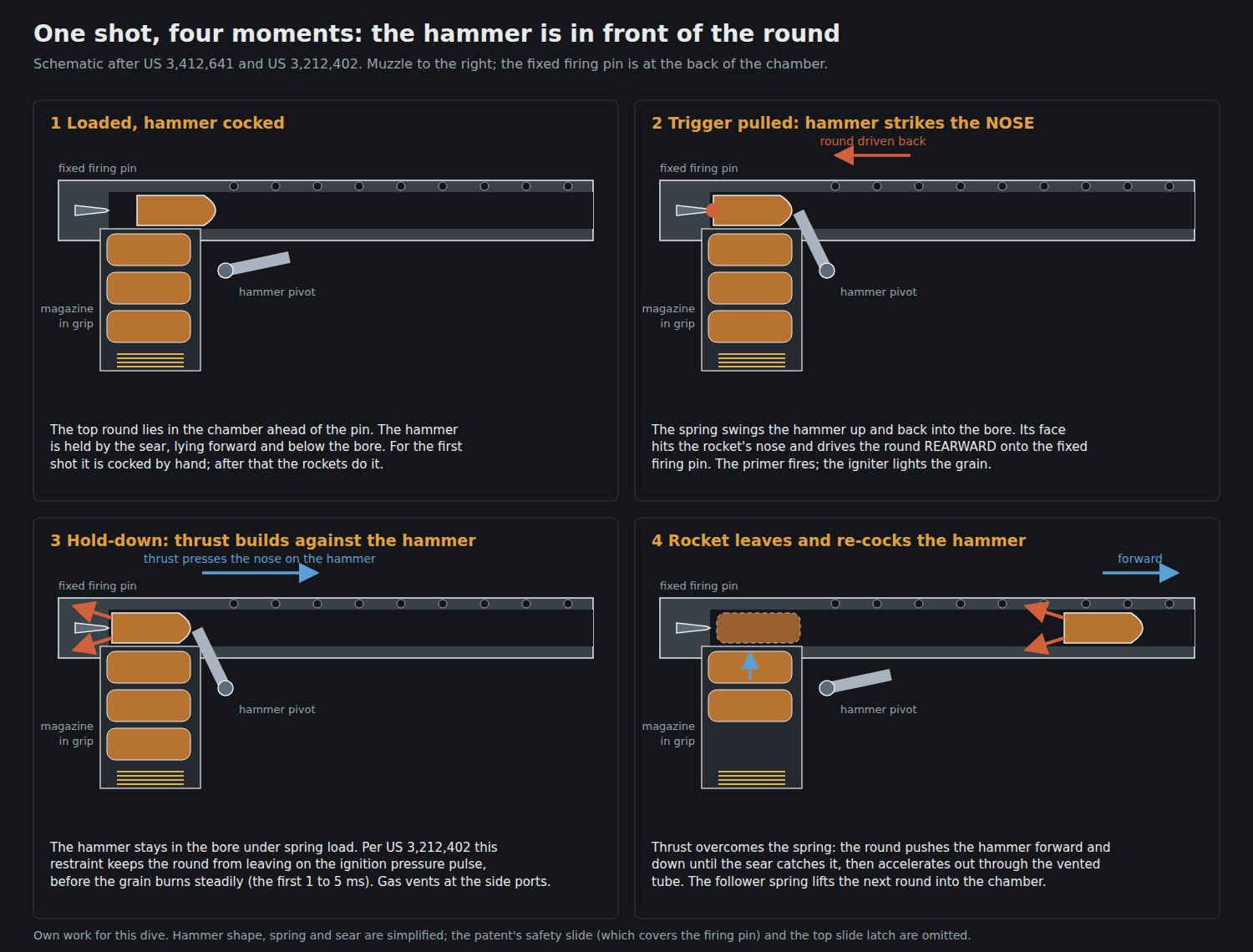
The Gyrojet’s hammer is in front of the round, and it drives the round backward. The fixed firing pin is at the back of the chamber, where a conventional gun’s breech face would be. On firing, the hammer swings up into the bore ahead of the round, strikes the round’s nose, and drives it rearward onto that pin; the primer fires; and the rocket, moving forward out of the gun, rides over the hammer and pushes it back down into the cocked position for the next shot.
The direction matters, because descriptions sometimes reverse it. MBA’s patent states it plainly: the hammer movement “moves the rocket in the chamber 49 within the slide to the rear to have its cap strike the point 22 of the firing pin 21”.1 The first patent’s claim says the mass strikes “the nose of said projectile thereby driving it rearwardly against said firing pin”.2 Spangler, Popular Science in 1965 (“Forward hammer … drives bullet back against a fixed firing pin”), Antaris and Rock Island Auction’s lot descriptions all say the same.3456
3.2 The Two Patents
Two US patents describe the pistol, and both are assigned to MB Associates.
- US 3,212,402, “Hand Weapon”, filed 29 November 1962 by Mathew C. Hengel, Arthur T. Biehl and Robert Mainhardt, issued 19 October 1965. This is the concept patent: a launch tube, rockets in the handle, and a spring-loaded “impacting-restraining” mass in front of the round. It also covers alternatives never used in the production pistol — a pyrotechnic wire pulled through the nozzle as the restraint, a hammer that acts as its own firing pin on a nose-mounted primer, and a tube in which each rocket’s exhaust fires the next.2
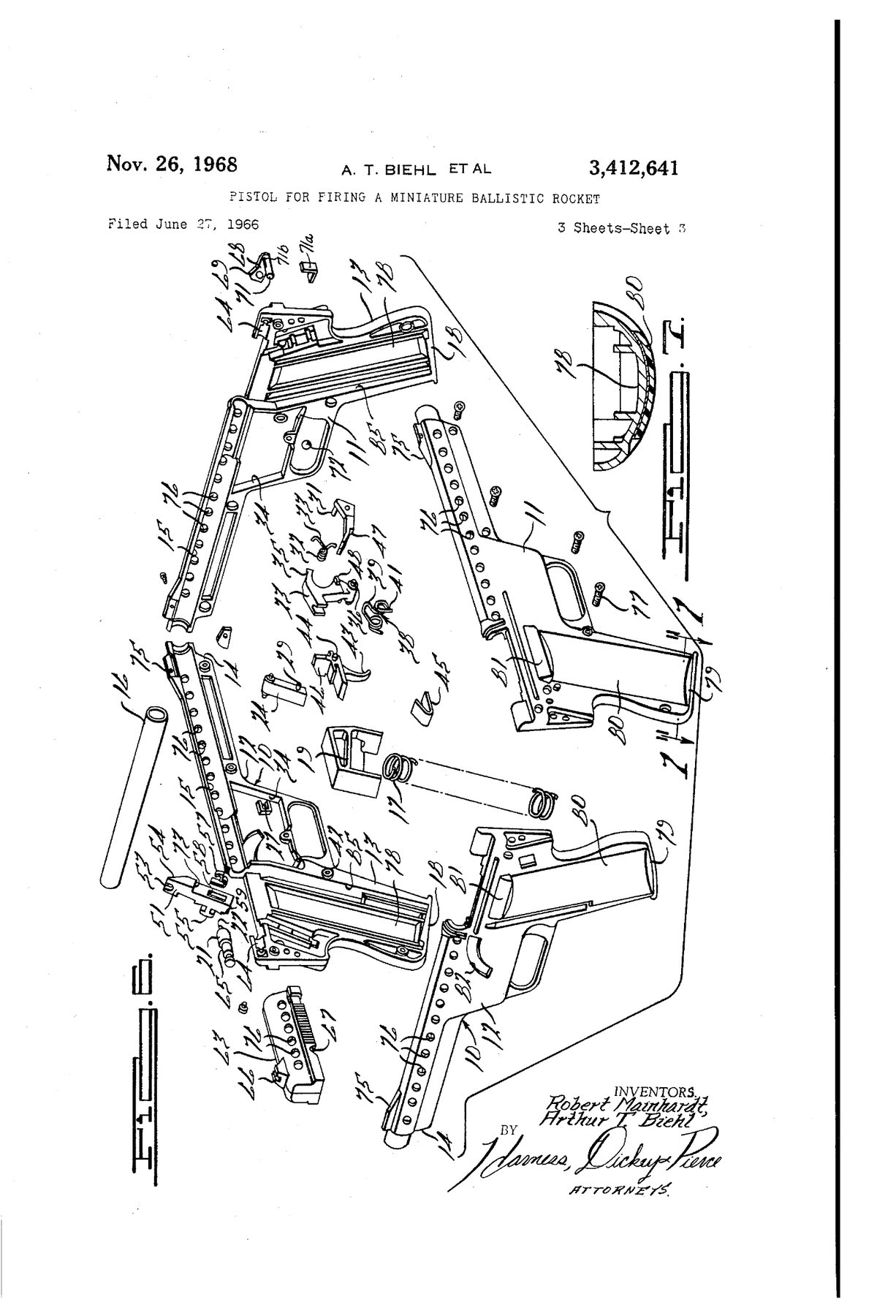
- US 3,412,641, “Pistol for Firing a Miniature Ballistic Rocket”, filed 27 June 1966 by Arthur T. Biehl and Robert Mainhardt of Diablo, California, issued 26 November 1968. It describes itself as “an improvement over that illustrated, described and claimed in Patent No. 3,212,402”, and it is essentially the Mark I Model B: a frame of two cast halves, a stainless barrel tube, a magazine in the handle, a rear top slide that uncovers the magazine, a safety that covers the firing pin, and the sear, pawl and link mechanism. It is the number stamped on the right side of the 12 mm pistols (Volume 5).1
3.3 The Parts
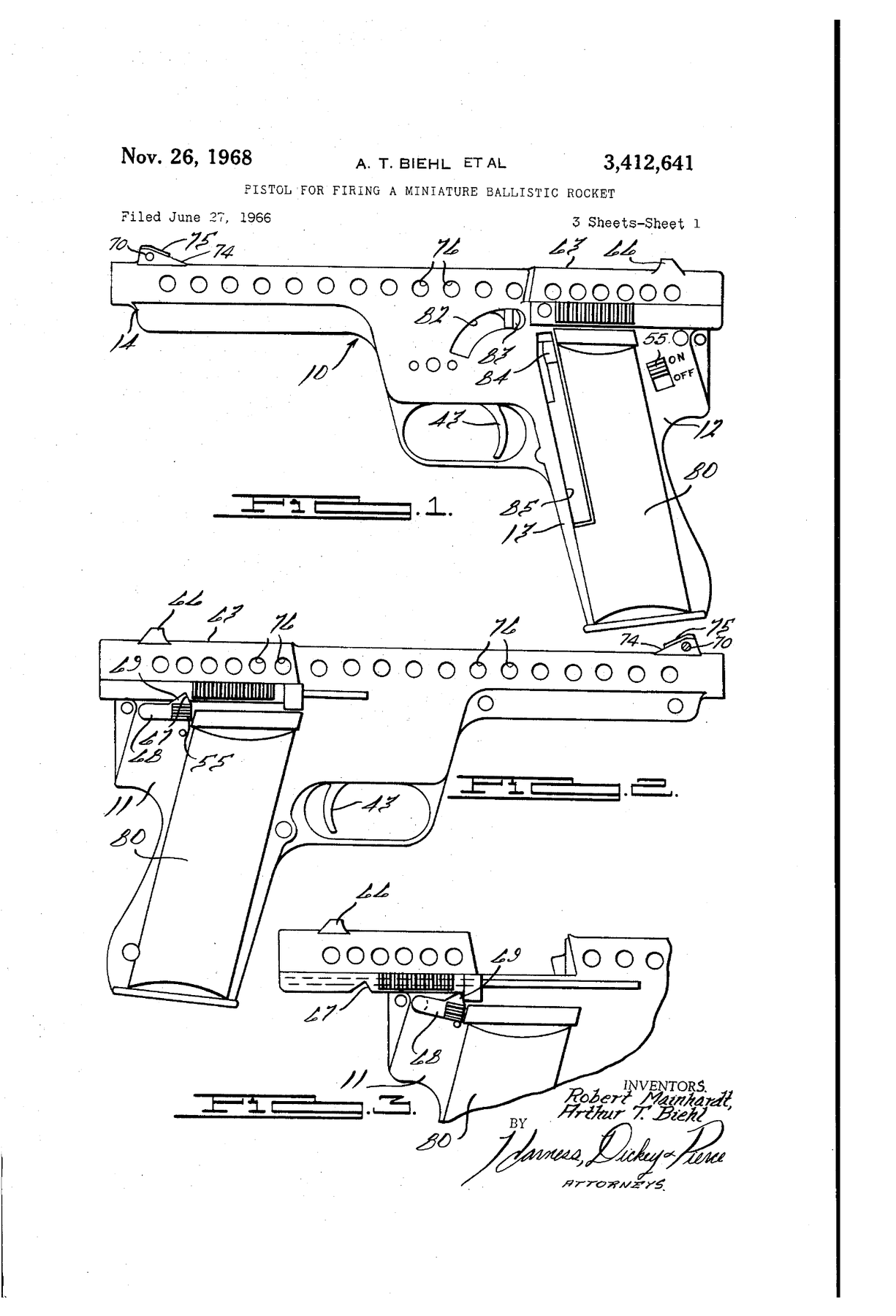
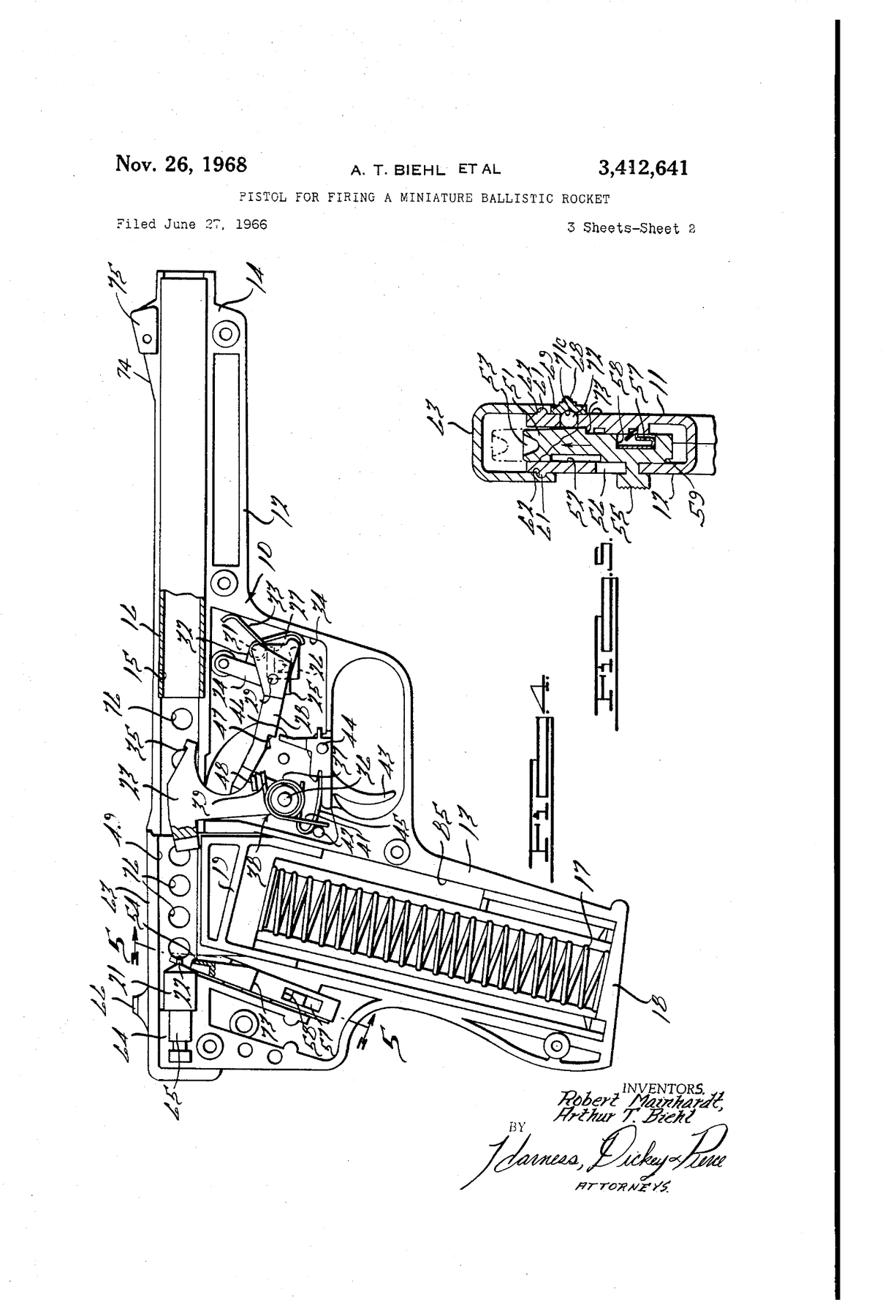
The reference numbers are the patent’s, from US 3,412,641.1
Frame (10) — two halves (11, 12), each a single casting, joined by screws (77). The patent says the halves “are made of cast material which may be plastic, white metal and the like”; “white metal” covers the zinc-based die-casting alloys the production guns used (Volume 4). The barrel section (14) has a recess (15) along it.
Barrel (16) — “a tube of hard material, such as stainless steel”, “bonded with a plastic or other suitable bonding material” into that recess. The barrel and the slide have holes (76) in their side walls “to permit the escape of the hot gases”. It is a smooth guide tube, not a pressure-bearing barrel.
Magazine — the handle (13) itself: a coil spring (17) on the base plate (18) pushing a follower (19) upward. A projection (84) on the follower runs in a slot (85) in the side of the handle, which lets the shooter push the follower down when loading and gives “visible indication of how many rockets remain”. MBA’s instructions call it “the tab lever on the magazine follower to the left of the hand grip”.7
Firing pin (21) — fixed in frame half 12 at the back of the chamber, “in axial alignment with the tube 16”, its point (22) facing forward. It does not move.
Hammer (23) — pivoted on a pin (36) in the frame, forward of the magazine and below the bore, driven by a double-coil spring (38) whose U-shaped middle (39) bears on the back of the hammer “to have it swing counterclockwise to strike the end of a rocket when released”. A finger (83) on the hammer projects through an arcuate slot (82) in the frame, which is how the first shot is cocked by hand. MBA’s instructions call this the “hammer cocking lever”.7
Pawl and sear (24, 25) — a swinging pawl whose edge (25) is the sear, engaging a notch (35) in the hammer to hold it cocked “out of the path of movement of the rocket”.
Trigger (43) and link (28) — the trigger pivots on a pin (44), urged by a flat U-spring (45); a finger (46) on the trigger engages a notch (47) under a link (28) that connects to the pawl.
Slide (63) — the rear part of the top of the gun, over the magazine, riding on projections (61) of the frame halves. It carries the rear sight (66) and forms the firing chamber (49) in which the top round sits. A latch (68), spring-biased by a flat spring (71a), catches a notch (67) in the slide to lock it forward.
Safety (51) — a sliding element in a slideway (52) at the back of the frame, worked by a knurled knob (55), with a spring (57) and a locking notch (59). Its role is described below.
Grips (80) — “ivory, wood, plastic, and the like”, shaped to the handle and “secured by a suitable adhesive”. That detail matters when a grip comes loose (Volume 8).
3.4 The Cycle, Step by Step
The sequence below follows the patent’s own description, in its order.1
- Cocked, round in the chamber. The top round in the magazine sits in the chamber (49) inside the slide, its base toward the fixed firing pin. The hammer is held back by the sear (25) in its notch (35), lying forward and below the bore so that the chamber above the follower is clear. For the first shot the shooter has cocked it by hand through the slot; MBA: “Depress the hammer cocking lever until it locks. (This is necessary only for the first shot. Succeeding shots can be fired semi-automatically).”7
- Trigger. Pulling the trigger rearward moves its finger (46) forward, carrying the link (28) forward, which swings the pawl and lifts the sear (25) out of the hammer notch.
- Strike. The hammer spring swings the hammer up into the bore. The hammer “moves the rocket in the chamber 49 within the slide to the rear to have its cap strike the point 22 of the firing pin 21.” The primer fires; its flash passes through the flash hole to the igniter, which lights the grain along its bore (Volume 2).
- Hold-down. “The firing of the cap and the ignition of the propellant builds up a force rearwardly of the rocket which is retained from movement by the hammer 23 which remains in engagement therewith. The rocket is held in this manner until sufficient pressure has been built up to have the projectile move forwardly.” The exhaust escapes through the rocket’s ports and out of the holes in the slide and barrel walls.
- Re-cock. The rocket’s forward movement causes “the clockwise rotation of the hammer into latched position”: the round shoulders the hammer forward and down until the sear drops into the notch again. The trigger link’s notch re-engages as the hammer comes down, so the trigger must be released and pulled again for the next shot.
- Feed. “When this has occurred, the next adjacent rocket within the handle magazine is moved upwardly into the chamber 49 in position to be fired upon the next actuation of the trigger 23” (the patent’s text here repeats the hammer’s number in error; the trigger is 43).
- Exit. The rocket, now under full thrust, runs down the vented tube and leaves the muzzle at a walking-to-jogging pace — about 105 ft/s a foot beyond it, on the only measurements published (Volume 2).
That is the whole mechanism. There is no bolt, no extractor, no ejector and no locking; the only reciprocating part in normal firing is the hammer, and the energy that cocks it comes from the rocket.
3.5 Why Hold the Round Back?
The hold-down is not incidental. The first patent explains it in its opening column: “it is an inherent characteristic of the ignition of most miniature ballistic rockets that an ignition pressure pulse occurs before stable and uniform burning of the rocket propellant is achieved. This pressure pulse may cause rockets to be prematurely ejected from short launchers at unstable velocities resulting in unpredictable and dangerous projectile attitudes when uniform ignition and thrust of the rocket is finally achieved.” The remedy was to exploit “the characteristically low initial rocket acceleration” with “a mass … which provides a restraining or hold-down force to the rocket during its ignition period”, and to use the same mass to fire the primer by striking the round’s nose.2
In other words, the hammer’s second job — holding the round for the first instant — is a fix for the rocket’s worst flaw at launch. The patent gives the time scale: the internal ballistics approach “a steady state condition (about the first 1 to 5 milliseconds of burning)”.2 MBA had met the same problem with Finjets: its early demonstration kit told the operator to press a square of onion-skin paper over the fins, because it “acts as a hold down, allowing the rocket to build up to full thrust before leaving tube.”8
It is also why the Gyrojet cannot simply be made “faster at the muzzle” by a longer barrel. A longer launch tube helps guidance, as the carbines show, but the rocket still leaves slowly: most of its acceleration happens in free flight (Volume 2).
3.6 The Safety and the Slide Interlock
The patent’s safety does not block the trigger or the hammer. It covers the firing pin. The safety element (51) slides in a slideway (52) that “directs a cavity end 53 over the point 22 to present a flat face 54 to the butt end of the rocket which is out of engagement with the cap carried thereby.” With the safety up, a round driven back by the hammer meets a flat steel face instead of a pin point.1
The same part interlocks the top slide. The slide latch (68) carries a ball (72) that the safety element locks in a recess (71c) when the safety is “Off”, so that the slide cannot be opened while the gun can fire. Moving the safety up to the safe position lines a relief (73) up with the ball and frees the latch. Conversely, the safety cannot be moved down to “Off” unless the latch is fully home, “in latched position”.1 The effect is that the chamber can be opened only on safe, and the gun can be put on fire only with the chamber closed.
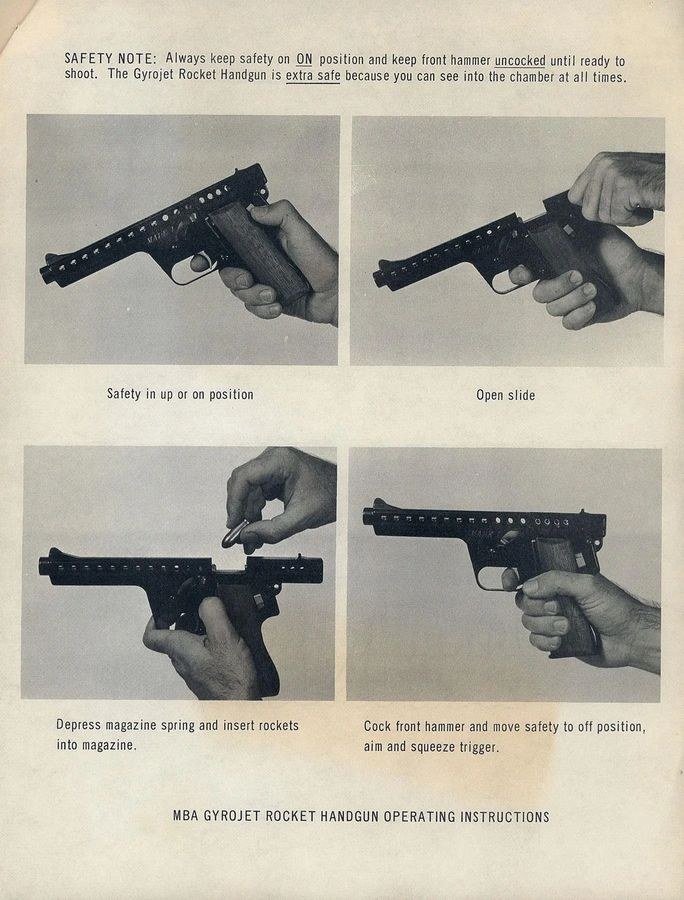
MBA’s photographs call the safe position “up or on”, and its instructions tell the shooter to load with the safety “in the ON position”.7 The patent’s Figure 1 shows the knob marked ON and OFF. Rock Island Auction’s descriptions of Model B pistols place “a safety lever on the left rear portion of the frame”.6 Several auction lots record safeties that “need adjustment”, and one carbine in which “the hammer drops with the safety activated” — which on this design is less alarming than it sounds, because the safety guards the pin, not the hammer, but it still means the safety has not been proved and the gun should not be loaded until it is (Volume 8).
3.7 Loading and Unloading
MBA’s instructions give the sequence for the Model B, which the patent also describes.71
- Load: safety on, and — the instructions insist, in capitals — “the hammer is released (not cocked) during loading.” Depress the slide latch on the right side and draw the top slide back “as far as possible”. Push the follower down with its tab on the left of the grip, and “slide the rounds nose-first into the top opening”, continuing until the magazine holds six or the number wanted. Push the slide fully forward, which “will automatically lock it closed”.
- Seat the last round: “The last round might be in a crooked position in the firing chamber. When the safety is moved to the OFF position and the hammer moved slightly forward, the round will correctly position itself against the firing pin.”
- Unload: safety on, open the slide, “Depress the cocking lever slightly and the rockets will eject” — the follower spring throws them out of the top.
The unload instruction explains the complaint most often made by men who carried the gun. David Kirschbaum, a reconnaissance soldier quoted in Mendenhall’s article, liked the pistol — “light, quiet, low-maintenance, and a hell of a punch” — but not its feed: “To clear a jam, you’d have to slide back that slide, meanwhile holding all the rockets down with your thumb, and then they’d all want to come springing out! … It should’ve had a magazine like a regular automatic, instead of everything being integral.”9 Reloading was equally slow: six rounds, one at a time, through the top.
3.8 What Is Not There
Set against a conventional self-loading pistol, the Gyrojet omits almost everything:
Table 1 — Set against a conventional self-loading pistol, the Gyrojet omits almost everything
| Conventional automatic | Gyrojet | Why it can be omitted |
|---|---|---|
| Locked or heavy breech | None | Peak pressure is inside the rocket, not the gun (Volume 4) |
| Chamber sized for pressure | A guide in a sheet of the slide | Same |
| Rifled barrel | Smooth vented tube | The round spins itself |
| Extractor and ejector | None | Nothing is left behind; the primer leaves with the rocket |
| Reciprocating slide or bolt | None; the top slide moves only for loading | The rocket cocks the hammer directly |
| Recoil spring | None | There is almost no recoil to absorb |
| Detachable magazine | Fixed magazine in the grip | A design choice, not a necessity |
Antaris counts “only twenty two parts” in the pistol, with steel “reserved for the springs, screws, barrel liner, and firing pin”. The count could not be checked against a parts list.5
3.9 Where the Guns Differ From the Patent
The production pistols follow US 3,412,641 closely, but the sources record some differences.
- Hammer during loading. The patent says that before loading, “the hammer 23 had been cocked to clear the area above the magazine follower.” MBA’s instructions for the shipped guns say the opposite: the hammer must be released while loading. The instructions govern for any real gun.17
- Loading gate. The patent and the Model B use the sliding top slide. The earlier Mark I used what Rock Island calls “a hinged loading gate on the left side”, and Antaris a “swiveling loading gate”; the Model 137 began with an open loading port, and Antaris says rounds dropping out of it forced MBA to add the gate.65
- Barrel. The Model 137 at first had no barrel at all: Spangler says “there were merely guide ribs that were cast into the frame”, and tubes were added later because they gave better accuracy. Antaris: the Model 137 “shot the rockets directly out the frame rails”, and the Mark I had “a smooth bored barrel sleeve”.35
- Rifling in the 12 mm gun. Spangler states that the 12 mm Model C barrels “were dutifully given very light rifling, although it was totally useless because the rocket spin was imparted by the canted nozzles”. No other source consulted mentions rifling, and none was checked on a gun. It is recorded as Spangler’s statement.3
3.10 The Carbines, the Survival Pistol and the Automatic That Never Sold
The carbines are the pistol mechanism in a stock. Antaris describes the Mark I (A-series) carbine as built on “standard pistol frames”, fitted with an 18-inch barrel shrouded by a forend and a stock attached “via a modified lanyard loop”, and the Model B sporter as “a standard pistol frame” shrouded by a separate walnut pistol grip, with cut-outs in the stock “to allow access to the cocking lever and safety”.5 Rock Island’s lot text for the sporter repeats the mechanism: “The nose of the round is forced rearward onto a stationary firing pin igniting the fuel, expelling the round and recocking for the next shot.”6 The longer tube gave better guidance; Popular Science reported the carbine as weighing “only about four pounds”.4
The survival pistol had a telescoping barrel. Spangler: it “could be pushed all the way back for ease of storage, but for use, it could be pulled forward to clear the hammer and provide better guidance”. The phrase “to clear the hammer” follows from the geometry above: the hammer swings up into the bore ahead of the chamber, so a retracted tube would be in its way. Carpenter describes a spear adapter loaded into the survival pistol’s muzzle cap: a standard rocket fired into the hollow base of the spear at about 150 ft/s, seated itself, and pushed the spear out — “moving forward, cocking the hammer for another shot” on the way.310
The Model 137 was, according to Antaris, fitted with “a selective fire switch … marked A ‘automatic’-S ‘semiautomatic’ on the left side”, and “pistols released to the public had this switch ‘plugged’ with a screw for deactivation”. Carpenter reports Mainhardt telling him that “the prototypes and first production models intended for the military were full-automatic … even though MBA never sold any full-automatic pistol (or carbine) to anybody, including the military”. The plugged A–S switch is visible on the Model 137 shown in Volume 5.511 The first patent’s claim of rates “above 30 rounds/second” from “actual models” describes what the mechanism could do with the sear held off; no source located describes how the automatic version controlled it.2 Any automatic Gyrojet is a machine gun under federal law regardless of calibre, and nothing in this dive suggests any exists in civilian hands.
3.11 Recoil and Noise
Popular Science, reporting MBA’s claims in 1965, said the 13 mm round “packs a bigger punch than a 45-caliber automatic, but has about only 1/10 as much recoil”.4 The mechanism explains why the recoil is small without making it zero: the gun feels the hammer blow, the reaction of the brief hold-down, and the exhaust striking the inside of the slide and tube, but it never has to stop a breech block driven back by 20,000 psi. The patent calls the design “recoilless”.2
Noise is split. At the gun, the sound is the rocket lighting; Kirschbaum described “a sort of ‘Psssssst!’ It sounded like air escaping from a truck tire, maybe a half-second long.”9 Downrange, rounds that pass the speed of sound crack; in the 2002 test about half did.9 MBA’s claim of “no muzzle blast” is accurate in the sense that no high-pressure gas leaves the muzzle behind the projectile.12
References
Footnotes
-
A. T. Biehl and R. Mainhardt, US Patent 3,412,641, “Pistol for Firing a Miniature Ballistic Rocket”, filed 27 June 1966, issued 26 November 1968, assigned to MB Associates, cols. 1–4, https://patentimages.storage.googleapis.com/pdfs/US3412641.pdf . ↩ ↩2 ↩3 ↩4 ↩5 ↩6 ↩7 ↩8
-
M. C. Hengel, A. T. Biehl and R. Mainhardt, US Patent 3,212,402, “Hand Weapon”, filed 29 November 1962, issued 19 October 1965, https://patentimages.storage.googleapis.com/pdfs/US3212402.pdf . ↩ ↩2 ↩3 ↩4 ↩5 ↩6
-
John Spangler, “MBA Gyrojet Mark I Model B Pistols and Carbines: Rocket Science Meets Reality”, ASAC Bulletin 105 (2012), pp. 58–66, retrieved 2026-09-19. ↩ ↩2 ↩3 ↩4
-
“More punch than a .45: Rocket-firing small arms”, Popular Science vol. 187 no. 6 (December 1965), p. 113, Internet Archive, retrieved 2026-09-19. ↩ ↩2 ↩3
-
Leonardo M. Antaris, “The Gyrojet Rocket Handguns: An Early Exploration Into The Future”, Gun Journal, January 1997, read from photographs with Rock Island Auction lot 57/1886, retrieved 2026-09-19. ↩ ↩2 ↩3 ↩4 ↩5 ↩6
-
Rock Island Auction Company lot descriptions, including auction 47 lot 3814, auction 56 lot 898, auction 58 lot 290, auction 71 lot 1806, auction 4095 lots 564 and 566, and auction 4096 lot 1599, https://www.rockislandauction.com/detail/ followed by auction and lot number, retrieved 2026-09-19. ↩ ↩2 ↩3 ↩4
-
MBAssociates, letter and “Operating Instructions” (three pages and photograph sheet), Model B period, photographed with Rock Island Auction lot 57/1886 (30 November 2012), https://www.rockislandauction.com/detail/57/1886 , retrieved 2026-09-19. ↩ ↩2 ↩3 ↩4 ↩5 ↩6
-
Mel Carpenter, Chapter 28 (June 2012), gyrojet.net, https://web.archive.org/web/20180721025145/http://www.gyrojet.net/ch28.pdf , retrieved 2026-09-19. ↩
-
Monty Mendenhall, “Gyrojets — Review” (part 2), deathwind.com, Wayback capture of 20 February 2003, https://web.archive.org/web/20030220110005/http://www.deathwind.com/review_2.htm , retrieved 2026-09-19. ↩ ↩2 ↩3
-
Mel Carpenter, Chapter 27 (June 2011), gyrojet.net, https://web.archive.org/web/20170913024859/http://www.gyrojet.net/Ch27.pdf , retrieved 2026-09-19. ↩
-
Mel Carpenter, “Questions and Answers”, gyrojet.net, Wayback capture of 21 July 2018, retrieved 2026-09-19. ↩
-
Mel Carpenter, An Introduction to MBA Gyrojets and Other MBA Ordnance (2010), Chapter 6, sample chapter, retrieved 2026-09-19. ↩
Comments (0)