MBAssociates Gyrojet · Volume 2
The Round — Canted Nozzles, a Tenth of a Second, and a Rocket That Is Slow at the Muzzle
How a Gyrojet rocket is built, why it spins, what it actually does in its first thirty feet, and why it hit so badly: the physics set against every published number, with the numbers kept apart where they disagree
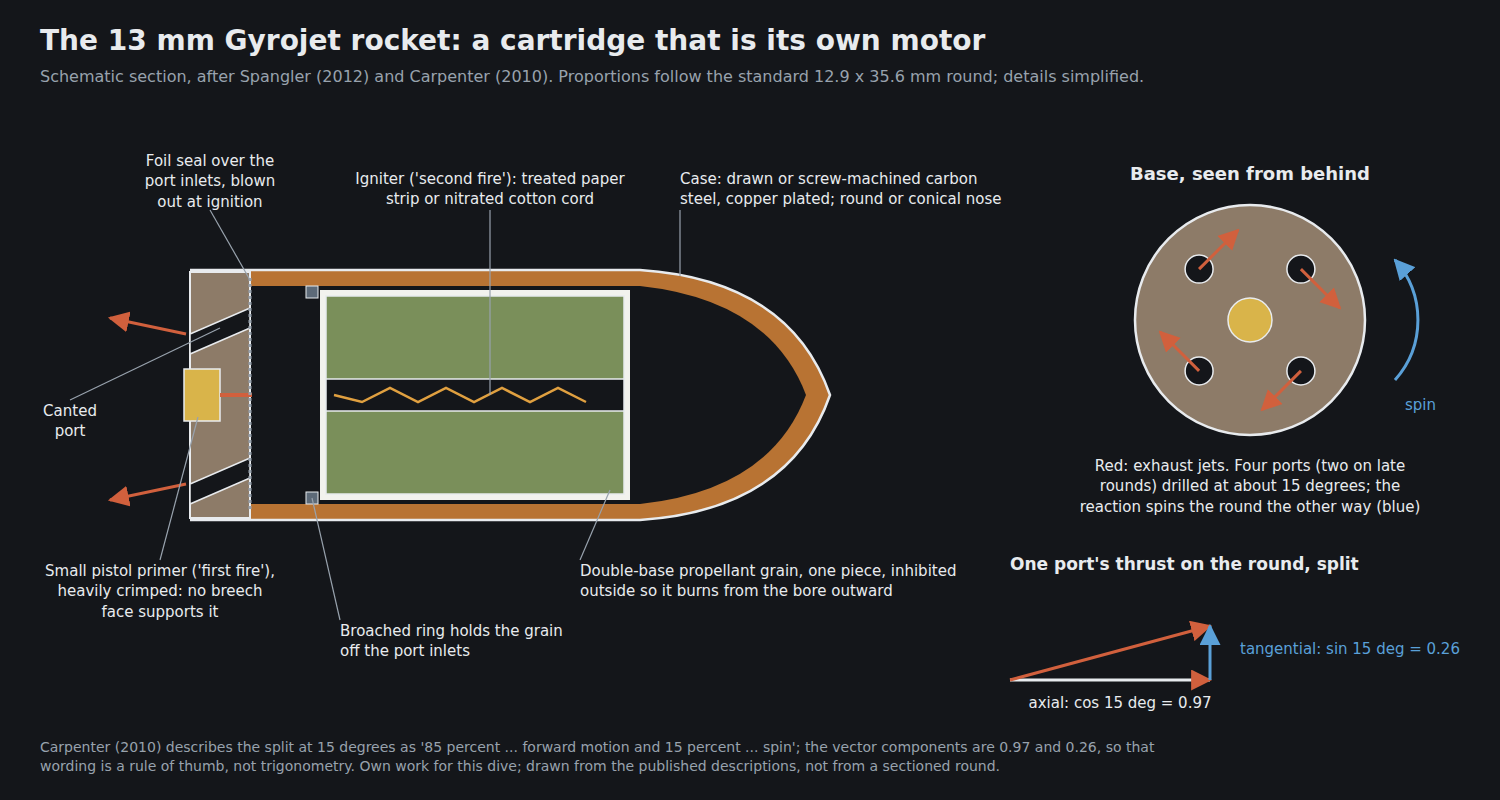
A Gyrojet round is a small solid-fuel rocket motor with a primer in its tail. Everything else about the Gyrojet — the light die-cast gun, the absence of recoil, the vented tube, the slow muzzle, the scattered hits — follows from that one fact, and this volume sets it out from the sources, with the arithmetic shown where the sources disagree.
2.1 Not a Cartridge, Not Caseless
MBA was explicit about what the round was not. Its first news release, dated 1 July 1965 and quoted by Carpenter, read: “Gyrojet is not a ‘caseless cartridge’ development. The Gyrojet propellant is a solid fuel and is ignited by a percussion primer. When fired, the complete rocket, including the primer, thrusts forward and accelerates rapidly and accurately toward the target. Nothing is left in the chamber to be ejected as in conventional guns.”1 Popular Science repeated the point in December 1965, noting that the company said its guns “are not a caseless-cartridge development”.2
The distinction matters. A caseless cartridge, like the Daisy V/L’s that the hub’s Daisy dive covers, still burns its propellant behind the bullet inside a chamber that must hold the pressure. A Gyrojet burns its propellant inside the projectile, and the pressure is held by the projectile’s own steel case. The gun is a launch tube, not a pressure vessel (Volume 4). Nineteenth-century precedents that put powder in the bullet — Spangler cites the 1848 Hunt “Rocket Ball” and the Volcanic cartridge of 1854 — were fired in closed barrels and depended on barrel pressure; they were not rockets.3
2.2 What Is Inside
Spangler and Carpenter describe the same six components, and the section drawing above follows them.31
- The case. Carbon steel, either deep drawn — Carpenter names Olin (Winchester) of East Alton, Illinois, as a supplier of drawn, copper-plated cases — or turned on screw machines by local shops. Most were copper plated against rust. Rounds meant for immediate test firing were sometimes left bare, and dummies were often nickel plated. Nose shapes were a round ogive or a pointed cone. Spangler adds that concentricity “is critical because without it, it will be unbalanced and wildly inaccurate as the rocket rotates in flight.”
- The propellant grain. A single piece of double-base (nitrocellulose and nitroglycerine) propellant, which Carpenter says MBA bought largely from the Hercules Powder Company — “the same used in some military rockets such as the ‘Bazooka’” — as extruded strands, sized in a doweling fixture, cut to length and turned on a lathe. The grain has a central perforation and burns only from the inside out, because its outer surface is coated with an inhibitor. The inhibitor MBA found worked best was titanium oxide, and the source was a high-titanium white outside house paint sold in the San Francisco Bay area, “Moore’s Number Eight”, sprayed on in a booth. Carpenter adds that when other rocket companies asked how MBA made such a good inhibitor, Mainhardt told them to buy a gallon at their local paint store.
- The igniter. A “second fire” that carries flame from the primer along the whole perforation at once: a strip of treated paper “similar to magician’s flash paper”, or a length of nitrated cotton cord. The first design, a pellet of boron–potassium nitrate in the nose of the grain, lit reliably but was dirty, and burning pieces “tended to fly back in the shooter’s face”.
- The retaining ring. A lip broached into the case wall, or a separate ring, holds the grain forward so that it cannot slide back and block the port inlets. Loose, granular powder was never used for exactly that reason.
- The nozzle, or base. Machined carbon steel, usually copper plated, with a primer pocket and flash hole in the centre and — the essential feature — two or more ports drilled at an angle. Four ports is the early standard, two the late. Spangler adds a subtle requirement: the base material must erode as the rocket burns, so that the ports enlarge as the burning area and gas flow grow, or “there is a risk that the rocket will explode.” The base is held in by a crimp or a rolled cannelure.
- The primer. An ordinary, off-the-shelf 0.175 in small pistol primer — Carpenter says MBA bought some from the San Francisco Gun Exchange — heavily crimped, because it is never supported by a breech face: the primer leaves with the rocket.
- The seals. A thin adhesive foil inside the base over the port inlets, punctured over the flash hole and blown out at ignition, and a lacquer called “Humiseal” painted round the primer and the case-to-base joint, tinted with red food dye so that an inspector could see it had been applied. Carpenter says the seals worked well enough that sealed rounds “could be fired underwater”.
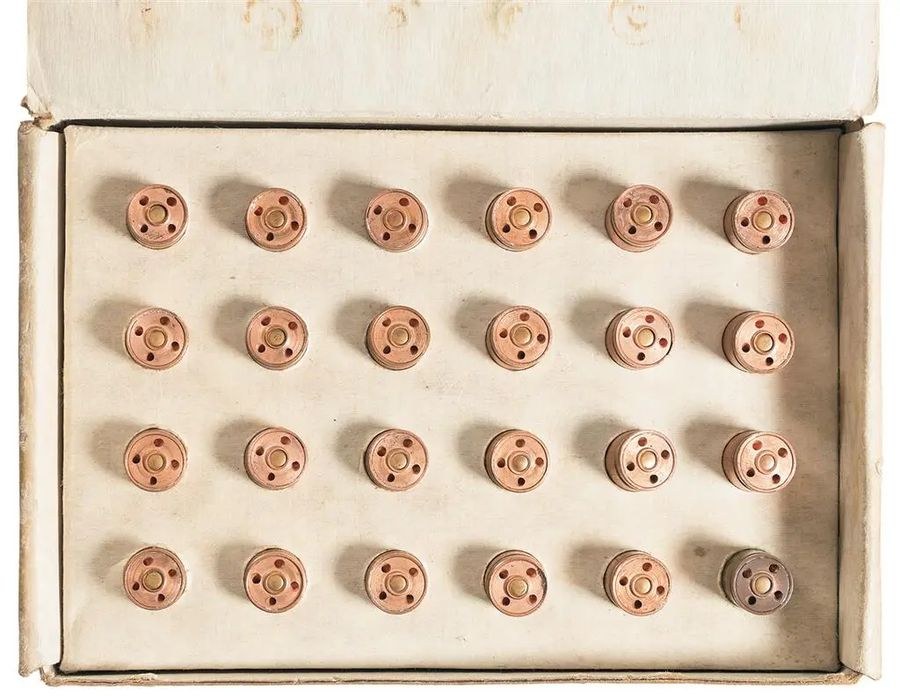
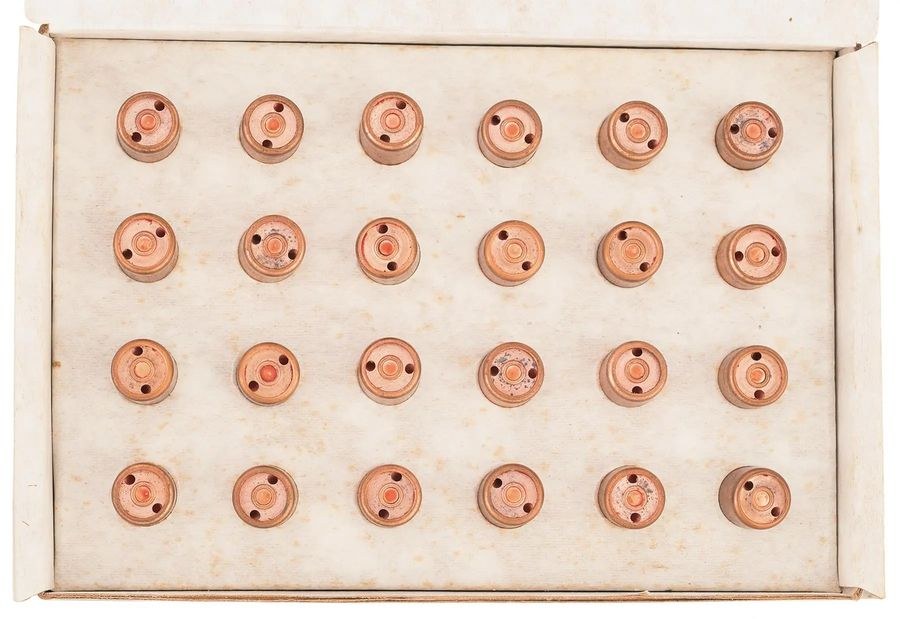
Every Gyrojet, Finjet and Lancejet, Carpenter writes, “was assembled by hand”.1 The significance of that sentence appears below, under accuracy.
2.3 Sizes: 13 mm and 12 mm Are Neither
MBA’s calibre names are labels, not dimensions, and they were not even consistent units: the company used millimetres for some rounds and inches for others, and sometimes both for the same one. Carpenter measured “hundreds” and found that most “12 mm” rounds are 12.54 mm (0.494 in) in diameter and most “13 mm” rounds 12.94 mm (0.509 in).1 Rock Island Auction’s descriptions of late production boxes give about 12.8 to 12.9 mm.4 The standard 13 mm case is 1.4 in (35.6 mm) long.5
Two consequences follow. First, the “12 mm” round is the old “.49 calibre” round of the Model 137 under a metric name — Spangler says as much when he writes that MBA “reduced the caliber to the earlier .49 caliber” after 1968 (Volume 6).3 Second, Carpenter observes that a collector “without a precision digital caliper will have a tough time telling the difference between apparently identical 12mm and 13mm rounds” — a difference of 0.4 mm, or about 0.016 in.1
The law does not follow MBA’s labels either. The line in the National Firearms Act is half an inch of bore; a 13 mm gun’s bore is over it and a 12 mm gun’s is under it, whatever the rounds measure (Volume 6).
2.4 Why It Spins
A rocket accelerates slowly at first, so it cannot be spun by rifling the way a bullet is: at a hundred feet per second there is nothing to drive a jacket into grooves. The Gyrojet spins itself. Each port is drilled at an angle to the axis, so each jet pushes the round both forward and sideways; the sideways parts, arranged round the base, add up to a torque, and the round turns about its axis like a lawn sprinkler. The patents describe the ports as “skewed to the longitudinal axis of the rocket to provide stabilization”.6
The angle is a trade. More cant means more spin and more stability, but less of the thrust pushes the round forward, and very high spin loads the case in hoop stress; Carpenter says one of MBA’s larger designs, the so-called .50 BMG Gyrojet, “came apart in flight” for that reason. MBA drilled ports at angles from 7° to 35°, with 15° typical, and made nozzles with anything from two to ten ports. Some rounds spin clockwise and some counter-clockwise.1
Carpenter summarises the 15° choice as “85 percent of the total thrust produced being used for forward motion and 15 percent used to create spin”, and Antaris quotes “factory literature” as putting it at 90 and 10 per cent “of the energy”.17 Neither is the geometry. At a 15° cant, the axial component of each jet is cos 15° = 0.966 of its thrust, and the tangential component is sin 15° = 0.259. The axial loss is only about 3.4 per cent; the tangential component is about a quarter of the thrust, but it does not “use up” a quarter, because force components are not shares of a total. The percentages in the literature are rules of thumb and are not repeated here as physics.
2.5 How Fast It Spins: Two Figures Ten Times Apart
Table 1 — How Fast It Spins: Two Figures Ten Times Apart
| Source | Spin rate |
|---|---|
| Spangler (2012) | “approximately 19,000 revolutions per minute” |
| Antaris (1997), citing factory literature | ”150,000–200,000 revolutions per minute” |
The two figures differ by a factor of eight to ten, and neither source gives a measurement or a method. A rough check shows which is at least possible. Assume a 185-grain round (0.012 kg; Antaris’s figure for the standard rocket), reaching 1,250 ft/s (381 m/s) in 0.12 s (Carpenter’s burn time), so an average axial thrust of about 0.012 × 381 / 0.12 ≈ 38 N. At a 15° cant the tangential thrust is 38 × tan 15° ≈ 10 N. If the ports sit about 4.5 mm off the axis — an assumption, since no drawing gives the port radius — the torque is about 0.046 N·m. The round, treated as a solid cylinder of 6.5 mm radius, has a moment of inertia of about ½ × 0.012 × 0.0065² ≈ 2.5 × 10⁻⁷ kg·m². Torque over inertia gives an angular acceleration of about 1.8 × 10⁵ rad/s², and over 0.12 s a final spin of about 22,000 rad/s, or roughly 210,000 rpm.
That is an upper bound, since it ignores aerodynamic spin damping and the falling mass and changing thrust of a real burn, but it shows that the factory figure quoted by Antaris is in the physically plausible range and that 19,000 rpm would require either far less torque or far more damping than the geometry suggests. The check does not prove either published number. It is recorded here as this dive’s arithmetic, not as a measurement.
2.6 The Velocity Curve
A bullet is fastest at the muzzle and slows from there. A rocket is slowest at the muzzle and speeds up until its fuel is gone. Every source agrees on that shape; they disagree on the numbers.
Table 2 — The Velocity Curve
| Source | Burn time | Top speed | Where it is reached |
|---|---|---|---|
| Popular Science, Dec 1965 (MBA’s figures) | “about 100 milliseconds” | 1,250 ft/s | not stated |
| Antaris (1997) | 0.10 s | 1,250 ft/s (185 gr standard round) | “approximately 30 feet beyond the muzzle” |
| Carpenter (2010) | 0.12 s | 1,250 ft/s | ”about 45 feet downrange” |
| Spangler (2012) | “approximately 1/10th of a second" | "approximately 1500 feet per second" | "about 60 feet from the muzzle” |
| Mendenhall (c. 2002), from MBA data | — | 1,250 ft/s | 60 ft (his expectation) |
| Commons description of the NFM carbine (museum text) | “a tenth of a second” | not usable (see below) | 50 ft |
The four positions for burnout — 30, 45, 50 and 60 feet — cannot all be right, and the chart below plots them separately against the only measurements that have been published.
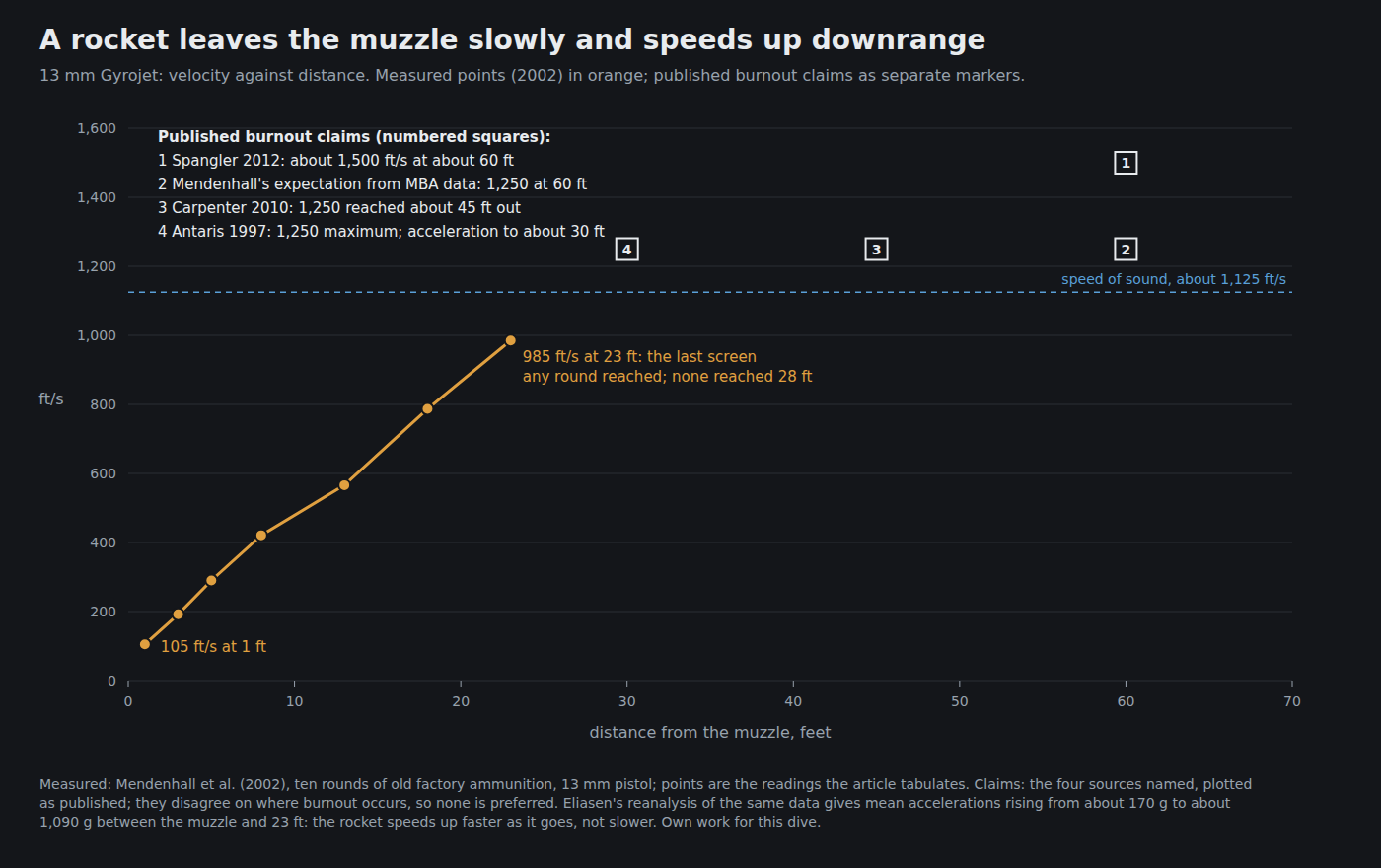
The one internal check available is simple kinematics. If a rocket reaches 1,250 ft/s after 0.12 s with constant acceleration, its average speed is 625 ft/s and it covers 75 feet. If its acceleration rises through the burn, as the measurements below show, it covers less than 75 feet in the same time, because it spends more of the burn going slowly. So a burnout at 45 to 60 feet is consistent with MBA’s 1,250 ft/s and 0.1 to 0.12 s; burnout at 30 feet requires either a shorter burn or a steeper rise.
2.7 What the 2002 Measurements Show
The only published chronograph work on original ammunition is a test by Monty Mendenhall and colleagues, published on the “Deathwind” website around 2002 (and apparently in Small Arms Review, which was not seen). They set eight chronographs at 1, 3, 5, 8, 13, 18, 23 and 28 feet in front of a 13 mm pistol and fired ten rounds of old factory ammunition. Their tabulated readings were 105 ft/s at 1 ft, 192 at 3, 290 at 5, 421 at 8, 566 at 13, 787 at 18 and 985 at 23. Only three rounds passed over the first seven screens; none triggered the one at 28 feet.8
Mendenhall concluded that the rocket accelerated hardest at the muzzle and then less — an “acceleration anomaly” he suggested MBA had engineered with a special initiator. Alan Eliasen reanalysed the same table and showed that the conclusion came from dividing by distance instead of time. Acceleration is the change in velocity over the change in time; computed that way from Mendenhall’s own readings, the mean acceleration rises steadily, from about 170 g over the first foot to about 1,090 g between 18 and 23 feet, and the round takes about 72 milliseconds to cover 23 feet.9 This dive repeated Eliasen’s arithmetic from the published table and got the same values. A rising acceleration is what the design predicts: the rocket loses mass as it burns, the burning surface of an inside-out grain grows, and Spangler’s eroding ports let more gas through as it does.
Extrapolating is risky, but it is instructive. At 23 feet the round was doing 985 ft/s and accelerating at roughly 35,000 ft/s². Holding that acceleration, it would reach 1,250 ft/s in about another 8 milliseconds and 9 feet — at about 32 feet, some 80 milliseconds after firing. That lands on Antaris’s 30 feet rather than Spangler’s 60, but it rests on ammunition some thirty-five years old and on a speed of 1,250 ft/s that the 2002 test never observed. It is offered as arithmetic, not as a finding.
About half the 2002 rounds made a supersonic crack and half a “bottle rocket” whoosh, which fits a top speed on either side of the roughly 1,125 ft/s speed of sound.8
The Commons description of the carbine at the National Firearms Museum, apparently copied from a museum placard, says the rocket “reaches maximum velocity at 50 feet in a tenth of a second and acquire the 400 G ratio (17,000 feet per second)”. The 17,000 figure is not a velocity the round ever reached; 400 g is about 12,900 ft/s², so the phrase appears to garble an acceleration. It is not used here.10
2.8 Energy at the Muzzle and Downrange
Kinetic energy is weight in grains times velocity squared, divided by 450,240. For the 185-grain round Antaris describes:
Table 3 — Kinetic energy is weight in grains times velocity squared, divided by 450,240. For the 185-grain round Antaris describes
| Point | Velocity | Energy |
|---|---|---|
| 1 ft from the muzzle (2002 reading) | 105 ft/s | 185 × 105² / 450,240 ≈ 4.5 ft·lbf |
| 23 ft (2002 reading) | 985 ft/s | 185 × 985² / 450,240 ≈ 399 ft·lbf |
| Burnout, MBA’s figure | 1,250 ft/s | 185 × 1,250² / 450,240 ≈ 642 ft·lbf |
Carpenter reports MBA’s claim that the round’s downrange energy “was almost twice that of a .45 ACP bullet”; a 230-grain .45 bullet would need about 1,120 ft/s to carry 642 ft·lbf, so the claim holds against ordinary .45 ball only at or after burnout.1 At arm’s length the round carries about as much energy as a thrown baseball. Carpenter reports “a couple of documented cases” of people shot “multiple times with a Gyrojet at point-blank range (a foot or less) with little apparent effect”, including a robber who fired a stolen Gyrojet six times at a storekeeper, threw it down “in disgust and ran away”.1 He does not name his sources in the chapter seen, and the story is repeated here as his, but the arithmetic above says it is entirely possible. The same arithmetic undercuts any use of the Gyrojet as a defensive handgun: “A very low muzzle velocity in a defensive handgun where combat ranges can be quite short”, in Carpenter’s words, “was a serious disadvantage that MBA never overcame.”1
Weight itself is uncertain. Antaris gives “usually … 230 grains” in one paragraph and 185 grains for the standard round in another; Wikipedia gives 180 grains without a source.711 The energy table uses 185 because it is the figure Antaris attaches to the 1,250 ft/s velocity.
2.9 Why It Missed
MBA’s accuracy claims were modest and the results worse. The sources give:
- ARPA, July 1963: the H. P. White tests of the .49-calibre pistol found “problems on reliability and accuracy … which require correction before additional production is undertaken”.12
- Finjets before them: a 24-rocket salvo gave “only a 50% chance of even a single rocket hitting within an 18-inch circle at 100 yards” (Spangler).3
- MBA’s own figures, as reported by Mendenhall: a best claim of “2.5 mils CEP, or 30 inches at 100 yards”, and elsewhere in MBA literature an average of seven feet at 100 yards. The two parts of the first claim do not agree with each other — 2.5 mils at 100 yards is 9 inches, and 30 inches is about 8.3 mils — so the pairing is reported as he gave it and not resolved.8
- The 2002 test: five of ten rounds struck a 36 × 36 inch target at 100 feet.8
- A 1971 reviewer at ARPA, commenting on a later study of small-arms rocket ammunition and quoted by Carpenter: “[It’s] Gyrojet all over again. If the target is close enough to hit, you can’t kill it. If you can kill it, you can’t hit it.”1
The causes are also documented. Carpenter names two. The first is tipping error: as the slow round leaves the muzzle its nose is no longer supported while its base still is, gravity tips it very slightly, and its thrust is misaligned from the first instant of free flight. The slower the exit, the larger the error. The second, which Carpenter calls “the primary reason for the Gyrojet’s inaccuracy”, is nozzle-port misalignment. Each port was drilled individually with custom tapered drills in a hand-indexed fixture MBA’s machinists called “Bertha”; the drills broke, sometimes on the fourth port of a four-port base, and “any play in the holding fixture or drill press would cause port misalignment.” A port that is out of angle or out of place pushes the round off its axis for the whole burn. MBA tried eight-port bases so that one bad port would matter less, and Carpenter’s later chapter shows eight-port specimens with visibly uneven spacing.113
A third mechanism follows from the physics even without a defect. A bullet leaves the barrel at full speed and then coasts; small disturbances act on it for a fraction of a second. A Gyrojet spends its first tenth of a second as a low-speed rocket steering on its own thrust, in air, through the transonic region, and any asymmetry in that thrust has the whole burn to act. Mendenhall made this point; it is also why a rifled launcher would not have helped.8
Wikipedia states that later production accuracy suffered from “a manufacturing flaw … which partially blocked one of the exhaust ports”, citing Kevin Dockery’s Future Weapons (2007). That book was not seen, and the claim is not repeated here as fact; it is consistent with Carpenter’s account of port problems but more specific than any source examined.11
2.10 Reliability
Mendenhall reports that MBA’s early testing found a 10 per cent failure rate, and that after tightening quality control the company claimed 99 per cent reliability — still, as he says, one failure in a hundred for anyone going “into harm’s way”.8 In the 2002 test, four of ten rounds failed to fire on the first pull, fired after re-cocking, and one was a hang fire that went off “several seconds” after the trigger was pulled.8 Those were rounds more than thirty years old; a 1990s shooter quoted in the same article remembered about half his rounds failing, some of them falling a short distance from the muzzle and spinning on the ground until they burned out.8
The failure modes line up with the construction. A primer that must be driven onto a fixed pin by a hammer blow, with the round free to move, gets a softer strike than a primer in a supported chamber; the operating instructions’ first remedy for a misfire is “recock and fire again” (Volume 8).14 And propellant, igniter and seals age. Wikipedia’s statement that the vent ports “allowed humid air into fuel” in Army tests is unsourced there, but it is exactly what the foil seal and red lacquer were meant to prevent.11
2.11 Heat
Mendenhall reports that MBA literature gave the propellant’s burning temperature as 5,000 °F and warned that a round could start a fire in flammable material at close range.8 MBA’s own instructions say, in capitals under “General”, “Do not fire the Gyrojet Rocket Handgun into flammable material at close ranges.”14 Antaris quotes Mainhardt himself: “I wouldn’t want to shoot into a dry brush patch at five feet … [a] round would serve as a miniature blow torch at that range.” Asked about wounds, Mainhardt added: “Since the round is hot, there might be some seared meat around the wound channel.”7
2.12 The Variations a Collector Meets
The rounds in collections vary more than the guns. The ones most often seen, from Carpenter’s chapters and Rock Island Auction’s lot descriptions:154
- Standard 13 mm, round nose or conical, four-port base — the early production round, copper plated.
- Standard 13 mm with a two-port base — later production; Carpenter traces the two-port base to a machine that drilled two ports at once, bought for the Gyro-Signal flare programme, and says two ports “performed much better than expected”.
- Wadcutter 13 mm — a flatter, shallow-pointed nose. Rock Island describes boxes of them with a loose MBA note “regarding the wadcutter design”. Carpenter says early wadcutters had a sharp edge at the nose that could catch on the barrel while loading, and a bevel was added.
- Powder-metal bases — sintered bases with three or four slots instead of drilled ports, which Mainhardt called the best MBA made; often seen in late 12 mm rounds.
- 12 mm — the post-1968 round for the Mark II Model C, outwardly almost identical to 13 mm.
- Long rounds — experimental 2.0, 2.3 and 3.0 in cases that would not feed from a Model B magazine. Carpenter reports, from “a reliable source”, that they were a response to penetration judged insufficient in tests in Vietnam; that account is second-hand and is recorded as his.5
- Dummies and presentation rounds — often nickel plated, sometimes with rubber “grains”; cased presentation sets carried ten.
- Flares — the 13 mm Gyro-Signal family, in several colours and sizes (Volume 7).
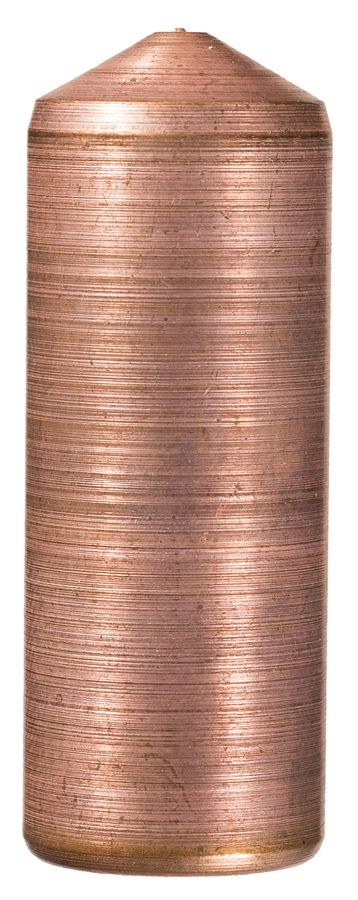
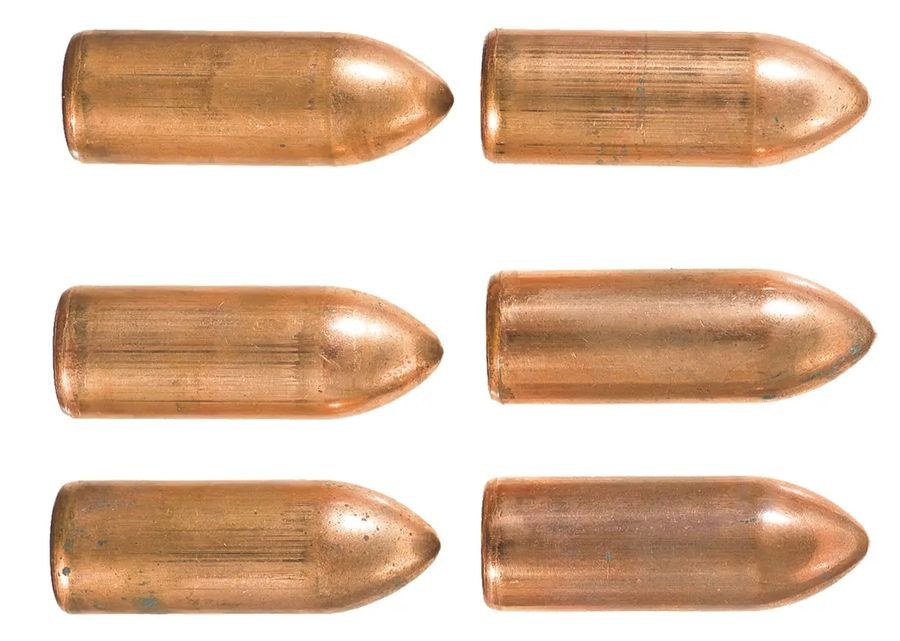
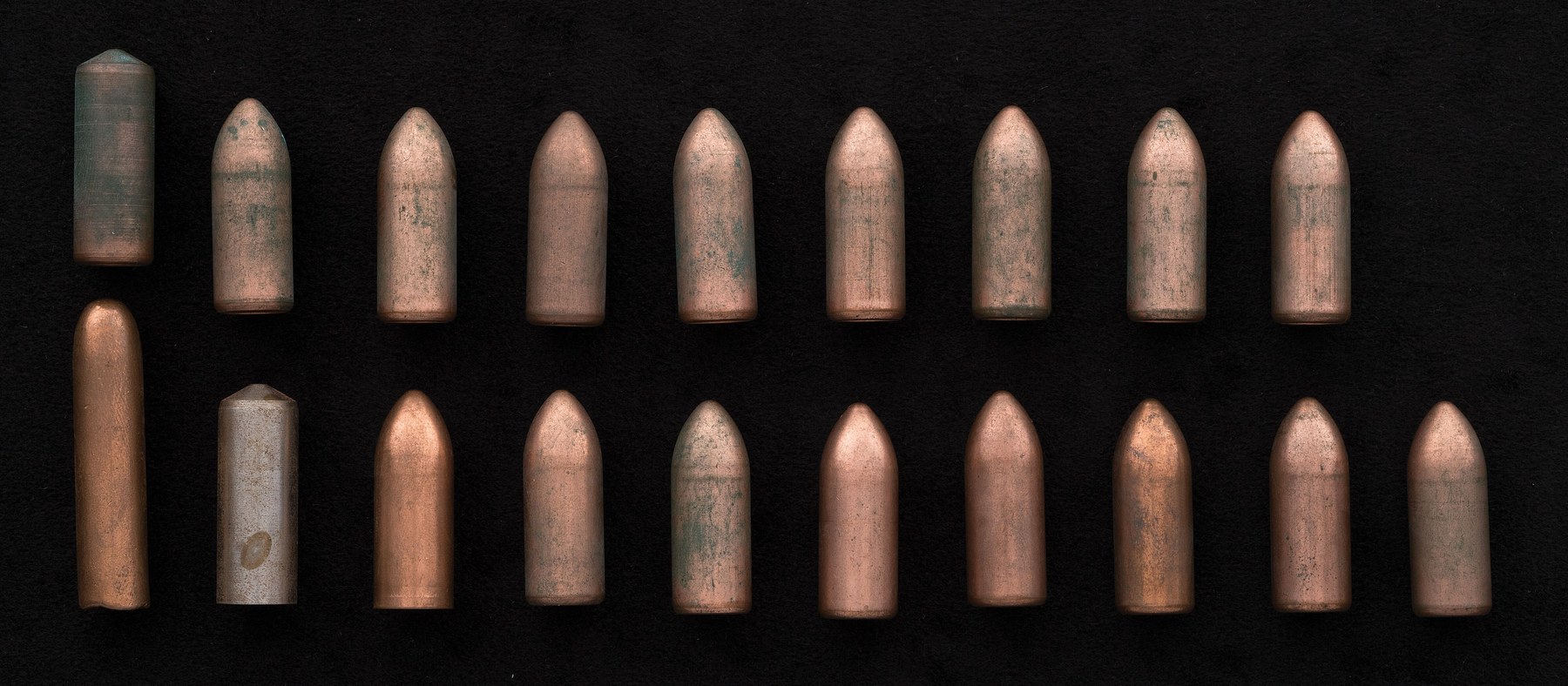
One terminological trap: Carpenter’s book uses “Mark I” to “Mark IV” for generations of the 13 mm rocket — “Mark I 13mm Gyrojets: First Generation”, “Mark II … Low Cost”, “Mark III … Low Dispersion”, “Mark IV … Low Cost, Low Dispersion” — which are not the same thing as the Mark I and Mark II pistols.15 A box of “Mark II” rockets is not necessarily ammunition for a Mark II pistol. One late box label read in an auction photograph gives a different kind of designation altogether: “13 MM-11A / LOT 089 / MFD. 3-68”.4
2.13 Numbers Not Repeated Here
- “About 1250 fps at 30 ft” as a single agreed figure (Wikipedia): the sources give four different burnout distances, set out above.
- “5-mil accuracy (about 17 MOA, or about 4.5 inches at 25 yards)” (Wikipedia, citing Smith’s Book of Pistols and Revolvers): not checked against Smith. The conversion itself is sound (5 mils is about 17 MOA, about 4.5 inches at 25 yards), but the source of the 5-mil claim, and whether it is a group size or a mean radius, could not be confirmed.
- Ammunition “over $800 per round” (Wikipedia, citing a Swedish collectors’ page): see the dated auction record in Volume 7 instead.
- The Minchakievich story (Wikipedia: a Pleasanton friend who invented the canted ports and approached Gene Roddenberry for Star Trek): its sources are given as “Livermore Labs, p. 42” and “Paramount Pictures, Correspondence, vol. XIX”, neither identifiable; MBA’s patents, Carpenter and Spangler do not mention him. Not repeated.
References
Footnotes
-
Mel Carpenter, An Introduction to MBA Gyrojets and Other MBA Ordnance (2010), Chapter 6, pp. 77–86, sample chapter, https://web.archive.org/web/20120904025322/http://www.gyrojet.net/Gyrojet_Book_Sample_Chapter_6.pdf , retrieved 2026-09-19. ↩ ↩2 ↩3 ↩4 ↩5 ↩6 ↩7 ↩8 ↩9 ↩10 ↩11 ↩12 ↩13
-
“More punch than a .45: Rocket-firing small arms”, Popular Science vol. 187 no. 6 (December 1965), p. 113, Internet Archive, retrieved 2026-09-19. ↩
-
John Spangler, “MBA Gyrojet Mark I Model B Pistols and Carbines: Rocket Science Meets Reality”, ASAC Bulletin 105 (2012), pp. 58–66, https://americansocietyofarmscollectors.org/wp-content/uploads/2022/04/2012-B105-MBA-Gyrojet-Mark-I-Model-B-Pistols-and-C.pdf , retrieved 2026-09-19. ↩ ↩2 ↩3 ↩4
-
Rock Island Auction Company lot descriptions of Gyrojet ammunition: auction 65 lot 1935 (11 September 2015); auction 69 lots 838 and 3810 (December 2016); auction 71 lots 935 and 1807 (September 2017); auction 89 lot 600 (25 August 2023); auction 4090 lot 3757 (10 December 2023); https://www.rockislandauction.com/detail/ followed by auction and lot number, retrieved 2026-09-19. ↩ ↩2 ↩3
-
Mel Carpenter, Chapter 28, “Supplemental Miscellaneous Notes by Chapter” (June 2012), https://web.archive.org/web/20180721025145/http://www.gyrojet.net/ch28.pdf , retrieved 2026-09-19. ↩ ↩2 ↩3
-
M. C. Hengel, A. T. Biehl and R. Mainhardt, US Patent 3,212,402, filed 29 November 1962, issued 19 October 1965, col. 3, https://patentimages.storage.googleapis.com/pdfs/US3212402.pdf . ↩
-
Leonardo M. Antaris, “The Gyrojet Rocket Handguns: An Early Exploration Into The Future”, Gun Journal, January 1997, read from photographs with Rock Island Auction lot 57/1886, https://www.rockislandauction.com/detail/57/1886 , retrieved 2026-09-19. ↩ ↩2 ↩3
-
Monty Mendenhall, “Gyrojets — Review” (part 2), deathwind.com, Wayback capture of 20 February 2003, https://web.archive.org/web/20030220110005/http://www.deathwind.com/review_2.htm , retrieved 2026-09-19. The page refers to an earlier instalment in Small Arms Review, not seen. ↩ ↩2 ↩3 ↩4 ↩5 ↩6 ↩7 ↩8 ↩9
-
Alan Eliasen, “Gyrojet Ballistics”, https://futureboy.us/blog/gyrojet.html , retrieved 2026-09-19. ↩
-
Wikimedia Commons, “File:Gyrojet Rocket Carbine at the National Firearms Museum.jpg”, description, https://commons.wikimedia.org/wiki/File:Gyrojet_Rocket_Carbine_at_the_National_Firearms_Museum.jpg , retrieved 2026-09-19. ↩
-
ARPA, Project AGILE Quarterly Report, 1 April – 30 June 1963, DTIC AD338491, p. 15, Wayback copy of http://www.dtic.mil/dtic/tr/fulltext/u2/338491.pdf , retrieved 2026-09-19. ↩
-
Mel Carpenter, Chapter 29, “Supplemental Miscellaneous Notes by Chapter” (2016), https://web.archive.org/web/20170918161453/http://www.gyrojet.net/ch29.pdf , retrieved 2026-09-19. ↩
-
MBAssociates, “Operating Instructions” (Model B period), photographed with Rock Island Auction lot 57/1886, retrieved 2026-09-19. ↩ ↩2
-
Mel Carpenter, book contents page, gyrojet.net, https://web.archive.org/web/20180721025141/http://www.gyrojet.net/contents.htm , retrieved 2026-09-19. ↩

Comments (0)