MBAssociates Gyrojet · Volume 1
MBAssociates — Two Nuclear Engineers, a Nike Site, and a Rocket That Became a Pistol
Robert Mainhardt and Art Biehl, the Finjet and Lancejet that came first, the ARPA money that paid for the Gyrojet, and how a profitable defence contractor came to sell a gun it never made money on
The MBAssociates Gyrojet is the only firearm sold to the American public whose projectile is a rocket. It fired a self-contained, spin-stabilised solid-fuel motor, about half an inch across and an inch and a half long, from a vented tube in a pistol or carbine whose frame was a zinc-alloy die casting. It was made in small numbers between 1962 and about 1972 — the sources put the total at roughly 1,900 guns of every kind — and it failed commercially, but it is the most literal “ray gun” ever put on a dealer’s counter, and its story runs through the Advanced Research Projects Agency, Vietnam, a James Bond film and the Gun Control Act of 1968.
1.1 What This Dive Is
This is a reference dive. The owner of this hub does not own a Gyrojet; the dive belongs to a series on the streamlined, “space-age” firearms of the 1950s and 1960s, alongside the Whitney Wolverine. Its eight volumes cover the company (this volume), the round (Volume 2), the mechanism (Volume 3), the look and why a rocket permits it (Volume 4), the variants and how to tell them apart (Volume 5), the law — which for a 13 mm Gyrojet is a genuine teaching case (Volume 6) — trials, films and the collector market (Volume 7), and handling, maintenance and repair from MBA’s own instruction sheet (Volume 8).
The literature is thin and repetitive. Three sources carry most of the weight here, and each is quoted by name so that a reader can weigh it: John Spangler’s 2012 paper for the American Society of Arms Collectors, which itself defers to Mel Carpenter; the parts of Carpenter’s 2010 book An Introduction to MBA Gyrojets and Other MBA Ordnance that he published on his website (a sample chapter, three supplementary chapters, a serial-number census and a question-and-answer page); and Leonardo Antaris’s January 1997 Gun Journal article, which survives as photographs in a Rock Island Auction lot. Primary documents are used wherever they exist: MBA’s two pistol patents, a declassified ARPA report of 1963, CIA correspondence of 1960–62, Popular Science of December 1965, MBA’s own operating instructions, and ATF’s Curios or Relics List. Carpenter’s full book was not obtained, and where it would have settled a question the text says so.
1.2 The Founders
Robert Mainhardt (1922–2006). Spangler, drawing on Carpenter, gives Mainhardt a master’s degree in engineering and a wartime post running the materials laboratory at Los Alamos, where he was one of the B-29 “weaponeers” who armed the atomic bomb in flight. After the war he worked for the Atomic Energy Commission’s intelligence division, the Lawrence Livermore laboratory and Aerojet-General Nucleonics.1 Antaris adds the University of California Radiation Laboratory and describes Mainhardt as having founded Aerojet-General Nucleonics in 1956 and served as its vice president and general manager until 1960; Spangler says only that he worked there.2 Carpenter records that he had no middle name.3
Arthur T. Biehl (1924–1993). A physicist with an engineering doctorate and a Naval Reserve commission, Biehl worked for North American Aviation and at Livermore before joining Mainhardt at Aerojet-General Nucleonics.1 The two men worked together there on the AGN-201, a small, self-contained, low-power reactor built in the 1950s for teaching, medical and industrial use. According to Spangler, their “creative tendencies chafed under management who wanted them for long-term supervision of a completed project”, and they left.1
Carpenter credits Biehl with the name: he “coined the term Gyrojet in 1961”, and GYRO-JET became MBA’s registered trademark, number 799,701, on 7 December 1965. Carpenter adds that the name is technically wrong — a jet engine breathes air, and a Gyrojet carries its own oxidiser — and that Mainhardt defended it on the ground that the exhaust “jetted” from the ports.4
1.3 A Company, Not a Gun Maker
MB Associates — the initials are Mainhardt’s and Biehl’s, and the company wrote itself as one word, “MBAssociates” — was founded in 1960. Spangler gives the date as 1 April 1960; Carpenter’s supplementary chapter distinguishes the founding in 1960 from incorporation in April 1961, when MBA absorbed an internal marketing shell called OrdTech.15 The earliest surviving letterhead located, on a July 1962 letter to the CIA, gives the address as 1279 Boulevard Way, Walnut Creek, “near San Francisco”, with Mainhardt signing as vice president and general manager.6 By December 1965 Popular Science placed the company in San Ramon, and the operating instructions shipped with the pistols carry a San Ramon letterhead signed by Mainhardt as president.78
The San Ramon site was unusual. Spangler describes it as “an entire former Nike missile site with numerous buildings and bunkers”, on Bollinger Canyon Road, not far from Livermore.13
What matters most for understanding the Gyrojet is what else MBA made. Spangler insists that MBA “was a large operation, not just two guys struggling in a garage”, that it “did not set out to become a ‘gun company’”, and that it was “a profitable corporation every year it was in business, although the small Gyrojets themselves were never profitable”. Its money came from radar chaff and infrared flare countermeasures for aircraft, the dispensers that carried them, “cold smoke” marker charges for practice bombs, and engineering studies. The Gyrojet pistol, in Spangler’s words, was “a very small, ultimately unsuccessful, part of the overall MBA operation.”1
That context explains a good deal about the gun: why it looks like a product of an aerospace model shop rather than a gun factory (Volume 4), why its makers kept offering it to the military long after civilians had lost interest, and why the company survived its failure.
1.4 Microjets: Finjets and Lancejets First
The Gyrojet was not MBA’s first small rocket, and “Microjet” was not the name of a single round. Carpenter defines “Microjet” as MBA’s designation for its whole family of miniature rockets — Gyrojets, Finjets and Lancejets — excluding the solid “Javette” darts.3 The CIA’s own paperwork uses the word for MBA’s concept as early as January 1961.9
- Finjets came first: fin-stabilised rockets of about 3 mm body diameter, under two inches long, with steel needle noses. Spangler traces them to a 1961 idea, raised with the head of the new Defense Advanced Research Projects Agency — an old associate of the founders — for “cheap disposable weapons that could be provided to Vietnamese peasants to defend themselves against Viet Cong attackers”: a throwaway handgun firing a salvo of tiny rockets, to be air-dropped where needed. The accuracy was poor. A 24-rocket salvo had, in Spangler’s summary, “only a 50% chance of even a single rocket hitting within an 18-inch circle at 100 yards.”1
- Lancejets were longer, heavier-nosed rockets of about quarter-inch calibre and six inches long, stabilised like a javelin by mass concentrated at the nose, proposed for mine clearing and later as underwater projectiles.13
- Javettes were unpowered sub-miniature darts, some as small as 0.030 in, fired from adapted cartridges; Carpenter’s and Spangler’s accounts connect some of them to sentry dogs and to the CIA.13
A CIA memorandum of 17 January 1961, released in 2011, records the agency’s reaction to an MBA “Microjet Proposal”. Mainhardt had visited in December 1960; the proposal went to the Weapons Panel of the agency’s Technical Requirements Board on 7 December, which concluded that the microjet “was a Weapon which could be of use to the CS but not of sufficient use for us to underwrite an expensive R&D program in connection therewith.” The memo notes that the Army was “considering this concept in competition with another system”, and describes the agency’s interest as “lukewarm”.9
1.5 From Fins to Spin: the Gyrojet, 1961
Finjets were inaccurate and awkward. Carpenter quotes MBA’s 1962 study MB82 comparing the two approaches: spin-stabilised rockets would pack more densely with no fins to protect, would be easier to load and fire from short launchers, would have less drag and simpler cases, and would work in vacuum — NASA was on MBA’s list of customers. Against that, spin rockets were shorter for their diameter and so held less propellant, needed tighter manufacturing tolerances, and were harder to analyse.4
The decisive argument was commercial. MBA’s target customer was the U.S. military, and Carpenter reports that the company met “a strong reluctance … to adopt a totally new small arms weapons technology”. A spin-stabilised rocket could be made to look like a cartridge and fired from a gun that looked like a gun. Mainhardt quoted Biehl as asking, “Why don’t we make it look like a .45 ACP?” — the rocket and the pistol both — and Carpenter states that MBA “designed its firearms specifically to look like then-current military rifles and pistols”, the M1911A1 for the pistol and the M16 for the carbine.4 Volume 4 comes back to that sentence, because it is the key to the look.
Carpenter also records how close the company came to failing before the Gyrojet: “At one point, the entire MBA work force was laid off because of the lack of revenue to pay salaries. If a new product had not been developed, MBA would have failed in 1961.” Financial support from a “Prince Trust” and a few government research contracts kept it alive.4
Spangler dates the start of spin-rocket experiments to 1961, beginning with rockets about an eighth of an inch across and working up. One attempt was a rocket for a modified M1911 pistol, abandoned because the round was too short to hold enough propellant. By 1962 MBA had settled on a .49-calibre rocket with good stability.1
1.6 The Pistol: a Sketch, a Patent, and ARPA’s Hundred Guns
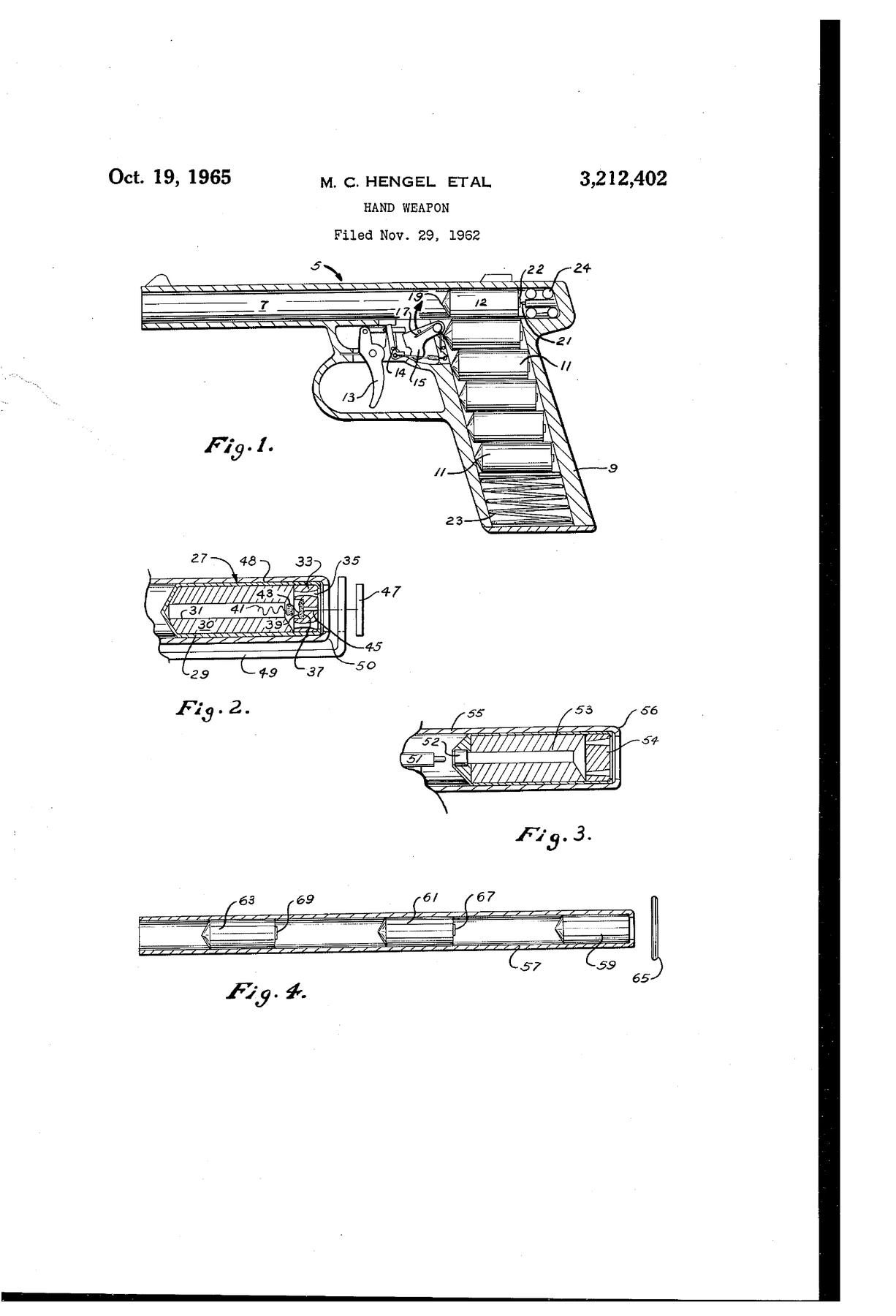
A rocket needs something to launch it. Spangler dates the “first rough sketch of the pistol mechanism” to 10 October 1962, and MBA filed the patent application six weeks later, on 29 November 1962. That application became US Patent 3,212,402, “Hand Weapon”, issued on 19 October 1965 to Mathew C. Hengel of Hayward and to Biehl and Mainhardt, all assigned to MB Associates.110 Its first figure — the hero image of this volume — contains the whole Gyrojet pistol in outline: rockets stacked in the grip, a launch tube instead of a barrel, and a spring-driven mass that swings up in front of the round, strikes its nose and drives it back onto a fixed firing pin (Volume 3).
The patent is also the clearest statement of the idea behind the gun. Because “miniature rockets do not depend on high temperature and pressure gases in the weapon”, it says, “a rocket hand weapon is recoilless and its barrel tends not to become corroded or over heated”, and “launcher materials may be lightweight plastics or metals”. It estimates that “an entire hand weapon system with six rocket projectiles would weigh about one half pound as compared to standard service automatics which weight about two and a half pounds unloaded”.10 That half-pound figure was never reached, but the direction of the argument — light, cheap, cast — shaped every Gyrojet that followed.
The money for the first pistols came from ARPA. Project AGILE was ARPA’s remote-area-conflict programme, much of it directed at South-East Asia, and its quarterly report for April to June 1963 — once CONFIDENTIAL, now cleared for public release — lists a “Microrocket Pistol” task: “To develop a very low cost, defensive weapon suitable for use by indigenous paramilitary or civilian forces against guerrilla attacks.” The gun “is to be die cast of zinc or aluminum alloy and will fire .49 caliber microrocket projectiles which are loaded into a magazine in the handle”, and the rocket “is expected to equal or surpass the lethality of the .45 caliber ACP cartridge”. The report’s summary adds that the pistol “is expected to cost an order of magnitude less than any equivalent small arm presently available”.11
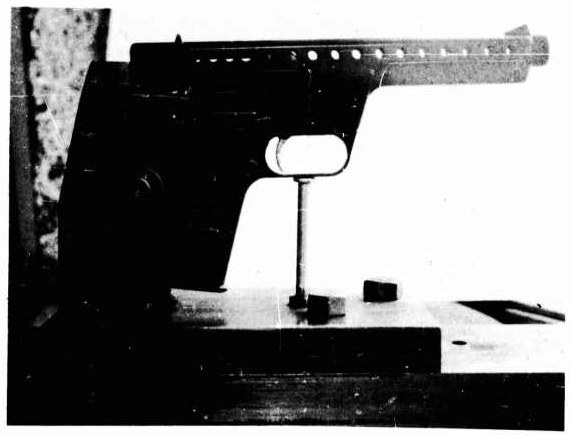
The same report records the result. “Under contract to ARPA, the H. P. White Laboratory conducted engineer design tests on the MB Associates caliber .49 gyrojet pistol and ammunition. MB Associates furnished 101 pistols and 1,000 rounds of ammunition for the tests. Preliminary report of tests indicates problems on reliability and accuracy were encountered which require correction before additional production is undertaken.”11 The problems it names — reliability and accuracy — were never fully solved, and Volume 2 explains why.
A CIA letter of July 1962 shows that MBA was also shopping a “.50 Gyrojet Hand Weapon” to the intelligence community: Mainhardt wrote to the agency’s deputy director for research offering an “Evaluation Quantity of the Low Cost, Highly Effective Caliber .50 Gyrojet Hand Weapon” under proposal MB-137a. The reply of 21 July 1962 called it “a rather interesting idea” and forwarded it elsewhere.6 The proposal number and the name of the first production pistol, the Model 137, are almost certainly related; no source located states the connection outright.
1.7 Selling to Collectors
The military did not buy. Spangler’s account of what happened next is the key to the Gyrojet’s odd market position. Mainhardt “had observed that Colt was selling a lot of ‘commemorative’ pistols to collectors, rather than shooters, so he decided to test that market, hoping to generate sales from people less concerned about accuracy or reliability than the shooters he had initially targeted.” The first 13 mm pistols, the Mark I, went out from about 1963 in walnut cases — “the same ones as used for Gerber knives” — some marked “EXPERIMENTAL”, at around $250 to $300.1
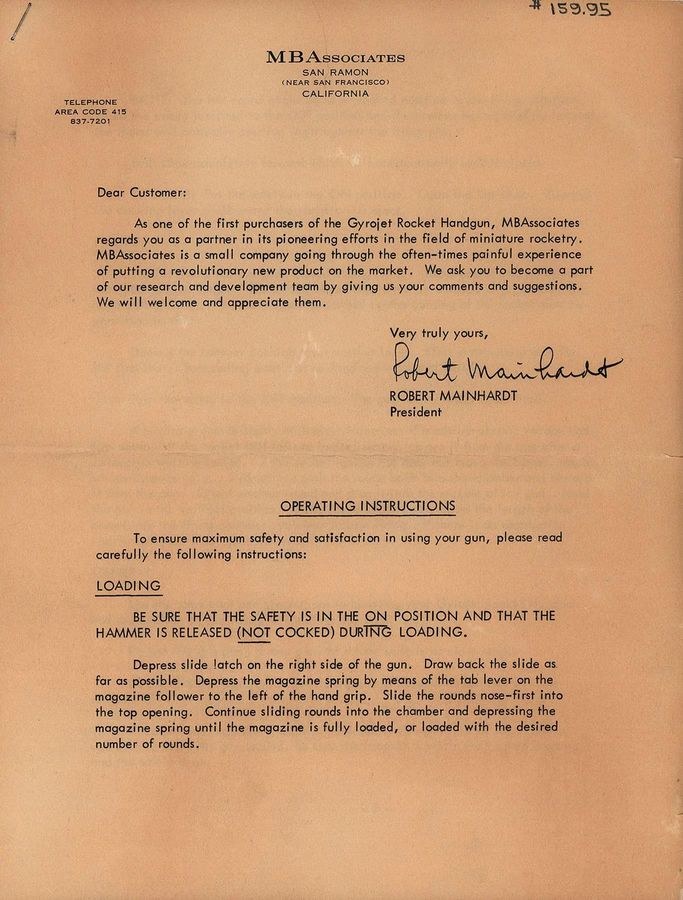
The letter shipped with the guns makes the same point in MBA’s own words. It asked each buyer “to become a part of our research and development team by giving us your comments and suggestions.”8 The customers were, in effect, the test programme.
The improved Mark I Model B went on show at the Las Vegas gun show in September 1965 at $160 to $175 in a cardboard box, or $250 as a “presentation model” in a walnut case with ten dummy rounds and a medallion of the rocket pioneer Robert Goddard; the carbines followed at $300.1 Popular Science, three months later, quoted different figures — $250 for “first-edition” pistols, an expected $50 once full production was reached, $200 for the carbine and ammunition at 12 to 15 cents a round — which are best read as MBA’s projections rather than its prices.7 Spangler’s comparison of the real prices is damning: in 1965 a Colt M1911 cost $82, a Ruger Super Blackhawk $116, a Smith & Wesson Model 29 $140, and the 13 mm rockets $1.35 each, when fifty rounds of .22 Long Rifle cost about 80 cents.1
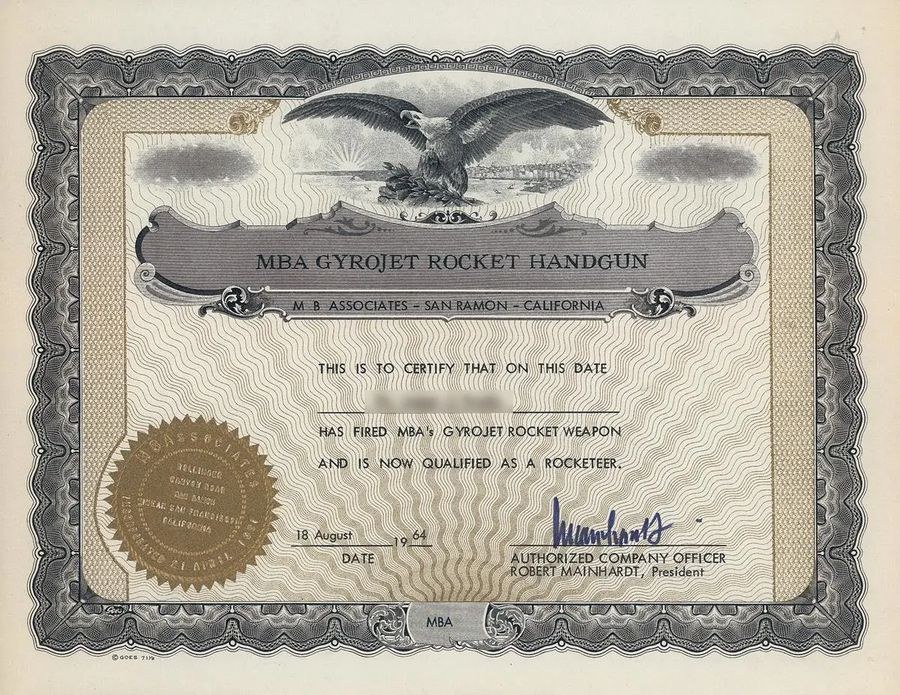
Buyers who fired a Gyrojet at the factory received a certificate declaring them qualified “as a rocketeer”. Carpenter notes that MBA printed them on modified blank stock certificates, and that the same design, signed by Mainhardt, certified the cased presentation pistols.12
1.8 and After
The Gun Control Act of 1968 turned 13 mm into a problem. A 13 mm bore is 0.512 in, over the half-inch line in the National Firearms Act’s definition of a destructive device, and the Gyrojet’s rocket is propelled by “an explosive or other propellant”. MBA’s response, according to Spangler, was to stop making 13 mm pistols and carbines and to return to the earlier, smaller calibre — nominally 12 mm, about .49 in — in a pistol marked “MARK II MODEL C”. Roughly 600 were made from about 1969 to 1972, at a price cut to $99.1 Volume 6 sets out the law, quotes ATF’s list, and explains why the serial number now decides whether a surviving 13 mm gun is a curio or a destructive device.
Carpenter’s account of the same moment adds the business side: by 1968 “Gyrojet firearms and rocket sales were stagnant”, the Act “had placed the entire Gyrojet line in jeopardy”, and Mainhardt, with a manufacturing capability he did not want to lose, set his ordnance systems manager Robert C. Mawhinney to work on less-lethal weapons. The result was the Stun-Bag — a cloth bag of shot fired from a conventional cartridge case — and, after the Kent State shootings of 4 May 1970, a “blank check” to finish it quickly.3 MBA went on to make 40 mm Stun-Bag rounds for the M79, 37 mm and 12-gauge “Stinger” rounds, and the .38 Special “Short Stop”.1
The one Gyrojet product that did make money was a flare. Spangler describes the Gyrojet flare, developed in 1965 for the survival version of the Model B pistol, becoming the Model 201 signal flare fired from a simple pen-type launcher, a two-stage round whose flare section separates from a Gyrojet motor, and a profitable line that replaced the older “Penguin” flare and “remains in service today”.1 Carpenter writes of “millions of 13mm Gyro-Signal survival flares and launchers” for U.S. and foreign services.4 Volume 7 shows one being fired by a U.S. Air Force pilot in training in 2010.
1.9 The End of MBA, and of Mainhardt’s Companies
Biehl left MBA in 1965 but stayed on its board as a part-owner. In 1980 Tracor, Inc. bought the company — Spangler says for its “lucrative chaff and flare business, not the unprofitable Gyrojet segment” — and it became Tracor/MBA. Mainhardt stayed as president until 1982.13
Mainhardt then founded two more companies. Trebor, Inc. (“Robert” backwards), formed in January 1983, sold less-lethal products and leftover MBA inventory and filed for bankruptcy in July 1988; Protection and Survival International, founded on 3 September 1991 to sell off what remained of MBA’s and Trebor’s stock, lasted about a year.3 Some of the ammunition that surfaces today almost certainly came out of those sell-offs; one of the most expensive lots of Gyrojet rounds ever sold was consigned by the great-grandchild of a man who “worked for MBA in the late 60s and early 70s” (Volume 7).13
Wikipedia’s article on the Gyrojet says that MB Associates “went bankrupt in 1975”. Nothing in the sources consulted supports that: Spangler has MBA profitable to its sale to Tracor in 1980, and Carpenter’s corporate history runs through Tracor, Trebor and PSI. The 1975 date is not repeated here as fact.14
1.10 Timeline
Table 1 — Timeline
| Date | Event | Source |
|---|---|---|
| 1956–60 | Mainhardt at Aerojet-General Nucleonics | Spangler; Antaris |
| 1960 | MB Associates founded (Spangler: 1 April 1960) | Spangler; Carpenter |
| Dec 1960 – Jan 1961 | CIA reviews MBA’s “Microjet Proposal”; interest “lukewarm” | CIA memo, 17 Jan 1961 |
| 1961 | Biehl coins “Gyrojet”; spin-rocket experiments begin; company nearly fails | Carpenter; Spangler |
| Apr 1961 | MBA incorporated, absorbs OrdTech | Carpenter ch. 28 |
| Jul 1962 | Mainhardt offers a “.50 Gyrojet Hand Weapon” (MB-137a) to the CIA | CIA letters |
| 10 Oct 1962 | First sketch of the pistol mechanism | Spangler |
| 29 Nov 1962 | Patent application filed (US 3,212,402) | the patent |
| 1962–63 | Model 137 (.49 cal.) pistols; 101 furnished for ARPA tests | Spangler; ARPA 1963 |
| 1963–65 | Mark I 13 mm pistols, cased, some “EXPERIMENTAL” | Spangler; RIA lots |
| 1 Jul 1965 | MBA’s first Gyrojet news release | Carpenter ch. 6 |
| Sep 1965 | Mark I Model B and carbines shown at Las Vegas | Spangler |
| 19 Oct 1965 | US 3,212,402 issued | the patent |
| 7 Dec 1965 | GYRO-JET trademark registered | Carpenter ch. 6 |
| 27 May 1966 | Life, “Deadly Zip Gun for the Missile Age” | Spangler |
| 20 Dec 1966 | Murderers’ Row released, with a Gyrojet survival pistol | Carpenter ch. 28 |
| 1967 | You Only Live Twice | Spangler |
| 1968 | Gun Control Act; 13 mm production ends | Spangler; Carpenter |
| 26 Nov 1968 | US 3,412,641 issued (improved pistol) | the patent |
| c. 1969–72 | Mark II Model C, 12 mm, about 600 made | Spangler; Carpenter census |
| 1970 | Less-lethal programme accelerated after Kent State | Carpenter |
| 1980 | Tracor buys MBA | Spangler; Carpenter |
| 1982 | Mainhardt leaves Tracor/MBA | Spangler; Carpenter |
| 1983–88 | Trebor, Inc. | Carpenter |
| 1991–c. 1992 | Protection and Survival International | Carpenter |
| 2006 | Mainhardt dies | Spangler |
1.11 How Many Were Made
No MBA production ledger has been published, and the totals in circulation differ. They are given here by source, not averaged.
Table 2 — How Many Were Made
| Model | Figure | Source |
|---|---|---|
| All Gyrojet pistols and carbines | ”approximately 1900” | Spangler (2012) |
| All types | ”fewer than 2,000” | Antaris (1997) |
| All Mark 1 pistols, carbines and rifles | ”no greater than 1,900” (attributed to “educated collectors”) | RIA lot 4095/564 (2025) |
| Model 137 (.49 cal.) | “approximately 45” | Spangler |
| Model 137 | ”only 32 were completed” (estimate) | Antaris |
| Model 137 | highest known butt number 144, “does not necessarily mean” 144 finished | Carpenter census |
| Model 137 | ”only around 150” | RIA lot 89/598 (2023) |
| .49-cal. pistols furnished to ARPA’s tester | 101 | ARPA, July 1963 |
| Mark I (Model A) pistols | ”approximately 100” (1963–65) | Spangler |
| Mark I, A serial range | ”fewer than 100”, of which 85 cased | Antaris |
| Mark I Model B pistols and carbines | ”approximately 1100” (1965–68) | Spangler |
| Model B military carbines | ”less than 100” | Spangler |
| Model B sporter carbines | ”approximately 300” | Spangler |
| Mark II Model C (12 mm) | “approximately 600” | Spangler; Antaris; Carpenter (gun logs to 606) |
The Model 137 is the worst case: five figures, from 32 to about 150, none of them a count. The ARPA report is the only contemporary document, and it says MBA furnished 101 pistols — which cannot be reconciled with Antaris’s 32 or Spangler’s 45 unless those figures count something narrower, such as guns sold. The honest statement is that more than a hundred .49-calibre pistols existed by mid-1963, and nobody has published how many reached the public.
1.12 The Volumes That Follow
- Volume 2 — the round: how a Gyrojet rocket is built, why it spins, why it is slow at the muzzle, and why it missed.
- Volume 3 — how the pistol works, from the two patents: a hammer in front of the round, a fixed firing pin behind it, and a rocket that re-cocks the gun as it leaves.
- Volume 4 — the look: zinc die casting, vented tubes and why a rocket needs no breech.
- Volume 5 — variants and identification, with comparison plates.
- Volume 6 — the law: destructive devices, the 1968 redesign, and ATF’s serial ranges.
- Volume 7 — trials, Vietnam, the screen, and the collector market.
- Volume 8 — handling, maintenance and repair, from MBA’s own instructions.
References
Footnotes
-
John Spangler, “MBA Gyrojet Mark I Model B Pistols and Carbines: Rocket Science Meets Reality”, American Society of Arms Collectors Bulletin 105 (2012), pp. 58–66, https://americansocietyofarmscollectors.org/wp-content/uploads/2022/04/2012-B105-MBA-Gyrojet-Mark-I-Model-B-Pistols-and-C.pdf , retrieved 2026-09-19. Spangler states that “the definitive story is told in Mel Carpenter’s excellent book”. ↩ ↩2 ↩3 ↩4 ↩5 ↩6 ↩7 ↩8 ↩9 ↩10 ↩11 ↩12 ↩13 ↩14 ↩15 ↩16 ↩17 ↩18
-
Leonardo M. Antaris, “The Gyrojet Rocket Handguns: An Early Exploration Into The Future”, Gun Journal, January 1997; read from photographs of the article’s pages included with Rock Island Auction lot 57/1886 (30 November 2012), https://www.rockislandauction.com/detail/57/1886 , retrieved 2026-09-19. ↩
-
Mel Carpenter, “Questions and Answers” (updated 2 November 2010) and “Gyrojet Census by Serial Number”, gyrojet.net, Wayback Machine captures of 21 July 2018, https://web.archive.org/web/20180721025140/http://www.gyrojet.net/qna.htm and …/census.htm , retrieved 2026-09-19. ↩ ↩2 ↩3 ↩4 ↩5 ↩6 ↩7 ↩8
-
Mel Carpenter, An Introduction to MBA Gyrojets and Other MBA Ordnance (2010), Chapter 6, “Introduction to Gyrojets”, pp. 77–86, published as a sample chapter at https://web.archive.org/web/20120904025322/http://www.gyrojet.net/Gyrojet_Book_Sample_Chapter_6.pdf , retrieved 2026-09-19. The rest of the book was not obtained. ↩ ↩2 ↩3 ↩4 ↩5
-
Mel Carpenter, Chapter 28, “Supplemental Miscellaneous Notes by Chapter” (June 2012), gyrojet.net, https://web.archive.org/web/20180721025145/http://www.gyrojet.net/ch28.pdf , retrieved 2026-09-19. ↩
-
Robert Mainhardt, MB Associates, to Dr Herbert Scoville Jr, Deputy Director (Research), CIA, 10 July 1962, CIA-RDP66R00638R000100060028-7; reply by Edward B. Giller, 21 July 1962, CIA-RDP66R00638R000100060029-6; Internet Archive copies of the CIA Reading Room documents, https://archive.org/details/cia-readingroom-document-cia-rdp66r00638r000100060028-7 , retrieved 2026-09-19. ↩ ↩2
-
“More punch than a .45: Rocket-firing small arms”, Popular Science vol. 187 no. 6 (December 1965), p. 113, Internet Archive item popular-science-vol-187-6-dec-1965-popular-science, retrieved 2026-09-19. (US 3,412,641 cites the article as p. 133.) ↩ ↩2
-
MBAssociates, letter to purchasers and “Operating Instructions”, three pages and a photograph sheet, Model B period; photographed with Rock Island Auction lot 57/1886 (30 November 2012), https://www.rockislandauction.com/detail/57/1886 , retrieved 2026-09-19. ↩ ↩2
-
Deputy Chief, DD/P/TSD, memorandum for the Deputy Director (Plans), “Microjet Proposal”, 17 January 1961, with memorandum for the record of the Weapons Panel meeting of 7 December 1960, CIA-RDP78-03642A002400020027-4 (sanitized, released 2011), https://archive.org/details/cia-readingroom-document-cia-rdp78-03642a002400020027-4 , retrieved 2026-09-19. ↩ ↩2
-
M. C. Hengel, A. T. Biehl and R. Mainhardt, US Patent 3,212,402, “Hand Weapon”, filed 29 November 1962, issued 19 October 1965, https://patentimages.storage.googleapis.com/pdfs/US3212402.pdf . ↩ ↩2
-
Advanced Research Projects Agency, Project AGILE: Remote Area Conflict, Quarterly Report 1 April – 30 June 1963, issued by Battelle Memorial Institute, 15 July 1963, pp. 15–16 (Tab 1) and the sub-project summary; DTIC AD338491, originally CONFIDENTIAL, now approved for public release; Wayback copy of http://www.dtic.mil/dtic/tr/fulltext/u2/338491.pdf , retrieved 2026-09-19. ↩ ↩2
-
Mel Carpenter, Chapter 27, “Supplemental Miscellaneous Notes by Chapter” (June 2011), gyrojet.net, https://web.archive.org/web/20170913024859/http://www.gyrojet.net/Ch27.pdf , retrieved 2026-09-19. ↩
-
Rock Island Auction Company, auction 1049, lot 3798, “Gyrojet 13 mm Rocket Ammunition”, 5 October 2025, https://www.rockislandauction.com/detail/1049/3798 , retrieved 2026-09-19. ↩
-
Wikipedia, “Gyrojet”, consulted 2026-09-19 (the 1975 bankruptcy is stated in its “Survival 2000” section without a source). ↩
Comments (0)