Mauser HSc · Volume 8
Collecting One, the Law, and the Screen
Thirty dated auction results, a ten-fold premium on the first thirteen hundred pistols, a rare calibre the market does not notice, and a curio-and-relic position that turns over in 2027
There is a lot of dated price evidence for this pistol, and it says something that the general accounts do not: the HSc is a cheap gun with one very expensive corner.
The figures below are hammer prices from Rock Island Auction, with their estimates alongside, retrieved on 20 September 2026 through the Wayback CDX index because the auction house’s own search is closed to automated retrieval. They are what somebody actually paid at a major auction on a named date. They exclude the buyer’s premium, which is real money and is not in these numbers.
8.1 What They Actually Sell For
8.1.1 Ordinary wartime pistols
Table 1 — Ordinary wartime pistols
| Date | Lot | Description | Estimate | Hammer |
|---|---|---|---|---|
| 20 Feb 2015 | 1024/3725 | Mauser HSc, 7.65 mm | $750–1,000 | $800 |
| 25 Feb 2016 | 1026/632 | Mauser HSc, 7.65 mm | $800–1,100 | $750 |
| 26 Jun 2016 | 1027/4403 | Mauser HSc, 7.65 mm | $1,000–1,500 | $950 |
| 24 Feb 2021 | 2040/302 | Mauser HSc | $500–800 | $700 |
| 25 Aug 2021 | 2049/275 | Mauser Model HSc | $700–900 | $650 |
| 7 Oct 2021 | 1038/2732 | military proofed | $800–1,200 | $1,200 |
| 8 Oct 2021 | 1038/4593 | military, with holster | $800–1,200 | $750 |
| 9 Nov 2022 | 2065/232 | with holster | $500–800 | $1,000 |
| 11 Jan 2023 | 2068/787 | with holster | $500–900 | $500 |
| 7 Jun 2023 | 2074/256 | military proofed | $500–800 | $425 |
| 7 Feb 2024 | 2083/749 | with holster | $600–900 | $750 |
| 16 Oct 2024 | 2095/369 | with holster | $500–900 | $950 |
| 21 Feb 2025 | 1048/427 | military proofed | $900–1,300 | $1,000 |
| 22 Feb 2025 | 1048/2582 | military proofed | $900–1,300 | $1,000 |
Fourteen results across ten years, running $425 to $1,200, with most of them between $700 and $1,000. There is no obvious trend; a 2015 gun made $800 and a 2023 gun made $425.
For comparison, American Rifleman valued a c. 1943 WaA135 army pistol in NRA Very Good at $500 on 11 May 2017.1 That sits at the bottom of this range, which is about right for a condition grade rather than a top example.
8.1.2 Post-war Mauser-Interarms, 1968–77
Table 2 — Post-war Mauser-Interarms, 1968–77
| Date | Lot | Description | Estimate | Hammer |
|---|---|---|---|---|
| 29 Dec 2020 | 2038/505 | with box | $400–700 | $500 |
| 27 Jan 2021 | 2039/940 | nickel, with box | $400–600 | $600 |
| 10 Mar 2021 | 2041/739 | with box | $400–700 | $450 |
| 20 Oct 2021 | 2051/587 | — | $400–600 | $650 |
| 12 Jan 2022 | 2054/804 | — | $400–600 | $400 |
| 2 Mar 2022 | 2055/684 | with box | $500–700 | $475 |
| 1 Mar 2023 | 2070/882 | — | $600–800 | $450 |
| 10 Jan 2024 | 2081/33 | with box | $600–800 | $700 |
| 30 Oct 2024 | 2096/716 | with box | $500–800 | $350 |
| 30 Oct 2024 | 2096/909 | — | $400–700 | $300 |
$300 to $700, and ten results with no trend either. A pistol that cost $120 new in 1973 sells for about four times that fifty years later, which over that span is a loss in real terms.2
8.1.3 American Eagle, 1977
Table 3 — American Eagle, 1977
| Date | Lot | Estimate | Hammer |
|---|---|---|---|
| 25 Aug 2021 | 2049/28, .380, with box, manual and test target | $700–1,000 | $600 |
| 20 Oct 2021 | 2051/588, 7.65 mm, with box | $600–800 | $650 |
| 30 Mar 2022 | 2056/28 | $500–800 | $600 |
| 20 Jul 2022 | 2061/647 | $500–800 | $450 |
| 20 Jul 2022 | 2061/649 | $500–800 | $450 |
| 30 Oct 2024 | 2096/33 | $500–800 | $450 |
8.1.4 Italian licensed pistols
Table 4 — Italian licensed pistols
| Date | Lot | Description | Estimate | Hammer |
|---|---|---|---|---|
| 25 Aug 2021 | 2049/753 | two pistols, an HSc Super and an HSc-80 | $500–800 | $600 |
| 25 Aug 2021 | 2049/757 | two pistols | $500–800 | $500 |
| 14 Sep 2022 | 2063/554 | one HSc Super | $200–400 | $350 |
| 11 Jan 2023 | 2068/783 | one HSc Super | $300–500 | $325 |
8.2 The Ten-Fold Gun
Now the corner of the market that everything above is a floor for.
Table 5 — The Ten-Fold Gun
| Date | Lot | Description | Estimate | Hammer |
|---|---|---|---|---|
| 9 Dec 2023 | 4090/1511 | Early HSc, low grip screws, matching barrel, lanyard loop | $5,500–8,500 | $6,500 |
| 23 Aug 2024 | 4092/382 | ”Early Production Low Grip Screw Commercial”, early 1941 | $6,000–9,000 | $5,500 |
| 7 Dec 2024 | 4093/1379 | Low Grip Screw Commercial, serial 700296 | $7,000–9,500 | $7,000 |
🔴 The first thirteen hundred pistols are worth roughly ten times the next quarter of a million.
The reason is set out in Volume 5. The earliest commercial HScs were assembled on frames whose grip screws sit unusually low; Rock Island Auction’s descriptions place them in the 700000 to 701000 serial range, say the screw later moved up by three quarters of an inch, and report that about 1,350 frames were built that way, of which “a reported 500 went to the Kriegsmarine, with one example known to have been purchased by the army, and the remainder sold commercially”.34
Two things make this the sharpest collecting fact about the pistol.
The population is tiny and it is known. About 1,350 out of 334,357 — four pistols in every thousand ever made. The 7 December 2024 lot is serial 700296, which its catalogue calls “the 296th production example”.4
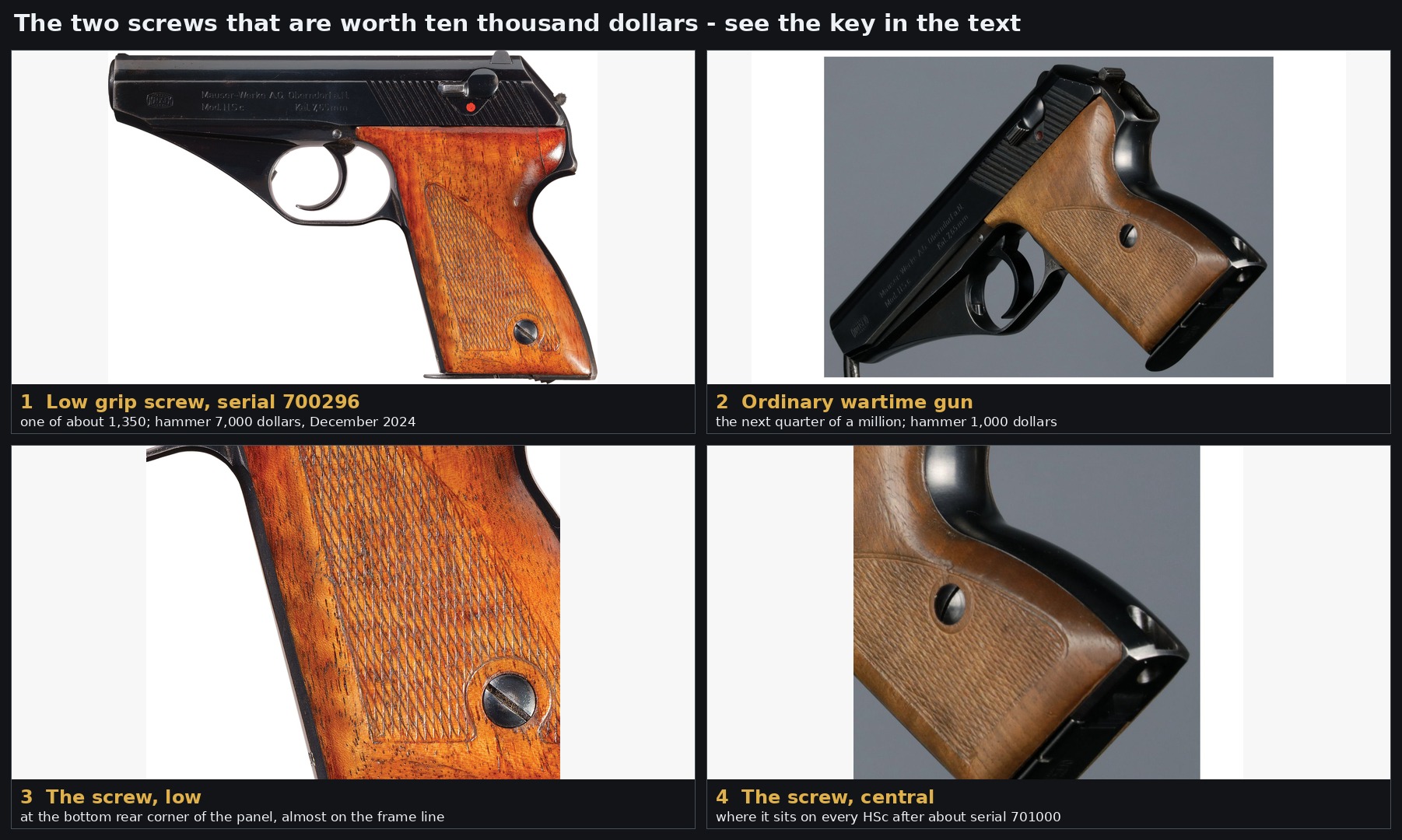
It is identifiable from across a table. The feature is the position of two screws. Volume 7’s plates show what an ordinary wartime grip panel looks like; the low-screw guns put the screw noticeably lower in the panel. Anybody who knows the tell is looking at a five-figure pistol in a tray of four-figure ones — and anybody who does not is looking at an old Mauser.
⚠ It also makes this the HSc most worth faking, and the fake is a grip panel and a pair of screw holes. Any gun claimed as a low-screw example should have its serial checked against the range, its barrel and slide numbers checked for matching, and the whole thing checked by somebody with a reference book. The premium is more than the pistol.
8.3 Navy, Police and Provenance
American Rifleman’s rule of thumb, published in 2017, is that “Navy guns bring about double that of Army specimens, as do World War II-vintage Swiss commercial models”, while “late World War II police and postwar guns normally have the least value”.1
The auction record supports the first half and complicates the second.
Table 6 — Navy, Police and Provenance
| Date | Lot | What it is | Estimate | Hammer |
|---|---|---|---|---|
| 23 Jun 2017 | 1029/2576 | eagle over M Kriegsmarine acceptance, holster, spare magazine | $900–1,400 | $1,700 |
| 6 Oct 2022 | 1041/4438 | Kriegsmarine marked, eagle over M III/8 | $800–1,200 | $1,600 |
| 7 Dec 2024 | 4093/1374 | Kriegsmarine 4th Model, from Jan C. Still’s own collection | $2,750–4,250 | $3,500 |
| 24 Aug 2024 | 4092/1375 | German police, eagle over swastika over L | $1,600–2,500 | $2,500 |
| 23 Jun 2024 | 1046/4428 | German police proofed | $800–1,400 | $1,000 |
Navy guns do roughly double an army gun, which is what American Rifleman says.
Police guns do not obviously bring the least. One made $1,000 and one made $2,500, against $425 to $1,200 for military-proofed guns. The $2,500 gun’s catalogue identifies its mark specifically as the eagle over swastika over L police proof; the $1,000 gun’s does not.56 That is a small sample and it may be condition rather than marking, but a correctly identified police mark is not a discount on this evidence.
Documented provenance is worth a multiple. The 7 December 2024 Kriegsmarine pistol came from the collection of Jan C. Still, the author of Axis Pistols in World War II, is photographed by serial in his own book on page 174, and was sold with a certificate of authenticity from his family. Still’s book records approximately 4,500 of that fourth Kriegsmarine variation made, with 47 reported by survey.7 It hammered at $3,500 against $1,600–1,700 for navy guns without that paperwork.
That is the general rule in collecting and it is worth stating in the pistol’s own terms. On an HSc, paperwork is worth about as much as the pistol.
8.4 The Rare Calibre the Market Does Not Notice
Volume 6 establishes from Burnham and Theodore’s production sheet that the 1977 American Eagle run of 5,000 pistols was split about 153 in 7.65 mm and 4,847 in 9 mm Kurz — the .32 being roughly three per cent of the run and the scarcest regular-production HSc variant in the record.8
Two American Eagles in the table above can be placed in that split from their own frame stampings:
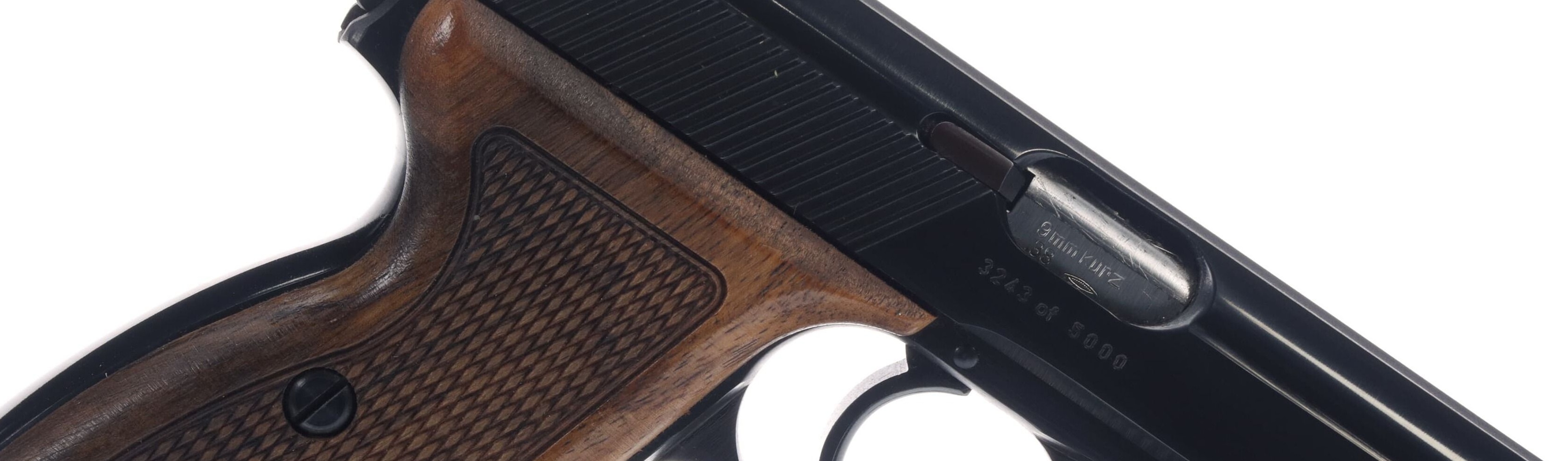
- lot 2049/28, frame stamped “4243 of 5000”, slide marked 9 mm Kurz — inside the .380 block, hammer $600;9
- lot 2051/588, frame stamped “0065 of 5000”, slide marked 7,65 mm — inside the .32 block, hammer $650.10
🔴 The rare one made fifty dollars more than the common one.
Six American Eagle results run $450 to $650 with no visible regard for calibre, and the pistol that is one of about a hundred and fifty is priced as one of five thousand. There are two possible readings and this dive cannot choose between them: either the market knows and does not care, or — more likely, given that the calibre is marked in small letters on the slide and the number is on the frame under the slide — nobody is looking.
Either way it is the one place in this pistol’s market where a reader who has read Volume 6 knows something the room does not. ⚠ The sample is two pistols. It is a lead, not a law.
8.5 The Italians at the Bottom
A Renato Gamba HSc Super sells for $325 to $350 on its own, against $300–$700 for a German post-war gun and $425–$1,200 for a wartime one.1112
That is the cheapest way into the shape by a clear margin, and Volume 6 gives the reasons to think about it rather than dismiss it: these are licensed pistols, not copies, with “under license of Mauser-Werke A.G. Oberndorf a.N.” on the slide, made in the Brescian gun valley.13 What they are not is a Mauser, and the market is pricing that distinction at about half.
⚠ Everything about the Italian guns in this dive rests on auction photographs and catalogue lines. No production figure, no date range and no serial scheme was obtained. A buyer at these prices is buying a pistol, not a documented variant.
8.6 What Moves a Price, and What Kills One
From the evidence assembled above and in Volume 5, in rough order of how much money is involved:
- Low grip screws, serial in the 700000s — a multiple of about ten.
- Documented provenance, especially a pistol published by serial in the standard reference — a multiple of about two on top of whatever else it is.
- Kriegsmarine acceptance — about double an army gun, as American Rifleman says.1
- A correctly identified police proof — on this evidence, no discount and possibly a premium.
- Matching numbers across frame, barrel and slide.
- The original box, manual, brush, test target and spare magazine on a post-war gun — worth having, though the table above shows boxed guns at $350 and unboxed ones at $650, so it is not decisive.
- A holster, which appears in many wartime lots and does not obviously move the price.
And what kills one:
- A refinish. The HSc’s finish history is its production history — polished commercial blue, military dusk blue, phosphate — and a reblue erases both the evidence and the shallow electropencilled slide number that proves the gun is matching.144
- Mismatched numbers, which on a French-period gun may be original and on a wartime gun are not.8
- Replaced grips, which are the most-swapped part on any pistol of this age and which Volume 7 uses as an era test.
- A forged acceptance mark, which is the risk that scales with everything above it.
8.7 Curio and Relic, and the Date That Matters
The Mauser HSc is an ordinary Title I handgun. It has nothing to do with the National Firearms Act.
Its curio-and-relic position is unusually clean, and it is about to change.
By name. ATF’s Firearms Curios or Relics List for 1972–1998 lists, in Section II, firearms classified as curios or relics under the Gun Control Act:
“Mauser, semiautomatic pistols mfd. prior to 1946, any caliber.”15
That covers every wartime HSc and almost all of the French-period production, which ran to June 1946.
By age. The list quotes the regulatory definition, then at 27 CFR § 178.11 and now § 478.11: a firearm is a curio or relic if it was “manufactured at least 50 years prior to the current date, but not including replicas thereof”.15 The hub’s M1 Garand dive sets out the definition in full and what the status allows a licensed collector to do; none of it is restated here.
🔴 The date to have in mind is 2027. As this volume is written, in September 2026, every HSc made up to and including 1976 is fifty years old and therefore a curio or relic by age. The 1977 American Eagle is not, and becomes one during 2027. A pistol from the last block of the last run is, for a few more months, the only HSc that is not C&R.
Three consequences follow for a buyer.
- A collector’s licence covers essentially the whole pistol’s history, from the first low-screw gun of 1940 to the 1975–76 New Model.
- C&R status changes how a licensed collector may acquire one. It does not change what the pistol is, and it confers nothing at all on a gun that has been re-manufactured or re-barrelled.
- “C&R” is not a valuation. Roughly 334,000 pistols are eligible. Scarcity within that population is what the earlier sections are about.
8.8 The Rest of the Legal Position
Two points, both short because the hub already owns them.
Michigan. An HSc is a pistol under Michigan law and is bought, sold and transferred under the same pistol-licensing and sales-record statutes as any other handgun, MCL 28.422 and 28.422a. The hub’s Remington XP-100 dive quotes both and explains the licence, the concealed-pistol-licence exemptions and the pistol sales record. Nothing about a 1940s German pocket pistol, or its curio status, alters that.
Nazi-era markings. Several European countries restrict the display or sale of items bearing the swastika, and the acceptance and proof marks described in Volume 5 include eagle-over-swastika stamps. That is a live issue for a collector shipping or travelling internationally and it is outside the scope of this dive; no jurisdiction’s rule is stated here because none was researched.
8.9 On Screen
The HSc had a long screen career, almost all of it in European cinema, and the record of it is the Internet Movie Firearms Database, consulted on 19 September 2026.16
⚠ Two things in IMFDB’s own header text about this pistol are wrong, and they are worth naming because the page is the most-read HSc reference on the internet. It says the pistol was “made by Mauser commercially between 1936-1939” — Burnham and Theodore record the first HSc test fired on 19 September 1940.8 And it gives “Fire Modes: Semi-automatic (single action)” for a pistol whose entire commercial reason for existing is its double-action trigger.16 The appearance list below is used as it stands; the text around it is not.
The entries a reader is most likely to have seen:
- Is Paris Burning? (1966), Gert Fröbe as General Dietrich von Choltitz — the German commander of Paris, carrying a German officer’s pistol, which is about as on-the-nose as casting a sidearm gets.
- Never Say Never Again (1983), Sean Connery as James Bond. Bond’s pistol is the Walther PPK; in this film he carries the Mauser. Given how much of Volume 7 is about the two pistols being confused, it is fitting that the most famous HSc on film belongs to the man who made the Walther famous.
- Funeral in Berlin (1966), carried by an Israeli agent.
- The Sucker (Le corniaud, 1965), Louis de Funès; and the OSS 117 films of 1965 and 1966, which is the pistol doing its native job as a European spy-film prop.
- Lacombe, Lucien (1974), Pierre Blaise — a French film about collaboration, with a French-relevant German pistol.
- Day for Night (La Nuit américaine, 1973), where it appears on the property tray, which is the most honest possible screen credit for a prop gun.
- A Colt Is My Passport (1967), The Silent One (1973), Casino (1992), Avalon (2001), Shpion (2012).
- Il conto è chiuso (1976), which IMFDB annotates as “possibly Renato Gamba manufactured” — the Italian licensed pistol, in an Italian film, two years before the HSc-80.
- Anime: Akira (1987), Mezzo Forte (1998), Najica Blitz Tactics (2001).
- Games: World of Guns: Gun Disassembly, which added the “Nazi German model” with an 8-round magazine on 16 September 2023, and Resident Evil 2 (2019), where it appears as the “Broom Hc” in the West German pattern.
A useful pattern is visible in that list: the HSc is a European film pistol. Its Anglophone appearances are a handful; its German Edgar Wallace krimis, French thrillers, Italian polizieschi and Japanese films are many. It went where the pistols went.
8.10 What to Buy
Three readers, three answers.
Somebody who wants to shoot one. A post-war Mauser-Interarms gun at $300–$700 in .380 or .32, with its box if possible. It is the newest, the most likely to be mechanically sound, the cheapest, and the one whose loss will not be a historical one. Volume 4 says what cannot be sourced about parts and magazines before money changes hands.
Somebody who wants the history. A wartime pistol with a legible acceptance mark, matching numbers and honest original finish, at $700–$1,200. Read Volume 5 first and Volume 7 second, and check the proof beside the chamber under the slide.
Somebody who wants the object. The low-grip-screw commercial pistols of 1940–41 are the top of this market by an order of magnitude, they are identifiable by the position of two screws, and for that reason they are the ones to have authenticated by somebody with the reference books rather than by a dive built on auction catalogues.
And a fourth answer that costs nothing. Every patent quoted through these volumes — US 2,138,213, US 2,117,826 and US 2,177,227 — is in the public domain and can be read in full in an afternoon. They are better written than most of what has been published about the pistol since, and they are the only place where the man who designed it explains why it is shaped the way it is.
References
Footnotes
-
Garry James, “This Old Gun: Mauser HSc Pistol”, American Rifleman, 11 May 2017, https://www.americanrifleman.org/content/this-old-gun-mauser-hsc-pistol/ , retrieved 2026-09-19. ↩ ↩2 ↩3
-
Interarms, Interarms 73 catalogue, Alexandria, Virginia, 1973, p. 16. Internet Archive item
interarms-73, retrieved 2026-09-19. ↩ -
Rock Island Auction Company, lot 4092/382, “Early Production ‘Low Grip Screw’ Mauser HSc Commercial Pistol”, 23 August 2024, https://www.rockislandauction.com/detail/4092/382/ , retrieved 2026-09-20. ↩
-
Rock Island Auction Company, lot 4093/1379, serial 700296, 7 December 2024, https://www.rockislandauction.com/detail/4093/1379/ , retrieved 2026-09-20. ↩ ↩2 ↩3
-
Rock Island Auction Company, lot 4092/1375, 24 August 2024, https://www.rockislandauction.com/detail/4092/1375/ , retrieved 2026-09-20. ↩
-
Rock Island Auction Company, lot 1046/4428, 23 June 2024, https://www.rockislandauction.com/detail/1046/4428/ , retrieved 2026-09-20. ↩
-
Rock Island Auction Company, lot 4093/1374, “Mauser Kriegsmarine 4th Model HSc Pistol, From Jan C. Still”, 7 December 2024, https://www.rockislandauction.com/detail/4093/1374/ , retrieved 2026-09-20. Provenance: the Jan Still Luger Collection. ↩
-
Alan D. Burnham and Peter H. Theodore, “Mauser HSc Production History”, 1 May 2008, retrieved 2026-09-19 from https://web.archive.org/web/20101125173453/http://mauserguns.com/Mauser_HSc_Production.pdf . ↩ ↩2 ↩3
-
Rock Island Auction Company, lot 2049/28, 25 August 2021, https://www.rockislandauction.com/detail/2049/28/ , retrieved 2026-09-20. The frame number and calibre marking were read from the lot’s own photographs at full resolution. ↩
-
Rock Island Auction Company, lot 2051/588, 20 October 2021, https://www.rockislandauction.com/detail/2051/588/ , retrieved 2026-09-20. The frame number and calibre marking were read from the lot’s own photographs at full resolution. ↩
-
Rock Island Auction Company, lot 2063/554, “Renato Gamba/Mauser HSc Super Semi-Automatic Pistol”, 14 September 2022, https://www.rockislandauction.com/detail/2063/554/ , retrieved 2026-09-20. ↩
-
Rock Island Auction Company, lot 2068/783, 11 January 2023, https://www.rockislandauction.com/detail/2068/783/ , retrieved 2026-09-20. ↩
-
Rock Island Auction Company, lot 2049/753, 25 August 2021, https://www.rockislandauction.com/detail/2049/753/ , retrieved 2026-09-20. ↩
-
“Mauser HSc”, Wikipedia, consulted 2026-09-19. ↩
-
Bureau of Alcohol, Tobacco and Firearms, Firearms Curios or Relics List, 1972–1998, “entries are cumulative and current through May 20, 1998”. Retrieved 2026-09-20 from the mirror at https://www.makarov.com/pdf/curio.pdf ; ATF’s own page returned HTTP 403 to this project’s fetch engine. The Mauser entry is in Section II; the definition quoted is the list’s own rendering of 27 CFR § 178.11, now § 478.11. ↩ ↩2
-
“Mauser HSc”, Internet Movie Firearms Database, revision 1973957, consulted 2026-09-19, https://www.imfdb.org/wiki/Mauser_HSc . ↩ ↩2
Comments (0)