Mauser HSc · Volume 2
Alex Seidel's Patents — What the Shape Is Actually For
Three United States patents name the designer, date the design to August 1934, and explain — in his own filed words — why the trigger, the butt and the hammer are the shapes they are
Volume 1 left the pistol at the point where it had a designer, a brief and a shape. This volume asks the question the rest of the streamlined series asks of every gun in it: how much of the way it looks was decided by how it had to work and be made?
For most of the guns in that series the honest answer is “some of it, and the rest is styling”. For the Mauser HSc the answer can be given with unusual precision, because the designer filed patents that state the purpose of several of the pistol’s most recognisable curves, and those statements are on public record.
2.1 What a Patent Settles, and What It Does Not
Every popular account of the HSc credits Alex Seidel. The credit is almost always traceable, at one or two removes, to Heckler & Koch’s own corporate history page — the source behind English Wikipedia’s flat sentence, “He designed the Mauser HSc pistol in 1934”.1 A company’s account of its own founder is not nothing, but it is not a document either.
There are documents. Three United States patents name “Alex Seidel, Oberndorf-on-the-Neckar, Germany, assignor to Mauser-Werke A.G., Oberndorf-on-the-Neckar, Germany, a joint-stock company of Germany”, and two of the three carry his signature in facsimile at the foot of the drawings.234 A patent is sworn by its inventor and is contemporaneous with the work. That is a better footing than a corporate web page, and it appears not to have been used in the popular literature on this pistol.
It settles two things.
It settles that Seidel is the inventor of the pistol’s fire control, its safety system and its magazine catch, in the legal and technical sense that he swore to that and Mauser assigned the rights.
It dates the work. All three patents descend from one United States application, Serial No. 37,078, filed 20 August 1935, and the first of them records its German priority as “in Germany August 10, 1934”.2 That is three weeks after Seidel’s twenty-fifth birthday, and it corroborates Forgotten Weapons’s statement that Mauser gave the project to an engineer who was “25 at the beginning”.5 Where English Wikipedia’s HSc article says the pistol was “Designed 1935–36” and its Seidel article says 1934, the patent record supports 1934.61
It does not settle that he drew the whole pistol alone. The German biography, citing the printed official history of Heckler & Koch, describes him as group leader for the pistol-development sector inside Mauser’s design department — the head of a section.7 A patent names the inventor of the claimed improvements; it says nothing about who detailed the slide or who laid out the grip. A reference account should say “Seidel’s patents” and let “Seidel’s pistol” carry the looser meaning it has always had.
2.2 The Three Patents
Table 1 — The Three Patents
| Patent | Title | Filed | Granted | German priority | Subject |
|---|---|---|---|---|---|
| US 2,138,213 | Fire arm | 20 Aug 1935, Ser. 37,078 | 29 Nov 1938 | 10 Aug 1934 | the trigger unit, the forked connecting rod, the hammer-blow safety |
| US 2,117,826 | Firearm (division) | 24 Aug 1937, Ser. 160,680 | 17 May 1938 | 6 May 1935 | the magazine holder combined with the hammer spring and push rod |
| US 2,177,227 | Firearm (division) | 24 Aug 1937 | 24 Oct 1939 | 1934 | the single slide member performing three safety functions |
Two of them are divisions of the third — the Patent Office required the one 1935 application to be split, which is why an inventor filing in August 1935 ends up with grants in 1938 and 1939. The second of the three carries a separate, later German priority of 6 May 1935, which is a useful detail in itself: the magazine catch was designed roughly nine months after the fire control.
The dates also explain something Forgotten Weapons says about the programme’s motive. Its text is that “the HSc was carefully designed to avoid infringing on other patents, particularly Walther’s”.5 A pistol designed around somebody else’s patents is a pistol whose own novelty has to be documented carefully, and that is exactly what this cluster of filings looks like.
2.3 The Trigger Is a Seal
The single best sentence in the whole record is in US 2,138,213, and it is about a curve.
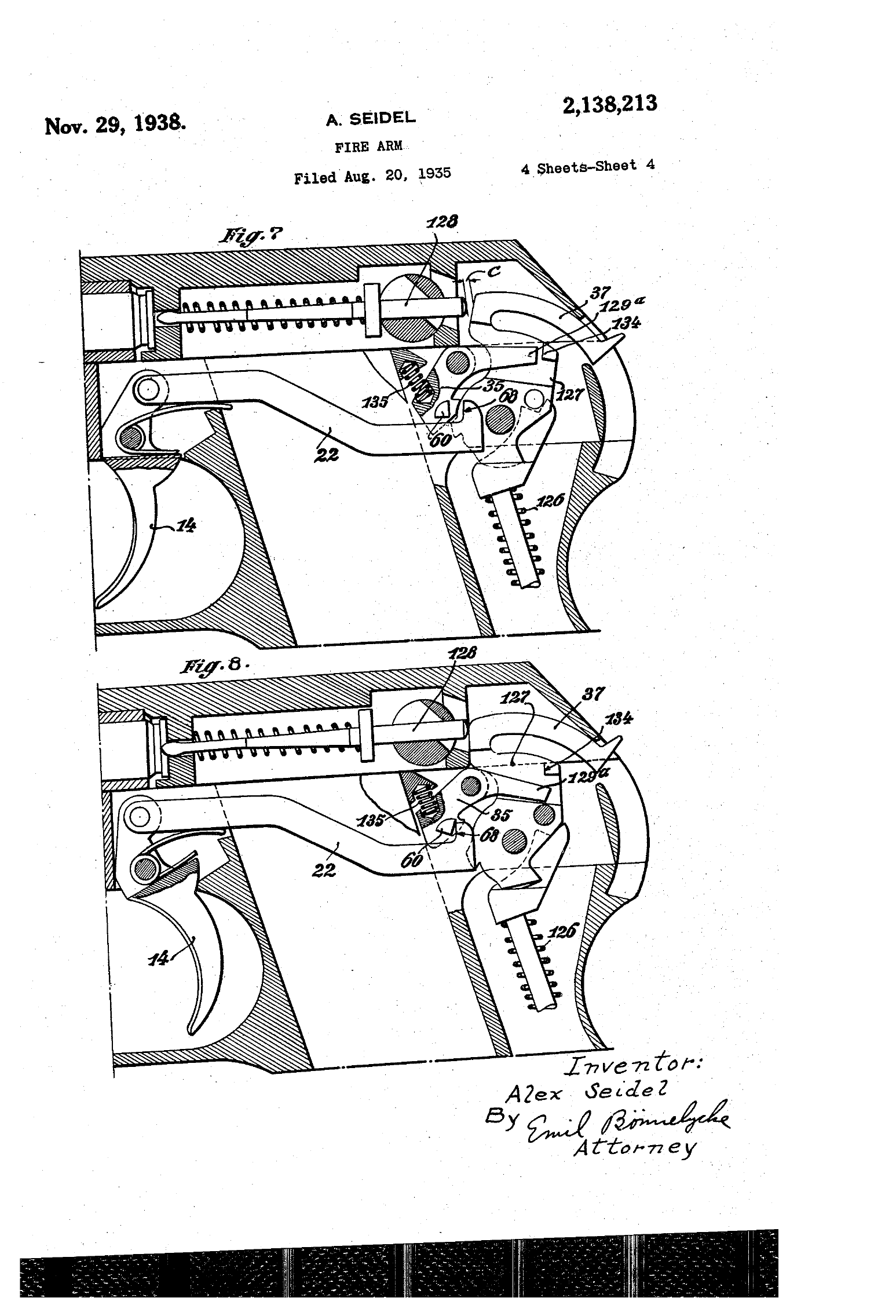
“The trigger 14 is so designed that it makes a perfectly tight seal in the casing of the arm at its lower side. … In order to effect a tight seal in all other positions of the trigger, curved faces 19 and 20 are provided whose curvatures have the axis of the trigger pin 16 for their centre. When the trigger is rocked about its pin 16, the curved faces 19 and 20 are always in sealing relation to the mating faces of the stock.”2
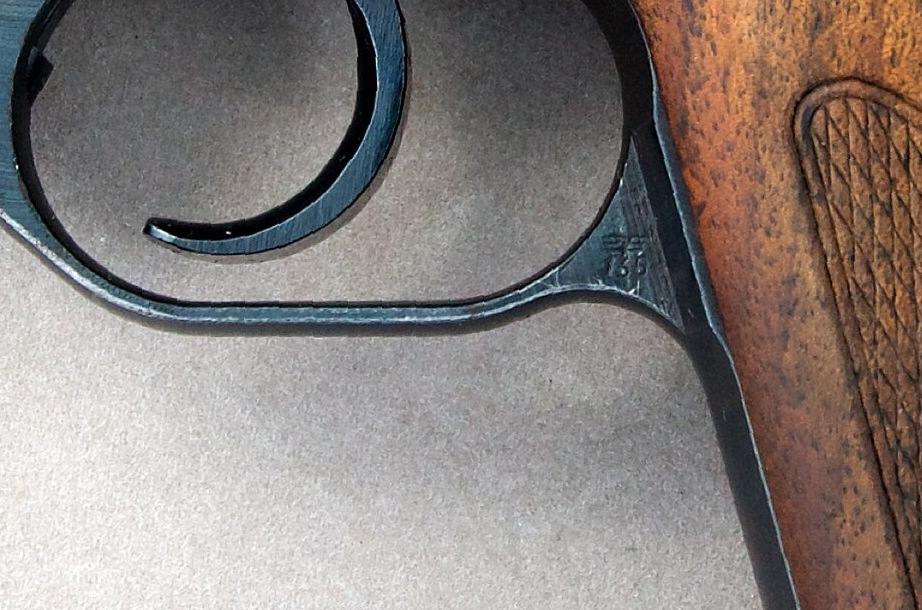
Look at what that specifies. A trigger has to move; a moving part in a hole normally means a gap, and a gap means dirt. Seidel’s answer is that the trigger’s flanks and the frame’s aperture are made arcs of circles centred on the trigger pin. A circle struck about the pivot is the one profile that sweeps through its mating opening without ever opening a gap, at any point in the travel.
The consequence is visible in every photograph of the pistol and is one of the things that makes it look the way it does. Where a Mauser 1914’s trigger meets its frame at a hard step, and where most pocket pistols of the period leave a visible slot, the HSc’s trigger runs into the frame as an unbroken curve. That curve is not a stylist’s flourish, and its radius is not free: it is fixed by the position of the trigger pin, because that is the only centre that keeps the joint shut.
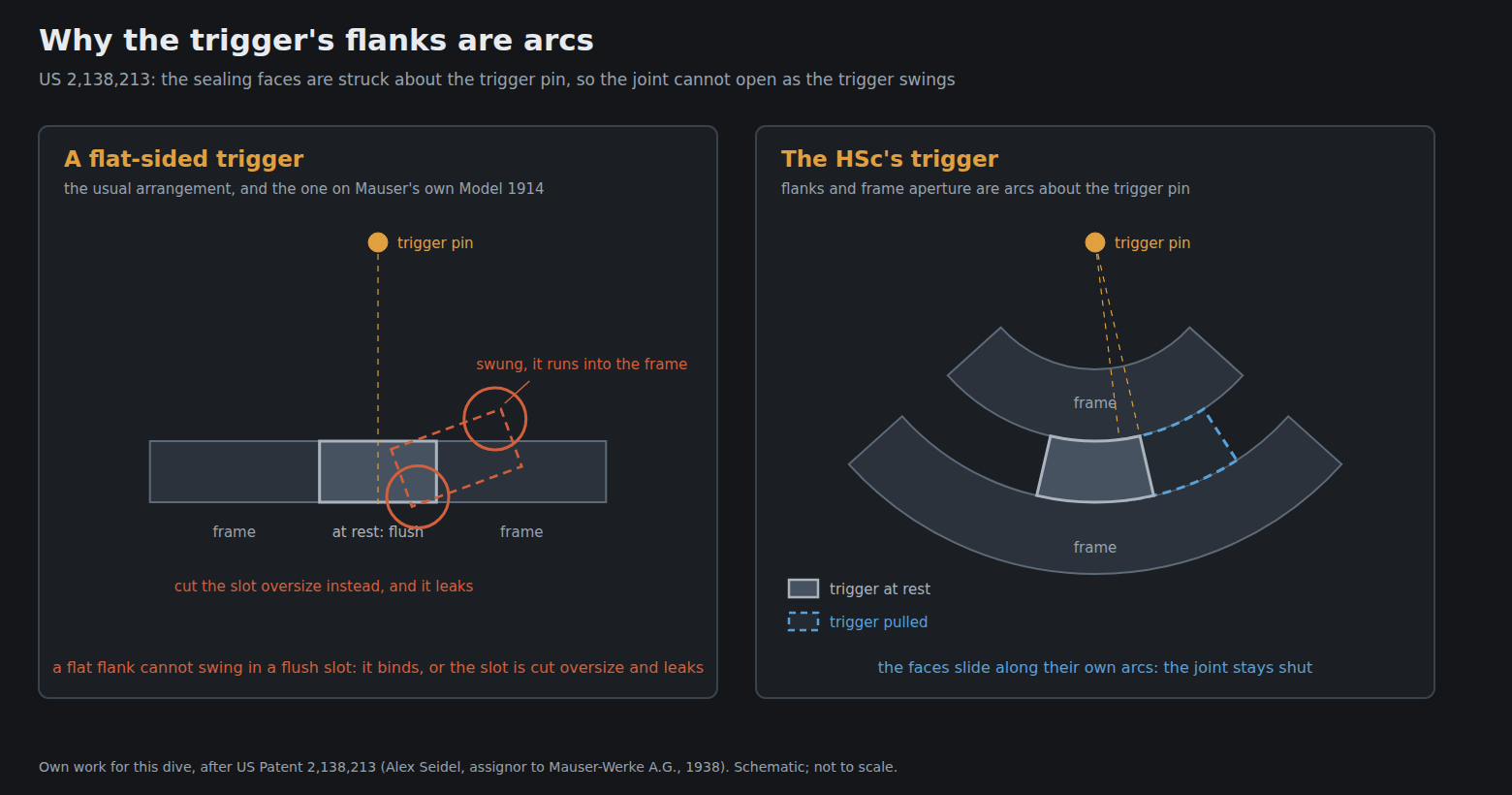
This is worth stating carefully because it is the hinge of the argument. The claim here is not that the HSc has no styling. It is that a specific, conspicuous, much-admired feature of its outline — the seamless trigger-to-frame junction — is documented by its designer as a functional requirement with a geometric solution, nine years before anybody wrote the words “Art Deco” about the gun.
2.4 The Fire Control Holds Itself Together
The same patent’s stated objects begin with assembly, not with shooting:
“The improved trigger mechanism according to my invention is so designed that it is assembled and inserted in the arm, and removed from the arm, and disassembled simply, rapidly and without any extra tools and fastening members such as screws and the like.”2
The mechanism it describes is a small chassis. Two side plates joined by a transverse member form a frame that drops into a recess in the grip frame from above, once the barrel and the breech have been taken off. Lugs on the plates engage faces in the recess so the frame cannot shift fore and aft or side to side; one plate is taller than the other and its top bears up under the barrel, so it cannot lift out. The trigger and its spring go in from the rear, between the plates.2
Then comes the detail that gives the whole idea away:
“since the pin is without any projections, it is not held against axial displacement before the frame is inserted in the recess, and the pin is restrained by the inner faces of the recess”.2
The trigger pin is a plain, unheaded, unstaked cylinder whose ends finish flush with the side plates. Nothing holds it in. What holds it in is the inside of the pistol’s own frame once the unit is fitted. The pistol retains its own fire control, and the retainers are surfaces that had to be machined anyway.
That is a production decision with an aesthetic consequence, and it is the second half of the argument. A pistol assembled without screws is a pistol with no screw heads on the outside; the HSc’s frame carries one screw, and it holds the grip panels on.
The same patent also improves the double-action pull itself. The link from trigger to hammer is described as “a double fork”, with a pair of long arms forward and a pair of short arms aft of a transverse web: “The two long arms embrace the stock and hold the rod against tilting during the pulling of the trigger. The short arms embrace the hammer and are equipped with hooks engaging shoulders on the hammer. By these means, all tilting forces are eliminated in the transmission from the trigger to the hammer.”2 The stated problem is “increased resistance against the pulling of the trigger” — this is a patent about making a double-action trigger feel better, filed against a competitor whose double action was the reason the project existed at all.
2.5 One Slide, Three Jobs
US 2,177,227 is the shortest of the three and the most characteristic. Its background section sets out what a self-loading pistol normally needs: one device to stop the cocked hammer being released if the breech is not fully closed, and another to stop the pistol firing again if the trigger is still held down. Then:
“According to the present invention, the trigger mechanism and the safety device are simplified, and the reliability of the pistol is increased, by providing a single member or slide for performing all the aforesaid functions.”4
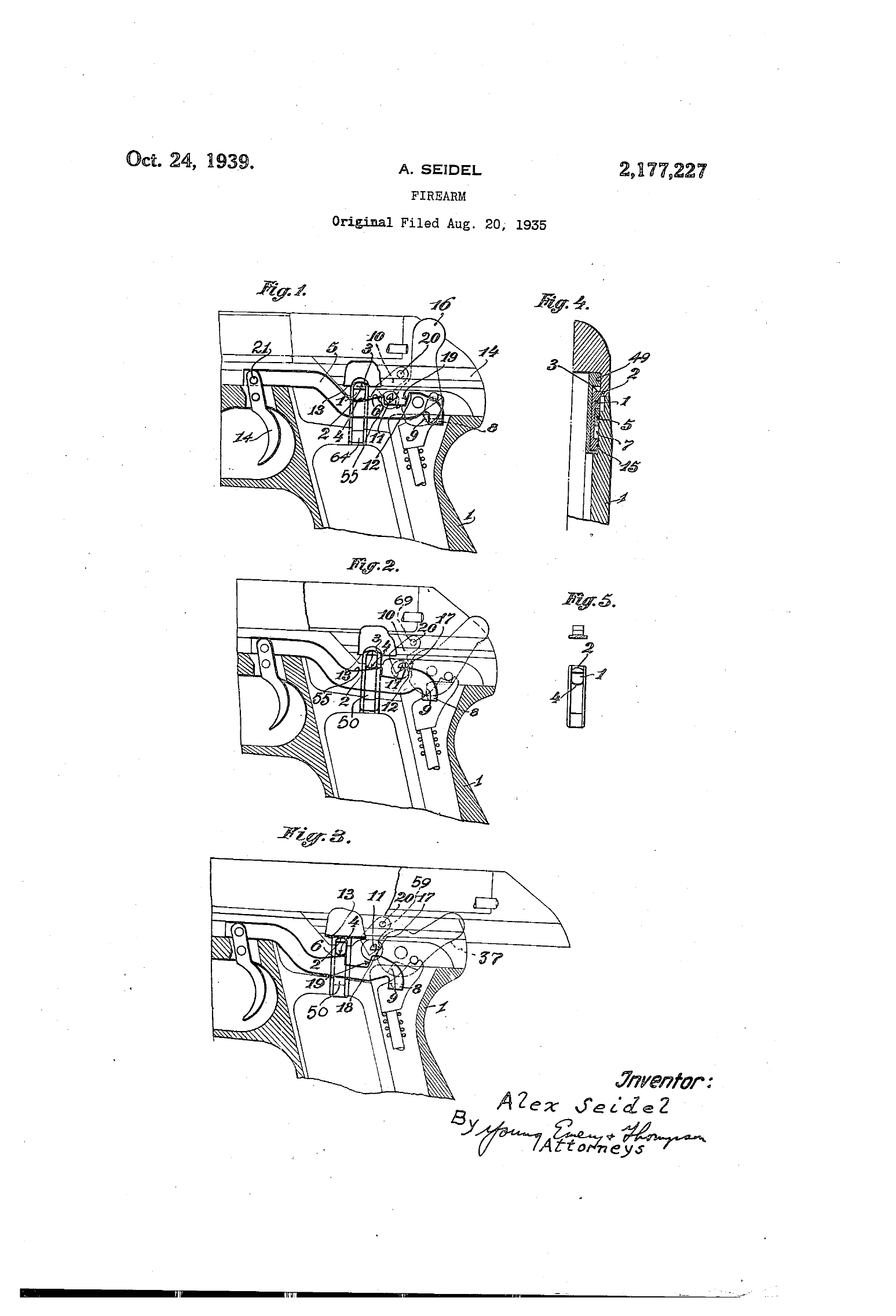
The patent then numbers the three functions itself:
- Control of the connecting rod when cocking from the trigger. A lifting cam on the connecting rod rides the slide’s lug and pushes the rod down so that “a short time before the arresting of the hammer by the catch, the hammer becomes disengaged from the connecting rod and is free to strike”. That sentence is the double-action let-off.
- Safety against firing in succession. When the breech recoils, a crescent in it forces the slide down, which rocks the connecting rod out of engagement with the sear’s lug so the sear can catch the hammer on the return stroke. Without it, the patent says in as many words, “the pistol would operate like a machine gun”.
- Safety if the arm is not fully closed. “As long as the breech is not in said position, the upper end of the slide cannot enter the crescent, and so it holds down the connecting rod by its lug, disengaging the connecting rod from the hammer and the spring catch and causing it to perform an idle movement when the trigger is pulled.”4
Three functions, one part, and the patent argues explicitly that consolidating them increases reliability rather than trading it away. Volume 3 follows the same part through a complete firing cycle.
2.6 The Butt: One Spring, Two Jobs, and a Flush Bottom
US 2,117,826 is about the magazine catch, and it is the second place where the patent explains a line in the pistol’s silhouette.
Its first object is again assembly: the magazine holder, the hammer push rod and the hammer spring are one removable unit, joined by a bayonet joint whose two projections are deliberately made of different size, “so the parts of the unit will fit only in one definite position with respect to each other”.3 A sub-assembly that physically cannot be put together wrongly is a factory decision, and the patent says the push rod, its head and its projections “are preferably forged in one piece, so that the manufacture thereof is facilitated and cheapened”.3
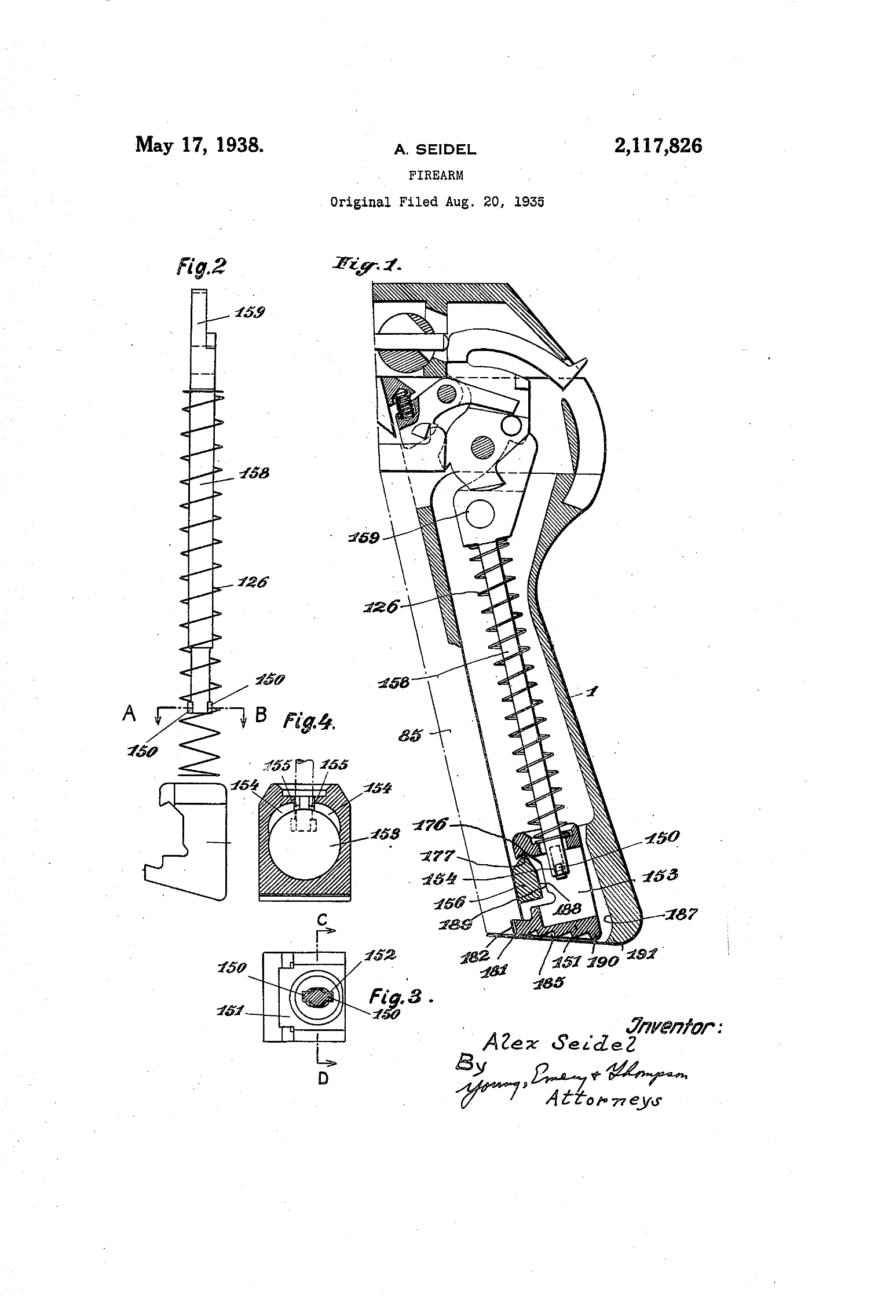
Then the mechanical economy. The catch has no spring of its own. The hammer spring does the work, through a deliberate leverage ratio: “The leverage at which the strong hammer spring acts is large compared with the leverage of the magazine at the lug, and therefore the magazine is firmly forced into the stock, and held in position.”3 One spring, two jobs.
And then the two sentences that explain the shape of the butt:
“An important advantage of the magazine holder according to my invention is that it closes the recess in which it is positioned, when the magazine is inserted, and when it is extracted, so that access of dirt to the recess, to the cock spring, and to the push rod is prevented.”
“The lower end of the magazine holder is flush with the bottom of the magazine and the under side of the stock and thus does not interfere with the manipulation of the pistol, as in the old pistols.”3
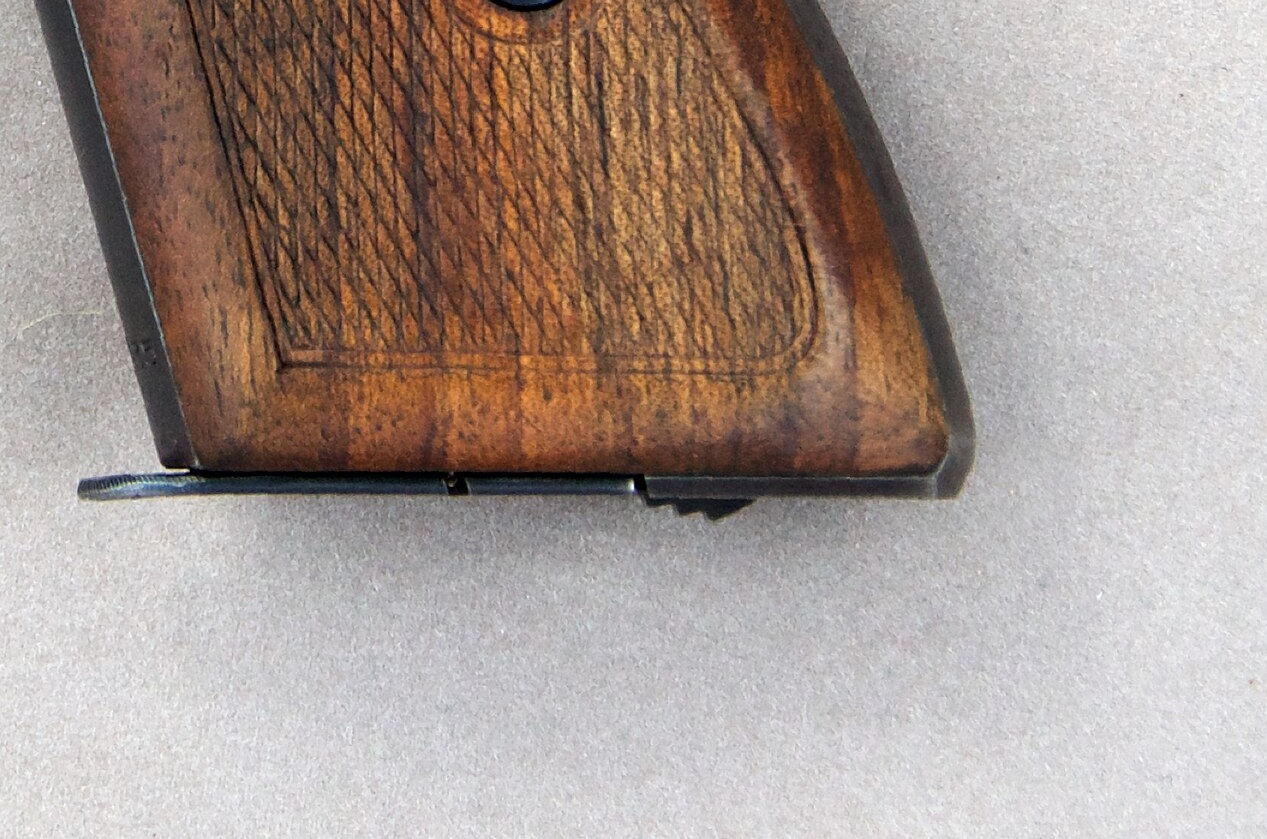
“As in the old pistols” is the designer of a 1934 pocket pistol saying, in a legal document, that the protruding magazine catch on his own firm’s 1914 model is a defect. The flush heel is the fix, and it is also the reason the butt of an HSc reads as one continuous curve from backstrap to floorplate.
American Rifleman describes the working consequence without connecting it to the patent: the pistol “had a typical European heel-style catch, though a lip on the forward part of the magazine allowed it to be easily extracted when the catch was pushed to the rear”.8 The patent’s own instruction matches — “pressure in an inwardly inclined direction is exerted against the holder by its grooves” — and the lip exists because a catch flush with the butt leaves nothing else to pull on.3
2.7 The Hammer That Closes the Hole It Sits In
The third of the pistol’s signature features is the hammer, which is sunk into the slide with only a small spur showing. American Rifleman describes it as “a reduced exposed hammer, the spur of which — to allow for easier concealment — peeked out of the rear of the slide just far enough to allow a positive thumb-cock”.8
Concealment is the usual explanation and it is certainly part of it. But the maker’s own marketing put a different reason first. Interarms’s 1973 catalogue, describing the same pistol thirty-five years later, says: “Its special hammer design prevents the intrusion of dirt or dust into the action when the hammer is cocked.”9
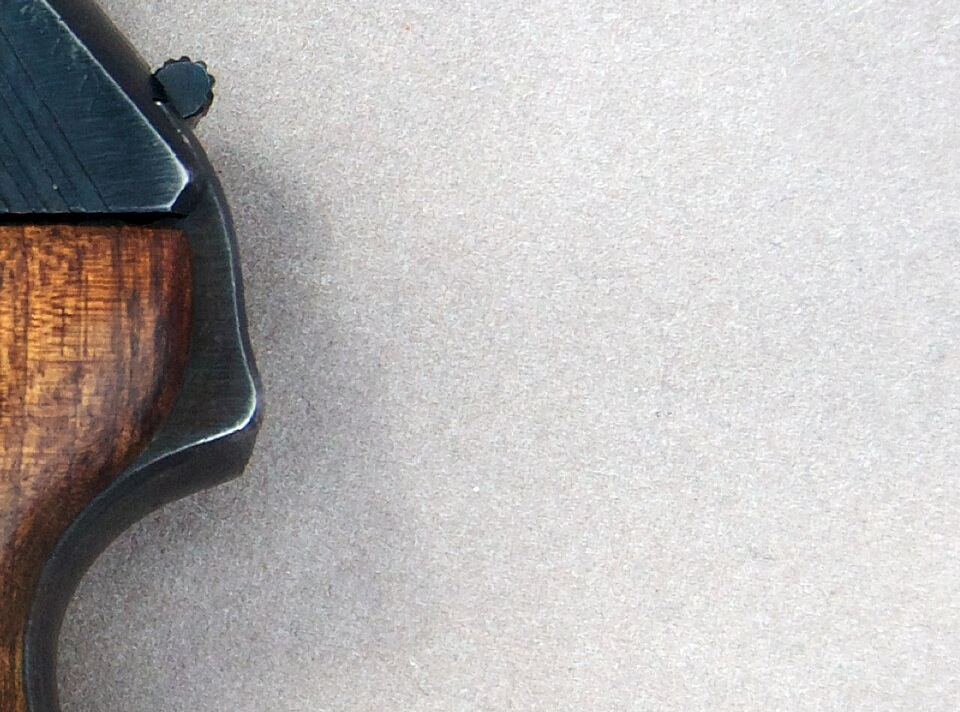
That is the third seal on the same pistol. A reference account cannot call it patented — no patent obtained for this dive claims the hammer shroud — but it can note that the firm that built the gun, in its own promotional copy, described the hammer as a dust seal and not as a concealment feature. Taken with the trigger and the magazine catch, a pattern is visible: on this pistol, every place where something has to move through the outside of the frame has been closed, and the closures are what the smoothness consists of.
2.8 So How Much of the Look Is Styling?
Some of it. The argument above covers the trigger junction, the butt, the hammer, the absence of exposed screws and the absence of a protruding catch. It does not cover everything, and a dive that claimed otherwise would be overreaching.
Not argued from construction, and honestly labelled as styling:
- The long, unbroken top line of the slide and the fully enclosed barrel. These are not patented and no source explains them functionally. What Volume 1 establishes is where they came from commercially: Forgotten Weapons records that the commercial design “had a full-length slide, covering a recoil spring located around the barrel”, and that the German army’s requirements “specifically called for an exposed barrel”, which forced Mauser to take the enclosure off and adopt a Webley-style lever system for the HSv trials entry.10 So the enclosed slide is a commercial choice that the military customer rejected — which is evidence about who it was for, not about what it does.
- The raked grip angle and the swept line where the frame meets the trigger guard.
- The contours of the slide’s rear, beyond what the hammer shroud requires.
- The sight arrangement — a front blade milled from the slide and lying in a longitudinal channel, with a matted non-glare surface.8119 This one sits on the boundary: a front sight inside a channel is undeniably snag-free, and undeniably part of the unbroken top line, and no source says which came first.
The fair summary is this. The HSc is a streamlined object in the 1930s sense, and it was sold as one. But under the styling there is a consistent engineering programme — exclude dirt, delete fasteners, make one part do several jobs — and at least three of the features that make the pistol look the way it does are that programme showing through. The look and the construction are not the same thing on this pistol, but they are not independent either: the construction sets the vocabulary and the styling speaks it.
That conclusion bears directly on a claim in this hub’s Whitney Wolverine dive, which argues that in the Whitney, uniquely among the streamlined guns, “the look and the construction are the same decision”. On the evidence of these three patents, the Mauser HSc has a serious claim to the same thing, twenty years earlier, and with the designer’s reasons on the public record rather than in a magazine interview.
2.9 The Rest of the Family, and the Thread to Heckler and Koch
The three American patents are not the whole filing. The Google Patents index returns a further cluster on the same German priorities, assigned to Mauser-Werke and several naming Seidel: DE 640721 C, “self-loading pistol with cocking trigger and hammer”; DE 670241 C, “firing pin safety on a self-loading pistol with hammer and trigger”; DE 685721 C, “magazine holder for pistols”; DE 691840 C, “safety device for cock pistols with pull trigger”; the Swiss CH 186874 A, CH 199222 A and CH 188360 A; the French FR 796497 A on the barrel stop; and the Austrian AT 160369 B.12
None of those was read for this dive, and one of them matters: DE 670241 C is almost certainly the slide-mounted safety lever, and it is the document that would settle a disagreement Volume 3 has to leave open. The Google Patents servers began refusing every request after the three United States documents had been retrieved, and the German patent office’s own hosts are outside what this project’s fetch policy will take. The numbers are recorded here so that a later pass knows where to look; nothing in these volumes rests on them.
The same index shows where the man went next. Alex Seidel appears as inventor on Heckler & Koch filings including US 3,678,800, “Self-loading pistol with cocking trigger”, with a priority of 18 September 1968, and US 3,861,273, “Self-loading pistol with a stock” of 1972.12 The engineer who patented a cocking-trigger pocket pistol for Mauser in 1934 was still patenting cocking-trigger pistols under his own company’s name thirty-four years later.
The pistol in between is H&K’s first, the HK4 of the mid-1960s. Wikipedia’s article on it — thinly sourced, and it says so — states that “the HK4 is largely a refined Mauser HSc self-loading pistol”, and quotes a Guns.com account that “using the HSc as a base, in 1963 Seidel began working closely with fellow HK engineer Tilo Moller on a pistol that would have a breech bolt with a firing pin operable at different angles”, the arrangement that let the HK4 change calibre by swapping a barrel.13 The HK4 also, Wikipedia notes, “has an internal safety mechanism that will keep the firing pin misaligned from the hammer until the trigger is pulled” — which is the HSc’s principle, carried across a war, an occupation and a new company.13
German Wikipedia puts it in one sentence: the HSc “served as the basis for another new development, namely the HK4 of Heckler & Koch in Oberndorf”.14 It is the only line of descent in this hub that runs from a 1930s pocket pistol to a firm still making service rifles today, and it runs through one man who was twenty-five when he started.
References
Footnotes
-
US Patent 2,138,213, “Fire Arm”, Alex Seidel, assignor to Mauser-Werke A.G., Oberndorf-on-the-Neckar; application 20 August 1935, Serial No. 37,078; “in Germany August 10, 1934”; granted 29 November 1938; 4 sheets. https://patents.google.com/patent/US2138213A/en , PDF retrieved 2026-09-19. Quotations are from the printed text; the scan’s optical character recognition is imperfect and every quoted sentence was read against the page image. ↩ ↩2 ↩3 ↩4 ↩5 ↩6 ↩7
-
US Patent 2,117,826, “Firearm”, Alex Seidel, assignor to Mauser-Werke A.G.; original application 20 August 1935, Serial No. 37,078, divided and filed 24 August 1937 as Serial No. 160,680; “In Germany May 6, 1935”; granted 17 May 1938; 6 claims. https://patents.google.com/patent/US2117826A/en , retrieved 2026-09-19. ↩ ↩2 ↩3 ↩4 ↩5 ↩6
-
US Patent 2,177,227, “Firearm”, Alex Seidel, assignor to Mauser-Werke A.G.; division of Serial No. 37,078, filed 24 August 1937; granted 24 October 1939. https://patents.google.com/patent/US2177227A/en , retrieved 2026-09-19. ↩ ↩2 ↩3
-
Ian McCollum, “Evolution of the Military Mauser HSc Pistol”, Forgotten Weapons, https://www.forgottenweapons.com/evolution-of-the-military-mauser-hsc-pistol/ , retrieved 2026-09-20. ↩ ↩2
-
“Mauser HSc”, Wikipedia, consulted 2026-09-19. ↩
-
“Alex Seidel”, German Wikipedia, revision 265794163, consulted 2026-09-19, citing Kersten and Schmid, Heckler & Koch: HK; die offizielle Geschichte (1999), pp. 18 and 29. ↩
-
Garry James, “This Old Gun: Mauser HSc Pistol”, American Rifleman, 11 May 2017, https://www.americanrifleman.org/content/this-old-gun-mauser-hsc-pistol/ , retrieved 2026-09-19. ↩ ↩2 ↩3
-
Interarms, Interarms 73 catalogue, Alexandria, Virginia, 1973, p. 16, “Model HSc Automatic Pistols”. Internet Archive item
interarms-73, https://archive.org/details/interarms-73 , retrieved 2026-09-19. The page was read as a rendered image, not only as optical character recognition. ↩ ↩2 -
Ian McCollum, “RIA: Prototype Mauser HSv Pistols”, Forgotten Weapons, https://www.forgottenweapons.com/ria-prototype-mauser-hsv-pistols-video/ , retrieved 2026-09-20. ↩
-
Maxim Popenker, “Mauser HSc”, Modern Firearms, https://modernfirearms.net/en/handguns/handguns-en/germany-semi-automatic-pistols/mauser-hsc-eng/ , retrieved 2026-09-19. ↩
-
Patent family members and Seidel’s later filings as listed by the Google Patents search index, queried 2026-09-19 for assignee Mauser-Werke and for inventor Alex Seidel. Only the three United States documents above were retrieved and read; the German, Swiss, French and Austrian members are recorded by number and indexed title only. ↩ ↩2
-
“Heckler & Koch HK4”, Wikipedia, consulted 2026-09-20. The article carries a Wikipedia notice that it needs additional citations. The Guns.com sentence quoted is reproduced verbatim inside Wikipedia’s citation to Chris Eger, “Heckler & Koch’s 1st Handgun: The HK4”, Guns.com, 20 April 2020; the Guns.com page itself returned HTTP 403 to this project’s fetch engine and was not read. ↩ ↩2
-
“Mauser HSc”, German Wikipedia, revision 265079350, consulted 2026-09-19. ↩
Comments (0)