Mauser HSc · Volume 3
How It Works
A blowback with no lock, a hammer the trigger cocks, a sear that is disconnected by the breech itself, a safety that moves the firing pin instead of the hammer — and one feature it is constantly credited with and does not have
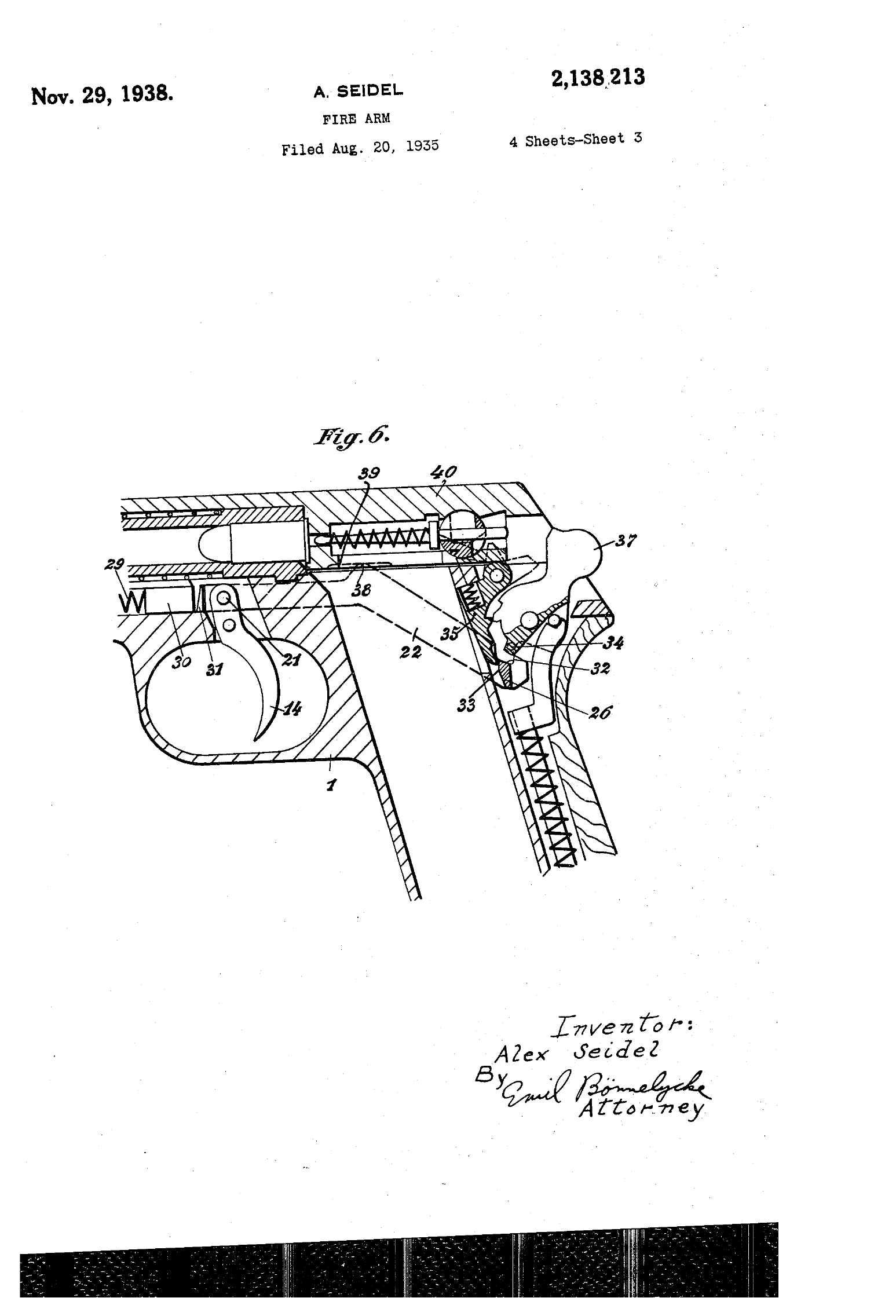
The Mauser HSc is a mechanically modest pistol in which two or three arrangements are unusually clever. The modesty is in the operating system: there is no lock, no gas system, no fire selector and nothing in the barrel but rifling. The cleverness is entirely in the fire control, and this volume works through it in the order the pistol itself works — which is also, conveniently, the order in which Alex Seidel’s patents describe it.
Three general cautions before starting. No manual was obtained for this dive — not Mauser’s, not Interarms’s, not a military one — so nothing here is a disassembly instruction and Volume 4 says what that absence means. One point genuinely could not be settled, and it is flagged where it arises. And the pistol is routinely credited with a feature it does not appear to have, which is the subject of the last section but one.
3.1 What Kind of Pistol It Is
Straight blowback. The breech is never locked. The slide is held forward by its recoil spring and by its own mass, and when the cartridge fires the case pushes back against the breech face and starts the slide moving. Because the slide is heavy relative to the pressure impulse of a small pistol cartridge, the bullet has left the barrel and pressure has fallen before the case is clear of the chamber. Nothing holds the breech shut; the breech is merely slow to open. German Wikipedia’s term for it, Masseverschluss, says it exactly: a mass breech.1
This is what lets the pistol be as simple as it is, and it is also the reason for the calibre ceiling. 7.65 mm Browning and 9 mm Browning Short operate at pressures and energies a slide of a few hundred grams can absorb. Volume 1 records that when Mauser wanted the same design in 9×19 mm Parabellum for the army it did not scale the blowback up: it went to a rotating-barrel locked breech on Josef Nickl’s patent, and that pistol never entered production.2
Fixed barrel, spring around it. The barrel does not move. English Wikipedia’s description of the pistol — “a semi-exposed hammer, double-action trigger, single-column magazine, and a spring surrounding the barrel” — names the layout.3 The recoil spring is concentric with the barrel inside the slide, which is what allows the slide to be a closed tube from the muzzle back and gives the pistol its unbroken top line. Volume 1 records that this is precisely the arrangement the German army rejected when it specified an exposed barrel for its P.08 replacement trials.4
Double action, then single action. A hammer sits at the rear, mostly shrouded by the slide. With the hammer down on a chambered round, a long pull on the trigger cocks and releases it; the slide then re-cocks the hammer for every subsequent shot, which are all short single-action pulls. Interarms’s 1973 catalogue put the sales case in a sentence: the pistol “combines the advantages of both the revolver and the automatic pistols through its double action design which safely permits a cartridge to be carried in the chamber for immediate firing”.5
Feed and capacity. A single-column detachable box magazine in the butt, released by a catch at the heel: eight rounds in 7.65 mm, seven in 9 mm Kurz, and one more in the chamber.316 One source dissents and it is the maker’s importer: the Interarms catalogue’s 1973 specification table prints “Mag. Cap’y 7 Rounds” in a cell spanning all three of its catalogue numbers, including the .32 ACP gun.5 That is either a catalogue error or a merged cell in the table’s own typesetting; it is noted here because it is a primary document and it disagrees with everything else.
Rifling. Six grooves, right-hand twist.1
3.2 The Cycle, Shot by Shot
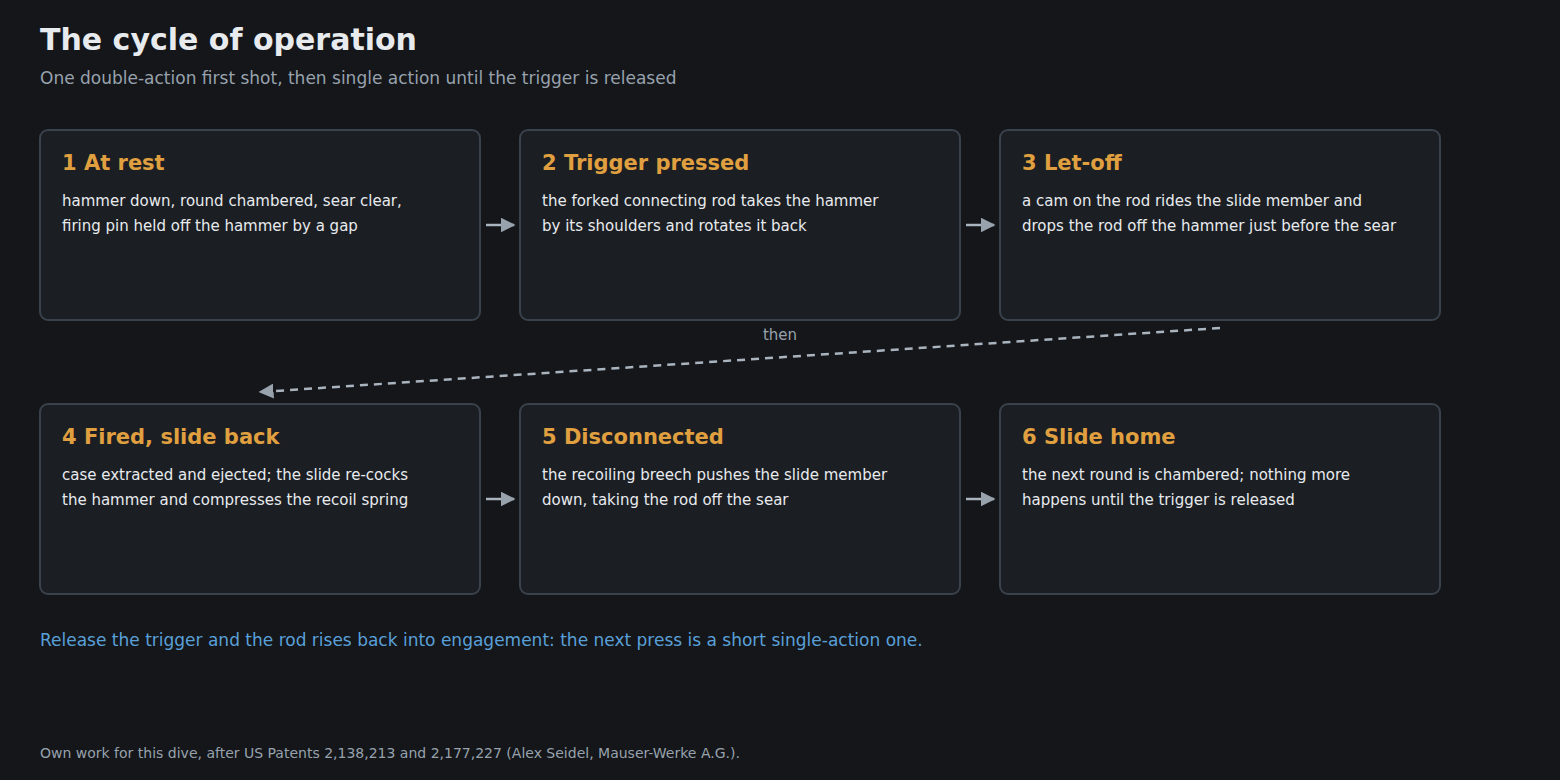
With the pistol loaded and the hammer down, one complete cycle runs as follows.
- The trigger is pressed. The trigger pivots on its pin and pulls the connecting rod forward. The rod is the double fork described in Volume 2 — two long arms embracing the frame ahead of the pivot and two short arms with hooks engaging shoulders on the hammer behind it.7 The hooks take the hammer and rotate it back against the hammer spring in the butt.
- Let-off. Just before the hammer reaches full cock, a lifting cam on the connecting rod rides over a lug and the rod is pushed down, so “a short time before the arresting of the hammer by the catch, the hammer becomes disengaged from the connecting rod and is free to strike”.8 The hammer falls under its own spring, not under the shooter’s finger.
- Ignition. The hammer strikes the rear of the firing pin, which is a free-floating inertia pin carried in the breech. Interarms’s feature list names it: “Intertia-Type Firing Pin”, spelling and all.5
- Recoil. The case pushes the slide back. The extractor, mounted in the slide, holds the case rim; the case strikes the ejector and is thrown out. The slide’s travel compresses the recoil spring around the barrel and rotates the hammer back to full cock, where the sear catches it.
- Disconnection. As the slide moves back it also drives the slide member described in the next section downward, which rocks the connecting rod out of engagement with the sear. That is what allows the sear to take the hammer on the way home; without it, the patent says, “the pistol would operate like a machine gun”.8
- The return stroke. The recoil spring drives the slide forward; the breech face strips the top round out of the magazine and chambers it. The pistol is now cocked, loaded and ready.
- Reset. Nothing further happens until the trigger is released, because the connecting rod is still disconnected. Releasing it lets the rod rise back into engagement, and the next press is a short single-action one.
When the magazine is empty the pistol simply stops with the slide forward. Nothing consulted for this dive describes a hold-open on the HSc, and none is visible in the patent drawings or in the photographs used in these volumes; the absence is stated here as an observation rather than as a sourced fact.
3.3 The First Shot Is the Different One
The double-action first shot is the whole commercial argument of the pistol and it is worth separating the mechanics from the marketing.
Mechanically, a double-action pull does two jobs with one finger: it cocks a hammer against a spring stiff enough to set off a primer, and then it releases it. That makes it long and heavy compared with the single-action pulls that follow. Seidel’s patent addresses the consequence directly, and the passage quoted in Volume 2 is worth repeating in a mechanical context: the double-fork connecting rod exists because “the two long arms embrace the stock and hold the rod against tilting during the pulling of the trigger”, and by those means “all tilting forces are eliminated in the transmission from the trigger to the hammer”, the stated problem being “increased resistance against the pulling of the trigger”.7
A single-arm link between a trigger low in the frame and a hammer high at the rear wants to twist as it is pushed; twisting means side-load; side-load means friction; friction means a heavier, grittier pull. Forking the link on both ends and letting it straddle the frame and the hammer takes the twist out. It is a small, specific, well-aimed piece of design, and it is aimed squarely at the Walther PP.
3.4 The Part That Does Three Jobs
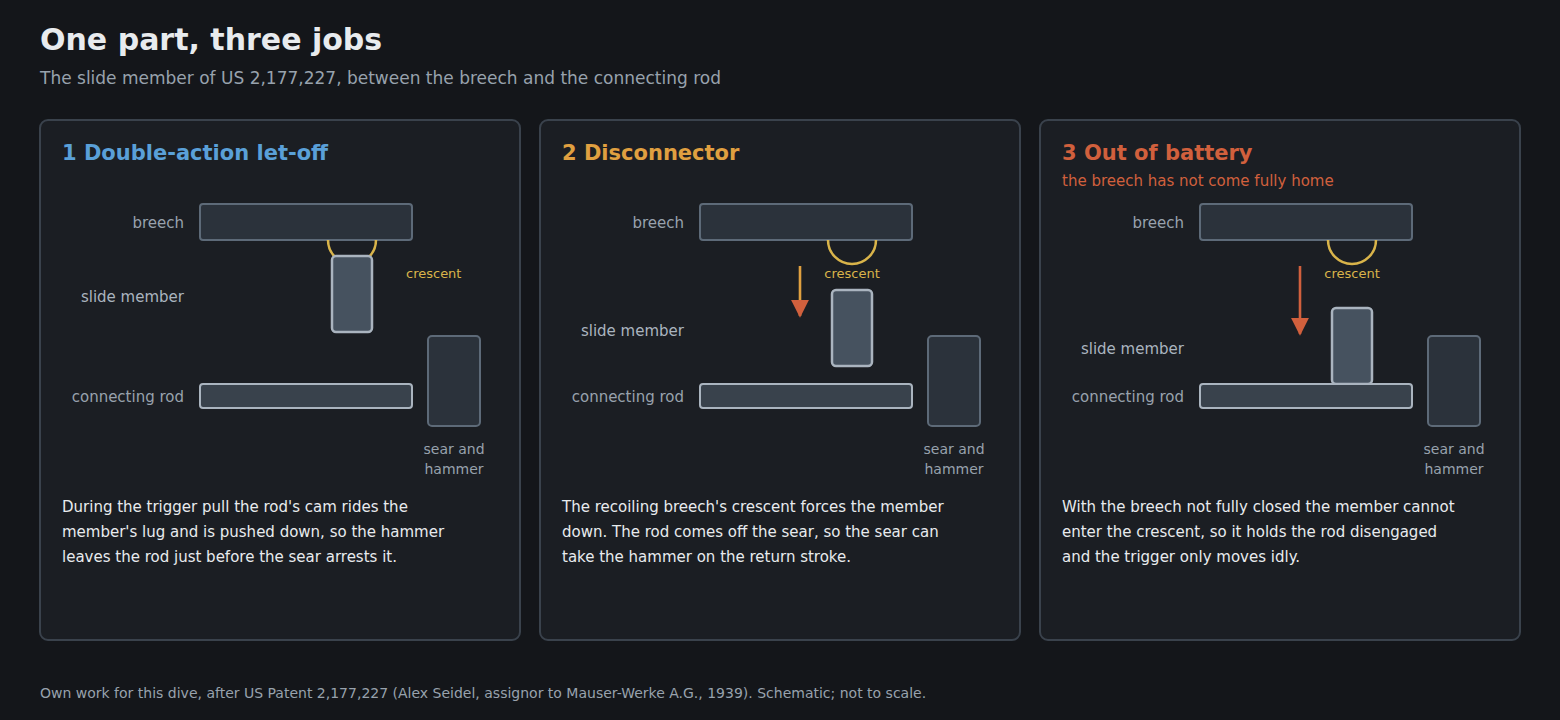
The mechanism that makes the HSc worth a mechanism volume is a single sliding part between the breech and the connecting rod. The patent’s own framing is that pistols normally need separate devices for the out-of-battery interlock and the disconnector, and that “according to the present invention, the trigger mechanism and the safety device are simplified, and the reliability of the pistol is increased, by providing a single member or slide for performing all the aforesaid functions”.8
The three functions, in the patent’s own numbering:
Table 1 — The three functions, in the patent's own numbering
| Function | How the part does it | |
|---|---|---|
| 1 | Double-action let-off | a lifting cam on the connecting rod engages the member’s upper lug, pushing the rod down so the hammer leaves the rod just before the sear arrests it |
| 2 | Disconnector | the recoiling breech’s crescent forces the member down, rocking the rod out of engagement with the sear’s lug so the sear can catch the returning hammer |
| 3 | Out-of-battery safety | while the breech is not fully closed the member’s upper end cannot enter the crescent, so it holds the rod disengaged and a trigger pull “performs an idle movement” |
The reason this is good engineering rather than merely economical is that all three functions are keyed to the same physical question — where is the breech, and where is the connecting rod. One part that senses breech position and one part that moves the rod are, on reflection, the same part. Splitting them, as most designs do, means two parts that have to agree with each other.
It is also the sort of thing a firm does when it is designing around a competitor’s patents. Volume 2 records Forgotten Weapons’s statement that “the HSc was carefully designed to avoid infringing on other patents, particularly Walther’s”, and a consolidated three-in-one member is both novel and hard to read onto somebody else’s claims.9
3.5 The Safety Lever, and What It Is Not
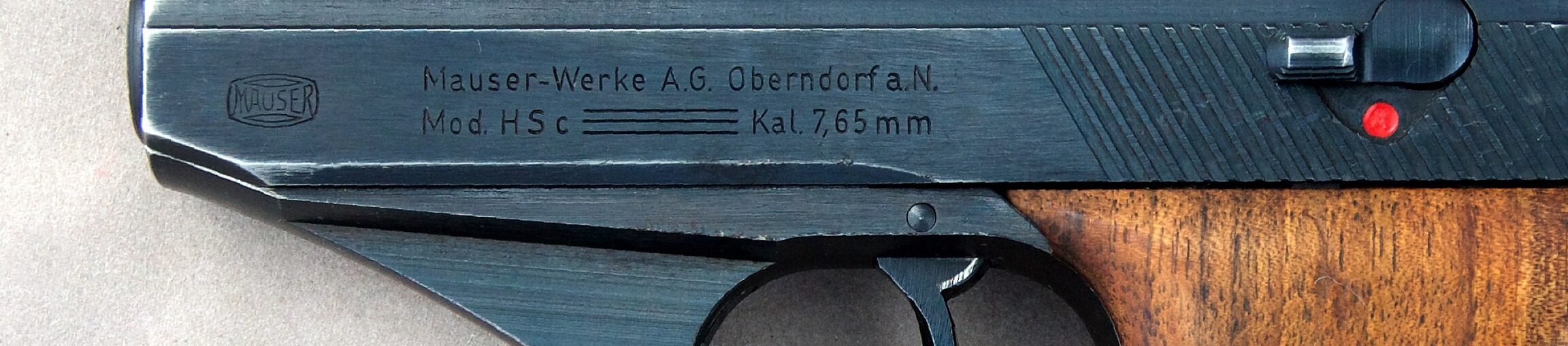
The HSc’s manual safety is a lever on the left side of the slide, and what it acts on is the firing pin, not the hammer.
American Rifleman: “the gun had a slide-mounted safety which, when ‘on safe,’ locked and lifted up the rear of the internal spring-loaded firing pin, preventing the hammer from striking it.”6
Modern Firearms: “The safety switch is mounted on the slide and when engaged (lowered), moves the rear part of the firing pin out of the reach of hammer and locks it.”10
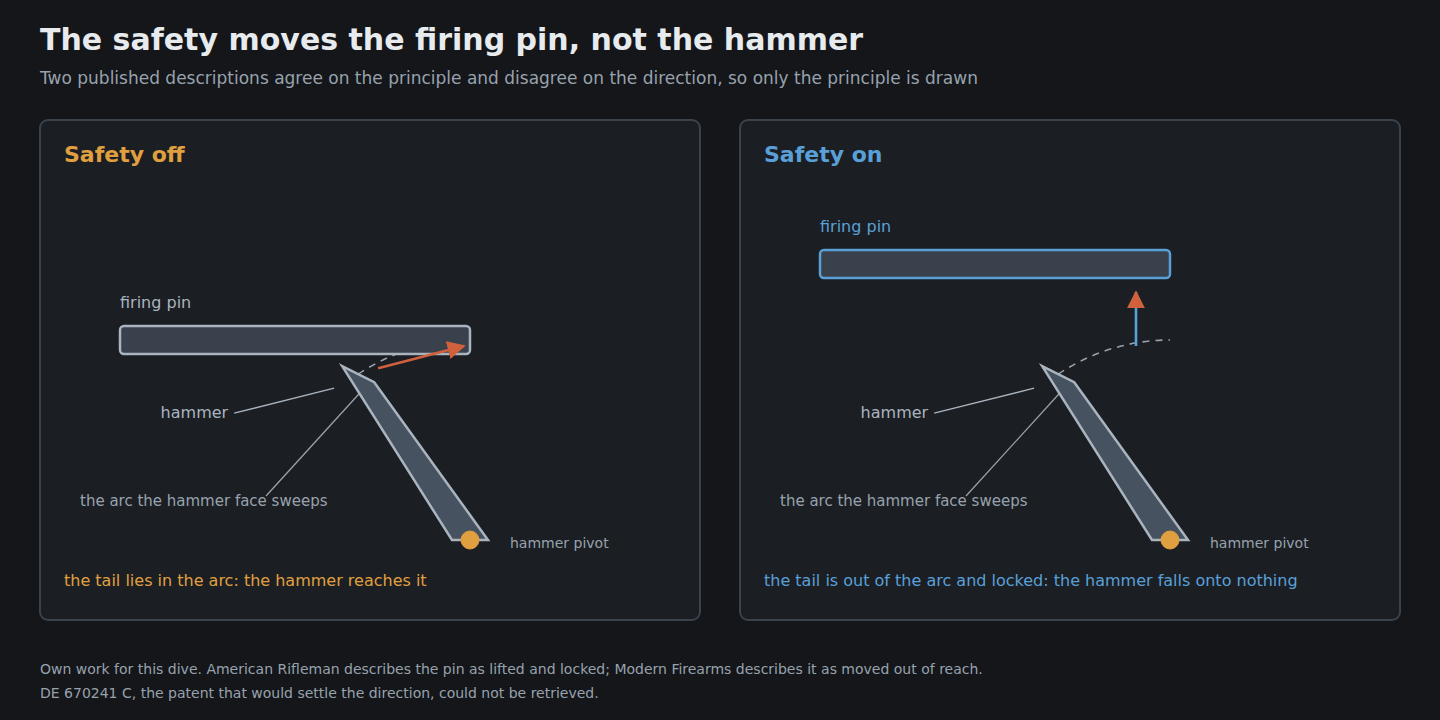
The two accounts agree on the principle — the tail of the firing pin is taken out of the hammer’s path and locked there — and disagree on the direction. American Rifleman has it lifted up; Modern Firearms has it moved out of reach with the lever lowered. Neither is obviously wrong and this dive could not settle it. The document that would is almost certainly DE 670241 C, “firing pin safety on a self-loading pistol with hammer and trigger”, on the same 10 August 1934 priority as the rest of the family; Volume 2 explains why it could not be retrieved.11 Until somebody reads it, a reference account should say the pin is displaced and locked, and not say which way.
What can be said with more confidence is what the safety is not.
It is not a decocker. This is the sharpest functional difference between the HSc and the Walther PP that it was built to beat. Wikipedia’s account of the PP names among its features “a safety, which, when activated, decocks the pistol” — the lever drops the hammer onto a blocked firing pin.12 Nothing consulted for this dive describes the HSc’s safety doing anything of the kind, and two sources that describe the mechanism in detail describe it as acting on the firing pin alone.610 A reader who owns one and assumes otherwise is assuming a Walther feature on a Mauser.
That leaves the practical question of how a chambered HSc is made safe with the hammer down, and the honest answer is that no source consulted for this dive says. One commenter on the Forgotten Weapons article raises exactly the problem — “how you safely lowered a hammer on a chambered HSc … what a tiny little hammer spur and no way to put your finger on the back of the firing pin” — and nobody answers him.9 That is a reader’s remark and not a source, but the question it asks is real and this volume cannot close it. Volume 4 returns to it as a handling matter.
It does not lock the slide. Nothing consulted describes the lever restraining slide movement.
3.6 The Magazine Safety
The HSc has one, and this is one of the few mechanical claims in the whole subject that can be confirmed from two entirely independent directions.
German Wikipedia, on the pistol’s civilian design intent: “Bereits das Entfernen des Magazins blockiert den Abzug” — merely removing the magazine blocks the trigger. Its explanation of why is the one a designer would give: it prevents a shot being fired from a pistol somebody is unloading, when the magazine has been taken out and a round is still in the chamber.1
Interarms’s 1973 catalogue, in its bullet list of the pistol’s features: “Magazine Safety”.5
A German encyclopedia describing the wartime gun and an American importer’s catalogue describing the 1973 gun agree, thirty years apart, that the feature exists. That is as well established as anything in this dive.
It is worth being clear about what a magazine safety is and is not for, because it is an unpopular feature among shooters and the reasons the HSc has one are specific. It does not make the pistol safer to carry. What it does is remove one particular accident: the pistol whose magazine has been removed, which its handler therefore believes is unloaded, which still has a cartridge in the chamber. German Wikipedia connects it explicitly to the pistol having been designed “unter dem Gesichtspunkt der zivilen Nutzung” — from the point of view of civilian use — along with its high standard of finish.1 It is a feature for a policeman’s or a householder’s pistol, and Volume 5 records that the pistol spent most of its production life as a soldier’s.
3.7 The Firing Pin and the Blow-on-the-Hammer Problem
The last piece of the safety system is the one that operates without anybody touching a lever, and it is in the first patent.
US 2,138,213’s Figures 7 and 8 are captioned in the text as showing “the safety means by which firing by a blow or the like on the hammer is prevented”. The patent describes two separate provisions:
A rest gap. With the hammer down, “the hammer spring holds the striking face of the hammer at a distance c from the rear end of the firing pin”.7 The hammer at rest is not touching the pin. A pistol whose hammer rests on the firing pin is a pistol that can fire if dropped on the hammer; this one does not rest on it.
A positive block. A locking bellcrank sits in a recess in the frame with its free end opposite a lug on the hammer whenever the trigger is released. Cock the hammer and let it go without touching the trigger, or strike the hammer while it is down, and the bellcrank is in the way.7 Pressing the trigger is what moves it clear.
The patent states the threat model plainly: “Such unintentional operation may occur if a blow strikes the uncocked hammer, or if the cocked hammer is released without operation of the trigger.”7
The inertia firing pin is the third element. A pin shorter than the space it travels in cannot be pushed through to the primer by a static load; it fires only when the hammer’s blow throws it forward. Interarms names the feature in 1973 and Seidel’s drawings show it in 1935.57
Read together, the HSc’s safety system has four independent elements, which is a lot for a 1930s pocket pistol: the manual firing-pin lock, the magazine safety, the hammer-blow bellcrank with its rest gap, and the out-of-battery interlock built into the slide member. It is worth noticing what they are all about. Three of the four are about the pistol not going off, and the fourth is about it not going off out of battery. None of them is about the shooter’s convenience.
3.8 What It Does Not Have
The HSc is very often described — in forum posts, catalogue copy and casual comparisons — as having a loaded-chamber indicator, usually with the slide-mounted extractor named as the indicating part.
No source consulted for this dive says so.
The check is worth setting out because it is the kind of claim that survives on being repeated. Four sources list the pistol’s features at length and independently:
Table 2 — The check is worth setting out because it is the kind of claim that survives on being repeated. Four sources list the pistol's features at length and independently
| Source | Names magazine safety | Names firing-pin safety | Names inertia pin | Names a loaded-chamber indicator |
|---|---|---|---|---|
| American Rifleman, 20176 | no | yes | no | no |
| Modern Firearms10 | no | yes | no | no |
| English Wikipedia3 | no | no | no | no |
| German Wikipedia1 | yes | no | no | no |
| Interarms catalogue, 19735 | yes | yes (as “Positive Thumb Safety”) | yes | no |
The 1973 catalogue is the strongest of these on the point, because its purpose was to sell the pistol and it lists ten features in a row to do it — including two safeties, the inertia firing pin, the walnut grips and the matted sight channel. A loaded-chamber indicator was a selling feature in 1973 and Walther had been advertising one since 1929. If the HSc had one, that list is where it would be.512
Where the idea comes from is not hard to guess. The Walther PP and PPK, which this pistol is constantly mistaken for and constantly compared with, do have one — a pin that stands proud of the rear of the slide when a round is chambered.12 Volume 7 treats this as one of the things that tells the two apart.
The position taken here is the narrow one: no source located for this dive describes a loaded-chamber indicator on the Mauser HSc, and the best-placed source not to mention one is the maker’s importer selling the gun. That is not the same as proving a negative, and an owner with the pistol in hand can settle it in a second in a way this dive cannot.
3.9 Sights, Barrel and What the Pistol Will Do
The sights are minimal and deliberately so. American Rifleman: “sights involved nothing more than a dovetailed rear round notch and a small square blade milled out of the slide”.6 Modern Firearms adds the detail that matters to the pistol’s outline: “even a front sight blade is concealed within longitudinal groove on the top of the slide”.10 Interarms’s catalogue describes the same thing from the selling side — “Open, Fixed, Recess” sights and a “Matted Non-glare Sight Channel”.5 English Wikipedia’s account of the late-war economies notes that on pistols after about serial 855,000 “the cross-hatched machining inside the top sight channel is no longer there”, which is a useful reminder that the matting was a machining operation somebody eventually decided to stop paying for.3
Dimensions are given differently by different sources and the spread is real:
Table 3 — Dimensions are given differently by different sources and the spread is real
| English Wikipedia3 | German Wikipedia1 | American Rifleman6 | Interarms 19735 | |
|---|---|---|---|---|
| Overall length | 152 mm / 6.0 in | 152 mm | 6 in | 6.05 in |
| Barrel | 86 mm / 3.4 in | 86 mm | 3.4 in | 3.375 in |
| Height | — | 111 mm | — | — |
| Sight radius | — | 125 mm | — | — |
| Weight, unloaded | 700 g | 0.64 kg | 25 oz (709 g) | — |
The two Wikipedias disagree with each other by 60 grams, which is about nine per cent of the pistol. No attempt is made here to resolve it; the figures are given with their sources.
For velocity there is one attributed number. English Wikipedia gives 290 m/s (950 ft/s) with 7.65×17 mm, citing Chamberlain and Gander, Axis Pistols, Rifles and Grenades (1976), p. 19 — a book not obtained for this dive.3 The same infobox gives an effective range of 40 m, which for a fixed-sight pocket pistol should be read as a statement about the sights and the cartridge rather than as a measurement.
What all of that describes is a pistol that is a little smaller than a Walther PP and a little larger than a PPK, firing the same cartridge from a shorter barrel than the PP’s, with sights designed not to catch on a pocket. It is a defensive pistol at conversational distances and it was never anything else. Volume 4 turns to keeping one working.
References
Footnotes
-
“Mauser HSc”, German Wikipedia, revision 265079350, consulted 2026-09-19. ↩ ↩2 ↩3 ↩4 ↩5 ↩6 ↩7
-
Ian McCollum, “Prototype Locked-Breech 9x19mm Mauser HSc”, Forgotten Weapons, https://www.forgottenweapons.com/prototype-locked-breech-9x19mm-mauser-hsc/ , retrieved 2026-09-20. ↩
-
“Mauser HSc”, Wikipedia, consulted 2026-09-19. Its velocity figure is cited there to Peter Chamberlain and Terry Gander, Axis Pistols, Rifles and Grenades (Arco, 1976), p. 19, which was not obtained. ↩ ↩2 ↩3 ↩4 ↩5 ↩6
-
Ian McCollum, “RIA: Prototype Mauser HSv Pistols”, Forgotten Weapons, https://www.forgottenweapons.com/ria-prototype-mauser-hsv-pistols-video/ , retrieved 2026-09-20. ↩
-
Interarms, Interarms 73 catalogue, Alexandria, Virginia, 1973, p. 16. Internet Archive item
interarms-73, https://archive.org/details/interarms-73 , retrieved 2026-09-19; the page was read as a rendered image. ↩ ↩2 ↩3 ↩4 ↩5 ↩6 ↩7 ↩8 ↩9 -
Garry James, “This Old Gun: Mauser HSc Pistol”, American Rifleman, 11 May 2017, https://www.americanrifleman.org/content/this-old-gun-mauser-hsc-pistol/ , retrieved 2026-09-19. ↩ ↩2 ↩3 ↩4 ↩5 ↩6
-
US Patent 2,138,213, “Fire Arm”, Alex Seidel, assignor to Mauser-Werke A.G.; filed 20 August 1935; German priority 10 August 1934; granted 29 November 1938. https://patents.google.com/patent/US2138213A/en , retrieved 2026-09-19. ↩ ↩2 ↩3 ↩4 ↩5 ↩6
-
US Patent 2,177,227, “Firearm”, Alex Seidel, assignor to Mauser-Werke A.G.; division of Serial No. 37,078, filed 24 August 1937; granted 24 October 1939. https://patents.google.com/patent/US2177227A/en , retrieved 2026-09-19. ↩ ↩2 ↩3
-
Ian McCollum, “Evolution of the Military Mauser HSc Pistol”, Forgotten Weapons, https://www.forgottenweapons.com/evolution-of-the-military-mauser-hsc-pistol/ , retrieved 2026-09-20. The hammer-lowering question quoted is from a reader comment on that page, not from the article. ↩ ↩2
-
Maxim Popenker, “Mauser HSc”, Modern Firearms, https://modernfirearms.net/en/handguns/handguns-en/germany-semi-automatic-pistols/mauser-hsc-eng/ , retrieved 2026-09-19. ↩ ↩2 ↩3 ↩4
-
German, Swiss, French and Austrian family members as listed by the Google Patents search index, queried 2026-09-19. None was retrieved; see Volume 2. ↩
-
“Walther PP”, Wikipedia, consulted 2026-09-20, for the PP’s decocking safety and loaded-chamber indicator. ↩ ↩2 ↩3
Comments (0)