Mauser HSc · Volume 6
After Oberndorf Fell — the French Guns, Interarms and the HSc-80
A year of production under an occupying army, twenty-two years of nothing, nine years as an American import at a hundred and twenty dollars, and an Italian ending that could not be verified
The Mauser HSc has three production lives and only the first of them is usually told. This volume covers the other two, plus the twenty-two-year gap between them, and ends with a claim that this dive could not stand up.
6.1 July 1945
Oberndorf am Neckar lies in what became the French occupation zone, and the Mauser works did not stop.
Forgotten Weapons: “In July 1945, just a few months after the first French troops entered Oberndorf, the Mauser factory began assembling guns under French oversight. In addition to HSc pistols, P38 pistols, K98k rifles, and Model 45 training rifles, Mauser also had sufficient stocks of Luger parts to assemble several thousand for French use (as well as occasional sale to Allied occupation soldiers).”1
That list is worth reading slowly, because it describes an arms factory being run by the army that had just captured it, making the same weapons for the other side, within weeks. The French had an immediate and total shortage of serviceable small arms: their own prewar stocks were gone, and Forgotten Weapons notes that the assembled Lugers went straight into front-line service — “the Spahis who made up French General Koenig’s personal bodyguard carried Lugers” — before being phased out as the MAC-50 came on line.1
The HSc went the same way.
6.2 Nineteen Thousand Three Hundred Pistols, a Quarter of Them Parts
Burnham and Theodore’s sheet gives the French period its own block, and the breakdown inside it is the interesting part.2
Table 1 — Nineteen Thousand Three Hundred Pistols, a Quarter of Them Parts
| Dates | Serials | Total | Manufactured | Assembled |
|---|---|---|---|---|
| May 1945 – June 1946 | 951 940 – 971 239 | 19,300 | 14,596 | c. 4,704 |
The authors’ own footnote on the last column reads: “Assembled using leftover parts from the war.”2
So of the 19,300 pistols of the French period, roughly one in four is a parts-bin gun — wartime components that existed on 8 May 1945 and were put together afterwards. This matters in two directions. For a collector it means a French-period HSc may be an almost entirely wartime pistol wearing a post-war serial. For an owner it means the fits and the heat treatments in a given gun may come from any point in the previous five years.
The serial range runs straight on from the wartime series with no break: the last wartime pistol is 951,939 and the first French-period pistol is 951,940.2 The factory did not restart a series, because from the factory’s point of view it had not stopped.
Forgotten Weapons’s independent figure for the period is “about 15,000 made under French occupation”, which matches the manufactured column rather than the total, and is the strongest corroboration this dive has for Burnham and Theodore’s arithmetic.3
6.3 The RW Proof and Indochina
English Wikipedia supplies the marking and the destination in two sentences: “The HSc pistols made by the French in 1945–1946 bear an RW proof. Most of these pistols were destined for French forces fighting in the First Indochina War.”4
⚠ No source consulted explains what RW stands for or what body applied it, and the marking caution in Volume 5 applies here with more force rather than less: Wikipedia’s is a single uncited sentence in a general encyclopedia.
Where it is, though, can be pinned down. Rock Island Auction sold a pair of French-period pistols in January 2022, from a named collection, and its description is specific in two ways Wikipedia is not:
“With unnumbered black factory box. ‘RW’ proof on the left side of the trigger guard and ‘ejo’ marked grips.”5
So the proof sits where the army’s acceptance stamp sat, on the left of the trigger guard; and the grip panels carry ejo, a German wartime three-letter maker code, which is a reminder of what Burnham and Theodore’s “assembled using leftover parts from the war” footnote means in the hand.2 ⚠ No code table was consulted for this dive and no maker is attached to ejo here; the hub’s standard for German wartime codes is set out in Volume 5 and in the MP 40 dive, and it is not to guess.
The Indochina destination is consistent with what happened to the French-period Lugers, which Forgotten Weapons records as “used early in the fighting in Indochina” before being displaced by the MAC-50 and passing to second-line and Gendarmerie service into the 1970s.1 English Wikipedia’s service list for the HSc includes the First Indochina War, the 1958 Lebanon crisis, the Lebanese Civil War and the Burundian Civil War, the last of those sourced to the Small Arms Survey’s 2007 yearbook.4 A German pocket pistol assembled by a French occupation administration in 1945 was still turning up in central African conflict inventories sixty years later.
6.4 Twenty-Two Years of Nothing
Production stopped in June 1946 and the next HSc was made in October 1968.
German Wikipedia’s account of what happened in between is brief and is the only one located: after the French continued production, “später wurden die Anlagen demontiert” — later the plant was dismantled.6 Mauser as a maker of military small arms ceased to exist; what survived was a name, a site and a workforce.
Three of that workforce are relevant to this dive. On 28 December 1949 Edmund Heckler, Theodor Koch and Alex Seidel founded Heckler & Koch in Oberndorf.7 Volume 2 follows the design thread: H&K’s first pistol, the HK4 of the mid-1960s, is described by Wikipedia as “largely a refined Mauser HSc”, developed from 1963 with the HSc as its base.8
So for most of the gap, the HSc’s designer was two miles away building a different company, and the pistol that carried his ideas forward carried somebody else’s name on the slide.
6.5 October 1968: the New Model
Mauser resumed commercial pistol production at Oberndorf and ran it to 1977.4 Burnham and Theodore’s third block is the record, and it uses a serial scheme unlike either of the earlier ones: a calibre prefix and a dot.2
Table 2 — October 1968: the New Model
| Dates | 7.65 mm serials | Made | 9 mm K serials | Made |
|---|---|---|---|---|
| October 1968 – 1969 | 00.1001 – 00.3000 | 2,000 | 01.1001 – 01.1500 | 500 |
| 1970 | 00.3001 – 00.10000 | 7,000 | 01.1501 – 01.18500 | 17,000 |
| 1971–1974 | 00.10001 – 00.15000 | 5,000 | 01.18501 – 01.38000 | 19,500 |
| 1975–1976 | 00.15001 – 00.19868 | 4,868 | 01.38001 – 01.40250 | 2,250 |
| New Model total | 18,868 | 39,250 | ||
| American Eagle, 1977 | 0001 – 0153 of 5000 | c. 153 | 0154 – 5000 of 5000 | 4,847 |
| Calibre total | 19,021 | 44,097 | ||
| 1968–1977 total | 63,118 |
A prefix of 00 is a 7.65 mm gun and a prefix of 01 is a 9 mm Kurz gun. That is the fastest single check on a post-war HSc’s calibre, and it is in the serial rather than on the slide.
English Wikipedia’s note on where they went: “Most went to German police units, and others were exported, primarily to the North American commercial market where they were available in both blued and nickel finishes.”4
Adding the three production lives together: 251,939 wartime, 19,300 French, 63,118 post-war — 334,357 pistols, which is where Wikipedia’s “over 334,000” comes from.24 American Rifleman gives “about 350,000 HSc pistols … manufactured by Mauser”, unsourced.9 ⚠ The two figures are given here separately. They are not averaged, and the higher one is not adopted merely because it is rounder.
6.6 What Interarms Was Selling, and for How Much
The North American importer was Interarms of Alexandria, Virginia — Samuel Cummings’s firm, which at the time was also the importer of Walther’s pistols, so the same catalogue sold the HSc and the gun it had been designed to beat.
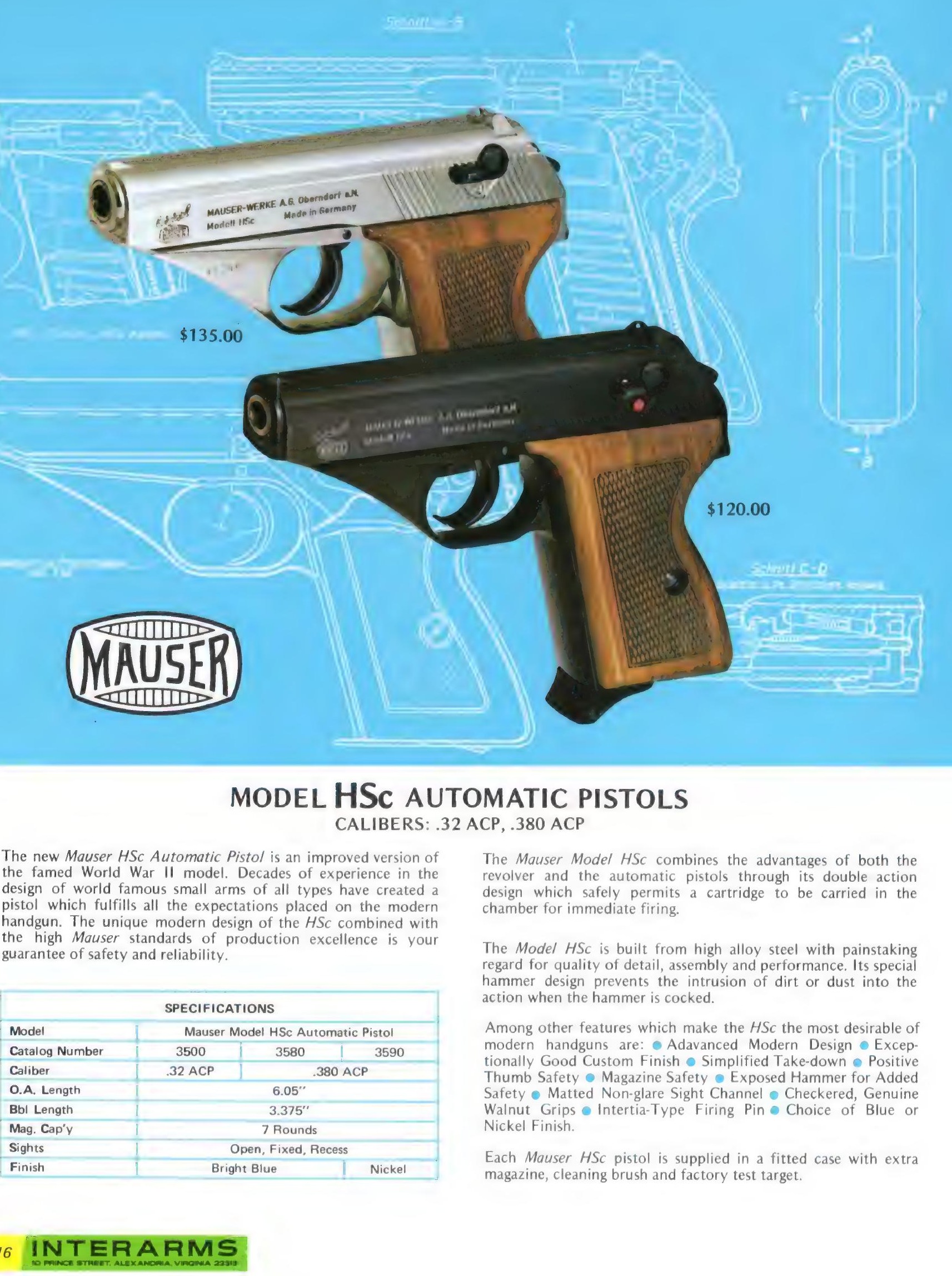
Its 1973 catalogue is the best primary document located for the post-war pistol, and unusually for a dive of this kind it is readable in full.10 Page 16 is a single page on the HSc, printed over a background of a Mauser factory sectional drawing with its German section labels still legible.
The prices, as printed beside the photographs on the page:
Table 3 — The prices, as printed beside the photographs on the page:
| Finish | Price, 1973 |
|---|---|
| Bright Blue | $120.00 |
| Nickel | $135.00 |
The specification table, as printed:
Table 4 — The specification table, as printed:
| Catalogue numbers | 3500 (.32 ACP), 3580 and 3590 (.380 ACP) |
| Overall length | 6.05 in |
| Barrel length | 3.375 in |
| Magazine capacity | 7 rounds |
| Sights | Open, Fixed, Recess |
| Finish | Bright Blue / Nickel |
⚠ The magazine-capacity cell spans all three catalogue numbers, including the .32 ACP gun, and reads seven rounds. Every other source gives eight for 7.65 mm. It is reproduced here exactly as printed because it is a primary document; it is either a catalogue error or a merged cell in the table’s own typesetting, and this dive does not know which.10
The feature list, verbatim, spelling included: “Adavanced Modern Design · Exceptionally Good Custom Finish · Simplified Take-down · Positive Thumb Safety · Magazine Safety · Exposed Hammer for Added Safety · Matted Non-glare Sight Channel · Checkered, Genuine Walnut Grips · Intertia-Type Firing Pin · Choice of Blue or Nickel Finish.”10
What was in the box: “Each Mauser HSc pistol is supplied in a fitted case with extra magazine, cleaning brush and factory test target.”10
Three of those details do real work elsewhere in this dive. The magazine safety and the inertia firing pin confirm mechanism claims in Volume 3. The fitted case with its second magazine, brush and test target tells a buyer today what a complete 1968–77 gun looks like, which Volume 8 turns into money. And the copy’s claim that the hammer “prevents the intrusion of dirt or dust into the action when the hammer is cocked” is the maker’s own explanation of a feature everybody else explains as concealment, which is the argument of Volume 2.10
The slide legend visible in the catalogue photograph is the post-war one and it differs from the wartime legend in two specific ways that Volume 7 uses as an identification test: “Modell HSc” rather than “Mod. HSc”, and the added line “Made in Germany”, which a pistol sold in Germany in 1943 had no reason to carry.10
6.7 The .380 Correction
American Rifleman’s account of the post-war gun contains one statement this dive can correct from the production record: “In 1970 the gun was also offered in 9 mm Kurz (.380 ACP).”9
Burnham and Theodore’s table shows a 9 mm Kurz block 01.1001 to 01.1500 — 500 pistols — October 1968 to 1969, opening at exactly the same moment as the 7.65 mm block that begins the New Model.2 The .380 was there from the first day of post-war production. What happened in 1970 is that it took over: 17,000 .380s against 7,000 .32s in that year alone.
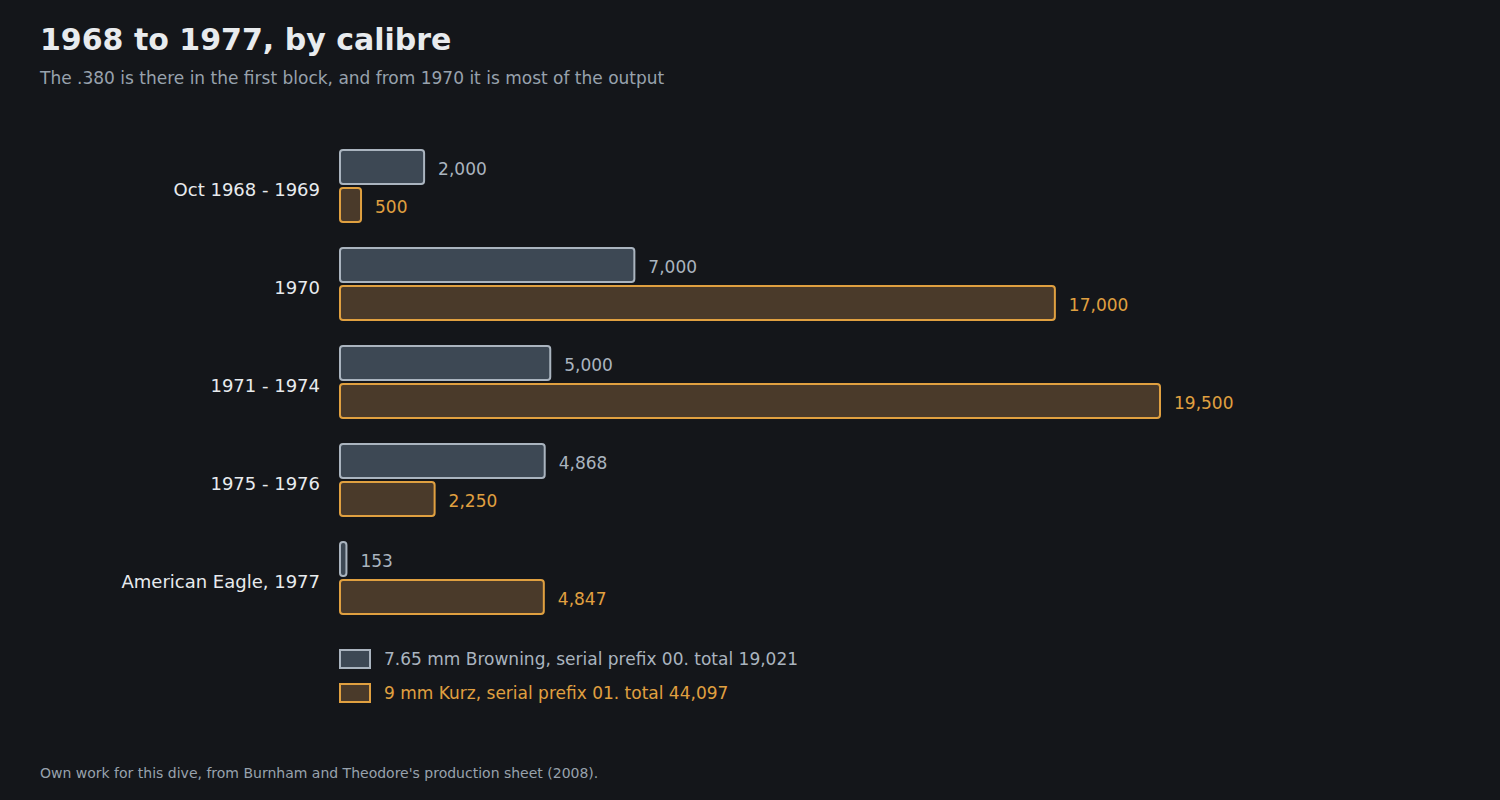
The larger point is the one the totals make. Across 1968 to 1977 Mauser built 44,097 pistols in 9 mm Kurz against 19,021 in 7.65 mm — better than two to one the other way round from the wartime gun, which was made in 7.65 mm only.2 The HSc that most Americans have handled is a .380, and the HSc that most collectors care about is a .32, and they are the same pistol separated by thirty years and a market.
6.8 The American Eagle, 1977
The last block in the table is a commemorative. Burnham and Theodore give it as 5,000 pistols in 1977, numbered 0001 to 5000 in a series of its own, split 0001 to about 0153 in 7.65 mm and 0154 to 5000 in 9 mm Kurz — about 153 .32s against 4,847 .380s.2
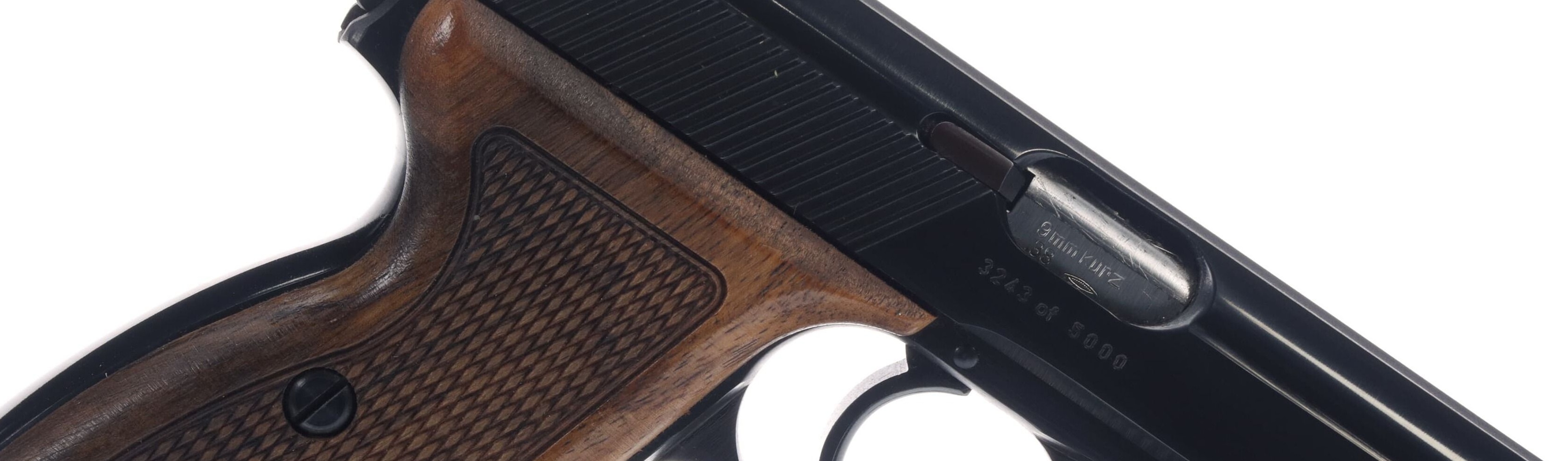
That split can be checked against a pistol. Rock Island Auction’s lot 2049/28 of 25 August 2021 is an American Eagle whose frame is stamped “4243 of 5000” and whose slide is marked 9 mm Kurz.11 Serial 4243 sits well inside Burnham and Theodore’s 0154-to-5000 .380 block, exactly where their table says a .380 should be. It is a small check and it is the only independent test of that sheet this dive was able to make against a physical object.
Two further things follow and both are collector points.
The American Eagle has its own serial series, numbered “N of 5000” on the frame rather than carrying a 00. or 01. prefix. A four-digit “of 5000” number on an HSc is a 1977 commemorative, not a wartime gun with digits missing.
The .32 American Eagle is genuinely rare. About 153 pistols out of a 5,000-gun run, out of a total production of a third of a million, is the scarcest regular-production HSc variant the table records. ⚠ No auction result specifically for a 7.65 mm American Eagle was located for this dive, so no premium is quoted for it in Volume 8; the rarity is arithmetic from the production sheet, and what the market pays for it is unknown here.
The lot also confirms what a complete post-war gun carries, and it answers a question Volume 4 had to leave open. It was sold “with matching factory box, the manual, test target, and extra magazine”.11 Three more Interarms HSc lots from 2020 and 2021 are catalogued the same way — box, manual, brush, test target, spare magazine.12 So an owner’s manual for this pistol certainly exists; Volume 4’s finding is narrower than it looks, and is simply that no copy of it has been digitised anywhere this dive could reach.
6.9 The HSc-80, and What Could Not Be Confirmed
The pistol’s last chapter is the one usually given in a single vague clause, and it turned out to be settleable — not from any reference book, but by reading the slides of two pistols in an auction photograph.
What the written sources say. American Rifleman, with no date, model name or figure: “Additionally, copies were made in Italy by Renato Gamba.”9 German Wikipedia, unsourced: in the 1970s Mauser reissued the pistol, “unter anderem als HSc-80 mit vergrößerter Magazinkapazität” — among other things as the HSc-80 with enlarged magazine capacity — and gave up production soon after.6 Wikipedia’s article on the 9×18 mm Ultra names “Mauser HSc-80” among the pistols chambered for it, alongside the Walther PP Super and the SIG Sauer P230, citing a 2012 Guns.com review whose title alone tells the story: “Gun Review: Mauser HSc-80: A decent gun except for the 9mm Ultra cartridge”.13 That review is gone from the live web and no archived capture was found; no Italian source could be read at all.
What the photographs establish. Rock Island Auction sold a lot catalogued simply as “Two Renato Gamba/Mauser HSc Pistols”, “Manufactured in Italy”, with a matching factory box, on 25 August 2021.14 Its thirteen photographs are of two visibly different pistols, and both slides are legible at full resolution.
The first pistol’s slide reads, in three lines:
”… UNDER LICENSE OF [MA]USER-WERKE A.G. Oberndorf a.N.” “HSc SUPER” “CAL .380 ACP”
The second pistol’s slide reads:
“MAUSER - HSC 80” “…ed under license by … [G]AMBA S.p.A. GARDONE V.T. ITALY”
and its frame carries a small “S.A.B.” stamp forward of the trigger guard.
That settles several things at once, from the objects themselves rather than from repetition.
“Copies” is the wrong word. Both pistols say under licence of, or by, Mauser-Werke A.G., Oberndorf. American Rifleman’s “copies were made in Italy” describes a licensed production, not a clone.
The place is Gardone Val Trompia, the Brescian gun-making valley, which is where Renato Gamba’s works are.
There are at least two Italian models, not one. An HSc Super in .380 ACP and an HSc-80. They are different pistols: the Super retains the HSc outline with wrap-around wooden grips, and the HSc-80 is visibly larger and squarer, with black moulded wrap-around grips, a bigger trigger guard and a straighter slide.
English Wikipedia’s unsourced “HSc Super” variant is real. Its infobox lists it and cites nothing; a slide legend now does.4
What is still not established. No production figure, no date range, no serial scheme, and no magazine capacity — German Wikipedia’s “enlarged magazine capacity” remains unsourced, and although the HSc-80 in the photographs is plainly a bigger pistol than a wartime HSc, a bigger pistol is not a count. The chambering of the HSc-80 is also unconfirmed here: the one pistol whose calibre marking is legible in this lot is the HSc Super, and it reads .380 ACP, not 9 mm Ultra. The Ultra attribution rests entirely on a citation to a review nobody can now read.
The Ultra context is worth keeping even so, because it explains what a pistol like this was for. The 9×18 mm Ultra was a 1936 Luftwaffe cartridge that Walther revived in the PP Super of 1972–73 for the West German federal police; the police then chose 9×19 mm instead after the rise of far-left terrorism, the cartridge reached civilian sale in 1975, and the PP Super was discontinued in 1979.13 A licensed Italian Mauser pocket pistol enlarged and renamed around 1980 is a pistol chasing a contract that had already gone elsewhere.
⚠ One caution stands for Volume 8. English Wikipedia’s HSc infobox lists 9×18 mm Ultra as a chambering of the HSc itself, unsourced and uncorroborated by anything gathered here.4 An ordinary HSc offered for sale in 9 mm Ultra is a pistol to ask hard questions about; an HSc-80 so offered is a different and more plausible claim, and still one to see marked on the slide.
The one document that would close the remaining gaps is a Renato Gamba catalogue. It is not on the public internet. It is the sort of thing that turns up on a collector’s shelf.
References
Footnotes
-
Ian McCollum, “1945: The French Occupy Mauser and Make Lugers”, Forgotten Weapons, https://www.forgottenweapons.com/1945-the-french-occupy-mauser-and-make-lugers/ , retrieved 2026-09-20. ↩ ↩2 ↩3
-
Alan D. Burnham and Peter H. Theodore, “Mauser HSc Production History”, 1 May 2008; retrieved 2026-09-19 from https://web.archive.org/web/20101125173453/http://mauserguns.com/Mauser_HSc_Production.pdf . ↩ ↩2 ↩3 ↩4 ↩5 ↩6 ↩7 ↩8 ↩9
-
Ian McCollum, “Evolution of the Military Mauser HSc Pistol”, Forgotten Weapons, https://www.forgottenweapons.com/evolution-of-the-military-mauser-hsc-pistol/ , retrieved 2026-09-20. ↩
-
“Mauser HSc”, Wikipedia, consulted 2026-09-19. Its Burundian Civil War service entry is cited there to Small Arms Survey, The Small Arms Survey 2007: Guns and the City, Cambridge University Press, p. 204. ↩ ↩2 ↩3 ↩4 ↩5 ↩6 ↩7
-
Rock Island Auction Company, lot 2054/256, “Two French Production Mauser HSc Semi-Automatic Pistols”, 12 January 2022, estimate $900–1,200, hammer $900, https://www.rockislandauction.com/detail/2054/256/ , retrieved 2026-09-20. Provenance: The Milan J. Turk Collection. ↩
-
“Mauser HSc”, German Wikipedia, revision 265079350, consulted 2026-09-19. ↩ ↩2
-
“Alex Seidel”, German Wikipedia, revision 265794163, consulted 2026-09-19. ↩
-
“Heckler & Koch HK4”, Wikipedia, consulted 2026-09-20; the article carries a Wikipedia notice that it needs additional citations. ↩
-
Garry James, “This Old Gun: Mauser HSc Pistol”, American Rifleman, 11 May 2017, https://www.americanrifleman.org/content/this-old-gun-mauser-hsc-pistol/ , retrieved 2026-09-19. ↩ ↩2 ↩3
-
Interarms, Interarms 73 catalogue, Alexandria, Virginia, 1973, p. 16, “Model HSc Automatic Pistols”. Internet Archive item
interarms-73, https://archive.org/details/interarms-73 , retrieved 2026-09-19. The page was read as a rendered image at 200 dots per inch as well as in its optical character recognition, because the prices and the specification table are set in a layout the text extraction scrambles. ↩ ↩2 ↩3 ↩4 ↩5 ↩6 -
Rock Island Auction Company, lot 2049/28, “Mauser/Interarms HSc American Eagle One of Five Thousand Pistol”, 25 August 2021, estimate $700–1,000, hammer $600, https://www.rockislandauction.com/detail/2049/28/ , retrieved 2026-09-20. Catalogue text: “Manufactured in Germany. With matching factory box, the manual, test target, and extra magazine.” ↩ ↩2
-
Rock Island Auction Company lots 2038/505 (29 December 2020, hammer $500), 2039/940 (27 January 2021, nickel, hammer $600) and 2041/739 (10 March 2021, hammer $450), all catalogued as Mauser/Interarms HSc pistols with box, manual, brush or test target and an extra magazine. Retrieved 2026-09-20. ↩
-
“9×18mm Ultra”, Wikipedia, consulted 2026-09-20, citing Frank C. Barnes, Cartridges of the World (Gun Digest Books, 2012), p. 338, and, for the HSc-80, Jim Downey, “Gun Review: Mauser HSc-80: A decent gun except for the 9mm Ultra cartridge”, Guns.com, 2 May 2012. The Downey review could not be retrieved: the live page is gone and no Wayback capture was located on 2026-09-20. ↩ ↩2
-
Rock Island Auction Company, lot 2049/753, “Two Renato Gamba/Mauser HSc Pistols”, 25 August 2021, estimate $500–800, hammer $600, https://www.rockislandauction.com/detail/2049/753/ , retrieved 2026-09-20. Catalogue text: “Manufactured in Italy. With matching factory box, and extra magazine.” The slide legends quoted here were read from the lot’s own photographs at full resolution by this dive, not from the catalogue text. ↩
Comments (0)