Mauser HSc · Volume 4
Keeping It Working — Field Strip, Detail Strip, Maintenance and Repair
No manual could be found for this pistol, in any language, from any of its three makers. This volume says what was looked for, what the patents establish instead, and what a correct procedure has to account for
This volume is the one the hub’s brief insists on for every dive: how the thing comes apart, how it is kept running, what goes wrong and who can fix it. On most guns it is written from a manual.
On this one it cannot be, because no manual was found.
That statement is the volume’s first finding and it is the reason the volume is shaped the way it is. What follows is an account of the search, then everything the primary documents do establish, and then — carefully separated from it — what a correct procedure would have to account for. No disassembly sequence is reconstructed from memory here. The hub has shipped invented sequences before and this dive will not add one.
4.1 The Manual That Could Not Be Found
Three organisations made this pistol — Mauser-Werke before and after the war, the French administration at Oberndorf in 1945–46, and Renato Gamba in Italy — and Interarms imported and sold it in the United States for the better part of a decade. Any of the four could have published an owner’s manual and at least two of them certainly did. None was located.
What was searched, and what it returned:
- The Internet Archive’s whole catalogue, by phrase and by title, for “Mauser HSc”, “Modell HSc” and “Model HSc”. Three items match. One is the Interarms 1973 catalogue used throughout these volumes, which is a sales document with a specification table and no instructions. One is a CIA reading-room document. The third, catalogued as “Model HSC”, is an installation manual for a Goulds water pump.
- The Internet Archive’s manuals collections, including the item “Lots of gun PDFs / firearms manuals”, which holds 1,996 files. It contains three Mauser manuals, all for rifles.
- An item promisingly titled “Die neue MAUSER Selbstladepistole”. It is the post-war Mauser Parabellum — the Luger — in German, English and French, and it does not mention the HSc.
- Steve’s Pages, the large free manual mirror. Its Mauser holdings are the rifle line, the Model 90DA and the Parabellum. No HSc.
- The US Army’s 1945 Catalog of Enemy Ordnance Materiel, which would be the natural place for an allied technical description of a German service pistol. Its pistol coverage is the Walther P.38 and the Walther signal pistol. The HSc does not appear.
A negative result from a search is not proof of absence — and in this case the proof of existence turned up elsewhere in the dive. Four Rock Island Auction lots of 1968–77 Mauser/Interarms pistols are catalogued as being sold with “the manual”, along with the factory box, the cleaning brush, the test target and the spare magazine that the 1973 catalogue says the pistol shipped with.12 So the post-war owner’s manual certainly exists, in quantity, in collectors’ hands.
The finding is therefore narrower and more annoying than “there is no manual”. There is a manual, and nobody has scanned it. A reader who wants one should expect to buy a paper copy with a pistol, and the hub would be glad of a scan.
4.2 The One Published Sentence About Taking It Apart
There is exactly one published statement located that describes how the pistol opens, and it is a single clause in Modern Firearms:
“The barrel can be detached from the frame by the release of the lock, located inside of the triggerguard.”3
That is not a procedure and it is not written as one. What it establishes is the location of the takedown catch: inside the trigger guard, not on the slide, not at the muzzle, not under the grip.
Interarms’s 1973 catalogue adds only a claim, in its bullet list of selling features: “Simplified Take-down”.2
Those two statements together — a catch in the trigger guard, and a takedown the maker thought was simple enough to advertise — are the whole of the public record.
4.3 What a Correct Field-Strip Procedure Must Account For
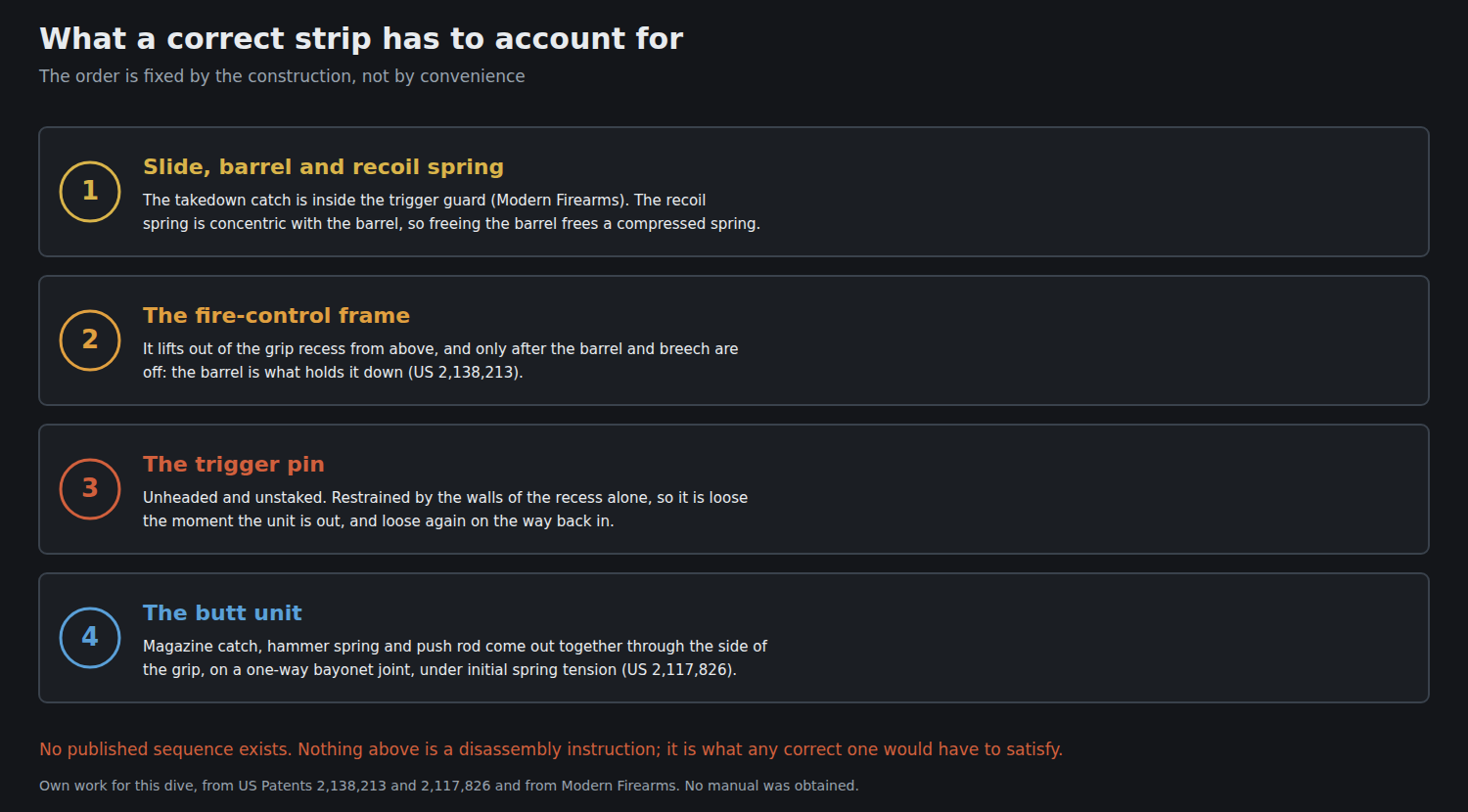
Since a sequence cannot be reproduced, here instead is what any correct sequence has to satisfy. All of it is drawn from documents, and where something is an inference from construction it is labelled as one.
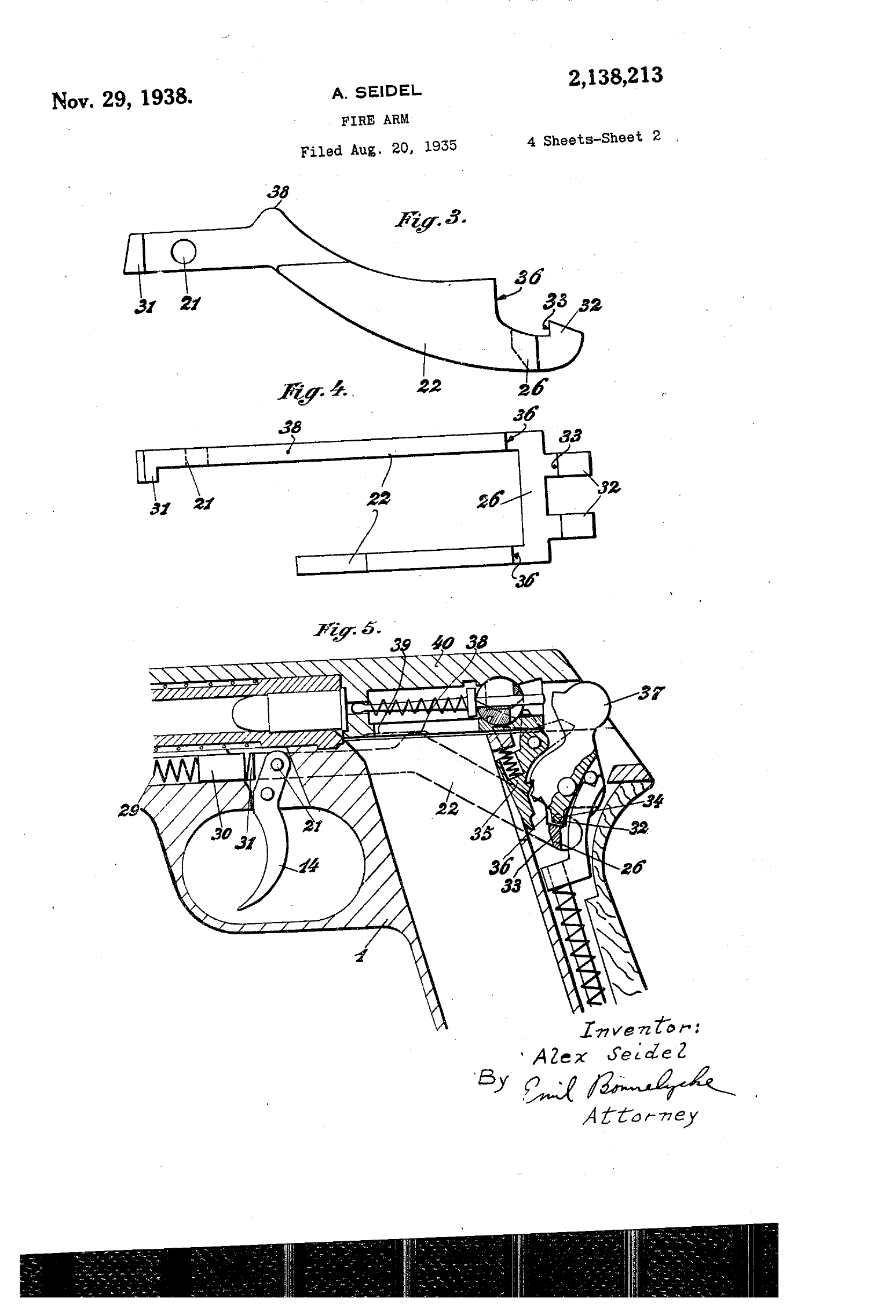
1. The order of removal is fixed by the way the pistol is built, not by convenience. US 2,138,213 states that the fire-control frame “is inserted from the top, after the barrel and the breech have been removed”, and that one of its side plates is taller “and its top engages below the lower face of the barrel, so that the frame is held against vertical displacement”.4 Read backwards, that means the barrel is what holds the fire control down. Nothing inside the frame can be lifted out until the barrel is off.
2. The trigger pin is loose the moment the frame is out. The same patent: “the ends of the trigger pin are flush with the outer faces of the side plates and, since the pin is without any projections, it is not held against axial displacement before the frame is inserted in the recess, and the pin is restrained by the inner faces of the recess”.4 An unheaded, unstaked pin held only by the frame’s walls will walk out of a stripped fire-control unit if it is handled carelessly. This is the single most practical warning the patents contain, and it applies in reverse on assembly.
3. The connecting rod may or may not come with the trigger. The patent is explicit that both arrangements were contemplated: “The connection of the rod and trigger may be separated when the frame is removed, or the connection may be permanent so that the frame, the trigger, and the connecting rod are removed together.”4 Which one a given HSc uses is not established here. Anyone opening one should find out before pulling.
4. There is a strong spring in the butt and it is not the magazine spring. The hammer spring lives on the push rod inside the grip frame and, per US 2,117,826, it “is under initial tension” even at rest, and it is also what holds the magazine in.5 Nothing in the butt should be disturbed without expecting a spring under load.
5. The recoil spring is around the barrel, inside the slide. English Wikipedia’s description names “a spring surrounding the barrel”.6 A takedown that frees the barrel therefore also frees a compressed spring.
6. The slide carries the extractor, the firing pin and the safety. All three are in the reciprocating part, which means a slide stripped off the frame is still a loaded assembly of small parts and springs.
7. There is no hold-open. Nothing consulted describes one, and none is visible in the drawings or photographs used in these volumes. A procedure that assumes a slide stop to work against does not apply to this pistol. Stated as an observation.
4.4 The Detail Strip, as the Patents Describe It
For one sub-assembly — the magazine catch, the hammer spring and the push rod — a primary document does give a procedure, in the inventor’s own words. It is reproduced here because it is genuinely better evidence than most manuals, and because it explains a step that would otherwise be baffling.
“To extract the unit, the side wall of the pistol stock is removed, the holder is disengaged from the edge of the magazine, and the push rod, the hammer spring and the holder are extracted together.”5
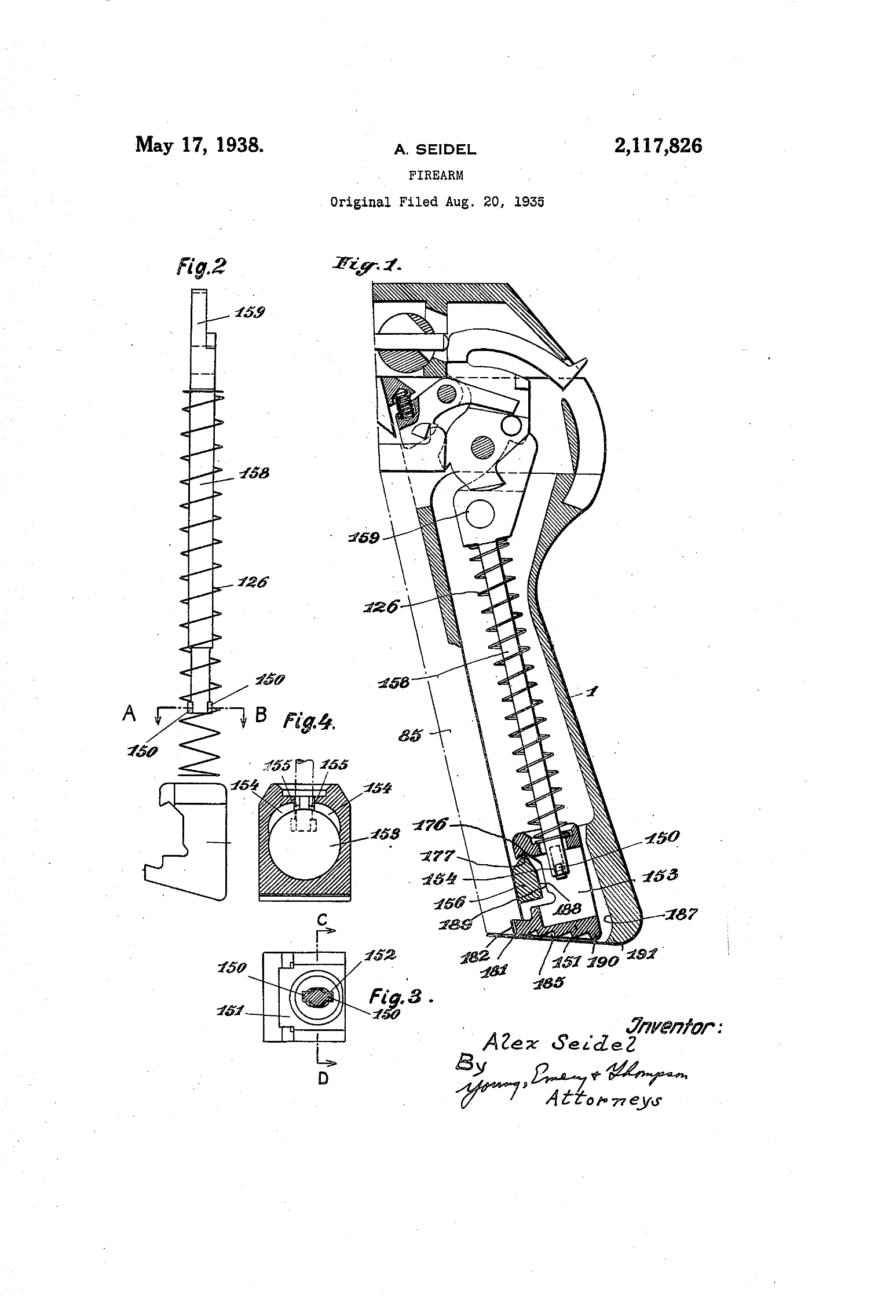
“For detaching the rod from the holder, the rod is pushed down into the central cavity of the holder against the reaction of the hammer spring, until the projections have passed the notches in the holder. The rod is now turned through 90 degrees, and extracted upwardly while the spring expands.”5
Three things follow, and they are the sort of thing that is usually learned by ruining a part.
The grip panel is a service access. “The side wall of the pistol stock is removed” is the first step of the detail strip, which is why the grip screw is the only screw on the pistol.
It is a bayonet joint, deliberately asymmetric. The two projections on the push rod are of different size, so “the parts of the unit will fit only in one definite position with respect to each other”.5 If it will not go together, it is the wrong way round, and forcing it is the wrong answer.
The magazine is part of the retention. “Relative rotation of the parts is prevented in this position by an edge of the magazine which engages in a seat of the magazine holder.”5 With a magazine in the pistol, the unit is locked against the rotation that would release the bayonet joint. With the magazine out, it is not. That is an elegant piece of design and it is also a reason not to fiddle with the heel of an empty pistol.
The patent adds one reassurance: when the unit is out of the gun, “the projections hold the push rod against turning, by engaging in notches at the top of the central cavity of the holder, and against abutments formed by such notches, so that the push rod is not forced off by its spring”.5 The assembly is captive in the hand. It is when the rod is deliberately pushed down and turned that the spring becomes free.
Beyond that sub-assembly, no detail-strip account exists in the sources gathered here. The sear, the bellcrank, the slide member, the extractor and the firing-pin safety are all described mechanically in the patents and their removal is described nowhere.
4.5 Handling: Loading, Unloading, and the Hammer Problem
The loading cycle is the ordinary one for a pocket automatic and does not need a manual: magazine in, slide drawn fully back and released, pistol now loaded and cocked.
Making it safe afterwards is where this pistol has a genuine gap in the literature, and Volume 3 raises it. The safety lever locks the firing pin; nothing consulted describes it dropping the hammer, and the Walther PP’s decocking safety — which the HSc is routinely assumed to share — is a different mechanism on a different gun.738 The hammer spur is small, deliberately so, because the whole point of the shrouded hammer was concealment and dirt exclusion.72
That leaves the question of how a chambered HSc is carried with the hammer down, and no source located for this dive answers it. The question is not this volume’s invention: a reader of the Forgotten Weapons article raises exactly the same difficulty and is not answered.9 Three possibilities exist — that the pistol was intended to be carried cocked with the safety on, that the hammer was intended to be lowered manually on a live chamber in the ordinary careful way, or that there is a decocking provision no consulted source mentions — and this dive cannot choose between them.
What the design does provide, and what is documented, is that a hammer at rest is not touching the firing pin: US 2,138,213 specifies a gap between the hammer’s striking face and the pin’s rear end when the hammer is down, and a locking bellcrank positively in the way whenever the trigger is released.4 A hammer lowered onto a loaded chamber on an HSc is resting against a blocked system, not against a primer. That is a statement about the mechanism, not permission to practise the manoeuvre on a loaded gun.
The magazine safety has a handling consequence that catches people out. With the magazine removed the trigger is blocked.102 It follows that the standard unloading order — magazine out, then rack the chamber clear — leaves a pistol that cannot be dry-fired to verify. It also follows that a pistol which “will not fire” may simply have a magazine that is not fully seated.
4.6 Cleaning and Lubrication
No maker’s schedule was found, so none is given. What can be said is what the design implies, and the design is unusually articulate about dirt.
Volume 2 sets out the three closures: the trigger’s flanks are arcs struck about its pivot so the joint never opens; the magazine catch “closes the recess in which it is positioned, when the magazine is inserted, and when it is extracted, so that access of dirt to the recess, to the cock spring, and to the push rod is prevented”; and Interarms’s own copy says the hammer “prevents the intrusion of dirt or dust into the action when the hammer is cocked”.452
Two practical consequences follow from a sealed design, and they point in opposite directions.
The good one. A pistol carried in a pocket or a holster keeps its fire control cleaner than a pistol with open slots at the trigger and the heel. This is exactly what the closures were for.
The awkward one. What does get in does not easily get out, and it cannot be flushed through an opening that does not exist. On a sealed mechanism, solvent and oil applied from outside reach the outside. Anything beyond a light external clean means opening the pistol, and opening the pistol means the constraints in the two sections above.
The lubrication points that can be named without inventing a schedule are the ones the mechanism’s own geometry dictates: the slide rails; the barrel’s bearing in the slide; the hammer pivot, the sear and the bearing faces of the connecting rod’s hooks; the slide member and the lug it rides on; and the trigger’s sealing faces, which are the one place where oil doubles as part of the seal. Oil should be sparing everywhere, because a pistol designed to exclude dust will hold whatever dust the oil catches.
4.7 Function Checks an Owner Can Actually Make
These follow from documented features and can be made on an unloaded pistol without taking anything apart. They do not require a manual, because each one tests a mechanism a source describes.
Table 1 — Function Checks an Owner Can Actually Make
| Check | What it tests | Expected result |
|---|---|---|
| Remove the magazine, then press the trigger | the magazine safety102 | the trigger is blocked |
| Insert an empty magazine, cock the hammer, apply the safety, press the trigger | the firing-pin lock73 | the hammer may or may not fall depending on the design; the firing pin must not be driven forward |
| With the hammer down, look at the gap between hammer face and firing-pin tail | the rest gap specified in the patent4 | the hammer should not rest on the pin |
| Hold the trigger down after a dry shot, cycle the slide, then release the trigger | the disconnector function of the slide member11 | the hammer stays cocked while the trigger is held; the trigger resets audibly on release |
| Press the trigger with the slide held slightly out of battery | the out-of-battery interlock11 | the trigger should move idly and nothing should release |
A pistol that fails the second or the fifth of those is not safe to shoot and is a gunsmith’s problem.
4.8 Wear, Breakage and What Is Not Claimed Here
No repair literature for the HSc was located — no armourer’s notes, no parts-failure list, no collector’s account of common breakages that could be attributed to a named source. A list of “known weak parts” is exactly the sort of thing a dive can invent without noticing, and none is invented here.
What can be said is documented, and it is mostly about the guns rather than the design.
Late-war guns are not early-war guns. English Wikipedia’s account of the production variations records that from roughly serial 745,000 “the high quality finish of the earlier pistols starts to decline”; that from about 790,000 “the polish of these pistols is rougher” and the military “dusk blue” appears; that the cross-hatched machining inside the sight channel is dropped; that black plastic grip panels appear in the late 940,000s; and that the last guns, from about 949,500, are phosphate finished with “a mix of older blued parts and later phosphated parts”.6 A pistol assembled from mixed-finish parts at the end of a losing war is a pistol whose fits and heat treatments deserve more scepticism than a 1941 commercial gun’s.
French-period guns are partly wartime parts. Burnham and Theodore’s sheet divides the 19,300 pistols of May 1945 to June 1946 into 14,596 manufactured and about 4,704 assembled, with their own footnote: “Assembled using leftover parts from the war.”12 Roughly a quarter of that production is a parts-bin gun put together under an occupying administration.
The rest is inference from the mechanism, and is labelled as such. The parts that carry the working loads are the sear and the hammer’s engaging tooth; the hooks on the connecting rod that take the hammer during the double-action pull; the slide member and its lugs, which are struck by the recoiling breech every shot; and the extractor. A worn sear or a rounded hammer tooth on any pistol shows up as a hammer that will not stay cocked or that follows the slide down, and either symptom on an HSc is a reason to stop shooting it. That is general gunsmithing, offered as such; no source consulted says these are the HSc’s characteristic failures, and an experienced hand should treat the list as where to look rather than as what to expect.
4.9 Magazines
The wartime pistol takes an eight-round single-column magazine in 7.65 mm Browning; the post-war gun takes seven in 9 mm Kurz.6107 Magazines are therefore not interchangeable across calibre, and the .380 magazine body is not a .32 magazine with a different follower.
Two features are documented and both matter to an owner.
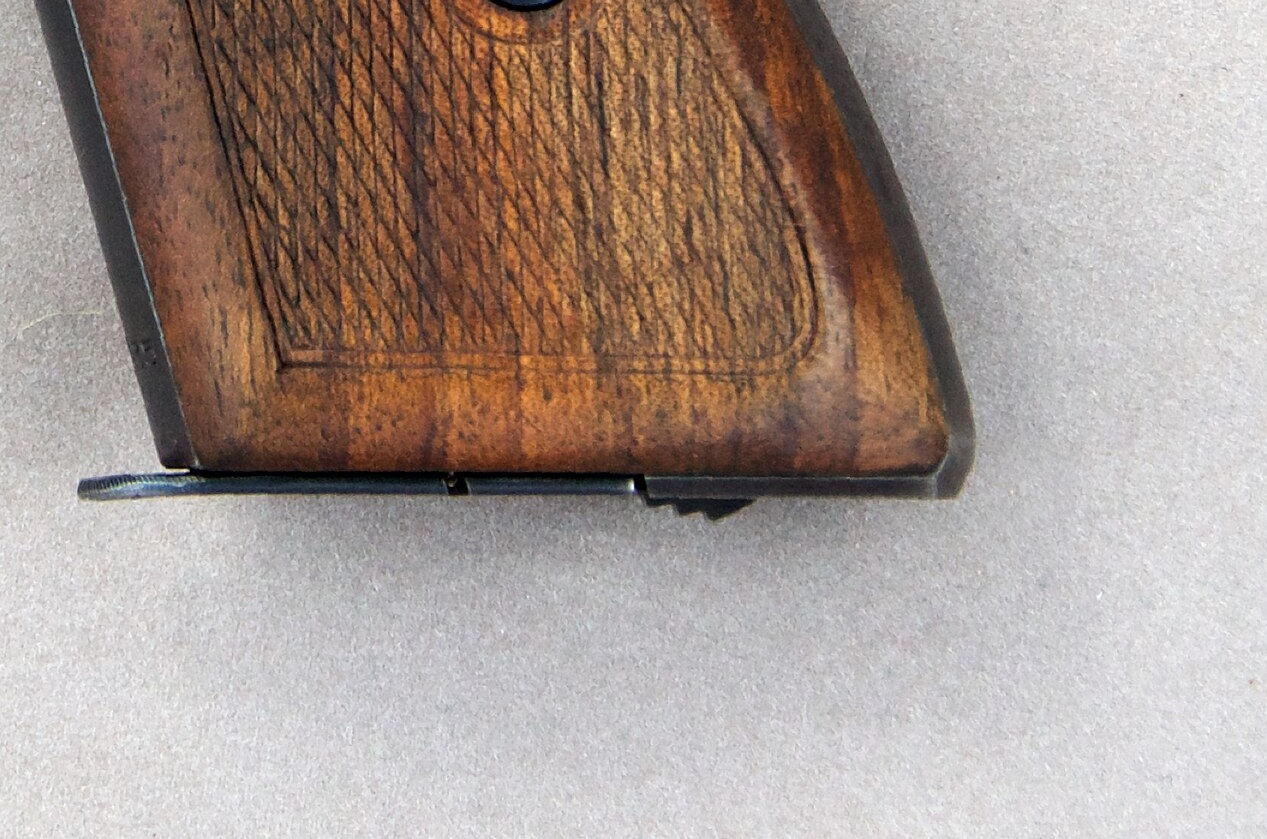
The floorplate lip. American Rifleman notes that “a lip on the forward part of the magazine allowed it to be easily extracted when the catch was pushed to the rear”.7 Volume 2 explains why it has to be there: the catch is flush with the butt, so there is nothing else to pull on. A magazine whose lip is bent or missing is a magazine that is hard to get out of the gun.
The magazine is a structural part of the catch. US 2,117,826 describes an edge of the magazine engaging a seat in the holder and preventing the unit’s rotation.5 A magazine with a damaged body edge is not just a feeding problem.
The Interarms gun shipped with a spare: “Each Mauser HSc pistol is supplied in a fitted case with extra magazine, cleaning brush and factory test target.”2 A 1968–77 pistol offered today without its second magazine is missing something it left the factory with, which is worth knowing both for price and for provenance.
⚠ Current availability of new magazines could not be established. Two specialist magazine makers’ catalogues were fetched and neither could be searched by this project’s tooling; no maker, part number or price is stated here because none could be verified. This is a gap, and it is the kind of gap that a reader with the pistol in hand can close faster than a dive can.
4.10 Parts, and Who Is Left to Help
The picture for parts is worse than for a comparable American gun of the same age, and the reason is straightforward: there is no surviving manufacturer to write to.
Mauser’s HSc production ended in 1977. Interarms, the importer, is long gone. Renato Gamba’s involvement is recorded in a single sentence in American Rifleman and could not be confirmed further (Volume 6).7
Gun Parts Corporation’s Mauser index page was fetched on 20 September 2026 and reached no HSc entry; the page it serves is headed for the rifle line and its product listing is rendered in the browser, so it could not be searched by this project’s fetch engine. That is a limitation of the tooling, not a finding about the company’s stock, and it is reported as such.
The practical position, stated without a vendor name because none could be verified, is the ordinary one for a 1940s European pocket pistol: springs and pins are the sort of thing a competent gunsmith makes or adapts; a broken sear, hammer or extractor means finding a donor pistol; and grips, magazines and complete slides are bought from the collector market rather than from a counter.
The one piece of advice this volume will give in its own voice is about who should open one. The fire control is a self-contained unit retained by the barrel, with an unheaded pin restrained by the frame’s own walls, and a hammer-spring assembly on a deliberately asymmetric bayonet joint under initial tension.45 None of that is beyond an experienced bench. All of it is beyond somebody working it out with a screwdriver and no drawing — and the drawings, at least, are free: the three patents cited throughout these volumes are in the public domain and can be read in full.
References
Footnotes
-
Rock Island Auction Company lots 2038/505 (29 December 2020), 2039/940 (27 January 2021), 2041/739 (10 March 2021) and 2049/28 (25 August 2021), all catalogued as Mauser/Interarms HSc pistols sold with box, manual, brush or test target and an extra magazine. Retrieved 2026-09-20. ↩
-
Interarms, Interarms 73 catalogue, Alexandria, Virginia, 1973, p. 16. Internet Archive item
interarms-73, https://archive.org/details/interarms-73 , retrieved 2026-09-19. ↩ ↩2 ↩3 ↩4 ↩5 ↩6 ↩7 -
Maxim Popenker, “Mauser HSc”, Modern Firearms, https://modernfirearms.net/en/handguns/handguns-en/germany-semi-automatic-pistols/mauser-hsc-eng/ , retrieved 2026-09-19. ↩ ↩2 ↩3
-
US Patent 2,138,213, “Fire Arm”, Alex Seidel, assignor to Mauser-Werke A.G.; filed 20 August 1935; German priority 10 August 1934; granted 29 November 1938. https://patents.google.com/patent/US2138213A/en , retrieved 2026-09-19. ↩ ↩2 ↩3 ↩4 ↩5 ↩6 ↩7
-
US Patent 2,117,826, “Firearm”, Alex Seidel, assignor to Mauser-Werke A.G.; division of Serial No. 37,078, filed 24 August 1937; German priority 6 May 1935; granted 17 May 1938. https://patents.google.com/patent/US2117826A/en , retrieved 2026-09-19. ↩ ↩2 ↩3 ↩4 ↩5 ↩6 ↩7 ↩8 ↩9
-
Garry James, “This Old Gun: Mauser HSc Pistol”, American Rifleman, 11 May 2017, https://www.americanrifleman.org/content/this-old-gun-mauser-hsc-pistol/ , retrieved 2026-09-19. ↩ ↩2 ↩3 ↩4 ↩5 ↩6
-
“Walther PP”, Wikipedia, consulted 2026-09-20. ↩
-
Ian McCollum, “Evolution of the Military Mauser HSc Pistol”, Forgotten Weapons, https://www.forgottenweapons.com/evolution-of-the-military-mauser-hsc-pistol/ , retrieved 2026-09-20. The hammer-lowering question is from a reader comment on that page. ↩
-
“Mauser HSc”, German Wikipedia, revision 265079350, consulted 2026-09-19. ↩ ↩2 ↩3
-
US Patent 2,177,227, “Firearm”, Alex Seidel, assignor to Mauser-Werke A.G.; granted 24 October 1939. https://patents.google.com/patent/US2177227A/en , retrieved 2026-09-19. ↩ ↩2
-
Alan D. Burnham and Peter H. Theodore, “Mauser HSc Production History”, 1 May 2008, retrieved 2026-09-19 from https://web.archive.org/web/20101125173453/http://mauserguns.com/Mauser_HSc_Production.pdf . ↩
Comments (0)