Mauser HSc · Volume 7
Telling Them Apart
Which pistol it is not, which HSc it is, and the one place to look first — with every variant photographed from the same side in the same orientation
7.1 Two Different Questions
A reader looking at a small German double-action blowback is asking two questions at once, and they have different answers.
Is it an HSc, or is it a Walther? This is the common error, it is made constantly, and it is settled in about a second once the right place to look is known.
Which HSc is it? Between 1940 and about 1980 the same basic pistol was built in Oberndorf under three different régimes and in Gardone Val Trompia under licence, and the differences run from a thousand dollars to ten thousand. This is the harder question and most of this volume is about it.
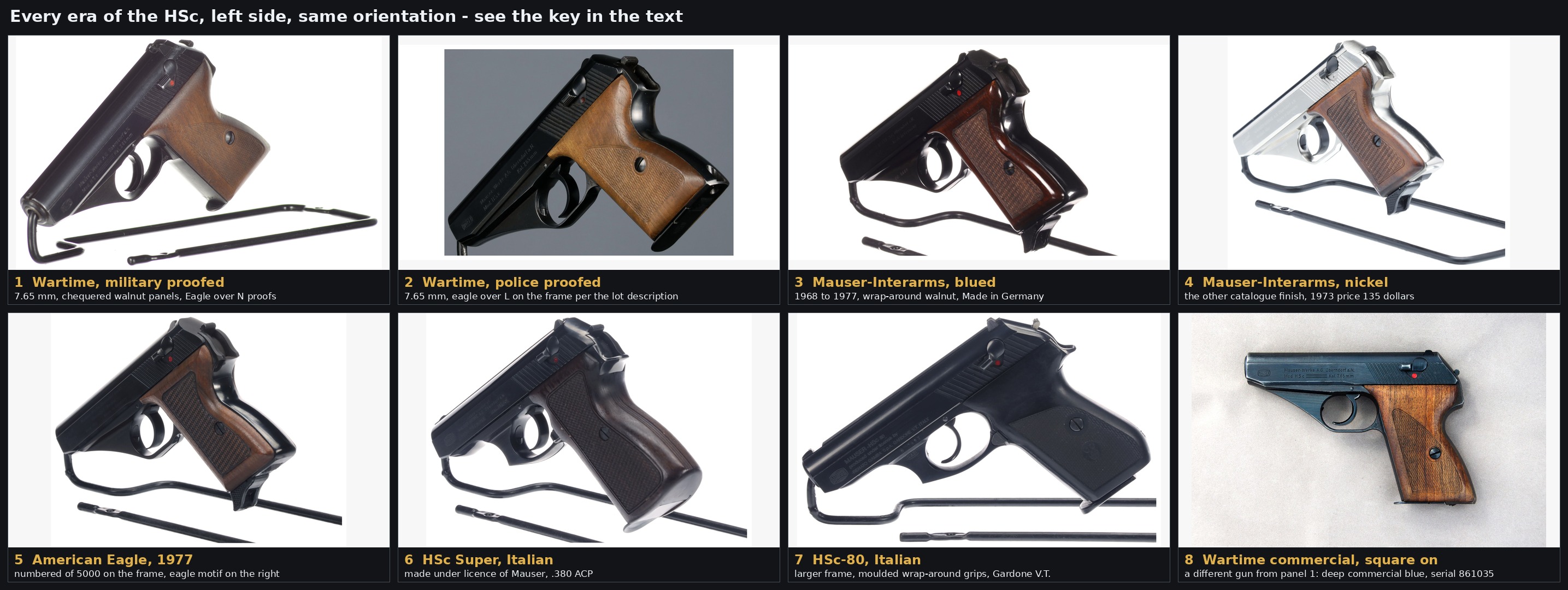
Every photograph in this volume shows the pistol’s left side, with the muzzle to the left. That is not decoration: on an HSc the slide legend and the safety lever are on the left, so a left-side photograph carries the identification and a right-side one does not. Mixing sides in a comparison plate is the single most reliable way to misidentify a variant, and this hub has done it before.
7.2 The First Test Is the Muzzle
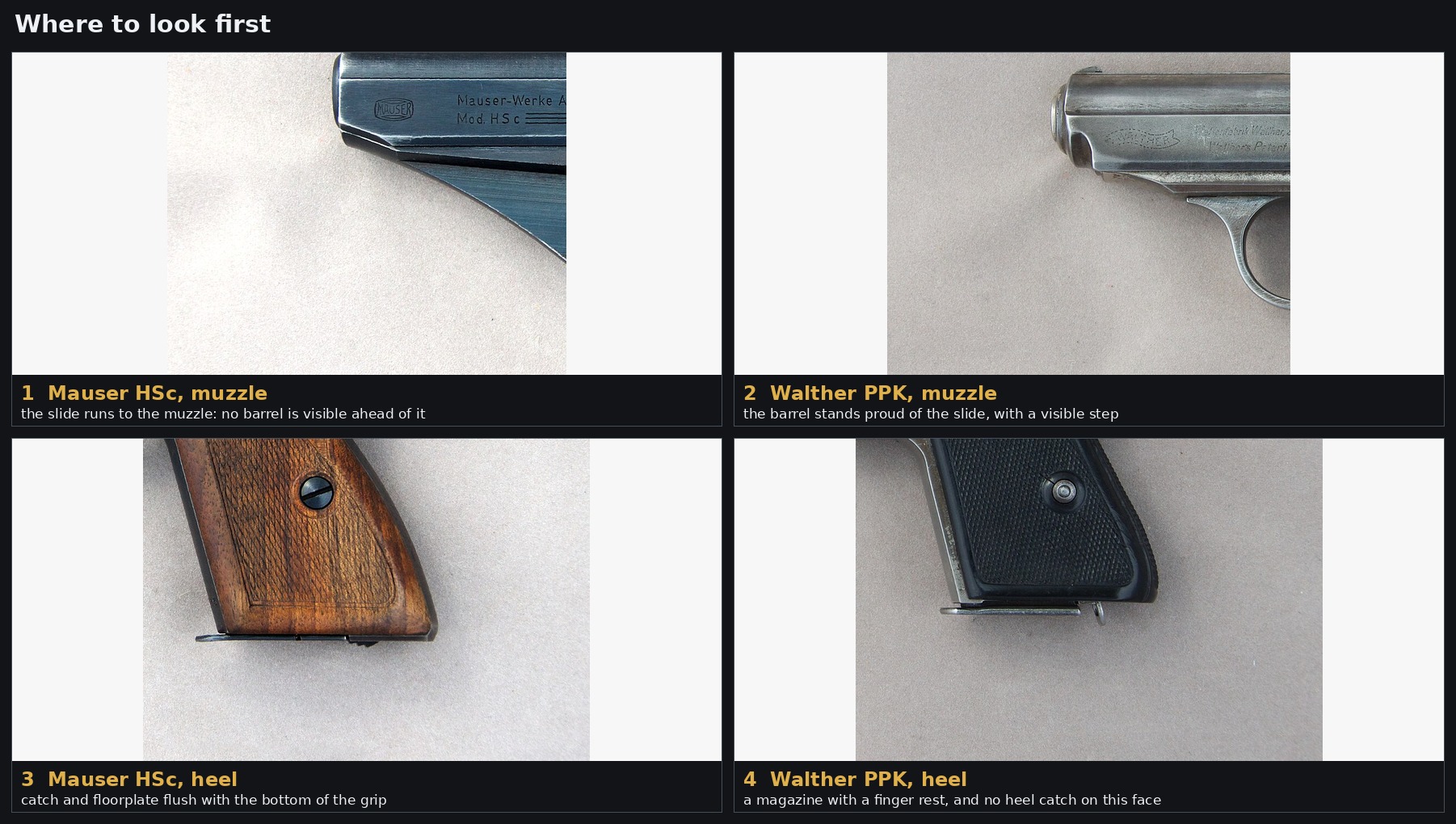
Look at the front of the slide.
On a Mauser HSc the slide is a closed tube that runs the full length of the pistol. The barrel is inside it, with the recoil spring wrapped around the barrel, and nothing projects ahead of the slide. The nose of the slide is a plain bevelled block with the bore in the middle of it.
On a Walther PP or PPK the barrel stands proud of the slide by an inch or so, with an unmistakable step where the slide ends and the barrel begins.
That is the whole test and it works from across a room, in a bad photograph, on a gun in a display case. Volume 1 explains why the difference exists: the enclosed slide with its concentric recoil spring is what Mauser designed for the commercial market, and it is precisely the feature the German army rejected when it specified an exposed barrel for its P.08 replacement trials.1
The second test is the heel of the butt. The HSc’s magazine catch and floorplate finish flush with the bottom of the grip frame, in one plane, because US 2,117,826 specifies a catch that “is flush with the bottom of the magazine and the under side of the stock and thus does not interfere with the manipulation of the pistol, as in the old pistols”.2 The Walther’s magazine has a finger rest on it and the catch is elsewhere.
7.3 Against the Walther PP, the PPK and the Sauer 38H
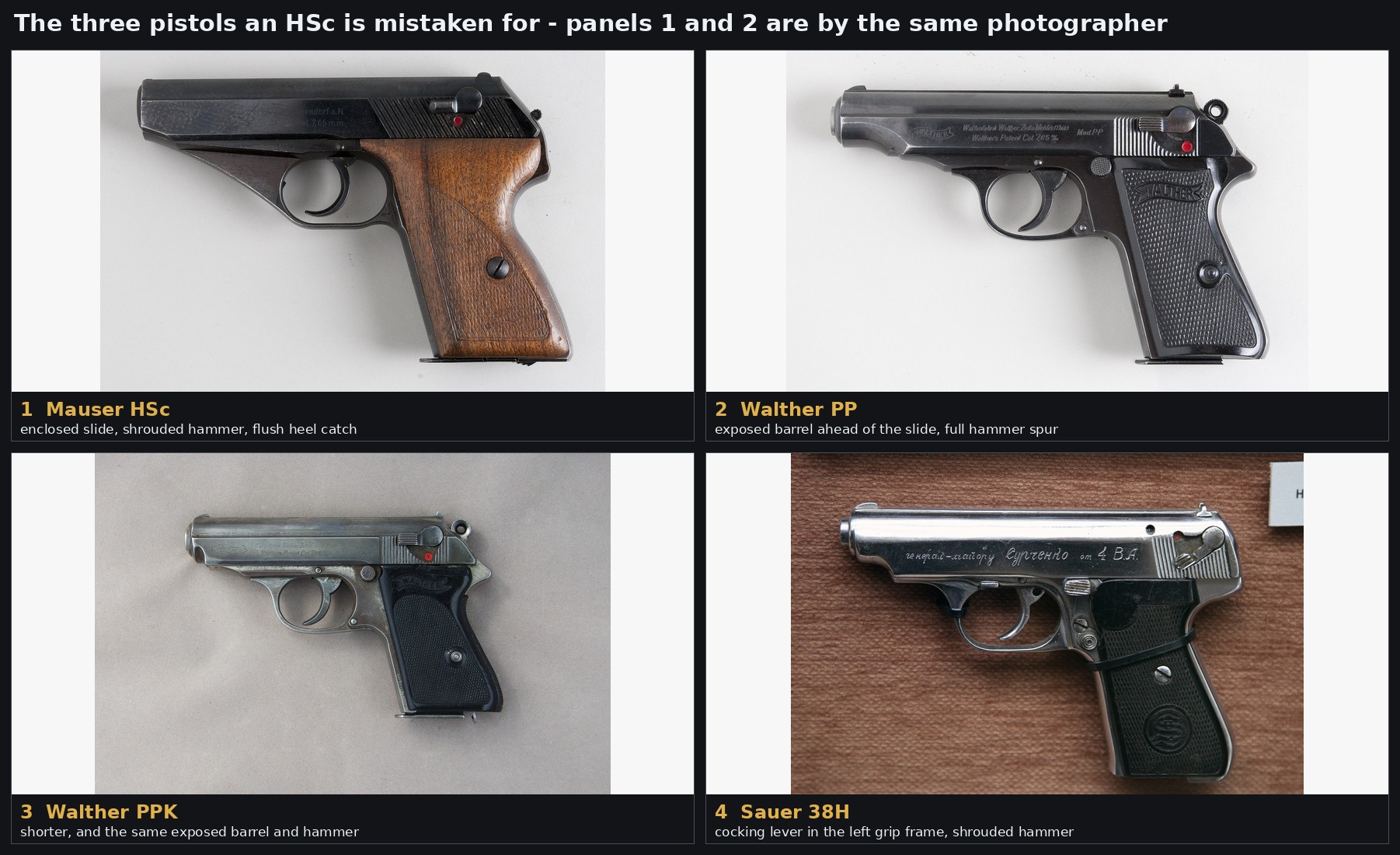
Three German double-action pocket pistols of the late 1930s look alike at a glance and are different in the hand.
The Walther PP (1929) and PPK (1931) are the pistols the HSc exists to compete with.3 Both have an exposed barrel, a full hammer spur, a decocking safety and a loaded-chamber indicator. The Sauer 38H (1938) has a shrouded hammer like the HSc’s, which is why it is the one that actually confuses people, but it has a cocking and decocking lever in the left grip frame that neither of the others has.4
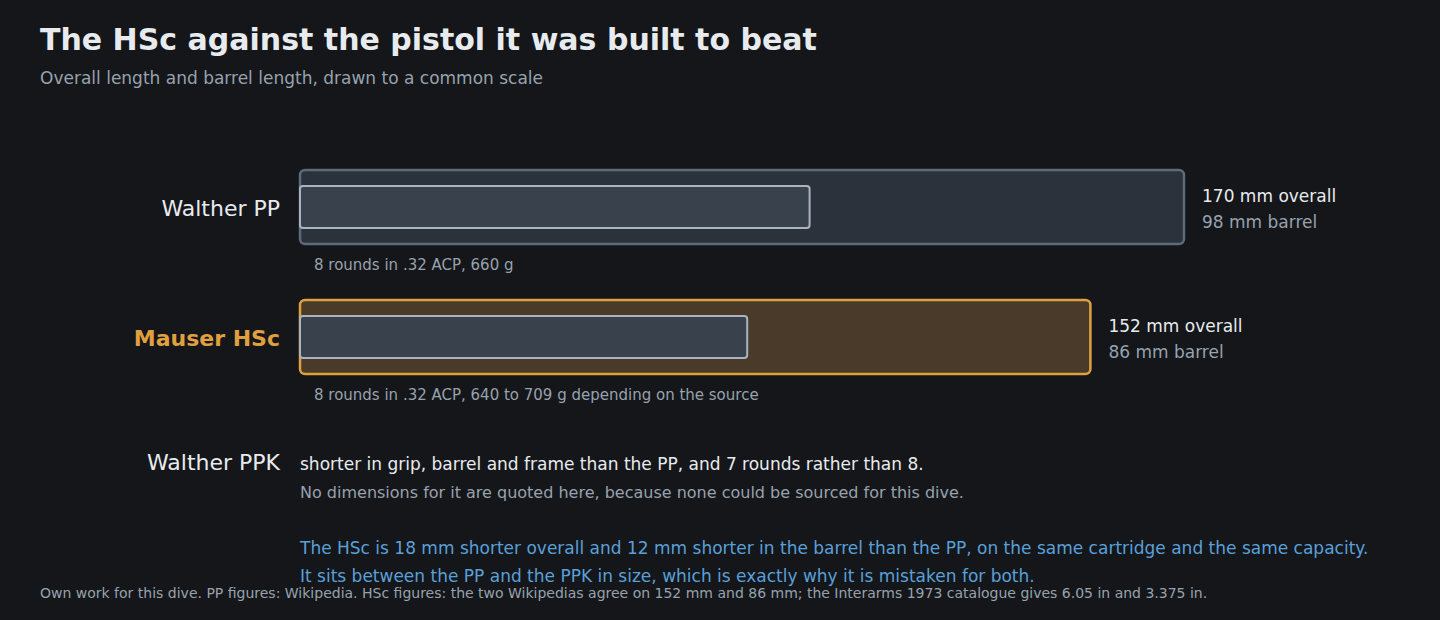
The size question is the one that causes the most trouble, because the HSc sits between the two Walthers.
7.4 Is It an HSc at All: the Table
Table 1 — Is It an HSc at All: the Table
| Feature | Mauser HSc | Walther PP | Walther PPK | Sauer 38H |
|---|---|---|---|---|
| Barrel at the muzzle | enclosed by the slide, nothing projects | projects ahead of the slide | projects ahead of the slide | projects ahead of the slide |
| Hammer | sunk into the slide, small spur only | full exposed spur | full exposed spur | shrouded |
| Safety lever | on the slide, left, marked S with a red dot | on the slide, and it decocks | on the slide, and it decocks | separate cocking and decocking lever in the grip frame |
| Loaded-chamber indicator | none found in any source | yes, a pin at the rear of the slide | yes | not established here |
| Magazine catch | at the heel, flush with the butt | at the heel | at the heel | at the heel |
| Magazine floorplate | plain, with a forward lip to pull on | finger rest common | finger rest common | finger rest common |
| Overall length | 152 mm | 170 mm | shorter than the PP, figure not sourced here | not sourced here |
| Maker’s name on the slide | Mauser banner, Mauser-Werke A.G. Oberndorf a.N. | Carl Walther, Zella-Mehlis | Carl Walther | J. P. Sauer & Sohn |
The loaded-chamber row is worth dwelling on, because it is the one that gets asserted the other way round. Volume 3 sets out the check: four sources that list the HSc’s features at length, including the importer’s own 1973 catalogue with its ten-item selling list, and not one of them names a loaded-chamber indicator.56789 The Walther has one. If somebody is telling you the HSc’s extractor indicates a loaded chamber, ask them for a source.
7.5 Every Era, Same Side, Same Orientation
The plate at the head of this volume is the reference. The key:
Table 2 — The plate at the head of this volume is the reference. The key
| Panel | What it is | The tell |
|---|---|---|
| 1 | Wartime, military proofed | small chequered walnut panels that do not cover the backstrap; Eagle over N proofs; two-line slide legend |
| 2 | Wartime, police proofed | the same gun with an eagle over swastika over L proof on the trigger guard1011 |
| 3 | Mauser-Interarms, blued, 1968–77 | wrap-around walnut grips; the legend adds Modell HSc and Made in Germany |
| 4 | Mauser-Interarms, nickel | the other catalogue finish; 1973 list price $135 against $120 for the blue9 |
| 5 | American Eagle, 1977 | frame stamped “N of 5000”; an eagle motif on the right of the frame |
| 6 | HSc Super, Italian | wrap-around wooden grips, slide reads under license of Mauser-Werke and CAL .380 ACP |
| 7 | HSc-80, Italian | visibly larger and squarer; black moulded wrap-around grips; slide reads MAUSER - HSC 80 and GARDONE V.T. ITALY; S.A.B. on the frame |
| 8 | Wartime commercial, square on | a different pistol from panel 1: deep commercial blue, chequered walnut panels, serial 861035 |
Two things jump out of the plate that no table conveys.
The grips changed more than the gun did. Panels 1, 2 and 8 have small chequered panels let into the frame with a plain border. Panels 3, 4, 5 and 6 have wrap-around grips that cover the backstrap and fill the hand. That single feature separates the wartime pistols from everything after 1968, and it is visible at any distance.
The HSc-80 is not a variant of this pistol, it is a bigger pistol. Panel 7 is the only one in the set whose outline is different: a deeper frame, a squarer slide, a larger trigger guard. Anyone offered an “HSc” that looks like panel 7 is being offered something else.
7.6 The Slide Legend Is the Fastest Test
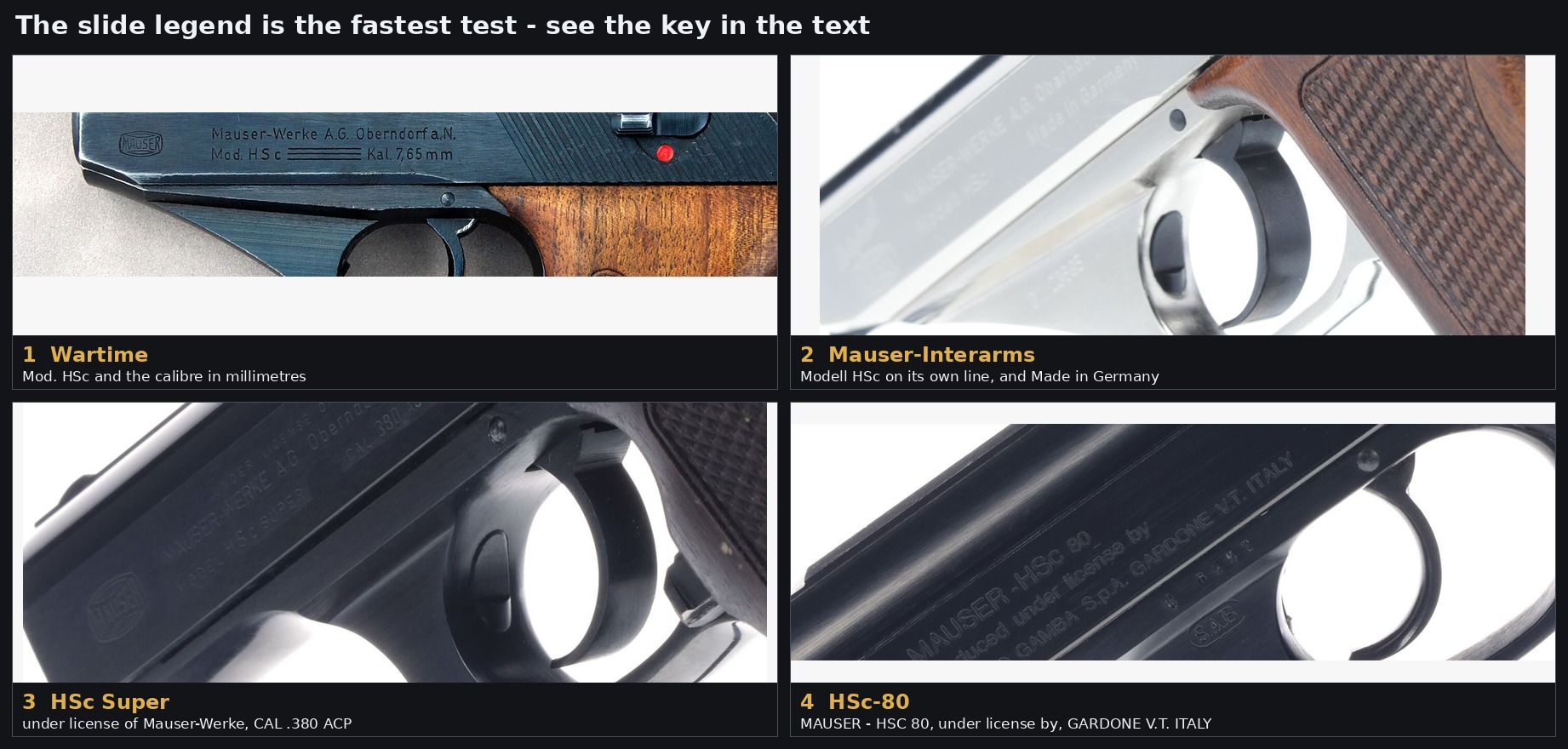
Five words separate the four eras.
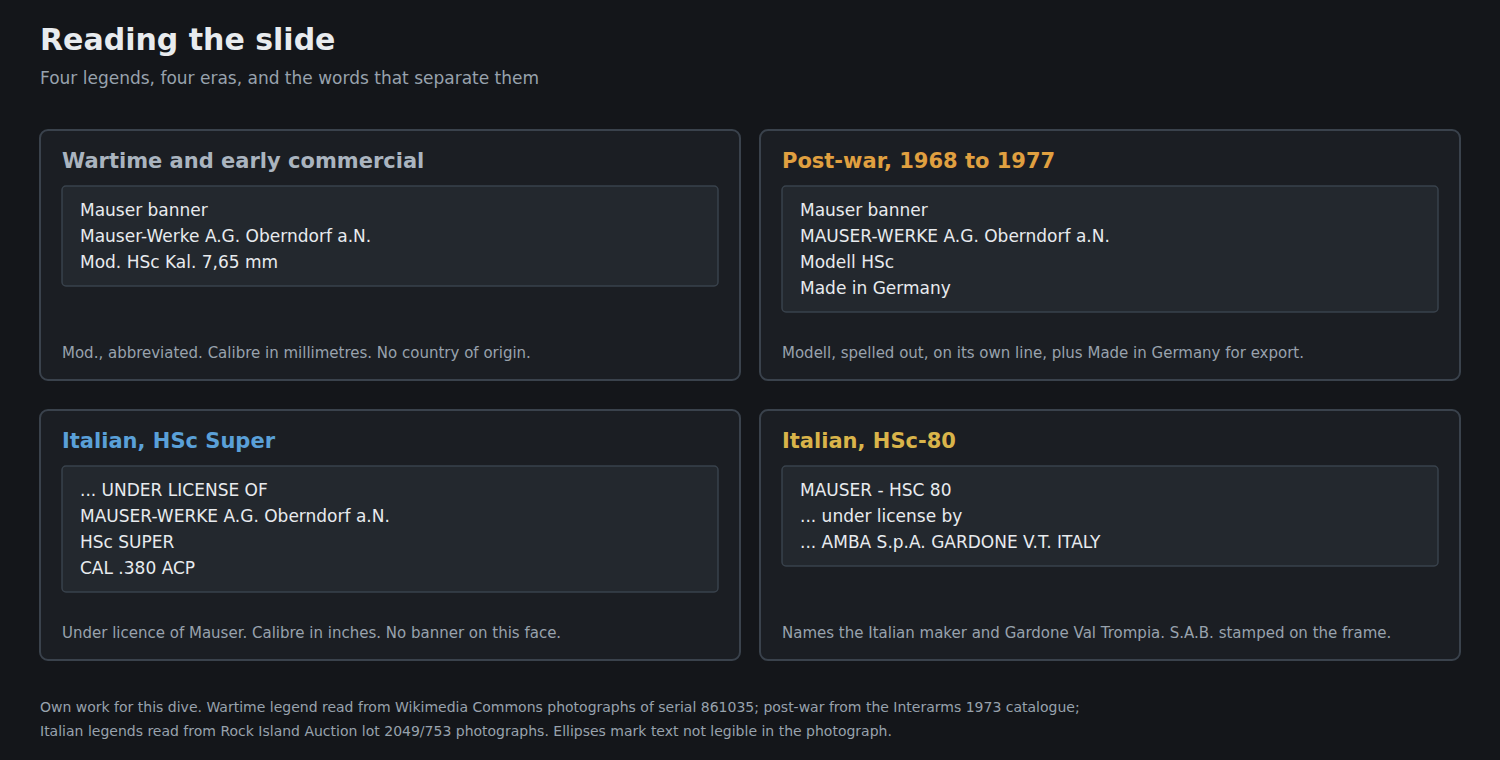
- “Mod. HSc”, abbreviated, with the calibre as Kal. 7,65 mm and no country of origin: a German-market gun, wartime or immediate pre-war commercial.
- “Modell HSc” on its own line, plus “Made in Germany”: 1968–1977. The country of origin appears on the export guns and is absent from the wartime German-market legend, which is an observation from the two photographs rather than a claim about which rule required it.
- “under license of Mauser-Werke A.G.” with the calibre in inches as CAL .380 ACP: Italian, and an HSc Super.
- “MAUSER - HSC 80” with “under license by … GAMBA S.p.A. GARDONE V.T. ITALY” and S.A.B. on the frame: Italian, and the larger HSc-80.
The last two are the find of this dive. Volume 6 sets out how little the written sources say about the Italian pistols — one clause in American Rifleman, one unsourced sentence in German Wikipedia — and how much two auction photographs turn out to say.5812
7.7 Grips, and How Far They Wrap
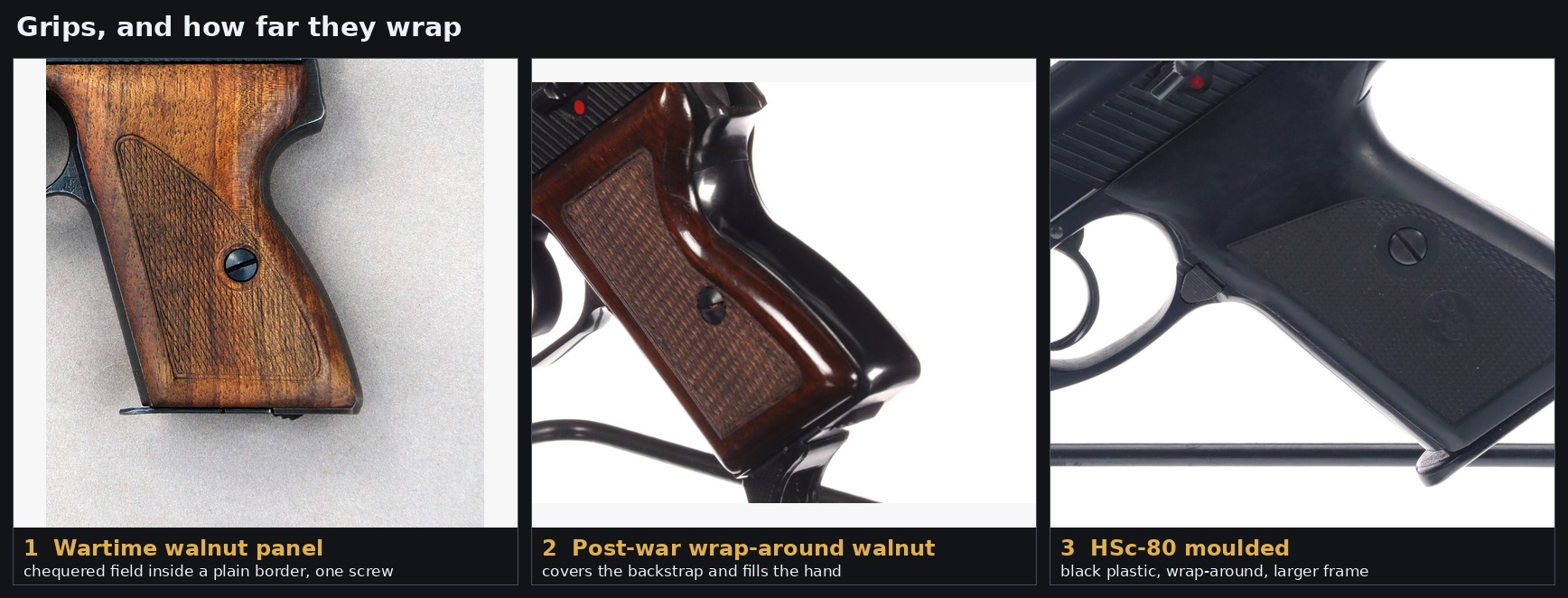
Grips are the fastest era test after the slide legend, and they carry one trap.
Wartime guns have panels, not wrap-arounds. A chequered field inside a plain moulded border, one screw, and the backstrap is bare metal.
Black plastic panels are late-war, not post-war. English Wikipedia records black plastic grip panels appearing in the late 940,000 serial range, in the last months of production.7 They are still panels, still small, and still leave the backstrap bare. A black wrap-around is a post-war or Italian grip; a black panel on a phosphate-finished gun is a very late wartime one and is worth more, not less.
Grip panels are the most-swapped part on any old pistol. A wartime frame wearing post-war grips is an ordinary thing to meet. The grips date the grips.
One documented curiosity belongs here. French-period guns have been catalogued with grips marked “ejo”, a German wartime three-letter maker code, which is what Burnham and Theodore’s “assembled using leftover parts from the war” footnote looks like in the hand.1314 ⚠ No code table was consulted for this dive and no maker is attached to ejo here.
7.8 Which HSc Is It: the Table
Table 3 — Which HSc Is It: the Table
| Feature | Wartime, 1940–45 | French, 1945–46 | Mauser-Interarms, 1968–77 | American Eagle, 1977 | HSc Super, Italian | HSc-80, Italian |
|---|---|---|---|---|---|---|
| Serial | 700 001 – 951 939 | 951 940 – 971 239 | prefix 00. for 7.65 mm, 01. for 9 mm Kurz | ”N of 5000” on the frame | not established here | not established here |
| Slide legend | Mod. HSc, Kal. 7,65 mm | as wartime | Modell HSc, Made in Germany | as Mauser-Interarms | under license of Mauser-Werke, HSc SUPER | MAUSER - HSC 80, GARDONE V.T. ITALY |
| Grips | small chequered walnut panels; black plastic panels at the very end | as wartime, some marked ejo | wrap-around walnut | wrap-around walnut | wrap-around wood | black moulded wrap-around |
| Distinctive mark | Eagle over 655 / 135 / WaA135; Eagle over N; navy eagle over M; police eagle over swastika over L | ”RW” on the left of the trigger guard | none | eagle motif on the right of the frame | none located | S.A.B. on the frame |
| Calibre | 7.65 mm only | 7.65 mm | 7.65 mm or 9 mm Kurz | mostly 9 mm Kurz; about 153 in 7.65 mm | .380 ACP | not established here |
| Finish | polished blue early, dusk blue later, phosphate at the end | blue | bright blue or nickel | blue | blue | blue |
| Where to look | left trigger-guard web, right of the slide, chamber under the slide | left of the trigger guard | left of the slide | right of the frame | left of the slide | left of the slide, and the frame |
7.9 Magazines, Boxes and What Came With It
Three accessories carry identification of their own.
Magazines. A commercial wartime pistol has been catalogued with its “correct magazine with in-the-white body and blue rounded Mauser banner floorplate”.15 That is a specific and checkable thing: the body left bright, the floorplate blued and rounded and carrying the banner. Capacity is eight in 7.65 mm and seven in 9 mm Kurz, and the two are not interchangeable.78
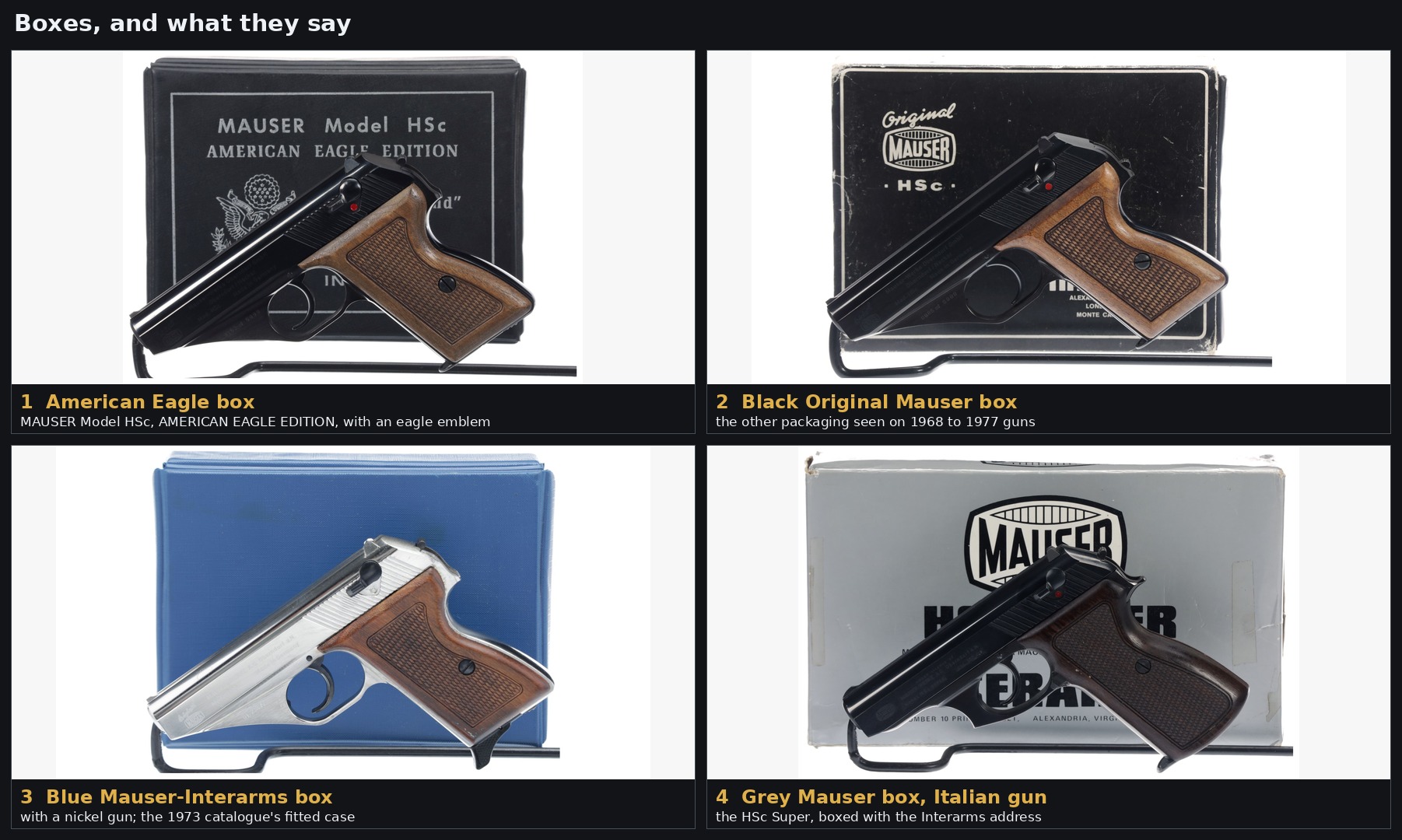
Boxes. The post-war guns came in a fitted case with an extra magazine, a cleaning brush and a factory test target, which is the 1973 catalogue’s own list.9 Two box styles appear in the auction record: a black “Original MAUSER HSc” box and a grey Mauser box carrying the Interarms address at 10 Prince Street, Alexandria, Virginia. The American Eagle came in a black box printed “MAUSER Model HSc — AMERICAN EAGLE EDITION” with an eagle emblem.1617 The French-period pistols have been sold with an “unnumbered black factory box”.13
Holsters. Wartime HScs turn up in military-proofed holsters, including on commercial pistols carried by men who bought their own.7 A holster is not evidence about the pistol in it.
7.10 What a Photograph Cannot Settle
This volume is built on photographs and it should say what photographs cannot do.
They cannot confirm matching numbers. The full serial is on the front of the grip frame; the last three digits are stamped on the bottom of the barrel and electropencilled on the flat of the slide under the muzzle.715 None of the three is visible in a normal side view, and the electropencilled one is shallow enough to be polished away by a refinish.
They cannot confirm a proof that lives under the slide. One of the Eagle over N proofs is struck on the barrel beside the chamber, concealed by the closed slide.1815 It is the hardest proof to fake and the easiest to overlook.
They cannot distinguish an original finish from a good refinish, and the HSc’s finish history is exactly what a collector is paying for: polished commercial blue, military dusk blue, and phosphate, in that order down the war.78
They cannot settle the direction the safety moves the firing pin, which Volume 3 leaves open, or whether a given pistol’s magazine safety still works, which Volume 4 gives a bench check for.
And one warning that belongs in an identification volume rather than a collecting one. Acceptance marks on German wartime firearms are among the most forged features in the collecting world, and Volume 8 shows why: the difference between an unmarked commercial gun and a navy-marked one is a multiple, not a percentage. Every mark named in these volumes comes from an uncited encyclopedia article or a commercial auction catalogue. Neither is a reference book, and for money this size a reference book is what a buyer should be using.
References
Footnotes
-
Ian McCollum, “RIA: Prototype Mauser HSv Pistols”, Forgotten Weapons, retrieved 2026-09-20. ↩
-
US Patent 2,117,826, “Firearm”, Alex Seidel, assignor to Mauser-Werke A.G., granted 17 May 1938. ↩
-
“Walther PP”, Wikipedia, consulted 2026-09-20. ↩
-
Ian McCollum, “Evolution of the Military Mauser HSc Pistol”, Forgotten Weapons, retrieved 2026-09-20. ↩
-
Garry James, “This Old Gun: Mauser HSc Pistol”, American Rifleman, 11 May 2017, https://www.americanrifleman.org/content/this-old-gun-mauser-hsc-pistol/ , retrieved 2026-09-19. ↩ ↩2
-
Maxim Popenker, “Mauser HSc”, Modern Firearms, https://modernfirearms.net/en/handguns/handguns-en/germany-semi-automatic-pistols/mauser-hsc-eng/ , retrieved 2026-09-19. ↩
-
“Mauser HSc”, Wikipedia, consulted 2026-09-19. ↩ ↩2 ↩3 ↩4 ↩5 ↩6
-
“Mauser HSc”, German Wikipedia, revision 265079350, consulted 2026-09-19. ↩ ↩2 ↩3 ↩4
-
Interarms, Interarms 73 catalogue, Alexandria, Virginia, 1973, p. 16. Internet Archive item
interarms-73, retrieved 2026-09-19. ↩ ↩2 ↩3 -
Rock Island Auction Company, lot 1046/4428, 23 June 2024, https://www.rockislandauction.com/detail/1046/4428/ , retrieved 2026-09-20. ↩
-
Rock Island Auction Company, lot 4092/1375, 24 August 2024, https://www.rockislandauction.com/detail/4092/1375/ , retrieved 2026-09-20. ↩
-
Rock Island Auction Company, lot 2049/753, “Two Renato Gamba/Mauser HSc Pistols”, 25 August 2021, https://www.rockislandauction.com/detail/2049/753/ , retrieved 2026-09-20. The slide legends quoted in this volume were read from the lot’s own photographs at full resolution. ↩
-
Rock Island Auction Company, lot 2054/256, 12 January 2022, https://www.rockislandauction.com/detail/2054/256/ , retrieved 2026-09-20. ↩ ↩2
-
Alan D. Burnham and Peter H. Theodore, “Mauser HSc Production History”, 1 May 2008, retrieved 2026-09-19 from the Internet Archive. ↩
-
Rock Island Auction Company, lot 4093/1379, serial 700296, 7 December 2024, https://www.rockislandauction.com/detail/4093/1379/ , retrieved 2026-09-20. ↩ ↩2 ↩3
-
Rock Island Auction Company, lots 2049/28 (25 August 2021), 2051/588 (20 October 2021) and 2061/647 (20 July 2022), American Eagle pistols with their boxes. Retrieved 2026-09-20. ↩
-
Rock Island Auction Company lots 2038/505, 2039/940, 2041/739, 2081/33 and 2096/716, Mauser-Interarms HSc pistols with boxes. Retrieved 2026-09-20. ↩
-
Rock Island Auction Company, lot 4092/382, 23 August 2024, https://www.rockislandauction.com/detail/4092/382/ , retrieved 2026-09-20. ↩
Comments (0)