Mauser HSc · Volume 1
Walther Made Them Do It — Mauser, the Pocket Pistol, and the Gun Called HSc
How a firm that had led the world in military self-loaders in 1896 found itself, forty years later, selling a boxy pocket pistol nobody wanted — and what it handed a twenty-five-year-old engineer to fix it
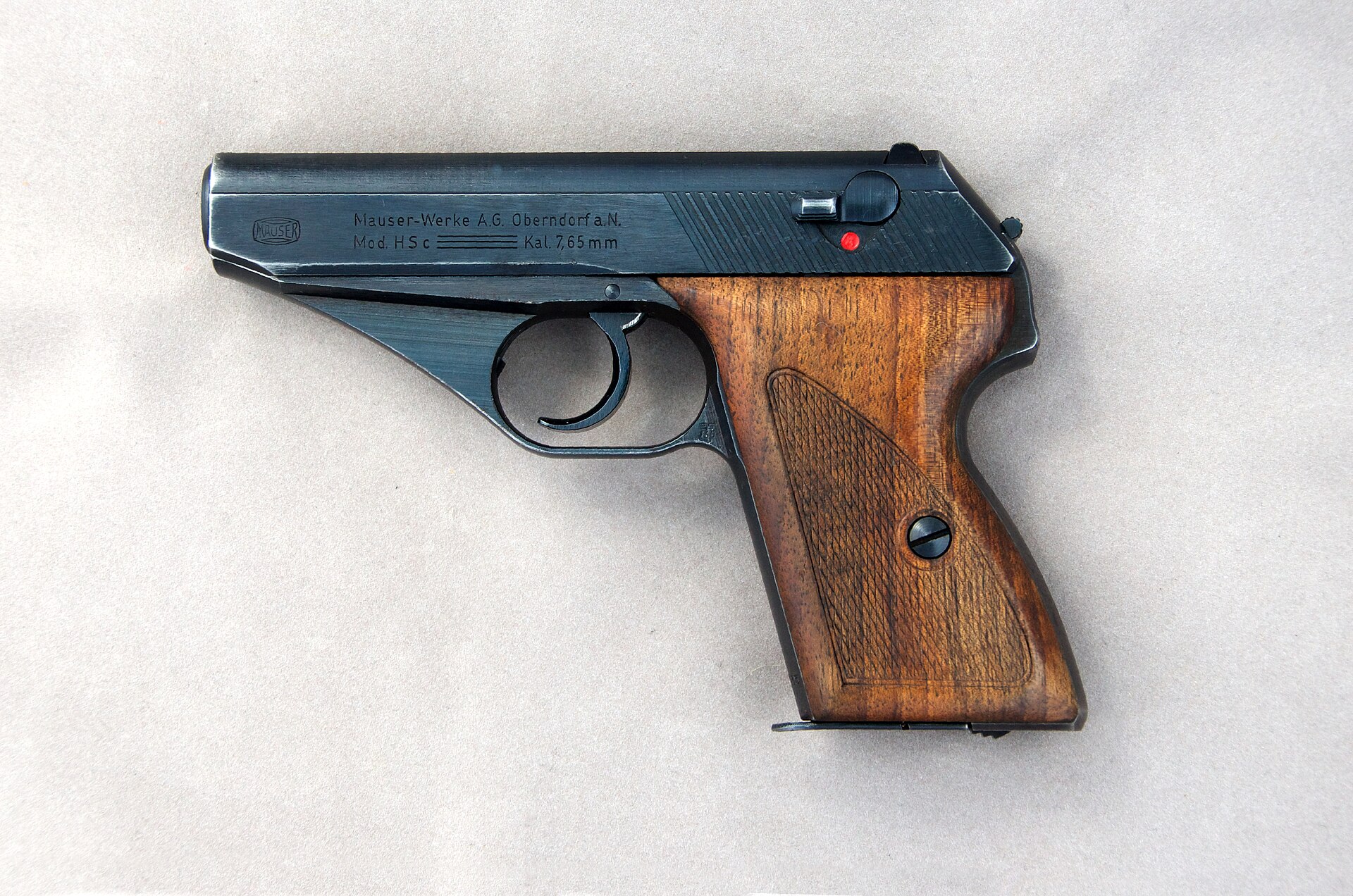
In 1896 Mauser-Werke of Oberndorf am Neckar put the C96 on the market and the firm spent the next thirty years as one of the two or three names that mattered in the self-loading pistol. By the middle of the 1930s it was losing the police and commercial trade to a company forty miles away in Zella-Mehlis that had been making air rifles when the C96 was new.
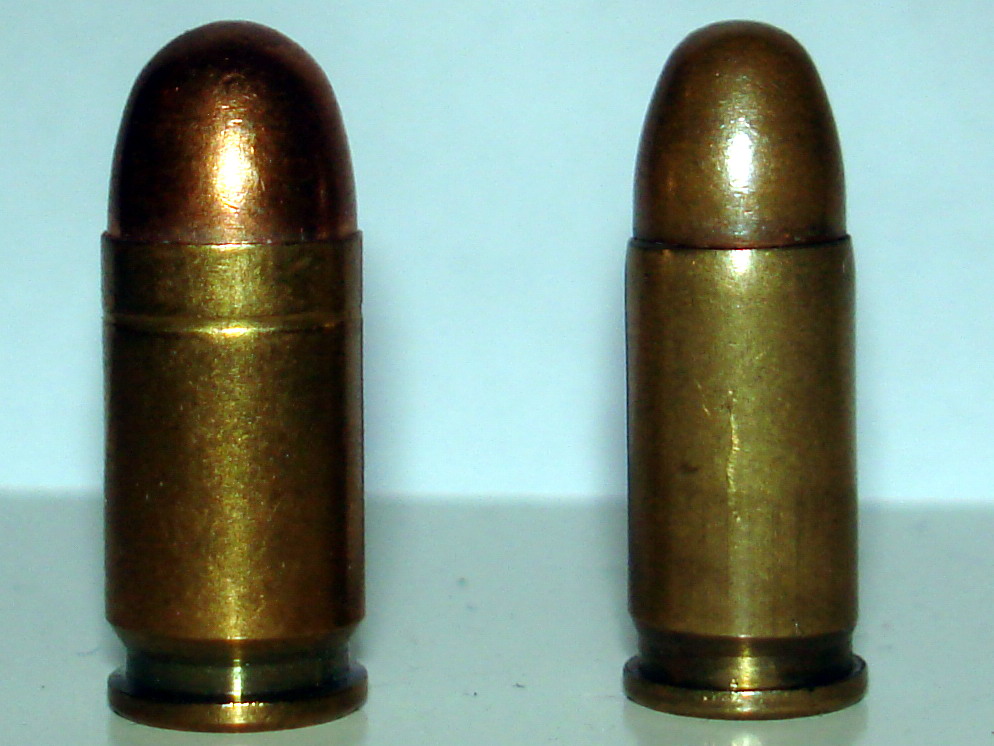
The pistol that answered that is the subject of these volumes. It is a small double-action blowback in 7.65 mm Browning, and it is, by a decade or more, the earliest gun in this hub’s streamlined series — a 1930s object in a set otherwise drawn from the jet age. American Rifleman puts it in exactly those terms, calling it “a streamlined, up-to-date double-action blowback” that reflected “the sleek Art Deco look of the period, in the manner of such things as the new Volkswagen automobile which appeared almost concurrently”.1
That is the received description and it is not wrong. It is also not the interesting part. The interesting part, set out in Volume 2, is that the pistol’s designer filed patents which say, in his own words, what several of those curves are for — and the answer is almost never decoration.
1.1 The Shape of the Problem
Two things had gone wrong for Mauser’s handgun business at once.
The first was that the C96 had aged out. It was a large, expensive, exposed-mechanism military pistol with a magazine in front of the trigger, and although Mauser kept it in production and kept improving it, the world had moved to the box magazine in the butt. This hub’s Mauser C96 dive covers that gun and its long decline in full, and none of it is restated here.
The second was smaller and more commercially painful. Mauser’s pocket pistols — the 1910, the 1914 and the 1934, a family of 6.35 mm and 7.65 mm blowbacks descended from one another — had become unfashionable. American Rifleman’s judgement is blunt: they were “extremely well-made, cleverly designed and popular in their day”, but “being single-action and a bit boxy they were perceived to be old-technology”, and “in the face of stiff competition from Walther, sales were flagging”.1 Forgotten Weapons puts the same thing structurally: by the 1930s Mauser “had lost major market share to Sauer and Walther in police and commercial guns”, and the 1910/1914/1934 line “was getting a bit old”.2
Those two sentences are the whole brief for the HSc.
1.2 What Mauser Was Selling in 1934
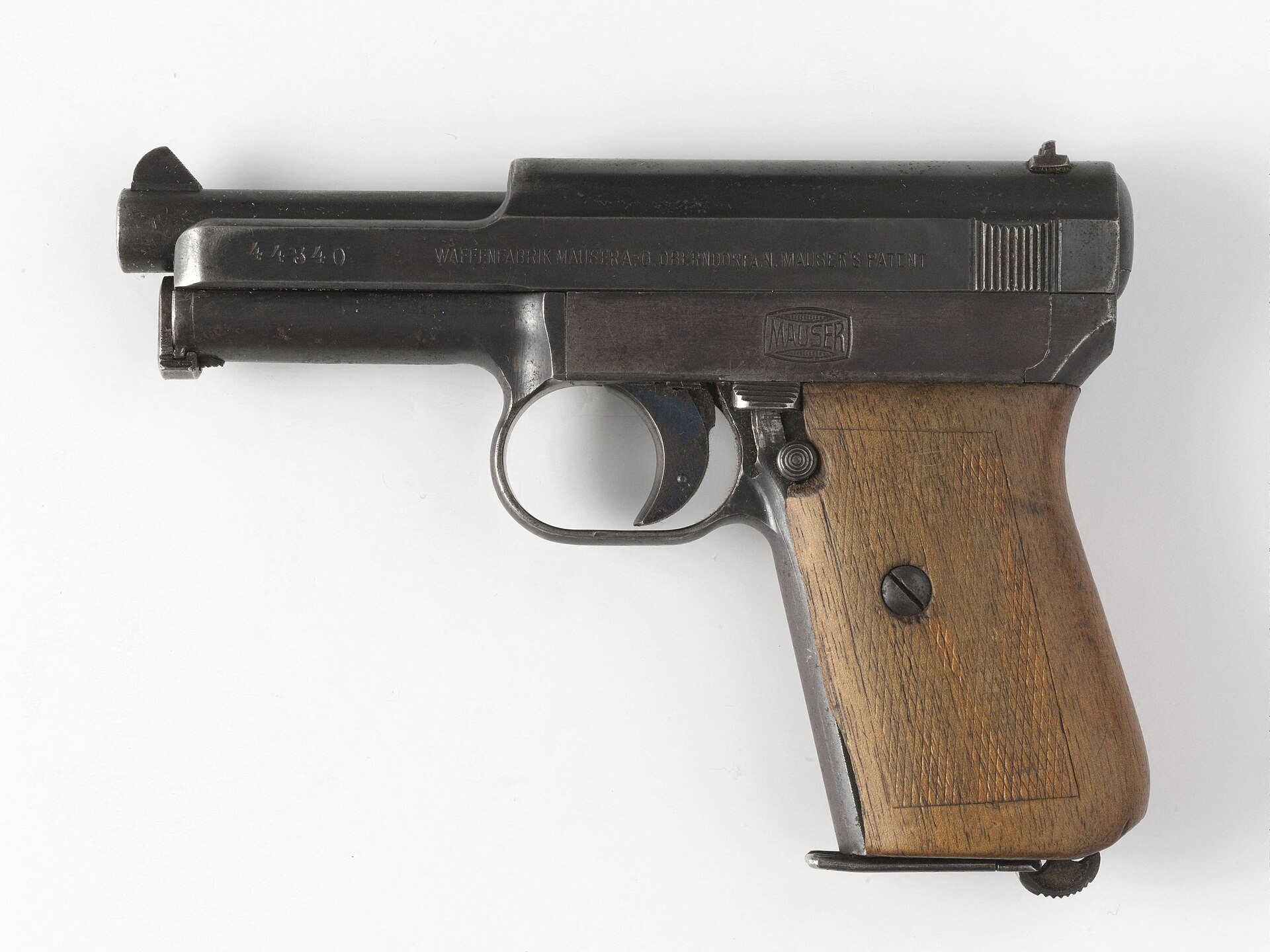
The Model 1914 is worth looking at carefully before anything else, because the HSc is best understood as its answer rather than as an abstract exercise in styling.
It is a striker-fired — strictly, an internal-hammer — blowback with a barrel that is retained by a bayonet collar at the front of the frame, a slide that is essentially a rectangular box, a separate breech block visible at the rear, a grip safety arrangement on some variants, a magazine catch that projects from the butt, and a trigger that sits in a squared-off guard. It is well made. It is also, in 1934, a pre-1914 design in its third revision, and it looks it.
The functional objection is the one that mattered to a police buyer: the pistol is single-action. To carry it ready, a round has to be chambered and the striker left under tension, which means relying on a manual safety; to carry it safe, the chamber has to be empty, which means a two-handed operation before the first shot. There is no third option.
1.3 What Walther Had Done
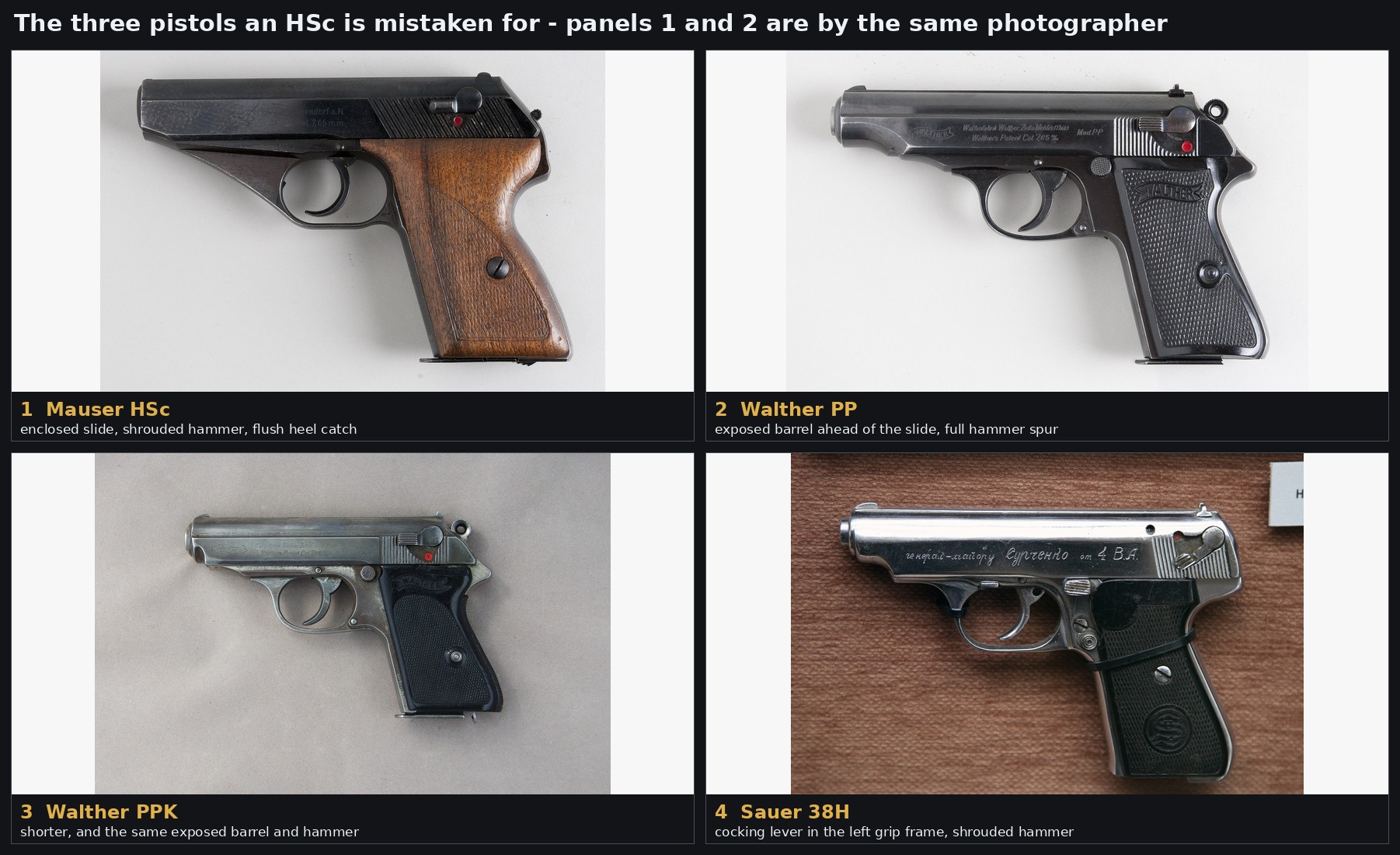
Carl Walther Waffenfabrik of Zella-Mehlis introduced the Polizeipistole, the PP, in 1929, and the shortened PPK in 1931.3 American Rifleman dates the pair 1929 and 1930; Wikipedia’s Walther PP article gives 1931 for the PPK, citing a printed source.13 Both dates are in circulation and neither is resolved here.
What Walther had done was combine, in one small pistol, a set of features that individually were not new and together were:
- a double-action trigger, so a chambered round could be fired by pulling through on a hammer at rest, with subsequent shots single-action;
- a safety that decocks, lowering the hammer onto a blocked firing pin rather than merely locking a cocked mechanism;
- a loaded-chamber indicator, a pin that stands proud of the slide’s rear face when there is a cartridge in the chamber;
- an automatic hammer block interposed except when the trigger is pressed;
- a rounded hammer spur that would not snag on the draw.3
Wikipedia’s summary of the PP series is that these “were rare at the time it was first produced, but were in common usage by the late 20th Century”.3 For a plain-clothes policeman in 1930 the combination was close to decisive: the pistol could be carried loaded, on safe, hammer down, and fired one-handed by pulling the trigger.
J. P. Sauer & Sohn of Suhl reached the same conclusion and in 1938 produced the 38H, another double-action 7.65 mm blowback — with, uniquely, a cocking and decocking lever in the left grip frame. By the time Mauser’s answer reached the market it would be competing with both.2
1.4 The Engineer Who Got the Job
Mauser gave the work to Alex Seidel — full name Alexius Wilhelm Seidel, born 4 July 1909.4
Two independent sources agree on how young that made him. Forgotten Weapons says Mauser “tasked a very young (25 at the beginning of the project) engineer named Alex Seidel with it”.2 The German biography, sourced to Kersten and Schmid’s official history of Heckler & Koch, gives his birth date, from which twenty-five runs from July 1934 to July 1935.4 The earliest patent priority traced for the design — the German application behind all three of his US patents on the pistol — is 10 August 1934, three weeks after his twenty-fifth birthday.5
He was not an outsider. His father, Paul Seidel, was an Obermeister — a master foreman — at Mauser in Oberndorf. Alex apprenticed there as a mechanic in 1927–28, read mechanical engineering at the Württemberg state engineering school at Esslingen am Neckar until 1932, and then went back to Mauser as an engineer, where he became group leader for the pistol-development sector within the design department.4
That job title is worth holding onto, because it is a more careful statement than the one usually made. English Wikipedia’s biography says flatly “He designed the Mauser HSc pistol in 1934”, and its only source is Heckler & Koch’s own archived corporate history page.6 The German biography, citing the printed official history, says the HSc was “among his best-known developments” and that he led the section.4 Volume 2 sets out the primary evidence that does exist — three United States patents naming him as inventor — and what that evidence does and does not establish.
Seidel’s later career is the reason this pistol matters to the rest of the hub. From the autumn of 1944 he worked on the Volkspistole, the emergency pistol programme that followed Hitler’s Volkssturm decree of 25 September 1944; it never reached series production and two specimens were made.4 On 28 December 1949 he founded Heckler & Koch GmbH with Edmund Heckler and Theodor Koch, and ran the firm until he retired on 19 December 1980.4 Volume 2 follows the line from the HSc to H&K’s first pistol, the HK4.
One further thing belongs in a reference account of the man and is usually left out. In September 2023 the Gesellschaft für Unternehmensgeschichte announced the findings of a study, Waffeningenieure im Zwielicht, on the three founders of Heckler & Koch. Its conclusion, as reported by SWR, was that Seidel — like Heckler and Koch — had been responsible for forced labourers at his former firm, in his and Koch’s case the Oberndorf Mauser works, and was a career profiteer of the National Socialist period, though not a war criminal.4 The pistol described in these volumes was designed before that and by a very young man; the factory that made a quarter of a million of them in wartime is a different matter, and Volume 5 returns to it.
1.5 Two Pistols, Not One
The most useful single fact about the HSc programme is that it was never a single pistol.
Forgotten Weapons, examining the surviving hardware, describes the intent: “When Mauser began development of the HSc pistol, it was intended to be a pair of guns — a simple blowback gun in .32 or .380 caliber for civilian and police use and a larger locked-breech type in 9x19mm for military use.”7 Mauser had tried the two-sizes trick before with the 1910 family and had made both blowback, which did not work; this time, for the 9 mm gun, Seidel “looked at what technology Mauser owned, and chose Josef Nickl’s rotating barrel patent”.7
The prototype record matches. Burnham and Theodore’s production sheet opens with a pre-production block of twenty-two pistols, V 1001 to V 1022, dated 1934–1937, in “7.65 mm / 9 mm K / 9 mm”.8 Three calibres in twenty-two guns is not a pocket-pistol programme; it is two programmes sharing a serial series. And Forgotten Weapons identifies the first of them directly: “This pistol is number V1001, the very first prototype HSc, and it’s one of the rotating barrel locked breech guns.”7
So the earliest surviving HSc is a 9 mm service pistol with a turning barrel, and the gun that this dive is about is the small half of a two-gun family whose large half failed.
1.6 The Army Wanted the Barrel Outside
When the German military finally moved to replace the P.08 Luger in the late 1930s it ran a trial with three main entrants: BSW with a gas-operated pistol, Walther with the design that became the P.38, and Mauser with a locked-breech 9 mm derived from the HSc work — the HSv.9
The requirement that shaped the Mauser entry is the single most important sentence in this volume:
“However, the German military requirements specifically called for an exposed barrel. This forced Mauser to redesign its recoil spring system, and they opted to use a lever system like in Webley automatic pistols. With that change, and having moved the magazine release to the pistol’s heel, they had an entrant for military testing.”9
The commercial design, Forgotten Weapons notes in the same passage, “had a full-length slide, covering a recoil spring located around the barrel”.9
Read that twice, because it inverts the usual account of the pistol’s appearance. The smooth, unbroken slide that runs from the muzzle to the hammer — the feature that makes the HSc look like a 1930s streamlined object — is precisely the feature the army rejected. The Wehrmacht wanted the barrel out in the open, as on a Luger or a P.38, and to get an entry into the trial Mauser had to take the enclosure off and replace the concentric recoil spring with a lever system borrowed from Webley practice.
The HSc’s streamline, in other words, is not what a military customer asked for. It is what was left when the military requirement was declined.
The HSv itself lost, and Forgotten Weapons is clear that it did not lose on merit: “It appears that the Mauser HSv in 9×19 was every bit as good of a pistol as the P.38 … However, the Mauser was significantly more expensive, which led to the Walther design winning.”9 Burnham and Theodore record the whole of HSv production as eight pistols, V 1023 to V 1030, 1937, 9 mm, “(P.08 Replacement)”.8
Eight guns. The programme that was supposed to be the important one ended in eight pistols and a line in a table, and the pocket blowback it was attached to went on to make a third of a million.
1.7 The Letter c, and the Missing a and b
HSc stands for Hahn-Selbstspanner, a self-cocking hammer — a hammer the trigger cocks — and c, in American Rifleman’s words, indicates “the third and accepted design”.1 English Wikipedia glosses it the same way: “Hahn Selbstspanner (‘self-cocking hammer’) Pistole, third and final design ‘C’”.10 German Wikipedia agrees that several prototypes were built and the third went into series.11
There the agreement stops, and a reference account should say so plainly: no source consulted for this dive documents an HSa or an HSb as built hardware. Burnham and Theodore’s prototype table, which is the most granular record found, lists an “HSc” block and an “HSv” block and no others.8 The a and the b are, on the evidence assembled here, an inference from the letter.
There is exactly one account of them, and it is second-hand. A commenter on the Forgotten Weapons article, citing Hogg and Weeks, Pistols of the World (1992), p. 212, writes that the design began in 1934–35; that “the HSa came out in 1937 after a long wrangle with Walther and August Menz over infringements of their double-action searage patents”; that “changes in searage and safety setups led to the HSb in 1938”; and that the final HSc “began production in 1939”; and that the lower-case letters “simply mean first, second, and third subtypes, nothing more”.2
That is worth reporting and is not worth relying on. The page was not consulted; the comment is a reader’s; and the 1939 production date disagrees with every other source, including the factory serial record. What it does supply, and what is corroborated independently, is a motive: Forgotten Weapons’s own text says “the HSc was carefully designed to avoid infringing on other patents, particularly Walther’s”.2 Volume 2 shows what that looks like in the patent record — a pistol whose fire control is patented three times over in unusually specific terms.
1.8 Ready in 1938, Permitted in 1940
The last piece of the chronology is the one that resolves the apparent contradiction between “designed in the mid-1930s” and “production began in 1940”.
Forgotten Weapons: “The initial guns were ready in 1938, but it took until 1940 to secure government permission to put them into production.”2
Burnham and Theodore’s sheet then picks the story up with a single line that is the most precise date in the whole subject: 19 September 1940, serial 700 001, “First HSc Test Fired”.8 Serial production of 49,268 pistols follows from December 1940.
Two things follow from that pair of facts. The pistol was finished two years before it was allowed; and the number it starts at, 700 000, is not a fresh series but a continuation of the Mauser Model 1934’s serial range — the gun it was designed to replace handed over its numbers to its replacement.10
1.9 What Being Late Was Worth
It is tempting to read the delay as a disaster. In the event it was not, for a reason that has nothing to do with the pistol’s merits.
By late 1940 Germany was at war, and a small, well-made, double-action pocket pistol that had been designed for police officers and commercial buyers found itself with three military and police customers at once. English Wikipedia’s account of the order of procurement is that the pistol “was procured initially by the navy (Kriegsmarine), soon followed by the Army and police”, and that Luftwaffe and Waffen-SS HScs came out of Army and police stocks rather than from contracts of their own.10 Of the first 1,350 commercial pistols made, about half went to the Kriegsmarine.10
The scale of what followed is set out in Volume 5. In round numbers: about 252,000 pistols between the first test firing in September 1940 and the end in April 1945, of which roughly 54 per cent went to the army, 11 per cent to the navy, 12 per cent to the police and 24 per cent to civilian buyers.8 A pistol conceived to win back a police market ended up as a war-production item, and then — after the French had run the factory for a year, and after a twenty-two-year gap — came back in 1968 as a commercial pistol again, which is where Volume 6 takes it.
Forgotten Weapons’s summary of the whole arc is as good as any: the large locked-breech gun “would fail to make any inroads and never enter production”, while “the small scale blowback design would prove very popular (as the HSc, adopted by the Kriegsmarine among others and selling very well commercially)”.9
The next volume asks a narrower question about that small blowback: how much of the way it looks was decided by how it had to be made.
References
Footnotes
-
Garry James, “This Old Gun: Mauser HSc Pistol”, American Rifleman, 11 May 2017, https://www.americanrifleman.org/content/this-old-gun-mauser-hsc-pistol/ , retrieved 2026-09-19. ↩ ↩2 ↩3 ↩4
-
Ian McCollum, “Evolution of the Military Mauser HSc Pistol”, Forgotten Weapons, https://www.forgottenweapons.com/evolution-of-the-military-mauser-hsc-pistol/ , retrieved 2026-09-20. The Hogg and Weeks material quoted here is from a reader comment on that page, not from the article, and is flagged as such in the text. ↩ ↩2 ↩3 ↩4 ↩5 ↩6
-
“Walther PP”, Wikipedia, consulted 2026-09-20, for the PP’s 1929 design date, the PPK’s 1931 release, the meaning of the K as Kriminal rather than kurz, and the feature list quoted. ↩ ↩2 ↩3 ↩4
-
“Alex Seidel”, German Wikipedia, revision 265794163 of 1 April 2026, consulted 2026-09-19, citing Manfred Kersten and Walter Schmid, Heckler & Koch: HK; die offizielle Geschichte der Oberndorfer Firma Heckler & Koch (Weispfennig, Wuppertal, 1999), pp. 18 and 29, and, for the 2023 study, “Studie zu Vergangenheit Oberndorfer Firmengründer — Gründer Heckler & Koch: Profiteure der NS-Zeit, aber keine Kriegsverbrecher”, SWR Aktuell, 19 September 2023. Neither the book nor the study was obtained. ↩ ↩2 ↩3 ↩4 ↩5 ↩6 ↩7
-
US Patent 2,138,213, “Fire Arm”, Alex Seidel, assignor to Mauser-Werke A.G.; application 20 August 1935, Serial No. 37,078; “in Germany August 10, 1934”; granted 29 November 1938. Full text and drawings at https://patents.google.com/patent/US2138213A/en ; local copy in this dive’s sources. ↩
-
“Alex Seidel”, Wikipedia, consulted 2026-09-19. Its statement that he designed the HSc in 1934 is sourced only to an archived Heckler & Koch corporate history page. ↩
-
Ian McCollum, “Prototype Locked-Breech 9x19mm Mauser HSc”, Forgotten Weapons, https://www.forgottenweapons.com/prototype-locked-breech-9x19mm-mauser-hsc/ , retrieved 2026-09-20. ↩ ↩2 ↩3
-
Alan D. Burnham and Peter H. Theodore, “Mauser HSc Production History”, compiled 1 May 2008, provided by MauserGuns.com. The live host is gone; retrieved 2026-09-19 from the Internet Archive, https://web.archive.org/web/20101125173453/http://mauserguns.com/Mauser_HSc_Production.pdf . The same authors wrote The Mauser HSc Pistol (2008), which was not obtained. Every column of the sheet’s wartime table was re-added for this dive and sums exactly to the printed totals. ↩ ↩2 ↩3 ↩4 ↩5
-
Ian McCollum, “RIA: Prototype Mauser HSv Pistols”, Forgotten Weapons, https://www.forgottenweapons.com/ria-prototype-mauser-hsv-pistols-video/ , retrieved 2026-09-20. ↩ ↩2 ↩3 ↩4 ↩5
-
“Mauser HSc”, Wikipedia, consulted 2026-09-19. The production and markings narrative is uncited within the article and is treated here as the collector consensus, attributed, not as an independent source. ↩ ↩2 ↩3 ↩4
-
“Mauser HSc”, German Wikipedia, revision 265079350 of 9 March 2026, consulted 2026-09-19. Its only listed literature is Chris McNab, Handfeuerwaffen des 20. und 21. Jahrhunderts; its production dates of “1937 bis 1945 (danach noch einmal 1964 – Mitte der 1980er Jahre)” disagree with the factory serial record and are not used. ↩
Comments (0)