Mauser HSc · Volume 5
The War Years — Contracts, Acceptance Marks and Serial Blocks
A quarter of a million pistols in four and a half years, a navy that bought them first, five army variations that can be read off the trigger guard, and a marking table this dive will not pretend is settled
A pistol designed for policemen and shopkeepers spent almost the whole of its first production life being issued to soldiers and sailors. This volume is about that period: what was made, who got it, and what is stamped on it.
It is also the volume where this hub’s standard for German wartime markings applies, and that standard is restrictive. The MP 40 dive sets it out: name the evidence behind a code table, refuse to present the table as settled, and tell a reader relying on it for a purchase to confirm it independently. The same discipline is used here, for the same reason.
5.1 September 1940
Volume 1 leaves the pistol finished and waiting. Forgotten Weapons’s account is that “the initial guns were ready in 1938, but it took until 1940 to secure government permission to put them into production”.1
Burnham and Theodore’s production sheet then opens with one line that is the most precise date in the subject:
19 September 1940 — serial 700 001 — 1 — “(First HSc Test Fired)”2
Serial production follows from December 1940. The number the series starts at is not a fresh block: English Wikipedia records that production began “at serial number 700,000, as an extension of the serial number range of the Mauser Model 1934 pistol, a much more difficult pistol to manufacture”.3 The gun the HSc replaced handed over its numbers to its replacement, and the parenthesis about manufacturing difficulty is the commercial argument of the whole programme in six words.
The first 1,350 pistols were commercial guns with the grip screws set unusually low in the panels — the “Low Grip Screw” variety, which is the most sought-after HSc there is. At approximately serial 701345 the screws moved up to a more central, sturdier position.3
⚠ The auction literature tells the same story with different numbers, and the differences are worth keeping in view. Rock Island Auction’s catalogue descriptions put the low-screw guns in the 700000 to 701000 serial range rather than up to 701345; say the screw moved up by three quarters of an inch; and report that of the approximately 1,350 early frames, “a reported 500 of the low grip screw HSc pistols went to the Kriegsmarine, with one example known to have been purchased by the army, and the remainder sold commercially.”45 Wikipedia says about half of the 1,350 went to the navy.3 Five hundred is not half of 1,350, and neither account can be checked here. Both are given.
5.2 The Navy Bought It First
The order of adoption is counter-intuitive and is worth stating plainly, because the HSc is usually filed as an army pistol.
English Wikipedia: the HSc “was procured initially by the navy (Kriegsmarine), soon followed by the Army and police”, and pistols used by the Luftwaffe or Waffen-SS were drawn from Army and police stocks rather than bought under contracts of their own.3 Of the first 1,350 commercial pistols, “approximately half of this initial production was purchased by Nazi Germany’s Kriegsmarine”.3
The army’s first order was for 3,000 pistols, beginning at serial 701,345 and running intermittently to about 712,000.3
“Intermittently” is the word to notice, and it recurs through every one of the army variations. The serial series was one series, and contracts were filled out of it as the guns came off the line. A serial number does not, by itself, tell you who a given HSc was made for — it tells you roughly when it was made and therefore which marking scheme to expect. This is the same lesson the MP 40 dive draws from duplicated serials, arrived at by a different route.6
5.3 The Numbers, and Two Versions of Them
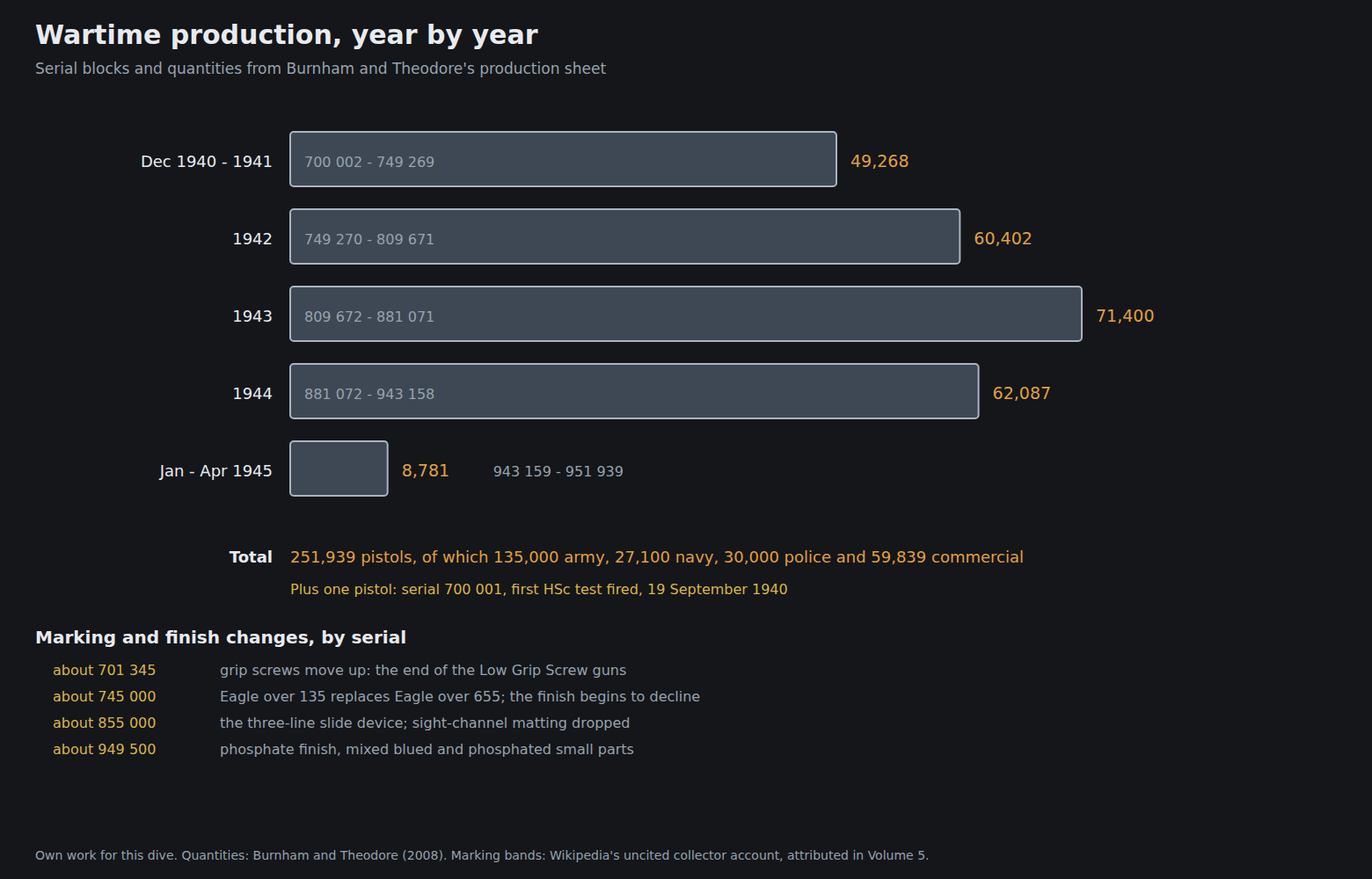
Burnham and Theodore’s sheet is the most granular record found. Every column in it was re-added for this dive and every column sums exactly to its printed total.2
Table 1 — The Numbers, and Two Versions of Them
| Period | Serials | Total | Army | Navy | Police | Civil |
|---|---|---|---|---|---|---|
| 19 Sep 1940 | 700 001 | 1 | 1 | |||
| Dec 1940 – 1941 | 700 002 – 749 269 | 49,268 | 28,760 | 11,450 | 4,400 | 4,658 |
| 1942 | 749 270 – 809 671 | 60,402 | 27,000 | 8,400 | 7,300 | 17,702 |
| 1943 | 809 672 – 881 071 | 71,400 | 39,065 | 4,250 | 6,700 | 21,385 |
| 1944 | 881 072 – 943 158 | 62,087 | 34,366 | 3,000 | 9,000 | 15,721 |
| Jan–Apr 1945 | 943 159 – 951 939 | 8,781 | c. 5,809 | 0 | c. 2,600 | c. 372 |
| Total | 251,939 | 135,000 | 27,100 | 30,000 | 59,839 |
Three things are visible in that table that no summary conveys.
The navy’s share collapses and the army’s does not. The Kriegsmarine takes 11,450 pistols in the first year and 3,000 in 1944, and none at all in 1945. A sidearm is a low priority for a navy that is losing its ships.
Nearly a quarter of wartime production was sold to civilians, and the civil figure peaks in 1943 at 21,385 — the same year army deliveries peak. Forgotten Weapons notes the consequence: “Military personnel of all ranks not issued sidearms often purchased HSc pistols in the commercial marketplace and carried them in the field”, which is how commercial-marked HScs came home in American duffel bags, “often in military proofed HSc holsters”.3
The last four months are a rump. 8,781 pistols from January to April 1945, three of the four figures marked by the authors themselves as estimates.
⚠ Wikipedia prints a different breakdown of the same total, and it is worth flagging rather than quietly choosing between them. Its distribution table reads Army 137,121 (54.4 per cent), Navy 27,100 (10.8 per cent), Police 28,300 (11.2 per cent), Commercial 59,467 (23.6 per cent), total 251,988.3 It sums correctly. It does not match Burnham and Theodore’s 135,000 / 27,100 / 30,000 / 59,839 and total of 251,939, which the same Wikipedia article cites elsewhere for its overall production figure. The navy column agrees exactly; nothing else does, and the totals differ by 49 pistols. Both are given here, attributed, and neither is averaged into the other.
For the whole-production picture, Forgotten Weapons gives “a total of about 272,000 made by the end of the war (including about 15,000 made under French occupation of the Mauser factory complex)”.1 That reconciles with the sheet unusually well: 251,939 wartime plus 19,300 French is 271,239, and the sheet’s French block is 14,596 manufactured plus about 4,704 assembled from wartime parts.2 Two independent accounts agreeing to that resolution is the firmest numerical ground in this dive.
5.4 The Five Army Variations
English Wikipedia’s account of the army guns divides them into five variations by marking and serial band. It is uncited within the article and is plainly derived from the specialist collector literature — Burnham and Theodore’s book, Weaver, Speed and Schmid’s Mauser Pistolen, Still’s Axis Pistols in World War II, Pender’s Mauser Pocket Pistols and Whittington’s German Pistols and Holsters are all listed in its bibliography, and none of them was obtained for this dive.3 It is reproduced here as the collector consensus, attributed, with the caution in the next section.
Table 2 — The Five Army Variations
| Variation | Approximate serials | Quantity | Acceptance mark | Firing proofs | Other |
|---|---|---|---|---|---|
| 1 | 701,345 to about 712,000 | 3,000 | Eagle over 655, left rear trigger-guard web | Eagle over N, right rear trigger-guard web and front of right slide | small army test proof on the left rear grip tang |
| 2 | about 712,000 to about 745,000 | about 5,000 | Eagle over 655 | the two Eagle over N proofs | no proof on the grip tang; finish still first quality |
| 3 | about 745,000 to about 790,000 | about 4,000 | Eagle over 135 | the two Eagle over N proofs | high-quality finish begins to decline |
| 4 | about 790,000 to 886,000 | 31,000 | Eagle over 135 | as before | after 855,000 a three-line device on the left slide beside the banner; rougher polish; military dusk blue; sight-channel cross-hatching dropped |
| 5 | about 886,000 to 952,000 | about 32,000 | Eagle over WaA135 | as before | three-line device; black plastic grips from the late 940,000s; phosphate finish from about 949,500 |
All five bands are described as intermittent: army guns were taken out of a continuous series that was simultaneously filling navy, police and commercial orders.3
The phosphate-finished pistols at the very end are the ones a collector will hear about. English Wikipedia describes the finish as “somewhat similar to the U.S. parkerizing finish”, “variable, from a dark grey to an almost green color”, frequently with “a mix of older blued parts and later phosphated parts”, and adds a marking detail of the kind that only comes from handling a lot of them: the WaA135 stamps are “generally ‘right side up’ on the early phosphate pistols but ‘upside down’ on the later pistols”.3
5.5 What the Marks Are — and the Standard This Hub Applies
The marks named above fall into three kinds, and the distinction matters more than the numbers.
Acceptance stamps — the eagle over a number — are Waffenamt marks: they record that an inspector acting for the ordnance office accepted the part or the pistol. The number identifies the inspection office, not the factory and not the pistol.
Firing proofs — the eagle over N — are the commercial Nitro proof, applied by the proof house, recording that the pistol was fired with a proof load. They appear on commercial guns too.
The three-line device on the left slide after about serial 855,000 is a factory marking and is not an acceptance mark at all.
Now the caution, and it is the same one the MP 40 dive makes about maker codes.
No authoritative published table of these marks was located for this dive. The mapping above comes from an uncited Wikipedia article whose bibliography lists five specialist books, none of which was obtained. The account is coherent, it is consistent with the photographs used in these volumes, and it is very probably right. It has not been checked against a primary reference, and a reader relying on it to value or authenticate a purchase should confirm it independently. Acceptance marks are among the most forged features on German wartime firearms, precisely because Volume 8 shows what they are worth.
This dive also does not claim to know what “Eagle over 655” and “Eagle over 135” were as institutions — which office, which inspector, which jurisdiction. No source consulted says, and guessing would be worse than silence.
5.5.1 The marks the published account leaves out
There is one substantive addition to make, and it comes from a source that is not a reference book at all: the lot descriptions written by Rock Island Auction’s cataloguers, which are read and priced by people who handle these pistols in quantity.
Wikipedia’s account names four marks — Eagle over 655, Eagle over 135, Eagle over WaA135 and the Eagle over N firing proof — and all four are army or commercial marks.3 But the production table shows 27,100 navy pistols and 30,000 police pistols, and those customers had inspectorates of their own. The auction catalogues name them:
Table 3 — Wikipedia's account names four marks — Eagle over 655, Eagle over 135, Eagle over WaA135 and the Eagle over N firing proof — and all four are army or commercial marks.[^enhsc] But the production table shows 27,100 navy pistols and 30,000 police pistols, and those customers had inspectorates of their own. The auction catalogues name them
| Mark | Where | Attributed to | Source |
|---|---|---|---|
| eagle over M | front grip strap | Kriegsmarine acceptance | RIA lot 1029/2576, 23 June 20177 |
| eagle over M III/8 | left side of the trigger guard | navy acceptance | RIA lot 1041/4438, 6 October 20228 |
| eagle over M III/6 | left side of the trigger guard | navy acceptance, fourth variation | RIA lot 4093/1374, 7 December 20249 |
| eagle over swastika over L | trigger guard | German police proof | RIA lots 1046/4428 and 4092/13751011 |
| eagle over swastika | right side of the trigger guard | proof | RIA lot 4093/13749 |
| RW | left side of the trigger guard | French occupation period | RIA lot 2054/256, 12 January 202212 |
| Eagle over 655, Eagle over N | — | army acceptance, firing proof | RIA lot 1045/502, 16 February 202413 |
Four observations, and the last is a caution.
The navy mark is a different letter and a different place. An eagle over M on the front grip strap, or an eagle over M III and a number on the left of the trigger guard, is not going to be found by somebody who has read only the army marking table and is looking for three digits.
The navy inspection marks are numbered. Two catalogued guns give M III/8 and M III/6. That is a series, not a single mark, and it means the navy’s inspectorate can in principle be resolved to a number in the way the army’s can.
The police mark is not a bare eagle over L. One lot calls it “eagle/L”; a later and more careful one calls it the “eagle/swastika L” police proofmark, on the trigger guard.1011
⚠ An auction catalogue is a commercial document. It is written to sell a lot, it is not peer-reviewed, and its identifications are not always right — this hub’s High Standard Sentinel dive documents a case where the same auction house catalogued a rare finish as a common one and it sold for less than half what it should have. The marks above are reported because a number of independent lot descriptions name them and no reference book consulted for this dive does. They are a lead, not a table.
⚠ An auction catalogue is a commercial document. It is written to sell a lot, it is not peer-reviewed, and its identifications are not always right — this hub’s High Standard Sentinel dive documents a case where the same auction house catalogued a rare finish as a common one and it sold for less than half what it should have. The marks above are reported because four independent lot descriptions name them and no reference book consulted for this dive does. They are a lead, not a table.
5.5.2 Where the Eagle over N proofs actually are
Wikipedia places the firing proofs “on the right rear trigger guard web and at the front of the right slide”.3 Two carefully written lot descriptions of commercial guns give three positions, and the third is one nobody would find by looking:
“‘eagle/N’ German proofs on the right front of the slide, right of the chamber (concealed by the slide) and right side of the trigger guard.”45
A proof struck on the barrel beside the chamber, under the closed slide, is visible only with the slide back or off. It is also, for that reason, the proof least likely to have been polished off in a refinish — which makes it the one to look for on a gun whose other markings look too crisp.
5.5.3 The safety is marked, not just dotted
The same description supplies a detail no other source consulted mentions: the pistol carries “‘S’ and red dot safety markings”.5 So the red dot beside the safety lever is one half of a pair — an S, for sicher, marking the safe position, and a red dot exposed in the fire position. A reader looking at the photographs in these volumes will find the dot easily and the S only if told it is there.
5.6 One Gun, Read
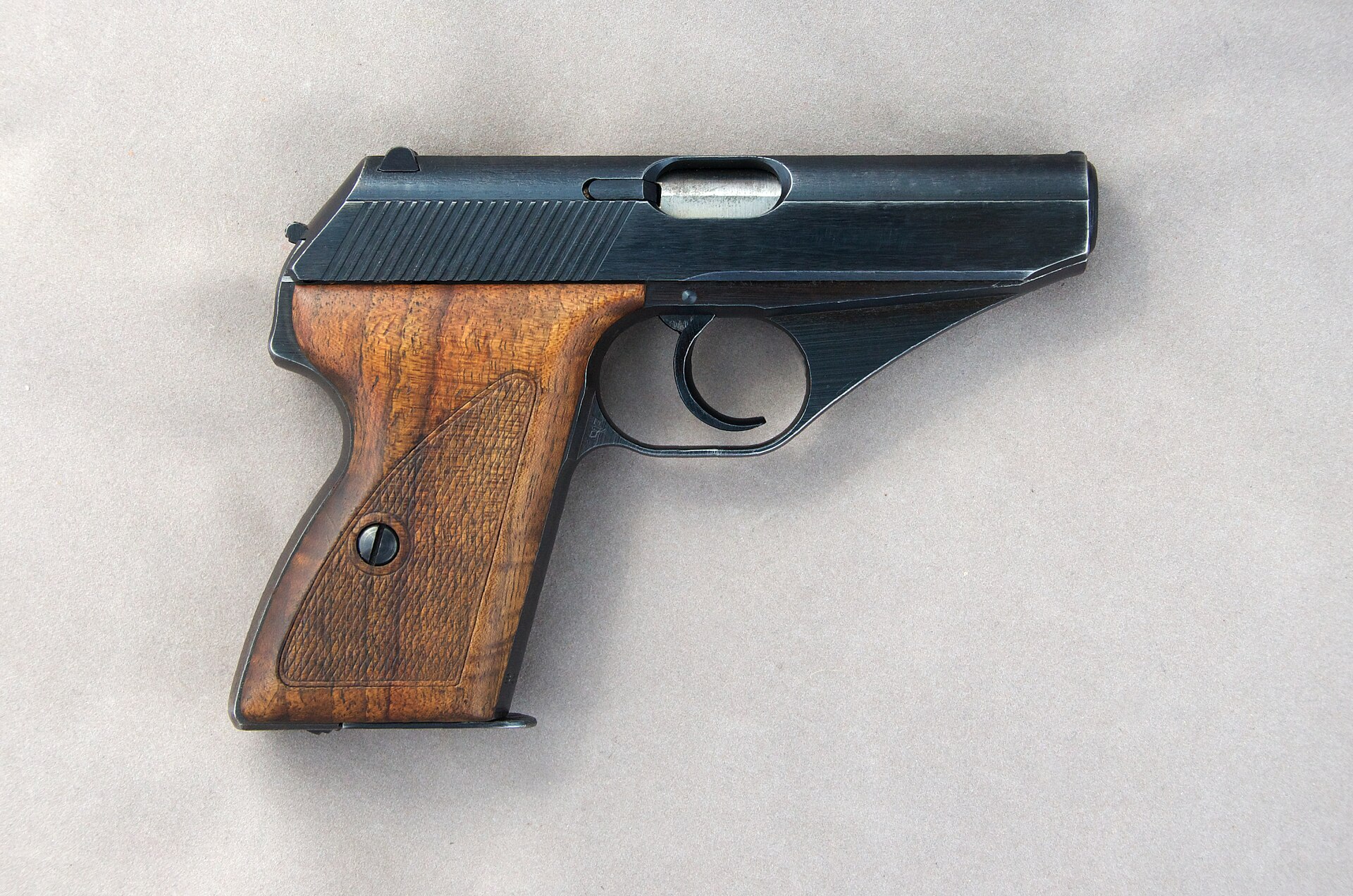
One wartime HSc can be examined here in detail, because two high-resolution photographs of it are freely licensed: a 7.65 mm pistol catalogued by its photographer as serial 861035.14
Read against the table above, 861035 falls in army variation 4 — the band from about 790,000 to 886,000, after the 855,000 point at which the three-line slide device appears. So a gun of that number should carry an Eagle over 135 acceptance on the left rear trigger-guard web, Eagle over N proofs on the right, and a slide legend of the later kind.
What the photographs show:
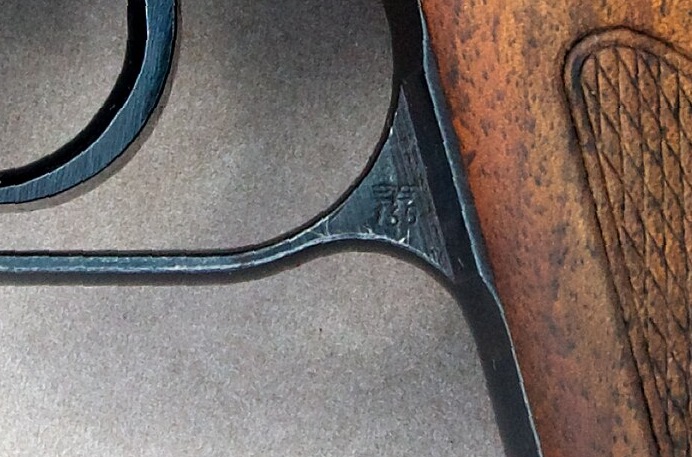
The acceptance stamp is there, in the right place. On the left rear web of the trigger guard there is a two-line stamp: a small spread-winged eagle over three digits. Enlarged, the digits read as 135. ⚠ The stamp is soft in the photograph and this reading is this dive’s, not a source’s; it is offered as consistent with the published scheme rather than as a confirmation of it.
The slide legend is the Mauser banner followed by two lines: “Mauser-Werke A.G. Oberndorf a.N.” over “Mod. HSc ————— Kal. 7,65 mm”. Whether that is what the collector literature means by “a three-line device stamped along with the Banner” could not be determined; the phrase may count the banner, or it may describe a separate mark. The disagreement, if it is one, is recorded rather than resolved.
The safety lever carries a red dot below and behind it, exposed in the photographed position.
The grips are walnut, with a chequered field inside a plain border and a single screw — not the black plastic panels of the late 940,000s.
The finish is a deep, well-polished blue, not a military dusk blue and certainly not phosphate.
The last two points are worth dwelling on, because they cut against the tidy narrative. A gun at 861035 is inside the band the literature describes as rougher and dusk-blued, and this one is neither. The most likely explanation is the one the production table supplies: 1943 was the peak year for civilian sales, 21,385 of them, and commercial guns kept a commercial finish.2 A serial number places a pistol in time. It does not tell you which customer it was built for, and the finish may be a better guide than the block.
5.7 Where the Serial Numbers Are
Three places, and the third is the one people miss.
“The full serial number of each pistol is located on the front of the grip frame, just above the magazine. The last three digits of that serial number are located on the bottom of the chamber (stamped) and the flat panel of the slide just under the muzzle (electropencilled).”3
Two practical consequences. A pistol whose last three digits do not agree across frame, barrel and slide is a parts gun, which for a collector is a different object from a matching one. And the slide’s number is electropencilled rather than stamped, which means it is shallow, it sits on a surface that gets handled and holstered, and it can be polished away by a well-meant refinish — taking the evidence of a matching gun with it.
5.8 The Decline, Measured in Finishing Operations
The most useful way to read the five variations is not as a marking table but as a record of things the factory stopped doing.
- The grip-screw position changes at 701,345 — an improvement, not an economy.3
- The army test proof on the grip tang disappears after variation 1.3
- The polish deteriorates from about 745,000 and is called “rougher” from about 790,000.3
- Bright commercial blue gives way to military dusk blue in the same band.3
- The cross-hatched machining inside the sight channel — a matting cut whose only purpose is to stop the top of the slide glaring — is dropped after 855,000.3
- Walnut grips give way to black plastic in the late 940,000s.3
- Bluing gives way to phosphate from about 949,500, with mixed-finish small parts.3
Every one of those is a finishing or fitting operation, and not one of them touches the mechanism. The pistol Mauser delivered in 1945 works the way the pistol it delivered in 1940 works; what changed is how long anybody was prepared to spend making it look like a Mauser. German Wikipedia’s summary is the same in one sentence: because of high demand “wurde die Produktion bald rationalisiert, wobei das Polieren und Brünieren der Metalloberflächen einer simplen Phosphatierung wich” — production was soon rationalised, with polishing and bluing giving way to simple phosphating.15
For a collector that ordering is the value ladder, and Volume 8 puts prices on it.
5.9 The Stamped Slide, and Where Seidel Went Next
One wartime experiment deserves recording because of where it leads. Forgotten Weapons’s survey of military HScs includes, alongside the preproduction prototype and the early and late production guns, “a 1942 stamped slide experimental version that would inform later Volkspistole designs”.1
A stamped slide is an attempt to get the most expensive machined part of a pistol out of a milling machine and into a press — the same logic that produced the MP 40’s stamped receiver, treated at length in that dive’s manufacturing volume. It did not reach production on the HSc.
It did reach Alex Seidel. From the autumn of 1944 he was working on the Volkspistole, the emergency pistol programme that followed Hitler’s Volkssturm decree of 25 September 1944, and it never entered series production; two specimens were made.16 The line from a 1942 pressed-steel HSc slide to a 1944 last-ditch pistol is short and it runs through one man’s drawing board.
5.10 The Factory
A reference account of this pistol has to say where a quarter of a million of them came from, and the answer is not only “Oberndorf”.
In September 2023 the Gesellschaft für Unternehmensgeschichte announced the findings of its study Waffeningenieure im Zwielicht on the three men who founded Heckler & Koch. As reported by SWR, its conclusion was that Alexius Seidel — like Edmund Heckler and Theodor Koch — had been, at his former firm, and in Seidel’s and Koch’s case that firm was the Oberndorf Mauser works, responsible for forced labourers and a career profiteer of the National Socialist period, though not a war criminal.16
The pistol described in these volumes was designed in 1934 and 1935 by a man in his mid-twenties. The wartime pistols in the table above were made in a plant that used forced labour, and the designer was by then a section head in it. Both sentences are true, neither cancels the other, and a dive that printed the production figures without the second would be printing half a page.
References
Footnotes
-
Ian McCollum, “Evolution of the Military Mauser HSc Pistol”, Forgotten Weapons, https://www.forgottenweapons.com/evolution-of-the-military-mauser-hsc-pistol/ , retrieved 2026-09-20. ↩ ↩2 ↩3
-
Alan D. Burnham and Peter H. Theodore, “Mauser HSc Production History”, compiled 1 May 2008, provided by MauserGuns.com; retrieved 2026-09-19 from the Internet Archive, https://web.archive.org/web/20101125173453/http://mauserguns.com/Mauser_HSc_Production.pdf . ↩ ↩2 ↩3 ↩4
-
“Mauser HSc”, Wikipedia, consulted 2026-09-19. The production-variation and markings narrative is uncited within the article; its bibliography lists Burnham and Theodore, The Mauser HSc Pistol (2008); Weaver, Speed and Schmid, Mauser Pistolen: Development and Production, 1877–1946 (2008); Still, Axis Pistols in World War II (1989); Pender, Mauser Pocket Pistols (1971); and Whittington, German Pistols and Holsters 1934–1945 (1969). None of the five was obtained for this dive. ↩ ↩2 ↩3 ↩4 ↩5 ↩6 ↩7 ↩8 ↩9 ↩10 ↩11 ↩12 ↩13 ↩14 ↩15 ↩16 ↩17 ↩18 ↩19 ↩20 ↩21
-
Rock Island Auction Company, lot 4092/382, “Early Production ‘Low Grip Screw’ Mauser HSc Commercial Pistol”, 23 August 2024, estimate $6,000–9,000, hammer $5,500, https://www.rockislandauction.com/detail/4092/382/ , retrieved 2026-09-20. ↩ ↩2
-
Rock Island Auction Company, lot 4093/1379, serial 700296, “Early Production ‘Low Grip Screw’ Mauser HSc Commercial Pistol”, 7 December 2024, estimate $7,000–9,500, hammer $7,000, https://www.rockislandauction.com/detail/4093/1379/ , retrieved 2026-09-20. ↩ ↩2 ↩3
-
This hub’s MP 40 dive, Volume 3, on German wartime maker codes and on why a serial number alone does not identify a weapon. ↩
-
Rock Island Auction Company, lot 1029/2576, 23 June 2017, https://www.rockislandauction.com/detail/1029/2576/ , retrieved 2026-09-20. Catalogue text: “‘eagle/M’ Kriegsmarine acceptance stamp on the front grip strap. With unmarked brown leather holster and extra magazine.” ↩
-
Rock Island Auction Company, lot 1041/4438, 6 October 2022, https://www.rockislandauction.com/detail/1041/4438/ , retrieved 2026-09-20. Catalogue text: “‘Eagle/N’ proofed and ‘eagle’ over ‘MIII/8’ navy acceptance mark on left side of trigger guard.” ↩
-
Rock Island Auction Company, lot 4093/1374, “Mauser Kriegsmarine 4th Model HSc Pistol, From Jan C. Still”, 7 December 2024, estimate $2,750–4,250, hammer $3,500, https://www.rockislandauction.com/detail/4093/1374/ , retrieved 2026-09-20. The lot states that the pistol is photographed on page 174 of Jan Still’s Axis Pistols, is identified there by serial as a Fourth Variation Kriegsmarine HSc from Still’s own collection, and that Still records approximately 4,500 of that variation made with 47 reported by survey. Provenance: the Jan Still Luger Collection. ↩ ↩2
-
Rock Island Auction Company, lot 1046/4428, 23 June 2024, https://www.rockislandauction.com/detail/1046/4428/ , retrieved 2026-09-20. Catalogue text: “‘Eagle/N’ proofed slide, ‘eagle/N’ and German police ‘eagle/L’ proofed frame.” ↩ ↩2
-
Rock Island Auction Company, lot 4092/1375, “World War II German Police ‘Eagle/L’ Mauser HSc Pistol”, 24 August 2024, estimate $1,600–2,500, hammer $2,500, https://www.rockislandauction.com/detail/4092/1375/ , retrieved 2026-09-20. ↩ ↩2
-
Rock Island Auction Company, lot 2054/256, “Two French Production Mauser HSc Semi-Automatic Pistols”, 12 January 2022, estimate $900–1,200, hammer $900, https://www.rockislandauction.com/detail/2054/256/ , retrieved 2026-09-20. Catalogue text: “With unnumbered black factory box. ‘RW’ proof on left side of trigger guard and ‘ejo’ marked grips.” Provenance: The Milan J. Turk Collection. ↩
-
Rock Island Auction Company, lot 1045/502, 16 February 2024, https://www.rockislandauction.com/detail/1045/502/ , retrieved 2026-09-20. Catalogue text: “‘Eagle/655’ and ‘Eagle/N’ proofed. With leather holster and an extra magazine.” ↩
-
Wikimedia Commons files “Mauser HSc .32 861035 L DSC7759.jpg” and “Mauser HSc .32 861035 R DSC7762.jpg”, photographs by Self Loader, CC BY-SA 4.0. The serial is the photographer’s own cataloguing; it was not independently verified. ↩
-
“Mauser HSc”, German Wikipedia, revision 265079350, consulted 2026-09-19. ↩
-
“Alex Seidel”, German Wikipedia, revision 265794163, consulted 2026-09-19, citing Kersten and Schmid, Heckler & Koch: HK; die offizielle Geschichte (1999), and, for the 2023 study, SWR Aktuell, 19 September 2023. ↩ ↩2
Comments (0)