Mannlicher M1901 & M1903 · Volume 9
Making One: From Parts, From Scratch, and the Law of a New Old Pistol
Why there is no parts-kit route, which part of each Mannlicher the law calls the frame, and how a lab could build the blowback pistol or the strut-locked one without inventing a dimension
9.1 What exists
No firing reproduction of either Mannlicher pistol was found, and no parts kit. A search on 19 October 2026 for Mannlicher 1905 parts, replicas and reproductions returned only listings of original pistols, and none of the sources consulted for this dive mentions a reproduction.1 The only new Mannlicher pistols will be the ones somebody makes.
That is a semi-automatic pistol, not a select-fire weapon, and making one for personal use is lawful federally and in Michigan within the limits set out below. This volume treats it at the depth of a lab with a lathe, a mill, CNC and a gunsmith’s bench (the hub’s lab catalogue is _shared/lab_capability.md). It gives no dimension that is not in a source, and says where the sources stop.
9.2 Path A: from parts
There is no from-parts path in the sense the hub usually means: no surplus parts kit, no commercial receiver, no catalogue of spares (Vol 6). What exists is the original pistol in pieces, and three things can be done with it.
- Completing an incomplete original. A pistol missing small parts (a spring, a sear, a side-plate catch) can be completed with parts from another original or with made parts. It remains the original firearm, with its own serial and its own legal status (Vol 8). This is gunsmithing, not making.
- Restoring a non-firing original. A pistol that has been deactivated is a separate legal question, not researched for this dive. One that is merely broken is completed as above.
- Assembling a “parts gun”. Combining parts from several originals produces a mixed pistol whose value as a collector’s piece is lower than any of its donors (Vol 5). Its legal identity is the frame’s (below). Breaking up a sound original for parts is not recommended here, and for the locked-breech line, of which perhaps 150 survive, it would be destruction.2
For both families, Path A is therefore a repair route. The building route is Path B.
9.3 The law of making one
The Borchardt C-93 dive’s Vol 9 sets out the federal and Michigan law of making a pistol for personal use, and the analysis is not repeated here. In summary: federal law does not require a non-licensee who makes a firearm for his own use, not for sale, to hold a licence or to mark it, though marking is prudent; the Gun Control Act’s antique exclusion does not reach a newly made pistol of a cartridge design (a new Mannlicher is a firearm, not an antique replica, because its ammunition is the point); and Michigan’s pistol licence and sales-record scheme is built around a transfer, so a maker should put the question of how to license a self-made pistol to the Michigan State Police in writing, or hold a concealed pistol licence.
Three points are particular to the Mannlicher.
-
The disconnector. A pistol that fires more than one shot for a single function of the trigger is a machine gun under 26 U.S.C. § 5845(b), which an individual may not lawfully make; the Borchardt dive’s Vol 9 sets out the law and the Olofson decision on malfunctioning disconnectors. The strut-locked pistol’s disconnector is a trailing link on the trigger, described by Wille (Vol 4). No source describes how the blowback pistol disconnects (Vol 4), so a builder of that pistol must design and prove a disconnector that is not documented, and should test it exhaustively with dummy rounds before any live round is loaded.
-
The holster-stock. Making a holster-stock for a newly made long pistol and attaching it makes a short-barrelled rifle. That needs an approved ATF Form 1 before the stock is fitted. The tax is $0 from 2026; the application and approval are not (Vol 8).
-
The carbine. A carbine with a barrel under 16 inches, Wille’s 300 mm (11.8 in) for instance, is a short-barrelled rifle when newly made; ATF’s listing of the factory carbines does not extend to copies. Form 1 first. A carbine with a barrel of 16 inches or more is an ordinary rifle.
9.4 Which part is the frame?
Federal regulation defines the frame of a handgun by what it houses. 27 CFR 478.12(a)(1):
“The term ‘frame’ means the part of a handgun, or variants thereof, that provides housing or a structure for the component (i.e., sear or equivalent) designed to hold back the hammer, striker, bolt, or similar primary energized component prior to initiation of the firing sequence, even if pins or other attachments are required to connect such component (i.e., sear or equivalent) to the housing or structure.”3
For a rifle the regulated part is the receiver, “the part … that provides housing or a structure for the primary component designed to block or seal the breech prior to initiation of the firing sequence (i.e., bolt, breechblock, or equivalent)”.3 Applying those words to the two Mannlichers, as this dive reads them:
- Blowback pistol. The sear, trigger bar and V-springs are mounted on the frame under the side covers, and the frame is forged with the chamber.4 The frame is the frame.
- Strut-locked pistol. The sear (Stange) pivots “im Schlosskasten”, in the lock housing, and Wille says “Sämtliche Teile des Schlosses sind in einem besonderen Schlosskasten untergebracht”: all the lock’s parts are in a separate lock housing, whose front part is also the magazine housing.5 On the text of 478.12(a)(1), the regulated frame of the pistol is the lock and magazine housing (part 17), not the outer frame (Rahmen, part 16) that the receiver slides in, and not the receiver.
- Strut-locked carbine. As a rifle, its regulated part is the one housing the bolt, the receiver (Gehäuse, part 3), which recoils with the barrel.
The same mechanism therefore has a different regulated part depending on whether it is built as a pistol or a carbine. This is this dive’s reading of the regulation; ATF has not been asked, and a maker should not rely on it without asking. The practical consequence for a builder is where the serial number goes, and which part, if made first, is already a firearm.
9.5 Path B: from scratch, and which pistol to build
Build the blowback pistol first. It has a fixed barrel, an unlocked breechblock, an external hammer and fewer parts, and it fires a cartridge of about .32 ACP power (Vol 7). Its difficulty is in the slide, a single part with a breechblock and two long arms joined by a cross-beam, and in the springs. The strut-locked pistol has more moving parts, a barrel and receiver that must slide true in the frame, a strut and step block that are the lock, a concealed hammer, a disconnector of trailing-link type and a detachable magazine, and it fires a cartridge whose correct load nobody publishes. It is a second project.
Choose the cartridge before drawing anything. The original cartridges are not made (Vol 7). A builder has three choices.
- The original cartridge, formed. For the blowback pistol, the 7.63 mm Mannlicher from formed brass; the chamber is then cut to fit the case the builder can make, and the case is trimmed to headspace on its mouth. For the strut-locked pistol, the 7.65 mm Mannlicher from .30 Mauser brass, loaded to Wille’s velocity and no higher.
- A modern cartridge of similar power, by redesign. A blowback in a currently made .32-class cartridge is a redesign, not a reproduction: breechblock mass, recoil-spring rate and the cam must be sized for that cartridge’s published maximum pressure, which the builder must take from the standards body’s own document. The original’s proportions were sized for an 85-grain bullet at about 1,000 to 1,070 ft/s (Vol 7) and cannot be assumed to suit anything else.
- The 7.63 Mauser in a strengthened strut-locked pistol. Hogg and Walter say that “though the breech-lock design was strong enough to withstand the Mauser round, the rest of the pistol was not”.6 A builder who wants the Mauser round must design the rest of the pistol for it and test it as a new design. That is a different pistol wearing Mannlicher’s lock.
Choices 2 and 3 produce pistols that must never be confused with originals. Their chambering should be marked on them (below).
9.6 Where the dimensions come from
No set of factory drawings for either pistol was found, and none is known to survive in a public collection. The sources:
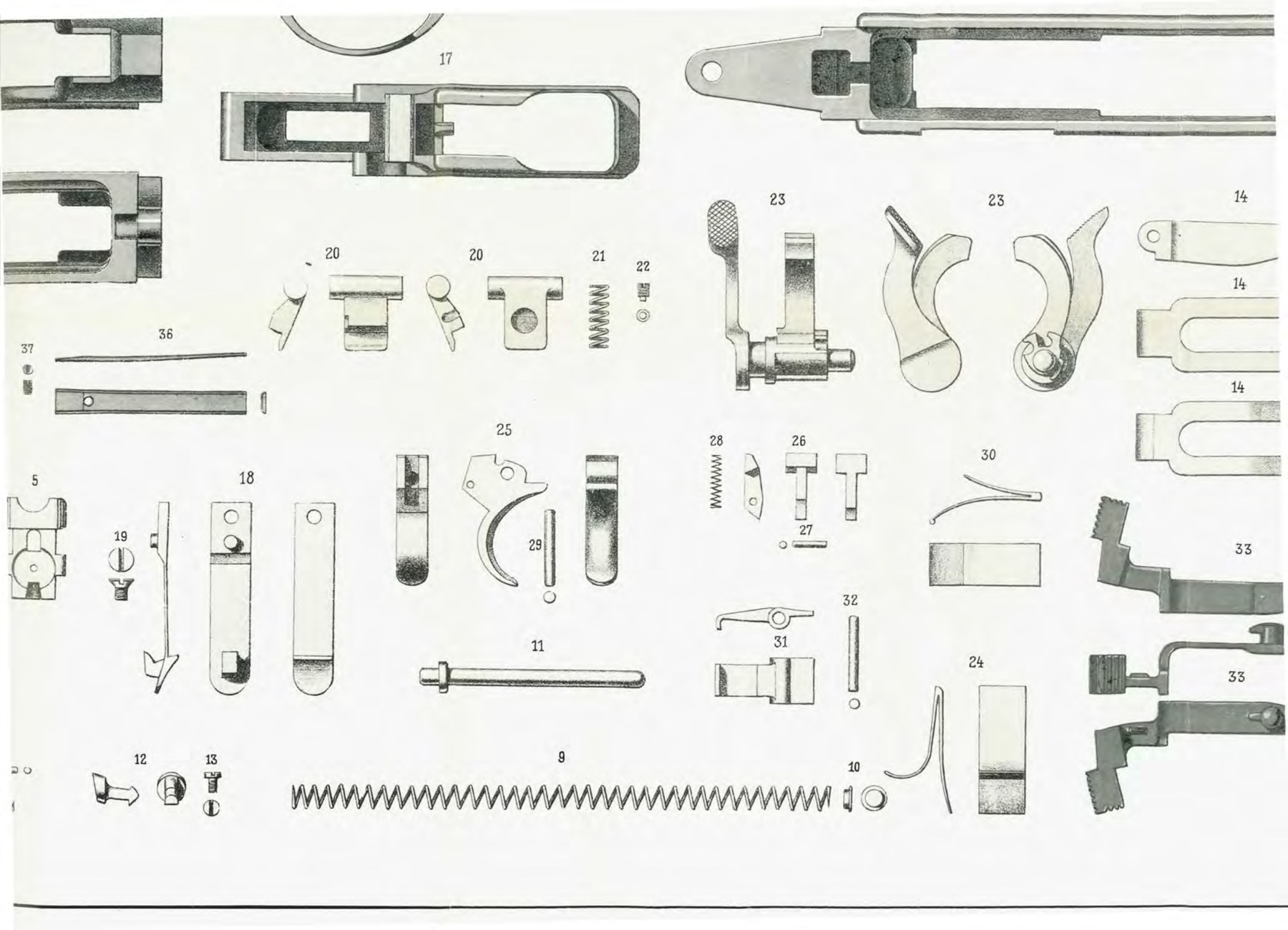
- Strut-locked pistol: Wille (1902). Bore between lands 7.65 mm (+0.03/−0.02); four grooves 0.12 mm deep, 2.93 mm wide, lands 3.08 mm; right-hand twist of 250 mm; chamber outside diameter 20 mm in an octagon, 15 mm ahead of it; long pistol 300 mm overall with a 152 mm barrel, rifled for 121 mm; short pistol 266 mm with a 119 mm barrel; height 139 mm; width 31 mm; weights 1,045 g and 980 g empty; 45 and 41 parts; the cartridge’s lengths and weights (Vols 3 and 7). And six plates of parts drawn to a common, though unstated, scale; the target diagrams are drawn “Masstab 1 : 12,5”, but the parts plates give no scale.5
- Blowback pistol: Smith (1947). Three pages of drawings, from manufacturer’s literature according to the Commons uploader, without dimensions.7 The secondary figures in Vol 2 (barrels of 140 to 160 mm, 910 g) are approximate and conflicting.
- An original. The only full source of dimensions for either pistol is a pistol. A builder with access to one should measure it non-destructively: a chamber cast, a bore slug, and measurements of every part removed in the field strip, without detail-stripping a collector’s pistol unless its owner agrees. Photographs at a known scale from a single plane help with the outline parts.
What none of them gives: the cam’s profile and the slot it rides in on the blowback pistol; the strut’s bevel angle and the step block’s step heights and ramp; spring rates and wire sizes; heat treatments; tolerances. Those must be measured from an original or designed and tested. This dive does not supply them.
9.7 The blowback pistol, group by group
The parts and their functions are in Vol 4. For a builder:
- Frame. One steel part carrying the chamber, the barrel thread, the guides for the slide arms, the grip frame, the lockwork seats on the left, the mainspring and cam seats on the right, and the magazine well with its lips and unloading lever. It is the regulated part (above), and the largest and most complex machined part of the pistol. A billet frame milled on a CNC mill is the obvious route; the original was a forging.
- Barrel. Screwed into the frame, with the front-sight rib “part of the barrel forging” (Wilson, as summarised).4 A pre-rifled .30-calibre blank of the right groove diameter, turned and threaded, with the rib machined or added, is the practical source; the groove diameter must come from a slugged original or the chosen cartridge’s specification.
- Slide. Breechblock and two arms joined by a cross-beam under the muzzle end of the arms, carrying the extractor and firing pin, with the slot for the cam on the underside and the clip guide in the breechblock face.84 The arms must be straight and parallel along their whole length or the slide will bind on the frame guides. One piece from billet on a mill, with care over distortion.
- Lockwork. Trigger, trigger bar, sear, the V trigger-sear spring, hammer with its two forks, and the heavy V mainspring that also loads the cam. Flat springs are the hard part (below).
- Side covers. The wrap-around cover with its forward arm locking under the recoil spring, and its catch ahead of the trigger guard. Sheet-steel or milled.
- Magazine. Fixed in the frame: follower, spring, the lip that the unloading lever withdraws, and the ejector bar at its back.
- Clips. The pistol loads from a clip in a guide on the breechblock face. Original clips survive; Mannlicher-Pieper clips for the locked-breech pistol had a sprung claw design (Vol 3). A builder can load the magazine through the open top without a clip.
9.8 The strut-locked pistol, group by group
From Wille’s parts list (Vol 4) and plates:
- Barrel and receiver. The barrel screws into the receiver, which slides in grooves in the frame. Barrel and receiver recoil together about 4 mm. They must slide true and without play, because their alignment is the lock’s alignment.
- Bolt. Bored for its recoil spring, which sits partly on a guide rod; rear-bottom bevel bearing on the strut; extractor on top, loaded through a thrust plate by the recoil spring; firing pin with its retaining pin and spring; cupped grip on top.5
- Strut and step block. The lock. The strut pivots at the bottom of the receiver’s rear wall and swings a few millimetres; its slot passes the hammer; its front bevel bears on the bolt; it rests on the step block, which is dovetailed into the lock housing. These are the parts whose geometry is not in any source, and whose failure would be a failure of the lock. They must be made from an original’s measurements, in a hardened steel, by a heat-treater (below).
- Lock and magazine housing. The regulated frame of the pistol (above): hammer, mainspring, sear, trigger with its trailing link and spring, safety seats, the step block, the ejector, the magazine catch and the housing catch.
- Frame (Rahmen). The outer structure in whose grooves the receiver slides; it stops the receiver’s recoil, carries the barrel spring’s seat, the safety and the grip. A billet part.
- Magazine. A detachable sheet-steel box with perforated sides, follower and zigzag spring, and a sliding floorplate.
- Holster-stock. Leather over a wooden block with a steel T-rail and a sprung locking pin. Making one and fitting it is making a short-barrelled rifle (above).
9.9 Springs and heat treatment
Both pistols depend on flat springs: the blowback pistol’s two V-springs, one of which drives the hammer and loads the cam at once; the strut-locked pistol’s mainspring and trigger spring. Flat V-springs of this kind are made by forging or bending spring steel, hardening and tempering it to a spring temper, and fitting it by trial; the coil springs (recoil, barrel, firing-pin, follower) can be wound or bought by rate once the rate is known from an original.
The hub’s lab has no heat-treatment oven; its powder-coat oven is not for heat treating (_shared/lab_capability.md). The strut, step block, bolt, sear, hammer and every flat spring therefore go to a heat-treat shop, or are done in a kiln bought or borrowed for the job. A builder must specify the steel and the hardness for each part before sending it; neither is in any source for these pistols.
9.10 What each machine in the lab is for
Against the catalogue in _shared/lab_capability.md as recorded on 2026-10-18:
Table 1 — Against the catalogue in shared/labcapability.md as recorded on 2026-10-18
| Machine | Use on a Mannlicher |
|---|---|
| CNC mill (Nomad 3) | Small steel parts: strut, sear, trigger, hammer, step block, safety, extractor, magazine catch; light passes |
| Manual mini mill with DRO | Frame, slide and receiver work within its travel; slots, dovetails, guides |
| Mini lathe (7×16) | Barrel turning and threading from a pre-rifled blank; firing pin, pins, guide rod, screws; chamber reaming with a reamer for the chosen case |
| CNC router (Shapeoko) | Grip panels in walnut; the wooden block of a holster-stock; aluminium fixtures |
| 3D printers | Fit-check models of the frame and slide from measurements before cutting steel; dummy-round gauges |
| Press brake | Side covers and the magazine body from sheet |
| CO2 laser | Engraving grip checkering patterns as a guide; cutting leather for a holster |
| Gunsmithing bench | Fitting, spring making and fitting, timing, finishing |
Whether the mini mill’s travel takes a full blowback frame in one setup was not checked, and should be before a frame is drawn. A frame larger than its travel needs a second setup or an outside shop.
9.11 Proving and first firing
A new pistol of an old design should be treated as unproven. A sequence consistent with the hub’s other build volumes:
- Function-check with dummy rounds: feeding from the magazine, extraction, ejection, hold-open (strut-locked pistol: after the last round), disconnection (the hammer must stay cocked until the trigger is released and pulled again; Vol 4).
- Check headspace with gauges made for the chosen case: on the blowback pistol the case mouth is the headspace surface.
- For the strut-locked pistol, confirm by hand that the barrel group cannot return until the bolt has, and that the strut sits fully on the upper step with the bolt closed (Vol 4). A strut that does not climb the step is a pistol that can fire unlocked.
- Fire the first rounds remotely, from a rest, with single rounds in the magazine, and inspect the case and the locking surfaces after each.
- Chronograph, and stop at the period velocity for the design (Vol 7), lower if anything is wrong.
A formal proof at an overpressure, as a European proof house would apply, is beyond a home lab without a means of making and measuring proof loads. The builder who wants one should ask a proof house or an ammunition maker.
9.12 Markings: do not make a fake
A new pistol must not be marked to pass as an original. No “WAFFENFABRIK STEYR”, no “PATENT MANNLICHER”, no Argentine arms, no Austrian proofs, no serial in an original range. A collector’s market in which ground-crest pistols, refinished pistols and rare trial pistols already confuse buyers (Vol 5) needs no more confusion. Mark the maker, the year and the chambering, clearly, on the regulated part (above), and record the build.
9.13 What could not be established
- Any factory drawing of either pistol; the scale of Wille’s parts plates.
- The cam profile, strut bevel, step heights, spring rates, steels and hardnesses.
- ATF’s view of which part of the strut-locked pistol is its frame.
- Whether any firing reproduction or kit has ever been made; one search found none.
- Whether the lab’s mini mill can hold a full blowback frame in one setup.
References
Footnotes
-
Web search “Mannlicher 1905 pistol parts Numrich OR Gun Parts Corp OR replica OR reproduction”, 19 October 2026: results were dealer and auction listings of original pistols only. ↩
-
James D. Julia, Spring 2009, lot 1156, quoting a letter of James Rankin, https://jamesdjulia.com/?p=463137, consulted 2026-10-19. ↩
-
27 CFR 478.12(a)(1)–(2), eCFR, https://www.ecfr.gov/current/title-27/chapter-II/subchapter-B/part-478/subpart-B/section-478.12, consulted 2026-10-19. ↩ ↩2
-
“Mannlicher M1901”, English Wikipedia, https://en.wikipedia.org/wiki/Mannlicher_M1901, consulted 2026-10-19 (summarising Wilson 1943). ↩ ↩2 ↩3
-
R. Wille, v. Mannlichers Selbstlade-Karabiner und Karabiner-Pistole m/1901 (Berlin 1902), pp. 6–12, 18–19, 22–26, 39–40 and Tafeln I–III, V, VI. Scan via Forgotten Weapons, consulted 2026-10-19. ↩ ↩2 ↩3
-
“Austro-Hungarian Mannlicher M1903 Pistol”, thinlineweapons.com, https://thinlineweapons.com/Hungariae/Mann03P.htm, consulted 2026-10-19. ↩
-
W. H. B. Smith, Mannlicher Rifles and Pistols (1947), pp. 214, 216, 218, as reproduced on Wikimedia Commons, consulted 2026-10-19. ↩
-
“Argentine Mannlicher Pistol Model 1905”, thinlineweapons.com, https://thinlineweapons.com/Hungariae/Mann05.htm, consulted 2026-10-19. ↩
Comments (0)