Mannlicher M1901 & M1903 · Volume 7
The Cartridges: 7.63 mm Mannlicher, 7.65 mm Mannlicher, and the Rounds That Must Not Go In
The straight-cased blowback cartridge and the bottlenecked locked-breech one, what each measured and was loaded with, what can be bought or made in October 2026, and the dangerous confusions with 7.63 Mauser, 7.65 Borchardt and the other 7.65s
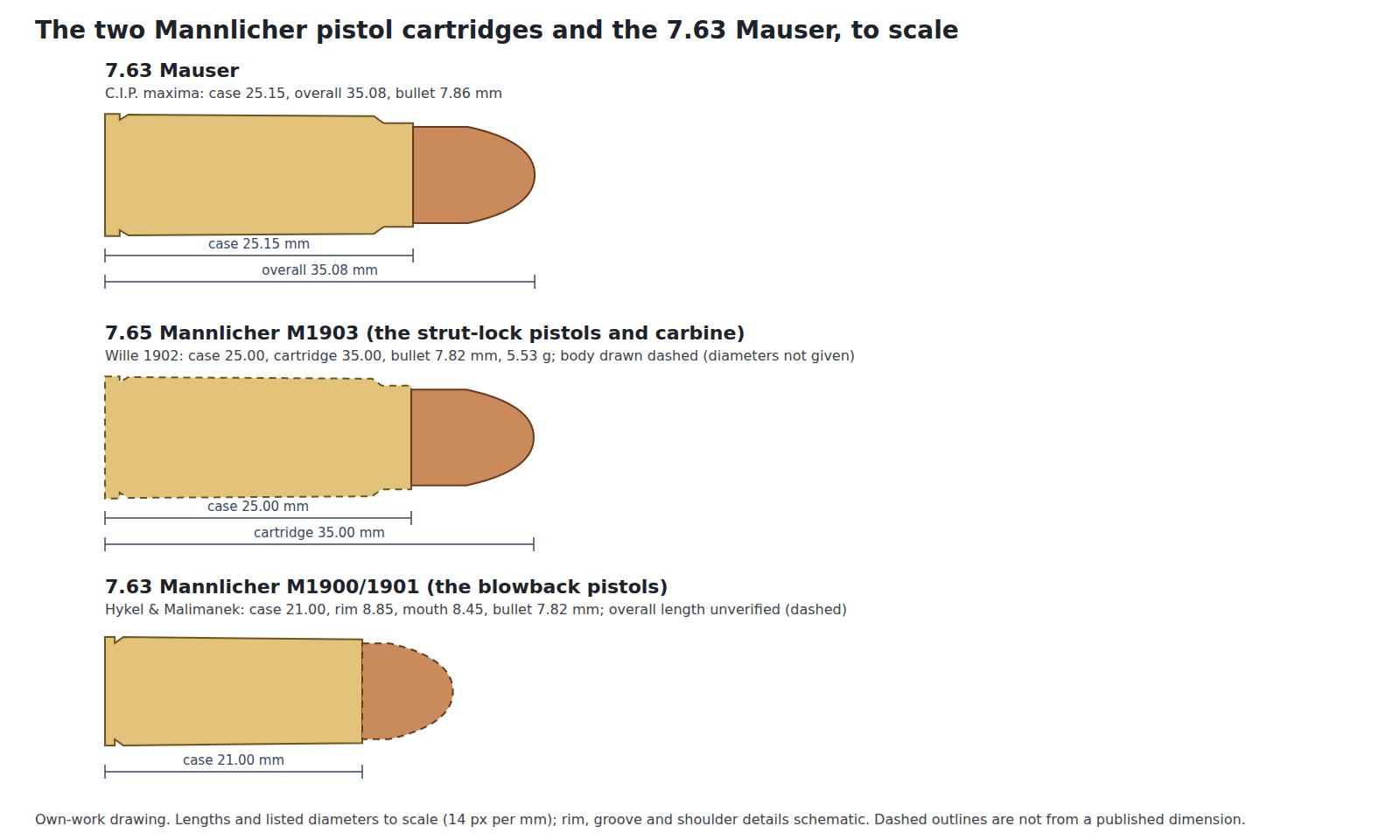
7.1 Five cartridges, three names
Mannlicher’s pistols used five cartridges in ten years, and the names overlap.
Table 1 — Five cartridges, three names
| Cartridge | Used in | Case | Other names |
|---|---|---|---|
| 6.5 mm Mannlicher M1894 | M1894 | Rimmed | 6.5×23R |
| 7.6 mm Mannlicher M1894 | M1894 | Rimmed | 7.6×24R; 7.8 mm Mannlicher M1894 |
| 8 mm Mannlicher M1900 | M1900 | Rimmed | — |
| 7.63 mm Mannlicher | M1901, M1905 | Straight, rimless, 21 mm | 7.65 mm Mannlicher (Germany); 7.65×21 mm (US); 7.63×21 |
| 7.65 mm Mannlicher | M1896, M1896/03, M1903 pistols and carbines | Bottlenecked, rimless, 25 mm | 7.63 mm Mannlicher M1903; 7.65 mm Mannlicher M1896 |
The names of the last two are the trap: each has been called both “7.63” and “7.65 Mannlicher”.12 English Wikipedia’s cartridge article itself warns that the diameters in its own infobox “do not seem to refer to either of them”.1 The M1894 rounds and the 8 mm M1900 are mentioned for completeness; no dimension or load for the 8 mm was found.
7.2 The 7.63 mm Mannlicher (the blowback pistols)
Dimensions. English Wikipedia’s article on the cartridge, citing Hýkel and Malimánek’s Czech reference Náboje do ručních palných zbraní (2002) and itself flagging the citation as needing verification, gives: “bullet dia at case mouth 7.82 mm; rim dia 8.85 mm; case bottom dia 8.85 mm; case mouth external dia 8.45 mm; case length 21.00 mm.”1 Its infobox gives other figures (bullet .308 in, neck .331, base .332, rim .334, case .84 in, overall 1.12 in) that the article says match neither Mannlicher round.1 The Czech figures are used here. The overall length was not established from any source this dive would rely on.
The case is called “straight” but is not quite: “the Mannlicher ‘straight sided’ cartridge actually has a straight taper to help in extraction”, from 8.85 mm at the base to 8.45 mm at the mouth.21 And “this cartridge headspaces on the mouth of the case” (Wilson, as cited).1 That matters for anyone forming cases (below): case length is the headspace dimension.
Load. Wilson, as summarised: “a bullet weighing approx. 85 grains (5.5 g) which may be steel or cupro-nickel jacketed. The powder charge varies with the type of powder used, the European standard being about 3.5 grains (227 mg) of DWM standard powder, producing a muzzle velocity in the neighborhood of 1070 ft/s (326 m/s).”2 Buffaloe: 86 grains, 3.2 grains of smokeless powder, 1,000 ft/s, 193 ft-lb.3 English Wikipedia’s M1905 article: an 82-grain bullet, 3.2 grains, about 1,000 ft/s.4 The three are given separately; none names its test barrel. The charge weights are period factory figures, quoted for history, and are not load data.
Manufacture. Wilson, as summarised, says British makers took up the cartridge when the pistol “became popular in South America”, and that Germany made it after the First World War as the “7.65 Mannlicher” to distinguish it from the 7.63 Mauser; a Forgotten Weapons reader notes Eley Brothers of London among its makers.15 The Stoeger catalogue of 1925, a New York importer’s, lists “7.63 m/m Mannlicher, Smokeless, F.M.J.” at $37.50 a thousand, against $55.00 for “7.63 m/m Mauser with clips”.6 Argentina’s own arsenals made it into the 1950s: the boxes illustrated below are labelled for the Fábrica Militar de Munición de Armas Portátiles “Borghi”, “50 Cartuchos Cal. 7,65 mm. Para pistola MANNLICHER”, and Buffaloe says Fabricaciones Militares at San Lorenzo made it until at least 1958.73
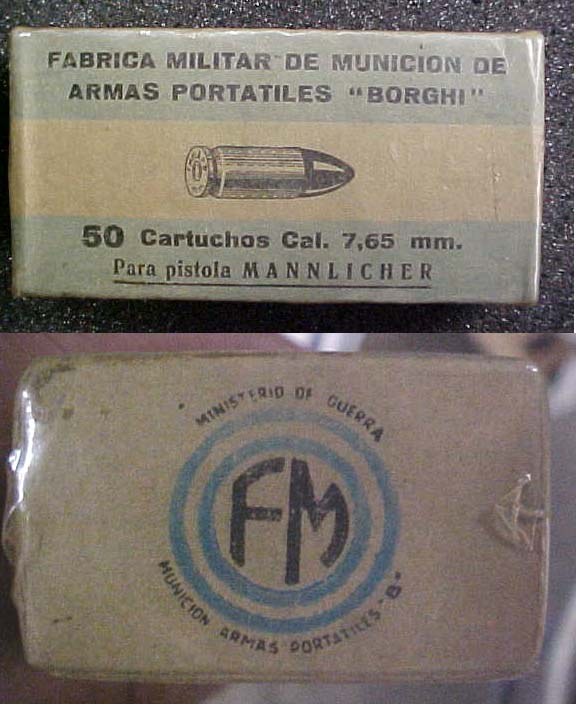
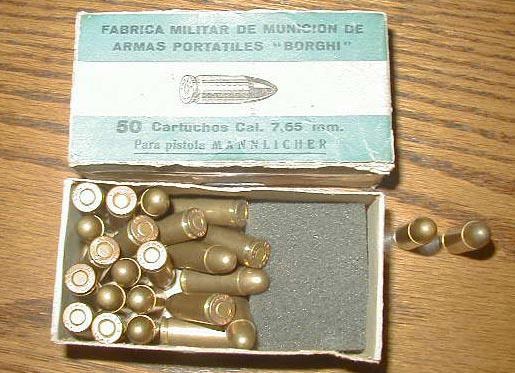
Note the box: “Cal. 7,65 mm”, with nothing else to separate it from the 7.65 mm Browning, the 7.65 mm Parabellum, the 7.65 mm French Longue or the locked-breech Mannlicher’s round. The words “Para pistola MANNLICHER” are what identify it.
7.3 The 7.65 mm Mannlicher M1903 (the locked-breech pistols)
Wille’s 1902 description is the only source found that gives this cartridge’s figures. His table, with conversions added:8
Table 2 — The 7.65 mm Mannlicher M1903 (the locked-breech pistols)
| Item | Wille 1902 | Equivalent |
|---|---|---|
| Cartridge length | 35.00 mm | 1.378 in |
| Cartridge weight | 10.40 g | 160.5 gr |
| Case length | 25.00 mm | 0.984 in |
| Case weight, with primer | 4.45 g | 68.7 gr |
| Bullet length | 14.00 mm (1.83 calibres) | 0.551 in |
| Bullet diameter | 7.82 mm | 0.308 in |
| Bullet weight | 5.53 g | 85.3 gr |
| Powder charge | 0.45 g | 6.9 gr |
| Case filled | 90 per cent | — |
| Highest pressure | 1,395 at (+25/−17), mean of 7 | about 1,368 bar; 19,800 psi |
| Muzzle velocity, carbine (300 mm barrel) | 450 m/s | 1,476 ft/s |
| Muzzle velocity, long pistol (152 mm) | 375 m/s | 1,230 ft/s |
| Muzzle velocity, short pistol (119 mm) | 360 m/s | 1,181 ft/s |
The case is “die gewöhnliche Flaschenform”, the usual bottle shape, divided into a cylindrical bullet seat, a steeply conical shoulder, a slightly conical powder chamber and the head with its primer.8 Wille gives no diameters for it; the drawing above borrows the 7.63 Mauser’s and says so. Thinlineweapons.com, after Hogg and Walter, describes it as “a 7.65mm bottle-necked rimless round offering the same dimensions as the 7.63mm Mauser but less velocity”, and James D. Julia’s 2009 catalogue as “dimensionally the same as the 30 Mauser but less powerful”.910 Both say “the same dimensions” without measurement; neither is a drawing.
7.4 The M1903 round and the 7.65 Borchardt: the same load
Set Wille’s figures beside the Borchardt factory’s own for its 7.65 mm cartridge, as published in the DWM and Loewe manuals and quoted in the Borchardt C-93 dive’s Vol 7:
Table 3 — Set Wille's figures beside the Borchardt factory's own for its 7.65 mm cartridge, as published in the DWM and Loewe manuals and quoted in the [Borchardt C-93 dive's Vol 7](/actual-firearms/pistols/borchardt-c93/vol-7/)
| Item | Mannlicher M1903 (Wille 1902) | Borchardt (DWM manual) | 7.63 Mauser (C.I.P.) |
|---|---|---|---|
| Cartridge length | 35.00 mm | 35 mm | 35.08 mm max |
| Case length | 25.00 mm | — | 25.15 mm max |
| Cartridge weight | 10.40 g | 10.55 g | — |
| Case weight | 4.45 g | 4.60 g | — |
| Bullet weight | 5.53 g | 5.50 g | — |
| Powder charge | 0.45 g | 0.45 g | — |
| Muzzle velocity | 375 m/s (152 mm barrel) | 400 m/s (190 mm barrel) | — |
| Highest pressure | 1,395 at (method not stated) | — | 2,250 bar (transducer) |
Sources: Wille8; DWM figures and C.I.P. sheet as cited in the Borchardt C-93 dive, Vol 7.
On the two factories’ own figures, the M1903 cartridge carries the Borchardt load. The same charge weight under a bullet within 0.03 g, in a cartridge of the same length, giving a somewhat lower velocity from a shorter barrel. Whether the powders were the same is not stated in either source, and two loads with the same charge weight of different powders are not the same load. But the period evidence is that Mannlicher’s locked-breech cartridge was loaded to Borchardt, not Mauser, levels. The C-93 dive records that the Borchardt and Mauser rounds were sold interchangeably and that whether the Mauser load was hotter is disputed (it quotes both sides). That dispute does not have to be settled to see the point for the Mannlicher: if a 7.65 Borchardt load is right for it, a 7.63 Mauser load is at least as hot, and by the weight of the authorities quoted there, hotter.
7.5 The dangerous confusions
1. 7.63 Mauser in the locked-breech Mannlicher. Do not. It chambers: every source that describes the M1903 round says it has the Mauser’s dimensions.910 It is loaded hotter: Pollard gives the C96’s 85-grain bullet at “about 1,394 ft. per sec.”, against Wille’s 1,230 ft/s from the long pistol, and the 7.63 Mauser’s C.I.P. maximum of 2,250 bar is far above the 1,395 at Wille measured, even allowing for the difference between a crusher and a transducer.118 And the one secondary account that discusses it says the pistol “was not strong enough to stand up to firing the Mauser round”, adding that “though the breech-lock design was strong enough to withstand the Mauser round, the rest of the pistol was not”.9 The Borchardt C-93 dive quotes Terry Wieland in Handloader (2018): “The Mannlicher was stronger than the Borchardt, but not as strong as the Mauser C96”, and “it is unwise to use Mauser rounds in either the Borchardt or the Mannlicher”; which Mannlicher Wieland means is not stated in the passage quoted, but only the locked-breech one takes the round. No measured failure was found. The evidence is enough: the cartridge that fits is not the cartridge the pistol was made for.
2. 7.62 Tokarev in the locked-breech Mannlicher. Never. The Tokarev is dimensionally similar to the 7.63 Mauser and loaded hotter still; the Borchardt C-93 dive’s Vol 7 sets out the evidence for that and for military Tokarev being hard to tell from Mauser by its headstamp. Everything in point 1 applies more strongly.
3. The two Mannlicher rounds in each other’s pistols. Smith, 1947, on the straight 7.63 mm Mannlicher: “They will not fit the Mannlicher locked-breech pistol.”12 The reverse is a matter of length: the locked-breech pistol’s 25 mm bottlenecked case cannot enter the blowback pistol’s 21 mm chamber, which is this dive’s inference from the published case lengths. Neither combination will fire as designed; neither should be forced.
4. The 7.65×21 name. In America the blowback Mannlicher’s round is sometimes listed as “7.65×21 mm”.2 So is the 7.65 mm Parabellum (.30 Luger), a quite different cartridge: bottlenecked, with a head of about 9.93 mm against the Mannlicher’s 8.85 mm, a case of 21.59 mm and a C.I.P. maximum of 235 MPa, 2,350 bar.13 Buffalo Arms lists “30 Luger (7.65x21)” cases on the same search results page as other 7.65 items, and offers no Mannlicher brass at all (below).14 The Parabellum’s head is too large for the blowback Mannlicher’s chamber, on the published figures; in the locked-breech pistol it is the wrong length and headspaces on a shoulder in the wrong place.13 Neither use should be tried.
5. 7.65 mm Browning (.32 ACP). Semi-rimmed, 17.3 mm long, with a rim of 9.1 mm.15 It is not the blowback Mannlicher’s cartridge and does not headspace in its chamber, which is set on the case mouth of a 21 mm case. Its use in a Mannlicher is not discussed further here, except to say that it is the most common “7.65 mm” round on sale, and a box marked only “7.65 mm” is most likely to be it.
6. The ATF list. ATF’s curios and relics list gives “cal. 7.63mm Mannlicher” for the M1903 along with the blowback pistols.16 It is a classification of the pistol, not a chambering statement, and it is wrong for the M1903. No reader should take a cartridge from it.
The rule that covers all six: have the chamber of the pistol in hand cast or measured, and match the cartridge to the chamber, never to a name.
7.6 Ballistics, source by source
Table 4 — Ballistics, source by source
| Cartridge, weapon | Bullet | Velocity | Source |
|---|---|---|---|
| 7.63 Mannlicher, blowback pistol | 85 gr | 1,070 ft/s (326 m/s) | Wilson, as cited2 |
| 7.63 Mannlicher, blowback pistol | 86 gr | 1,000 ft/s | Buffaloe3 |
| 7.63 Mannlicher, blowback pistol | — | 300 m/s; range 800 m | Pollard11 |
| 7.65 Mannlicher M1903, short pistol (119 mm) | 5.53 g (85.3 gr) | 360 m/s (1,181 ft/s), mean of 10 | Wille8 |
| 7.65 Mannlicher M1903, long pistol (152 mm) | 5.53 g | 375 m/s (1,230 ft/s), mean of 10 | Wille8 |
| 7.65 Mannlicher M1903, carbine (300 mm) | 5.53 g | 450 m/s (1,476 ft/s) | Wille8 |
| 7.6 mm Mannlicher M1894 | 112 gr | 798.6 ft/s at 53 ft | ONI 190117 |
Penetration: Wille’s long pistol put its bullet through 12 plates of 0.95 mm mild steel, or 8 boards of 30 mm pine, at 10 m (Vol 3).8 The ONI’s M1894 penetrated 6.3 inches of white pine at 25 yards.17 No modern chronograph figures from either Mannlicher pistol were found.
7.7 What can be bought in October 2026
Factory 7.63 mm Mannlicher. None found in production. A search of Buffalo Arms, the American specialist in obsolete cartridges, for “mannlicher”, “7.63”, “7.65” and “763” on 19 October 2026 returned 7.63 Mauser ammunition, Starline .30 Mauser cases, .30 Mauser dies and .30 Luger cases, and no Mannlicher pistol brass or ammunition.14 A Forgotten Weapons post of 2013 found the commonest source was “1940s Argentine surplus, which is noted to have pretty hard primers”, and that Buffalo Arms brass was then out of stock; its author ended with “half Argentine surplus and half modern loads made from .32-20 brass”.5 A reader’s comment on that post pointed to a seller at “$4.75 per round”; that seller’s page refused the fetcher and its current stock is not known.5
For the locked-breech pistol. No factory 7.65 mm Mannlicher M1903 ammunition is made or was found. The nearest factory cartridge is the 7.63 Mauser, which must not be fired in it (above). The nearest correct load is the 7.65 Borchardt’s, which is not made either. The Borchardt C-93 dive’s Vol 7 lists what is sold in its family as of 18 October 2026: Starline .30 Mauser brass, Lee .30 Mauser dies, and 7.63 Mauser ammunition from Fiocchi and PPU.
7.8 What can be made
Handloading is the only practical route to shooting either pistol. This dive gives no charge weights, by design: no published load data for either Mannlicher cartridge was found, and inventing it is how pistols and hands are lost. What it can give is what the problem is.
7.63 mm Mannlicher (blowback). The case must be formed from a parent. Readers on the Forgotten Weapons post report .32-20 brass, and .32 S&W Long, .32 H&R or .327 cases “turn[ed] the rim flush, recut the extracter groove … trim/shorten to .84″”, loaded with .32 ACP or .32 S&W dies; English Wikipedia’s M1905 article, uncited, credits one maker with forming it from .30 Super Carry brass with Tokarev bullets.54 None of those is a tested procedure, and two points govern any of them. First, the case headspaces on its mouth, so the trimmed length is the headspace and must match the chamber, measured. Second, the pistol is an unlocked blowback whose own historian warned against “overloaded cartridges”; any load must be worked up from below the period figures of about 1,000 to 1,070 ft/s, chronographed, and stopped there.12
7.65 mm Mannlicher M1903 (locked breech). The parent case is obvious: .30 Mauser (7.63 Mauser) brass, which Starline makes, is 25.15 mm long at C.I.P. maximum against Wille’s 25.00 mm.8 A trim to the chamber, measured, and a bullet of about 85 grains of the right diameter for the pistol’s groove, slugged, would reproduce the factory geometry. The load is the problem: it should reproduce Wille’s 375 m/s from a 152 mm barrel, which is the 7.65 Borchardt’s level, not the 7.63 Mauser’s. A load for this pistol must be worked up from well below and chronographed, by someone who has a means of measuring pressure or is content to stop well short of the factory velocity.
7.9 Shooting an original
The argument for shooting either pistol is that both were made to be shot and handle well (Vol 2). The arguments against are the ones above: no factory ammunition, surplus that may be corrosive and hard-primed, cases that must be made, no published load data, springs a century old, and, for the locked-breech pistol, a rarity that makes every part irreplaceable. A reader who decides to shoot one should have it examined by a gunsmith first (Vol 6), should shoot it with ammunition matched to its chamber by measurement, and should treat the first rounds as a test, not a range day.
7.10 What could not be established
- The overall length of the 7.63 mm Mannlicher cartridge and any drawing of either Mannlicher round by a standards body.
- The body diameters of the 7.65 mm Mannlicher M1903 case (Wille gives lengths only; his Tafel IV, with the cartridge drawing, is missing from the scan).
- Whether the M1903 and 7.65 Borchardt loads used the same powder.
- Whether Argentine surplus 7.65 mm Mannlicher is corrosive.
- Any modern chronograph figure, or any published handload, for either cartridge.
- Which Mannlicher Wieland’s 2018 warning refers to.
References
Footnotes
-
“7.65×21mm Mannlicher”, English Wikipedia, revision of 25 March 2024, https://en.wikipedia.org/wiki/7.65%C3%9721mm_Mannlicher, consulted 2026-10-19; it cites R. K. Wilson, Textbook of Automatic Pistols (1943), pp. 251–253, and J. Hýkel and V. Malimánek, Náboje do ručních palných zbraní (Naše vojsko, 2002). ↩ ↩2 ↩3 ↩4 ↩5 ↩6 ↩7
-
“Mannlicher M1901”, English Wikipedia, https://en.wikipedia.org/wiki/Mannlicher_M1901, consulted 2026-10-19. ↩ ↩2 ↩3 ↩4 ↩5
-
Ed Buffaloe, “The Steyr-Mannlicher M-1900”, Unblinking Eye, https://unblinkingeye.com/Guns/SM1900/sm1900.html, consulted 2026-10-19. ↩ ↩2 ↩3
-
“Mannlicher M1905”, English Wikipedia, https://en.wikipedia.org/wiki/Mannlicher_M1905, consulted 2026-10-19. ↩ ↩2
-
“Looking for Some 7.65mm Mannlicher Ammo…”, Forgotten Weapons, with reader comments, https://www.forgottenweapons.com/looking-for-some-7-65mm-mannlicher-ammo/, consulted 2026-10-19. ↩ ↩2 ↩3 ↩4
-
A. F. Stoeger, Inc., Stoeger Fire Arms & Ammunition catalogue (New York, 1925), p. 49, “Imported smokeless cartridges for automatic pistols and carbines”. Internet Archive, https://archive.org/details/stoeger-1925_202506, consulted 2026-10-19. ↩
-
Wesley Terrell, File:7.65×21mm Mannlicher.jpg and File:7.65 mm Mannlicher.jpg, Wikimedia Commons, CC BY-SA 3.0, consulted 2026-10-19. ↩
-
R. Wille, v. Mannlichers Selbstlade-Karabiner und Karabiner-Pistole m/1901 (Berlin 1902), pp. 16–21, 39–41. Scan via Forgotten Weapons, consulted 2026-10-19. ↩ ↩2 ↩3 ↩4 ↩5 ↩6 ↩7 ↩8 ↩9
-
“Austro-Hungarian Mannlicher M1903 Pistol”, thinlineweapons.com, https://thinlineweapons.com/Hungariae/Mann03P.htm, consulted 2026-10-19. ↩ ↩2 ↩3
-
James D. Julia, Spring 2009, lot 1156, https://jamesdjulia.com/?p=463137, consulted 2026-10-19. ↩ ↩2
-
Hugh B. C. Pollard, Automatic Pistols (1920), pp. 15, 23–24. Internet Archive, https://archive.org/details/automaticpistolspollard1920, consulted 2026-10-19. ↩ ↩2
-
W. H. B. Smith, Mannlicher Rifles and Pistols (1947), pp. 214, 218, as reproduced on Wikimedia Commons, consulted 2026-10-19. ↩ ↩2
-
“7.65×21mm Parabellum”, English Wikipedia, https://en.wikipedia.org/wiki/7.65%C3%9721mm_Parabellum, consulted 2026-10-19 (infobox dimensions; C.I.P. pressure). ↩ ↩2
-
Buffalo Arms Co., site search for “mannlicher”, “7.63”, “7.65” and “763”, https://www.buffaloarms.com/catalogsearch/result/?q=mannlicher (and the other terms), consulted 2026-10-19. ↩ ↩2
-
“.32 ACP”, English Wikipedia, https://en.wikipedia.org/wiki/.32_ACP, consulted 2026-10-19 (infobox dimensions). ↩
-
ATF, Firearms Curios or Relics List — January 1972 through April 2025 (ATF P 5300.11), Section II. Internet Archive copy https://web.archive.org/web/20260426215034if_/https://www.atf.gov/media/19856/download, consulted 2026-10-19. ↩
-
Office of Naval Intelligence, General Information Series No. XX (1901), p. 222. Internet Archive, https://archive.org/details/generalinformati3541unit, consulted 2026-10-19. ↩ ↩2
Comments (0)